Category Archives: Shortwave Radio

North Korea intensifies shortwave jamming

FlagNorthKorea

(Source: DailyNK via Andrea Borgnino)

North Korea has been from the beginning of March continually signal jamming radio broadcasts on the shortwave frequency used by the South Korean non-profit broadcaster Unification Media Group (UMG). Given the present situation, in which North Korean residents might be influenced by outside information condemning the regime and explaining the purpose of the sanctions imposed by the United Nations, the regime has showed the will to block sources of outside information that might cause unrest.

The shortwave frequency […] in question, 7515 [kHz], has been actively jammed starting on March 1st making it extremely difficult for North Korean listeners to tune in. On the 15, UMG organization began using three receivers to test out reception at that and adjacent frequencies on a daily basis and was able to confirm that the exact signal is being jammed.

The blocking effort is being concentrated on the time period from 10pm- midnight. Specifically, from 10-11pm the jamming is very strong. The signal jamming is undetectable from midnight to 1am. The signal blocking became weaker at midnight on March 15, from which point onward the entire three hour broadcast was audible. Starting on the 17, UMG moved the frequency, but the jamming operators seemed not to notice because the interference continued on the old wavelength.
Continue reading at the DailyNK online…

Bad Signals: Transmitters in need of care

China Radio International via Radio Havana Cuba

Click to enlarge

Click to enlarge

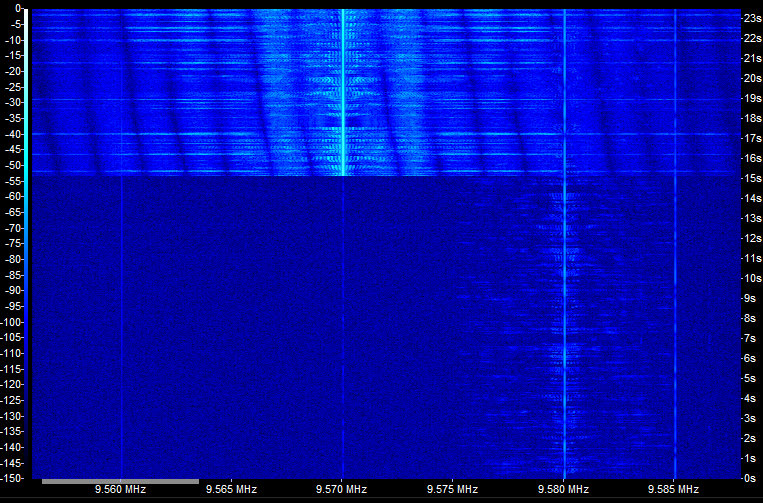
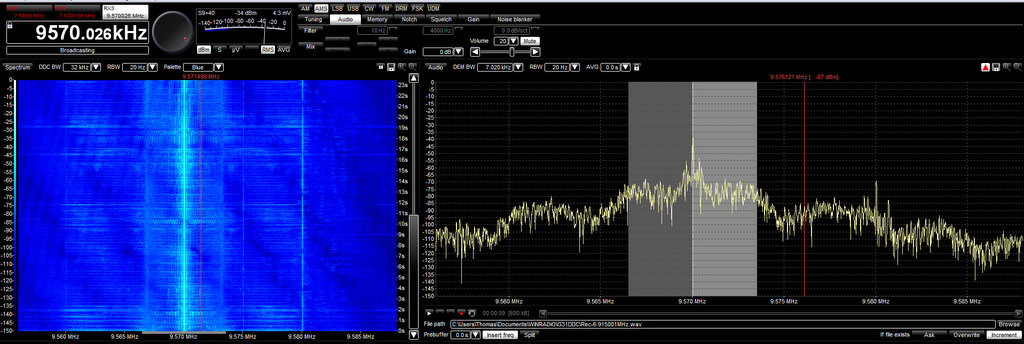
Each morning, I enjoy listening to Radio Australia on 9,580 kHz, but I’m forced to tune elsewhere due to interference when China Radio International starts broadcasting on 9,570 kHz, via Radio Havana Cuba’s relay.

Hypothetically I should be able to mitigate any adjacent interference from CRI by listening to Radio Australia’s upper sideband. But unfortunately, RHC’s transmitters spew spurious emissions a full 20 kHz on either side of their carrier. It’s most annoying.

Here’s what RHC/CRI’s 9570 kHz signal sounds like on 9560 kHz:

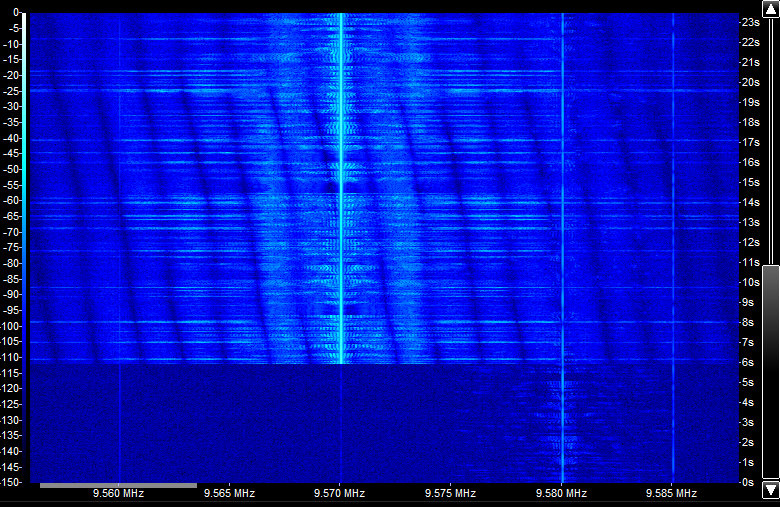
Here’s what my waterfall looked like when CRI signed off:

CRI-Spectrum-2Notice how clear the 35 kHz waterfall window became (that’s Radio Australia centered on 9850 kHz):CRI-SignOff

The reason for this is clear: obviously, some of RHC’s transmitters are in need of care–and they’re not the only ones.

Radio Cairo

I’ve received a number of requests from Radio Cairo to post notices about their English language broadcasts. Normally, I’m quite happy to post press releases, but in each case I’ve mentioned that their English broadcasts are almost impossible to understand. For years, RC has had a problem with AM modulation (I assume) and, to my knowledge, have never addressed it.

I’ve sent RC feedback on a number of occasions; in response, I’ve received only the inconclusive reply that they’re “looking into the situation.”

To underscore the point, on Sunday Andrea Borgnino shared the following video/audio of Radio Cairo via Twitter.

There are other broadcasters that emit messy signals, but Radio Havana Cuba and Radio Cairo are the most noticeable in my listening area. And, it seems, neither broadcaster is in any hurry to address their ongoing problems.

In Radio Cairo’s case, especially, the broadcaster is simply wasting money by attempting to broadcast a signal that can neither be received nor interpreted. It’s rather sad. Ultimately, one has to wonder why they bother to broadcast at all…

Radio Havana Cuba, China Radio International,  and Radio Cairo (among others) take note: a little care of your radio transmitters will go a long way toward increasing your listenership. 

What you can do:  Consider contacting broadcasters when when you become aware of transmitter problems. Despite RC’s notable exception, oftentimes a broadcaster may not be fully aware of the issue––thus your feedback is necessary to help correct the problem.

US Signal Corps: Horseback mobile

SignalCorpsHorse

Source: Time Magazine; BETTMANN / CORBIS

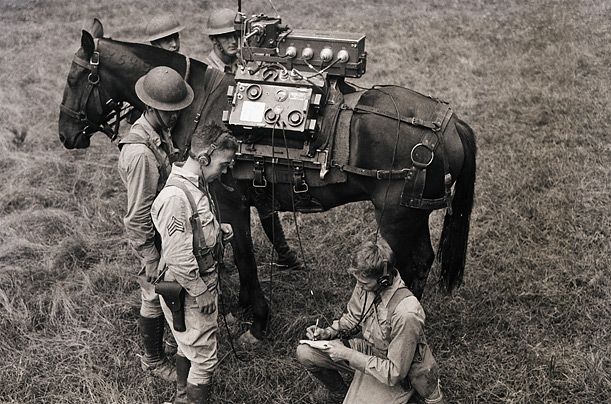
Yesterday, I stumbled upon this 1940 photograph of the US Army Signal Corps communicating via radio in the field.

I bet that radio kit weighs almost as much as or more than the typical soldier!

Does anyone know what model of Signal Corps radio that would be?

Update…

Richard comments:

Thomas,

The original photo is at the site below.

At the link, https://tinyurl.com/hxp5akx

It’s a Radio Set SCR-203 (Phillip pack saddle mounted). Consisted of:
BC-228 transmitter – Transmitter, 2.1-3.1 MHz, 2 ea VT-25 & VT-50, Part of SCR-203
BC-227 receiver – Receiver, 2.1-3.1 MHz, Part of SCR-203
BC-235 control box – Control box, Part of SCR-203

The unit was powered by various battery packs and a GN-35 hand cranked generator and used a 25 ft whip antenna (Image: W.J. Schweitzer collection)

Thanks so much for identifying the equipment, Richard!

Paul seeks your input for upcoming broadcasts

IMG_2797

SWLing Post contributor, Paul Walker, is seeking your input for his next shortwave broadcast. Paul writes:

Thomas, I will be doing another shortwave broadcast in about 2 months and I need some input from your readers, particularly those in the US.

I will likely broadcast just on WRMI this time, but instead of an East Coast target area on 11580khz, I am going to aim for the Midwest & West Coast via 5850khz or 7570khz.

It appears the signals which are on 2300UTC to 1400UTC daily have the same beam at 315 degrees towards Vancouver, Canada. They both appear to cover the Midwest fairly well as hitting the west coast.

I would love to hear from readers if there is an actual difference in the two signals despite the same power and beam. Maybe one channel has adjacent channel interference or something.

If folks could check either frequency as close as possible to 0500UTC/12midnight eastern and note conditions on both signal and the differences between the two, I would appreciate it. (0500utc/12midnight eastern wlll likely be the time of my next broadcast.

One friend already reported slightly better audio processing and slightly better modulation. […]I want to know what my target audience in the Midwest & Western US thinks.

Thanks,
Paul

Please feel free to comment if you can assist Paul.

Update: From the Isle of Music

ftiomfromomar212016Many thanks to SWLing Post reader, Bill Tilford, who shares this From The Isle of Music update:

March 21 in the Americas (March 22 in Europe, Asia, Africa and Oceania), our very special guest will be Ivan Acosta, leader of the Jazz ensemble Grupo de Cuba Somos in Santiago de Cuba, along with 3 songs by his ensemble. Also, more of Piñera Concertante, some vintage 1970s hits by Los Latinos and Grupo Los Llamas and some Timba from Dayron y El Boom.

*** Every Monday night from 8pm-9pm EDT in North, Central and South America (Tuesday morning from 0000-0100 UTC in Europe, Africa, Asia and Oceania) on the short waves on WBCQ The Planet, 7.490 MHz: From the Isle of Music, a new radio program dedicated to the music of Cuba – Jazz, Fusion, Timba, Nueva Trova, Son, Classical, Folklorica, interviews with musicians, even a little history of the music now and then. Partly in English, en parte en español. “Like” our page to keep informed about what we will bring you. (For those without shortwave or outside of viable signal range, there are also a couple of ways to stream the frequency via Internet; see the instructions in our NOTES section).

Breaking news: OIG Report on the Edward R. Murrow Transmitting Station

Fullscreen capture 3182016 51138 PM

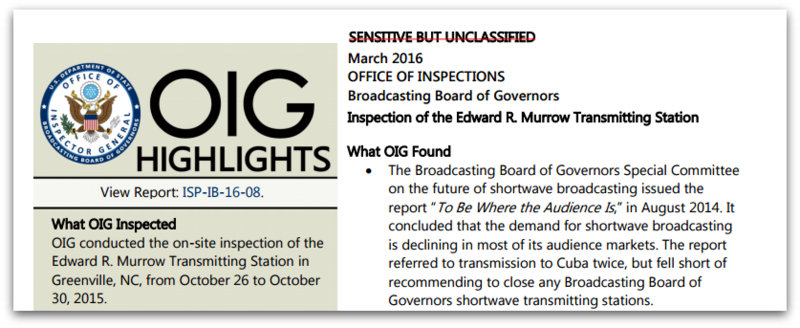
I’ve just received a copy of the Office of Inspections (OIG) report on the VOA transmitting station in Greenville, NC. The full OIG report is now in the public domain as a PDF.

Here are a few highlights…

A summary of what OIG found:

  • The Broadcasting Board of Governors Special Committee on the future of shortwave broadcasting issued the report “To Be Where the Audience Is,” in August 2014. It concluded that the demand for shortwave broadcasting is declining in most of its audience markets. The report referred to transmission to Cuba twice, but fell short of recommending to close any Broadcasting Board of Governors shortwave transmitting stations.
  • The Edward R. Murrow Transmitting Station reports to the Office of Cuba Broadcasting and Office of Technology, Services, and Innovation. The dual reporting structure has not affected operations negatively.
  • Administrative operations for the Edward R. Murrow Transmitting Station were effective, except in management of human resources. Specifically, the station
    manager’s position description was outdated and the performance evaluations record keeping did not comply with Federal regulations.
  • The Edward R. Murrow Transmitting Station had effective internal controls processes in place. The Edward R. Murrow Transmitting Station management were
    cognizant of internal controls and provides effective oversight of operations.
  • The Edward R. Murrow Transmitting Station complied with the Broadcasting Board of Governors and applicable Federal regulations for contracting, property management, and safety. The Edward R. Murrow Transmitting Station complied with the Broadcasting Board of Governors review processes for unliquidated obligations and the purchase card program.
  • The security and emergency preparedness at the Edward R. Murrow Transmitting Station met the Interagency Security Committee, Office of Security, and Office of
    Technology, Services, and Innovation policies and standards. The employees participated in emergency drills and complete required insider threat training
    annually.
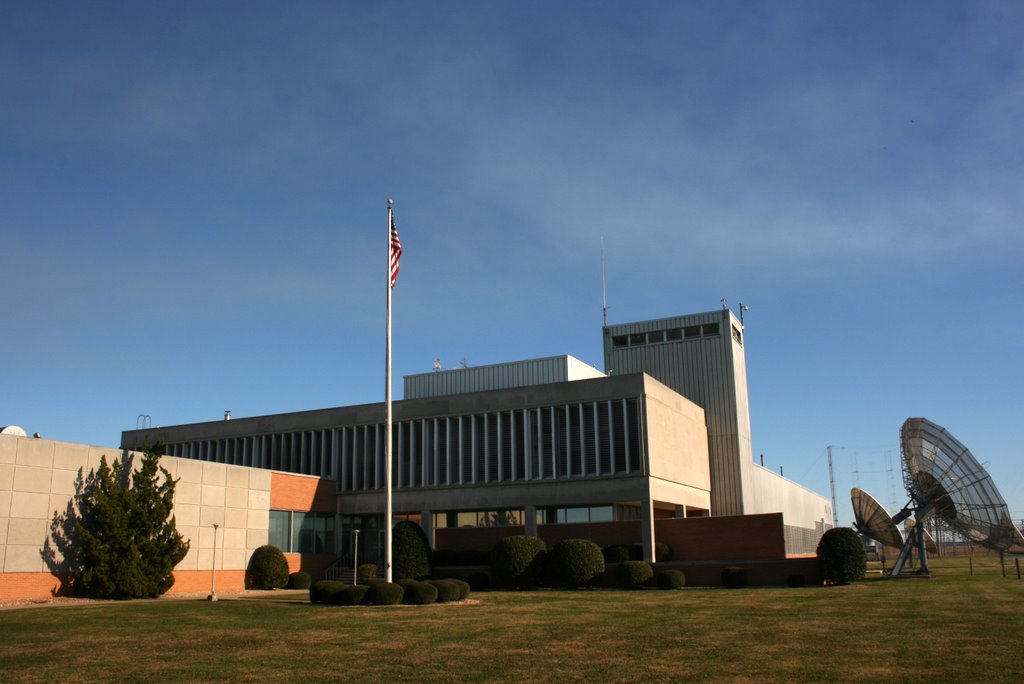
The Edward R. Murrow Transmitting Station's mail building, located in the center of the 2800 acres campus. (Click to enlarge)

The Edward R. Murrow Transmitting Station’s mail building, located in the center of the 2800 acres campus. (Click to enlarge)

Regarding the future of the station:

BBG has not evaluated the return on investment of the Station’s operations to determine its effectiveness in advancing the U.S. international media strategies. The BBG’s Special Committee report refers twice to transmissions to Cuba but falls short of recommending to close any BBG shortwave transmitting stations. Congress continues funding the Station’s budget even though on February 1, 2010, the BBG FY 2011 budget request proposed the closure of the Station.

Futhermore, in FY 2011, the Senate Committee on Appropriations asked BBG to submit a “multiyear strategic plan for broadcasting to Cuba to include an analysis of options for disseminating news and information to Cuba and a report on the cost effectiveness of each.”

The Office of Management and Budget’s Global Engagement Resource Guidance for FY 2015 and for FY 2016 address the need to modernize U.S. International media by “transitioning away from the use of shortwave radio where this platform is ineffective, toward more widely used media platforms like mobile, television, and the internet.” The United States International Broadcasting Act, Public Law 103-236, Section 303(a)(1) and (7) states that BBG has the responsibility to “be consistent with the broad foreign policy objectives of the United States” and “to effectively reach a significant audience.” Section 305(a)(7) states the Board is also authorized to “ensure that all broadcasting elements receive the highest quality and cost effective delivery services.” Given BBG’s limited resources and changes in technology as well as the significance of Cuba to U.S. national security objectives, BBG risks missing an opportunity to engage with Cuban audiences in a digital media environment.

Recommendation 1: The Broadcasting Board of Governors should prepare a written
cost/benefit evaluation of the Edward R. Murrow Transmitting Station to determine its
efficiency and effectiveness for continuing, reducing, or eliminating operations. (Action: BBG)

The full report:

Click here to download the full report as a PDF.

For a little context, this is the same station I’ve visited multiple times and even posted a photo tour of (click here to view) several years ago.

Hobart Radio International’s weekend shortwave schedule

HobartRadioInternational

(Source: Hobart Radio International on Facebook)

We are on air this weekend covering three continents:

Shortwave:
Channel 292 6070 19h00-19h30UTC Saturdays (Europe)
Channel 292 6070 00h00-00h30UTC Sunday
Channel 292 6070 12h30-13h00UTC Monday
Radio 700 7310 15h00-15h30UTC Sundays (Europe)
WRMI 9955 4h30-5h00UTC Sundays (North, South America, India)
WBCQ 5130 3h30-4h00UTC Mondays (North America)

FM:
World FM 88.2MHz 3h30-4UTC Thursdays (Tawa, New Zealand)
Soundwave FM 107.7MHz & 87.8MHz Sundays (Napier, New Zealand)

If you’ve not heard our shortwave community service before due to time differences or interference this weekend is your weekend! You can send reception reports for eQSL verification to: [email protected]