Category Archives: Shortwave Radio

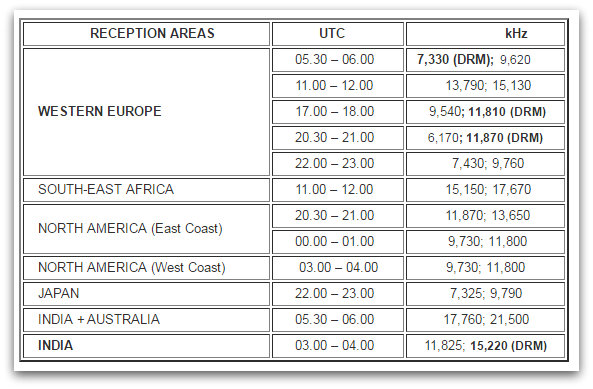
Radio Romania International 2016 Summer Broadcast Frequencies

RRI-RadioRomaniaInternational

Many thanks to SWLing Post contributor, David Iurescia (LW4DAF), who notes that Radio Romania International has published their updated English language broadcast frequencies:

RRI Summer Broadcast Frequencies valid March 27 to October 30, 2016

RRI-Schedule

Source: http://www.rri.ro/en_gb/rri_summer_broadcast_frequencies-2544502

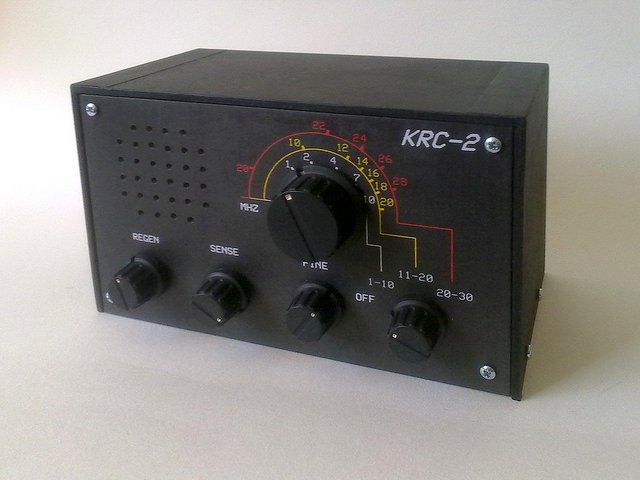
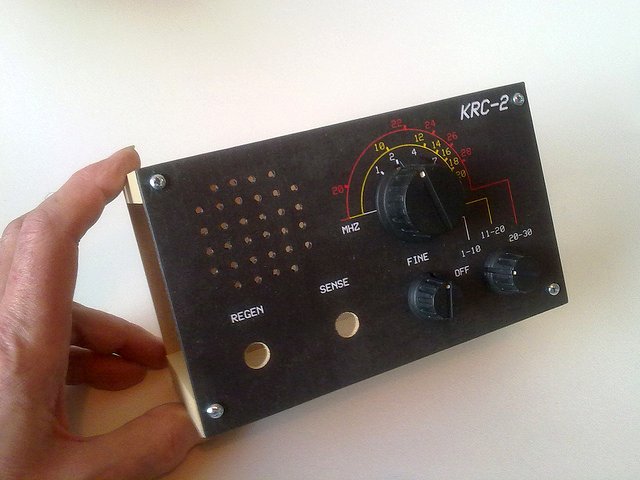
The KRC-2 shortwave regenerative receiver kit

KRC-2 shortwave regenerative receiver kit1

Tony Westbrook recently contacted me about a regenerative receiver kit he has designed and produced in the UK.  It’s called the KRC-2.  Here’s the product description:

1 – 30 MHz with band spread tuning.

Regeneration with a difference. The regeneration setting on the KRC-2 is unaffected by the receiver tuning or the antenna coupling. How do we achieve this? The regenerative stage is fixed at 10.7MHz and used as an IF amplifier. The main receiver board is extremely simple to construct using only one FET and an audio IC. Like all the KRC kits it comes with a comprehensive construction manual which brings this project well within the grasp of the keen constructor. It was referred to as “a very sensitive little receiver” by Rob Mannion of Practical Wireless. Its unconventional design and simplicity should amaze even the experienced constructor. Case size 7 x 4 x 3 inches. 6 x AA batteries supplied.

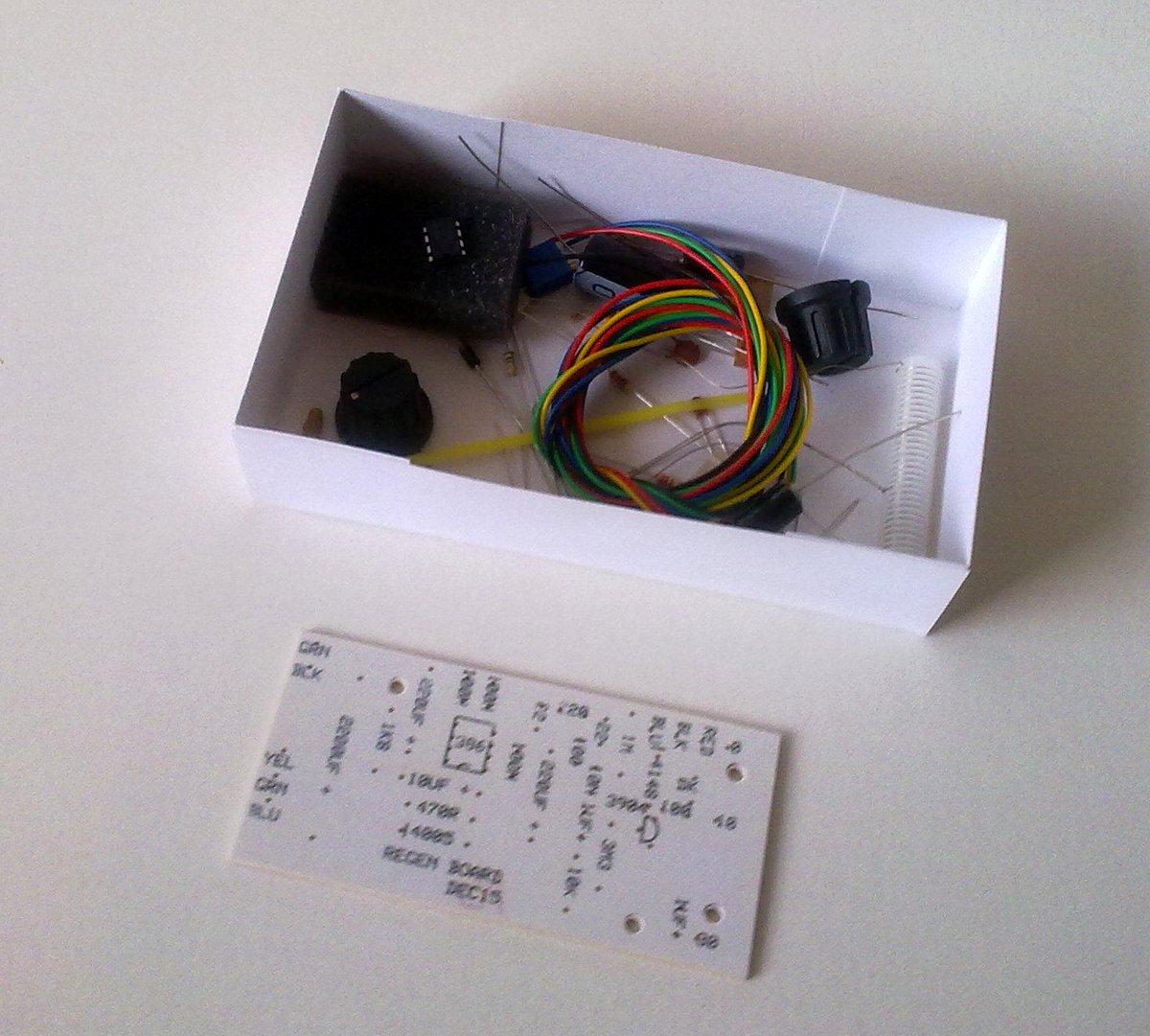
According to Tony, the kit comes with everything; UK orders are even supplied with batteries. Tony stated, “the only thing the customer needs is a soldering iron, solder cutters, etc.”

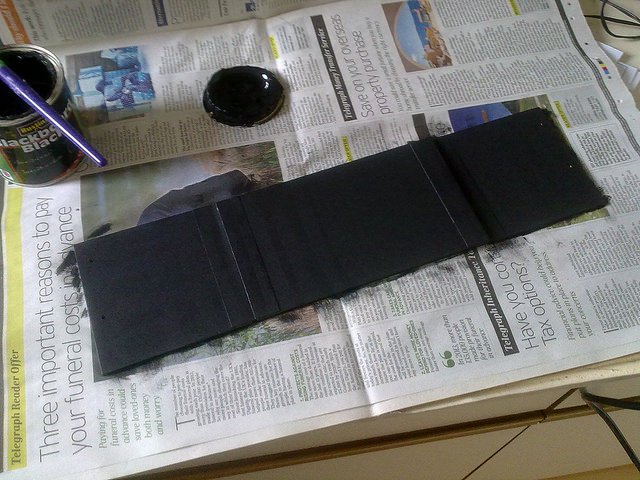
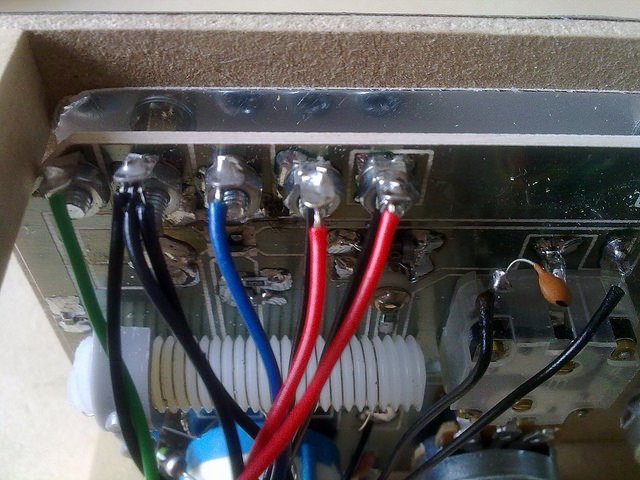
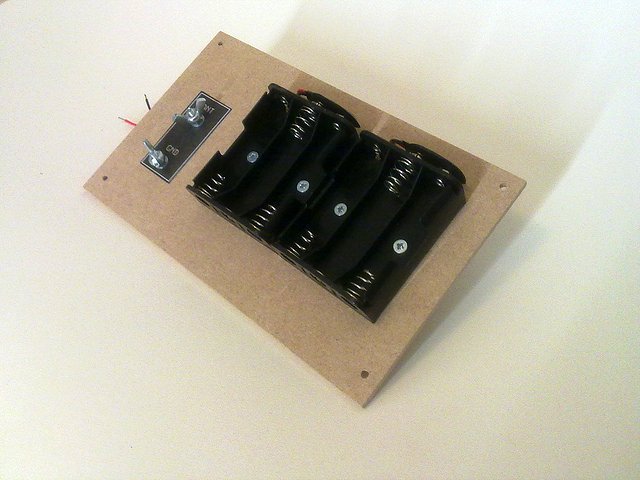
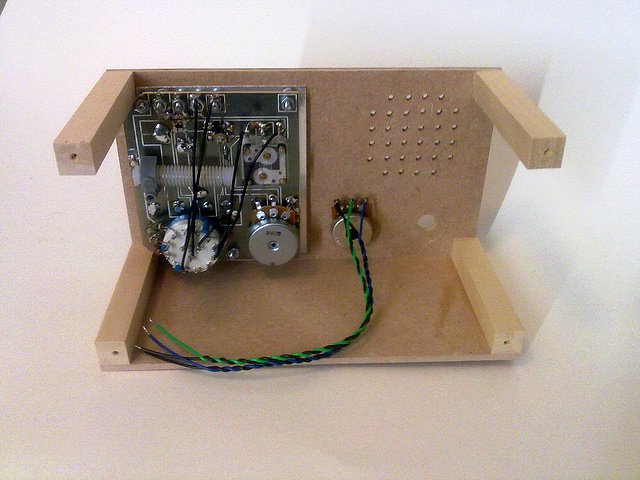
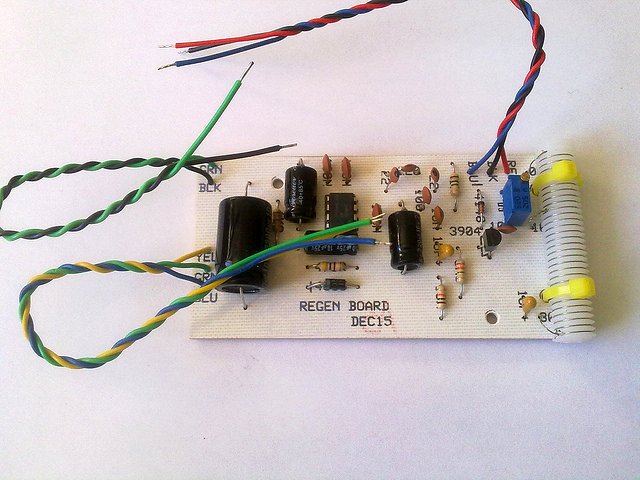
By request, Tony sent a few construction photos and three videos of the radio in operation:

Photos

KRC-2 shortwave regenerative receiver kit4KRC-2 shortwave regenerative receiver kit11 KRC-2 shortwave regenerative receiver kit10 KRC-2 shortwave regenerative receiver kit8 KRC-2 shortwave regenerative receiver kit7 KRC-2 shortwave regenerative receiver kit3 KRC-2 shortwave regenerative receiver kit2 KRC-2 shortwave regenerative receiver kit9 KRC-2 shortwave regenerative receiver kit6 KRC-2 shortwave regenerative receiver kit5

Videos

Video 1

Video 2

Video 3

Click here to view the KRC-2 and Tony’s other kits. 

Guest Post: Building a magnetic loop antenna & broadband amplifier for your SDR

Many thanks to SWLing Post contributor, Dave Gahimer (K9ZCE) for the following guest post:


Loop-Antenna

Small Magnetic Loop Antenna with Broadband Amplifier for SDR Reception

by Dave Gahimer (K9ZCE)

Those with limited space, or antenna restrictions, might find a small 1 meter loop antenna a solution.

My son lives in an apartment. One Loop leaning against a wall gives him acceptable reception with the SDRPlay RSP on the ground floor–2nd or 3rd level flats should have very good reception.

Ten meters off the ground outside should give reception equal to any SWL antenna. We all with SDRs fight the image problem. Normal resonate ham band antennas show too strong reception of unwanted bands/stations. Did I mention noise? Loops are well known for –6 db noise reduction.

Then there is the possibility of SDR chip damage from your 1.5 KW station! In researching Loops we came across LZ1AQ. A Brilliant design /engineer (http://www.lz1aq.signacor.com/). Deep reading sometimes, but a great understanding of what makes a good receiving loop antenna.

Those who chase DX know that sometimes fading is caused by the signals’ polarization changing in the Ionosphere. Having both vertical and horizontal loops, and the ability to combine both signals diminishes this fading problem. Being able to filter the powerful, commercial FM transmitters diminishes image problems. Clipping strong signals at the antenna from very near powerful antennas/transmitters could save the SDR receiver from damage.

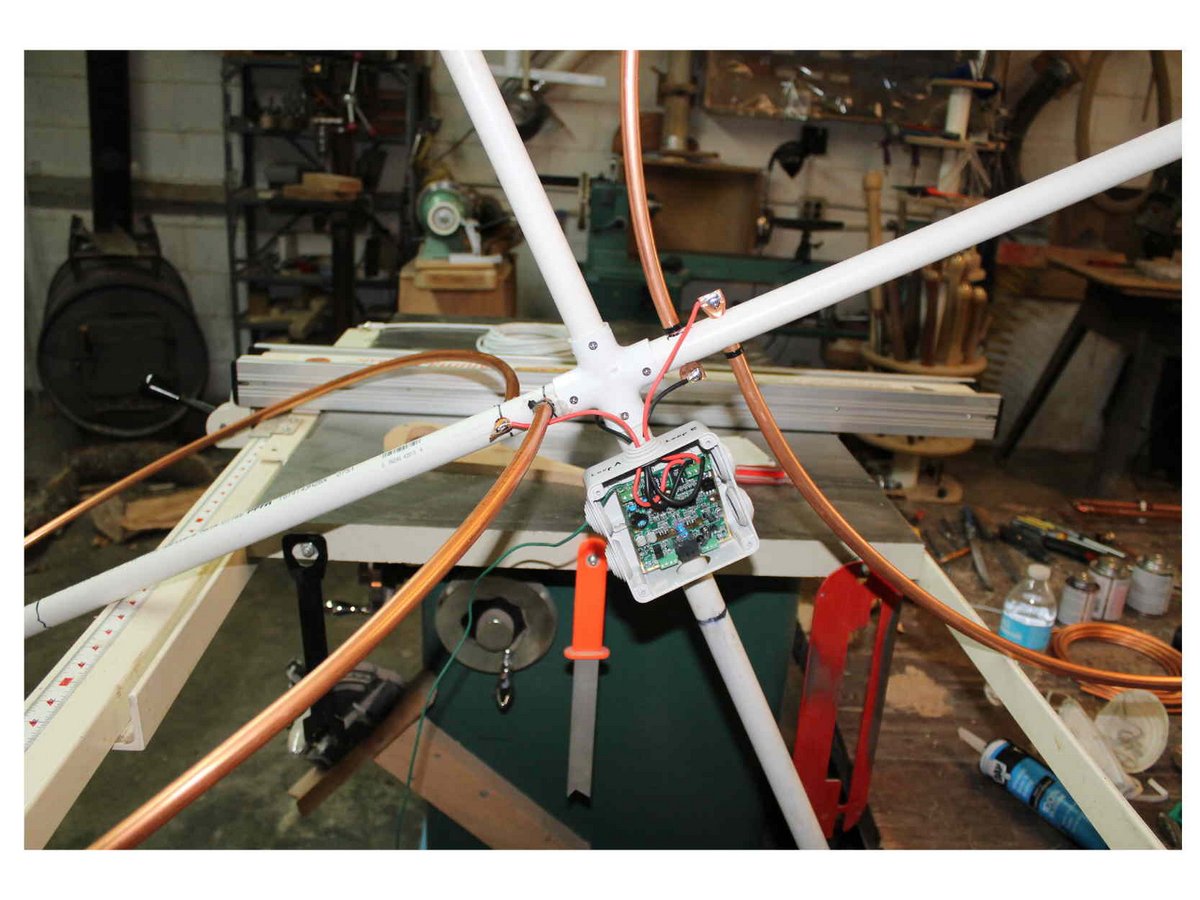
The LZ1AQ broad band Amp solves all these problems. http://active-antenna.eu/amplifier-kit/.

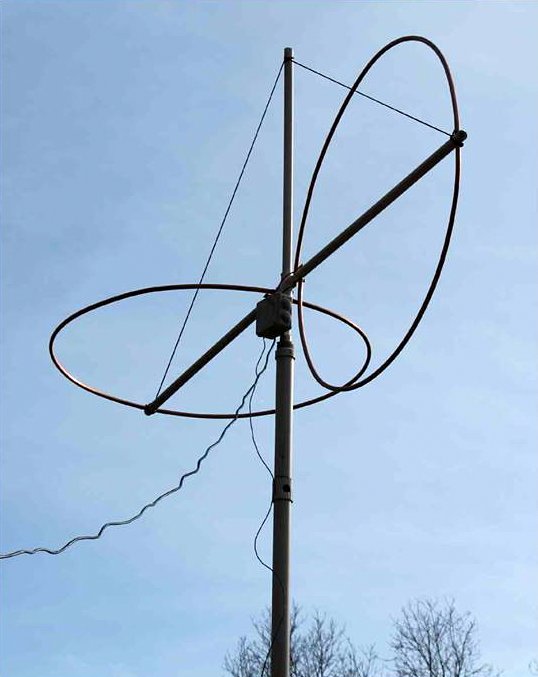
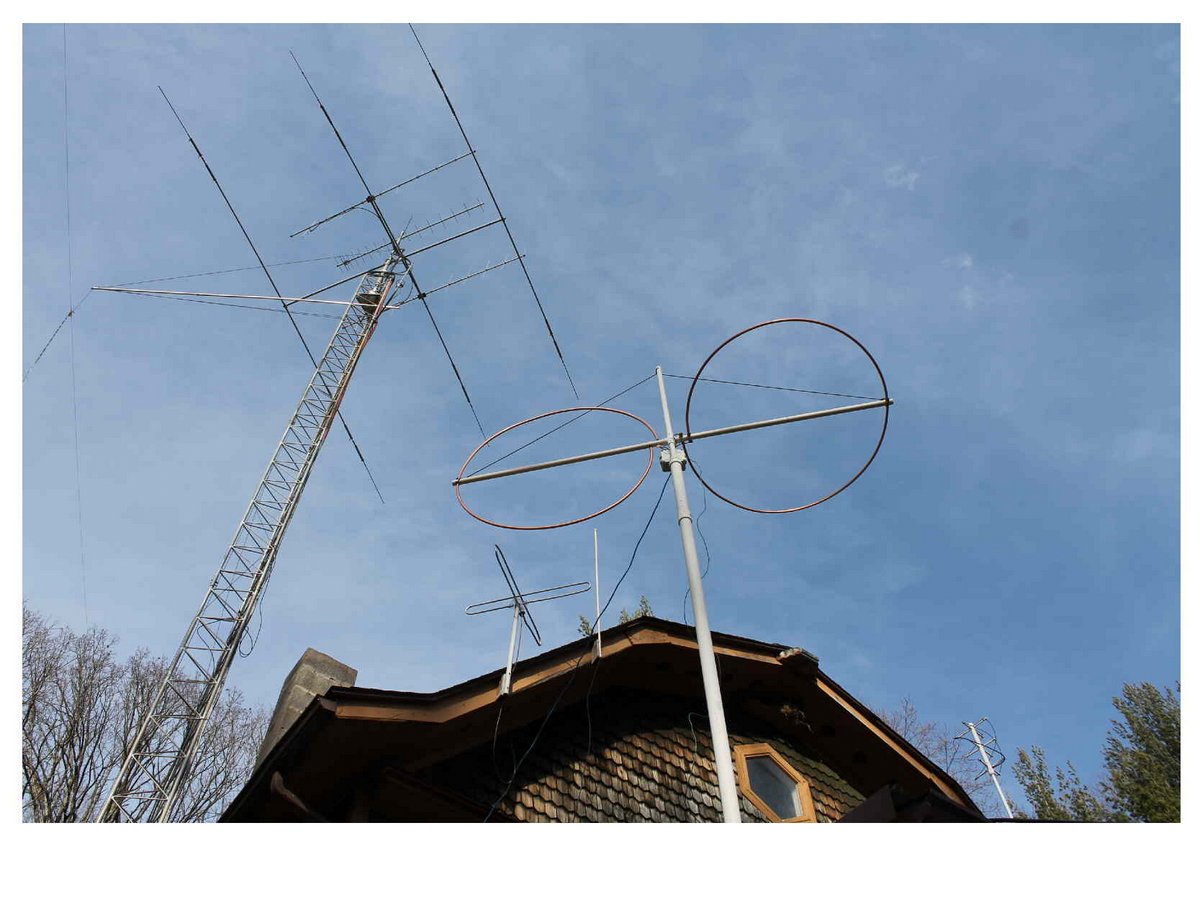
My son Ted and I built three, one meter loops from soft ½ inch copper plumbing tubing. One for his apartment, two for my crossed loops antenna. We weather proofed the Copper from corrosion by coating with outdoor clear spar varnish. We shaped the circle by drawing the tubing around a round glass top patio table.

The soft copper loop in held by white PCV plastic plumbing pipe. 1” or 1.25 inch schedule 40. Be careful to check that the PVC is schedule 40, thick wall. The thin wall pipe is not strong in the wind and will crack when you try to drill it.

Drill up to a 3/8 hole for the ½” copper tube to go through, then file out to fit. Here are some photos (click to enlarge):

crossed loops up 3 crossed loops up 4

Check out these links (all courtesy of LZ1AQ) to acquaint yourself with the loop construction and amplifier installation:

http://active-antenna.eu/tech-docs/2_ActiveAA_Mount_20.pdf

http://active-antenna.eu/tech-docs/1_ActiveAA_DandS_20.pdf

http://active-antenna.eu/tech-docs/3_ActiveAA_Antena_11.pdf

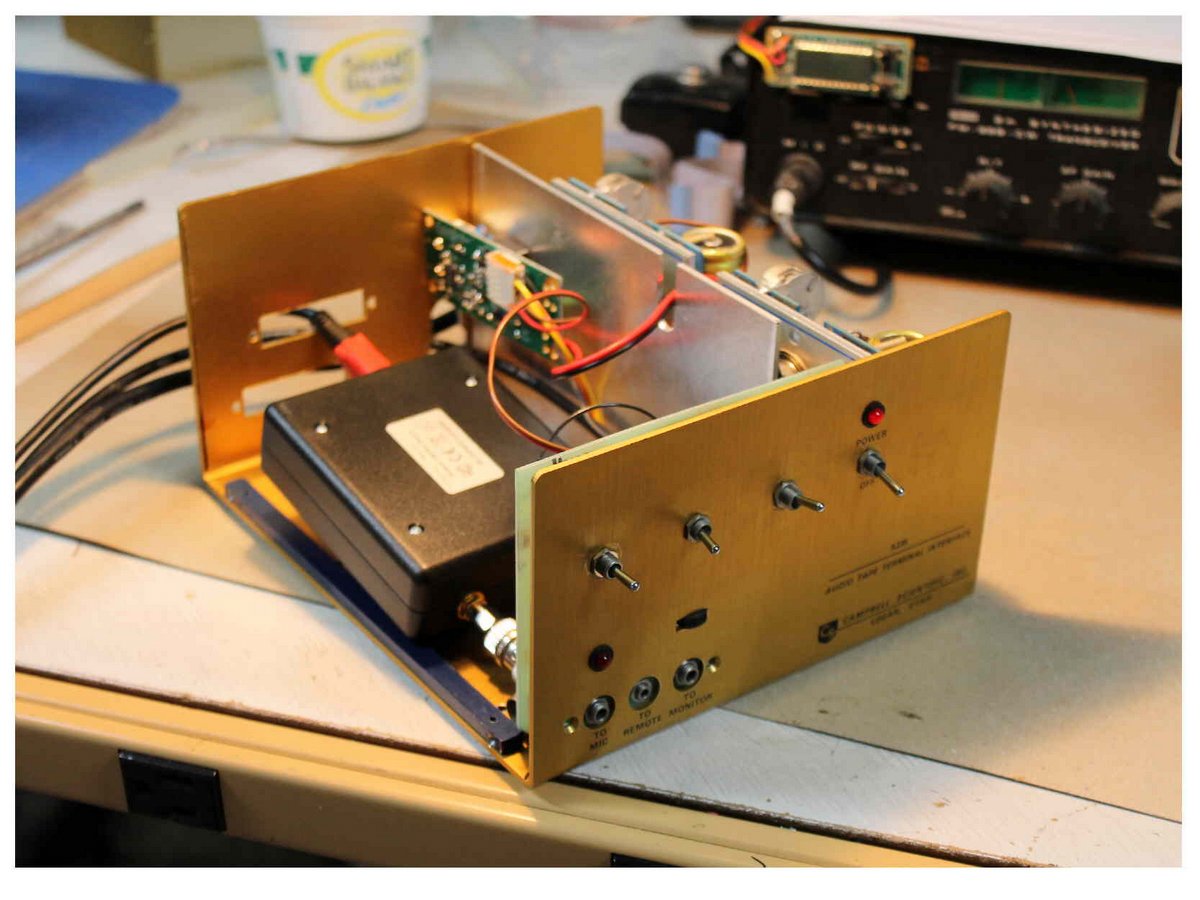
Many SDR receiver owners have seen improved noise and Image reduction by placing the plastic cased SDR unit on a small shielded/ grounded case.

crossed loops up 5

The Amp needs 12VDC from in the shack. The Amp has two relays that you can switch, from in the shack, to select Vertical or Horizontal loops, or a dipole. The loop amp connects back to the shack via a shielded Cat 5 cable, Make sure you get shielded CAT 5 to reduce noise pickup. Make sure you provide an adequate good Ground below the antenna, less noise pickup and lightening protection.

crossed loops up

Have fun!
Dave, K9ZCE
Retired from EE Dept @ Rose-Hulman Institute of Technology
Terre Haute, Indiana


Thank you so much, Dave!

Readers: yesterday I saw Dave’s loop antenna photos on the SDRplay RSP Facebook page. I was fascinated by his horizontally/vertically oriented loops and asked if he would write up a short guest post.  He kindly obliged in a matter of hours!

If you have an antenna project you’d like to share, please contact me. So many SWLs and ham radio operators live in areas with restrictions and pervasive RFI–projects like Dave’s can revive one’s radio life!

BBG’s Fiscal Year 2016 Congressional Budget Request

BBG-Budget-Request

Many thanks to SWLing Post contributor, Richard Langley, who shares a link to the Broadcasting Board of Governor’s Fiscal Year 2016 Congressional Budget Request.

Click here to download as a PDF.

I’ve read key portions of the request.

Regarding shortwave, the BBG are asking for budget reductions in almost all of the BBG shortwave broadcasting arms, with a few exceptions.   They acknowledge, in each case, that shortwave broadcasting is not as cost-effective as other means of distribution (including FM, Internet and satellite). The do acknowledge that shortwave broadcasting is still needed in some strategic markets. Here is, perhaps, the most telling quote I found:

“To serve audiences in less developed areas of the world, BBG must continue to broadcast via traditional technologies such as shortwave and maintain capability on these platforms by replacing antiquated equipment. But to stay relevant in competitive news markets and serve current and future audiences, BBG must invest in new cutting-edge technology. In areas where ownership and usage of shortwave radio has declined significantly, the Agency has evolved away from broadcasting in shortwave.”

A few specific highlights from the request:

Page 19

4) ENHANCE HIGH FREQUENCY TRANSMISSION CAPABILITY ($2.8M)
BBG will continue the shortwave realignment project that began in FY 2014, which increases shortwave transmission capability at its Kuwait Transmitting Station. This enhancement provides improved coverage to underserved areas of the world and
reduces operating costs by decreasing reliance on external leases. All aspects of
this proposal focus on improving transmission capability, while continuing
to reach audiences in Africa, Afghanistan, Pakistan, Iran, Tibet and
Western China. The added capacity will support broadcasts for RFE/RL, RFA and
VOA.

At $2.00 per broadcast hour, Kuwait provides the highest return on investment in the BBG transmitting station portfolio. Thus, BBG began expansion of the facility in FY 2014 with
the construction of a new high frequency antenna and design of the transmitter building expansion. The proposed investment, extending through FY 2018, will bring the Kuwait
Transmitting Station up to the maximum capability allowed by the country agreement and will enable the Agency to decrease overall operating costs for the foreseeable future. When the realignment project is completed, the Kuwait station will have ten shortwave transmitters with associated antennas.[…]

Page 22:

Reduce Shortwave Costs [-$2.90M] The Office of Technology, Services, and Innovation (TSI) will eliminate less effective transmission frequencies and realign transmissions to end high cost leases. TSI will realize additional reductions to antiquated technologies by reducing transmissions to Afghanistan, Pakistan, Burma, and Kurdish-speaking regions and eliminating shortwave to Russia, the Caucasus, Belarus, Laos, Cambodia, Rwanda, and Burundi. Audiences in these countries access news and information on more efficient,[…]

Page 69

STRATEGY BASED ON AUDIENCE
MEDIA HABITS
Using research on audience media habits, TSI will continue to move away from less effective legacy shortwave and medium wave transmissions toward other technologies, where appropriate, to reach larger and younger audiences. Where shortwave remains important, TSI is building a more cost-effective transmission infrastructure to support broadcast requirements. Of particular note are efforts at the Kuwait Transmitting Station. Because of the station’s strategic importance and low operating costs, TSI is installing a new shortwave antenna that is expected to be operational in FY 2015 and will expand the station’s transmitter building in FY 2016 to accommodate future transmitter build-outs.[…]

Page 109

To serve audiences in less developed areas of the world, BBG must continue to broadcast via traditional technologies such as shortwave and maintain capability on these platforms by replacing antiquated equipment. But to stay relevant in competitive news markets and serve current and future audiences, BBG must invest in new cutting-edge technology. In areas where ownership and usage of shortwave radio has declined significantly, the Agency has evolved away from broadcasting in shortwave.
BBG has closed transmission stations, repurposed equipment and invested these savings in platforms that the audience has shifted to, primarily in digital media technology and other high-priority programming.

Click here to download the full request as a PDF.

Radio Taiwan International Spanish language service schedule

RadioTaiwanInternationalLogoMany thanks to SWLing Post contributor, David Iurescia LW4DAF, who writes:

I’m sending you the new schedule for Radio Taiwan International in Spanish since March, 27:

To: South America 00:00-01:00 UTC – 11530 Khz
Central America 03:00-04:00 UTC – 5985 Khz

Source:

http://spanish.rti.org.tw/whatsNew/?recordId=16216

Happy Easter!

And a Happy Easter to you, too, David!

WWII: Sussex home provided Bletchley Park with intercepts

SWLingPost-Numbers1(Source: Eastbourne Herald)

Much has been written about Bletchley Park and the decoding of German Enigma signals. However, the code breakers first needed the raw material – transcripts of enemy messages.

The British Y Service was the ‘ears’ of Bletchley Park and without this, code breaking was impossible. There were several departments under the control of MI-8. The RAF, Army, Navy, Metropolitan Police, Post Office and Foreign Office had interceptors and American units also contributed. Haystoun House in Church Street, Willingdon – today flats and previously an old people’s home – was the base of the American 129th Signal Radio Intelligence Company. In the 1940s it stood alone with space for the so-called ‘aerial farm’ – 40 aerials in the form of inverted L’s, 20 on each side of the house.

These were fed to a ‘set room’ that could cater for 42 receivers. Tables around walls had partitions to separate operating positions. Operators kept four-hour watches, known as ‘tricks’ and searchers tuned over a segment of the short wave spectrum listening for any new stations that might pop up. Experienced operators were able to recognise the Morse styles – the so-called ‘fists’ – of individual German signallers. Message pads were ferried by dispatch rider to London. Operators were trained at Camp Crowder in Missouri where they learnt to copy high-speed Morse onto a typewriter. However, a pencil and message pad proved easier because receivers drifted off frequency and one hand was needed to re-tune. The daily schedule was 15 sets at night and 25 during the day.[…]

Continue reading: http://www.eastbourneherald.co.uk/news/nostalgia/nostalgia-willingdon-home-was-the-sussex-bletchley-park-1-7269441#ixzz43fTvD8hO

Radio Martí: an uncertain future with the “thaw” in US/Cuba relations

Havana, Cuba (Photo: Wikimedia)

Havana, Cuba (Photo: Wikimedia)

(Source: PRI)

RadioMartiOn first impression, Radio and TV Martí looks and feels pretty much like any other newsroom. Emilio Vazquez shows me around, and we stop and watch two radio broadcasters behind a thick pane of glass.

“We have a morning show known as ‘El Revoltillo,’ which is like an on-air swap market type of show, where people call in and offer different products and services for sale on island,” says Vazquez.

But here’s what’s different about this call-in show: It’s illegal for its listeners to call in, or even to listen. That is, if they even can — the Cuban government tries to jam broadcast signals coming from Florida. Vazquez said they’re always trying to stay one step ahead.

“We have various methods of transmission. We have medium-wave transmission on AM frequency, we have our short-wave transmissions as well.”

Those change frequencies throughout the course of the day.

Radio and TV Martí has been delivering news and information to Cuba since 1985, an intense period of the Cold War. The Cuban American National Foundation, a powerful lobbying group of Cuban exiles in Miami, helped persuade the Reagan Administration to create the stations, which fall under the Broadcasting Board of Governors, a US government agency.

[…]Still, critics of the Martís question if Cubans are getting the best information from the government news agency. They call the programming one-dimensional, conservative and a mouthpiece of American policy. Gamarra says he’s staunchly disagreed with many editorials broadcast by the Martís over the years.

“But I think the criticism of them, that because they’re conservative, they’re not good journalists, doesn’t follow. They still have some value,” says Gamarra. “I think [the Martís] has an expiration date though.”

As part of the US government, Radio and TV Martí works out of large compound in Miami fortified by barbed wire, guards, and airport-type screening. As part of the US government, Radio and TV Martí works out of large compound in Miami fortified by barbed wire, guards, and airport-type screening. Credit: Jason Margolis
When that expiration date should be is the big question. With a thaw in US-Cuba relations, some say the time is now. Democratic Congresswoman Betty McCollum of Minnesota introduced a bill to end the Martís. It’s called the: “Stop Wasting Taxpayer Money on Cuba Broadcasting Act.” The Martís cost US taxpayers $27 million a year.

President Barck Obama wants to turn the Martís into an independent non-profit, but still funded by the government. It would be called a “grantee.”

Many conservatives say that would weaken the government’s commitment, and that the Martís still provide an invaluable service exposing human rights abuses in Cuba.

Malule González says her operation is more important than ever, even with President Obama on the island today.

“Don’t be confused by people shaking hands, that doesn’t mean that the Cuban people have any freedom,” says González.

Read the full article on PRI’s website…