Category Archives: Shortwave Radio

German regulators prohibit digital modes on broadcast bands

DigiDX

(Source: Kim Elliott via Richard Langley)

VOA Radiogram, 2-3 April 2016: BNetzA sagt nein!

New this weekend is the elimination of the digital text modes from shortwave transmitters in Germany.

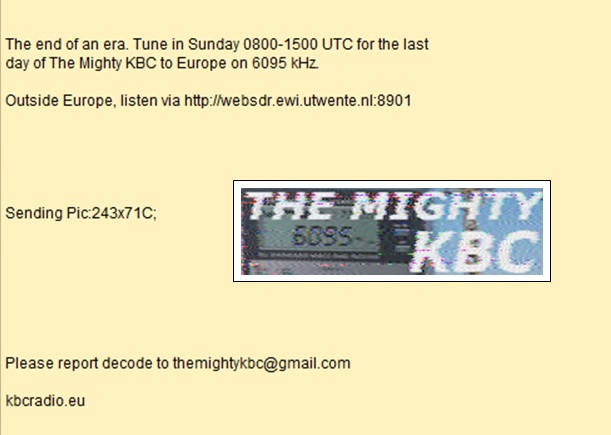
The German regulator Bundesnetzagentur has ruled that the digital modes are not allowed in the broadcast bands. Because of this, there will be no MFSK32 on The Mighty KBC this weekend, because it uses a transmitter in Nauen, Germany. And, for the time being, there will be no DigiDX MFSK broadcasts on Channel 292, 6070 kHz, and Radio 700, 3985 kHz.

Listeners in Germany might want to note these arguments for the digital modes on the shortwave broadcast bands:
1) It is broadcasting, not point-to-point communication.
2) It can be received on any shortwave radio, even inexpensive portables with no SSB capability. (Software is required to decode the text and images, but this can be included in future shortwave radios.)
3) DRM is legal on the shortwave broadcast bands, and DRM can transmit text and images.
4) Text and images via analog radio requires less spectrum (bandwidth) than DRM.
5) Text and images via analog radio are a useful new application for underutilized shortwave transmitters and frequencies.
6) Text and images via analog radio extend the range of a shortwave transmitter, resulting in accurate content in conditions where voice transmissions may be unintelligible.
7) Digital modes via shortwave can be a useful alternative when the Internet is not available due to disasters or to net censorship by dictators.

On the same note, SWLing Post contributor, Harald Kuhl, also comments with a news release from DigiDX:

“DigiDX transmissions via Channel 292 (6070kHz) and suspended until further notice. This is due to action by the German regulator Bundesnetzagentur against digital mode transmissions and is beyond our control. Broadcasts via WRMI will continue and we hope to find another outlet to use for transmissions to Europe.”

[later:]·

“Good news – Thanks to Jeff White we have another frequency for this Sunday’s broadcast which should be better for Europe. 15770kHz at 2130. Please can anyone in Europe, North America and elsewhere please send reception reports to [email protected] for this extra broadcast.”

Sources: DigiDX website & FB
Guest Post: Using the HackRF One for DGPS Beacon Reception

h1-preliminary1-445Many thanks to SWLing Post contributor, Mario Filippi (N2HUN) for the following guest post:


Receiving  with a HackRF One, SDR#, and MultiPSK

by Mario Filippi (N2HUN)

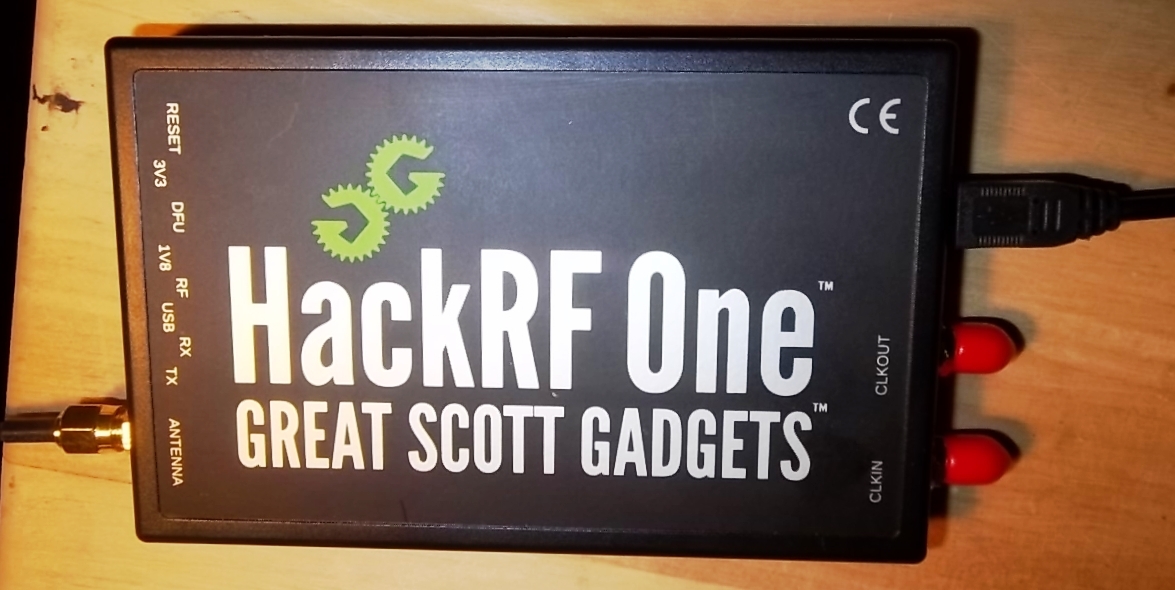
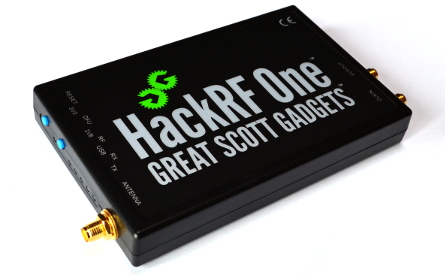
The HackRF One is a Software Defined Radio manufactured by Great Scott Gadgets (www.greatscottgadgets.com) and has been on the market for a few years. Having used an SDR-Dongle for several years I felt it was time to “step up” to this wideband (1 MHz – 6 GHz) receiver to investigate a broader breadth of the radio spectrum, so one was purchased from Sparkfun (www.sparkfun.com).

Recently I performed a rudimentary evaluation of its ability to receive DGPS (Differential Global Positioning System) beacons found in the Longwave band  between 285 – 325 KHz; this frequency range is well below the HackRF One’s stated lower receive limit of 1 MHz.

100_5864

DGPS beacons, when tuned using SSB, emit a distinctive warbling sound, and at this QTH, depending on band conditions and time of year, can be heard as far away as the Midwest. Winter brings the cold weather but also excellent conditions for receiving these beacons, some of which were former marine radiobeacons retrofitted to provide greater DGPS accuracy.

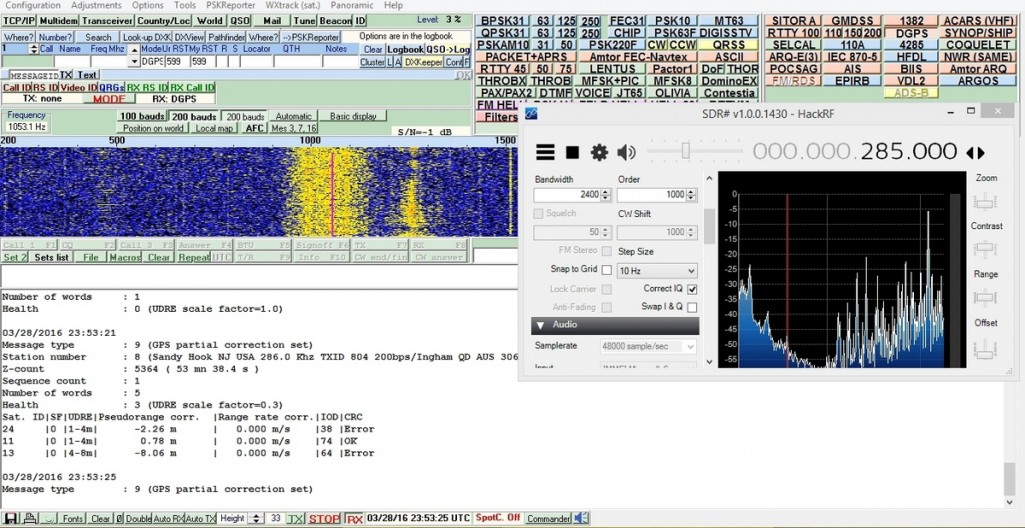
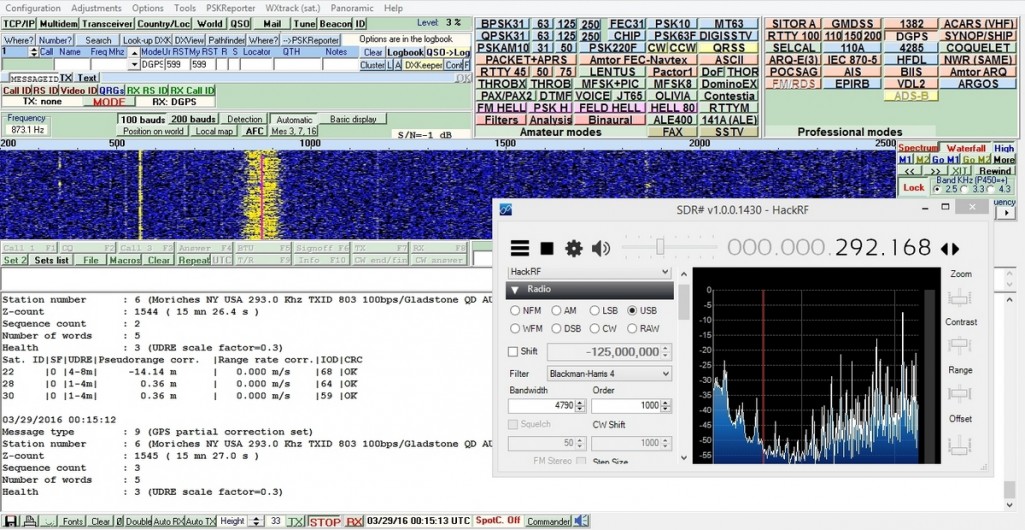
The HackRF One, when used with SDR#, MultiPSK, audio piping software, and a good (43 foot vertical) receiving antenna was able to receive DGPS beacons, and two screen captures are below:

DGPS beacon from Sandy Hook, NJ. SDR# using HackRF One in foreground, MultiPSK software in background with decoded information.

DGPS beacon from Sandy Hook, NJ. SDR# using HackRF One in foreground, MultiPSK software in background with decoded information. Click to enlarge.

DGPS beacon from Moriches, NY. Click to enlarge.

DGPS beacon from Moriches, NY. Click to enlarge.

I was very pleased that the HackRF One was able to receive DGPS stations, though tuning them in seemed a bit trickier than with a standard RTL-SDR dongle.  Since this time of year is not optimal for monitoring DGPS beacons, as well as the Longwave band in general, it’s reassuring to know that come winter I’ll be able to do some DGPS beacon DX’ing with the HackRF One.  However, anyone with a shortwave radio and a good antenna can avail themselves of DGPS beacon hunting, just tune down between 285 – 325 KHz and listen for the distinctive warble.

To decode, look into an excellent program like MultiPSK (http://f6cte.free.fr/index_anglais.htm). 73’s!


Thank you, Mario, for another great post!

When Mario told me he had purchased the $299 HackRF One, I was hoping he would do some guest posts about this SDR–DGPS beacons was use I had never thought of. Looking forward to more of your guest posts, Mario!

The BBC World Service A16 shortwave broadcast schedule

(Image source: BBC)Many thanks to SWLing Post contributor, Dan H, who writes:

The A16 schedule is released for BBC World Service. Here is a link to the A16 frequency page which features additional links to regional frequency charts and transmitter details.

http://www.bbc.co.uk/programmes/articles/2x9tqt6mc05vB2S37j8MWMJ/global-short-wave-frequencies

Good news for me is the BBC World Service English language transmission on 11890 kHz from 1500-1700 UTC. Although beamed to Afghanistan and Iran this signal has been strong in northern California for the last several mornings! I must be receiving an odd lobe off of this one! Now I have BBC during breakfast in addition to 7445 kHz I use during my evenings at 0500. Here is a video I shot of 11890 reception this morning.

(Click here to view on YouTube.)

I hope this information is useful for SWL Post readers.

Indeed it is!  Thank you for sharing the schedule info and your video, Dan!

London Shortwave says farewell to Radio Belarus

london shortwave belarus

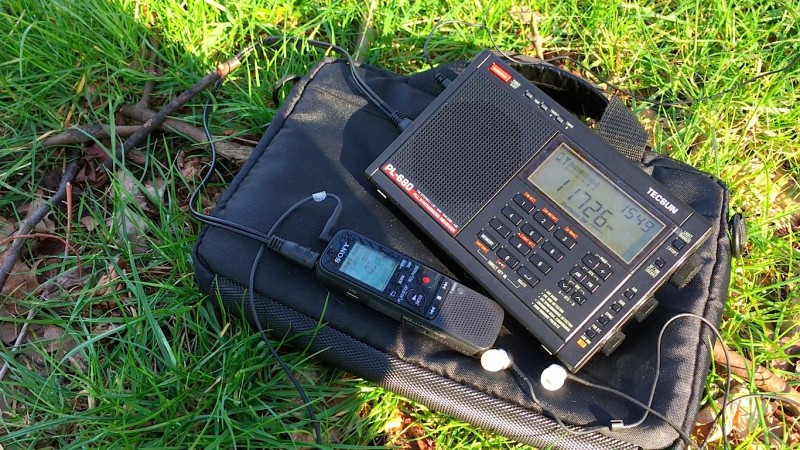
SWLing Post contributor, London Shortwave, hit his local park today with his Tecsun PL-680 and Zoom H1 in tow, then recorded the final broadcasts of Radio Belarus. He has published a post on his blog with details and two recordings of Radio Belarus.

Click here to read his post.

Many thanks to London Shortwave for also going out of his way to post both recordings on the Shortwave Radio Audio Archive! If you have a recording of Radio Belarus, we can add it as well.

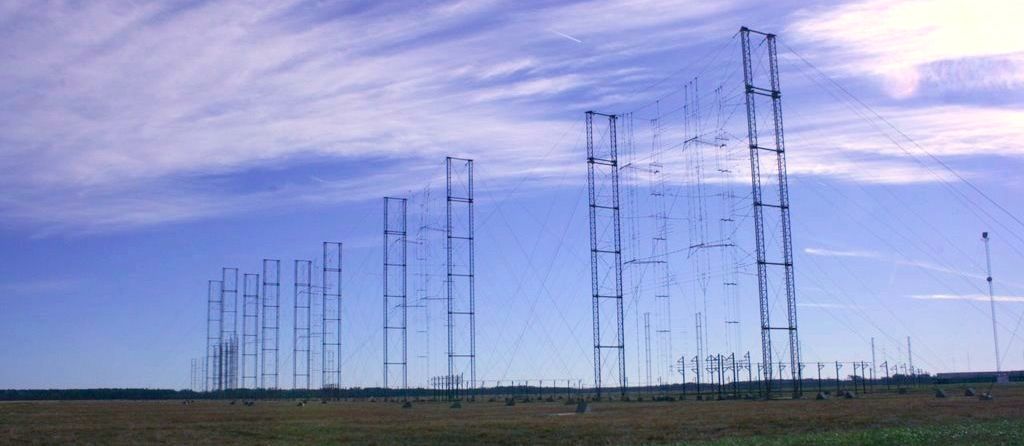
Any requests? Heading to the Edward R. Murrow transmitting station…

VOA-Greenville-Curtain-Antennas

I’m planning to visit the Edward R. Murrow transmitter station for a few hours on Friday (tomorrow). This will be my third trip to the station and I’ll be hanging out with the chief engineer, Macon Dail. I plan to take more photos–especially of some recent transmitter upgrades.

Any questions/requests?

If you like, I would be happy to ask Macon any technical/engineering questions you may have about the site and post his replies here on the SWLing Post next week.

Additionally, if you have something specific you’d like me to photograph, please ask and I’ll attempt to do so. The only areas I’m not allowed to photograph are those dealing with site security.

Please comment with your questions and requests no later than tomorrow morning!

In case you’re not familiar, the Edward R. Murrow transmitter site is the last BBG shortwave broadcasting site on US soil. Click here for a photo tour I posted a few ago.

The CountyComm GP5/SSB: my go-to shortwave radio for hiking

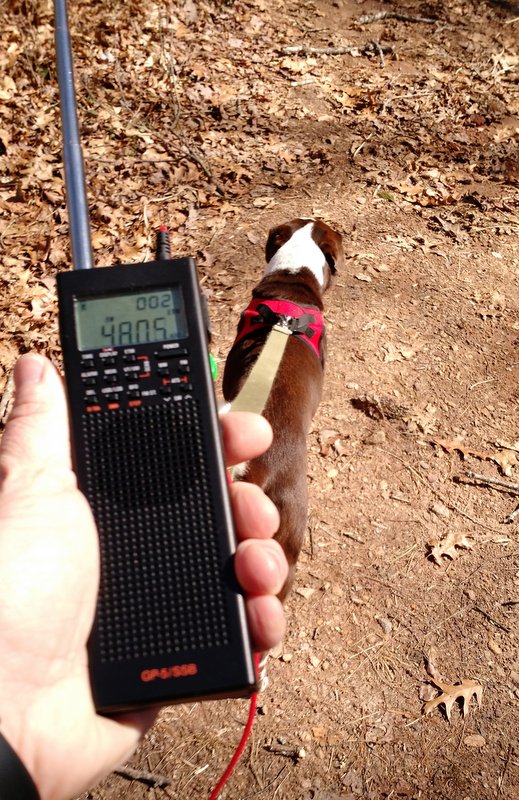
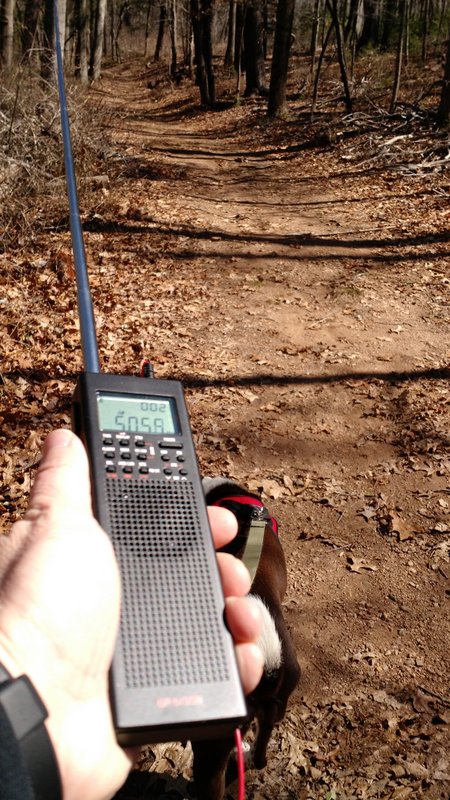
CountyComm GP5/SSB while hiking

My two hiking companions: the CountyComm GP5/SSB and Hazel the dog.

Posting the Blinq deal a few moments ago reminded me that my favorite shortwave radio to use while hiking/walking is the CountyComm GP5/SSB.

I have CountyComm’s custom GP5 case which I clip to my belt or backpack. While hiking, I find it handy to open the case from the top, pull the radio out and operate/tune it with only one hand. Indeed, the vertical form factor of the GP5/SSB is ergonomically-ideal; I can control almost all of the radio functions without having to use two hands. A huge bonus while hiking on uneven terrain!

Typically, when I start a hike, I enable an EMT scan and within a minute or so, the GP5/SSB populates temporary memory positions with all of the signals it can easily receive. When you’re in the middle of the woods–far from sources of radio interference–you’ll be amazed by what you can hear.

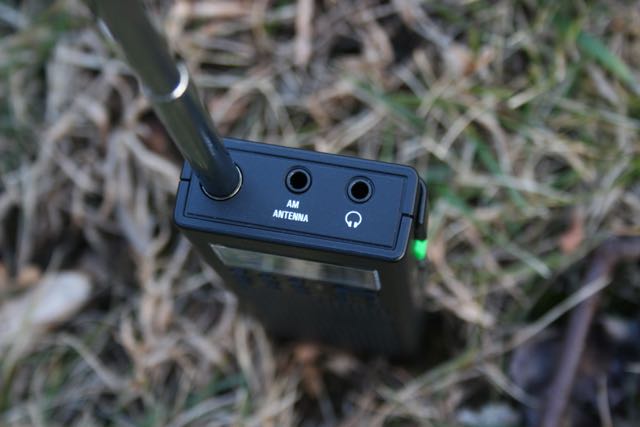
GP5SSB-Top

Of course, with the antenna fully extended, one does have to watch out for low-hanging branches, etc.

CountyComm GP5/SSB while hiking

Since the telescoping antenna doesn’t swivel, it’s much easier to hold the radio in a way that the antenna points forward while you hike (bonus: it’ll catch all of the spider webs across the trail before your face does!).

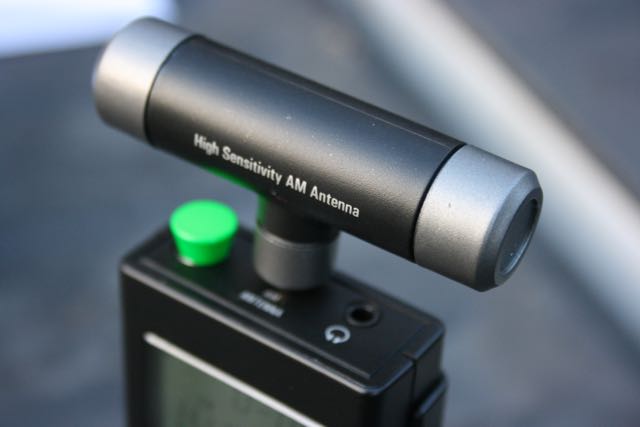
GP5SSB-MW-Antenna

So far, I’ve never used the external mediumwave ferrite bar antenna while hiking–I worry that I could drop the radio and damage either the antenna or the 1/8″ antenna jack.

I typically listen to the GP5 with headphones unless I’m walking a trail during the time of year when black bears are active (in which case the speaker helps alert bears that I’m in the neighborhood).

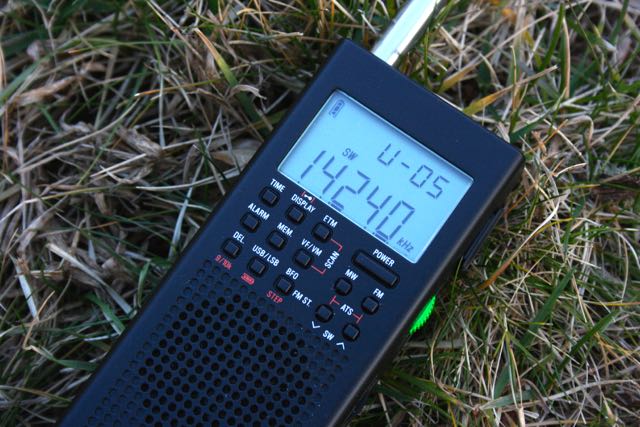
GP5SSB-Front

Of course, there are a few other radio models with an identical vertical form-factor–most notably, the:

If you’re not familiar with the CountyComm GP5/SSB, click here to read previous posts. I also featured the CountyComm GP5/DSP (Tecsun PL-360) in an ultra portable shoot out in 2014–click here to read.

Do you have a favorite shortwave portable for hiking, biking or cycling? Please comment!

Steve notes the end of The Mighty KBC on 6,095 kHz

MightyKBCTruck

Many thanks to SWLing Post contributor, Steve Yothment, who writes:

[Below, you’ll find] my reception report for the digital decode of the Fldigi message by Dr. Kim Elliott on The Mighty KBC (6040 kHz) Saturday night:

noname

I took Kim Elliott’s suggestion and listened to The Mighty KBC on 6095 kHz on Sunday morning using the Utwente WebSDR which receives signals in Enschede, in the Netherlands.

The Mighty KBC finished their last broadcast on 6095 kHz at 11:00AM our time. I recorded their program, but the file is big. So, attached is the last 4 minutes of their program (click here to download), as received by the WebSDR:

It’s too bad that The Mighty KBC is shutting down!

Many thanks for both your decoded message and your recorded audio, Steve! I agree: it is too bad the KBC had to shut down their 6095 kHz broadcast.

Note that The Mighty KBC will continue on their AM frequency, DAB and streaming. Check out the KBC website for details.