Many thanks to SWLing Post and Shortwave Radio Audio Archive contributor, Brian Smith, for the following guest post and vintage recording:
Shortwave Radio 1974: Canada, Argentina, Spain, West Germany, Albania, utility stations
-Brian Smith (W9IND)
Want to know what shortwave radio sounded like in 1974? This 55-minute recording, recovered from a cassette, was never intended to be anything but “audio notes”: I was an 18-year-old shortwave listener who collected QSL cards from international stations, and I was tired of using a pen and a notepad to copy down details of the broadcasts. I wanted an easier way to record what I heard, and my cassette tape recorder seemed like the perfect means to accomplish that goal.
But it wasn’t. I soon discovered that it was simpler to just edit my notes as I was jotting them down — not spend time on endless searches for specific information located all over on the tape. To make a long story shorter, I abandoned my “audio notes” plan after a single shortwave recording: This one.
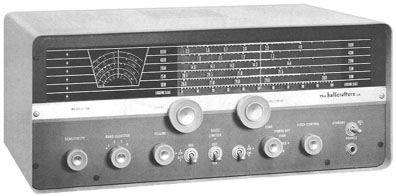
Hallicrafters S-108 (Image source: DXing.com)
Still, for those who want to experience the feel of sitting at a shortwave radio in the mid-1970s and slowly spinning the dial, this tape delivers. Nothing great in terms of sound quality; I was using a Hallicrafters S-108 that was outdated even at the time. And my recording “technique” involved placing the cassette microphone next to the radio speaker.
Thus, what you’ll hear is a grab bag of randomness: Major shortwave broadcasting stations from Canada, Argentina, Spain, Germany and Albania; maritime CW and other utility stations; and even a one-sided conversation involving a mobile phone, apparently located at sea. There are lengthy (even boring) programs, theme songs and interval signals, and brief IDs, one in Morse code from an Italian Navy station and another from a Department of Energy station used to track shipments of nuclear materials. And I can’t even identify the station behind every recording, including several Spanish broadcasts (I don’t speak the language) and an interview in English with a UFO book author.
The following is a guide, with approximate Windows Media Player starting times, of the signals on this recording. (Incidentally, the CBC recording was from July 11, 1974 — a date I deduced by researching the Major League Baseball scores of the previous day.)
Guide To The Recording
00:00 — CBC (Radio Canada) Northern and Armed Forces Service: News and sports.
07:51 — RAE (Radio Argentina): Sign-off with closing theme
09:14 — Department of Energy station in Belton, Missouri: “This is KRF-265 clear.”
09:17 — Interval signal: Radio Spain.
09:40 — New York Radio, WSY-70 (aviation weather broadcast)
10:22 — Unidentified station (Spanish?): Music.
10:51— Unidentified station (English): Historic drama with mention of Vice President John Adams, plus bell-heavy closing theme.
14:12 — Unidentified station (Spanish?): Male announcer, poor signal strength.
14:20 — Unidentified station (Spanish): Theme music and apparent ID, good signal strength.
15:16 — Unidentified station (foreign-speaking, possibly Spanish): Song, “Chirpy Chirpy Cheep Cheep.”
17:00 — Deutsche Welle (The Voice of West Germany): Announcement of frequencies, theme song.
17:39 — Unidentified station (English): Interview with the Rev. Barry Downing, author of “The Bible and Flying Saucers.”
24:36 — One side of mobile telephone conversation in SSB, possibly from maritime location.
30:37 — Radio Tirana (Albania): Lengthy economic and geopolitical talk (female announcer); bad audio. Theme and ID at 36:23, sign-off at 55:03.
55:11 — Italian Navy, Rome: “VVV IDR3 (and long tone)” in Morse code.
Click here to download the recording as an MP3, or simply listen via the embedded audio player below:
Brian, this is a brilliant recording–regardless of audio quality–and we’re very thankful you took the time to share it. Propagation has left something to be desired as of late, so time traveling back to 1974 has been incredibly fun.
Post Readers: If, like Brian, you have off-air recordings on tape that you’d like to share, please contact me! Even if you don’t have the means to transfer your tapes to a digital format, I’m a part of a small community of shortwave radio archivists who would be quite willing to help.