Category Archives: Software Defined Radio

Recording the 2014 World Cup Final

WorldCupBall-001Sunday was the FIFA World Cup Final, and not only was I looking forward to the game, but (to tell the truth) I was also looking forward to recording the game via the BBC World Service for the Shortwave Radio Audio Archive. Due to the BBC WS cuts, part of me fears this may be a last chance to capture this radio and sports history.

If you would like to hear the recordings of the World Cup Final, skip to the bottom of this post. But if you want to know how I managed to make the recordings, and why I made the choices I did, feel free to continue reading…Warning: full-on radio geek tech ahead!

Making the recording

I had two SDRs (software defined radios) at my disposal: the Elad FDM-S2 and my trusty WinRadio Excalibur.  To record this match, I choose to use an SDR rather than a tabletop receiver for several reasons, namely:

  1. I wanted to make a spectrum recording so that I could record more than one frequency at a time;
  2. SDRs make recording radio content on the fly much easier than using a tabletop receiver, which must be connected to an external audio recorder, and I wanted ease of use so I could enjoy the game, too.

Propagation was rather mediocre Sunday, and there were only three feasible BBC World Service English frequencies I could tune in mid-afternoon, none of which, of course, were targeting North America:

  • 11,810 kHz from Ascension Island
  • 13,660 kHz from Woofferton, UK
  • 15,400 kHz from Ascension Island
  • 9,915 kHz from Woofferton, UK (starting at 20:00 UTC)

My hunch was that either 13,660 or 15,400 kHz would be my best bet for the early part of the match (pre-game starting at 18:30 UTC, half time at 20:00 UTC), however, I knew they would drop off after the first half of the game. And 11,800 kHz would be my best bet in the latter part of the game, unless 9,915 kHz happened to be stronger.

In the past, 11,800 had served me quite well for afternoon BBC listening, but yesterday there was an unscheduled religious broadcaster on 11,825 that was causing interference a full 30 kHz on either side of their carrier! During my pre-game check of the frequency, each attempt I made to block this broad interference was unsuccessful–very frustrating.

Which SDR?

The FDM-S2 is a fine SDR, and I was very tempted put it to the test.  But while the Elad FDM-S2 is quite capable of making very wide spectrum recordings (up to 6 MHz) and could easily record all four frequencies on four different meter bands at the same time, I decided to use the WinRadio Excalibur, instead.

Why? If 11,800 kHz was my only viable frequency option in the latter half of the game, I needed a receiver that could sync to the less noisy lower sideband of 11,800 kHz. While Elad plans to add USB/LSB selectable synchronous detection in the next version of their SDR application, it currently does not have this capability.

I suppose, too, I feel more comfortable with the WinRadio Excalibur; I’ve been using it now for well over two years. If something were to go wrong during the broadcast, I knew I could diagnose it quickly on the Excalibur.

In addition, the Excalibur can do both a spectrum recording and up to three individual AF recordings at the same time (though limited within a 2MHz bandwidth). I’m not sure if Elad has plans for this in their next SDR.

Setting up the Excalibur

The Excalibur only has a 2 MHz bandwidth for spectrum recordings. I knew if I focused on the middle frequency of 13,660, I would be able to record it and either 15,400 or 11,810 at the same time, but not all three.

The first half of the match, I recorded both 13,660 kHz and 15,400 kHz in a 2 MHz wide spectrum recording. At the same time, I recorded the audio (an AF recording) from 13,660 kHz, which was consistently the stronger of the two frequencies.

Half time

By 20:00 UTC, I knew both 13,660 and 15,400 kHz would stop transmitting and I would need to either hop to 11,810 kHz or 9,915 kHz.

While maintaining a good audio recording of 13,660, I stopped the 2 MHz spectrum recording and moved it to encompass 13,660 and 11,810 kHz. A quick check proved that 11,810 was the strongest station. Fortunately, the interference above 11,810 had quieted somewhat at that point, and by using the LSB sync lock, this noise was successfully mitigated a bit.

Still, I could hear a chuffing sound coming from the splatter 11,825 was producing. So I enabled the notch filter and widened it to 2 kHz. By shifting it around in the upper side band, I was able to find the “sweet spot” where most of the splatter noise was canceled. I then started the audio recording on 11,810 a few minutes prior to 20:00 UTC, making a little audio overlap with simultaneous recording on 13,660.
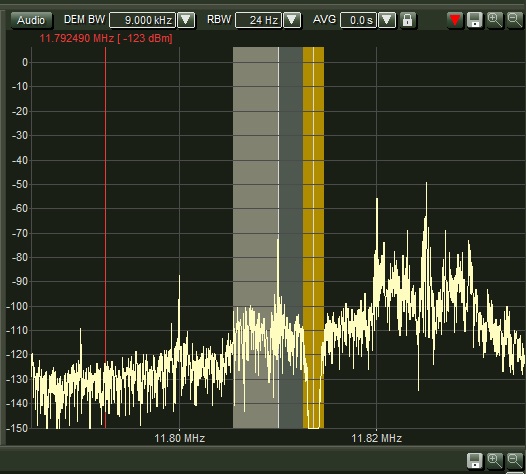
Syncing on the lower sideband and using the notch filter in the upper sideband mitigated most of the interference.

Syncing on the lower sideband and using the notch filter in the upper sideband mitigated most of the splatter interference.

In the end, I was very pleased with the results of the recordings. While capturing the BBC World Service isn’t exactly like snagging rare DX, I felt I had a lot riding on this recording, so pre-game preparations were necessary, especially since the Excalibur couldn’t record spectrum from 9,915 to 15,400 kHz.

And in theory, had I used the Elad FDM-S2, I could have recorded the entire chunk for three hours and then revisited the material later to make audio recordings from the AF.

The recordings

For your listening pleasure: the full 2014 World Cup final via the BBC World Service. This broadcast is broken into 3 sections: pre-game and the first half, second half, and extra time. Enjoy!
Pre-game and first half (13,66o kHz):

Second half (11,810 kHz):

Extra time and game wrap-up (11,810 kHz):

SDR# on a Toshiba Encore tablet PC

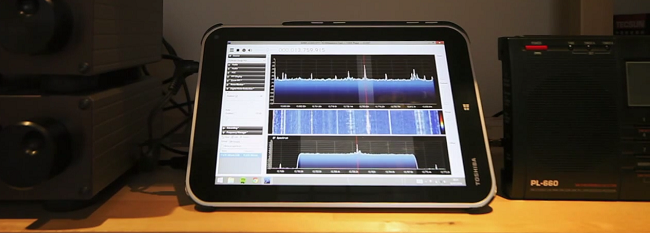
SDRSharp-ToshibaEncore-LondonShortwaveSWLing Post reader London Shortwave recently moved the Software Defined Radio (SDR) application SDR# (“SDR Sharp”) off of his MacBook Pro and onto a Toshiba Encore 8″ tablet PC. He recently posted this video of SDR# running his FunCube Dongle Pro+ on the Toshiba Encore tablet:

His reception of the Voice of Korea’s Spanish service is most impressive, especially considering the high level of RFI (radio noise) he must cope with at his home in London, England.

Click here to follow London Shortwave on Twitter.

SDR# now has AM synchronous detection

LondonShortwave-Park

SWLing Post reader, London Shortwave writes with a remarkable story about the free SDR application, SDR#(or, “SDR sharp”). He writes:

“Two days ago, I emailed Youssef (SDR# developer lead) to ask if he would consider adding synchronous AM detection to his software at some point.

To my great surprise he e-mailed me back the same day and told me that it wouldn’t take him long to write the necessary code. A few hours later he sent me a preview copy of the software with the feature included (all I had to do was to swap one .dll file in the version I had installed at the time). The following day, he integrated it into the latest release!

With the new sync detector the software is rapidly becoming my favourite SDR application.

Here’s a demo video I made for Youssef (and everyone else!) to show how I’ve been getting on with it:

This is amazing–what’s especially impressive is that a first iteration of AM sync should be so well implemented.  I love the way you can use the IF shift to block out interference within a sideband, much like USB/LSB selectable sideband. There are paid and OEM SDR applications that can’t do this.

London Shortwave: you’ve convinced me to see if SDR# will drive any of my receivers. Many thanks!

Happy Summer/Winter Solstice: Listening to New Zealand and Australia

Australia-NewZealand

I’ve been on the road a lot lately. A lack of time resulting from this, combined with frequent afternoon and evening thunderstorms when I am home, has meant that I’ve not had the radio time I often enjoy.

This morning,  I woke up around 5:50 AM determined to get a bit of time on the radio. After all, today is the first day of summer here in the US, and a special day for me. I walked outside and hooked my antenna back up; I had been forced to disconnect it yesterday as pop-up thunderstorms persisted throughout the afternoon and evening.

I then brewed a cup of coffee and settled into my “listening lounge” for some early morning tuning.

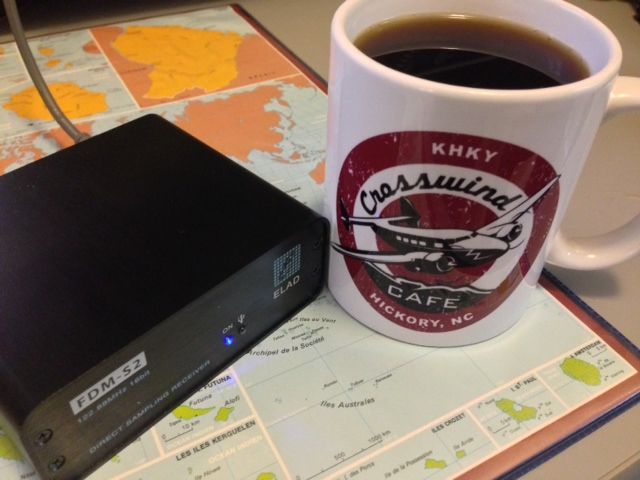
Elad-FDM-S2-Coffee

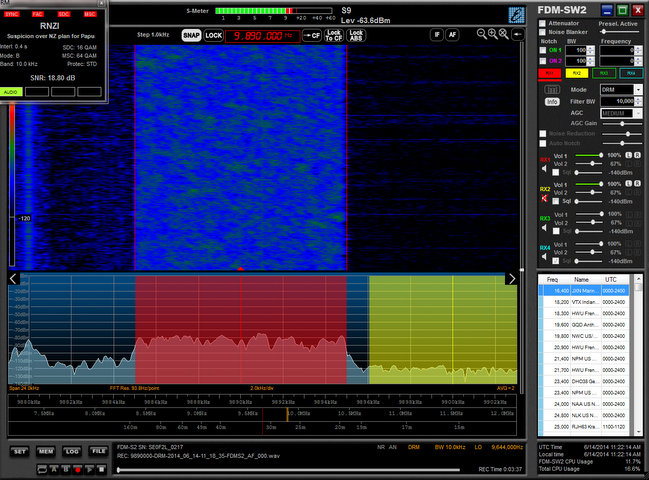
I started off this morning off by tuning the Elad FDM-S2 to Radio New Zealand International on 9,890 kHz in DRM (Digital Radio Mondiale). I was treated to one full hour of Peter Fry’s Saturday Night music; the DRM lock was completely stable.  Though I prefer the sonic characteristics of AM over digital modes, I’m most impressed with the audio quality DRM affords coming from a 50 kW signal being broadcast on the other side of the planet. The quality is so exceptional that, if you listen carefully, you can even hear the news reader shifting papers at the top of the hour.

That got me thinking: I’m flawlessly receiving and decoding a wireless digital audio signal from 13,500 kM away. Amazing. Especially considering that my laptop struggles to receive Wi-Fi in many hotels.

RNZI signed off after an hour, so I switched modes to AM and tuned to Radio Australia on 9,580 kHz.

BombersAs I had hoped, RA was broadcasting the second half of the AFL match featuring the Essendon Bombers who ultimately held a nine-point win over the Adelaide Crows. Alas, Radio Australia dropped the signal before the end of the final quarter, but I was able to watch the results roll in on my iPhone while making waffles in the kitchen. If this had been a World Cup match, I would have scoured the shortwaves for another Radio Australia frequency.

Immediately after tuning in RNZI, I hit the record button on the FDM-S2 (around 5:55 EDT/9:55 UTC) and didn’t stop the recording until after Radio Australia signed off, so there is a 30 second silence in the middle while I tuned and switched modes from DRM to AM.

Click here to download my full 2+ hour morning recording, or simply listen via the embedded player below:

Depending on which hemisphere you live in, I hope you enjoy this summer–or winter– solstice.

As for me, I’m looking forward to a happy birthday with my family.  Cheers!

Testing SDR#’s noise reduction in a London park

LondonShortwave-ParkSDR

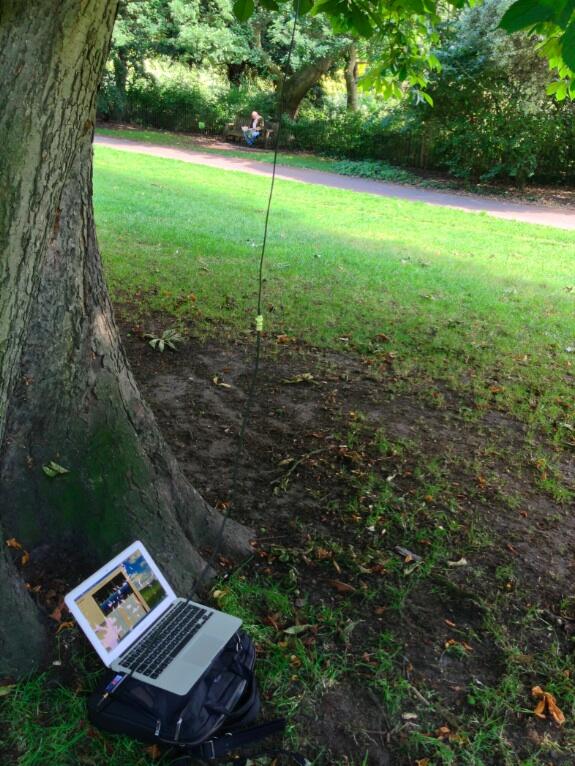
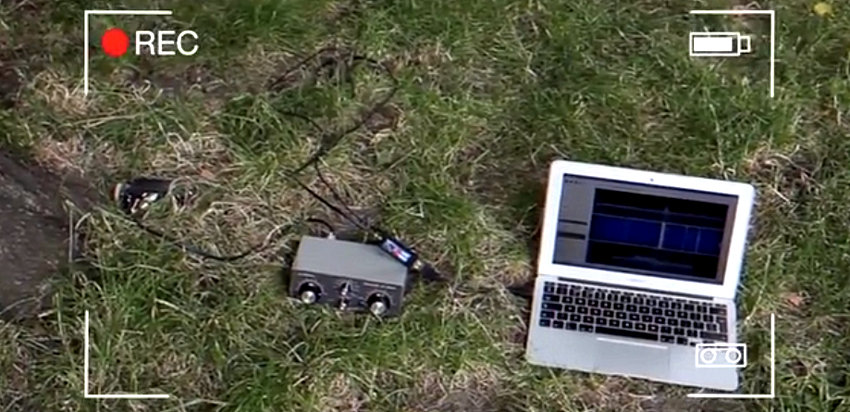
Yesterday, SWLing Post reader London Shortwave took his laptop, FunCube Dongle Pro+, and 6 meter long wire antenna to a local park where he tested SDR#‘s new IF noise reduction.

He made the following screencast/video where he toggles the IF noise reduction feature while receiving the BBC World Service’s Pashto language service on shortwave:

Most impressive! Indeed, I believe SDR#’s noise reduction might rival that of OEM applications. While I’m not the biggest fan of noise reduction for everyday use (due to inherent digital artifacts) it is a valuable tool when noise levels are high.

 Click here to follow @LondonShortwave on Twitter.

If you would like to experiment with SDR#, click here to download your free copy. SDR# has a number of additional plugins and dedicated users/developers who communicate via this this Yahoo! Group.

Many thanks to @LondonShortwave.

Any other readers using SDR#? Please comment.

Shortwave Radio Recordings: Radio New Zealand International (DRM)

This morning, while scanning the 31 meter band, I noticed a DRM (Digital Radio Mondiale) signal on 9,890 kHz. Normally, I ignore most DRM signals because the amount of signal strength needed to properly decode the mode (here in the US) is simply too low for pleasant, artifact-free copy.

Still, I thought I’d give the new Elad FDM-S2 a try, so I changed mode from AM to DRM.

RNZI-DRM-003To my amazement, the FDM-S2 quickly decoded the signal and produced excellent audio from Radio New Zealand International.

I assumed the decoding lock would not hold, but I was wrong; indeed, I believe there were only one or two significant drops in the 40+ minutes I listened. This may be a very good sign from the FDM-S2, even if propagation was above average.

I’m not a big DRM listener, but that’s mainly because there is so little to hear on the bands. The real test will be All India Radio in DRM–I’ve never managed to get a consistent lock on them from here in eastern North America.

Still, I’m pleased as punch that I can so easily copy RNZI–one of my favorite international broadcasters–in DRM.

Here’s a recording of the broadcast starting at 11:18 UTC on June 14, 2014. Click here to download the the recording as an MP3, or simply listen via the embedded player below:

Shortwave Radio Recordings: the Voice of Greece, one year on

Last night, while learning the ropes of the new Elad FDM-S2, I noticed some great music on 9,420 kHz, the former Voice of Greece frequency.

GREECE-ECONOMY-MEDIAIt was then that I realized yesterday (June 11) marked the one year anniversary of the day that the Greek government shut down ERT and the Voice of Greece. If interested, click here for some audio I recorded that very night.

Amazingly, one year later, 9,420 kHz is still active out of the Avlis transmitter site and last night, the Radio Station of Macedonia (a.k.a., ERT 3) was playing an excellent mix of Greek music and jazz.

Click here to listen to the 51 minute recording, made with the Elad FDM-S2 software defined receiver, starting at 00:50 UTC:

You’ll note great audio fidelity and a low noise floor despite the numerous static crashes present from area thunderstorms. (Note that I did not have DSP noise reduction nor the noise blanker engaged.) I started the recording in standard AM mode, then changed it to AM synchronous detection between songs in the first half of the recording.