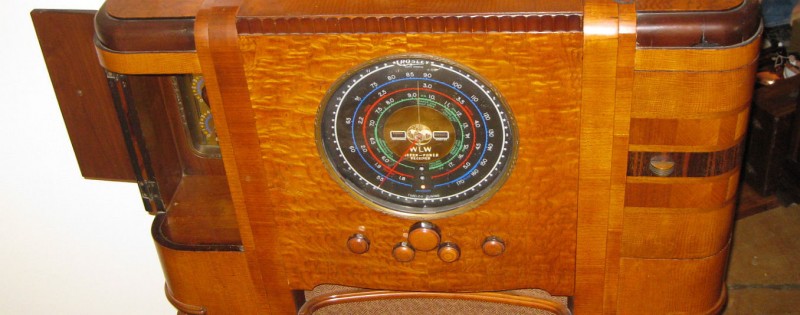
In response to our recent thread of posts about the Crosley WLW Model Super-Power Radio Receiver, I’d like to thank both Jonathan Marks and Mike Barraclough for sharing the following video by TNT Amusements on YouTube:

In response to our recent thread of posts about the Crosley WLW Model Super-Power Radio Receiver, I’d like to thank both Jonathan Marks and Mike Barraclough for sharing the following video by TNT Amusements on YouTube:
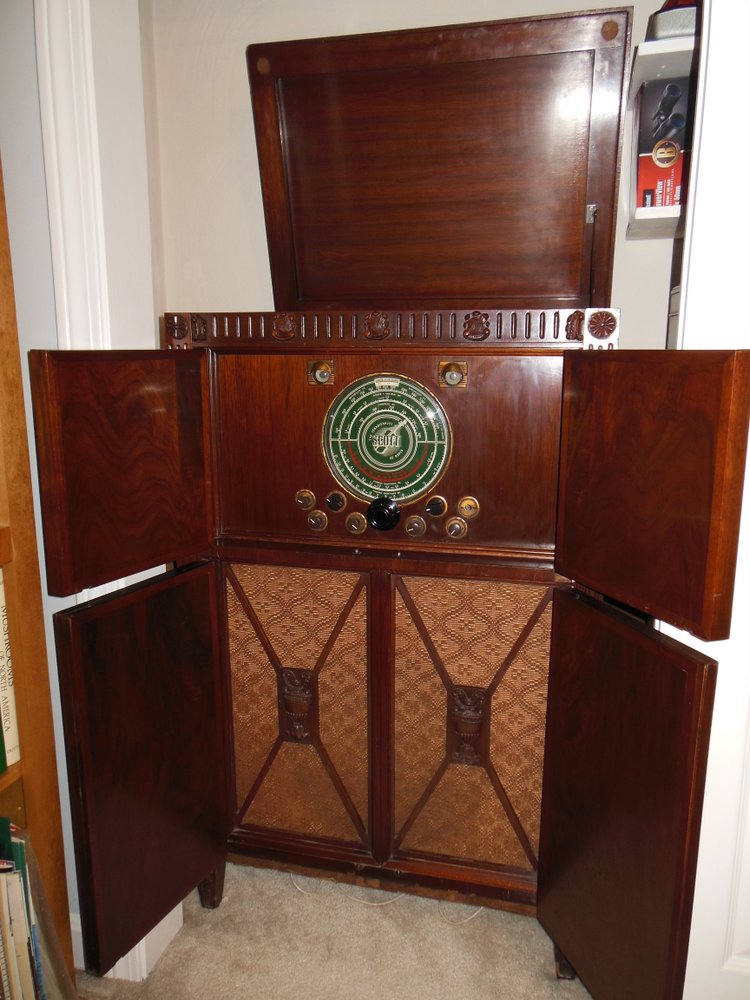
In response to an inquiry in our post about the Crosley WLW Model Super-Power Radio Receiver, SWLing Post contributor, Ken Carr, writes:
I’m not sure if my radio is a ‘benchmark’ but it sure is close to it.
It is the E. H. Scott Philharmonic Beam of Light console radio.
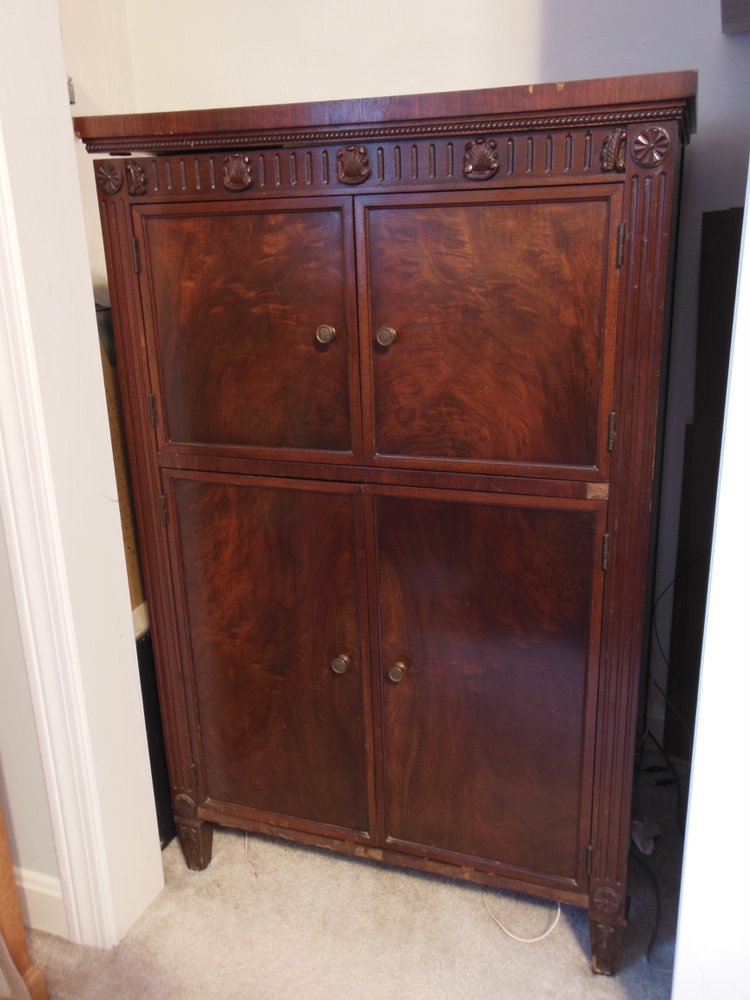
Mine appears to have been built in 1939 or early 1940. It has 30 tubes, most of which are covered by chrome-plated shields. The power supply/amplifier (4 6L6’s in the output stage), receiver, 15″ speaker and cabinet easily weigh over 150 pounds.
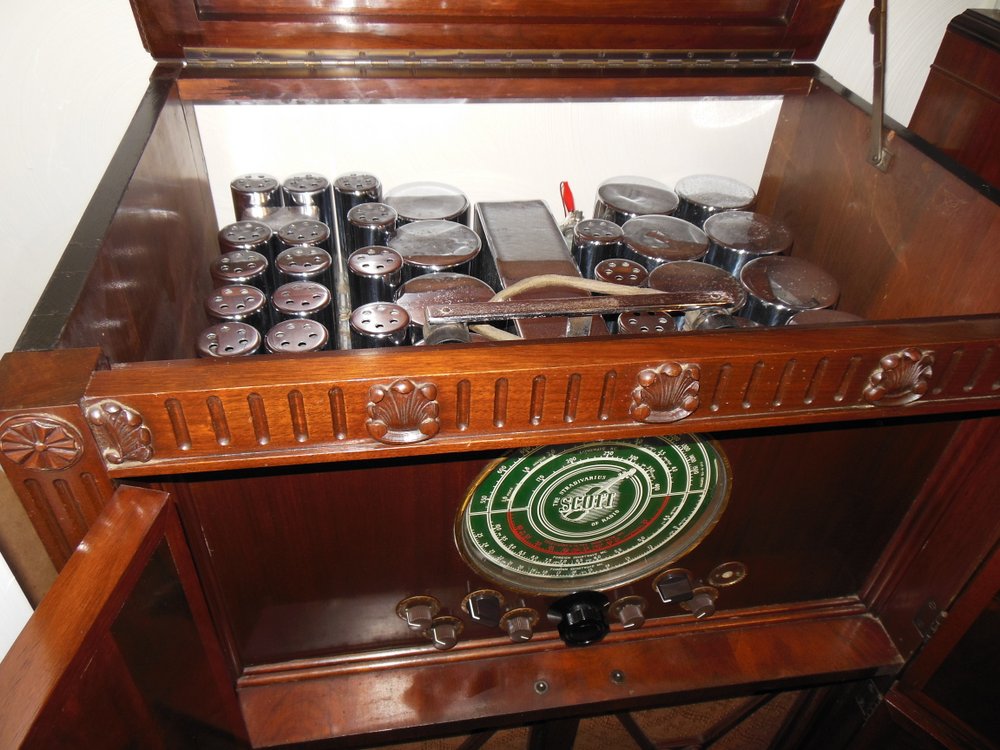
It took me two years of occasional work (I am retired so I don’t rush) to get it going and working reasonably well. I had to replace over 100 capacitors and correct some B+ voltage problems left by a previous repair person.
None of the knobs are correct (mine came without them … 9 required) and replacements are difficult to come by (and quite expensive when they do appear).
When receiving a strong station the volume is such that it would easily drown out anything within 100 yards (and with no distortion).
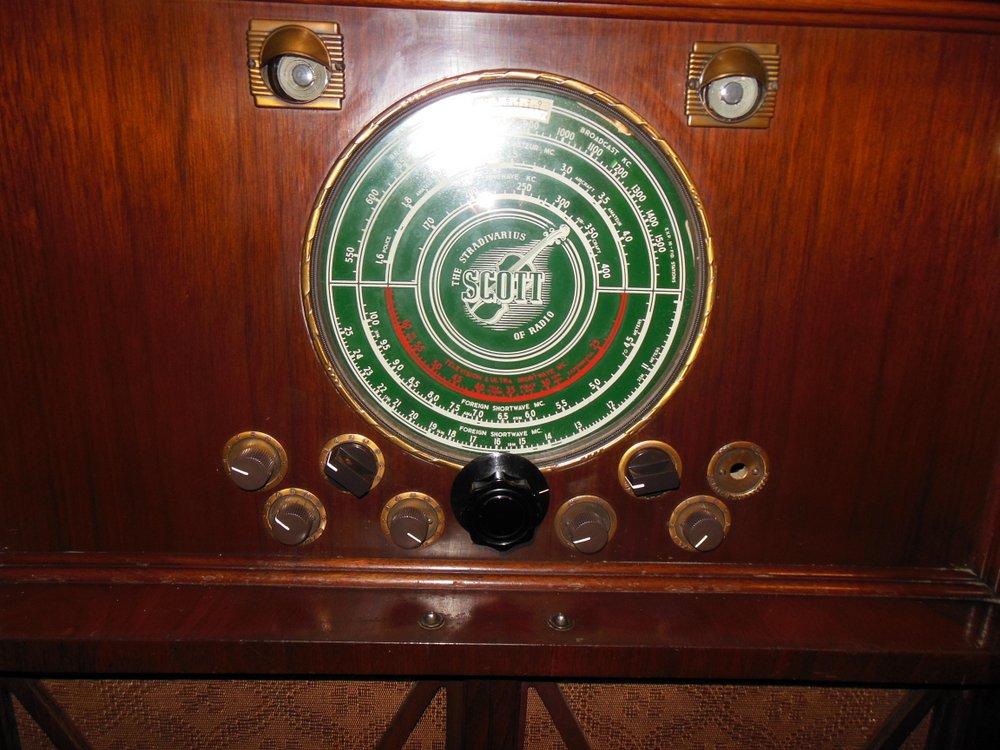
Some day I will post some details and photos on my WordPress site (idlenot.com). I’ll be sure to let you know, Thomas. [Note: Yes, Ken, please do!]
Oh, the first time I powered it up and received a station they were playing Light My Fire (The Doors, I think). Appropriate. I put a video of it on YouTube. The radio is all apart as I was still working on it at the time.
Click here to view on YouTube.
Now that is serendipity, Ken–I mean, the first music you hear after restoring this beauty is Light My Fire? Brilliant!
The E. H. Scott Philharmonic Beam of Light is a benchmark console by any standard. I first learned about this radio through a local classified ad–the owner was selling the internal components (and original knobs) but had no cabinet. I believe he was asking $1200. The chrome plating is such eye candy, I can see why some owner in the past removed it from the cabinet to save space. Still, it was a shame the cabinet had been discarded–as one can see from your photos, the craftsmanship is simply stunning.
Ken, thank you for taking the time to share the Beam of Light console with us!
Post readers: you should check out Ken’s blog, Idlenot.com, where you’ll find more vintage radio and classic cars!
(Image: AntiqueRadios.com)
(Source: Nuts and Volts)
In 1935, the Zenith Radio Corporation produced a stunning radio receiver called the Stratosphere model 1000Z. The set used 25 tubes and three loudspeakers — more than any other radio to date. An amazing (for the time) 50 watts drove its three speakers — one 6 inch dynamic high-frequency and two 12 inch dynamic low-frequency speakers.
Standing 50-1/2 inches tall, the Stratosphere sold for $750.00 — more than many automobiles; in comparison, a new Ford cost $652.00. At that price, it’s no wonder that only about 350 sets were produced during the four years that the Stratosphere was offered.
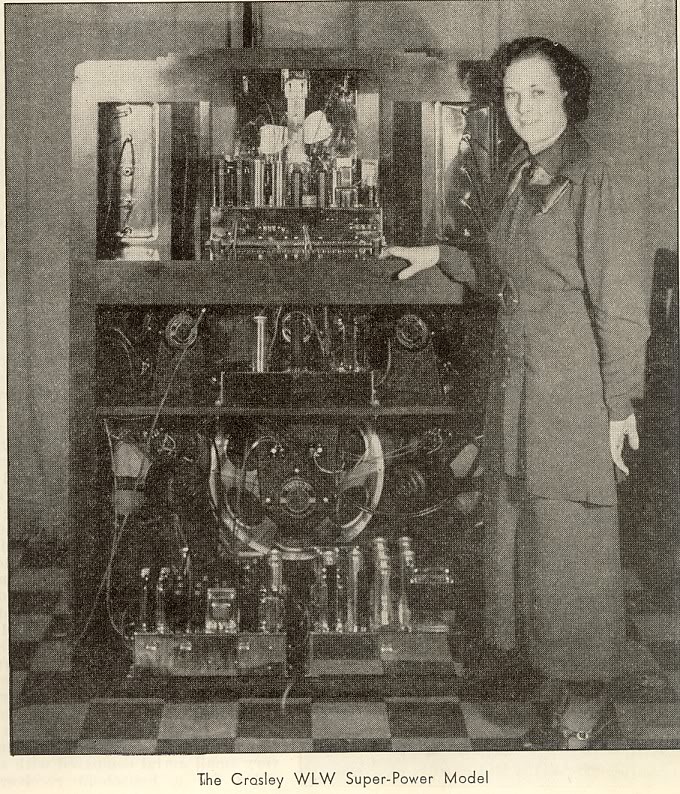
This achievement impressed Powel Crosley, Jr. — the President of the Crosley Radio Corporation — who praised it as a fine example of quality in radio construction, but it used “only” 25 tubes and three speakers! Crosley — who also owned the 500,000 watt powerhouse radio station, WLW — was inspired to surpass Zenith by bringing the world the largest and most powerful radio receiver yet known.
[…]Out of the numerous [engineering conferences were held throughout the winter months] and Crosley’s imagination came the basic specifications: the radio would be a superheterodyne receiver with no fewer than 30 tubes, six loudspeakers, four chassis; a suitably impressive cabinet would house it. More intricate than any set ever built, it would naturally have the highest possible quality and richness of tone.
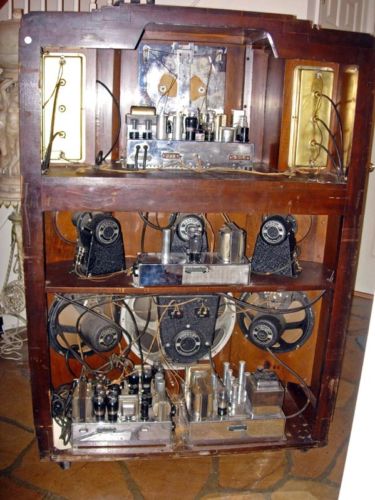
[…]In its completed form, the WLW Model Super-Power Radio Receiver indeed surpassed the Zenith Stratosphere model. It had 37 tubes, six speakers, and 75 watts of power. The cabinet stood 58 inches tall, 42 inches wide, and 22 inches deep. Everything inside the cabinet that could be was chromium-plated. The transformer coils, tubes, and speaker frames were finished in black and each chassis had its own serial number plate.
Continue reading the full article at Nuts and Volts…
Regular SWLing Post readers know that I’m a bit of a vintage radio nut, so I thought I’d do a little digging to see if any WLW Model Super-Power Radio Receivers had been sold or auctioned recently. I was curious what sort of price they’d fetch.
Let’s just say, some owners demand a high price…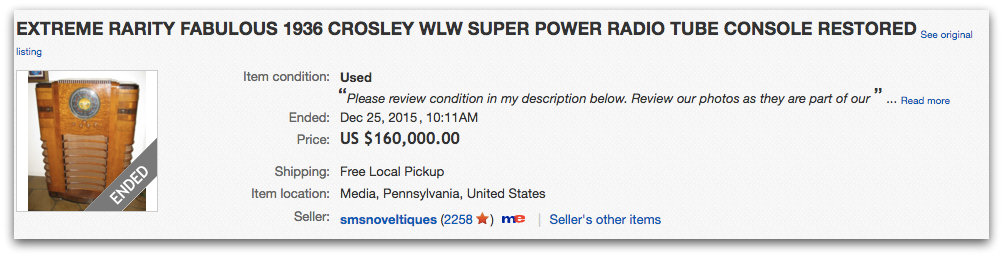
This unit was put up for sale on eBay for $160,000 US last year! While I know the Crosley WLW receiver is rare, that price was obviously over the top as is wasn’t sold. Still, the seller included some great photos of this near-mint model:
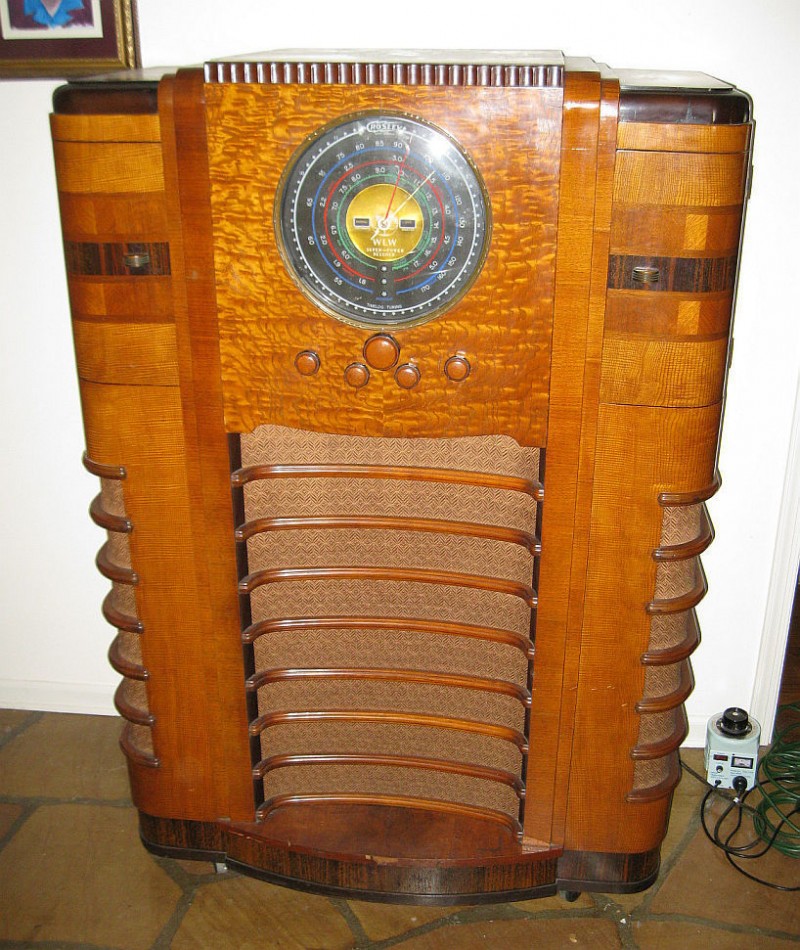


Around the time of the Zenith Stratosphere and the Crosley WLW–the mid to late 30s–radio manufacturers must have either believed there was a market for these high-end, high-fidelity receivers, or they simply enjoyed designing and manufacturing them as a company benchmark or showpiece.
While not as feature-packed as the Crosley WLW receiver, at the National Capital Radio and Television museum last year, I was completely enamored with this gorgeous powerhouse console: the E.H. Scott All-Wave 23 console.
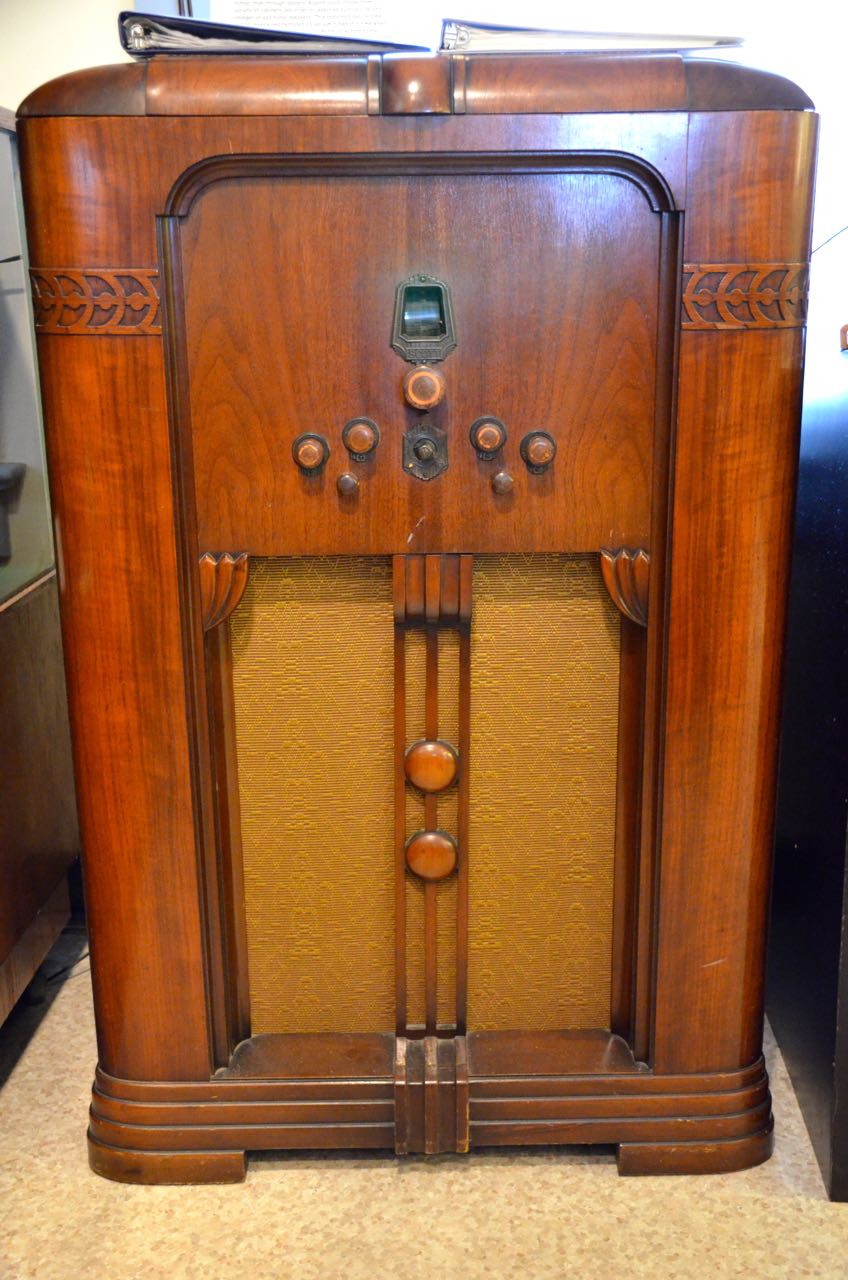
The docent told me that the E.H. Scott All-Wave 23 console could easily fill a banquet hall with hi-fi audio. It sported 23 tubes and a very large speaker. If memory serves, it originally sold for $750–easily three or four times the price of most console radios.
Post readers: Do you know of any other benchmark console radios? Do you own one of these amazing receivers? Please comment!
Every radio enthusiast knows that the Sony ICF-2010/2001D was a desirable, high performing portable receiver throughout its long production history. Manufactured from 1985 through 2003, few receivers were as consistently high on DXers’ “must have” list as the ICF-2010.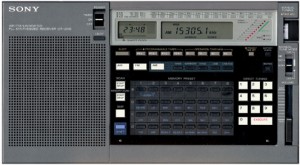
These Sony portables still command high prices on the used market, but what would you pay for a brand new, still in the sealed factory carton ICF-2010? Well, someone just won the high bid on this new, unopened 2010 for the princely sum of $982.00 USD plus shipping:
http://www.ebay.com/itm/SONY-ICF-2010-RECEIVER-BRAND-NEW-STILL-IN-FACTORY-SEALED-BOX-/111948598883
What’s your opinion? Outrageous, foolhardy purchase or a savvy investment for the future? Please comment below with your thoughts.
Guy Atkins is a Sr. Graphic Designer for T-Mobile and lives near Seattle, Washington. He’s a regular contributor to the SWLing Post.
Many thanks to SWLing Post and SRAA contributor, Brian D. Smith (W9IND), for the following guest post and recording.
Note that Brian could use your help to ID a few unidentified broadcasters in this recording. If you can help, please comment:
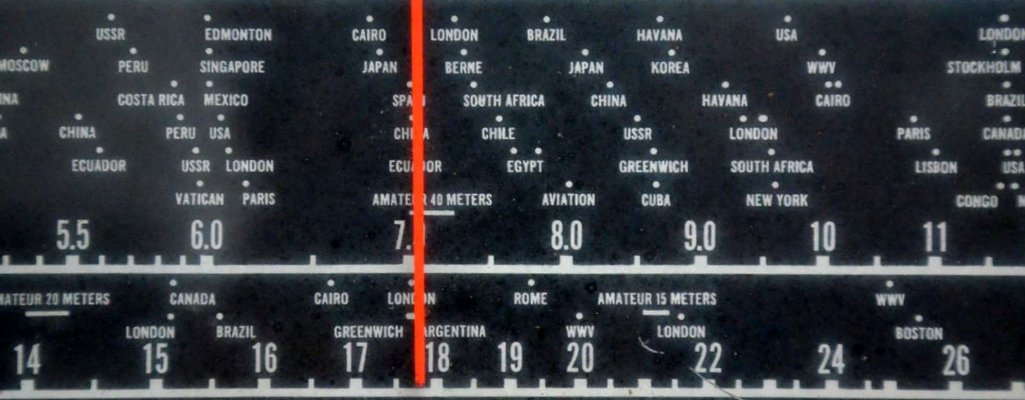
Shortwave Radio 1974: Canada, Argentina, Spain, West Germany, Albania, utility stations
Want to know what shortwave radio sounded like in 1974?
This 55-minute recording, recovered from a cassette, was never intended to be anything but “audio notes”: I was an 18-year-old shortwave listener who collected QSL cards from international stations, and I was tired of using a pen and a notepad to copy down details of the broadcasts. I wanted an easier way to record what I heard, and my cassette tape recorder seemed like the perfect means to accomplish that goal.
But it wasn’t. I soon discovered that it was simpler to just edit my notes as I was jotting them down — not spend time on endless searches for specific information located all over the tape. To make a long story shorter, I abandoned my “audio notes” plan after a single shortwave recording: This one.
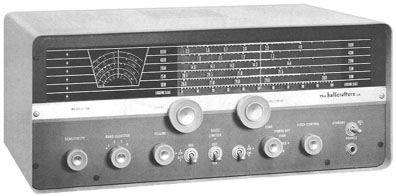
Hallicrafters S-108 (Image: DXing.com)
Still, for those who want to experience the feel of sitting at a shortwave radio in the mid-1970s and slowly spinning the dial, this tape delivers. Nothing great in terms of sound quality; I was using a Hallicrafters S-108 that was outdated even at the time. And my recording “technique” involved placing the cassette microphone next to the radio speaker.
Thus, what you’ll hear is a grab bag of randomness: Major shortwave broadcasting stations from Canada, Argentina, Spain, Germany and Albania; maritime CW and other utility stations; and even a one-sided conversation involving a mobile phone, apparently located at sea. There are lengthy (even boring) programs, theme songs and interval signals, and brief IDs, one in Morse code from an Italian Navy station and another from a Department of Energy station used to track shipments of nuclear materials. And I can’t even identify the station behind every recording, including several Spanish broadcasts (I don’t speak the language) and an interview in English with a UFO book author.
The following is a guide, with approximate Windows Media Player starting times, of the signals on this recording. (Incidentally, the CBC recording was from July 11, 1974 — a date I deduced by researching the Major League Baseball scores of the previous day.)
Guide to the Recording
0:00 — CBC (Radio Canada) Northern and Armed Forces Service: News and sports.
7:51 — RAE (Radio Argentina): Sign-off with closing theme
9:14 — Department of Energy station in Belton, Missouri: “This is KRF-265 clear.”
9:17 — Interval signal: Radio Spain.
9:40 — New York Radio, WSY-70 (aviation weather broadcast)
10:22 — Unidentified station (Spanish?): Music.
10:51— Unidentified station (English): Historic drama with mention of Vice President John Adams, plus bell-heavy closing theme.
14:12 — RAI (Italy), male announcer, poor signal strength.
14:20 — Unidentified station (Spanish): Theme music and apparent ID, good signal strength.
15:16 — Unidentified station (foreign-speaking, possibly Spanish): Song, “Chirpy Chirpy Cheep Cheep.”
17:00 — Deutsche Welle (The Voice of West Germany): Announcement of frequencies, theme song.
17:39 — Unidentified station (English): Interview with the Rev. Barry Downing, author of “The Bible and Flying Saucers.”
24:36 — One side of mobile telephone conversation in SSB, possibly from maritime location.
30:37 — Radio Tirana (Albania): Lengthy economic and geopolitical talk (female announcer); bad audio. Theme and ID at 36:23, sign-off at 55:03.
55:11 — Italian Navy, Rome: “VVV IDR3 (and long tone)” in Morse code.
Click here to download an MP3 of the full recording, or simply listen via the embedded player below:
Wow–what an amazing trip back in time, Brian! Thank you for taking the time to digitize and share your recording with us.
Post Readers: If you can help Brian ID the few unidentified stations in his recording, please comment!
Note that Brian is a frequent contributor to the Shortwave Radio Audio Archive. Click here to listen to his contributions.