Category Archives: What’s On Shortwave

The Mighty KBC broadcasting on two frequencies this weekend

Many thanks to Eric van Willegen who shares the following announcement:

The Mighty KBC on 2 frequencies

This Sunday 00:00 – 02:00 UTC
We will use 2 frequencies for across the pond!
6040 kHz & 6145 kHz. Don’t miss it.

Rocking Over The Ocean with 125.000 Watts!!

Note that’s Saturday afternoon/evening for those of us in North America!

Friday, March 3, 2017: The Shortwave Shindig via WRMI

(Source: David Goren)

The Shortwave Shindig
30th Annual Winter SWL FEST
Plymouth Meeting, PA
Friday 3/3/17 10pm-1am EST (0300-0600 UTC 3/4)
Live via WRMI 6855 khz

Join David Goren and friends for the annual Shortwave Shindig, a late night listening hang featuring live music, interviews and audio pieces exploring the history and aesthetics of the shortwave listening experience. Festivities begin at 9:15pm EST. Then at 10 pm EST we’ll go live on 6855 khz via WRMI, Radio Miami International, for a three hour broadcast including the best of Short Waves/Long Distance, an open call for shortwave based audio work co-sponsored by NASWA The North American Shortwave Association and Wave Farm, a media arts organization. Short Waves/Long Distance celebrates the 30th anniversary of the Fest, and the 20th Anniversary of Wave Farm.

Guest Post: Shortwave Recordings from Mount Kilimanjaro

Mount Kilimanjaro (Photo: Chris Johnson)

Many thanks to SWLing Post contributor, Chris Johnson, for sharing the following guest post:


Shortwave Recordings from Kilimanjaro

by Chris Johnson

Last month, I took a trip of a lifetime to Tanzania Africa to Climb Mount Kilimanjaro: Africa’s highest point and the world’s highest free standing mountain. It is also known as the “Rooftop of Africa” its summit stands at 19,341 feet or 5895 meters.

With this high elevation I figured that I could pick up a multitude of shortwave signals that I would normally not receive at lower altitudes. So I packed my Sony ICF- SW7600G to capture recordings of various signals, some common, others not so common.

Each night I unpacked my radio and extended the reel-wire antenna and scanned the bands. I came across an assortment of stations that I normally do not hear back home in the USA, but some were quite familiar such as the BBC, Radio Romania, and DW which had Africa as their target. In some cases their broadcast was targeted for Asia.

Below is a map of our trek along the Lemosho route and the camps where we stayed are listed with the recordings and the elevation (in meters) of each camp. The higher we climbed, the signals received were sometimes stronger but the surrounding mountains also limited the reception of others. I did find that the bands were congested with signals from stations that spoke Arabic, Swahili and Chinese, not surprising considering my location. For the purpose of this blog I only included the English speaking stations except for a few.

Unfortunately, the critical weight in our day packs was closely monitored and we could carry only the essentials on our climb from Barafu to the summit so I could not record at the summit of Uhuru Peak. Additionally, our time up there was limited to 15 minutes due to the lack of oxygen at that altitude. Below are selected recordings at each of the camps on the Lemosho route. Enjoy.

Click to enlarge

Mkubwa Camp Elevation 2650 meters 8 January 2017

Mkubwa Camp Elevation 2650 Meters BBC 7445 khz 1840Z 8 January 2017:

Shira Camp II Elevation 3850 meters 9 January 2017

Shira Camp II Elevation 3850 Meters SW Africa Radio League 4895 Khz 9 January 2017 1645z:

Shira Camp II Elevation 3850 Meters DW 9820 KHZ 1600z 9 January 2017:

Shira Camp II Elevation 3850 Meters 1 9 2017 1538z Channel Africa 9625 kHz:

Shira Camp II Elevation 3850 Meters All India Radio 13695 khz 1835z 9 January 2017:

Baranco Camp Elevation 3900 meters 10 January 2017

Baranco Camp NBC Zambia Radio 11 January 2017 5915 KHZ 0317z:

Baranco Camp 3900 Meters Voice Of Nigeria 7255 Khz 1 10 2017 1915z:

Karanga Camp Elevation 3995 meters 11 January 2017

Karanga Camp Elevation 3995 Meters All India Radio 13695 Khz 11 January 2017 1753 Z:

Karanga Camp 3995 Meters Voice Of Nigeria 7255 Khz 1812 GMT 11 January 2017:

Karanga Camp 3995 Meters Channel Africa 9625 Khz 11 January 2017 1735z:

Barafu Camp Elevation 4673 meters 12 January 2017

Barafu Camp 4673 Meters BBC Asia Target 7465 Khz 1429z:

Barafu Camp 4673 Meters All India Radio 13695 Khz 1 12 2017 1044 Z:

Barafu Camp 4673 Meters Radio Romania 15150 Khz 1210 Z:


Chris: thank you so much for taking the time to write up this guest post and share your excellent recordings and photos. Amazing!

Post readers: I don’t know about you, but I’m inspired and ready to pack my bags and do some shortwave travel!

Click here to check out other posts by Chris.

VORW Radio International expands with shortwave broadcast to Australia

Many thanks to SWLing Post contributor, John from VORW Radio International, who writes:

My weekly radio show “VORW Radio International” has now expanded with additional transmissions to Europe and even a transmission to Australia!

Each broadcast features a mixture of my commentary and listener requested music. You’ll hear a great variety of music in this program, from Classical to Classic Country, from Rock to Smooth Jazz, you’ll hear it all!

If you’re interested in listening, the updated broadcast schedule is as follows:

  • Thursday 1300 UTC – 1400 UTC – 6070 kHz to Europe
  • Thursday 2000 UTC – 2100 UTC – 6070 kHz to Europe
  • Friday 0100 UTC – 0200 UTC – 7490 kHz to North America (8 PM – 9 PM Eastern, Thursday)
  • Friday 1130 UTC – 1230 UTC – 3210 kHz to Northwest NSW, Australia

Questions, comments, reception reports and music requests may be sent to [email protected]

Reception reports will receive a QSL!

Very cool and bravo for expanding your broadcasts, John!

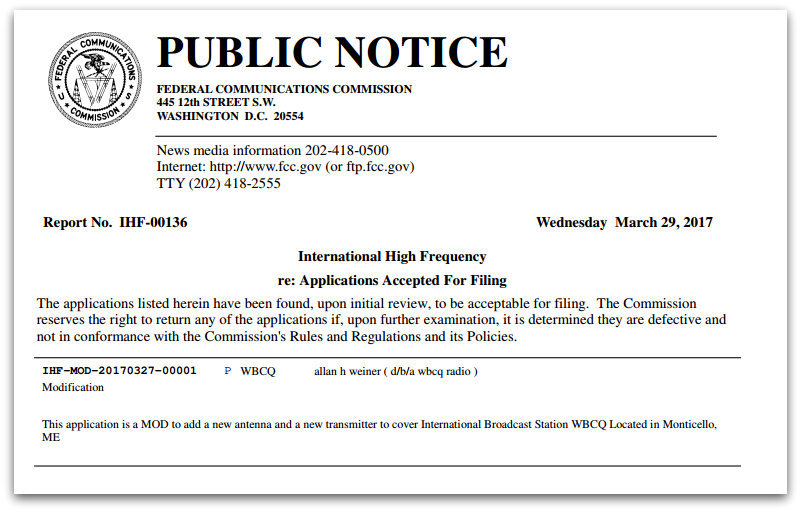
Coming Soon to WBCQ 7490: Uncle Bill’s Melting Pot


Bill Tilford, who currently brings us From the Isle of Music on WBCQ and Channel 292, is launching a second program, Uncle Bill’s Melting Pot, a half hour music variety program, on March 2 on WBCQ, 7490 Khz.  It will be a combination of Americana, World Music, Comedy, Novelty,  and Bill  threatens that it will  be one of the most musically eclectic programs on any band along with a few laughs here and there.

WBCQ pegs its long term schedule to EST/EDT and translates to UTC.   UBMP will air 7:00-7:30pm EST/EDT Thursdays (for the first couple of weeks, 0000-0030 UTC Fridays, then 2300-2330 Thursdays).

HAARP campaign update: Luxembourg Broadcast & Artificial Aurora

Many thanks to Chris Fallen (KL3WX), Assistant research professor in the University of Alaska Fairbanks Geophysical – Space Physics group , who shares the following update from the High Frequency Active Auroral Research Program (HAARP):

Campaign time!

Experiments begin in the mid morning 19 February Alaska Standard Time (AKST) and continue intermittently through the evening each day through 22 February.

Luxembourg Broadcast

The first radio modification of the ionosphere occurred in the early 1930s and was an accidental consequence of the new and powerful Radio Luxembourg transmitter. In certain situations, listeners of other weaker broadcast radio stations found that they sometimes heard Radio Luxembourg programming even though it was transmitted on a completely different frequency. Scientists and engineers eventually concluded that signals from powerful Radio Luxembourg and less powerful stations were being mixed in space, that is, through ionosphere modification.

HAARP will transmit a sequence of tones and music using amplitude modulation (AM) on two different radio frequencies (2.7 MHz and 3.3 MHz) in a sort of reproduction of this so-called Luxembourg Effect. If conditions are sufficient and you tune-in to one frequency or the other, you will hear tones and music from both frequencies. The tones and music have been specifically composed to take advantage of the Luxembourg effect.

The Luxembourg broadcast will begin as early as 6 p.m. on 19 and 20 February Alaska Standard Time (AKST) and conclude by 6:40 p.m. In Coordinate Universal Time (UTC), the broadcasts will begin as early as 03:00 on 20 and 21 February and conclude by 03:40. Tune in to 2.7 MHz or 3.3 MHz (2700 KHz or 3300 KHz), or both! The program is approximately 10 minutes in duration and will repeat until 6:40 p.m. AKST or 03:40 UTC.

Artificial Aurora

Aurora photographers in Alaska, Yukon Territory, and northwest British Columbia have a chance to photograph artificial aurora created with HAARP, starting immediately after the Luxembourg Broadcast and continuing until the ionosphere critical frequency over Gakona drops below about 2.7 MHz.

Radio listeners can still tune-in to these operations, but the transmissions are slightly more complex in order to test a scientific hypothesis. Also, at least in these initial experiments, the broadcast will only sound like a silent carrier wave, as if a radio DJ fell asleep and neglected to change the record (or now, more likely, the digital file). The specific transmission sequence is as follows:

MAIN: Repeat the following 480 second sequence if foF2 > 2.80 MHz

90 seconds : 2.80 MHz
30 seconds : OFF
90 seconds : 2.80 MHz, O mode, CW modulation, MZ direction
30 seconds : OFF
90 seconds : 2.82 MHz, O mode, CW modulation, MZ direction
30 seconds : OFF
90 seconds : 2.84 MHz, O mode, CW modulation, MZ direction
30 seconds : OFF

BACKUP: Repeat the following 240 second sequence if foF2 < 2.80 MHz

90 seconds : 2.75 MHz
30 seconds : OFF
90 seconds : 2.75 MHz
30 seconds : OFF

Thank you, Chris.

Chris tells me that his campaigns are “strenuous chair-and-keyboard marathons” where, at times, he drives a mile or so to adjust cameras and drives back to the operations center to make adjustments there–the process being repeated many times over. I can only imagine how challenging it must be working with a site so vast.

Note that we have given Chris Fallen an account on the SWLing Post so he can directly post details about HAARP campaigns and research prior to and after events, when his time allows.

HAARP February 2017 on air operations

Many thanks to Chris Fallen (KL3WX), Assistant research professor in the University of Alaska Fairbanks Geophysical – Space Physics group , who shares the following update in reference to upcoming HAARP activities:

Regarding this February 2017 campaign, HAARP will be operating from 19 to 22 February.

Specifically, experiments will begin daily sometime after 1800 hours 2/19 UTC. My experiments will be the last each day (local Alaska time) and are scheduled to start at 0330 hours on 2/20, 2/21, and 2/23 UTC; and at 0430 hours on 2/22.

Experiment times and frequencies are subject to change for various reasons, particularly in response to ionospheric conditions shortly before each experiment.

I will do my best to update https://twitter.com/ctfallen in real time.

Operations are very active times and I will be monitoring conditions and equipment so generally speaking, for my artificial aurora experiments, your best bet is to search around 2.7 MHz +/- 100 kHz given current conditions.

For the Luxembourg effect experiments, I will try to keep the two frequencies separated by about 1 MHz, which means that they will occur earlier in my experiment window rather than later, when the ionosphere is more dense.

Many thanks for the update, Chris.

SWLing Post readers viewing our website should find your Twitter feed embedded below. Those reading via RSS or our Feedburner email feed, can click here to view updates on Twitter.