CBK transmitter building to be demolished

cbk

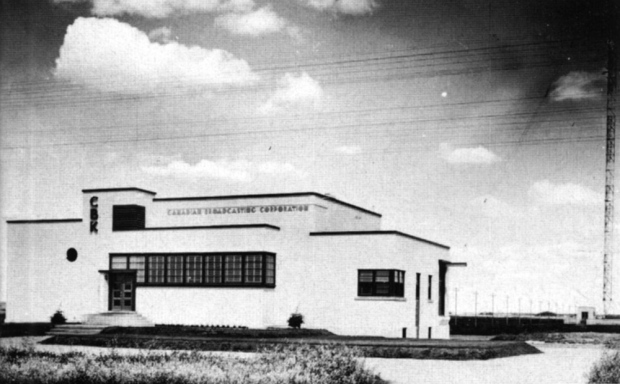
The CBK transmitter building in Watrous 1939 (Source: Dwight Kornelsen/ Watrousheritage.ca via CBC)

Many thanks to SWLing Post reader, Chris, who shares a link to this article from the CBC:

Historic CBK transmitter building in Watrous to be demolished

Most people who have grown up in the prairie provinces will have received their news via the CBC broadcast tower in Watrous.

The massive CBK building was established in 1939 as part of an overall CBC plan to bring programming to all parts of Canada. This was done with several well-placed 50,000 watt transmitters.

CBK was designed to serve all the prairie provinces, which is why Watrous was chosen as the site.

It is located in the centre of the populated portion of the prairies, and as a bonus it is located on a potash vein, making its ground conductivity one of the best on the continent.

In those days the technology for a single transmitter took up two floors of the building.

About 371 square metres was for the transmitter. That amount of equipment required a staff of six to maintain.

There was also a manager and living quarters for the staff.

During the Cold War, nuclear threat was a very real concern.

“The site was deemed important enough for communications that there was an armed guard protecting the transmitter,” said Stephen Tomchuk, transmitter supervisor for Saskatchewan.

“There was a fallout shelter built in the basement of the building that contained full facilities to be able to broadcast in the event of nuclear war,” added Tomchuk.[…]

Continue reading online…

Robert’s new radio blog

SX-99-DialSWLing Post reader, Robert Gulley (AK3Q), has just informed me that he’s started a radio blog on ak3q.com.  Robert notes:

“One of the recurring themes will be on the importance and relevance of shortwave radio, and nothing denotes this more than your work with Ears To Our World.

[…]Also, if interested I have an audio file of a voice CQ call from this past weekend’s ISS special event, along with audio of an SSTV image being sent. The cosmonaut makes a CQ call (after which getting over my shock I returned a call); he calls again and another station nearby tries to get him, and then immediately an SSTV image is transmitted.”

Very cool, Robert! I’ve always wanted to work the ISS, but never have managed to do it so far. But, hey, there’s always tomorrow!

Thanks, also, for mentioning Ears To Our World–so far, this year, we’ve distributed radios in Kenya, Cameroon, and South Sudan. There are still remote and impoverished parts of the world that benefit from the lifeline of information radio brings to them.

Readers, check out Robert’s blog at ak3q.com!

Neil’s updated radio kit guide

My Ozark Patrol regenerative receiver kit

My Ozark Patrol regenerative receiver kit

Neil Goldstein, W2NDG, has just informed me that he’s updated his comprehensive radio kit guide which can be found at RadioKitGuide.com. Many thanks, Neil!

The next kit I have on the table is the Sawdust Regenerative Receiver by BreadBoard Radio. Should be a lot of fun and a nice weekend project (once I have a free weekend to complete it). Still, I think I’ll check out Neil’s list to see if there are any new kits I’ve overlooked–after all, fall and winter kit-building seasons are just around the corner!

Jim’s shortwave listening post is a Navy ship

USNS Button - 02

USNS Sgt William R Button (Photo: NavySite.de)

SWLing Post contributor, Jim Clary (ND9M/VQ9JC) contacted me in June to obtain details about the BBC’s Midwinter broadcast to the British Antarctic Survey Team. Jim has been working on board the USNS Sgt William R Button since mid-June. While on board Jim has no web access, but he can send and receive emails and some files. I kept Jim informed about the time and frequencies of the BAS broadcast.

Jim had hoped to make a recording of the Midwinter broadcast at sea, but timing and some technical problems got in the way and he missed the bulk of the 30 minute program.

That’s okay, though, because Jim is an avid SWL and ham radio operator. During time off, he has logged a number of stations, so I asked if he would consider making a recording for us.  I mean, SWLing from a Navy ship?!  How cool is that?!

Within a week, Jim sent me a recording of the Voice of Korea. Here are some of his notes:

I’d heard [the Voice of Korea] many times before when Stateside (and they were Radio Pyongyang at the time), but their signals were always weak and had major polar flutter. Out here, the signal was in-my-face loud, so even though the station is not much of a rare DX catch, I wanted to get them on tape.[…]

[M]y location is the east southern Atlantic Ocean, not far from St. Helena.

[…]My ship is named USNS Sgt William R Button. The ship has been active since the mid 80s and was a “motor vessel” (M/V) until we became a Navy asset in 2009.

USNS Button - 04

[…]My receiver that I’m currently using is my QRP rig, a Yaesu FT-817ND. I changed over to a Navy antenna that I’m feeding with about 70 feet of 75-ohm RG-6 cable. There’s obviously some signal loss from both the length and impedance mismatch of the coax, but at these freqs it’s fairly negligible.

The antenna itself is an AS-2815/SSR-1 that’s mounted above the wheelhouse (bridge) of the ship. I can’t really describe the make up of the antenna simply because I don’t see why it works so well but it really does a good job. If I’d figured out where its feed point is a couple weeks ago, I would’ve had no problem logging the BBC’s Antarctic service!

.Click here to download Jim’s recording of the Voice of Korea or simply listen via the embedded player below. This broadcast was recorded on July 1, 2015 at 1900 UTC on 11910 kHz:

Many thanks, Jim! We look forward to any other recordings you wish to share!

The WSJ features Willis Conover

Willis Conover, The Voice of America (Source: Wikimedia Commons)(Source: Wall Street Journal via Any Sennitt)

The Radio Broadcaster Who Fought the Cold War Abroad but Remained Unheard at Home

By DOUG RAMSEY

During the Cold War, listeners in captive nations behind the Iron Curtain huddled around radios in basements and attics listening to the imposing bass-baritone voice of the man who sent them American music. His greeting—“Good evening, Willis Conover in Washington, D.C., with Music U.S.A.”—was familiar to millions around the world. At home, relatively few people knew him or his work. A proposal for a postage stamp honoring Conover may give hope to those who want the late Voice of America broadcaster to be awarded a larger mark of distinction.

For 40 years, until shortly before his death in 1996, Conover’s shortwave broadcasts on the Voice of America constituted one of his country’s most effective instruments of cultural diplomacy. Never a government employee, to maintain his independence he worked as a freelance contractor. With knowledge, taste, dignity and no tinge of politics, he introduced his listeners to jazz and American popular music. He interviewed virtually every prominent jazz figure of the second half of the 20th century. His use of the VOA’s “special English”—simple vocabulary and structures spoken at a slow tempo—made him, in effect, a teacher of the language to his listeners.

Countless musicians from former Iron Curtain countries have credited Conover with attracting them to jazz, among them the Czech bassists George Mraz and Miroslav Vitous, the Cuban saxophonist and clarinetist Paquito D’Rivera and the Russian trumpeter Valery Ponomarev. On the Conover Facebook page established in 2010, Ponomarev wrote that Conover had done as much for jazz “as Art Blakey, Duke Ellington, Horace Silver, Count Basie, Charlie Parker, Miles Davis and Dizzy Gillespie.” Conover’s New York Times obituary said, “In the long struggle between the forces of Communism and democracy, Mr. Conover, who went on the air in 1955 . . . proved more effective than a fleet of B-29’s.” In his publication Gene Lees Jazzletter, the influential critic wrote, “Willis Conover did more to crumble the Berlin Wall and bring about the collapse of the Soviet Empire than all the Cold War presidents put together.”[…]

Continue reading at the Wall Street Journal…

Regular SWLing Post readers know that I’m a huge fan of Willis Conover. Much like VOA’s Leo Sarkisian, Conover represented some of the best diplomacy this country has had to offer. [I’ve actually had the honor of meeting and interviewing Leo Sarkisian at his home in Maryland, a few years ago–one of the highlights of my career.]

Are there any SWLing Post readers out there who listened to Willis Conover from behind the “Iron Curtain?” Please comment!

Tecsun PL-600: $74.99 shipped at Amazon

PL-600

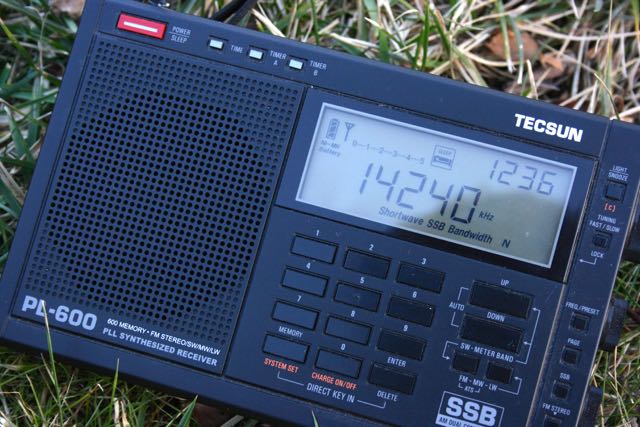
SWLing Post reader, Tom Ally, writes to say that the Tecsun PL-600 is currently on sale at Amazon.com for $74.99, shipping included. While this is not a deep discount, he notes that it is a lot of radio for the price. I still have a PL-600 and tend to agree with Tom. In fact, I was using my PL-600 this morning, comparing it to the new Sangean ATS-405. In many respects, the PL-600 reminds me of the Grundig G5.

Click here to view the Tecsun PL-600 on Amazon.

In the UK, digital radio is not always well-received

DABMany thanks to my buddy, Dan, who shares this article from the Daily Mail:

“It was supposed to be the technology that would transform the way we listen to the radio.

But audiences condemned DAB – or Digital Audio Broadcasting – as a disaster yesterday because of the poor quality of the signal.

They complained that it cuts out in the middle of broadcasts, while others claim the technology is already out of date.

One even joked on Twitter that while we can now receive close-up photos of Pluto taken billions of miles away, he ‘still can’t get a good signal on DAB’.

DAB had been heralded as less prone to interference than AM or FM, but household appliances including microwave ovens, laptops, mobile phones and TVs have all been found to affect reception. Power lines and the weather can knock out digital signals, while signal strength can be reduced in built-up areas, in basements and inside buildings with thick stone or reinforced concrete walls.”

Read more: http://www.dailymail.co.uk/news/article-3168864/Coming-loud-clear-gripes-digital-radio-Audiences-condemn-DAB-poor-quality-signal-cuts-middle-programmes.html