WWII shortwave messages found on cardboard discs

Photographer: Nigel Mykura. (Creative Commons)

(Source: The Globe and Mail)

The voices of Canadian servicemen fade in and out, at times clear and booming, at others distant and muffled. But for their families, these scratchy, static-laden messages were the sound of hope.

The men were prisoners captured during the Second World War by the Japanese army, which broadcast their messages home over Radio Tokyo. Short-wave radio enthusiasts on the west coast of the United States listened in, making a hobby of recording the messages onto cardboard discs and sending them to the soldiers’ families.

Complete with audio from the original discs, this is an article you should view in full at The Globe and Mail.


A review of the Degen DE321 DSP shortwave radio

This analog dial packs DSP!

The Degen DE321 is the first of a new type of radio hitting the market–a DSP-based receiver with an analog tuning dial. I was very intrigued by this radio since both it and the future Tecsun R-2010 are the newest of their kind. We’re still waiting for the R-2010 to hit the market, but the DE321 was introduced just a few weeks ago.

So, keep in mind that the DE321 I describe is not technically analog, although the dial and face appear to be.

Impressions

The Degen DE321 is slightly thinner than the Kaito WRX911.

My first impressions of this radio are very positive. The DE321 is small, slim, and fits nicely in the hand. While holding it the first time, I even noticed a small indentation where my index finger fits on the back of the radio underneath the telescoping whip antenna. Nice touch!

The DE321 also feels durable. It’s slightly thinner than the venerable WRX911–the radio I believe it best compares with in the analog world. It’s the first SW radio I’ve owned that can actually comfortably fit into the pocket of my jeans. Indeed, its size and form are fairly comparable to the typical smart phone.

For a very tiny built-in speaker, the DE321 has unexpectedly decent audio. In fact, it is easily superior to the WRX911–its tones are more mellow and there’s even a hint of bass response. I’m sure the DSP chip has been tweaked to produce audio suitable for this application.

The DE321 has a nice, sturdy back stand for tabletop listening. However, it takes quite a lot of pulling force to get it to pop out of its closed position; I keep fearing that I will break the stand when opening it up. For what it’s worth, I prefer this tension to radios that have floppy, lose back stands.

Tuning

The DE321 has a tiny red tuning light that works well when you receive a strong signal.

For a guy who was raised on analog tuning, yet now almost exclusively uses digital portables, the DE321 is a strange animal. When I first started tuning the radio, I noticed that the tuning wheel feels slightly “sticky.” At first, I thought the stickiness of the analog encoder was causing the tuning to skip over stations, as the action was not as fluid as most analog-tuned radios. Upon further investigation, I realized that it’s not the slightly sticky tuning wheel producing the tuning “skips,” rather, it’s the fact that the tuning is actually digital, thus I was hearing the “steps” between frequencies, which tricked my brain, translating into the sensory experience of wheel stickiness. Still, since the tuning wheel isn’t terribly fluid, I am not discounting some real frequency skipping at times.

I’m guessing that the steps are near 5 kHz on the shortwave bands, and that the single bandwidth is rather wide. The tuning steps on medium wave and FM seem to be appropriate for international use.

On a side note, the tuning experience is exactly opposite to that of the Grundig S350DL–an analog-tuned radio with digital display. The S350DL’s tuning feels sloppy and flexible, and the receiver is prone to drifting. The DE321, on the other hand, has a vague analog tuning display, but with precise, incremented tuning behind the scenes.

I’m pleased to note that the DE321’s stability is rock-solid and does not drift.

For casual band scanning, I find that the bandwidth and tuning steps are well placed. Happily, there is no noticeable muting between tuning steps.

Performance

The Degen DE321 with its older analog cousin the Kaito WRX911 in the background.

For this review, I compare the DE321 to the analog Kaito WRX911. The two have the same approximate size and price. In the near future, I’ll also compare reception with SiLabs DSP-based radios like the Tecsun R-2010 and the Tecsun PL-380. (Check back for these comparisons soon.)

On the shortwave bands, I feel that the sensitivity and selectivity are well-balanced. When I compare reception with the WRX911, the DE321 seems to pull in faint signals out of the murk a little better than the WRX911. However, I do notice some “pumping” as the AGC tries to cope with faint signals; it reminds me a bit of the Tecsun PL-310 in this respect. Sometimes I also notice that faint signals can range from being very faint to stepping up to clear and strong very quickly–the switch sounds like the DSP moving from not having enough signal to digest, to having enough to do its job. This can be a little frustrating as broadcasts may sound strong one minute, become weak within a fraction of a second, then pop back up again. I only observed this phenomena, however, when processing weak signals. Normal broadcast stations come in quite clearly.

Though I chose not to spend much time evaluating FM and AM (please comment if you have done so), I found the FM and AM (MW) performance to be on par with other radios using the SiLabs DSP chipset. I may expand upon this in the review later. (Update 16 Mar 2012: With more time spent on AM (MW) I realize performance on this band is sub-par–see comments).

Summary

Positives:

  • For a tiny speaker, the sound is surprisingly full
  • Sensitivity and selectivity are both good
  • Nice form–slim, and easily fits in the hand
  • Simple (see negative)
  • Inexpensive
  • Exceptionally wide FM bands (64-108 MHz) (see negative)
  • Unlike its analog counterparts, has absolutely no frequency drift

Negatives:

  • Back stand hard to pop open–though sturdy, it feels vulnerable as a lot of force is needed to open it
  • Tuning wheel feels slightly “sticky”
  • Absolutely no bells and whistles (see positive)
  • FM is in 2 bands, FM 1 and 2 (see positive)
  • AM (MW) performance is very weak
  • Though it looks analog, digital tuning produces slight “stepped” sound/ sensation, unlike the fluid experience of tuning a true analog radio

In conclusion, I think the DE321 is a great buy. It’s certainly a steal at $21 US, shipped. Though I simply find the idea of a rather vague analog encoder and display combined with the precision of a digital tuner a tad quirky–even backward–at the end of the day, the audio is very pleasant and the form perfect for slipping into your pocket.

I’m very eager to see how it stacks up against the soon-to-be-released Tecsun PL-2010.  Stay tuned as I compare these in the near future…

Like most Degen (and Tecsun) radios, the DE321 is only available from eBay sellers in China/Honk Kong. I would normally call this a negative, since there is no real warranty for those of us living outside the country of origin. Still, I’ve been most impressed with purchases I’ve made from these highly-rated sellers. I believe they would help you if a problem were to arise and my experience is that they do a second QC (quality check) of their own, prior to shipping. The Degen DE321 in this review was purchased from eBay seller 

.

Chase some pirates this weekend!

Start your search for pirate radio stations in the watering hole at 6,925 kHz and tune up to 7,000 kHz.

As I sit here in front of my radios this Friday evening, I notice the news on National Geographic that we have one of the largest sun spots to face us since 2005. This sunspot is the size of Jupiter! It’s all a little too coincidental on 11-11-11.

It can only mean one thing…

Turn on your radio and tune in some pirates!

For those of you new to pirate radio, most–but not all–activity can be found between 6,925 – 7,000 kHz (i.e. just below the 40 meter ham radio band). Pirates are not professional broadcasters, thus work  a day job during the week. That’s why you’re most likely to hear pirates Friday, Saturday and Sunday evenings.

Pirate signals are often faint–though perhaps old Sol may help a bit, depending on other conditions. For what it’s worth, I just heard a pirate on my tiny Degen DE321 portable (that review out tomorrow). Very good sign, indeed.  Just in case, consider reading our post on using SSB to help dig pirate signals out of the static.

What are you waiting for? Go chase some pirates!

BBG meets to discuss strategic management of U.S. international broadcasting

(Source: BBG)

The Broadcasting Board of Governors (BBG) will meet on Friday, November 18 at BBG headquarters in Washington, D.C., with a focus on its strategic management of U.S. international broadcasting.

The Board will consider recommendations from the BBG’s Governance Committee including the 2012 meeting schedule and receive briefings on the Agency’s Performance Accountability Report and global audience estimate. In addition, broadcast executives will update the Board on programming and coverage issues.

The meeting, which is scheduled to begin at 4:00 p.m., will be webcast both live and on-demand, at www.bbg.gov.

To express your opinion about the future of US International Broadcasting, please write the BBG:

Broadcasting Board of Governors (BBG)
330 Independence Avenue, SW
Washington, DC 20237

The Bonito RadioJet: Out of Germany, a new PC controlled shortwave receiver

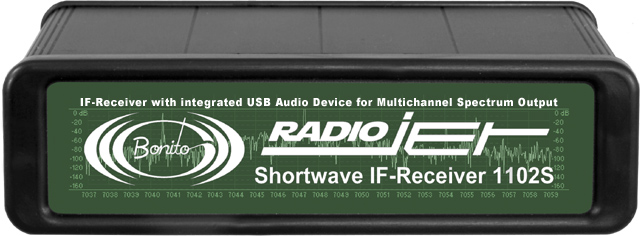
The Bonito 1102S RadioJet. (Source: Bonito.net)

I’ve been struggling to keep up with the pace of news during my recent travels, however one relatively new shortwave receiver, the Bonito 1102S RadioJet, has certainly captured my attention. Though still awaiting approval by the FCC in the US, the RadioJet is available for order through the manufacturer in Germany.  Universal Radio will retail the RadioJet for the US market once approved by the FCC.

What could make this radio worth consideration is the potentially low noise floor–evidently the antenna and analog to digital converter have a uniquely direct connection with no active components to add distortion.

The interface (GUI) looks clean and intuitive at first glance. Take a look for yourself in this video demonstration:

We’ve created an entry for the Bonito RadioJet in the SW Radio Index and will update it as information becomes available.

US Christian Broadcaster Still Believes in Shortwave

(Source: VOA News)

With the rise of the Internet, some news broadcasters, including the Voice of America, are moving away from shortwave radio.

But some religious broadcasters in America still believe in the medium.

“Our view is that there is a great future for shortwave,” says Charles Caudil, president of World Christian Broadcasting, which runs KNLS. He says its long-range signal is ideal for reaching rural areas in the developing world.

“Very few people there have the Internet available to them, or satellites. But they do have shortwave receivers. There are about three billion shortwave receivers in the world,” he said.

I think VOA could learn from their own report. While VOA believes that China (cited in this report) is well-equipped for the internet world, have they thought about internet surveillance (see previous post) in their on-line distribution model?

Looks like some broadcasters still do. Again, shortwave radio = anonymity.

Read full VOA report and watch video.