Radio Waves: RIP Dame Vera Lynn, 1928 London Noises, Repoliticizing VOA, and Shortwave Trading At the Speed of Light

Dame Vera Lynn (1917-2020)

Radio Waves:  Stories Making Waves in the World of Radio

Because I keep my ear to the waves, as well as receive many tips from others who do the same, I find myself privy to radio-related stories that might interest SWLing Post readers.  To that end: Welcome to the SWLing Post’s Radio Waves, a collection of links to interesting stories making waves in the world of radio. Enjoy!

Many thanks to SWLing Post contributors Tracy Wood, Dennis Dura, David Goren, and Kim Elliott for the following tips:


Obituary: Dame Vera Lynn, a symbol of resilience and hope (BBC News)

Dame Vera Lynn, who has died at the age of 103, was Britain’s wartime Forces’ Sweetheart, and remained one of the country’s most potent symbols of resilience and hope.

With songs such as We’ll Meet Again and The White Cliffs of Dover, she inspired both troops abroad and civilians at home during World War Two.

As Britain’s cities came under attack, her wistful songs, with their messages of yearning and optimism, were heard in millions of British homes.

And 75 years later, the country turned to her once again as it faced another stern test.[]

Click here to read our SWLing Post tribute to Dame Vera Lynn from 2015 which includes a recording made from my Scott Marine Model SLRM.

London street noises 1928 (Sound and History)

THERE ARE NO BBC radio recordings surviving from before 1931, so the job of representing the 1920s falls to this curiosity from the Columbia Graphophone Company. It’s a 12” 78rpm disc made in 1928 in association with the Daily Mail newspaper.

It seems likely that the disc was somehow tied in with a Daily Mail campaign over urban traffic noise. The commentator on both sides of the disc is a man named Commander Daniel and he doesn’t approve of everything he hears in the city streets.

The recordings were made from single, static locations in Leicester Square and Beauchamp Place on Tuesday 11th and Thursday 20th September respectively. Columbia probably used a recording van equipped with a disc-cutter.[]

Repoliticizing Voice of America (The Hill)

When Michael Pack takes over as the first politically-appointed CEO of the U.S. Agency for Global Media, his first task will be to comprehend the bewildering array of international broadcasting entities under the USAGM. This includes two government agencies: Voice of America and Office of Cuba Broadcasting (Radio and TV Martí), and four government funded corporations: Radio Free Europe/Radio Liberty, Radio Free Asia, Middle East Broadcasting Networks (the Arabic-language Alhurra and Radio Sawa) and the anti-censorship Open Technology Fund. Within this structure are broadcasting outlets that straddle two entities, such as the Russian-language Current TV. All told, the entities distribute content in 61 languages.

When past that hurdle, Pack must then decide if he wants to maintain the journalistic independence of USAGM’s entities, or if he wants to move them towards advocacy of the administration’s policies.[]

Companies Pitch Shortwave Radio to Shave Milliseconds Off Trades (Bloomberg)

High-frequency traders will famously do almost anything to get the latest market data and send their buy and sell orders a few milliseconds ahead of the competition. They blasted through mountains to build the most direct fiber-optic routes possible between exchanges in a competition that transformed global markets and was made famous by Michael Lewis’s book Flash Boys. Soon, pinging light through glass fiber at more than 124,000 miles per second wasn’t fast enough—the glass slows things down—so traders moved on to microwave transmitters that send signals through the air.

But that has problems, too. Microwaves travel only roughly as far as the eye can see before they peter out and need a signal boost. Now two rival market telecommunications companies have signed a pact that they say will give traders more access to experimental wireless signals which can travel across oceans.

To do that, signals need a longer wavelength—known as a shortwave rather than microwave—that bounces between the water and atmosphere. It’s an imperfect solution. The waves can handle only a fraction of the data that fiber can, carrying about a kilobit per second vs. gigabits. And some signals can be lost.

Raft Technologies Inc., a startup based in Tel Aviv, says the trade-offs are worth it. Raft says it can send data over shortwave from Chicago to Frankfurt in 31.4 milliseconds, which it says is about 4.5 milliseconds faster than the best available fiber route. That’s an eternity in an industry that tends to measure improvements by the thousandth of a millisecond. The company says the signal is about 85% reliable, compared with 100% for fiber. Clients can use a fiber line in parallel as a fail-safe measure.[]


Do you enjoy the SWLing Post?

Please consider supporting us via Patreon or our Coffee Fund!

Your support makes articles like this one possible. Thank you!

Al’s 1967 Radio Denmark QSL

Many thanks to SWLing Post contributor, Al Holt, who shared the following QSL and note on Twitter:

The posting about WRM and its originating from Denmark got me thinking about my early days SWLing and the wonderful QSL card I got from R. Denmark.

I hope to tune WRM on 19m soon!

Thank you for sharing this, Al!  That particular Radio Denmark QSL cards is one of my all-time favorites. I never received one myself, but I’ve always been fond of maps like this that highlight regional attractions/specialties.

Latest Elecraft KX2 firmware includes AM reception improvements

As I’ve noted in the past, I love my Elecraft KX2 and routinely use it for SWLing. I just learned that Elecraft has published a new KX2 firmware update that even includes some minor tweaks for AM mode reception. A proper nod to the SWLs in the Elecraft community.

From the release notes:

AM Receive: AM mode can provide a “warmer” sound when used to copy shortwave broadcast stations, and VFO tuning is less critical than when using SSB modes to copy AM. MENU:VFO CRS provides coarse-tuning selections of 1, 5, 9 and 10 kHz for AM mode.

Click here to visit the Elecraft Firmware and Software page to download the firmware and install utility.

World Music Radio broadcasting 24/7 on the 19 meter band

Many thanks to SWLing Post contributor, Harald Kuhl, who shares the following from Stig Hartvig Nielsen with World Music Radio.

I’m testing a new audio feed for the 15805 kHz transmitter. Hopefully more stable than the previous one, which sometimes would run 24 hrs without a single drop out – at other times produce drop outs almost continuously.

My plan is to keep 15805 kHz (200 W) on the air 24/7 for the next week or two. Should give DXers around the world a chance to catch 15805 when conditions on 15 MHz in some rare cases might improve. Currently propagation on 15 MHz is usually poor with a few fair days, but right now at this time of the years I suppose chances are the best.

WMR on 15805 kHz (200 W) – transmitter site: Randers
WMR on 5840 kHz (100 W) – transmitter site: Bramming
F.pl.: Power increase to 500 W on 5840 kHz. And new transmitter on 927 kHz
(500 W) in Hvidovre

Best 73s
Stig Hartvig Nielsen
www.wmr.radio
Keeping Short Wave Radio Alive!

Thank you for the tip, Harald!

FTIOM & UBMP, June 21-27

From the Isle of Music, June 21-27:
This week, a special conversation recorded in the home of César López in January with three members of the Cuban Sax Quintet including music from their album Saxofones Live Sessions, a winner of Cubadisco’s Grand Prize in 2019.
The broadcasts take place:
1. For Eastern Europe but audible well beyond the target area in most of the Eastern Hemisphere (including parts of East Asia and Oceania) with 100Kw, Sunday 1500-1600 UTC on SpaceLine, 9400 KHz, from Sofia, Bulgaria (1800-1900 MSK)
If you don’t have a shortwave radio or are out of range, you can listen live to an uplink from a listening radio in the Netherlands during the broadcast at
http://websdr.ewi.utwente.nl:8901/?tune=9400am
2. For the Americas and parts of Europe, Tuesday 0000-0100 on WBCQ, 7490 KHz from Monticello, ME, USA (Monday 8-9PM EDT in the US).
If you don’t have a shortwave or are out of range, you can listen to a live stream from the WBCQ website here (choose 7490): http://www.wbcq.com/?page_id=7
3 & 4. For Europe and sometimes beyond, Tuesday 1900-2000 UTC and Saturday 1200-1300 UTC on Channel 292, 6070 KHz from Rohrbach, Germany.
If you don’t have a shortwave radio or are out of range, you can listen live to uplinks from various websdrs in Europe.
Our Facebook page is https://www.facebook.com/fromtheisleofmusic/
Our Patreon page is https://www.patreon.com/tilford

Uncle Bill’s Melting Pot, June 21 and 23:
Episode 170 honors the recently-deceased Florian Schneider, a cofounder of Kraftwerk, with some of the early music of that band.
The transmissions take place:
1.Sundays 2200-2300 (6:00PM -7:00PM EDT) on WBCQ The Planet 7490 KHz from the US to the Americas and parts of Europe
If you don’t have a shortwave or are out of range, you can listen to a live stream from the WBCQ website here (choose 7490): http://www.wbcq.com/?page_id=7
2. Tuesdays 2000-2100 UTC on Channel 292, 6070 KHz from Rohrbach, Germany for Europe.
If you don’t have a shortwave radio or are out of range, you can listen live to an uplink from different web SDRs in Europe
including a live uplink from a listening radio in the Netherlands at http://websdr.ewi.utwente.nl:8901/?tune=6070am
Our Facebook page is https://www.facebook.com/UncleBillsMeltingPot/
Our Patreon page is https://www.patreon.com/tilford

Snagging two state game lands in three days for Parks On The Air

View from Waterrock Knob on the Blue Ridge Parkway (June 13, 2020).

You might have noticed from recent posts, I’ve been on a bit of a POTA (Parks On The Air) kick lately.

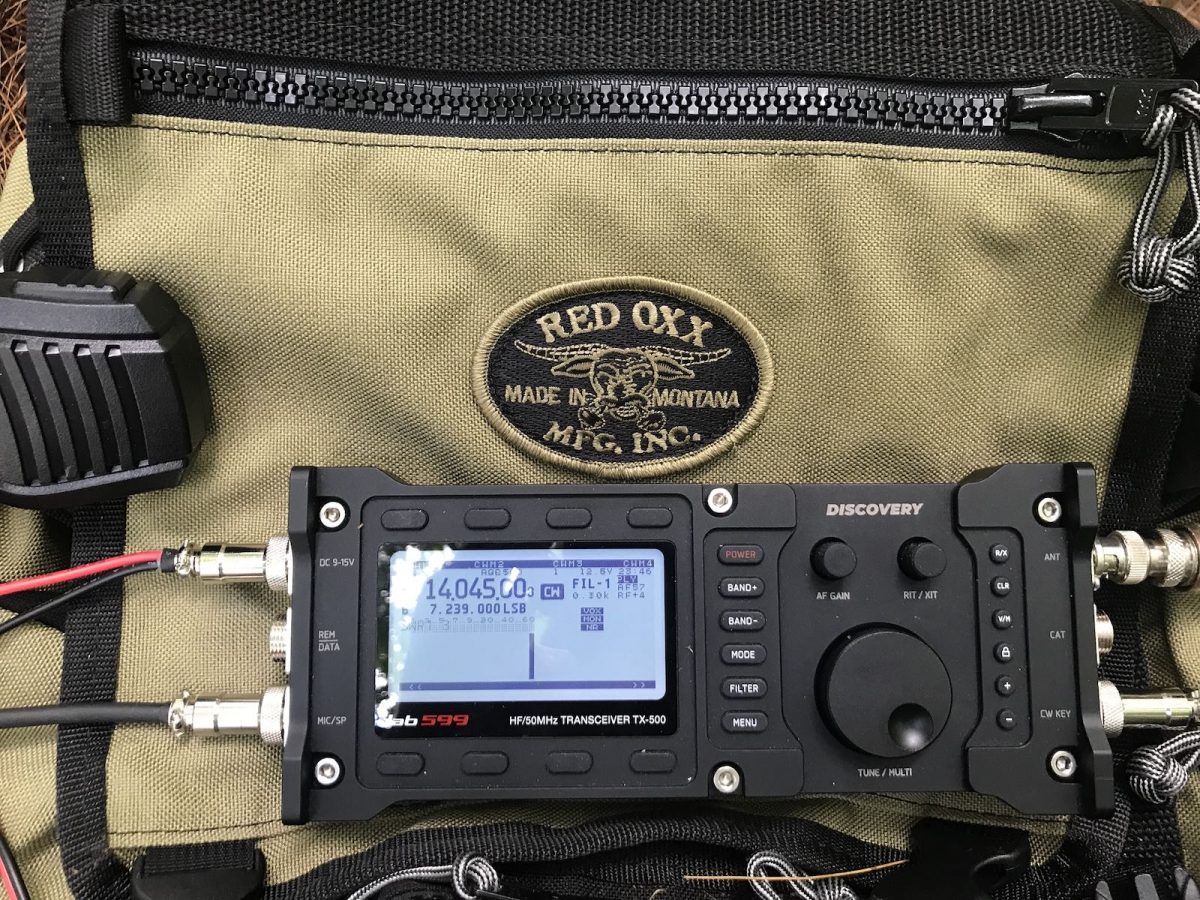
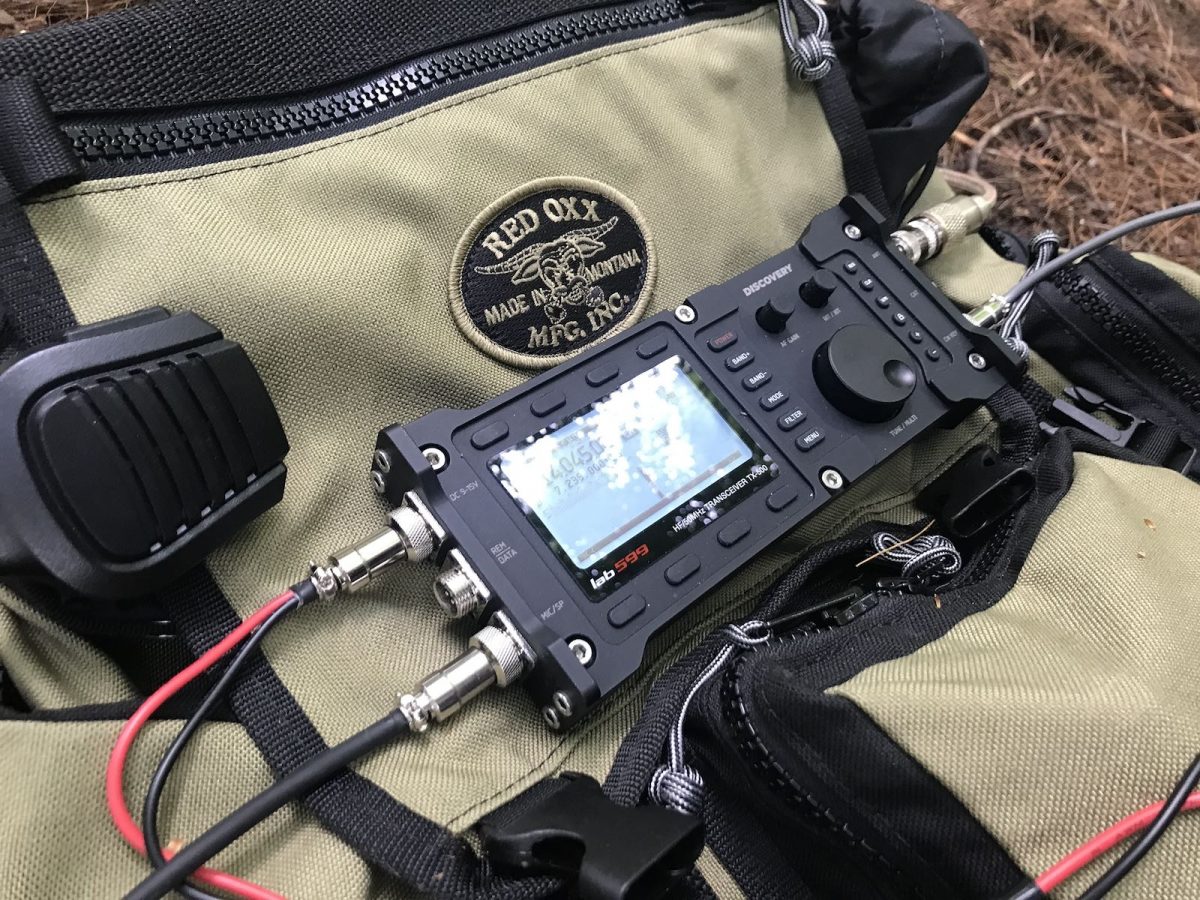
I’ve been enjoying taking the Xiegu G90 to the field and seeing just how well it performs under intensive use on battery power. So far, it has certainly proven itself to be a capable field rig.

Still, on two recent activations I also brought my trusty Elecraft KX2 along as well.  Without a doubt, it’s still my number one field rig. It will be difficult for another field transceiver to displace it.

With that said, the G90 is less than half the price of the KX2 (when the KX2 is configured with the optional ATU). The G90 can also pump out a full 20 watts of power–nearly double that of the KX2. I also love the G90’s spectrum display which makes it so easy to find free frequencies and hunt other parks. Its internal antenna tuner–like the KX2’s–can match almost anything very quickly.

Here are a couple of quick reports from my recent activations:

William H Silver State Game Land (K-6967)

Saturday, my family had planned a trip to visit my father-in-law. My wife encouraged me to find a nearby park to activate as there are so many between our house and his. I made it slightly more challenging by deciding to find a park or POTA entity I’d never visited.

Turns out the William H Silver State Game Land was only a 30 minute detour. I had never visited it and, in fact, it was even an ATNO (All Time New One) for Parks On The Air, meaning no one had yet activated it.

I had initially planned 1.5 to 2 hours for the activation, but we were running behind Saturday morning so I had to cut my time at the park to a total of about one hour–which included set-up, operation, and take-down.

We arrived at the site and I immediately deployed my EFT Trail-Friendly end-fed antenna.

My 12 year old daughter (who is studying for her ham radio license and is a great at digging callsigns out of the noise) helped me log contacts. I stuck with very brief exchanges so that I could work as many stations as possible. When activating an ATNO, I always want to give as many POTA “hunters” as possible the best opportunity to put the site in their log books.

I started on the 40 meter band and worked 20 stations in 25 minutes with the Xiegu G90.

I then moved up to the 20 meter band and switched over to the Elecraft KX2.

Turns out, 20 meters was pretty unstable, so I worked very few stations. I did work a station in California with 10 watts and a wire, though, so I’ll still call that a success.

I plan to visit this same site again later this year–it’s very accessible.

Buffalo Cove State Game Land (K-6886)

Monday morning, even though the weather outlook was dodgy, I scheduled another park activation which, like Saturday’s, was at a state game land which was another ATNO.

I like game lands. Unlike state parks, I don’t have to worry about crowds and I also usually get to take my Subaru or truck off-road. Access roads here in the mountains are typically steep, curvy, and washed-out in places. Finding the site can be very challenging, too. Still, I love adding a little off-road fun to a park activation!

The Buffalo Cove State Game Land is much larger than park K-6967 (above). I drove deep into the lands and found a large parking and camping area for hunters. I had the whole place to myself, so I found the best tree to support my end-fed antenna.

I operated the KX2 exclusively on this activation because I wanted to use its voice keyer and my Heil headset for hands-free VOX operation.

In the course of 90 minutes, I worked 51 stations from the trunk/boot of my car.

Many thanks to my good friend Mike (K8RAT) who made the whole process much smoother by spotting me on the POTA site.

Band conditions were actually pretty rough today, so I was very pleased with the results and intend to return here for a weekend activation later this year as well. This would actually be an ideal location for making low-noise portable SDR recordings while camping overnight.

This weekend, I decided I want to increase my portable field antenna arsenal. More about that in a future post!


Do you enjoy the SWLing Post?

Please consider supporting us via Patreon or our Coffee Fund!

Your support makes articles like this one possible. Thank you!

Help record the 2020 BBC Antarctic Midwinter Broadcast on June 21

Halley VI Research Station on the Brunt Ice Shelf in Antarctica (Source: British Antarctic Survey)

Every year, the BBC broadcasts a special program to the scientists and support staff in the British Antarctic Survey Team. The BBC plays music requests and sends special messages to the small team of 40+ located at various Antarctic research stations. Each year, the thirty minute show is guaranteed to be quirky, nostalgic, and certainly a DX-worthy catch!

After successful listener events from years past, I’m once again calling on all SWLing Post readers and shortwave radio listeners to make a short recording (say, 30-60 seconds) of the BBC Antarctic Midwinter Broadcast and share it here at the Post (frequencies and time below).

The recording can be audio-only, or even a video taken from any recording device or smart phone. It would be helpful to have a description and/or photo of your listening environment and location, if possible. Please only submit recordings made from your location–since this is all about how you’re able to receive the broadcast at your location, we would rather not include WebSDR recordings.

Audio should be in the MP3 format and videos either hosted on YouTube or Vimeo so that I can easily embed them without having to convert and upload myself.

If you submit your recording to me, I will post it here on the SWLing Post–and insure that the British Antarctic Survey receives the post, too.  The recordings will be arranged by geographic location. Note that due to my schedule this year, it might take a few weeks before I can curate all of the recordings (the process typically takes 8+ hours!).

2020 Midwinter Broadcast Frequencies

The BBC Antarctica winter solstice broadcast will be on June 21, 2020 at 2130-2200 UTC.

Many thanks to SWLing Post contributor, Troy Riedel, who shares the frequencies the BBC plan to use.  Note that, in the past, the BBC has sometimes only broadcast on three of the four announced frequencies:

  • 5790 kHz Woofferton
  • 6170 kHz Ascension
  • 7360 kHz Woofferton
  • 9580 kHz Ascension

The Midwinter broadcast is one of my favorite programs of the year. I suppose, in part, this is because it happens on June 21–the Summer/Winter solstice–which also happens to be my birthday!

Recording the Midwinter Broadcast has become an SWLing Post community tradition!