HAARP Open House this weekend

HAARP

(Source: University of Alaska Fairbanks via Andrea Borgnino)

OPEN HOUSE AUGUST 27, 2016

9 a.m. to 3 p.m. at HAARP, 11.3 mile Tok Cutoff Highway, Gakona, Alaska

Facility tours, mobile planetarium, permafrost exhibit, science demos and talks, and BBQ.

Free and suitable for all ages!

open-house-flyer-2016-4-2_0ALSO: Science lecture Friday August 26, 7 p.m. at the Wrangell-St. Elias National Park Visitor Center Auditorium, mile 106.8 Richardson Highway, Copper Center, Alaska.

“Radio Modification of the Ionosphere, and Who Uses This HAARP Thing Anyway?” by Dr. Chris Fallen

Free, in partnership with the Wrangell Institute for Science and the Environment (WISE)

For more information on either of these events, download the flyer by clicking on the image above, or email [email protected].


The High Frequency Active Auroral Research Program, or HAARP, is a scientific endeavor aimed at studying the properties and behavior of the ionosphere. Operation of the research facility was transferred from the United States Air Force to the University of Alaska Fairbanks on Aug. 11, 2015, allowing HAARP to continue with exploration of ionospheric phenomenology via a land-use cooperative research and development agreement.

HAARP is the world’s most capable high-power, high-frequency transmitter for study of the ionosphere. The HAARP program is committed to developing a world-class ionospheric research facility consisting of:

  • The Ionospheric Research Instrument, a high power transmitter facility operating in the High Frequency range. The IRI can be used to temporarily excite a limited area of the ionosphere for scientific study.
  • A sophisticated suite of scientific or diagnostic instruments that can be used to observe the physical processes that occur in the excited region.

Observation of the processes resulting from the use of the IRI in a controlled manner will allow scientists to better understand processes that occur continuously under the natural stimulation of the sun.

Scientific instruments installed at the HAARP Observatory can also be used for a variety of continuing research efforts which do not involve the use of the IRI but are strictly passive. These include ionospheric characterization using satellite beacons, telescopic observation of the fine structure in the aurora and documentation of long-term variations in the ozone layer.

Click here to download event flyer.

Video: Elecraft KX2 daytime shortwave AM performance

ElecraftKX2

After publishing the post this morning regarding the AM mode addition to the Elecraft KX2, SWLing Post contributor Ivan Cholakov (NO2CW) created the following video comparing the KX2’s daytime shortwave reception with that of the Kenwood R-2000:

Click here to view on YouTube.

The Elecraft KX2 now has AM mode!

Elecraft-KX2-6

The Elecraft KX2 at the 2016 Hamvention

Many thanks to a number of SWLing Post readers (including, Eric, Dave, Jim and Greg) who shared the following message from Wayne (N6KR) on the Elecraft message boards:

We added AM mode to the KX2 today, both transmit and receive. Its primary purpose is for SWL (short-wave listening), i.e. copying commercial AM stations. (Remember that the KX2’s sensitivity drops off rapidly below 2 MHz due to protective high-pass filtering, so it wouldn’t be your first choice for AM brodcast-band DXing.)

AM transmit is far less efficient than SSB, so it would typically be used only if the target receiver can’t demodulate SSB, or for special applications. For example, there’s some AM activity and experimentation in the ham bands, notably around 3.870 kHz at night. I’ll have to drop in with 10 watts (carrier + sidebands) and get a report 🙂

While the KX2 was optimized for SSB, AM mode sounds fine, and of course is easier to tune than when using SSB modes with AM. In AM mode, the operator can select 1, 5, 9, or 10 kHz steps for course tuning using the VFO CRS menu entry. (Yes, some countries use 9 kHz intervals between stations.)

If you’re interested in testing AM mode on the KX2, please email me directly.

73,
Wayne
N6KR

On Sunday, I ordered a KX2 (with ATU, rechargeable battery pack, quick charger and paddles)–it should arrive next Monday. First thing I’ll do is upgrade the firmware so it’ll have AM mode.

Many thanks to Wayne (N6KR) for putting this KX2 upgrade at the front of the (long) line of requests.  I’ll be reviewing the KX2 for the November issue of The Spectrum Monitor magazine and, as an avid SWL, AM mode adds an important dimension to my evaluation. (Truth is, I know that Wayne has a soft spot for SWLing too.)

Elecraft-KX2-Data-SheetClick here for a previous post with more information and photos of the Elecraft KX2.

Click here to view the KX2 on Elecraft’s website.

The “Hidden Den” of Pirate Radio

NYC-NewYork-Brooklyn-Map

Many thanks to SWLing Post contributor, Martin Kraft, who writes:

Where’s the hidden den of pirate radio? The Caribbean? The South China Sea? Nope, according to RadioWorld, it’s the New York City metro area:
http://www.radioworld.com/article/nybsa-76-pirates-stations-in-new-york-northern-nj/279213

NYSBA: 76 Pirate Stations in New York, Northern N.J.

A number of pirate stations are operating throughout New York City and Northern New Jersey, according to a recent engineering survey that was recently unveiled by the New York State Broadcasters Association.

According to the survey, 76 stations are currently operating without an FCC license in four primary locations. There are 19 unauthorized stations in the Bronx, N.Y.; 29 in Brooklyn, N.Y.; 13 in Newark, N.J.; and 15 in Paterson, N.J. Brooklyn saw a 58% increase in the number of pirate stations compared to a similar survey conducted in 2015.

The survey does observe that it has likely underestimated the number of pirate stations in the area, and that the total number could be more than 100.

“Like our previous studies, the new survey provides compelling evidence that the FCC needs to address this problem,” said David Donovan, president of the NYSBA. “Last summer, the entire New York Congressional delegation asked the FCC to fix the problem. While the FCC has published an Enforcement Advisory, it needs to devote the manpower and resources to increase its enforcement efforts. Moreover, Congressional action will be important to assist the FCC in these efforts.”

The potential harms associated with pirate stations include: interference to Broadcast Emergency Alert Services; interference to FAA frequencies; and failure to comply with RF radiation rules of licensed broadcast stations.

The survey was conducted by engineering firm Meintel, Sgrignoli and Wallace. The full study can be found here.

Thank you, Martin!

When I visit my buddy David Goren in Brooklyn, I’m simply amazed at the diversity of the pirate radio scene on the FM band. When David isn’t surfing the shortwaves, he’s logging local pirate radio stations. Check out his Facebook page: Flatbush Pirate Decoder. David most recently presented a program on the NYC pirate scene at the 11th HOPE conference–you can download a recording of the presentation here.

Reminder: The Classics Experience with Paul Walker

SX-99-Dial-Nar

(Source: Paul Walker)

The next broadcast of The Classics Experience with Paul Walker is going to be the biggest yet. It’ll all take place in late August with 2 hours of rock n roll music with maybe a few country songs thrown in for good measure. The show is ALL about the music and providing something different on the shortwave bands, so all you’ll get from the show is MUSIC. There will be NO rants, raves, personal opinions or political and religious rants. No commercials or sponsors either. I fund the broadcast out of my own pocket so I can pick whatever music I want and not have to answer to anyone but George D. Beagle!

WRMI 7570kHz Saturday August 27th 0400 to 0600UTC. Beaming at 315 degrees towards Vancouver. It should provide a good signal to the West Coast of the US and Canada and probably parts of the midwest and upper midwest along the way.

WRMI 11580kHz Friday August 26th 2100 UTC to 2300UTC., This signal target area is Eastern North America and Western Europe.

WRMI 11530kHz Saturday August 27th, 0200UTC to 0400UTC targetting South America with maybe a little spill over to extreme Western Africa.

WINB 9265kHz Saturday August 27th 0330 to 0530UTC. This should provide good coverage into the Midwest, parts of southern Canada, into Mexico along with parts of Central & Southern Europe it seemed.. It was weakly heard in Australia and New Zealand during my last broadcast.

Channel 292 6070kHz Friday August 26th 2200 to 2400UTC. This should provide good coverage of central and parts of Western Europe.

Shortwave Services 15195khz via Armenia Saturday August 27th 1200 to 1400UTC. Beaming at 65 degrees towards Japan.

I am going to suspend my request for $ to cover postage and QSL costs. I’ve been so lax in sending out QSL cards, I haven’t gotten around to any of them from previous broadcasts and have gotten a few nastygrams about it. I feel bad, so I won’t ask for any money to cover costs this time around.

Contact information for reception reports:
Paul B. Walker, Jr.
PO Box 353
Galena, Alaska 99741-0353 USA

There may be MFSK32 data and pictures during the broadcast. I will announce during the broadcast if and when that happens.

From the Isle of Music Preview for August 29/30

PromoFTIOMAUG302016small

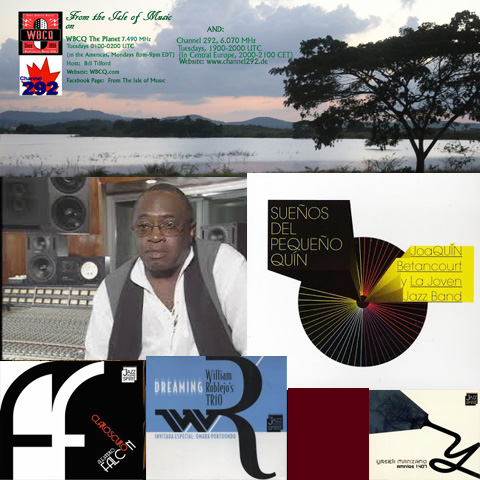
Our August 30 (August 29 in the Americas on WBCQ) program
offers more of Caribe Nostrum, winner of Cubadisco 2016 in the Concert and Chamber Music category and one of the two Gran Premio winners. Guido López Gavilán, the Director, will join us to talk about the music. Our Jazz guest is Carlos Averhoff Jr., whose album Iresi was nominated in the Jazz category of Cubadisco 2016. Mr. Gavilan with converse with us in Spanish, Mr. Averhoff in English, and we will feature music from both albums.

Two options for listening on shortwave:
WBCQ, 7490 KHz, Tuesdays 0000-0100 UTC
(8pm-9pm EDT Mondays in the Americas)
Channel 292, 6070 KHz, Tuesdays 1900-2000 UTC
(2100-2200 CEST)
See the NOTES section of our Facebook page for more information.

Details Emerge: The PantronX Titus II DRM Portable Receiver

TitusII-DRM-Receiver

Many thanks to SWLing Post contributor, Harald Kuhl (DL1ABJ), who shares more details about the new Titus 2 DRM receiver via the DRM Consortium Chairman, Ruxandra Obreja:

NEW DRM RECEIVER UNVEILED at HFCC MEETING IN MIAMI, FLORIDA THIS WEEK!

The HFCC meeting is being held 22-26 August in Miami and on this occasion there was a live DRM transmission form Radio Vaticana received on  the new Titus2 DRM receiver (pls. see attached document with picture and details) http://www.drmna.info/.

Here is also a little testimony of how this prototype to be sold “at under 100 dollars” performed from Ray Robinson, Operations Manager at KVOH (Voice of Hope / Voz de Esperanza):

I’m currently at the HFCC conference in Miami, and reception of the DRM broadcast here this afternoon was very successful.  Reception was made outside the hotel on two receivers – a  NewStar DR-111 and a brand new pre-production receiver from Pantronix called the Titus 2, with a cluster of attendees gathered round taking photos and videos.  The latter receiver is based on an Android tablet in a stereo radio format with one speaker each side of the central horizontal tablet.  Reception on both radios was solid throughout, on a day when analog reception on 16m was plagued with a lot of atmospheric noise.  We haven’t done detailed calculations, but figure there were probably at least three hops from Italy to Miami, and for a daylight path, the reception quality was nothing short of astounding.

Click here to download the Titus II PDF brochure.

TitusII-DRM-Receiver-Specifications