Author Archives: Thomas

Nothing on shortwave? I still disagree.

SpectrumDisplay-31Meters-WinRadioExcalibur

One of the most popular posts on the SWLing Post is one published nearly two years ago: “Is there anything to listen to on shortwave?

In that article, I posted recordings made on the 31 meter band of eight different broadcasters, all of which I found within a 250 kHz chunk of bandwidth on a Friday afternoon.

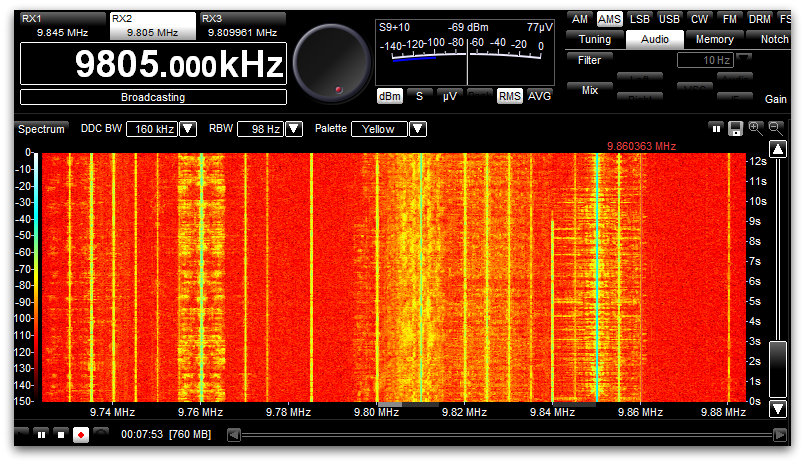
On February 8th (this past Saturday), I recorded a 160 kHz chunk of spectrum on the 31 meter band with my WinRadio Excalibur, starting around 1:00 UTC and lasting for about 9 hours.  I made this spectrum recording in attempt to capture the Voice of Korea on one of their three scheduled frequencies.

While VOK wasn’t audible enough to make a good recording, I did log the following stations all within this thin slice of radio spectrum (click on links for recordings):

I’m guessing that I only logged 50% of what I heard as this list was put together from a quick scan through the recording. In fact, I’m systematically making recordings of each of these broadcasts, from the spectrum file, and adding them to the Shortwave Radio Audio Archive. I may actually discover more stations in the process.

My point is, if you think there’s nothing to listen to on shortwave, you’re simply not listening!

Now back to my radio…
Shortwave Radio Recordings: Voice of Indonesia French language service

RRI-VoiceOfIndonesiaFor your listening pleasure: one hour of the Voice of Indonesia’s French language service. This broadcast was recorded in Europe on February 5, 2014 by Shortwave Radio Audio Archive contributor, Frank, around 20:00 UTC on 9,526 kHz.

Frank was using his Kenwood R-5000 and Wellbrook ALA 1530+ antenna.

Click here to download the recording as an MP3, or simply listen via the embedded player below:

Please check out the Shortwave Radio Audio Archive for recordings from around the world. Consider becoming a contributor!

“Why The Humanitarian Community Should Shape The Future Of Shortwave”

300px-Hurricane_Isabel_from_ISSAs World Radio Day approaches, writer Mehmet Burk (founder of ReliefAnalysis.com) considers the importance of shortwave radio, especially in terms of disaster relief.

Burke posted the article, Why The Humanitarian Community Should Shape The Future Of Shortwave on Interaction.org. Here’s a quote:

“In the 1980s and 1990s, shortwave radio was an audio version of today’s internet. Almost every nation on earth broadcast a shortwave signal and vital humanitarian news and local depictions of current events could literally be heard half a world away. The Internet did to shortwave broadcasting market much like what it did to print newspapers.[…]

But radio remains the most wide-reaching media platform in the world today. In areas like Africa and the Pacific, it is the dominant form of communication. Like no other form of media, radio can bridge the digital divide and literacy divide in regions across the globe. Radio receivers can be made to be inexpensive, ruggedized, and indispensable in a disaster or humanitarian situation. In the future, shortwave receivers may even simply be stand-alone microchips we can activate using our smartphones and tablets.”

I’m honored that Burk reached out and even quoted me in this article.

Click here to read: Why The Humanitarian Community Should Shape The Future Of Shortwave.

Many thanks to Mehmet Burk for considering radio’s importance in the wake of disaster and honoring World Radio Day 2014!

RadioShack to close 500 retail stores

RadioShackAdClipAfter serving up a comical, self-effacing Super Bowl ad on Sunday, RadioShack’s stock momentarily surged, only to plummet after RadioShack announced yesterday that they are to close about 500 of their 4,500 retail stores in the coming months.

RadioShack admitted through its ad that the retailer’s mindset had been “stuck in the 80s”–an outdated image to make way for “Do It Together” brand positioning. Now investors must be questioning if “The Shack” can thrive in a retailing environment dominated by online and big-box retailers.

While many radio listeners and amateur radio operators (like myself) miss the early decades of their retail offerings, RadioShack is the only chain I know of in the US that still carries shortwave radios on their shelves–an easy access point for newcomers to SWLing. I imagine part of RadioShack’s new brand positioning will eliminate legacy product lines as they are no longer as profitable as they once were.

Many thanks to Dave (N9EWO) for the tip. 

Click here to watch RadioShack’s Super Bowl ad on YouTube.

Bonito releases the AntennaJet ASM300 Antenna Switch and Mixer

asm300-380

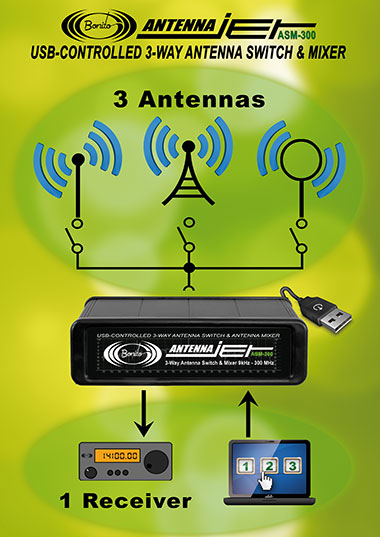
Dennis Walter, President of the Germany-based radio manufacturer Bonito, has just informed me that their AntennaJet ASM300 has now been officially released. Bonito’s website describes the ASM300:

With the AntennaJet ASM 300, we add another component to our supplies of receiving equipment. It is USB-controlled and you can connect up to three different receiving antennas from 9 kHz – 300 MHz loss-free to one output socket.

Additionally, you can combine all three input channels according to your needs. They are then connected in phase to the output socket. Thus you can always find the best combination of antennas when receiving conditions are bad.

The HF-inputs are BNC and are protected against short and pulse-shaped voltage surges with complex ESD protection circuits. Because the voltage supply is integrated via USB, you do not need an additional power supply, which make the ASM300 ideal for portable operation.

At a price of 249 EUR, this would not be an inexpensive addition to your radio shack, but I can imagine many SWLs and hams who could appreciate a high quality antenna switcher. I’m very intrigued by the ability to mix phased input channels. With antennas positioned properly, it might afford you some ability to null on HF.

Cross Country Wireless introduces an HF Upconverter

The CCW HF Upconverter (Photo: Cross Country Wireless)

The CCW HF Upconverter (Photo: Cross Country Wireless)

(Source: Southgate ARC)

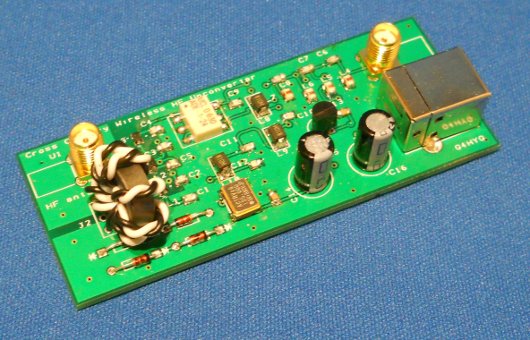
Cross Country Wireless have just released a HF Upconverter. This will allow HF or VHF SDR receivers such as the RTLSDR dongles, Funcube or our own SDR-4+ receiver to work on HF, LF and VLF.

Unlike other upconverters currently available we have added the RF protection features from our SDR-4+ receiver including an antenna isolation transformer and RF over-power protection. This protects the SDR receiver or dongle and the attached PC from damage caused by static electricity charges on the antenna or nearby high power transmitters.

There are two versions of the Upconverter. One has a 125 MHz local oscillator and the frequency range is 12 kHz to 45 MHz. This is intended for use with the RTLSDR and Funcube dongles.

The other version has a 10 MHz local oscillator and is designed for use with the SDR-4+. This has a frequency range of 12 kHz to 1.6 MHz.

Here are some of the specifications Cross Country Wireless  has published for the HF Upconverter:

Technical data – 125 MHz version for RTLSDR and Funcube dongles

  • Frequency range: 12 kHz to 45 MHz
  • Input impedance: 50 ohms
  • IF rejection: > 60 dB
  • Local oscillator frequency: 125 MHz
  • Local oscillator level at antenna socket: < -50 dBm
  • Gain: -6 dB
  • RF connectors: SMA female
  • Power connector: USB B

Technical data – 10 MHz version for SDR-4+ receiver

  • Frequency range: 12 kHz to 1.6 MHz
  • Input impedance: 50 ohms
  • IF rejection: >100 dB
  • Local oscillator frequency: 10 MHz
  • Local oscillator level at antenna socket: < -60 dBm
  • >Gain: -6 dB
  • RF connectors: SMA female
  • Power connector: USB B

Also, from CCW on YouTube:

“This is a video of a Cross Country Wireless HF Upconverter used with a CCW SDR-4+ receiver to listen to VLF and LF transmissions using a half wave dipole cut for the 80m amateur band.”

(Click here if you are unable to view the video above.)

There are 20 second samples of the following stations:

  • BBC Radio 5 Live on 693 kHz AM
  • BBC Radio 4 on 198 kHz AM
  • GYN2 Skelton on 81 kHz FSK
  • MSF Anthorn on 60 kHz time signal
  • GQD Anthorn on 22.1 kHz Anthorn
  • GQD Anthorn on 19.6 kHz

This version of the Upcoverter uses a 10 MHz local oscillator so the frequency displayed is 10 MHz higher than that received i.e. 10.693 MHz = 0.693 MHz = 693 kHz.

Click here for more information on CCW’s website.

Dietmar compares the Tecsun PL-310ET to the Icom R-71A

Image Source: Anon-CoSWLing Post reader, Dietmar, writes:

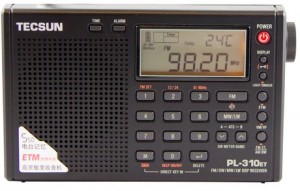
“I recently saw a YouTube video that demonstrated that the new Tecsun PL-310ET has better reception than the previous PL-310 that you reviewed [see video below].

I purchased the PL-310ET for $50 (incl. shipping) from Anon-Co and received it from Hong Kong in less than two weeks. Anon listed the PL-310ET as their #1 selling item at the time of purchase (PL-660 was #3).

The PL-310ET now has the very useful ETM. I am quite impressed with the radio’s reception. Basically, I could listen to the same radio stations that I could get with my 20+ year old ICOM R-71A. However, the Tecsun’s sound quality was considerably better. The ICOM had a slight edge with interfering stations in a few cases.

When comparing radios, I used the Tecsun with its telescope antenna and the ICOM with an indoor Palomar shortwave loop antenna with range from 5000 KHz to approx. 17000 kHz.

The PL-310ET also has external antenna input and can charge NiMH batteries.

I consider the Tecsun a great bargain considering what I once paid for the ICOM.”

Many thanks for your thoughts on the PL-310ET, Dietmar! I may just pull the trigger on a new PL-310ET. Perhaps it could replace my PL-380 as a travel radio. I’m curious if its dimensions are any smaller than the PL-380 and if it mutes between frequencies when band scanning.

Anyone else have thoughts about the PL-310ET?

I believe this is the comparison video Dietmar was referencing:

Click here to search eBay for the Tecsun PL-310ET.