Shortwave listening and everything radio including reviews, broadcasting, ham radio, field operation, DXing, maker kits, travel, emergency gear, events, and more
Many thanks to SWLing Post contributor, Curtis, who shares the following video from NBC Left Field:
Hawaii’s recent false nuclear missile alert showed us how reliant we are on cell phones and modern technology—and how unprepared we are if they become inaccessible. But in case the unexpected happens, an unlikely group of hobbyists—ham radio operators—are standing at the ready and may save us all.
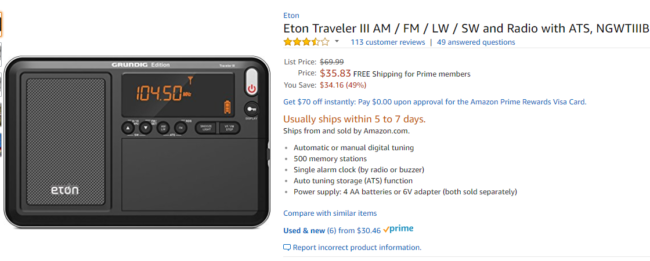
Amazon has just posted an excellent price for the Eton Grundig Edition Traveller III shortwave portable: $35.83 shipped! This is the lowest price I’ve seen for the Traveller III since December when it hit this lowest price for a very brief period of time. As with any Amazon spricing, this could end at any time.
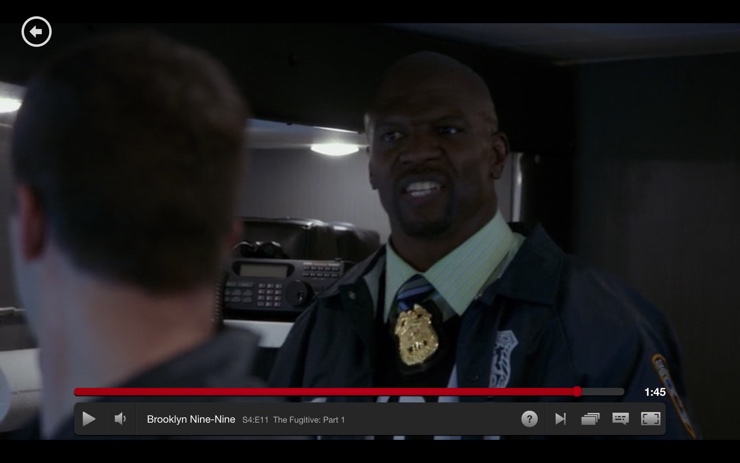
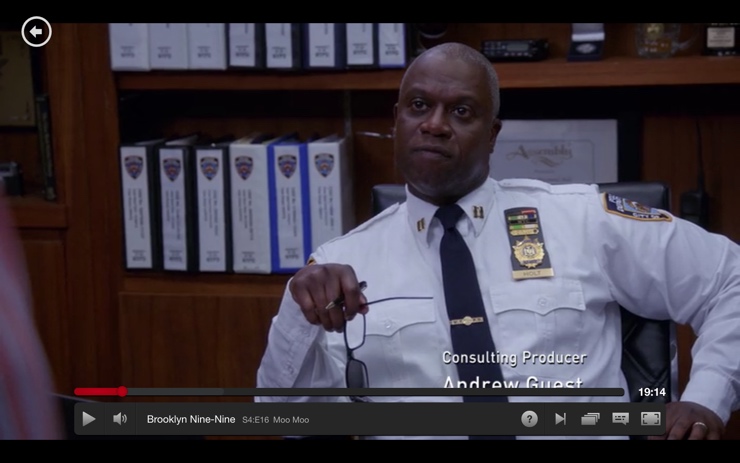
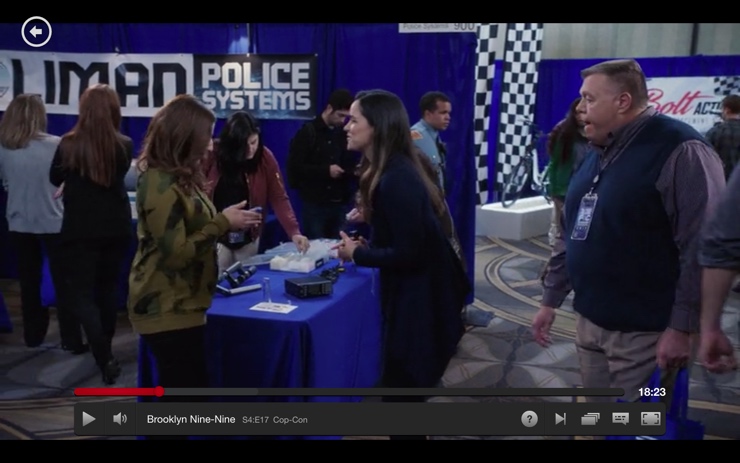
The first is what looks like a scanner behind Terry Jeffords, then an unidentified radio in the book case behind Captain Ray Holt, and finally what I think is a AOR 8600 on the table next to Amy Santiago.
Many thanks, Mark! You have very sharp eyes–especially spotting the AOR on the table in the last scene!
Please comment if you can identify this radio gear!
Okay SWLing Post readers: I need you to dig through your off-air recordings for something pretty obscure…
Over at the Shortwave Radio Audio Archive, I frequently receive inquiries from educators, researchers, historians, and enthusiasts looking for very specific off-air recordings, often for some worthy project or other. It’s quite a thrill when I can lay hands on just what’s being sought in our rather deep recordings archive.
I recently received just such an inquiry from producer Meghan Keane at NPR, and though we were not able to provide immediate help, I’m quite intrigued by the subject and thus not quite ready to give up the search. Meghan writes:
My name is Meghan Keane and I’m a producer for NPR’s Invisibilia. I’m working on a story about Somalia and music, and am currently looking for some archival sound.
Around 2010, many radio stations in Somalia broadcasted animal noises and gun shot noises to protest Al-Shabab. I am hoping to find audio of that to use in my story. Please let me know if you have any leads!
Fascinating stuff. I do recall a news story about Somali radio broadcasts including animal and gun shot noises back in the day, but I never actually heard a broadcast on shortwave or mediumwave.
Post readers: Can you help Meghan track down such a recording? If you can, please comment and/or contact me!
With Solar Minimum right around the corner, sunspot counts are at an almost 10-year low. So it came as a surprise yesterday when a relatively large sunspot emerged near the sun’s eastern limb.
AR2699 has a primary dark core larger than Earth with many smaller magnetic condensations trailing behind it, in all stretching more than 75,000 km across the sun’s surface.
Rare “solar minimum sunspots” are capable of intense explosions just like sunspots during more active phases of the solar cycle.
Many thanks to SWLing Post contributor, Luke Perry, who writes:
I am experiencing a issue with my shortwave reception at my part-time home. I have been helping out my mother so I have brought over my Sony portable, along with the Sony active antenna. I have a constant ‘clicking’ sound starting at about 5 kHz or thereabouts that make listening unbearable. As the video shows the problem is non-existent below 4 kHz. I tried moving the radio throughout the house thinking it could be something in the room and still get the same interference.
I was hoping that the filter on the active antenna would help but it does little to remedy the problem. I have no issues with MW or FM reception at all.
I have made a short YouTube video to document the problem in the hopes that one of the blog readers can identify it. I looked online at other instances of RFI and I could not find one that is similar. Hope that someone can help me!
After listening to the first few seconds of your recording, I thought it sounded a bit like an electric fence controller. However the interval between pops is nearly random, which suggests a different source. I suppose it’s possible a faulty fence controller could do this. I believe the only way you could defeat this noise (without shutting it down at the source) would be to use a radio with a durable noise blanker. Of course, I know of no portable radios with an NB function (though most SDRs and tabletop receivers include an NB).
Post readers: Can help Luke ID the source of this noise? Does it sound familiar to you? Please comment!
Many thanks to SWLing Post contributor, Mad Radio DXer, who writes:
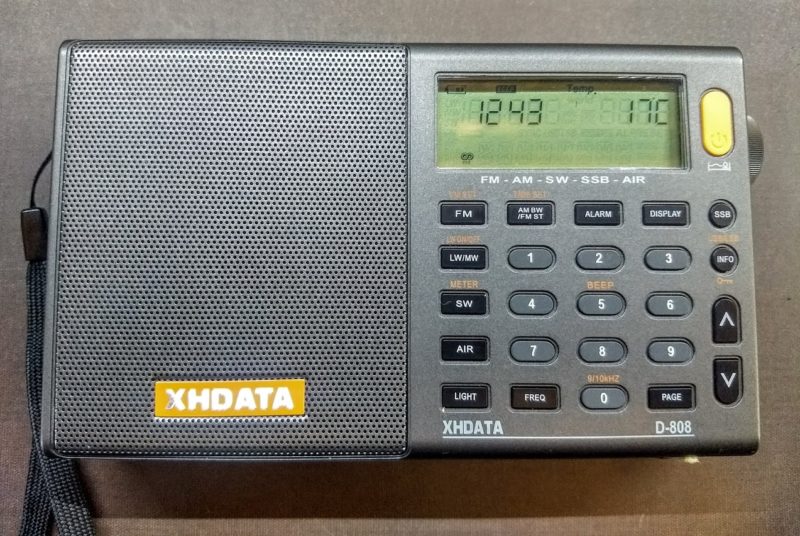
I want to bring to the attention of your readers & fellow XHDATA D-808 owners that it can accept an external antenna on MW without the need for any modifications. This I found out during a DXpedition to the field when I used around 50 metres of longwire.
I have some videos to prove this. The first is the difference between the external longwire antenna vs the internal ferrite antenna…
The second video is pretty much the same as the first, but this time I am tuning on a lower frequency of the MW band. Also I show that not only can the 3.5mm antenna input be used to connect an external MW antenna, but the internal whip antenna too.
The third video shows the difference between the XHDATA D-808 vs the Degen DE1103 PLL (using the external MW antenna trick). when using an external antenna for Medium Wave. In my opinion there is not much difference between them reception-wise, but the D-808 has the advantage of being able to select tighter bandwidth filters for less QRM from stations on adjacent frequencies.
These days I am more of a MW DXer than on shortwave. I am thrilled to have found out that the XHDATA D-808 can accept an external antenna for Medium Wave in stock form, since my understanding when I read some reviews was that it could not unless an internal modification was done. I will do more experiments of MW reception with the D-808 on my next DXpedition.
I want to add a few more points…
The D-808 does not work with an external longwire antenna for Long Wave. I tried this & will upload a video of the result soon. However, I tried using my LW induction antenna at home & it did get stations which it could not using the internal ferrite antenna on its own. Again a video of that will be upcoming.
I tried using a Wellbrook antenna for improved MW reception on the D-808 & unfortunately it does not work well. There was too much background noise, & there were harmonics + images all over the band. I would instead recommend using a good passive antenna like a longwire rahter than a strong active one.
It is recommended to use 25 metres or more longwire for best results. Obviously, the more longwire used means the lower the frequency gain for reception.
I cannot guarantee that this will work for all XHDATA D-808 units in case, for eg, some have different firmware versions. All I can say is it does not hurt to try, but bear in mind what I said about the longwire antenna length. Also a nice quiet location away from manmade noise helps even more to minimise any QRM.
I hope this has been helpful & useful to all XHDATA D-808 who like me, are really into MW DXing.
I’m happy to hear that you’re enjoying MW DXing and that the XHDATA D-808 is serving you well! Over the years, my DXing habits shift and change, but I’ve always included a healthy amount of mediumwave DXing in the mix. Especially when propagation on HF is dismal, I head down to the MW band for some action! Thanks again for sharing your videos and tip!
Please support this website by adding us to your whitelist in your ad blocker. Ads are what helps us bring you premium content! Thank you!