Category Archives: AM

Chorus 4: The DSP chip that supports AM, FM, DAB, DAB+, HD Radio and DRM

FrontierSiliconThe London-based digital solutions company, Frontier Silicon, has announced a new DSP radio chip that offers a wide array of available modes and is even DRM ready.

I have seen no specifications for this chip yet, and do not know if it covers the shortwave radio spectrum.

Still, this might be the perfect chip to allow radio manufactures to design an inexpensive, fully digital product in countries where digital platforms are gaining strength (anywhere from the UK to India, for example).

Many thanks to Rob De Santos for apprising me of this. I’ll post the specifications when they become available. Read the full press release below:


(Source: Frontier Silicon Press Release)

Chorus 4 a single-chip solution, integrating four previously separate chips

London, 17th December 2013

Frontier Silicon announces details of Chorus 4, its next generation digital radio chip. Chorus 4 is a single-chip solution, which integrates four previously separate chips to deliver significant cost and energy consumption savings.

Chorus 4 is the fourth generation chip from Frontier Silicon. The chip is designed to encourage the continued advance of digital radio around the world by supporting all major global digital radio standards. Chorus 4 provides solutions for multiple devices, including consumer radios, the automotive aftermarket and, for the first time, smartphones and tablets. The company’s previous solutions have already powered over 20 million digital radios worldwide.

The key features and benefits of Chorus 4 are:

  • Low cost, single chip solution: integration of RF front-end, baseband, application processor and DAC (“four chips in one”) delivers significant cost savings which enable high quality, entry-level price point digital radios
  • Ultra-low power consumption – one month’s listening for 5-6 hours a day on a portable radio with four D cell batteries (comparable to FM performance)
  • Multiple solutions for portable and table-top radios, smart-device docks, wireless speakers, hand-held receivers, sound-bars and audio systems
  • Automotive aftermarket – solutions for head units, integrated convertors and low cost adapters
  • Smart devices – enables digital radio solutions for mobile phones and tablets
  • Bluetooth connectivity – connecting smart devices and digital radios to enable hybrid radio (with interactivity and additional content delivered via IP), music streaming and remote control
  • Integrated service guides – new software will enable listeners to select stations from a single list of digital and analogue stations regardless of platform
  • Multiple radio standards – including support for AM, FM, DAB, DAB+, HD Radio and DRM

Digital Tick compliant – Chorus 4 solutions meet all technology requirements of the UK minimum specifications for both domestic and automotive digital radio devices.
Frontier Silicon CEO, Anthony Sethill, said

“Chorus 4 represents a step change for the digital radio market. After ten years of development on this and previous solutions, we now have our fourth generation chip – an integrated, single chip offering enhanced functionality, lower cost and significantly greater energy efficiency. Chorus 4 will power multiple devices, including low cost automotive adapters and devices with Bluetooth connectivity. For the first time, digital radio in mass deployment smartphones will become a viable proposition. As a multi-standard chip, Chorus 4 will address emerging opportunities around the world. I look forward to working closely with broadcasters, transmission operators and device manufacturing partners to address these exciting opportunities.”

About Frontier Silicon Limited

Frontier Silicon is the world’s leading supplier of integrated circuits and modules for digital radio and connected audio products. Frontier Silicon is part of the Toumaz Group, a pioneer in low-power wireless semiconductor and software technologies for the consumer audio and wireless healthcare markets.

The group is headquartered in London, England, with design centres in Oxford, Cambridge, Hong Kong and Romania. The company also has sales and technical support teams in Hong Kong, China and Japan.

Frontier Silicon’s audio products offer solutions for DAB/DAB+, Internet radio and connected audio – from silicon through software to production-ready platform designs.

Customers supplied by Frontier Silicon include Argon, Bang & Olufsen, Bose, Bush, Denon, Dual, Geneva, Goodmans, Grundig, Hama, harman/kardon, Hitachi, JVC, Magic Box, NAD, Onkyo, Panasonic, Philips, Pinell, Pioneer, Pure, Revo, Roberts, Ruark Audio, Sangean, Sanyo, Sharp, Sony, TEAC, TechniSat, Tivoli Audio and Yamaha.

Frontier Silicon is a trademark or registered trademark of Frontier Silicon Ltd.
WG2XFQ: Brian Justin’s holiday longwave broadcasts

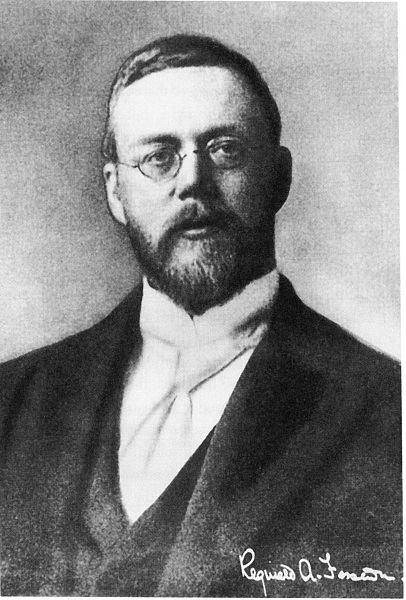
Reginald Fessenden: "The Father of Radio Broadcasting" (Source: Wikipedia)

Reginald Fessenden: “The Father of Radio Broadcasting” (Source: Wikipedia)

SWLing Post reader, Tom, recently shared a link to an article on the ARRL news page which describes this annual longwave broadcast:

“As he has over the past several years, Brian Justin, WA1ZMS/4 — an active participant in the ARRL’s WD2XSH 600 meter experimental project — will transmit voice and music on 486 kHz as WG2XFQ on Christmas Eve and Christmas Day and again on New Year’s Eve and New Year’s Day. Transmissions will begin at 0001 UTC and end at 2359 UTC.

Justin, who may be better known for his microwave exploits on ham radio, will use an AM audio loop modulating his vintage-style, homebrew transmitter to honor Reginald Fessenden’s Christmas Even 1906 AM voice transmission.”

Since I’m a sucker for radio history, I contacted Brian Justin and he kindly answered a few questions:

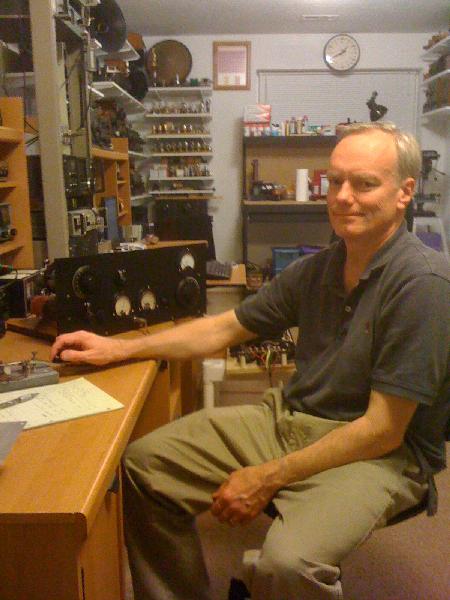
Brian Justin with his homebrew transmitter (Source: http://w4dex.com/500khz/wd2xsh31.htm)

Brian Justin with his homebrew transmitter (Source: w4dex.com)

SWLing: How did you first become interested in longwave (LW)?
Justin: Always had an interest in history of radio since becoming a ham at age 11. Early wireless had emphasis on LW and so it was a good trail to follow in my years as a ham.

SWLing: Is the process of getting a license to broadcast complicated?
Justin: Yes and No. What I hold is not a broadcast license as a TV or FM or AM station would have. I hold an FCC Part 5 license which is for The Experimental Radio Service. The LW and MF spectrum is formally US Govt spectrum that is managed by the NTIA (the US Govt Agency version of the FCC). So before the FCC can issue any license that is in non-FCC regulated bands the NTIA must first approve any license Grant. A good number of people who are involved in radio today don’t always understand the difference between FCC and NTIA spectrum. But licenses can be granted if you have the willingness to wait and know how the application process works. It’s not all that difficult once you know the context of what one is asking for.

SWLing: What is the best time to listen for WG2XFQ and how can listeners improve their chances of hearing you?
Justin: The transmissions are only a few times each year to mark historical dates in radio history. I try to make at least two each year, one for Fessenden and one for the Berlin Radio Treaty. I also ran one on the 100th Aniv of the sinking of the Titanic since wireless played a big role in the tragic event.

A loop antenna is a good antenna to try as one can at least null any loud noise source. But simple E-field probe antennas have worked for many in years past.

Anyone who copies WG2XFQ is encouraged to submit a logging of it at 500kc.com.

Thank you and good DX to all this Holiday Season. I hope I can deliver a tiny DX gift to all if the band is in good condition this year.


Many thanks, Brian!

I will be listening for WG2XFQ on 486 kHz on December 24th and 25th, then again on December 31st and January 1st. With any luck, and if conditions are favorable, perhaps I’ll hear a little longwave DX commemorating Reginald Fessenden’s Christmas Even 1906 AM voice transmission.

Readers, be sure to check out Brian Justin’s web page and the ARRL 600 meter experimental group’s website. Please log your WG2XFQ listener reports at: 500KC.com

If you would like to learn more about Reginald Fessenden, check out Fessenden.ca.

Eton self-powered radio $9.99 eBay Daily Deal

EtonFlashlight[UPDATE (16:20 UTC): the seller just raised the price to $14.99 each shipped–still an excellent deal!]

SWLing Post reader Paul comments with an excellent eBay Daily Deal:

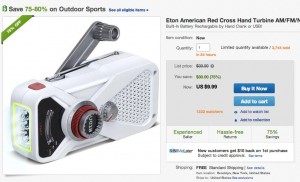
Eton American Red Cross Hand Turbine AM/FM/NOAA Emergency Weather Radio and LED Flashlight $9.99 + Free Shipping (eBay Daily Deal)

http://www.ebay.com/itm/390713915253

Without a doubt, this is the best deal I’ve ever seen for an Eton self-powered AM/FM/NOAA weather radio.

They limit five per customer–I just bought five of them.

A very inexpensive and useful gift for anyone on your shopping list.

Eton American Red Cross Hand Turbine AM/FM/NOAA Emergency Radio/Flashlight

Mike gives the Sangean PR-D15 high marks on AM

SWLing Post reader (and my good friend) Mike Kitchen writes of his new Sangean PR-D15:

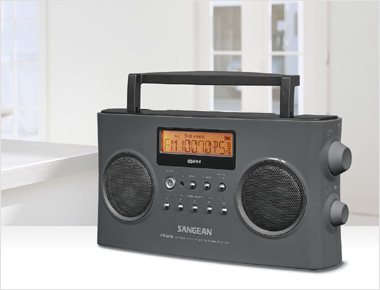
The Sangean PR-D15

The Sangean PR-D15

Having had the Sangean PR-D15 radio for about 10 days, I’m developing a respect for it.

With what I’ve learned in its use, there is a simplicity in operation that many should enjoy.

The big feature for a radio that I really must insist on, is being able to plug this radio into 12V DC with a power supply plug.  And this PR-D15 has this capability.  I am using a 12 Volt DC, 12 Amp Hour battery as power supply to this radio.  Digital displays and their illumination can really eat “AA”, “C” and “D” battery power, and using a 12V Gel Cell, AGM or auto battery allows many, many hours of listening.

Th Sangean PR-D15 uses a 200MM Ferrite bar internal antenna.  So far, after about 25 hours of AM DXing alone (not including daily AM use), I’ve learned this radio can really hear!

In a few days, I’ll do some side by side reception tests with the PR-D15 alongside my CCrane CCRadio-SP twin-ferrite analog portable radio.  And then, more side by side’s with a CCRadio-2E, the Enhanced version.

Mike, I look forward to your future radio comparison with great interest! The Sangean PR-D15 sounds like a keeper.

Shortwave Radio Recordings: Marion’s Attic

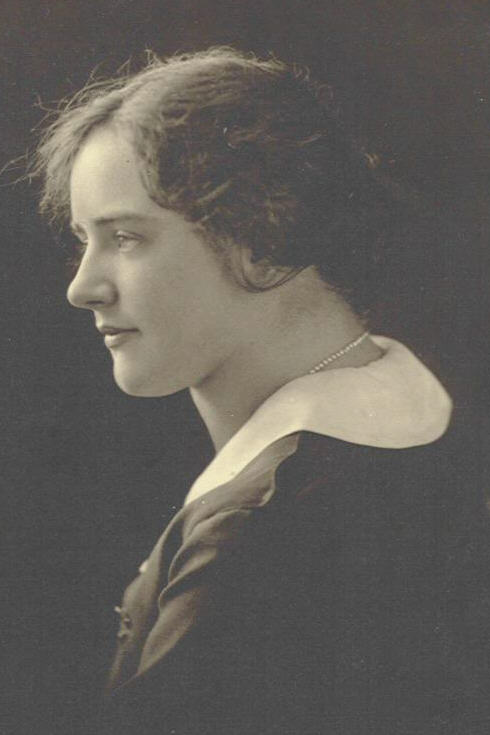
Marion Webster (Source: Marion's Attic)

Marion Webster (Source: Marion’s Attic)

If you’ve never heard Marion’s Attic on WBCQ, you don’t know what you’ve been missing–especially if you love early music recordings. Marion’s Attic describes the show as:

“[A] unique radio program, broadcasted on WBCQ, The Planet, [7.49] MHz (Shortwave Radio) every Sunday at 5 PM Eastern time. Hosted by Marion Webster & Kristina, and with occasional special guests.”

“Marion’s Attic is an eclectic radio program which plays original cylinder and disc records from the late 1890’s to the mid 1930’s. Having a library containing thousands of standard size cylinder records, dozens of 5 inch Concert Cylinders and an unknown amount of 78’s allows us to share unusual and forgotten music that you cannot hear anywhere else. What makes this special radio program unique is I play original records on the original phonographs when possible; many of which are over 100 years old. The theme varies from week to week; a show may feature popular songs from the early 1900’s one week, wild dance music from the roaring 20’s the next week.”

Marion’s Attic has been on WBCQ since September 21st, 1999 and is certainly one of their most popular shows. It’s quirky and authentic. I love it.

(Source: edisonphonology.com)

(Source: edisonphonology.com)

Mary tells us that each episode is recorded in her attic using simple recording equipment and original phonographs including:

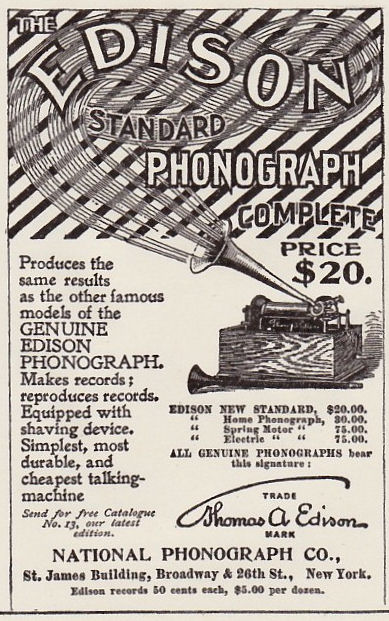
  • 1898 Edison Home phonograph for brown wax cylinders
  • 1900 Columbia Graphophone AG for Concert Cylinders
  • 1908 Edison Standard Model D phonograph for 2 & 4 minute wax cylinders
  • 1913 Edison Amberola V phonograph for Blue Amberol cylinders
  • 1923 Edison London Upright phonograph for Diamond Discs
  • 1965 Gerrard electronic turntable for 78 rpm records

Yesterday afternoon, at 16:59 EST (21:59 UTC), I tuned to Marion’s Attic on 7,490 kHz and started recording. You’ll hear about one minute of WBCQ’s interval signal and station ID, then straight into Marion’s Attic. Click here to download the show as an MP3 or simply listen via the embedded player below:

If you missed Marion’s Attic yesterday, you can catch it again tonight on WBCQ–check out the full broadcast schedule below:

  • Sundays:  7,490 kHz, 05:00PM – 06:00PM ET (22:00 – 23:00 UTC)
  • Mondays: 5,110 kHz, 09:00PM – 10:00PM ET (02:00 – 03:00 UTC)

WBCQ is easily heard in North, Central and South America–also in Europe.

Marion and Kristina often give shout outs to their listeners. You can contact them at [email protected] or:

Marion’s Attic
P.O. Box 583
Coventry, CT 06238

Many thanks to Marion and Kristina for sharing your wonderful collection of early music recordings!  I’d also like to thank SWLing Post reader, Mike, who is a big fan of Marion’s Attic and unknowingly gave me a nudge to mention their show here.

BBC Radio 4 Documentary: The World’s First Radio Station

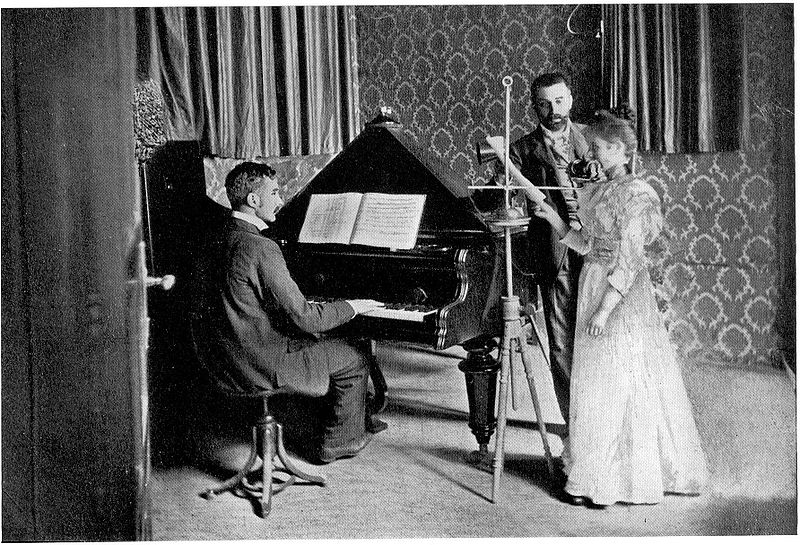
The concert room of Telefon Hírmondó (1901) Source: Wikimedia Commons

The concert room of Telefon Hírmondó (1901) Source: Wikimedia Commons

We’ve mentioned this 19th century broadcasting technology before; the “telephone newspaper.” If, like me, you found the technology fascinating, you’ll certainly love this BBC Radio 4 documentary The World’s First Radio Station.

Here is the description from BBC Radio 4:

We often think of the scheduled broadcasting of news, information and entertainment as having begun in the 1920s. But we’re wrong. It was in 1893 in Budapest that Theodore Puskas opened his Telefon Hirmondo or ‘Telephone Newspaper’.

Subscribers to this telephone service could enjoy a daily timetable of foreign, national and local news, sport, weather, fashion, stock market reports, language lessons, music, theatre and much more. It was delivered by a team of journalists, copy-writers, editors, announcers and engineers which would be familiar to any radio station today. To our ears, Telefon Hirmondo would have sounded uncannily modern. For example, there would be live relays of church services, theatre productions, concerts and opera performances and reports direct from parliament and sports events.

Laurie Taylor travels to Budapest to uncover this extraordinary story of ‘radio before radio’. He visits a special exhibition at the city’s postal museum and takes a look inside Hungarian State Opera, whose performances were broadcast live via Telefon Hirmondo from the 1890s.

Laurie explores the lengths to which Telefon Hirmondo went to market its product, hooking in not just domestic subscribers but hotels, restaurants, clubs, dental surgeries and barber shops. He also delves into the telephone’s early history to explain the confusion on both sides of the Atlantic over what the device was best used for.

How did Hungary come to lead the world in broadcasting, rather than the USA, Britain or France? The genius of Theodore Puskas is a large part of the explanation. Among the contributors, we hear from his descendant, Barbara Fally-Puskas.

Producer: Andrew Green
An Andrew Green production for BBC Radio 4.

Note that the documentary, produced by Andrew Green, will only be available online until Friday November 15, 2013. Click here to listen on the Radio 4 website.

FCC championing change that could “Bolster AM Radio”

FCC Commissioner Ajit Pai (R)

FCC Commissioner Ajit Pai

It appears that FCC Commissioner, Ajit Pai, is pushing a plan to revitalize declining AM radio station and listener numbers in the US. Read some of the details below or the full article on the New York Times website.

Many thanks to David Goren for the tip!

(Source: NY Times)

The [The Federal Communications Commission] announced late Thursday that it would begin seeking public comment on numerous changes[.]

[…]Because of interference caused by consumer electronics, smartphones and the like, AM radio often seems to deliver mostly static. The AM audience has fallen to 15 percent of all radio listeners, down from 50 percent as recently as 1978. While the FM audience has fallen as well, it draws more than five times the audience of AM.

[Steps include] eliminating a regulation requiring stations to prove that any new equipment decreases interference with other stations — a requirement that is expensive, cumbersome and difficult to meet.

The F.C.C. has also proposed eliminating or loosening rules that govern nighttime transmissions by AM stations. Those regulations currently require many AM stations to reduce their power or cease operating at night to avoid interference with other stations.

[…]The current regulations make it difficult for AM stations to locate towers where they will not interfere with nearby stations at night. They also put conflicting requirements on stations, mandating that they still cover most of their broadcast territory even while operating at reduced power.

The proposed new rules, the commission said, aim at keeping more stations on the air at night.

[T]he F.C.C. said it was ready to make available to current FM stations what are known as FM translators — empty spots on the FM dial where AM stations can broadcast. Those are particularly valuable in urban areas, where tall buildings with steel frames or aluminum siding can block AM signals, degrading reception.

[Read the full article at the NY Times website…]