Category Archives: Antennas

Guest Post: Jock explores the Tecsun PL-880’s ATS system

Many thanks to SWLing Post contributor, Jock Elliott, who shares the following guest post:


Oh, no, it’s broken – NOT! And other observations on the PL-880

by Jock Elliott, KB2GOM


Okay, okay, I’ll admit it: I’m an oldster, currently enjoying well over 70 trips around that Big Orange Ball in the sky. Further, I’ve been out of SWLing for a while.

Coming back into the hobby after more than a decade’s absence, has been eye-opening. Back when I wrote for Passport To World Band Radio, my main interest, equipment-wise, was tabletop communications receivers hooked to serious outdoor antennas.

Today, however, tabletop communications receivers are hard to come by (there are few new offerings), and, in my situation, serious outdoor antennas present a series of logistical problems that aren’t going to get solved quickly.

So that has brought me to today’s crop of portable shortwave receivers, and – bottom line – they are pretty darn cool, offering worthy performance on a number of levels. My latest acquisition is the Tecsun PL-880.

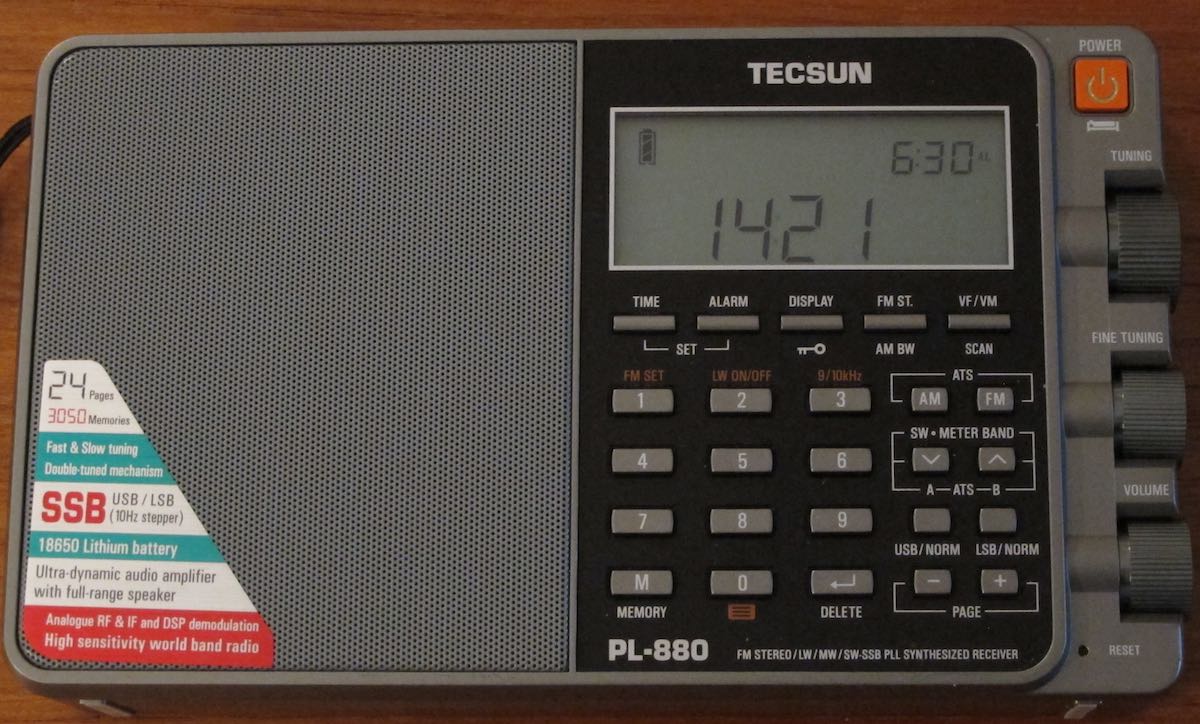
Like many of the current SW portables, it offers a system for scanning the SW bands and automatically storing the stations it finds into memory. On the PL-880, it’s called ATS (for Auto Tuning Storage.) Oh, you knew that. Yeah, but did you know that the PL-880 has, essentially, two ATS systems?

The down arrow activates ATS Mode A, and the up arrow activates ATS Mode B.

Check it out: If you press the DOWN arrow button (in the SW-METER BAND rectangle), the ATS Mode A system searches the band you are in (FM, MW/LW or SW, including ALL the SW meter bands), automatically stores stations it finds, and “previously stored radio stations will be replaced automatically by the newly found stations.” Each band has its own set of memories, so that SW stations will be stored in SW memories, FM stations will be stored in FM memories, and so forth.

ATS Mode B, however, behaves differently. You can activate it by pressing the UP arrow (in the SW-METER BAND rectangle). If you are in SW frequencies, ATS Mode B will search and store stations only within the current SW meter band. Further, it will NOT overwrite memories, but will start storing stations it finds, starting with the first available unused memory. Pretty neat.

You can, however, fool yourself. I ran ATS Mode A on SW frequencies one night and found a station that was broadcasting unusual stuff (Kennedy assassination, UFOs, and the like). A couple of nights later, I wanted to see what the night’s topic was on that station, so I punched the button to access memories and found . . . nothing! Oh, no, it’s broken!

Then I realized I was in SSB mode, and, it turns out, the PL-880 has a separate set of memories for SSB. (And the manual says that explicitly.) I switched off the SSB mode, and – tah-dah! – the SW memories reappeared. Sometimes it really does pay handsome dividends to read the manual.

One of the slick things about the PL-880’s memory setup is that, when you are in memory mode for a particular band, you can easily scroll through the memories simply by turning the tuning knob.
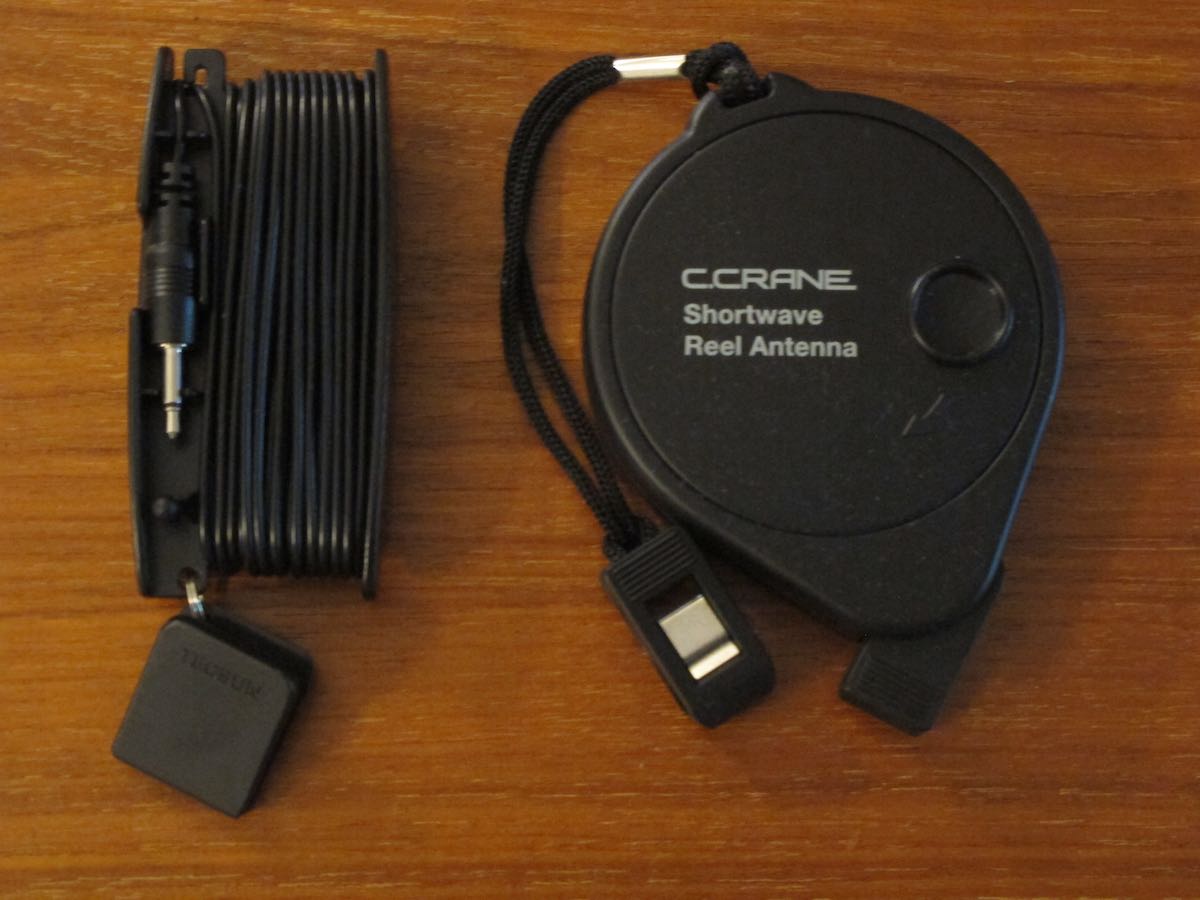
Wire antenna reels come in different styles. PL-880 (left) and CCrane Skywave SSB. But both improve performance for their respective radios.

The PL-880 has a nice long whip antenna (nearly twice as long as the CCrane Skywave SSB’s antenna), and it seems to be quite sensitive operating off the whip. But if you take the time to deploy the external wire antenna that comes with the PL-880, there is a considerable gain in sensitivity. Tuning around the 40-meter ham band, with the external wire antenna plugged into its socket, I could hear two stations in conversation, one louder than the other, but both copyable. When I tried to listen to the same pair of stations with just the PL-880’s whip antenna, the fainter station disappeared entirely, and the louder station was “down in the mud” but copyable. So the external wire antenna is clearly worth using.

So far, I am well pleased with the PL-880.

PS: Here’s a link to a really good article on extending the wire length of the reel-up antenna that came with the PL-880: https://www.hamuniverse.com/shortwavereelantenna.html
GRAHN Spezialantennen currently closed

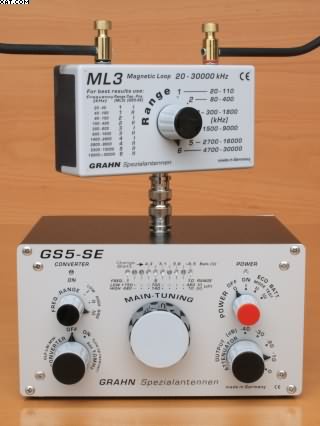
Many thanks to SWLing Post contributor, Dan Robinson, who notes that Grahn Spezialantennen is currently closed due to the fact that Mr. Grahn is undergoing extended medical treatment.

Dan received this message from Christine Grahn who did not indicate if/when the business might re-open. We certainly wish him all of the best in recovery.

Click here to view the Grahn Spezialantennen website.

RCI Sackville Antenna Farm Map and Legend

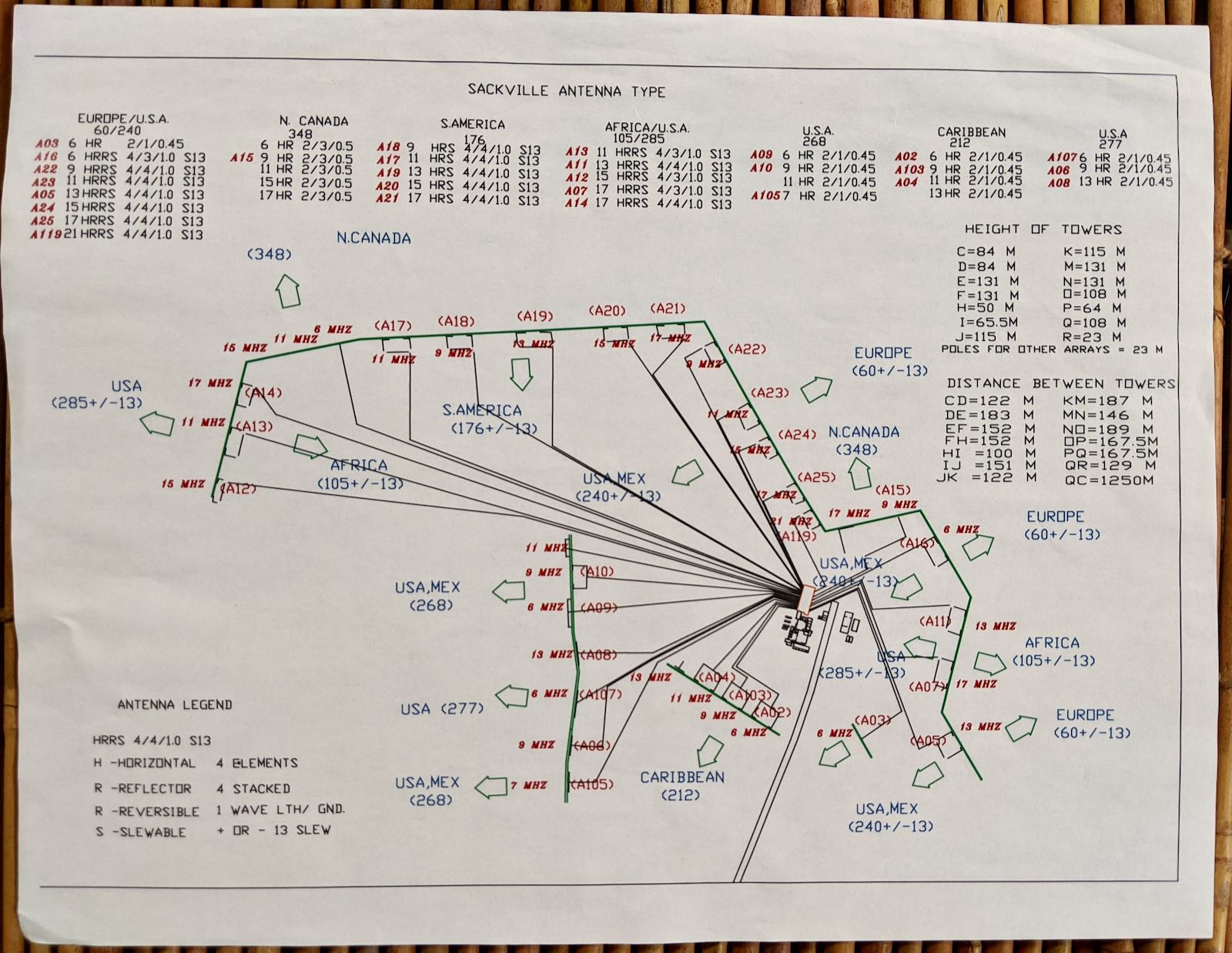
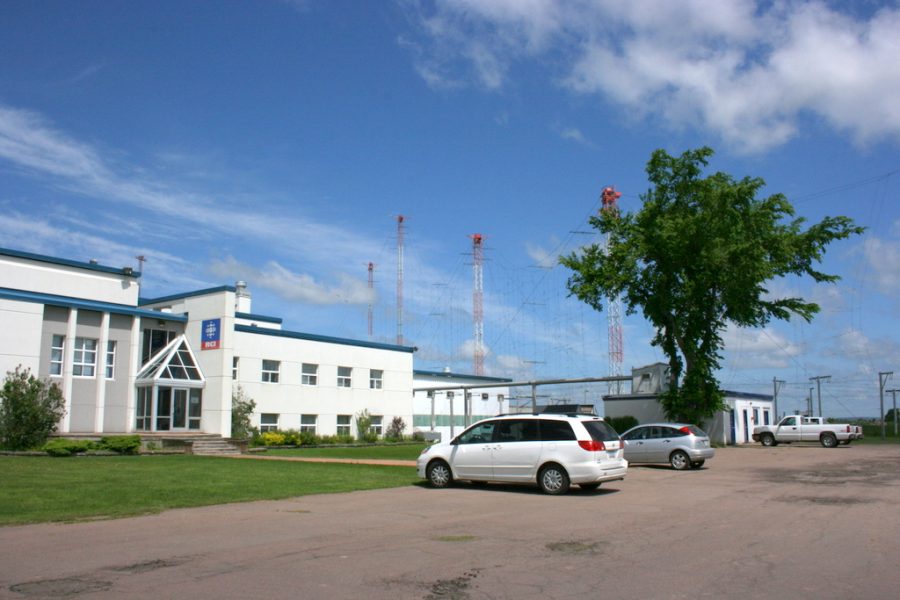
I’ve been going through some old paperwork recently and discovered this map of the antenna farm at Radio Canada International’s former Sackville, NB, transmitting site (click to enlarge):

I was given this printout by one of the staff members at Sackville when I visited there in the summer of 2012–only a few months before they closed, permanently.

I thought perhaps some others here in the SWLing Post community might enjoy checking out this map.

I do miss hearing RCI on the air. Hard to believe it’s almost been a decade.

Giuseppe’s Homebrew “TFerrite 2” Mediumwave & Shortwave Antenna

Many thanks to SWLing Post contributor, Giuseppe Morlè (IZ0GZW), who shares the following:

Dear Thomas my friend,

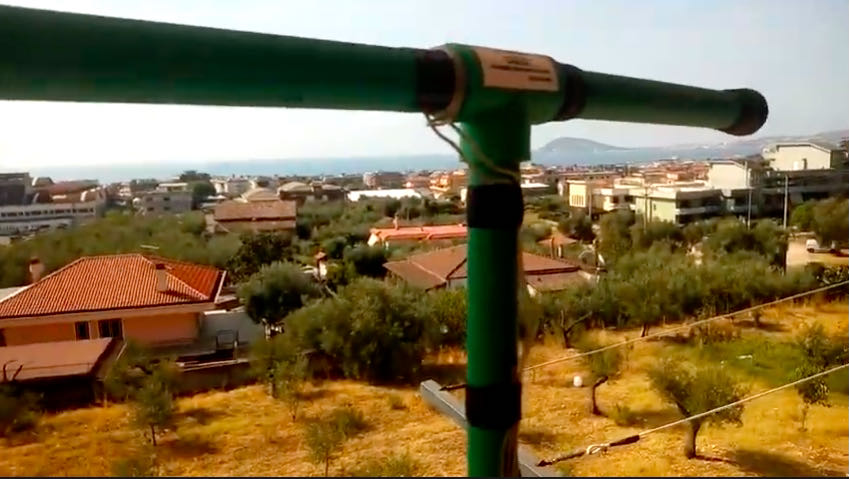
I built another Tferrite, (TFERRITE 2), for medium waves–this time also with the shortwave option.

A single variable capacitor, 800 pf, and a primary winding on the 2 ferrites of about 46 turns, a secondary winding of 3 turns to pick up the signal and send it to the receiver.

On the PVC tube I wound 4 more coils, for the shortwaves, connecting the ends to the same variable together with the other ends.

I interposed a switch on one end to eliminate or insert shortwaves.

I am sending you these 3 links from my YT channel where you can see the tests I have done in these days with no propagation.

The yield in mediumwave is excellent, like the other one, yet also good for the shortwaves–to be so small it compares very well.

Let me know what you and the whole SWLing community think!

Thanks to you and a greeting from Italy, Formia on the Tyrrhenian Sea.
73. Giuseppe.

Videos

View on YouTube.

View on YouTube.

View on YouTube.

This is brilliant, Giuseppe! Thank you so much for sharing your homebrew antenna projects. It seems they work so well from your beautiful urban location in Italy!

Wire antennas vs. mag loop antennas

In the past few weeks, I’ve gotten a lot of questions from readers who are trying to decide if they should install a magnetic loop antenna or a simple wire antenna at their home. Obviously, most of the questions come from shortwave radio listeners, but some have come from ham radio operators as well.

I realize that there’s a common theme to my answers and I thought it might be useful to share it here on the SWLing Post for future reference. I started to write a slightly more comprehensive article about this, but I quickly realized I want to keep my advice as short and clear as possible. I’ll be painting in broad brush strokes, but here you go:

If you live in an environment with a lot of radio interference…

Magnetic loop antennas are your friend.

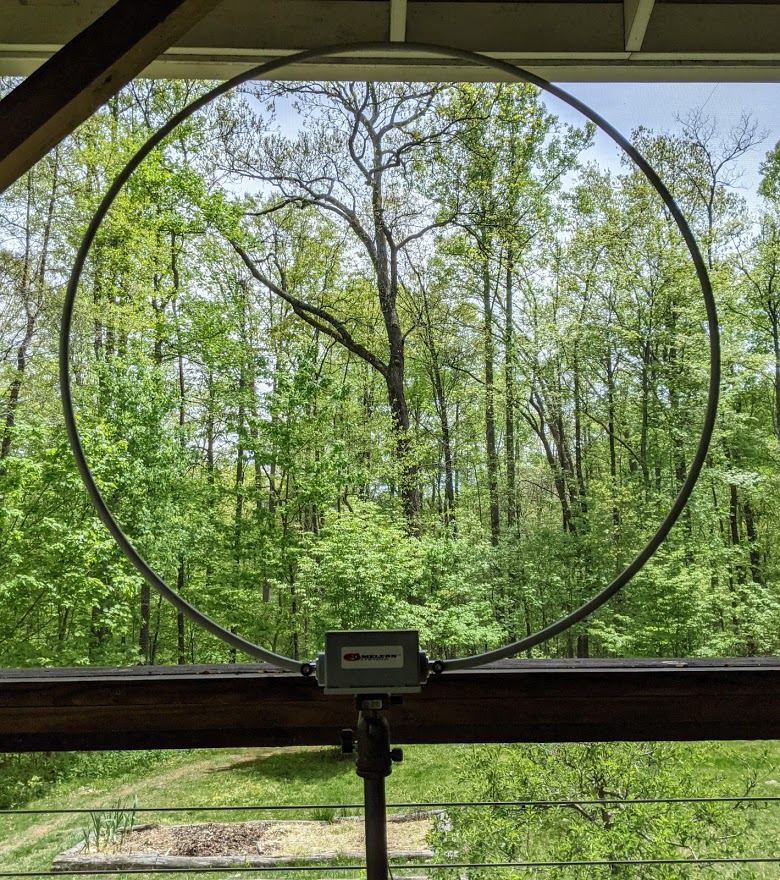
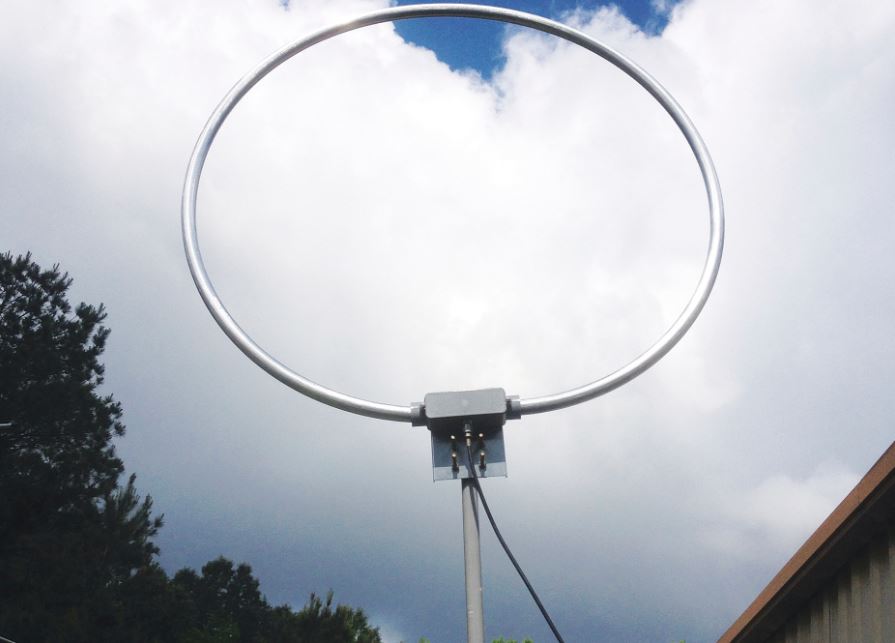
By design, mag loop antennas are some of the best antennas for mitigating the radio frequency interference (RFI) that plagues so many of our homes and neighborhoods. When oriented vertically, mag loop antennas can also be rotated to null out unwanted signals on lower frequencies.

Mag loops come in a wide variety of configurations:

  • The most popular among SWLs are wideband amplified loop antennas manufactured by companies like Wellbrook, Chameleon Antenna, MFJ, DX Engineering, Cross Country Wireless, Bonito, and a number of manufacturers in China. Unlike passive loop antennas, wideband amplified antennas require no manual tuning. These loops do require a power source, typically fed through a Bias-T or batteries.
  • Passive loop antennas are popular among ham radio operators because they’re easy to build and, unlike amplified loop antennas, one can transmit into them if designed correctly. They’re less popular among radio listeners only because they typically have a very narrow bandwidth and need to be re-tuned (via a variable capacitor) each time you move frequency even a few kilohertz. The NCPL (Noise-Cancelling Passive Loop) which is also known as the Moebius or YouLoop is a bit of an exception and doesn’t require tuning, but does require a receiver with a very high dynamic range.

Loop antennas can also be very stealthy. In fact, Loop on Ground (LoG) antennas are essentially invisible and could be deployed (under the cover of darkness, of course!) in the most restrictive of neighborhoods. Note that since LoGs are horizontal, they are essentially omni-directional. [13dka corrects this in the comments: “This is somewhat ambiguous and not entirely correct: LoGs are horizontally oriented but (somewhat surprisingly) vertically polarized, and even more surprisingly they have the trademark property of verticals”]

We’ve also featured other stealthy loop designs like this porch loop.

As with any antenna, mag loops prefer to be outdoors but can be effectively used indoors if that’s the only option.

If you live in an environment free of radio interference…

Outdoor wire antennas are very hard to beat.

I am a case in point, in fact: I live in a rural, remote location without any meaningful RFI. All of my external antennas are homebrew wire antennas and they serve me incredibly well.

If you’ve been a reader for long, you may note that I don’t personally review amplified magnetic loop antennas often–these are typically published by some of our amazing contributors. This is because I like to do “apples to apples” comparisons and usually don’t have a second compact magnetic loop antenna for comparison here at SWLing Post HQ.

Almost without exception, my cheap homebrew wire antennas outperform wideband amplified mag loop antennas…sometimes, by orders of magnitude.

Many years ago, I tested a Pixel Loop amplified mag loop antenna (now under a different name and sold by DX Engineering) specifically for use on the mediumwave band to null unwanted stations. It was a very capable amplified mag loop antenna, but other than its MW nulling abilities, all of my homebrew wire antennas outperformed it on the HF bands. Reception was, at times, dramatically better on my wire antennas.

Of course, for a wire antenna to perform properly, it needs to be deployed properly. There are excellent resources out there that describe ideal heights and configurations for any given wire antenna design.

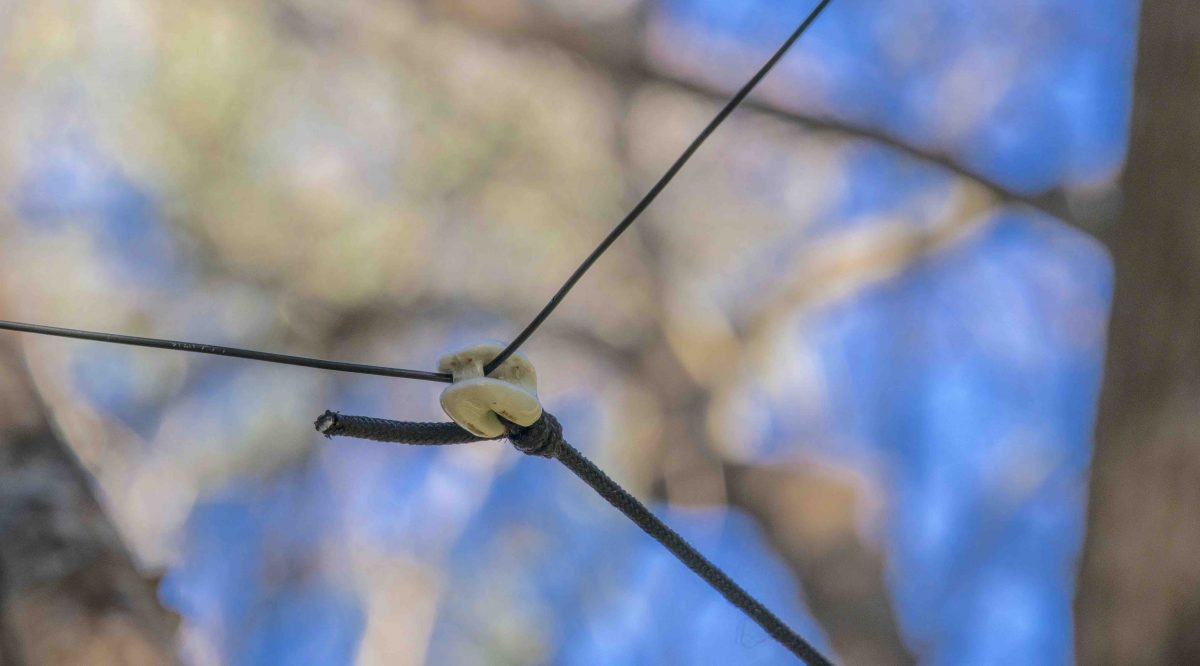
Keep in mind that wire antennas can be incredibly stealthy as well. It’s very difficult to see a wire antenna among or in front of a patch of trees, for example. At a previous home, I deployed a horizontal delta loop antenna on my property that–if you knew where to look–was easy to spot from the road. In all of the years we lived there not one neighbor took note, though, because the antenna wire had sky blue jacketing and I deployed it while no one was looking.

Summary

Experiment!

This isn’t an either/or choice for most of us. There’s no harm in building a simple wire antenna and trying it at home first. If the local noise floor is high, then consider adding a magnetic loop antenna to your arsenal as well.

You might find that the wire antenna has an advantage on frequencies where you have less radio interference, and the mag loop serves you well in those portions of the band with thicker RFI and QRM.

Find the best antenna system that works for you at home, but always remember that hitting the field with your radio has advantages as well!

What did I miss?

I omitted numerous antenna designs that aren’t straight-forward loop or simple wires. Check out some designs by our contributors Grayhat, , TomL, and many others here on the SWLing Post. As always, please feel free to comment!

Mike compares four active mag loop antennas

Many thanks to Jon Hudson who shared the following on the SDRplay Facebook page:

In this new video, Mike Harwood compares 4 different active mag loop antenna at various frequencies up to 52MHz using two SDRplay RSPduos which allowed simultaneous spectrum snapshots of the 4 loops in action with real signals.

These are loops from Bonito, Cross Country Wireless, LZ1AQ and Wellbrook.

This is the second of Mike’s antenna comparison videos. He welcomes comments which will help shape the content for future antenna experiments:

Paul’s thoughts about Mediumwave DXing in Alaska

Many thanks to SWLing Post contributor, Paul Walker, who has kindly allowed me to published some notes he recently shared among MW DXers about DXing in McGrath, Alaska, USA:
During a Zoom hang out with a bunch of Pacific NW DXers, one of the things that come up was why my DXing in Alaska is beyond amazing, and we’ve come to a few conclusions.

The extended darkness. Sunrise in the middle of winter here is 3+ hours later than the west coast, so once their Skywave burns off, I’m left with darkness over the pole and to my west.

There’re no operating AM stations within just under 200 miles from me which is a big help. I have heard distant signals on the same channel as “semi locals” such as 780 and 1080.
And I’m pretty sure there’s something to the fact I’m close to the North Pole. Still far, but closer than most.

Interesting to note though: pre sunset DX isn’t a thing there. What I’ve unscientifically discovered is it seems to be that the entire Pacific has to be dark for DX  to be worthwhile for me in the evening … despite my evening DX being Canada and the lower 48 US States.
What most everyone else hears at night, such as the transpacific signals from Japan, China, Australia etc…, I hear in the morning. Hearing anything from Asia or the Pacific at night is EXTREMELY rare.

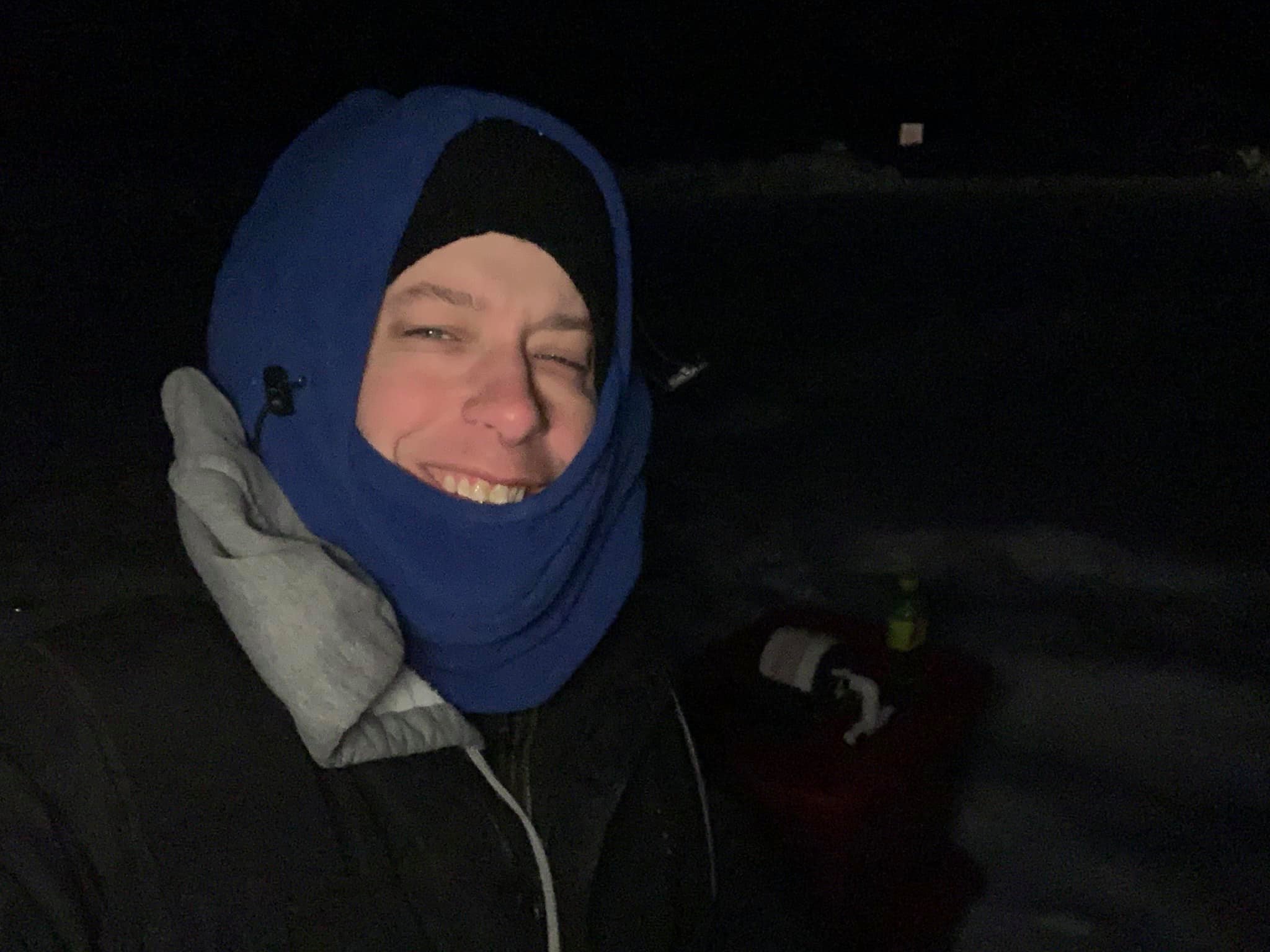
[Since I’m DXing outdoors in extremely cold conditions] I’m getting extra batteries, extra audio cables (to go between the recorder and the radio), another radio, and another recorder. Oh and some hot hands hand warmers. Also have some extra gloves and hats ordered too.. getting prepped for winter DXing well ahead of time!

The hand warmers are as much for my gloves as they are for my digital recorder… AA batteries don’t last long during continuous use in extreme cold.

i also have a portable battery and extra cable so I can use it for my phone. Those lithium ion batteries hate cold even more than aa alkaline batteries–they will shut off in the cold. In fact, you have to not only warm it up but charge it. The cold causes it to think tis dead…. and even warming it up won’t work.

Here’s a video link to my FSL antenna designed and built by Gary DeBock:

DXIng is one of the reasons I moved back up here to Alaska and it’s entirely fascinating. I learn something new every “DX season”.

Lower 48 theory and ideas just don’t hold a bunch of weight up here … I’ve had ideas and suggestions from some really smart people that just didn’t work out.

Until you’ve DXed in Alaska, it’s hard to explain and understand.

Thank you for sharing your notes, Paul! Having never done DX in those latitudes, I can only imagine how different conditions might be–especially in those long, dark winters!