Category Archives: Antennas

A full report from Gary DeBock’s Cook Islands (Aitutaki) Ultralight DXpedition

Many thanks to SWLing Post contributor, Gary DeBock, who shares the following notes from his Cook Islands Ultralight DXpedition:
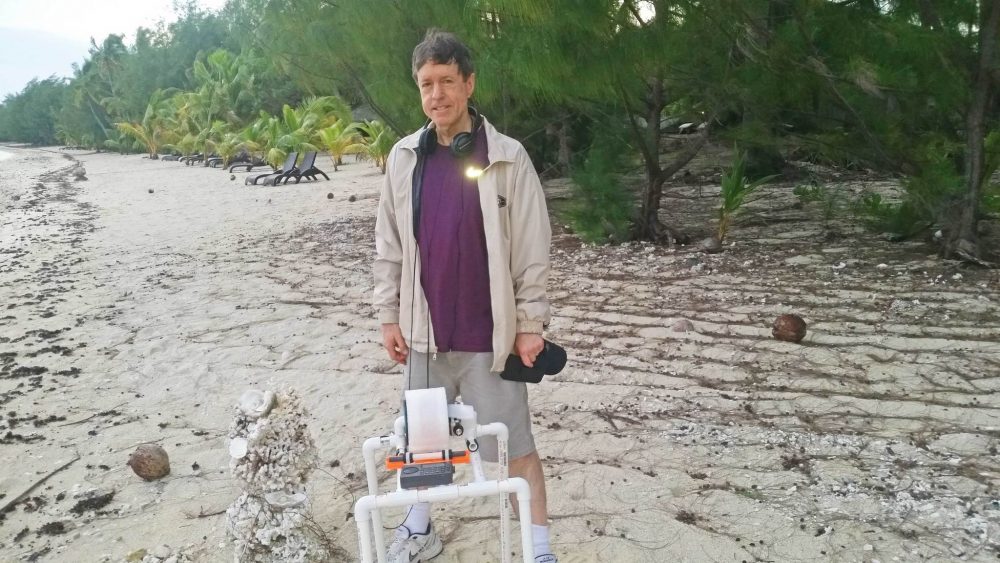

“Frequent Flyer” FSL antenna – Lagoon beach DXing setup photo

Checking out transoceanic DX propagation at an exotic ocean beach site can provide the hobby thrill of a lifetime– if a DXer is lucky enough to choose the ideal time, place and gear to make the chase. All of these fell into place in an amazing way during a 5-day trip to Aitutaki Island (2600 miles due south of Hawaii) with Ultralight radio gear, resulting in the reception of MW stations in India, Bangladesh, Mongolia and Cambodia– all at over 6,800 miles.

Because of extensive QRM from Australia and New Zealand the total number of Asian stations received was limited, but it was definitely a case of quality over quantity. Phenomenal gray line propagation around sunrise shut down Japanese signals almost completely, but boosted up those from the exotic countries in east and south Asia. Korean station reception was limited to the big guns, which was also primarily true for Chinese signals. Except for the ANZ pest QRM, the conditions seemed custom-designed for a west coast DXer to go after the exotic stations which rarely– if ever– show up in BC, Washington or Oregon (even though the Cook Islands’ distance to them is greater).
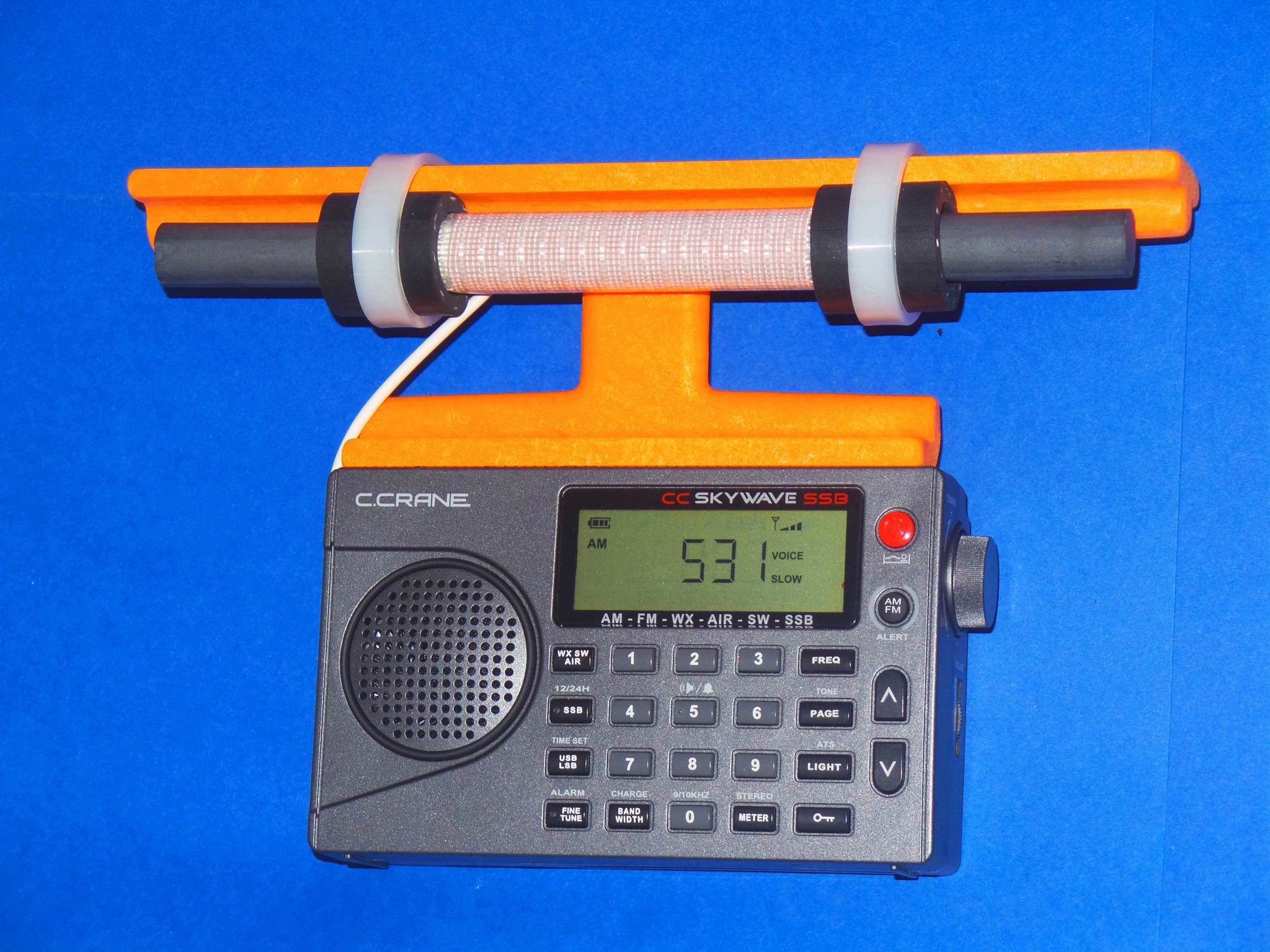
7.5 inch loopstick C.Crane Skywave SSB Ultralight

Ocean beach propagation at sunrise was strong enough to bring in both 693-Bangladesh and 1431-Mongolia at S9 levels almost every morning on my Ultralight gear, and allow both 657-AIR and 918-Cambodia to break through ANZ QRM on April 12th. No doubt many more of these exotic stations could have been logged except for Australian QRM on 576, 594, 872, 883 and 1566, but this only added to the thrill of the chase. The overall results were exceptional for a DXer using only a 7.5 inch loopstick Ultralight radio and 5 inch “Frequent Flyer” FSL– all designed to fit within hand-carry luggage, and easily pass through airport security inspections. Thanks very much to Alokesh Gupta, Hiroyuki Okamura, Jari Lehtinen, Chuck Hutton and Bruce Portzer, who all assisted in the identification of these stations!

657 All India Radio Kolkata, India, 200 kW (8,075 miles/ 12,995 km) Recorded by accident during a sunrise check of the Korean big guns at 1641 on April 12, reception of this longest-distance station went unnoticed until file review after return to the States. The female speaker (in the Bengali language) is the third station in the recording, after the female vocal music from Pyongyang BS and the Irish-accented male preacher from NZ’s Star network. Her speech peaks around 40 to 50 seconds into the recording. The isolation of the Star network at the 55 second point was done by the Ultralight’s loopstick, not by the propagation. Thanks to Alokesh Gupta for the language and station identification:

Click here to download an MP3 of this recording.

657 Pyongyang BS Pyongyang, N. Korea, 1500 kW Like most east Asian signals the N.K. big gun sounded pretty anemic in the Cook Islands. Its female vocal music at 1641 on April 12th shared the frequency with NZ’s Star network (Irish-accented preacher) and AIR’s female Bengali speaker:

Click here to download an MP3 of this recording.

693 Bangladesh Betar Dhaka, Bangladesh, 1000 kW (7,960 miles/ 12,810 km) Probably the biggest surprise of the DXpedition, with S9 signal peaks on 4 out of 5 sunrise sessions. Frequently snarling with the Oz pest 3AW, it usually managed a few minutes on top of the frequency each morning from 1630-1700 UTC. Exotic South Asian music was the usual format, and was very easy to distinguish from the talk-oriented format of 3AW (and other Oz co-channels). This first appearance at 1652 on 4-10 featured a “Bangladesh Betar” ID by a male speaker at 8 seconds into the recording (thanks to Chuck Hutton for listening):

Click here to download an MP3 of this recording.

This was followed by a lot of exotic music until 3AW claimed the frequency just before the 1700 TOH:

Click here to download an MP3 of this recording.

The next day (4-11) the exotic station was back with S9 peaks, including this typical music and female speaker at 1625:

Click here to download an MP3 of this recording.

The exotic music from Bangladesh was in an S9 snarl with 3AW (and another Oz pest) from 1659 throughout the 1700 TOH on April 11th:

Click here to download an MP3 of this recording.

774 JOUB Akita, Japan, 500 kW Oddly enough, this was the only Japanese signal making it to the island during the entire trip. Mixing with a goofy-sounding 3LO announcer at 1613 on 4-11, the Japanese female speech concerns a “doobutsuen” (a “zoo” in Japanese, similar to what the frequency sounded like with the 3LO announcer):

Click here to download an MP3 of this recording.

819 KCBS Pyongyang, N. Korea, 500 kW The N.K. big gun managed a potent signal for its 3+1 pips across its “TOH” at 1630 on 4-12 but never could shake off RNZ’s Tauranga transmitter:

Click here to download an MP3 of this recording.

909 CNR6 Quanzhou, China, 300 kW Strong signal with CNR ID (1:08) and Mandarin speech by male and female announcers. NZ’s Star network was apparently off the air at the time, since it was a real blaster when transmitting:

Click here to download an MP3 of this recording.

918 RNK Phnom Penh, Cambodia, 600 kW (6823 miles/ 10,981 km) Breaking through the Shandong and Oz QRM at an ideal time to dominate the frequency, its sign off transmission with the National Anthem peaked just before the 1700 TOH on April 12. Female speech in the Khmer language and exotic music are featured just before the anthem (thanks to Hiroyuki Okamura and Jari Lehtinen for listening, and identifying the National Anthem):

Click here to download an MP3 of this recording.

Chuck Hutton’s improved audio file of the same reception (thanks):

Click here to download an MP3 of this recording.

918 Shandong RGD Synchros (Multiple) The dominant Asian signal on the frequency, it rarely allowed Cambodia to sneak through. Here it is with female Mandarin speech at 1647 on 4-11:

Click here to download an MP3 of this recording.

Shandong RGD’s transmitters were poorly synchronized, resulting in the two-tone time pips at the 1700 TOH on 4-12 (during Cambodia’s National Anthem at 1:40, in the MP3 linked below). Although actually from two different transmitters, the sound effect sounds similar to that of a “cuckoo clock,” resulting in some initial confusion about their source:

Click here to download an MP3 of this recording.

972 HLCA Dangjin, S. Korea, 1500 kW The South Korean big gun played the part on most mornings, including this S9+ Korean female speech at 1631 on 4-12:

Click here to download an MP3 of this recording.

981 CNR1 Synchros Changchun/ Nanchang, China, 200 kW/ 200 kW The first of three CNR1 frequencies which usually produced strong signals, this music // 1377 was received at 1624 on 4-12:

Click here to download an MP3 of this recording.

1377 CNR1 Synchros (Various) Overall this was not only the strongest Chinese frequency on the band, but was the strongest Asian station on the band as well. Awesome S9+ signals were typical each morning, as with this male speech and music at 1622 on 4-12:

Click here to download an MP3 of this recording.

Another potent signal from this Chinese blaster at 1640 on 4-12:

Click here to download an MP3 of this recording.

1431 Mongolia (Relay Station) Choibalsan, Mongolia, 500 kW This station was easy to receive on the first attempt, with very little competition on the frequency. It typically managed an S9 signal after 1630 daily with the BBC’s Korean service, which seemed to be broadcast during the peak sunrise enhancement time in Aitutaki’s ocean-boosted propagation. Here is BBC’s Korean male announcer at an S9 level at 1632 on 4-11, with the BBC interval signal at 47 seconds into the recording:

Click here to download an MP3 of this recording.

The Mongolian relay program prior to 1630 was also in Korean, with this female Korean speech at 1627 on 4-11:

Click here to download an MP3 of this recording.

1566 HLAZ Jeju, S. Korea, 250 kW A very poor signal was typical during this trip, with the Chinese service barely showing up under 3NE and two other DU English stations (probably 4GM and Norfolk Island). Whenever 3NE was in a fade it had a chance, since other two co-channels were running very low power. Here is the latter situation, with the weak Chinese barely audible under the DU English snarl at 1641 on 4-12:

Click here to download an MP3 of this recording.

1593 CNR1 Changzhou, China, 600 kW This was another Chinese blaster, with S9 signals typical every morning. Here it was at 1641 on 4-12 with male Chinese speech and music at 1377:

Click here to download an MP3 of this recording.

73 and Good DX,

Gary DeBock (DXing in Aitutaki, Cook Islands)


Amazing, Gary! Thank you for taking us along on your excellent Ultralight DXpedition. With a modest portable radio and a little antenna ingenuity, you’re enjoying some outstanding DX! You’re living proof of the point I was trying to make in a post yesterday!

Thanks again, Gary, and good DX! 
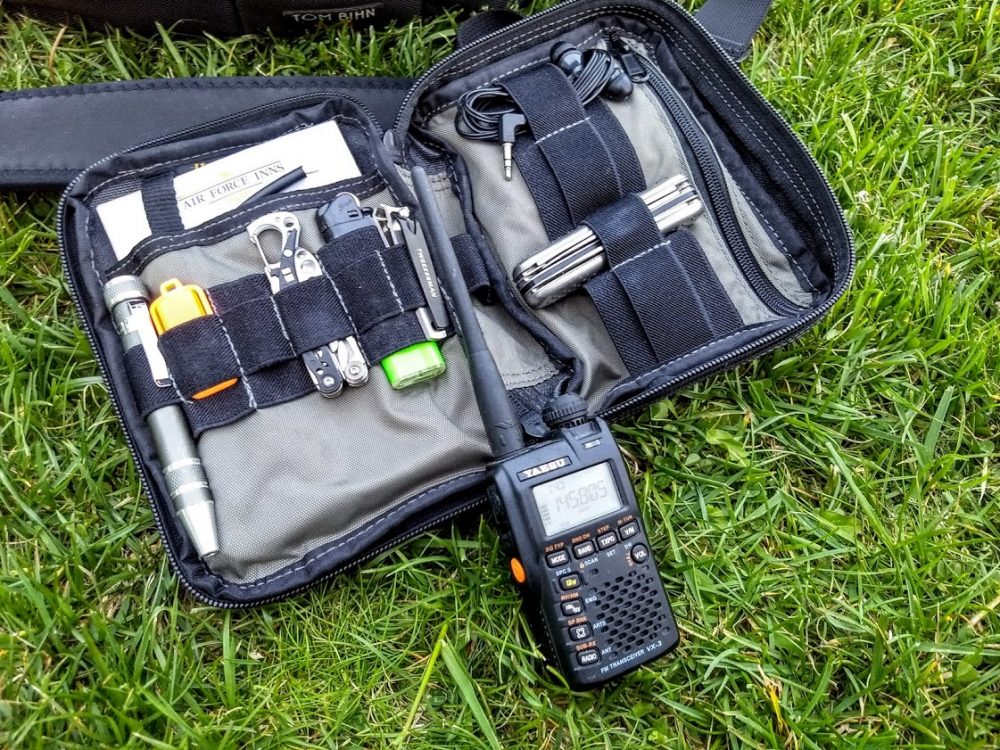
Everyday Carry: My EDC packs and radio kit

SWLing Post contributor, Matt, writes:

Thomas: I know you’re a self-proclaimed pack geek and so am I! You published a photo of your EDC pouch in a post last year. Just a teaser really! What is that pouch and I assume you have a larger carry bag as well? Can you provide more details? I’m ever revising and honing my own EDC pack. Any details would be appreciated.

Thanks for your question Matt!  Besides radio, you’re bringing up on one of my favorite topics: packs! You may regret having asked me!

Yesterday evening, I snapped a few photos of my EDC (Everyday Carry) bag and the pouch you’re referring to. Your inquiry is prompting me to consider publishing a more detailed look at my EDC gear–especially since radio is such an important part of it.

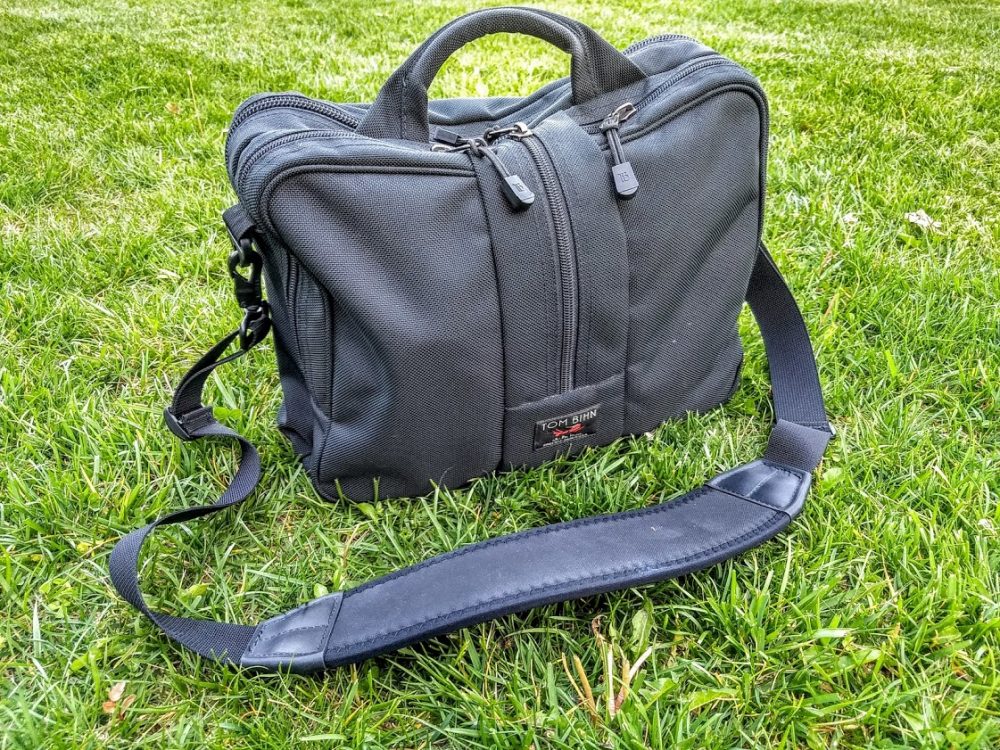
I do carry a larger EDC bag at all times. Typically, this is the Tom Bihn Pilot:

For years, I carried a Timbuk2 messenger bag, but it didn’t have the type of organization I prefer in an EDC bag. My EDC bag must be rugged, water resistant and accommodate my 13″ MacBook Air while still having enough depth to comfortably fit the rest of my gear.

I’ve been using the Tom Bihn Pilot for almost a year and have been very pleased. The Pilot is an investment to be sure, but (like Red Oxx) Tom Bihn construction quality is superb and comes with a lifetime warranty.

It’s amazing how much gear will comfortably fit inside without making the bag bulge. The Pilot also has a dedicated water bottle pocket in the middle of the front panel. While I do carry water, it primarily houses my never-leave-home-without-it Zojirushi Stainless Steel Mug (affiliate link) which is filled with piping hot dark roasted coffee!

I also use the water bottle pocket to hold full-sized handled VHF/UHF radios. It accommodates either my Kenwood TH-F6, Yaesu FT2D, or Anytone AT-D868UV perfectly. Indeed, all of the front pockets will accommodate an HT since the zippers terminate at the top of the bag. Long antennas can easily poke out while the zipper still seals 99% of the opening.

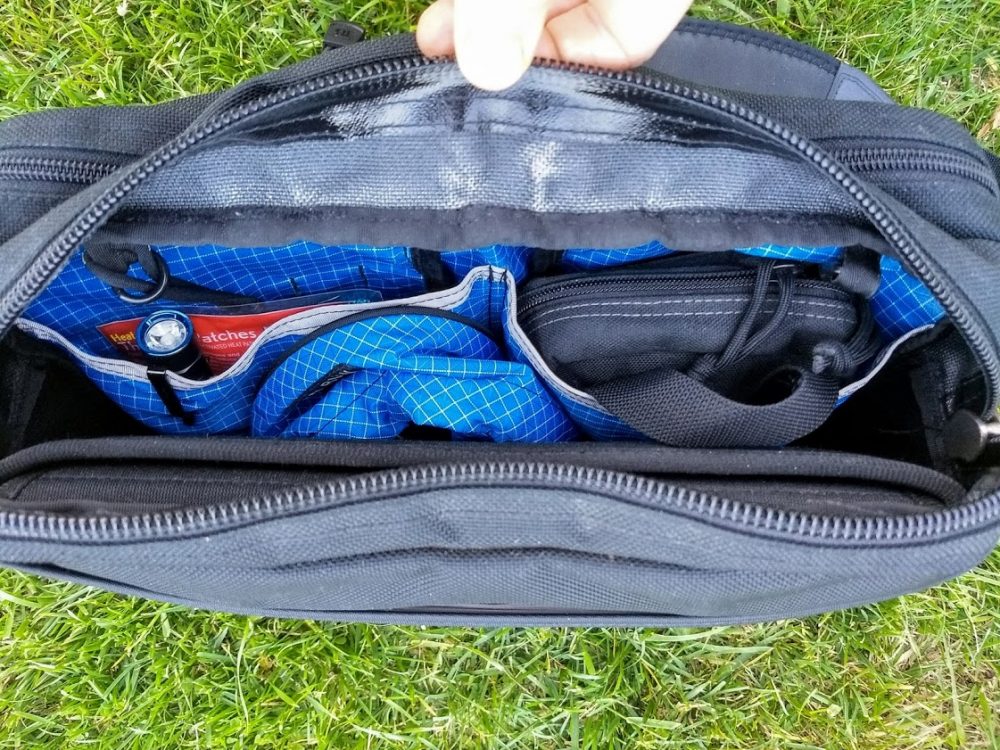
The Pilot has one main compartment that houses my 13″ MacBook Air laptop.

The Pilot laptop compartment is spacious and has two built-in pockets opposite the laptop sleeve: one of these pockets (the one on the right in the photo above) holds my EDC pouch, the other holds first aid supplies, an Olight SR1 flashlight and Nitecore LA10 latern (affiliate link). My laptop is in a TSA-friendly Tom Bihn Cache.

While the Tom Bihn Pilot is the bag I use most days, also use a Red Oxx Micro Manager and–when I need 25 liters of capacity–the Tom Bihn Synapse 25.

I pack most of my EDC gear in pouches, so moving from one bag to another takes me all of one minute.

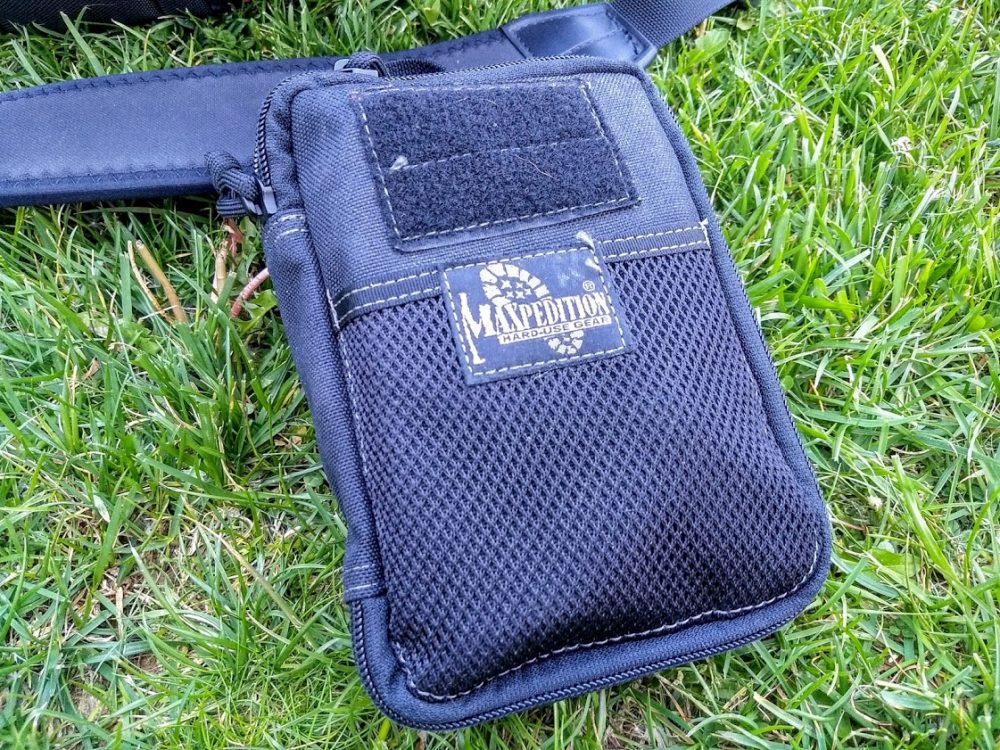
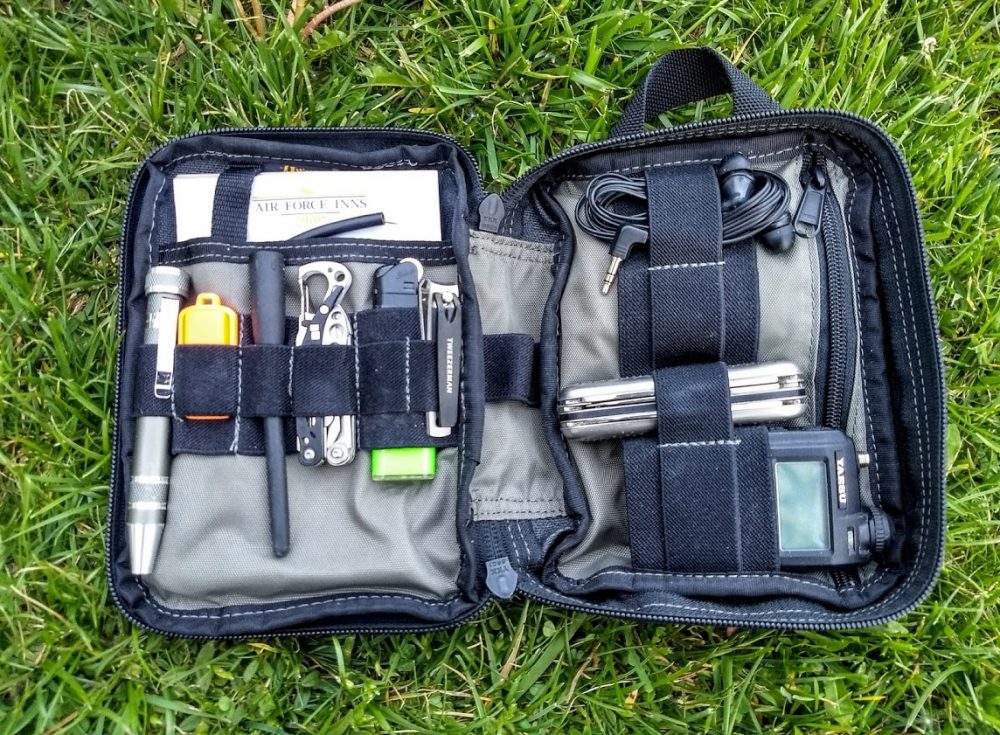
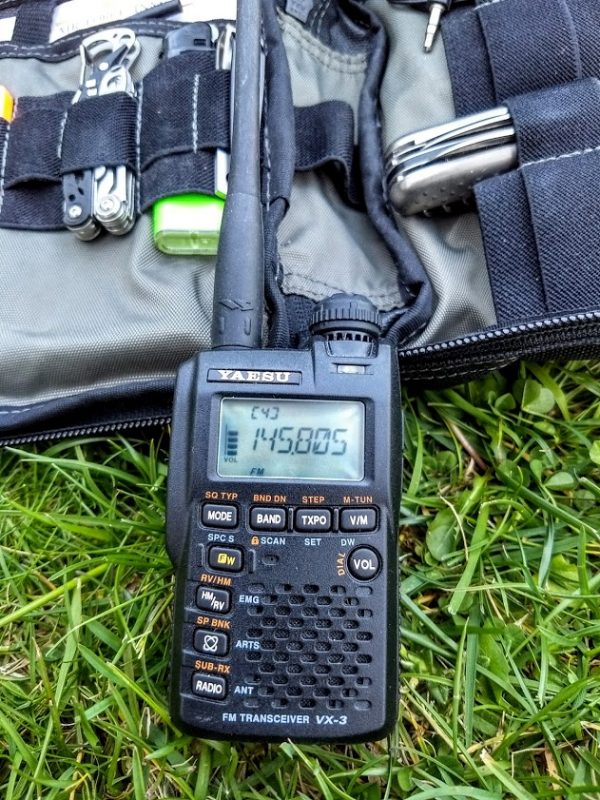
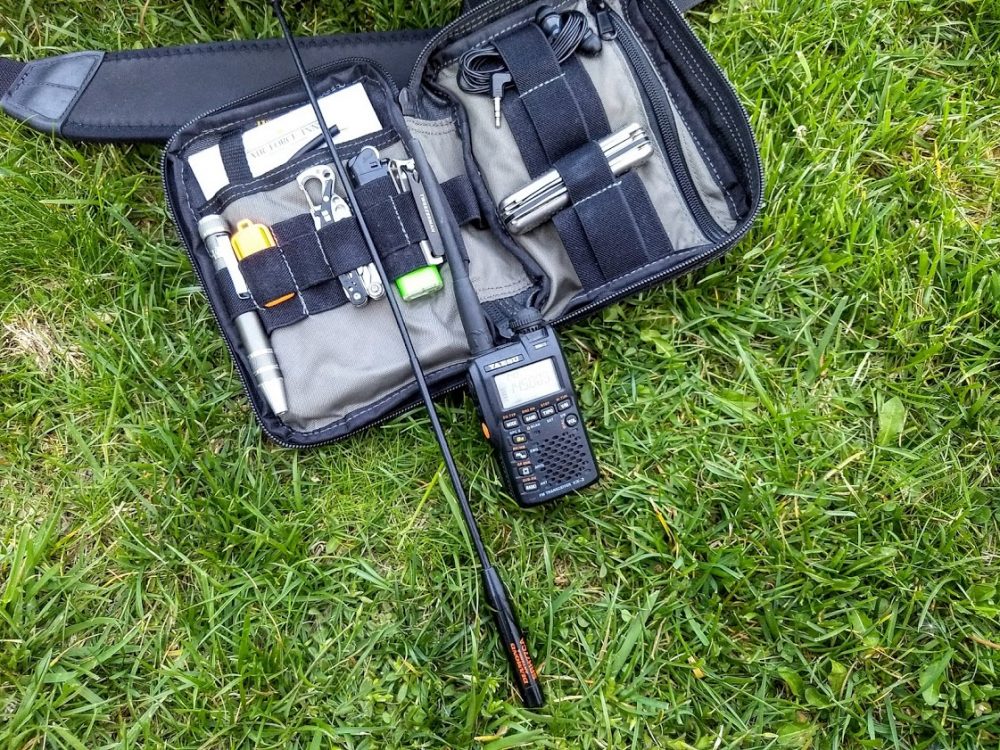
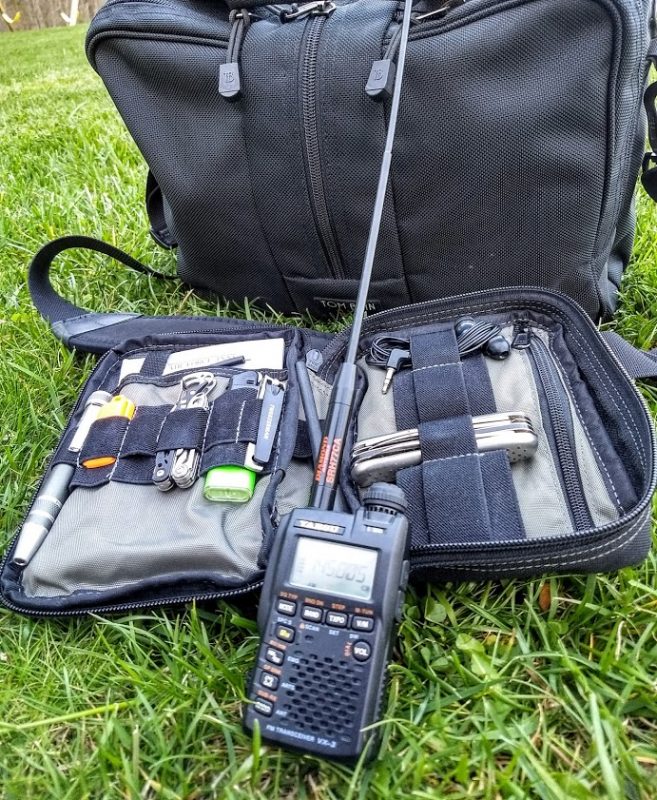
My EDC pouch is the Maxpedition Fatty Pocket Organizer (affiliate link). I love this pouch because it’s incredibly durable, affordable and opens like a clam shell to lay flat.

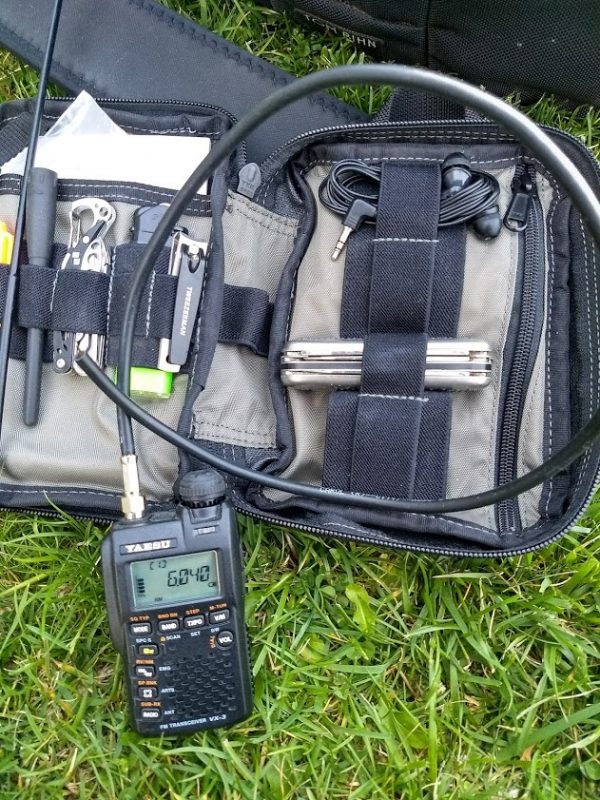
Everything has its place. Not only does it hold my Yaesu VX-3R handheld, but also a multi-function knife, a Leatherman Style PS tool, clippers, earphones, multi-bit screwdriver, USB stick, notepad, spare VX-3R battery, a mini first aid kit, titanium spork, and much more! Someday I’ll pull the whole thing apart and note each item.

Why do I choose the Yaesu VX-3R? First of all, it’s compact. This HT is so small it’ll tuck away anywhere. Not only is it dual band, but it’ll also receive the AM broadcast band (even has a little ferrite bar inside), the shortwave bands, and the FM broadcast band.

The mini rubber duck antenna will work in a pinch, but I also carry a flexible Diamond SRH77CA in the floor of the Tom Bihn Pilot’s main compartment.

When I attach the Diamond antenna, it significantly increases the VX-3R’s capabilities.

While the VX-3R does cover the HF bands, don’t expect amazing performance. Selectivity is poor, but sensitivity is adequate. For a shortwave antenna, I carry a short length of coax: one end is terminated with an SMA connector, the other has the center conductor exposed.

I also carry a short alligator clip cable which I clip to the exposed center conductor and then to a length of wire. The end result is a very cheap, flexible and effective portable HF antenna!

Someday, I’ll take everything out of my EDC pack, inventory the contents and publish a post about it. Somehow, that’ll please my inner pack geek! I’m overdue a review of the Tom Bihn PIlot and Synapse 25.

Post readers: Do you have an EDC pack built around a radio? Please comment and include links to your favorite gear!

Gary DeBock shares most distant catch from Cook Island DXpedition

Many thanks to SWLing Post contributor, Gary DeBock, who shares the following note about his recent Cook Island DXpedition:

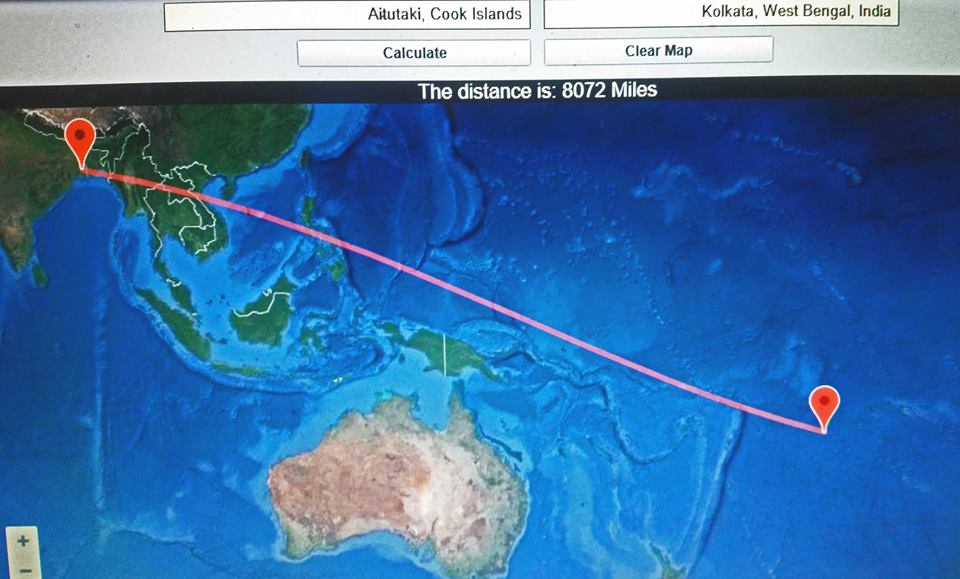
The farthest DX received during the Cook Island DXpedition (on Aitutaki island) was 657-All India Radio in Kolkata, India, at 8,072 miles (12,991 km). Recorded by accident during a sunrise check of the Korean big guns at 1641 on April 12, reception of this longest-distance station went unnoticed until file review after return to the States.

The female speaker (in the Bengali language) is the third station in the recording, after the female vocal music from Pyongyang BS and the Irish-accented male preacher from NZ’s Star network. Her speech peaks around 40 to 50 seconds into the recording.

The isolation of the Star network at the 55 second point was done by the Ultralight’s loopstick, not by the propagation. Thanks to Alokesh Gupta for the language and station identification!

Click here to download MP3.

Wow! A mediumwave DX catch of 8,072 miles using a compact (heavily souped-up!) CC Skywave SSB? Simply amazing, Gary!

Your enthusiasm and passion for Ultralight DX is simply infectious!

Video: Homebrew AM Loop Antenna Project by Thomas Cholakov (N1SPY)

Many thanks to SWLing Post contributor, Thomas Cholakov (N1SPY), who shares his latest video explaining the operation of a simple homebrew AM loop antenna:

Click here to view on YouTube.

Brilliant video, Thomas! I love the fact you included a demonstration with your SDRplay RSP1A as well. Via the spectrum display, it’s easy to see the the loop’s bandwidth and also the gain it provides when tuned to a station.

I love your AM loop antenna as well–such a simple design and ideal for demonstrating the mechanics of a passive loop antenna since all of the components are visible. I’m willing to bet you built this antenna for less than $10. Smart design as it’s both portable and effective! Keep up the excellent work, Thomas! We look forward to all of your future videos.

The Professor reviews the RFA200 external ferrite antenna

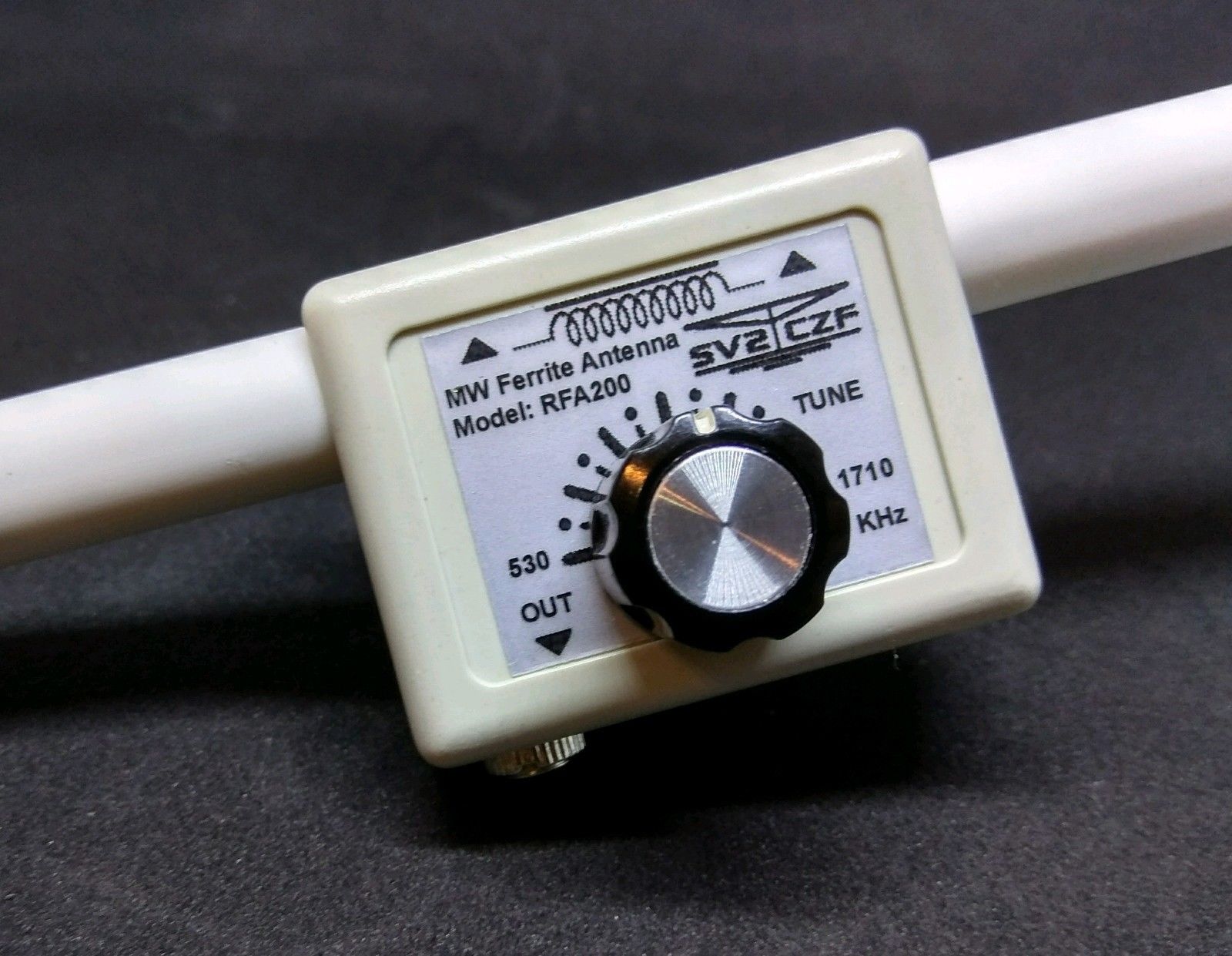
Many thanks to SWLing Post contributor, The Professor, who shares the following review of the RFA200 external ferrite antenna:


The Tecsun R-9012 and RFA200 MW antenna (Photo credit: The Professor)

A Quick Review of the RFA200

The Professor

I’ve considered saying something here about RFA200, as I bought one of these not long after its existence was announced on this blog a few months ago, but I’ve been hesitating because I didn’t have much good to say about it. A couple of times I’ve placed it up snug up against the the top of the two Tecsun sets I have handy (the PL-310ET and the PL-880) and found that despite a lot of knob turning it had little or no effect on improving signal on medium wave stations. I was not impressed.

But I guess I’ve kind of changed my mind on that. And oh yeah, I bought another radio. It’s funny how you can talk yourself into things when you’re talking someone else into something. But after I had mentioned to a reader here the other day that the very inexpensive Tecsun R-9012 was a worthy analog DX portable, I decided to drop twenty and pick one up for myself. After all, it was about the same price as a fancy Brooklyn hamburger. It arrived a couple days ago.

So, I have been playing with it a bit over the last few days. It’s as good as the other ones I’ve had which are the same basic radio (I’d mentioned that the bandswitch slider broke in a couple of mine). It’s single conversion. The bandwidth is a little wide, but it’s a very sensitive and simple analog set.

Yesterday I was going through the AM band and remembered that ferrite from Greece, and I pulled it out recalling that in my experience some radios are more susceptible to reception improvements using passive loops than others. Maybe this ferrite bar might be similar. And sure enough, the antenna made a notable difference this time. By placing it up against the R-9012 and tuning the thing I could certainly increase signal a bit. And I could even see it in the slight brightening or steadiness of the tuning light.

So, not a total waste money after all. I would emphasize that the difference in reception doesn’t seem to be as dramatic or sustaining as you might hear with a tunable loop antenna next to your radio. But it’s not junk either. Then again, for fifty dollars shipped it is a little pricey. Twice as much as a Tecsun tunable loop antenna, and two and half times more expensive than the R-9012 itself.

I found the best way to use this antenna is to tune the radio separately first and when you find a weaker signal you want to improve physically go ahead and rotate the radio until the signal is strongest and THEN put the antenna along the top of the radio and adjust the tuning knob on the antenna. Focus in on strengthening the signal you actually hear, going back and forth until it gets strongest. If you seem to be pulling up other stations it’s because the antenna adjustment will bring in adjacent stronger stations if you move it too far either way.

I’m surely not able to pin down the science involved in exactly how these things work, but perhaps somebody can chime in on this. I’m wondering if analog radio tuning in particular is better suited to the use of these tunable passive antennas, as opposed to PLL and DSP radios?

If you buy one of these be prepared to wait. At least mine took weeks to get here from Greece. And don’t expect miracles. But it seems rather well constructed, and will probably work with some radios. The seller has a 100% rating on eBay and has all sorts of interesting antennas for sale. I’m glad to see people succeeding in that business.


Many thanks, Prof, for sharing your fine review of the RFA200! Thanks for also mentioning the Tecsun R9012–I purchased one a couple years ago with the intention of reviewing it, then gave it to teenager who expressed interest in shortwave. I don’t think I actually put it on the air myself. I do enjoy simple old school analog radio–especially when making band scans. 

Click here to view the RFA200 antenna on eBay.

Backpack Shack 2.0: an update from the field

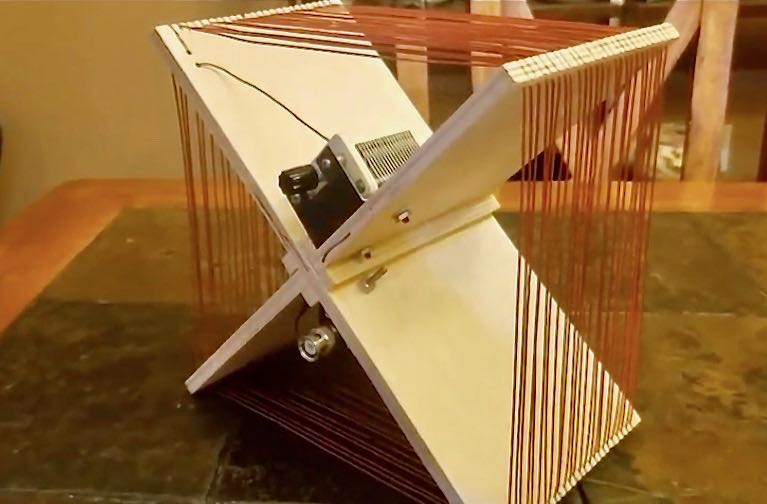
Finished Backpack Loop 2.0 and accessories assembled together

Many thanks to SWLing Post contributor, TomL, who shares the following update about his homebrew Backpack Shack 2.0 portable loop antenna:


Quick Field update

by TomL

This is just a quick Field Update for my Backpack Shack 2.0 antenna. It is not the most powerful antenna but in the right location it can be useful, especially with using an SDR. It was used during February in two Forest Preserve (County Park) locations outdoors and once from my usual Grocery Store parking lot!

Field Recordings

Please excuse some of the computer generated noises (caused by a slow CPU) as well as some audio connector problems on a couple of recordings.

Each Time is in UTC and Frequency in kHz. Where can you hear unique programming like these samples except Shortwave Radio??? Enjoy!

VOA, @03:00 on 6080 kHz in English from Sao Tome towards Africa (backside of their antenna, opposite of my location)

China Radio Int’l, @23:00 on 9415 kHz in Vietnamese from Beijing (not sure if this traveled around Antarctica to get to me or a backside of their antenna over the North Pole?)

WHR, @15:59 on 9965 kHz in Korean from T8WH Palau

Mighty KBC, @01:48 on 6150 kHz in English from Nauen Germany (announcer sound effects included!)

Voice of Greece, @20:34 on 9420 kHz in Greek from Avlis (unique stylized Greek music, INTERESTING artistic expression)

Vatican Radio, @20:27 on 9660 kHz in English from Vatican City to Africa

WINB, @21:30 on 9610 kHz in English from Red Lion, PA USA (a FUN song about promoting Radio listening!)

And my favorite Government-run authentic folk music station of Mexico, tiny 1KW XEPPM @04:17 on 6185 kHz with clear station ID

I will be working on a larger version of this antenna to transport in my car as well as a small VHF loop antenna for the outside deck for Air/Police/Weather scanning.

Hope to report sometime this Spring.


Thank you so much for the update, Tom! It looks to me like you’re having an amazing time with you homebrew loop in the field! 

As always, keep us in the loop! (Yeah…bad pun, I know!)

Guest Post: Radios I Have Known #2

Many thanks to SWLing Post contributor, Neil Goldstein, who shares the following guest post which originally appeared on his blog, Fofio:


Radios I Have Known #2 The old, the new, and the Select-A-Tenna

by Neil Goldstein

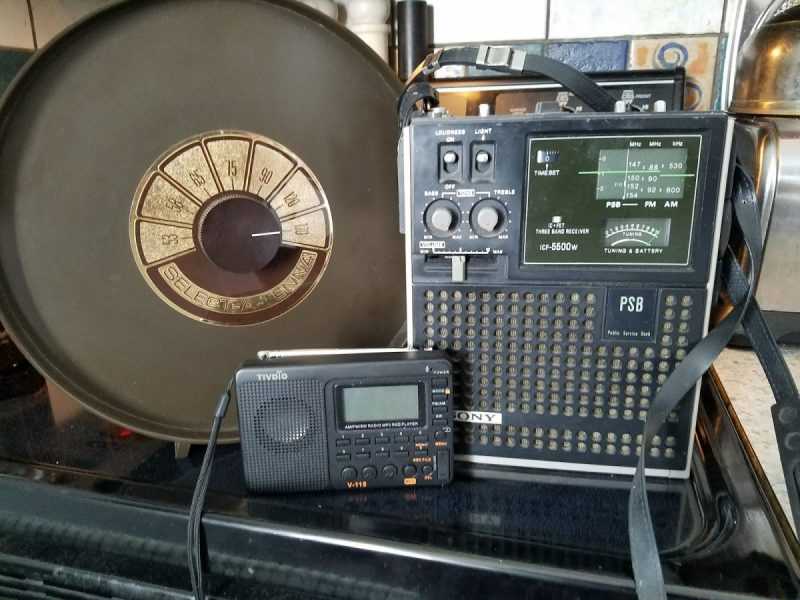
L-R: Select-A-Tenna, Tivdio V-115, Sony ICF-5500W

After promising this series a year and a half ago, I finally have started digging through the collection, and will start posting about once a week.  The radios, and accessories may not have anything in common (as seen in this post), but were all acquired because they were in some way interesting, or sentimental to me.  Here’s the first three:

Select-A-Tenna
One of the original air-core tunable AM antennas.  You just put this near the radio and peak it for reception.  I was watching for one of these in good shape, and not overpriced, and they have been in and out of production over the years.  This one is from a later production run as can be seen by the extended AM range (1700).  Jay Allen reviewed the S.A.T by comparing the the TERK Air Core antenna not long ago here:  https://radiojayallen.com/select-a-tenna-vs-terk-am-advantage/  The TERK reviewed well, and looks more modern, but I wanted the classic cheesy art-deco looking S.A.T.

Tivdio V-115
I won’t post a long, boring review here.  Many have already reviewed this radio.  All I can say is that if you like small, decent-sounding transistor radios, you will not be disappointed.  If you are expecting top-shelf performance, and perfect ergonomics, then you you may not be happy, but for around $19 you really should be happy with this little gem.  A great little radio at a great price and the most impressive thing here is the sound.  The radio has a small passive radiator like the Meloson M8, and M7, and really surprises me.  It can also be used as an amplified speaker, and has a micro SD slot for using it as a standalone MP3 player.  Grab one!

Sony ICF-5500W
Most transistor radio collectors know this radio.  It’s a classic for sure, but I have to give a little background on why I wanted one.  When I was about 12 years old, I had a few analog SW portables, but nothing with direct frequency readout.  Panasonic had introduced it’s series of direct-readout radios, the RF-2200, 2800, and 4800, and Sony was competing with the ICF-5900W.  Dad acknowledged the quality and technology of these radios, and told me that if I saved most of the money by working for him, he may help me get one.  The 2800, and 4800 were way out of reach, but one Sunday in the local paper, a department store in Kingston (Britt’s, which was Newberry’s answer to Macy’s) had the 2200 advertised for $138.88.  I had been flip-flopping between the Sony and the Panasonic for weeks, but that was the clincher.

The radio is still in use.  My sister in law has it.  I had given it to my late brother Paul at some point and she still uses it as her main radio.

Why this Sony though?  I still want a 5900W.  When I saw this one come up at an auction, I recognized the shape it was in.  The ICF-5500W was the companion radio to the 5900W.  AM/FM and VHF Hi (with a basic, but functional squelch control).  The 5500 and 5900 are a monument to Sony design at the time.  The pop-up antenna (which still works flawlessly), The separate Bass, Treble, and Loudness controls, The overall quality of sound and function, all of this is an example of what Sony was producing at the time.  I think their modern small electronics are a shadow of what they were capable of years ago.  This thing still sounds great and performs well next to my modern DSP radios.  I still would love to get a pristine 5900W but they usually fetch premium dollars.  Maybe someday.

Bravo Sony, but where did you go?

More to come!!


Thanks for sharing, Neil!  I, too, have the Tivdio V-115 and the Sony ICF-5900W.

The ‘5900W is a gem of a solid state receiver. It has brilliant AM broadcast band reception and rich audio. I need to open my ‘5900W and clean all of the contacts since some of the sliders are scratchy. It’ll make for a nice rainy day project!

We look forward to your next installment! Post Readers: be sure to check out Neil’s blog, Fofio!