Category Archives: Broadcasters

Song Of India now taking requests

india music(Source: PCJ International)

Coming soon from PCJ Radio International a new music program called Song Of India. This new program will feature classic Bollywood evergreens as well as music from Southeast Asia, Australia, England, United States and more.

To make a music request for our first program our email is [email protected].

Program teaser (click to play or right click to download)

The broadcast dates in October for our Medium Wave broadcasts to India are the following.

  • October 4, 2014 – 1330 to 1530 UTC (7 to 9pm Local India Time)
  • October 11, 2014 – 1330 to 1530 UTC (7 to 9pm Local India Time)
  • October 18, 2014 – 1330 to 1530 UTC (7 to 9pm Local India Time)
  • October 25, 2014 – 1330 to 1530 UTC (7 to 9pm Local India Time)

Frequency: 1125 khz

Wavescan contest: “rare, unusual, unique QSLs”

WavescanContest

Many thanks to SWLing Post reader, Tom Ally, who shares a link to Wavescan‘s 2014 Annual DX Contest where you are invited to share your rare, unique and unusual verifications.

(Source: AWR Wavescan)

Shortwave listeners, international radio monitors and DXers around the world are invited to search their collection of QSL cards and letters for rare, unusual and unique verifications. You are invited to make up a list (up to 5 in number) of your QSLs in this collective category, and to write a short paragraph about each. Partial entries for this year’s contest are considered to be valid.

Prize: At the conclusion of the contest, we at Wavescan are planning to write up and publish a detailed compilation of interesting information on a world wide basis about the rare, unusual and unique QSLs that come to light in this way. This will be the first occasion in the history of international radio broadcasting for the compilation of such a QSL list, and you all are invited to submit entries.

Submission period: Through September 2014.

Click here for full details…

From Moscow With Love via WRMI

FromMoscowWithLove

Many thanks to SWLing Post reader, Tom Ally, who informed me that WRMI is now relaying From Moscow With Love on 9,955 kHz, Mondays at 11:00 PM EDT (Tuesdays, 3:00 UTC).

Many thanks to Jeff White at WRMI for keeping one of my favorite VOR shows on the air.

You can view WRMI’s full schedule for 9,955 kHz by clicking here.

Nothing on the bands? Check out the Shortwave Radio Audio Archive!

SWRAA-Shortwave-Archive-iTunes-LogoAlas! Lately, the sun has been playing tricks on those of us who enjoy the magic of radio wave propagation. Due to solar disruptions in the ionosphere, propagation has been fickle, albeit with a few good openings. And it’s not likely to get any better or more predictable over the next couple of days.

If you’re not hearing a lot on the bands, fear not: as history demonstrates, this solar interference will soon end, and conditions will again improve. But in the meantime, this is the perfect opportunity to listen to some of the hundreds of recordings in the Shortwave Radio Audio Archive.

Listening to the recordings and subscribing to the podcast is 100% free, and entirely void of any advertising. The fact is, I pay for this site out of my own pocket.  Not only does it serve as a historical record of radio, but it’s for listeners like us to enjoy.  We already have over 600 podcast subscribers, and invite you to subscribe–as well as to contribute content in the form of your own radio recordings.

Great content, great contributors

Speaking of contributors, check out some of Dan Robinson‘s recent offerings to the archive; many of these are very rare recordings, and all date back to the 1970s:

Brilliant stuff! I hope you will spend some time listening to these great recordings on the archive, and perhaps even join the many contributors by submitting your own recordings, too. Enjoy!

The Mighty KBC is moving to 7,375 kHz

MightyKBCTruck

I just received word that The Mighty KBC is moving frequency from 9,925 to 7,375 kHz starting this Sunday September 7, 2014, 00:00 – 02:00 UTC.

The Mighty KBC’s Giant Jukebox is an easy catch in North America–even on a modest portable radio. Make the Giant Jukebox a part of your Saturday evening (or Sunday morning) entertainment.

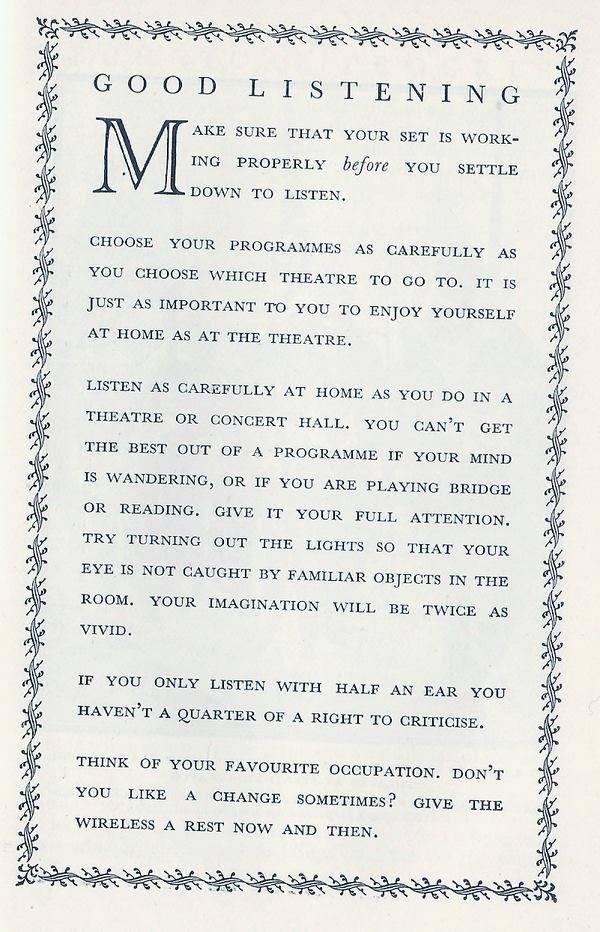
How to listen: A 1930 BBC radio manual

BBC-Radio-Manual

Many thanks to David Goren for sharing this article from Open Culture:

A comparison between the invention of radio and that of the Internet need not be a strained or superfical exercise. Parallels abound. The communication tool that first drew the world together with news, drama, and music took shape in a small but crowded field of amateur enthusiasts, engineers and physicists, military strategists, and competing corporate interests. In 1920, the technology emerged fully into the consumer sector with the first commercial broadcast by Westinghouse’s KDKA station in Pittsburgh on November 2, Election Day. By 1924, the U.S. had 600 commercial stations around the country, and in 1927, the model spread across the Atlantic when the British Broadcasting Corporation (the BBC) succeeded the British Broadcasting Company, formerly an extension of the Post Office.

Unlike the Wild West frontier of U.S. radio, since its 1922 inception the BBC operated under a centralized command structure that, paradoxically, fostered some very egalitarian attitudes to broadcasting—in certain respects. In others, however, the BBC, led by “conscientious founder” Lord John Reith, took on the task of providing its listeners with “elevating and educative” material, particularly avant garde music like the work of Arnold Schoenberg and the Second Viennese School. The BBC, writes David Stubbs in Fear of Music, “were prepared to be quite bold in their broadcasting policy, making a point of including ‘futurist’ or ‘art music,’ as they termed it.” As you might imagine, “listeners proved a little recalcitrant in the face of this highbrow policy.”

Continue reading…


Editor in Chief leaves Radio Netherlands

RNWMany thanks to Jonathan Marks, who shares this article from the populist Dutch daily newspaper De Telegraaf on Saturday.

If you can’t read Dutch, here’s a link to the article via Google Translate.

I believe RNW has struggled with identity and purpose since abandoning  all radio broadcasting and most programming in 2012. I’m still confused as to why they dropped The State We’re In; an award-winning program which had a loyal listenership and could have stood on its own.