Category Archives: Broadcasters

Washington Post: VOA needs to keep an “objective voice”

Many thanks to Richard Cuff for sharing this editorial from the Washington Post:

WashingtonPostLogo(Source: Washington Post)

AS AUTHORITARIAN states such as Russia and China ramp up well-funded and sophisticated global propaganda operations, U.S. officials and members of Congress fret that the U.S. government’s information operations are lagging behind. […]

A bipartisan bill headed for the House floor after more than a year of study and drafting would tackle some of these problems. But it also would take a dangerous step toward converting the most venerable and listened-to U.S. outlet, Voice of America, into another official mouthpiece.[…]

The bill sponsored by House Foreign Affairs Committee Chairman Edward R. Royce (R-Calif.) and ranking Democrat Eliot L. Engel (N.Y.) would refocus VOA on reporting “United States and international news and information,” which might eliminate some of the overlap. It also would usefully reorganize the management of the surrogates, combining them into one non-federal entity called the Freedom News Network and creating an independent governing board similar to the one that directs the National Endowment for Democracy.

However, the bill would define VOA as an instrument of U.S. “public diplomacy,” fold it into a new United States International Communications Agency and require programming that “is consistent with and promotes the broad foreign policies of the United States.” Quarterly meetings would be required with the State Department undersecretary charged with directing public diplomacy. This mandate inevitably would conflict with VOA’s historic mission of producing “accurate, objective and comprehensive news”; how could stories about controversial subjects such as the Guantanamo Bay prison or National Security Agency spying be “objective” and supportive of U.S. policy? The result could be an exodus of VOA’s best journalists and a steep drop in its credibility with international audiences.

[…]The United States will never beat China and Russia in the game of official propaganda, but it can win the war of ideas — if it doesn’t lose faith in its own principles.

Read the full editorial at the Washington Post website.
Shortwave Radio Recordings: Radio New Zealand International (DRM)

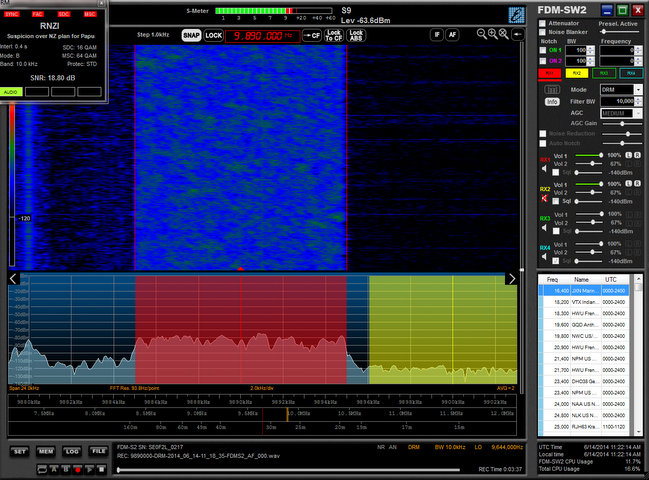
This morning, while scanning the 31 meter band, I noticed a DRM (Digital Radio Mondiale) signal on 9,890 kHz. Normally, I ignore most DRM signals because the amount of signal strength needed to properly decode the mode (here in the US) is simply too low for pleasant, artifact-free copy.

Still, I thought I’d give the new Elad FDM-S2 a try, so I changed mode from AM to DRM.

RNZI-DRM-003To my amazement, the FDM-S2 quickly decoded the signal and produced excellent audio from Radio New Zealand International.

I assumed the decoding lock would not hold, but I was wrong; indeed, I believe there were only one or two significant drops in the 40+ minutes I listened. This may be a very good sign from the FDM-S2, even if propagation was above average.

I’m not a big DRM listener, but that’s mainly because there is so little to hear on the bands. The real test will be All India Radio in DRM–I’ve never managed to get a consistent lock on them from here in eastern North America.

Still, I’m pleased as punch that I can so easily copy RNZI–one of my favorite international broadcasters–in DRM.

Here’s a recording of the broadcast starting at 11:18 UTC on June 14, 2014. Click here to download the the recording as an MP3, or simply listen via the embedded player below:

The state of the Broadcasting Board of Governors (BBG)


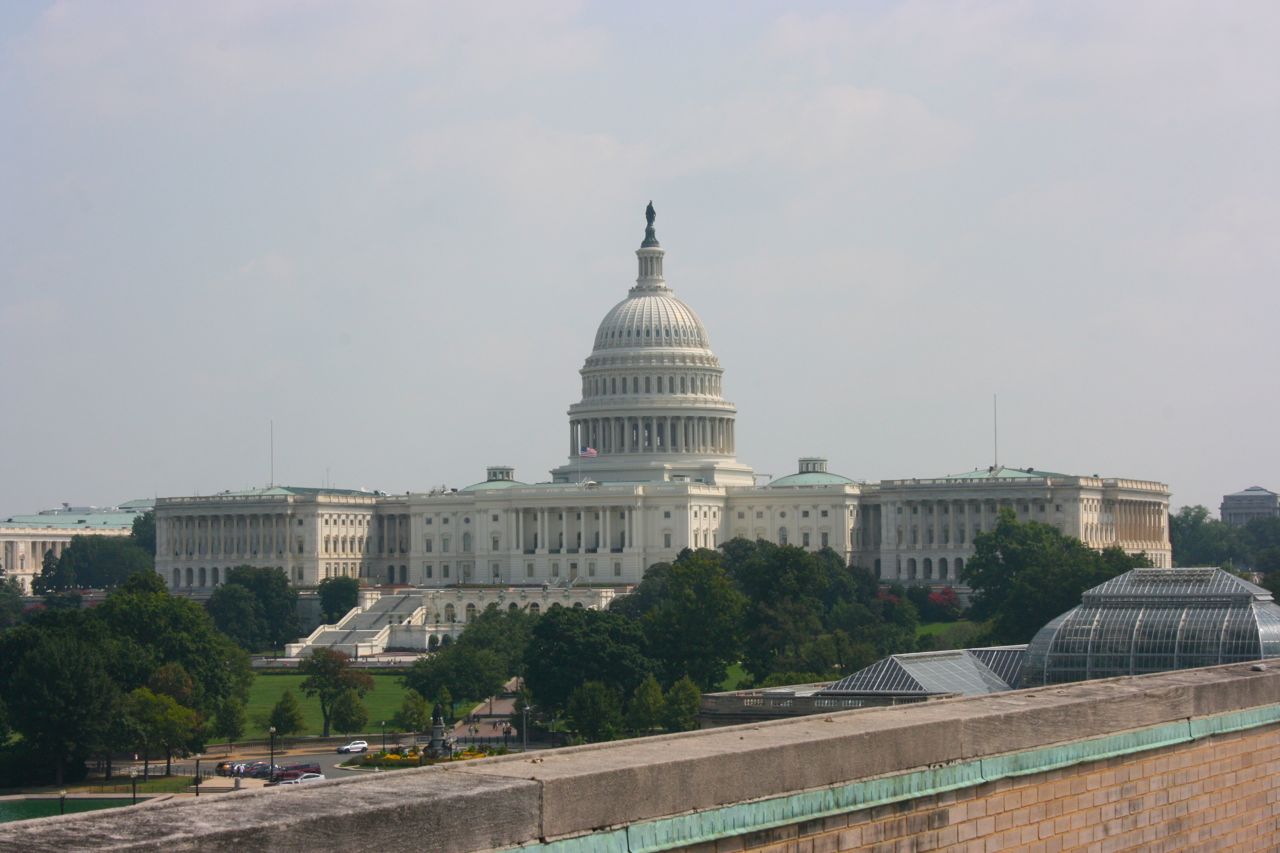
View of the Capitol Building from the roof of the Voice of America on 330 Independence Ave., S.W.

View of the Capitol Building from the roof of the Voice of America on 330 Independence Ave., S.W.

Many thanks to SWLing Post reader, Lyle, for sharing this article from Radio World which takes an in-depth look at the state of US International Broadcasting and poses the question, “How effective is the BBG in 2014?”

Shortwave Radio Recordings: the Voice of Greece, one year on

Last night, while learning the ropes of the new Elad FDM-S2, I noticed some great music on 9,420 kHz, the former Voice of Greece frequency.

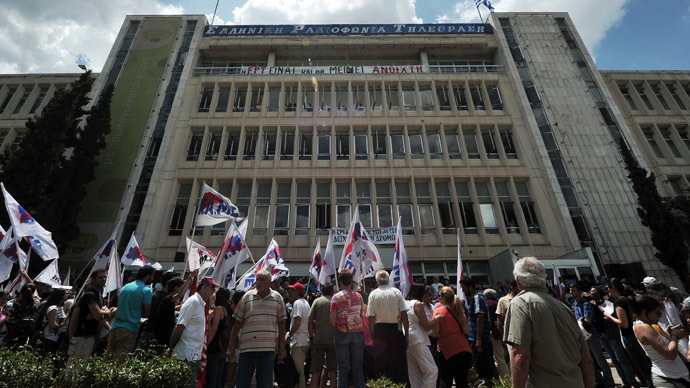
GREECE-ECONOMY-MEDIAIt was then that I realized yesterday (June 11) marked the one year anniversary of the day that the Greek government shut down ERT and the Voice of Greece. If interested, click here for some audio I recorded that very night.
Amazingly, one year later, 9,420 kHz is still active out of the Avlis transmitter site and last night, the Radio Station of Macedonia (a.k.a., ERT 3) was playing an excellent mix of Greek music and jazz.

Click here to listen to the 51 minute recording, made with the Elad FDM-S2 software defined receiver, starting at 00:50 UTC:

You’ll note great audio fidelity and a low noise floor despite the numerous static crashes present from area thunderstorms. (Note that I did not have DSP noise reduction nor the noise blanker engaged.) I started the recording in standard AM mode, then changed it to AM synchronous detection between songs in the first half of the recording.

Pirate Radio Recordings: Tip & Elvis Show

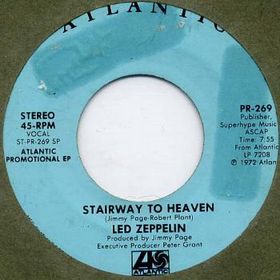
Led Zepplin is one of the many artists you'll hear on this pirate broadcast.

Led Zepplin is one of the many artists you’ll hear on this pirate broadcast.

For your listening pleasure: over two hours of the Tip and Elvis Show. This Euro pirate  broadcast was recorded by Shortwave Radio Audio Archive contributor, Frank.

Tip and Elvis was broadcasting on 6,220 kHz in AM–you’ll hear some adjacent digital interference, but signal strength is pretty good for (most likely low power) pirate radio. This recording starts around 20:30 GMT on May 31, 2014.

Click here to download the recording as an MP3 or simply listen via the embedded player below:

“I listen to NPR…on my shortwave radio”

npr_logoLast year, National Public Radio (NPR) asked listeners when and how they listen to NPR. Their goal was to put together clips into a short spot for the network’s spring fund drive. After telling them that I’ve been known to listen to NPR on shortwave, they asked for me to record a short clip stating this fact. I amiably complied.

Last week, I rediscovered the clip. The spot would have been aired on local member stations in the first half of 2013:

Have you listened to NPR on shortwave? Both the American Forces Network and Radio Australia broadcast NPR news content.

Remembering Radio Beijing: 25th anniversary of the Tiananmen Square massacre

A long shot of the iconic "Tank Man" on Tiananmen Square. Photographer: Stuart Franklin

A long shot of the iconic “Tank Man” on Tiananmen Square. Photographer: Stuart Franklin

Today is the 25th anniversary of the horrible events that took place in Beijing’s Tiananmen Square on June 4, 1989, during which Chinese troops opened fire on unarmed student demonstrators.

In this off-air shortwave radio recording of Radio Beijing, made on June 3rd, 1989, you’ll hear the news reader/editor depart from the script and comment on the massacre of protestors in Tiananmen Square:

It’s believed this brave news editor was detained shortly after the broadcast and spent years in a detention (re-training) camp.

Rest assured, you will hear no mention of the Tiananmen Square protests on China Radio International today–even though this year marks the 25th anniversary of the event. China’s state media goes to great lengths to keep this sort of on-air protest from happening again. State media even tries to limit on-line research of the protests; last year, we posted a fascinating article which listed banned search engine terms in China.

I also encourage you to check out Jonathan Marks’ comments (from a broadcaster’s perspective) on this particular Radio Beijing broadcast.