Shortwave listening and everything radio including reviews, broadcasting, ham radio, field operation, DXing, maker kits, travel, emergency gear, events, and more
Amid all the changes in television and digital media, a report from Nielsen released Tuesday found that radio’s nationwide audience reached an all-time high during the second quarter of 2015.
According to Nielsen, about 245 million Americans ages 12 and up used radio during the that span.
It was a continuation of an upward trend for radio, which has seen its national audience swell to record highs in each of the last two years. In the first quarter of this year, radio eclipsed television as the country’s top reaching medium.
“It’s a great radio with top FM, AM, and speaker sound. It blows away my C.Crane Radio-2E. Lack of illumination, however, makes it less than ideal as a bedside clock radio.”
Many thanks to Joris van Scheindelen (PE1KTH)–an SWLing Post contributor from the Netherlands–for the following guest post:
High Tech AM-FM DSP Receiver From
The old mode AM is still an interesting mode for amateur radio communication, also in amplitude CW.
Building your receiver is not difficult and quite fun. The semiconductor industry makes interesting integrated receiver chips today that will be useful for an AM receiver. Not only for broadcast reception but also for amateur AM reception or as part of an AM transceiver.
Silicon Labs also makes Si4734/35 receivers; these need a CPU to control the receiver, but are of interest for amateur use because the frequency can be tuned in 1 KHz steps and the audio channel bandwidth in 7 steps. There is no need for the transmitter to be on the receiving channel…
Si4835 AM-FM receiver
Looking for a small SW broadcast receiver design, and pocket size, I came to the excellent range of modern DSP receivers in a single chip from Slicon Labs.
I made a test bed set up has been made for the Si4835 AM-FM receiver.
The target specification was:
minimal components,
no micro-controller,
low power,
backlash free mechanical tuning,
good sensitivity,
earphone,
robust housing,
a short and small antenna system for outdoor use,
and minimal controls.
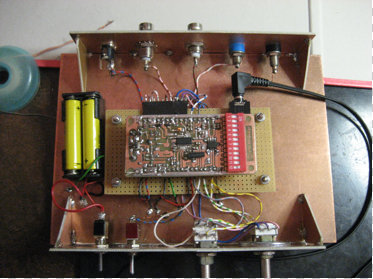
The Si4835 makes miniature design possible on a PCB (see photo Figure 1).
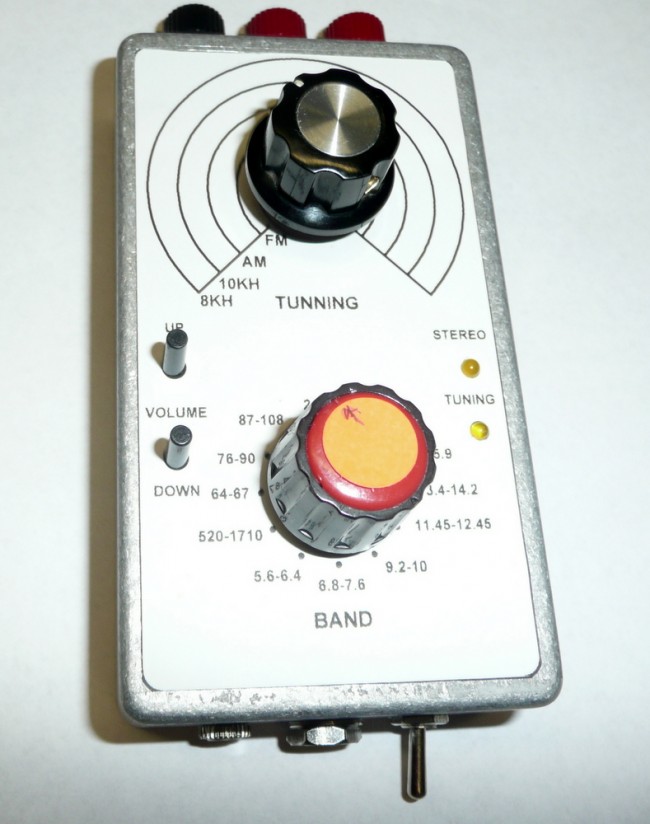
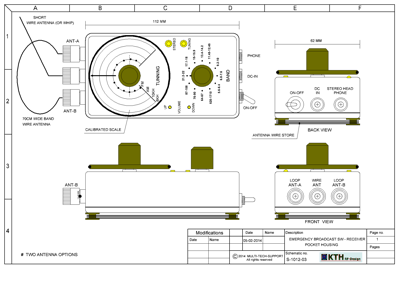
The red Dip (band) switch was replaced by a rotary switch in the final receiver design (Figure 4).
The receiver power is minimal 2 x 1.2 = 2.4 volts or a one cell LI-ION accu.
5 volts is the maximum for the Si4835 chip; current consumption is 30 mA.
Fig 1. Testbed setup for the Si4835.
The receiver has an RF pre-amplifier transistor and the LF amplifier is the TDA7050T.
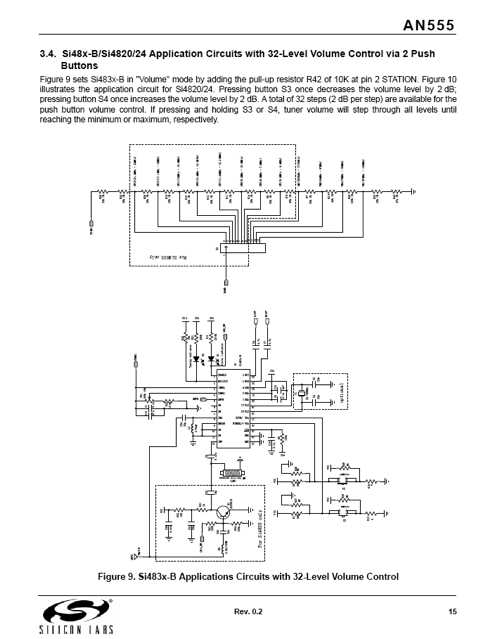
All receiver functions are in the chip; the schematic is very simple and can be built with minimal components (see schematic appnote AN555 Fig 2. below).
Only an LF amplifier has to be added to complete the receiver.
Fig 2. Receiver schematic Si4835 in the AN555 application note.
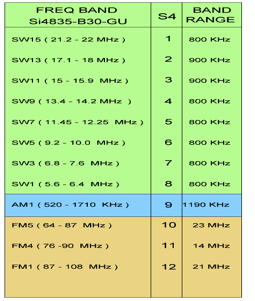
The Si4835 receiver has the following frequency bands–they are divided in sub bands 800 or 900 KHz wide (See Figure 3). The frequency step tuning is 10 kHz on AM, following the international broadcast raster standard.
Fig 3. Si4835 receiver sub bands.
This means there are 80 or 90 receive channels in the sub bands and make finding the BC stations on the scale more easy. The 10 KHz scale steps are linear. The frequency stability is locked to the 32 kHz X-tal via the synthesizer so there is no frequency drift. The AM LF audio channel is 5 kHz wide set by the DSP filter. Volume control can be done width 2 up-down push switches or by a LF potentiometer..
Fig 4. The experimental pocket aluminium receiver housing on PCB2.
Receiving results
I have been testing many hours and I am surprised about this little receiver.
The receiving results are excellent on FM and AM and signals of 2 -3 uV are well received.
Also the audio quality is good–especially on FM. As can be seen in the frequency table the 40 and 20 meter band are in the range. Clear AM phone amateur transmission has been received when the transmitter was tuned on the 10 kHz raster in 40 meter band on AM.
Also AM modulated CW signals can be received bud not un-modulated carrier CW–they sound “plop…plop”.
The 5 kHz wide LF channel is a bid too wide so many CW signals pass through the audio at the time, but if AM modulated that should not be a serious problem.
The broadcast stations in the SW bands (when the daytime conditions are good) up to 20 MHz are good and strong.
Conclusions
The Si4835 receiver can be a fine broadcast receiver for outdoor work and if an AM transmitter is tuned in the 10 kHz raster this receiver can also used for amateur phone reception.
Addendum: The Si4734/35 is a better amateur AM Receiver
The Si4734 and Si4735 are a better receiver choice for amateur AM purpose because the frequency tuning can be done in 1 kHz steps. Also the BW of the LF channel can be adjusted to 1 kHz wide.
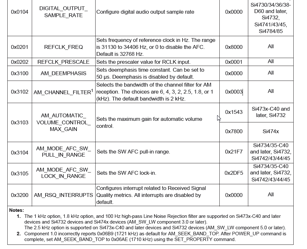
In Fig 5. from the programming APP note you see the code 0X3102 AM CHANNEL_FILTER it is possible to adjust the audio width by sending this code to the Si4734/35.
Fig 5. From the programming APP note
The LF bandwidth can be set on 1, 1.8, 2.5, 2, 3, 4 and 6 kHz wide.
This is excellent for modulated CW and AM phone discrimination in the audio channel.
The disadvantage is the need of an CPU and LCD display, “away from a minimalistic design”.
See also the note 1 and 2 improved 100 Hz rejection. See data sheet of the Si4734/35.
It look like that this receiver is a good receiver for building a modern AM-(AM)CW receiver or in a transceiver application. Tuning can be done digitally.
Think about this receiver [and the Si4835 chipset] when you intent to build a high tech AM – T/RX.
73 ‘ Joris van Scheindelen PE1KTH
What a fantastic home-brew receiver, Joris! I love the simple design of your receiver and the fact that it’s quite portable. Thanks so much for sharing your notes and documentation.
Before this latest hiking expedition, Dennis spent many hours pouring over the Virtual Radio Challenge III entries, looking up weights and specifications of radio gear and accessories…And the upshot? He’s chosen a winner of our Reader Challenge.
Again, in summary, a participant’s goal was to find the best and most portable radio gear to receive shortwave, AM (medium wave), FM, and NOAA weather to support a long through-hike on the Appalachian Trail, to plan each day’s hike, and to make accommodations for frequent spring and summer thunderstorms (as well as occasional spring snow or sleet)…all for a budget of $300 US. [Read full details of the Challenge by clicking here.]
Below are Dennis’ comments, along with those of the Challenge winner.
Dennis Blanchard (K1YPP) writes:
Dennis Blanchard operating a portable radio on the Appalachian Trail. (Photo: K1YPP)
I’ve just spent about five hours going over the entries. There are several that are very good…indeed, Challenge participants obviously put lots of thought into their entries.
It was really tough to decide, but I had to go with most practical.
Weight is a big consideration for me, and that leaves out solar panels, hand crank generators, and the like.
What most don’t realize is that the AT has a nickname: “The Long Green Tunnel.” This eliminates solar panels because there is little sun to be had, as you’re in the shade most of the time. By the time you get to camp it is usually too late in the day for any charging, and wearing a panel just doesn’t do any good because of the shade (and weight).
Not only is weight an issue, so is space in the pack…hikers need all the room they can get for food, and in the cooler weather, heavy clothes.
Anyway, out of five finalists, I would have to go with Eric McFadden (WD8RIF).
Eric’s winning entry
So, what did Eric choose? The following is Eric’s winning entry, beginning with his radio choice and following with a clear, practical explanation for it:
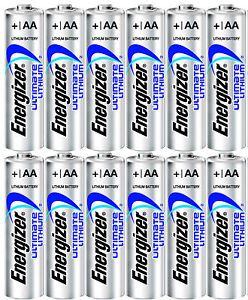
Energizer L91 Ultimate Lithium Cells, AA, 12-pack, $17.45 at Amazon
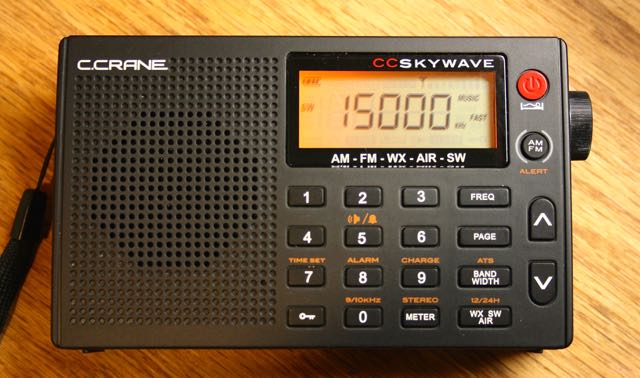
“The C.Crane Skywave is small (4.75″ x 3″ x 1.1″); light (5.5oz); power-stingy (30mA with headphones); and receives AM, FM, SW, NOAA Weather, and VHF Aviation.The Skywave runs on two AA cells, and comes with a case and CC Earbuds.
The Energizer L91 Ultimate Lithium AA cells provide 1.5v at approximately 3000m Ah, weigh 1/3 that of an alkaline AA cell, and last several times longer than an alkaline cell.
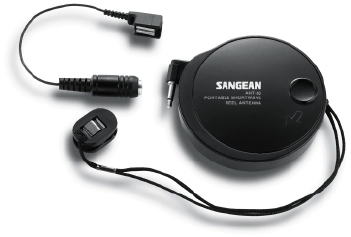
The Sangean ANT-60 would be tossed over a handy tree-limb and clipped to the Skywave’s whip antenna when the Skywave’s built-in 16″ whip isn’t quite adequate for listening to a shortwave broadcast station.
The purchase price of the Skywave, six pairs of Ultimate Lithium AA cells, and ANT-60 would be about $121 plus shipping, well under the $300 limit. The entire station should be small enough and light enough for easy carry in a backpack. If the twelve Ultimate Lithium AA cells don’t last the entire hike, enough of the budgeted $300 remains to purchase more cells (either Ultimate Lithium or alkaline, as available) along the route.”
To this sensible explanation, Eric adds:
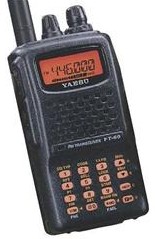
“Being a ham radio operator, I’d want to have a ham rig along, too. While I’d love to be able to operate HF CW along the AT, my Elecraft KX3 is too large and heavy to carry that far. However, my current Yaesu FT-60R 2m/70cm HT and Diamond SRH77CA whip should travel nicely clipped to a backpack strap and would serve as a back-up receiver for NOAA Weather and be available for pedestrian-mobile QSOs (chats) and calls for help, if needed.
In order to save weight and not have to hassle with charging batteries, I’d leave the NiMH pack at home and carry the FBA-25 six-cell AA holder and stuff it with additional Energizer Ultimate Lithium cells in order to save weight.
Since the C.Crane Skywave already meets all the requirements of the Virtual Challenge, and since I already own the HT, battery holder, and antenna, I won’t consider the cost of the HT, antenna, and batteries as part of the challenge.”
About Eric’s entry, Dennis notes:
Eric’s solution is small, lightweight, and does everything needed. He speculates that he would also bring along his Yaesu FT-60R, but didn’t feel he could include it because of cost. Curious, I looked it up on Amazon; should he take it along, this addition would still keep his total well under the $300.00 limit.
This would provide Eric with two receivers, [the ability to enjoy] ham radio communications, and not much weight to haul. He includes the AA Lithiums, and I have to say that, without a doubt, these are the finest hiking batteries out there: they’re light, last forever, and are readily obtainable. I only had to change mine out once on the entire, six-month AT hike, and I was on the air a lot.
Several of the other entries were winners also great; I basically had to use a dartboard to pick a winner. Good thinkers out there, especially considering none of them have actually ever done a hike of this magnitude.
Congrats, Eric! Thanks, Dennis! And more to come…
Congratulations to Eric McFadden for such a well thought-through entry!
I must say, I don’t envy Dennis in making this selection: it was obviously a challenging process on his end, too, and I’m glad I didn’t have to make it!
Dennis informed me that he plans to post and comment on some of his favorite entries in a few weeks, once he completes this latest multi-week hike. We will, of course, post his comments along with the finalist entries.
Note that when I originally received the reader inquiry which prompted the idea behind this Reader Challenge, the CC Skywave had not yet entered the market. Yet several of you chose it as your sidekick for the Appalachian Trail; clearly, clever minds think alike. Obviously, a radio that would function well on the Appalachian Trail would also be a great radio for your BOB (“bug out bag”), go kit or emergency supplies.
Thanks again to Dennis Blanchard, our intrepid judge, thanks to Universal Radio for the great prize, and many, many thanks to all our Reader Challenge participants, who made this process even more exciting and challenging! Meanwhile, don’t worry if you didn’t win the CountyComm GP5/SSB this time; we’ll soon have another opportunity to win one of these handy rigs in a completely different–and fun!–way.
Many thanks to SWLing Post reader, David Iurescia, who shares this news and audio report via the Radio Praha website:
“10:55 on Thursday morning was an important occasion in the history of radio in the Czech Republic as it was the exact moment that full digital broadcasting was launched in the country. The new network carries nine Czech Radio stations, some of which were previously only accessible online. For now the service is just available in the capital and Central Bohemia, but there are plans to roll it out to other parts of the country in the next few years.”
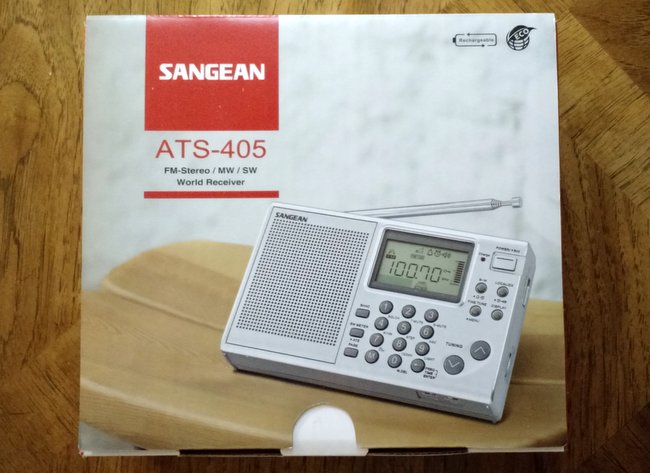
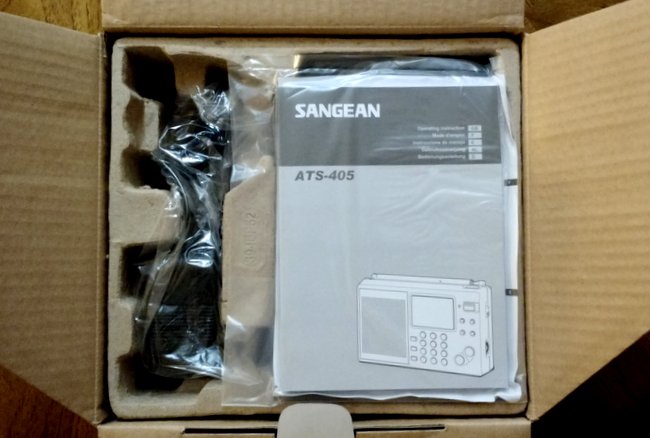
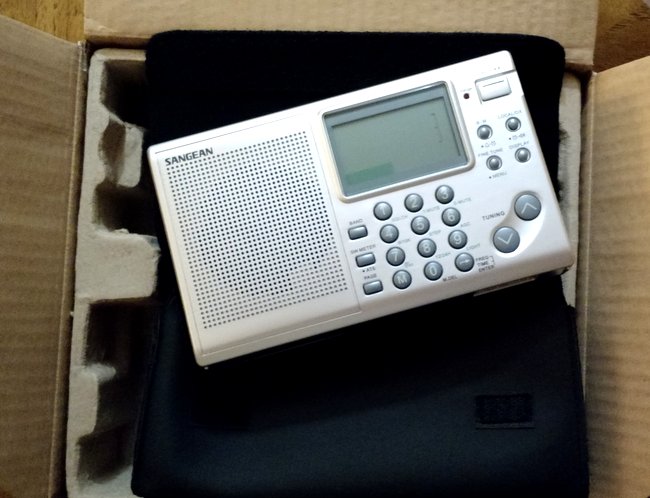
Just last week, I received the new Sangean ATS-405 on loan from Universal Radio. Though I’ve only had the radio for a week, I thought I’d share a few un-boxing photos (by request) and my initial impressions/review of this radio.
Unboxing
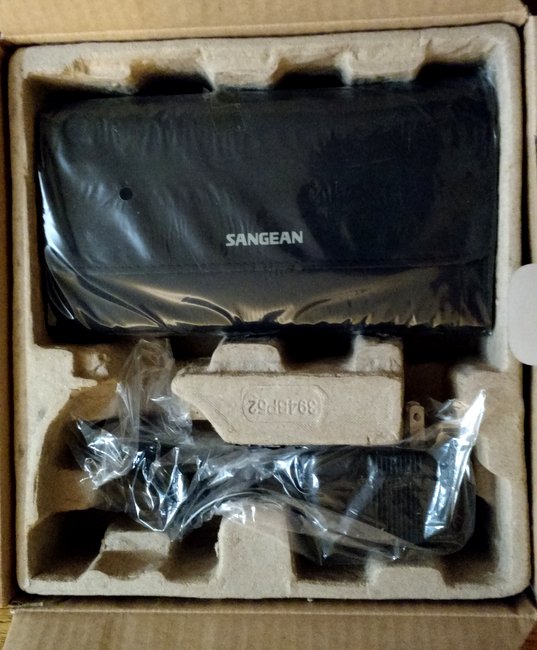
The ATS-405 comes with a thick owner’s manual (in five languages), a 7.5 volt AC adapter, and a soft radio case. The package does not contain rechargeable batteries nor a clip-on wire antenna (like many Tecsun products do, for example).
Overall, the packaging accommodates the radio and accessories efficiently and would probably ship safely even if the carrier doesn’t handle it with particular care.
The first thing I noticed about the ATS-405 is the near-identical design and layout Sangean has used in their design of past shortwave radios. If you’re a Sangean fan, you’ll find all of the functions, buttons, and labels pretty much in the same place; virtually no learning curve.
Performance: first impressions
After unboxing the ATS-405, I installed a fresh set of AA batteries in it and turned on the radio…
Display
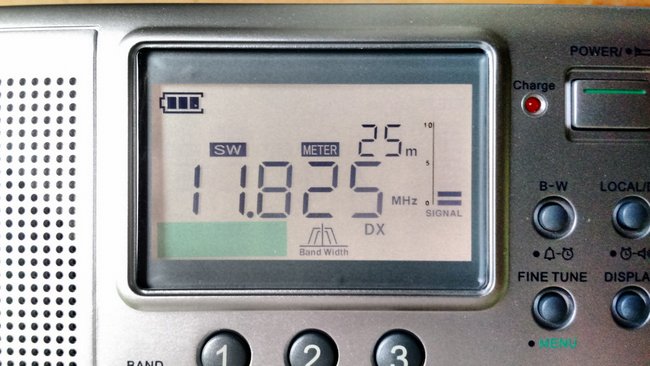
Like most Sangeans, the display is crisp, clear and can easily be read straight-on or at low angles, like when the radio is resting on its back stand, for example. If you look at the display from a higher angle, however, you’ll find that the LCD digits nearly disappear.
Back-lighting is perfect: it’s soft and consistent across the display, very much like the ATS-909X.
Audio
Audio from the internal speaker is good. It’s in the same league with most similarly-priced competitors.
Receiver performance
Keeping in mind that I’ve only logged a few days of listening time on the ATS-405, I do have some initial impressions about receiver performance across the bands:
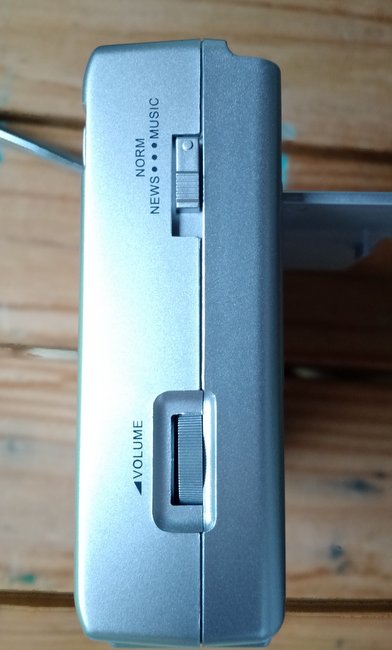
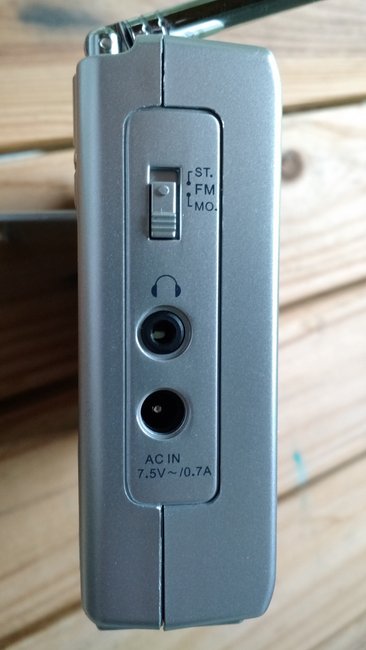
Right side view (click to enlarge)
FM
On a positive note, I believe FM performance is quite good. Perhaps not in the same league with my PL-660 or PL-680, but still the Sangean offers above-average sensitivity. I was able to pick up my distant benchmark FM stations with ease, though to help with the signal lock, I had to switch from stereo to mono reception.
AM/Mediumwave
AM reception is a bit of a mixed bag. I find that the ‘405’s overall sensitivity and selectivity are quite good for broadcast band listening.
When I first tuned around on the AM broadcast band, however, I found the noise floor a little too high. Regardless of whether I was tuned in to a station or not, there was an ever-present high-pitched hiss, like static. It was quite disappointing, especially since I read a review by Jay Allen that really complimented the AM performance on the ATS-405.
I trust Jay’s reviews, however, so I promptly contacted him. Jay pointed out that the problem may be that I was listening in the default “wide” filter setting on AM. And indeed, he was right–though I had changed filter settings a few times while tuned to local stations, I had moved it back to wide and didn’t make note of this. (The ATS-405, by the way, has three filter settings: wide, medium and narrow.)
Left side view (click to enlarge)
But the wide setting is really too wide, and was certainly the source for the bulk of the high-pitched hiss I heard. The best filter setting for most broadcast band listening is the middle position, which sounds like a 5-6 kHz filter. In the middle position, noise is decreased significantly. I also believe selecting the “music” audio tone setting helps dissipate some of the noise.
Regarding the noise floor: to be clear, I still feel like the noise level is slightly more noticeable, to my ear, on the ATS-405 than on the PL-660, PL-600, and PL-310ET when band-scanning or weak signal listening. This is most likely some internally-generated noise that somehow still meets Sangean’s engineering spec.
Local AM stations sound fantastic, and the ATS-405 can detect all of my benchmarks. AM audio fidelity is better than that of my PL-660 and, even, PL-310ET. When locked on a local station, the noise floor also seems to disappear. For some reason, I even find that the ATS-405 does a better job receiving local AM stations from indoors–even near noisy electronics–than other sub-$100 portables with which I’m familiar.
Uh-oh, birdies
The most disappointing discovery I made on the Sangean’s AM broadcast band is that it has DSP birdies. Birdies are internally-generated noises resulting from the outputs of the oscillators that form part of the DSP receiver circuit. While almost all receivers do have birdies somewhere in the receiver’s reception range, radio engineers try to keep them out of the way of the important parts of the band.
Unfortunately, my ATS-405 has strong DSP birdies on 800 and 1600 kHz. This is a big negative for me, since my favorite regional AM broadcast station is located on 1600 kHz (WTZQ). Rather than attempting to describe what the birdies sound like, here are a few audio clips that will give you an idea–I start with 1350 AM, which has no birdies and is representative of good AM reception:
WZGM 1350 kHz (broadcast sample with no birdie):
800 kHz (birdie on frequency with no broadcast signal):
WTZQ 1600 kHz (birdie on broadcast signal):
The ATS-405’s birdies almost sound like a jamming signal on 1600 kHz. Indeed, if this station were only located on a different frequency, I’m sure it would be quite audible on this radio…too bad.
Birdies on 800 and 1600 kHz may very well be deal-breakers for many of us. Again, since one of my favorite regional independent broadcasters is on 1600 kHz, it’s a deal-breaker for me.
Jay specifically mentioned a lack of birdies on the AM broadcast band in his review. It could very well be that he doesn’t hear them on his particular receiver–variations in quality control on a radio production line are certainly a real phenomena (the Grundig G3 is a case in point). This could indicate that some units may have pronounced birdies while others don’t. If you purchase an ATS-405, I would check to see if your unit has birdies after powering it up.
When I contacted an engineer for Sangean North America, and described my listening experience, he confirmed that he believed these are, indeed, DSP birdies. I may ask Sangean if they can send another ATS-405 for comparison.
On a more positive note, I checked harmonics in the HF/shortwave bands and heard no DSP birdies there.
Country of origin?
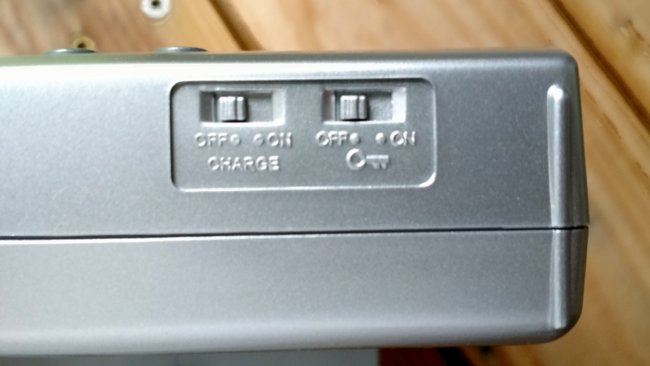
Bottom view with charge and keylock mechanical switches (click to enlarge)
One additional question I posed to Sangean: where is the ATS-405 made? One reader told me the radios are produced in both Taiwan and China. Thinking variations in quality control may be accounted for by two different production lines, I checked my radio to see where it was made. Unfortunately, my unit has no mention of country of origin; not on the radio, the box, the manual, behind the battery cover, nor on the back stand. It’s possible it could be marked internally, but I didn’t want to take apart a receiver I’ve been loaned.
Sangean came back with a firm answer:
“I can confirm that the ATS-405, along with all our radios, are manufactured in China. We have an office in Taipei for engineering, sales, marketing and customer support.”
Not a big surprise here; I expected China was the country of origin.
To sum up AM performance: if you aren’t bothered by the birdies on 800 and 1600 kHz, or if your unit isn’t producing them, you’ll find the ATS-405 a capable little AM broadcast band receiver.
Shortwave
Our HF propagation conditions since last Friday (when I first turned on the ATS-405) have been poor. Other than a few short band openings, I’ve struggled to hear anything other than the normal blow-torch broadcasters we hear in North America. Still, bad propagation conditions are actually good for reviewing some aspects of a shortwave receiver, so I used the opportunity.
In terms of sensitivity on the shortwave bands, I think the ATS-405 is mediocre. It lags behind my Tecsun PL-660, PL-600, PL-310ET, and CC Skywave. Adding a clip-on wire antenna to the telescoping whip (there is no aux antenna port) does help in terms of sensitivity.
Since I do most of my listening on the shortwave bands, this, too, is a deal-breaker for me. If you primarily listen to stronger shortwave stations, or spend most of your time on the FM/AM bands, then you might still consider the ATS-405.
The ATS-405’s selectivity seems to be on par with my other DSP-based portables. In truth, though, band conditions have been so unfavorable, I don’t feel like I’ve had ample opportunity to test selectivity. I’ll likely follow up this initial review with an update.
And as on medium wave, the noise floor on the shortwave bands seems a little high to me–especially with the filter set to the “wide” position.
Cool, innovative features
While I clearly haven’t been wowed by the ATS-405’s shortwave performance, I have been more favorably impressed with some of its innovative features: specifically, the ability to control squelch, tuning mute, and soft mute.
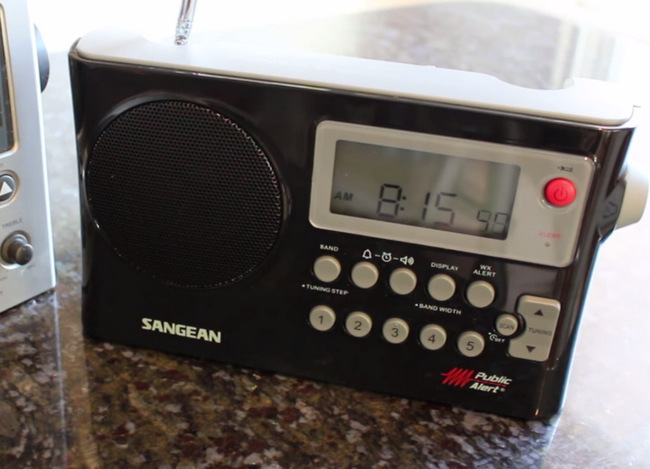
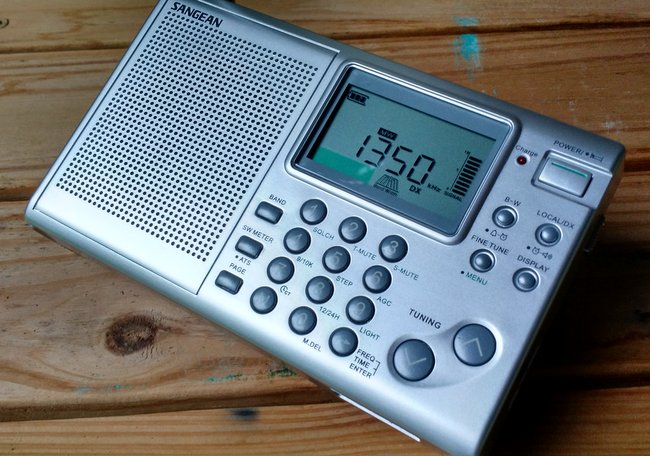
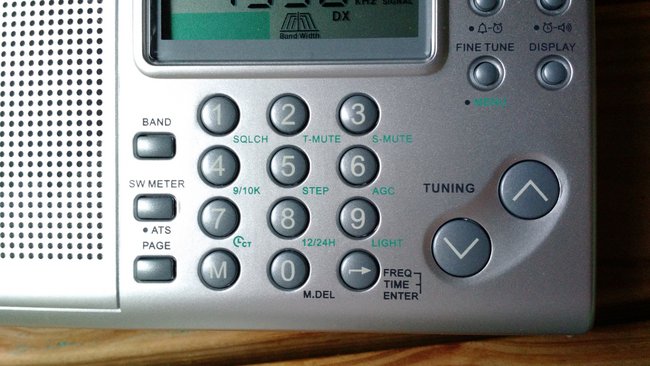
Using the menu button (see image above), you can engage or disengage the tuning mute and soft mute by pressing the “2” or “3” buttons on the keypad, then using the tuning up/down buttons to toggle these features on and off. Squelch works the same way, using the “1” button and volume control to set the threshold.
This menu control works regardless whether the radio is turned on or off.
Of course, by using the menu button and the keypad, you can also control the ‘405’s tuning steps, AGC, clock, and backlighting functionality; each of these are marked in green next to the appropriate button on the keypad (see image above), a very useful feature.
I wish other radio manufacturers would give users the ability to control some of the DSP chip’s built-in functionality, as the ‘405 does with the muting–especially since over-active soft muting has been the downfall of several DSP-based radios. Thanks for trail-blazing, Sangean!
Summary
Invariably, all radios have strengths and weaknesses; here is a list of my notes from the moment I put the ATS-405 on the air:
Pros:
Improved features and controls:
Soft Mute
Tuning Mute
Squelch
AGC
Crisp, clear display
Good travel size, similar to the Grundig YB400
Good AM/mediumwave sensitivity
Three audio/tone settings: Music, Norm, and News
Good FM sensitivity
Dedicated mechanical switches for keylock, audio tone, FM stereo/mono, and charging.
Cons:
Lackluster shortwave sensitivity
DSP Birdies on 800 and 1600 kHz
Higher SW/AM noise floor (especially in wide filter setting)
No tuning wheel
No AUX antenna port
No shortwave SSB reception (AM only)
No audio line-out port
I’m going to hold onto the Sangean ATS-405 for a few more weeks, as I’d like to give it a more thorough test on the shortwave bands. I hope to follow up with a post offering a few representative recordings.
My nutshell opinion of the ATS-405 so far is that it’s a decent little radio with a lot of functionality and features for a rig in its price class. But overall, its performance seems to me rather mediocre. If you primarily listen to FM, you’ll be pleased. If you’re a mediumwave listener, you’ll be pleased only if you don’t mind the 800/1600 kHz DSP birdies. If you’re primarily a shortwave listener, you’ll need to carry a clip-on wire antenna to bring the sensitivity up to the level of similarly-priced receivers.
In short, I do want to like this radio unreservedly. But it appears that Sangean may need to pull up its socks on their quality control. Readers: please comment if you’ve purchased the ATS-405–I’m very curious to learn whether there are QC discrepancies in performance from one unit to the next.
PLEASE NOTE: After publishing this following review, Sangean kindly agreed to dispatch a second unit for comparison.
“It was supposed to be the technology that would transform the way we listen to the radio.
But audiences condemned DAB – or Digital Audio Broadcasting – as a disaster yesterday because of the poor quality of the signal.
They complained that it cuts out in the middle of broadcasts, while others claim the technology is already out of date.
One even joked on Twitter that while we can now receive close-up photos of Pluto taken billions of miles away, he ‘still can’t get a good signal on DAB’.
DAB had been heralded as less prone to interference than AM or FM, but household appliances including microwave ovens, laptops, mobile phones and TVs have all been found to affect reception. Power lines and the weather can knock out digital signals, while signal strength can be reduced in built-up areas, in basements and inside buildings with thick stone or reinforced concrete walls.”




 Using the menu button (see image above), you can engage or disengage the tuning mute and soft mute by pressing the “2” or “3” buttons on the keypad, then using the tuning up/down buttons to toggle these features on and off. Squelch works the same way, using the “1” button and volume control to set the threshold.