Category Archives: Guest Posts

Guest Post: A “Horizontal DXer” explores the CC Skywave SSB and PL-880

Many thanks to SWLing Post contributor, Jock Elliott, who shares the following guest post:


Confessions of a horizontal DXer and some initial impressions of the Tecsun PL-880

by Jock Elliott

Back in the day when I wrote for Passport To World Band Radio, one of my favorite things to do, while my better half drifted off to sleep, was to clamp on a pair of headphones, lean back against the pillows, and mess around with a Sony 6800W shortwave receiver.

It wasn’t a radio that was built for band scanning: you had to rotate a dial to select the megahertz segment of the bands that you wanted, tune a built-in preselector to the appropriate area, and then dial in the frequency with a tuning knob. And memories? Ha! You want memories?!! There were no stinking memories . . . you had to remember what frequencies you wanted or at least what portions of the bands you wanted to tune. The memories were between your ears.

But it was a receiver with an extraordinarily low noise floor, and many a happy evening I enjoyed programming from half a world away. Drifting off to sleep with headphones piping in a signal from a distant land was not without its dangers, though. One night I fell asleep listening to the news from Radio Australia beamed, in English, to Papua, New Guinea. I woke a while later to the same newscast beamed to Papua, New Guinea, but this time in Pidgin English. I heard some English words, but the rest did not make sense. I panicked, thinking some neurologic event had scrambled my brain, but a crisp voice rescued me: “This has been the news in Pidgin English, from Radio Australia.” Thank God!

When Passport ceased publication, I neglected shortwave radio for over a decade, busy with freelance writing and running the Commuter Assistance Net on two meter ham radio.

Earlier this year, the SWLing bug bit me again, and I fired up a long-neglected Grundig Satellit 800 and started cruising around the HF frequencies. Many of the big-gun shortwave stations were gone, or they weren’t aiming programming at North America, but there was plenty to listen to, including shortwave stations, HF ham bands, and some utility stations.

Gee, I thought, it might be great to have a radio for a little horizontal in-bed DXing before shutting off the lights for the night . . . something I could hold in my lap, turn the tuning knob, and discover hidden treasures. The Satellit 800, emphatically, was not the answer. It is a large radio, roughly the size of the vaunted Zenith Transoceanic radios, and definitely not suited for laps.

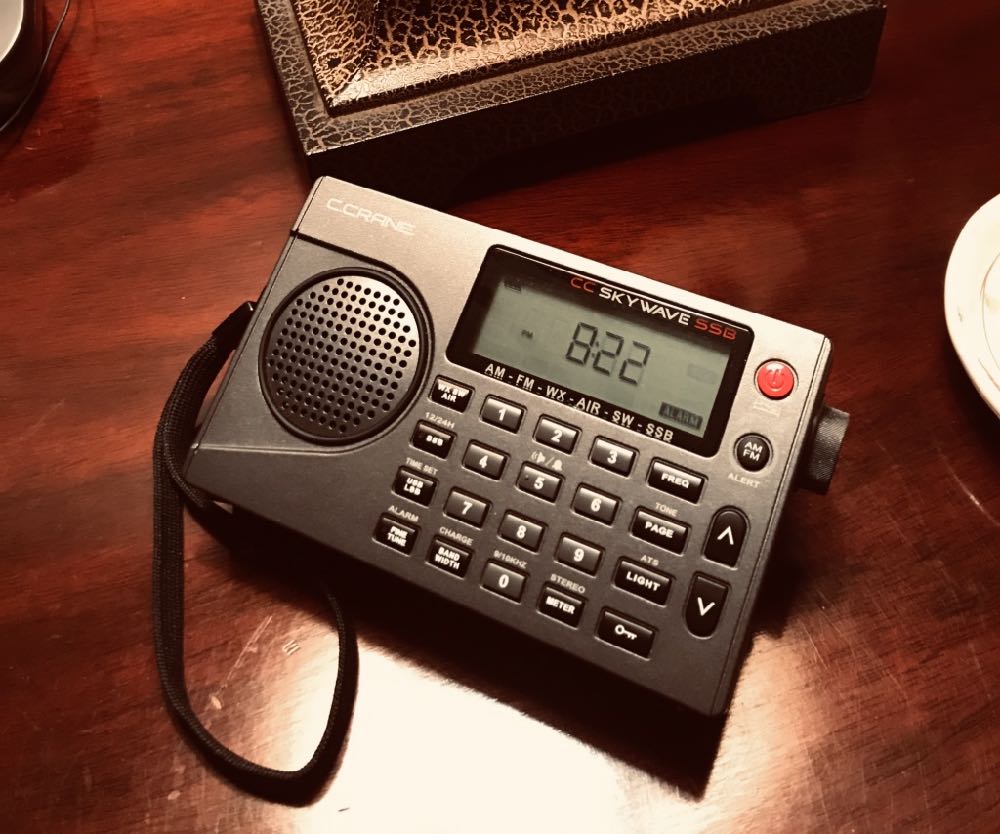
So, based on a great reputation and excellent reviews, I bought a CCrane Skywave SSB. The Skywave SSB is a powerhouse, offering AM, FM, Weather, Air, SW, and SSB in a package roughly the size of a deck of cards and perhaps twice as thick. And it delivers the goods, offering worthy performance on every band, although SW performance is greatly enhanced by attaching the wire antenna that is included with the Skywave SSB.

Two factors, I discovered, reduced the suitability of the Skywave SSB for bedside DXing. First, the tuning knob is really small, so you can’t just twirl your finger to traverse the bands. It also has click-detents on the tuning knob and muting between tuning steps, so the tuning is non-continuous, which diminishes the pleasure for me. So the drill becomes: use the automatic tuning system (ATS) to search the bands and store stations in memory and then use the keypad buttons to jump from stored station to stored station. Further, each keypad key makes a distinct “click” sound when properly depressed. And that brings us to the second factor: one night, I am attempting to explore the stations stored by the ATS when my bride, who was trying to doze off, taps me. “What?” I say. “Too much clicky-clicky,” she says. Oh, I thought; now I need to find a radio that is quiet, so long as I am wearing headphones.

Now, just to be clear: I would highly recommend the CCrane Skywave SSB (except for use next to a spouse who is attempting to sleep), particularly for traveling because it is so small and performs so well. To underscore the value of a shortwave-capable travel radio, some years ago, I spoke with a journalist who was in Russia when the Chernobyl nuclear disaster took place. Russian media were not reporting on it at all; he found out about Chernobyl by listening to the BBC on a shortwave radio he had tucked into his luggage, and he rapidly made plans to leave Russia.

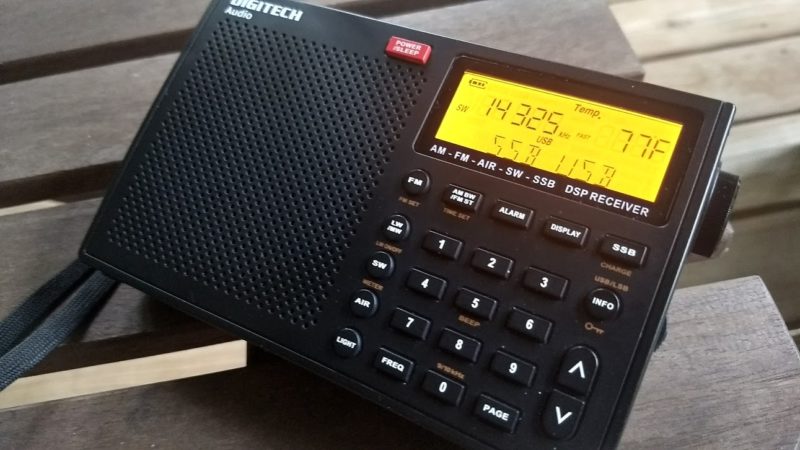
A bunch of research eventually led me to the Tecsun PL-880, which is about the size of a trade paperback book. According to some reviewers (including Dan Robinson), the 880 is a bit more sensitive and shortwave than the PL-990. The 880 offers a bunch of bandwidths on both AM and SSB, and the tuning is butter smooth with no muting or detents. The smallish tuning knob has a bit of knurling on the edge, which make it possible to twirl the knob with one finger; you can fine-tune SSB with another knob, and, with one button-press, use the tuning knob to select filter bandwidths or memory channels. In short, if you avoid the keypad, this is a radio that can be operated in near silence next to a better half who wishes to snooze.

The performance, so far, is exemplary; using the PL-880 whip antenna, I could readily hear Gander, Newfoundland, broadcasting aeronautical weather as well as Shannon, Ireland, air traffic controllers directing aircraft crossing the Atlantic Ocean. Yes! I haven’t yet begun to explore all that the PL-880 can do, but it promises to be a lot of fun.


Click here to read more posts by Jock Elliott.

Sam found where genealogy and radio meet

Many thanks to SWLing Post contributor, Sam Alcom (KB3DFJ), who shares the following guest post:


Genealogy and radio meet

by Sam Alcom (KB3DFJ)

Who knew two of my hobbies – genealogy and radio – would joyfully collide in such an unexpected way?

My grandfather died in the 1950s when I was just a few months old, so I didn’t know him, let alone have some misty recollection of him. Seemingly, our only connection was the DNA bloodline though my father.

But as I dove into my family’s history, one web search led me to William H. Alcorn and 3ADJ. What the heck was 3ADJ? I dug deeper and found Amateur Radio Stations of the United States, U.S. Department of Commerce, Radio Division from June 30, 1924. Both of us were hams!

He was licensed as amateur radio station 3ADJ in Port Norris, N.J. with authorization to operate up to 50 watts.

I found him and his 3ADJ callsign again listed in 1925 in the Department of Commerce, Bureau of Navigation, Radio Service publication. The “3” in his sign threw me for a brief loop, but I learned that in the early days of radio Southern New Jersey was part of the third call district along with Delaware, Maryland, Virginia, certain counties of Pennsylvania and the District of Columbia.

The worldradiohistory.com website, a goldmine for anyone delving into all aspects of broadcasting’s past, led me to more publications where I spied my grandfather in the late fall 1925 edition of Radio Listeners’ Guide and Call Book and the 1926 edition of Citizens’ Radio Call Book and Complete Radio Cyclopedia.

The last radio trace I find was in the June 30, 1927, edition of the Amateur Callbook.

It was around this time that the U.S.  began using “W” to start callsigns and I wondered if my grandfather continued with his radio hobby under the new designation. I looked up W2ADJ and found William Czak of West Brighton, N.Y., owning that sign. Likewise, W3ADJ belonged to the University of Maryland in College Park, Md. Both were from 1929.

I dug a little deeper to learn if he possibly had been an amateur prior to 1924, but I saw 3ADJ licensed to Horace Derby of Norfolk, VA., 1920 through 1923.

His amateur radio interest appears to have started sometime after 1921 and a stint in U.S. Navy as a Seaman Second Class and then seems to have waned – at least license-wise – as marriage and the first of my aunts, uncles and my dad were being born.  I wonder if my dad had known about his dad’s radio hobby. In all the years I’ve been a licensed ham and bono fide radio nerd, he never mentioned it.

Of course, learning on this radio connection to my grandfather raised a host of other questions. Did he enjoy CW as much as I do? What kind of contacts was he making with 50 watts? Would he have admired the WAS and DXCC award certificates hanging on my wall? Would my hefty binder of shortwave QSL cards impressed him?

So, I’ll keep poking, looking for more radio connections. Who knows, maybe, somewhere, there’s a 3ADJ QSL signed by my grandfather.

Jock satisfies his inner radio nerd with a deeper dive into NOAA weather radio

Many thanks to SWLing Post contributor, Jock Elliott, who shares the following guest post:

Perhaps the ultimate radio nerd story . . .

by Jock Elliott (KB2GOM)

Perhaps I am the only guy on planet earth with a “kinda” interest in DXing NOAA weather radio, but there you have it, and this led me down an interesting rabbit hole in the world of radio.

Earlier this year, I found myself in Sodus, NY, in the western part of the state, near the shores of Lake Ontario. I had with me the following: an Icom V80 2-meter handy-talkie with a sharply tuned commercial antenna that works great on my home repeater (146.94) in Troy, NY; a Uniden BC125AT scanner with a Diamond 77 antenna, and a CCrane Skywave SSB. All receive the NOAA weather channels.

In the early morning, I checked www.wunderground.com for weather in the Sodus area. Snow was expected overnight. So I grab the Uniden 125AT, activate the weather scan function, and found that it received NOAA weather radio channels 1, 2, and 3, and the audio sounded great through my headphones. I tried stepping through the weather radio channels on my Icom V80 and found that it received channels 1, 2, and 3, but with just a wee bit of static in the background. I tried switching the antennas between the 125AT and the V80, and there was no appreciable difference.

Now, here’s the interesting part: I tried the same trick on the CCrane Skywave SSB with its telescoping whip fully extended, and it received weather channel 1 just fine with excellent audio through the headphones. But channel 2 was way down in the soup, a hair above “barely audible.” I tried waving the Skywave around, point the whip antenna in different directions and orientations to see if I could improve the signal. I succeeded only in nulling it out. Weather radio channel 3 was not audible at all, but channel 4 was coming in well, and so was channel 7 . . . and the other two radios were not receiving channels 4 and 7 at all.

Frankly, I didn’t know what to make of this. To be clear, I was able to hear that forecast that I needed to hear — for Wayne County, NY — on all three radios. But why would there be such a stark difference between the CCrane Skywave SSB and the other two radios?

At this point, I was really curious what the answer might be.

The V80 and the 125AT “agreed” with each; both were receiving NOAA weather radio channels 1, 2, 3. The CCrane Skywave SSB appeared to be the anomaly, receiving channels 1, 2 (barely), and 4 and 7, which the V80 and 125AT did not receive.

Continue reading

Bill Rogers and the “Lost Radio”

Many thanks to SWLing Post contributor, Bill Rogers, for the following guest post:


“Lost Radio”

by Bill Rogers

When I was ten years old I lost my first wristwatch and my first radio. I think I have been trying to get them back ever since.

It was all part of a rather catastrophic family vacation trip around the Canadian side of Lake Huron, Port Huron across to Sarnia and then up around the shores of Georgian Bay all the way to Sault Sainte Marie and points north.

We had planned to go on around the north shore of Lake Superior too. We drove north to Wawa and saw the Goose statue. Then we headed north from there.

This was a long, long time ago, so I may misremember. But as I recall it, the Goose memorialized the completion of the Trans Canada Highway, and once past it you were really getting into the back end of beyond.

Not far past the Goose we came to what looked like a tollbooth, which surprised us. We hadn’t been aware there were any tolls along the Trans Canada. Dad pulled up and stopped.

“Hello,” the uniformed officer inside said. “Where ya going?”

“On around Superior.”

“Good. When do you expect to get to Thunder Bay?”

Dad was curious. “Why do you need to know?”

“Oh, for your own safety. So we know to send out a search if you don’t make it.”

Dad looked around and back at all of us. “I think we should head back instead.”

It was a wise choice. It had been a fun trip but it had a few challenges, so to speak.

We were five people in a white 1965 Dodge Coronet 440 pulling an old travel trailer we’d borrowed from one of my cousins. The Dodge was a comfortable car- it had an add-on air conditioning unit that occupied a good chunk of the space under the dashboard, and a radio (AM only of course) that worked well, and these were great luxuries at the time.

Dad had bought it used from his School District after it had served for a good while as a driver’s education car. First call on surplus vehicles was one of the benefits of working for the school district, but I don’t think being hammered by all those would-be new drivers had done the Dodge any good.

We’d borrowed the trailer. It was a heavy thing. The Dodge strained to pull it even though the car had a big V-8 engine. The trailer wasn’t big either. I remember wood paneling and too-small windows that kind of opened to let the inside heat and outside heat mingle when you stopped for the night and tried to sleep. Dad grumbled that the trailer weighed twice as much as a newer one would have.

Having borrowed a trailer to use one time only, Dad hadn’t gone big bucks on the trailer hitch. It simply clamped to the back bumper. Somewhere near Sudbury the bumper started to rip off.

That was another reason we wimped out and didn’t go on around Superior. We were behind schedule. The loose bumper had made us lose several travel days.

We’d limped into the nearest campground on Friday and stayed there while Dad wandered around to locate someone to weld the bumper back on. On Monday he did. “Guy said ‘This isn’t strong enough to pull anything heavy, I’d better weld on a couple bars fastening it direct to the frame.’ I told him that was a good idea.”

Along the way we’d seen much beautiful countryside and lots of rock cuts for the highway. Rock cuts impressed me since I was from southern Michigan where actual surface geology is unknown.

We bought a pretty basket of fruit at a farmer’s market and were 30 miles down the road before we found that everything below the top layer was green or rotten.

I had my transistor radio and was listening to it in the back seat. This was my first radio. It was a prized Christmas gift and made my sister jealous. “I was two years older than him before I got a radio,” she sniffed. She kept track of things like that.

My radio was branded “Sportsman.” That meant it came from the local hardware store where they also sold Sportsman brand outdoor gear and Sportsman brand rifles and shotguns.

I have no idea who actually made it. I can’t remember what it looked like. I do remember it had a Genuine Leather case and an earphone for private listening.

It didn’t work well in the back seat of the car, but I could get something if I held the radio up near the window. I listened to the different Canadian radio stations and noticed for the first time that Ontario English sounds just slightly different from my own, in a way that I can’t really describe. The difference is tiny but it is there. In Ontario they do not say “out and about in a boat” as “oot and aboot in a boot” as we on this side of the Lake say they do, but there is the tiniest twist to the end of the vowels in that direction. I can’t do it and I’ve made myself crazy trying.

At one point I picked up a Morse Code transmission at the lower end of the band, obviously a non directional beacon at the upper end of the longwave navigation frequencies. I played it for everyone in the car. They were not impressed. This is the first time that I learned most people aren’t as intrigued by odd radio signals as I am.

But I kept amusing myself with the radio. I borrowed our Province of Ontario official road map. As many road maps did, at the time, it had a listing of some of the more powerful radio stations, by city. That gave me signals to try for. I tried for the nearer ones and even received some of them.

The campground where we were laid up to have the car welded together was in an Ontario Provincial Park. The place was crowded because of some Boy Scouts gathering, but they found a place for us.

We went to the beach and did not feed the seagulls, since we were trying to be polite and proper and a sign said not to. But the gulls impressed me. Somebody must have been feeding them; there was a regular cloud of them.

We came back to find our trailer door pried open and a number of small valuables gone. Among them were my dad’s transistor radio and mine; Dad’s was his constant companion and must have been one of the first. Dad’s cheap wrist watch and my child size, hand-wound Timex watch were gone too.

The most expensive item missing was Dad’s “Palomar” binoculars. (In case you don’t know, the Mount Palomar Observatory contains what was the largest telescope in the world for many years. It is still there, although with creeping streetlights making sky glare all across Southern California I doubt it is able to do as much research as it once did.) Transistor radios were still fairly costly back then, but binoculars cost a fortune.

We reported the theft to the park rangers who didn’t care. Eventually one of them brought the binoculars back. “You left them on a picnic table on the far side of the park, near the Boy Scouts groups,” he said. Which was quite a trick, in that we hadn’t gone to that side of the park. Also he never explained why we would have smeared soap over all the lenses.

But the soap cleaned off easily and caused no permanent harm. My sister still has that set of binoculars. The watches and radios and whatever other small items we lost which (coincidentally, no doubt) could have fit unnoticed in a Boy Scout’s pockets or pack were never seen again, at least by us.

Anyway, after the car was welded back together we continued on our way. We got as far as Wawa. From there we headed back south, crossed the International Bridge and the Mackinaw Bridge, and went home.

The transmission on the Dodge never was quite right after hauling that heavy trailer so far. That contributed to that car’s early demise. (Of course it was the cheaper of the optional automatic transmissions, the two speed model instead of the three speed. The two speed automatic transmissions were always pretty crappy anyway.)

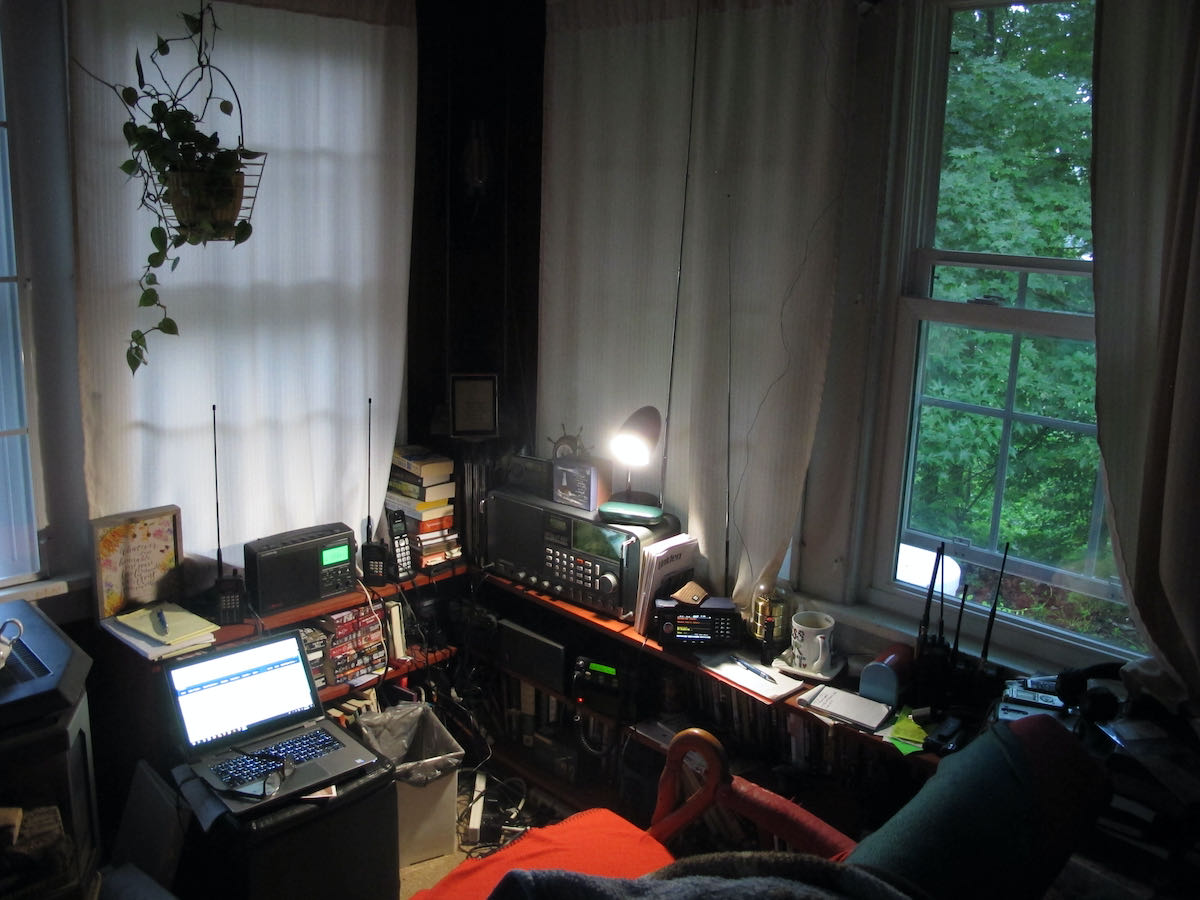
Today my home is crowded with more radios and watches than I know what to do with. Here at my writing desk I have three of each within sight, and there are plenty more here and there around the place.

I think I may have them all because I am trying in vain to get back that Sportsman AM transistor radio and that child-size Timex watch, the first radio and watch I ever had, the ones never saw again and never will. The sorrow of their loss might explain why I have collected so may others. It doesn’t explain the fountain pens, though.

Malahit DSP-2: Dan’s thoughts on external antennas, firmware, and purchase decisions

Many thanks to SWLing Post contributor, Dan Robinson, for the following guest post:


Additional Thoughts on the Malahit DSP-2 

  • Potential for Noise Reduction Using Non-Whip Antennas
  • Latest Firmware Changes

by Dan Robinson

After my last update on the Russia-made Malahit DSP-2, I thought it important to add something about the receiver, as it could well influence those who may be on the fence about purchasing one.

In a series of communications, Georgiy at Malahit team has stressed steps taken to attempt to deal with internal interference seen across the bands.  And he has asserted

that noise spikes lessen if the receiver is connected to a non-whip antenna.

Most of my tests have used whip antennas of various lengths, in various locations indoors and outdoors, because it’s my view that portability is a major attraction of these small SDR receivers.

Continue reading

Grayhat’s NCPL (Noise-Cancelling Passive Loop) antenna “tweak”

My NCPL antenna

Many thanks to SWLing Post contributor, Grayhat, who shares the following modification he made to a Noise-Cancelling Passive Loop antenna last year. He’s kindly allowed me to share his notes here, but apologized that at the time, he didn’t take photos of the project along the way and recycled many of the components into yet another antenna experiment.

Grayhat writes:

Here’s a simple tweak to the NCPL, made easy for anyone. Let’s start with the commercial NooElec 9:1 balun version 1 (not 2) … made in USA.

Look at the schematic of the balun:

Cut the R1 (0 Ohm resistor – jumper) so that the center tap of the transformer won’t be connected to ground, then solder a short piece of wire to the tap.

The first pic (top) shows the balun seen from top side, the arrow indicates the small hole going to the transformer tap.

This pic shows the bottom of the board with the trace to cut and the spot for soldering the tap wire (needs cleaning with a bit of sandpaper to remove the cover paint). The solder is as easy as 1-2-3 once the trace is cut and the spot cleaned just insert a wire from the top of the board and solder it to the bottom and there you go!

Build the NCPL using “fat” coax (RG8 will do) with the top cross connection.

NCPL modification schematic

Side note: the top “cross connection” is the weak point, so it would be a good idea putting a short piece of (say) PVC pipe over that point, the piece will also help suspending the loop or sticking its top to the support pole, as for the feedpoint, a small electrical junction box will fit and protect the tiny balun from bad weather

Now the difference: connect the two center conductors of the NCPL to the balun input and the braid to the wire going to the center tap (as above).

Such a configuration will give some advantages over the “standard” NCPL one. The loop will now be galvanically isolated from the feedline/receiver so it will have much less “static noise.” Due to the tap, the typical 8 pattern of the loop will be preserved, this means that the loop will now have much deeper nulls.

By the way, the balun could just be wound w/o buying it. I suggested the nooelec since that way anyone with little soldering ability will be able to put it together. Oh and by the way it’s then possible adding a small preamp at the balun output if one really wants, any preamp accepting a coax input will work. 🙂

Again, if you can/want, give it a try !

Many thanks for sharing this, Grayhat! We always welcome your inexpensive, innovative urban antenna projects!

Post readers: If you have question, feel free to comment and I’m sure Grayhat can help. 

Summer FM DX: Drive-by Sporadic E

Many thanks to SWLing Post contributor, TomL, who shares the following guest post:

Summer DX – Sporadic E, FM band

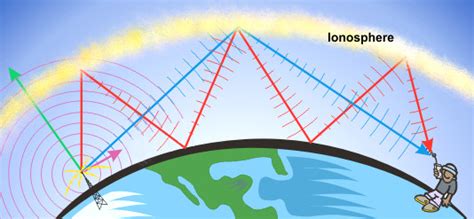
“Sporadic E” DXing is a specialty of some DXers.  I have never dabbled in it being content with mediumwave or shortwave listening.  However, it was truly fun to spontaneously hear this happen while driving on the Interstate highway, Wednesday August 4 around 6pm Central Time.

To quote from an ARRL propagation article:

“As frequency increases still further, signals will eventually pass through the F1 layer to the F2 layer. Because this is the highest reflecting layer, the distance spanned by signals reflecting from it is the greatest. The maximum skip distance for the E layer is about 2000 km. For the F2 layer that increases to about 4000 km—a significant gain.”

I was listening to the local classical music station WNIU in DeKalb, IL which is a good 50 kW transmitter about 10 miles behind me near the Interstate highway.  A different station was breaking through. Eventually, I heard a familiar Christian song “You Make Me Brave” swamp the classical music. I noticed it was a remake of a song made about 10+ years earlier. The two signals fought it out and then I heard the station ID “Spirit FM” and a short humorous segment called “Attitude Adjustment”, then more music.  Finally the local classical music station won out and I thought I would look up the station ID of that contentious station later.

When I googled “90.5 Spirit FM”, it came up with a station in Tampa Bay, FL called WBVM. Cool!  Just to be sure, I went to the station web site and looked up their playlist and this confirms what I heard:

Curious about the transmitter, Radio Locator said it was a 100kW station and gave the Long/Lat coordinates.  I then went to Google Earth and mapped an approximate distance of 977 miles (1572km), give or take 10 miles:

I did not have time to get on the shortwave radio to see if the 10 meter band was busy since I had things to do.  But it is a very nice surprise to hear in my old car radio an FM station almost 1000 miles away. For one thing, Analog radio is still fun.  Secondly, things are busy this summer if you are at the right frequency and time!

Happy Listening,

TomL