Category Archives: Guest Posts

Guest Post: Why listen to shortwave radio?

Many thanks to SWLing Post contributor, Jock Elliott, who shares the following guest post:


Why listen to shortwave radio?

By Jock Elliott, KB2GOM

Decades ago, an entrepreneur challenged his audience with a concept of critical importance: “Every once in a vhile, it is important to ask ourselves vhy are we in business?” He had a waaay cool Austrian accent, and his point was valid: every once in a while, we should examine our fundamentals.

So why, indeed, listen to shortwave radio?

For me, the short answer is: because there are treasures out there on the shortwave spectrum, that’s why. Further, with a relatively inexpensive shortwave receiver (even better if you have a receiver with single-sideband – SSB – capability), you hear them too. You can discover things that you are unlikely to find anywhere else, and not only are they fun to hear, they are also fun to find.

So let me present for your approval a shortwave journey that I took on October 24, 2021.

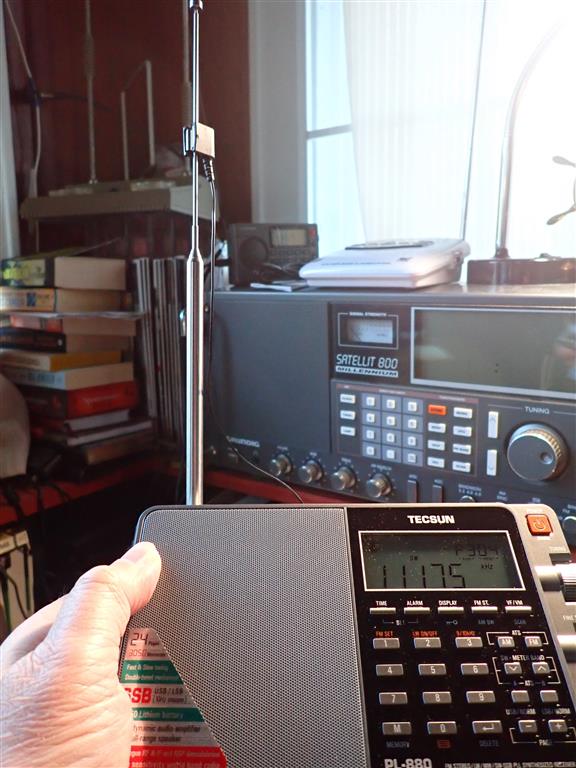
1115Z – It all starts when I am flipping through my old shortwave reference materials, and a copy of a page from Popular Communications magazine, April, 1986, catches my eye: “Handy Ute Finder by Hubble Gardiner, KNE0JX.” Utes are utility stations (as opposed to hams or international broadcasters), like ships at sea, planes in the air, and fixed commercial and military stations, and the like. The article presented places to look in the HF radio spectrum between 4000 kHz and 26960 kHz, for utility stations transmitting in SSB, CW, and RTTY/ARQ modes. Is this chart still valid? I don’t know, but since I enjoy hearing people doing their jobs on the air, why not start tuning from 4000 kHz in upper sideband and see what I can hear? Freeing the Tecsun PL-880 from its case, I extend the antenna, press the power button, punch in 4000 kHz, and start turning the dial. And while my initial impulse was to discover some “utes,” I am open to whatever comes through the headphones.

1128Z, 4426 kHz USB – a ute, super loud and clear, a weather forecast from the US Coast Guard Communications Command, including a forecast of tropical weather from the National Hurricane Center. If I were a mariner, I would be pleased to hear this forecast.

Duties call, and my cruise of the bands is interrupted, to be continued later in the day . . .

2130Z, 7490 kHz AM, — highly unusual music that sounds like a mash-up between 1930s movie music and oompah bands. It’s odd but pleasant and certainly not anything you are going to hear on the “regular” broadcast stations. Turns out it is a program called Marion’s Attic on WBCQ from Monticello, Maine. Two females, Marion (with a high squeaky voice) and Christine, play recordings from yesteryear (including wax cylinders, I think). Evidently, this program has been on the air for 22 years, and it made me smile.

2150Z, 8950 kHz USB, — a ute, European weather conditions for aviators from Shannon VOLMET, Ireland, very difficult to hear on the PL880’s whip antenna, but fully copyable on my Satellit 800 with wire antenna. How cool to hear weather from all the way across the pond!

2206Z, 9350 kHz AM, (back on the PL880) — USA Radio News on WWCR, then Owen Shroyer and a Dr. Bartlett discussing the problem of a hospital in Texas apparently putting plastic bags on the heads of covid patients. Unusual, I think, but I had heard enough about the virus of late and continue to rotate the tuning knob.

2215Z, 9395 kHz AM, — My ears are tickled by cool jazz, a very together group, laying it down with style. “This is cool jazz, jazz from the left coast,” the announcer intones as he cues up another group. It’s WRMI, transmitting from Okeechobee. Hearing it, I flashed back to “The Hawthorn Den, Jazz after Midnight” Saturday nights, listening under the covers when I was a kid.

2226Z, 9830 kHz, Voice of Turkey, in English — A professor presents an analysis of the United Nations, which he thinks needs to be reformed due to the shifting of the axes of power. This is followed by exotic music with nice female singer.

2239Z, 9955 kHz,WRMI, — Glen Hauser hosts The World of Radio, detailing the status of various shortwave stations around the world. Fascinating stuff and well worth the time.

2257Z, 10051 kHz USB, — a ute, weather for aviators again, but this time from Gander, Newfoundland. Makes me glad to be in a nice warm house.

So that’s what a little over an hour of turning the knob yielded, and that’s why to listen to shortwave radio: because you never know what you may encounter. Who knows what you might discover with a shortwave radio and a little wandering around?

Remember what Gandalf said: “Not all who wander are lost.

Guest Post: 13dka Explores the International Beacon Project

Many thanks to SWLing Post contributor, 13dka, who shares the following guest post:


In search of benchmark signals: The International Beacon Project

by 13dka

If you – like yours truly – like to tinker with antennas and radios to get the most out of them, you likely have your own set of reference stations. If this is a new concept for you – reference stations are whatever stations you deem apt to check propagation, the general function of your radio, when trying to improve reception or comparing radios… They are ideally always on when you need them and come in various strengths and distances on several bands from all over the world. Traditional sources for that are of course time signals and VOLMET stations on HF, even though the latter are giving you only two 5-minute slots per hour for testing reception from a specific region and the former have their own specialities here in Europe:

A typical scene on 10 MHz, captured at home 30 minutes after the full hour: BPM voice ID from China mixed with something else, then Italcable Italy kicks in on top of some faint murmur possibly from Ft. Collins, in winter some South American time stations may stack up on that together with splatter from RWM 4 kHz lower…

A reliable source of grassroots weak signals is particularly desirable for me because I enjoy proving and comparing the practical performance of radios at “the dike”, a QRM-free place on the German North Sea coast. In the absence of manmade noise and the presence of an ocean adding 10dB of antenna gain, finding benchmark stations with “grassroots” signal levels turned out to be a different challenge than it used to be: With somewhat sizeable antennas the stations tend to be (too) loud there, even with the baseline ionospheric conditions under a spotless sun in its activity minimum. In short, my old benchmark stations didn’t work so well anymore and I had to find something new. Continue reading

Bob’s Updated Passive, Resonant, Transformer-Coupled Loop Antenna for Shortwave

Figure 1. A Passive, Resonant, Transformer?Coupled Loop Antenna for Shortwave

Many thanks to SWLing Post contributor, Bob Colegrove, for the following guest post:


A Passive, Resonant, Transformer?Coupled Loop Antenna for Shortwave

By Bob Colegrove

Over the years I have resisted the level?of?effort necessary to construct and maintain outdoor antennas. Rather, I have focused on squeezing out all of the microvolts I could get inside the house. Many years ago I had access to a well?stocked engineering library, and used my advantage to gather information about the theory and development of loop antennas – a daunting undertaking for an English major. Ultimately, by adhering to a few basic rules, some of them dating back 100 years, I found quite acceptable performance can be had with an indoor passive antenna intersecting just a few square feet of electromagnetic energy.

Theory

There are a couple of advantages of resonant loops as opposed to non?resonant ones. The first is the fact that the signal dramatically increases when you reach the point of resonance. The second follows from the first in that resonance provides a natural bandpass which suppresses higher and lower frequencies. This gives the receiver a head start reducing intermodulation or other spurious responses. The downside of all this is that the resonant loop is, by design, a narrow?band antenna, which must be retuned every time the receiver frequency is changed by a few kHz. On the other hand, there is nothing quite as rewarding as the sight (S?meter) and sound you get when you peak up one of these antennas – you know when you are tuned in.

There is nothing new about the loop antenna described here. It’s just the distillation of the information I was able to collect and apply. There are a number of recurring points throughout the literature, one of which is the equation for “effective height” of a loop antenna. It basically comes down to the “NA product,” where N is the number of turns in the loop and A is the area they bound. In other words, provide the coil with as much inductance as possible.

Unfortunately, for resonant loops, the maximum coil size diminishes with frequency.
With this limitation on inductance, the challenge becomes minimizing unusable capacitance in the resonant frequency formula in order to get the highest inductance?to?capacitance (L/C) ratio possible. Some of the unusable capacitance is built into the coil itself in the form of distributed capacitance, or self?capacitance between the coil turns. This cannot be totally eliminated, but can be minimized by winding the coil as a flat spiral rather than a solenoid, and keeping the turns well separated.

The second trick is with the variable capacitor. Even with the plates fully open, there is residual capacitance on the order of 10 to 20 picofarads which can’t be used for tuning purposes. A simple solution is to insert a capacitor in series, about 1?4 the maximum value of the variable capacitor. This effectively decreases the minimum capacity and extends the upper frequency range. In order to restore the full operating range of the variable capacitor, the fixed capacitor can be bypassed with a ‘band switch.’ With the series capacitor shorted, the variable capacitor operates at its normal range and extends coverage to the lower frequencies. Continue reading

Guest Post: Simple Android Database Part 2

Many thanks to SWLing Post contributor, Bill Hemphill, who shares the following guest post:


Simple Android Database-PART 2

by Billy Hemphill, WD9EQD

In the first part, I showed how you could easily take a spreadsheet and create a simple database for viewing on an Android phone/tablet. The examples used in that article was two spreadsheets of radio schedules – one for Shortwave and one for FM Radio Programs. See the following link to the original article: https://swling.com/blog/2021/10/guest-post-radio-schedules-in-a-simple-android-database/

There are many lists on the internet of various radio databases. If the database can be downloaded as either a CVS file or a spreadsheet, then it is possible to load it into the PortoDB app on the phone tablet. I’ll show how this can be done with two popular databases that I reference all the time.

EIBI Data Base

Most of you are probably familiar with the EIBI database of shortwave schedules. Many of the Shortwave Schedule apps on the Phones reference this database. For example, I use the Skywave Schedules on my phone. While it does allow for me to search by many parameters, I thought it might be fun to have it in a PortoDB database. Plus it would be interesting to see how PortoDB performs with a large data set. Continue reading

Guest Post: Radio Schedules in a Simple Android Database

Many thanks to SWLing Post contributor, Bill Hemphill, who shares the following guest post:


Radio Schedules in a Simple Android Database

by Bill Hemphill

I am a program listener. I really enjoy listening to various radio stations direct and by internet streaming. Over time, I have come up with a couple of spread sheets that lists the program, station, time, date, etc. For example, following is the spreadsheet for the shortwave radio programs/stations that I enjoy:

As the program schedules change, I update the spreadsheet. This has worked quite well for me. I usually sort on the weekday and then print out the spreadsheet as a list by time and frequency for each day.

While this method works, it does mean that I have these multiple page printouts that I have to refer to. This got me thinking that it would be great to have this on my Android phone/tablet. Then I could refer to it no matter where I was located.

At first, I tried to use Google Sheets, but found that using a spreadsheet on the phone or even a tablet to be a pain. I then tried entering it into a calendar program, but also found that very cumbersome. Continue reading

Guest Post: A synchronous detector crash course!

Many thanks to SWLing Post contributor, 13dka, who shares the following guest post:


Revisiting the Belka’s “pseudo-sync detector”: A sync detector crash course!

by 13dka

“It’s usually hard to assess whether or not a sync detector helped with a particular dip in the signal or not, unless you have 2 samples of the same radio to record their output simultaneously and compare.”*

That’s what I wrote about the “pseudo sync detector” in my review of the Belka DSP last year.

Since I was recently upgrading to the Belka DX in order to pass on the Belka DSP to a friend, I had briefly two examples of almost the same radio on the table at the dike. I tuned them to the same stations and recorded some audio clips with one radio on sync detector, the other in regular AM mode, to answer the question whether or not sync has “helped with a particular dip in the signal”. Then I thought that demonstration would be an opportunity to try an explanation on what exactly (I think) sync detectors are all about anyway, hoping to find a middle ground between “technical” and “dumbed down beyond recognition”.

The trouble with sync detectors

Perhaps no component of a shortwave receiver is surrounded by so much misconception and confusion as sync detectors. Full disclosure: Until quite recently, I had an, at best, vague concept on what they do myself. It seems it’s not so much that people don’t know how they work, what they actually do when they work is where the ideas often diverge. Continue reading

HFDY vs. Fire Brothers: Dan compares two Chinese Malahit SDR clones

Many thanks to SWLing Post contributor, Dan Robinson, for the following guest post and review:


Two Chinese Clones:   A Look at Noise Levels

Arriving recently here in the radio shack, were a Chinese clone under the name of “Fire Brothers” and another under the name HFDY.  I thought it would be constructive to note the key differences between these two clones, both of which are running Malahit 1.10c firmware, and post some video of a brief comparison.

A note in advance of any comments – I am primarily a HF listener so these comparisons do not cover frequencies above 30 MHz.  For those whose focus is on higher frequencies I recommend looking through the many comments on the Malahit Facebook group and Telegram by those who use these receivers in those ranges.

HFDY

  • Constructed of metal-like material (a correction from my previous articles that this is fiberglass of the kind used in printed circuit boards – thanks to Georgiy of Malahiteam for pointing this out)
  • Front speaker grille is gold color and appears to be metal but may be fiberglass as well – audio is quite good
  • Two top-mounted antenna jacks, one 50 ohm, the other Hi-Z (makes switching between HF and FM/VHF reception easier) with in-use LED indicators
  • Two high quality right side mounted black metal encoder knobs with large power button (clear printed Frequency/STDBY/Volume printed on panel)
  • Cabinet held together with TORX screws
  • 1.10c firmware
  • Receiver is elongated left to right to accommodate left side front-firing speaker, but is thinner overall and could be easily placed in a pocket though not recommended to prevent damage
  • Like every one of these SDRs, suffers from body sensitivity to touch which reduces signal levels unless some sort of additional ground is attached to cabinet
  • Internal flat-type Lithium battery of 3300 mAh though apparently capable of fitting up to 8000 mAh

Continue reading