Shortwave listening and everything radio including reviews, broadcasting, ham radio, field operation, DXing, maker kits, travel, emergency gear, events, and more
CQ MF/LF Editor John Langridge, KB5NJD/WG2XIQ, reports that the FCC has authorized amateur radio use of the 630 and 2200-meter bands, effective October 16, 2017, providing registration procedures have been followed and no objections are received within 30 days.
The PLC (Power Line Communications) database is live and hams may begin registering immediately. They may begin operating on 472 kHz (630 meters) and 137 kHz (2200 meters) as early as October 16 if they register today and receive no objection in the next 30 days. Hams may not operate on the bands without going through this process.
John is asking all amateurs to register, even if they don’t plan to use these bands in the near future, as the FCC rules prohibit UTC (the Utilities Technology Council) from deploying PLC in these bands closer than 1 kilometer from registered stations. Registration now will protect your ability to use our new MF/LF bands in the future.
Many thanks to SWLing Post contributor, Michael Guerin, who shares this article at CNN by Dr. Don Lincoln, a senior physicist at Fermilab and researcher at the Large Hadron Collider:
Earth dodges a cosmic bullet — for now
Solar flares and related phenomena could cause tremendous damage to the Earth’s electric grids, writes Don Lincoln Read the full story
(CNN) Mother Nature has had a hectic past couple of weeks of hurricanes, an earthquake, wildfires and flooding. But while our attention has been turned to these humanitarian crises, Earth ducked a cosmic bullet the likes of which could have crippled human technological civilization.
Over the last week or so, the sun has experienced a series of solar flares, including the most energetic one in a decade. A solar flare occurs when magnetic energy in the vicinity of a sunspot is released, resulting in a bright spot on the sun that takes place over a time scale of perhaps 10 minutes — or even less.
[…]While solar flares can interfere with satellites, an even more dangerous phenomenon is called a coronal mass ejection (or CME). CMEs often accompany a flare and occur when some of the sun’s highly ionized material is ejected into space. Because a CME consists of matter and not the electromagnetic radiation of a flare, it can take a day or even more to travel from the sun to the Earth. Indeed, last week’s flares were accompanied by a CME, but it didn’t hit the Earth with its full fury.
If a CME happens to be aimed directly at Earth, the ionized particles can slam into the magnetic field that surrounds the Earth and distort its shape, a process called a geomagnetic storm. That’s when things can get dangerous. Moving magnetic fields can induce electrical currents on the Earth’s surface and damage equipment.
In 1989, a CME hit the Earth and knocked out power in Quebec and the northeast United States for nine hours. And in 1859, an enormous CME hit the Earth. Called the Carrington Event, after Richard Carrington, who observed and recorded it, this geomagnetic storm caused telegraph pylons and railroad rails to spark, shocked telegraph operators and was responsible for auroras visible at least as far south as Havana, Cuba, with some claims of auroras being observed near the Earth’s equator.
[…]A report by Lloyd’s of London in 2013 estimated that the damage to the US grid from a repeat of the Carrington Event would be in the range of $0.6-$2.3 trillion dollars and would require four to 10 years to repair.
“The total U.S. population at risk of extended power outage from a Carrington-level storm is between 20-40 million, with durations of 16 days to 1-2 years,” the Lloyd’s report said.[…]
Many thanks as well to Mike Hansgen (K8RAT) who also shares the latest space weather news from Tamitha Skov, reiterating how fortunate we were to miss this last barrage from our local star:
One additional note: I’m currently in the process of writing a lengthy article about how to protect your gear from an EMP (Electromagnetic Pulse) emanating from an event like this. In the past two weeks, I’ve had an uptick in inquiries about this, so I thought it best to consult an expert and produce a post. I’ll hopefully have this article published within a week or so. I’ll post it with the tag: EMP.
Mike Ladd, with SDRplay, has done an amazing job putting together a comprehensive series of how-to videos for those of us with the SDRplay RSP1 and RSP2 receivers. His first set of videos have focused on using SDRuno (SDRplay’s custom SDR application), and now he’s started an SDR Console series as well.
If you own an SDRplay RSP, take time to watch some or all of these videos as they’ll help you unlock RSP functionality you likely never knew existed. I’ve learned something new in each one I’ve watched.
Below, I’ve embedded 23 SDRuno how-to videos, a new SDR Console video and PDF/printable SDRplay documentation. Enjoy! (And thanks again, Mike!)
Many thanks to SWLing Post contributor, John Minor, who writes:
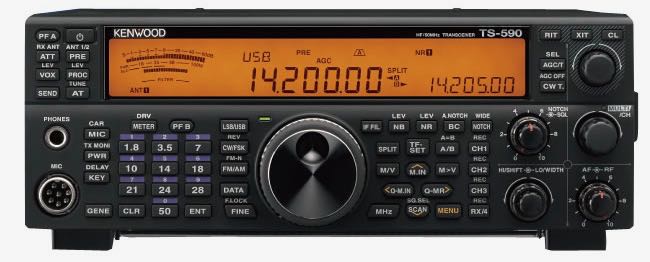
I am going to set up a rig to start DXing, and getting my technical license. My plan is to buy a Kenwood TS-590 SG transceiver and a discone antenna.
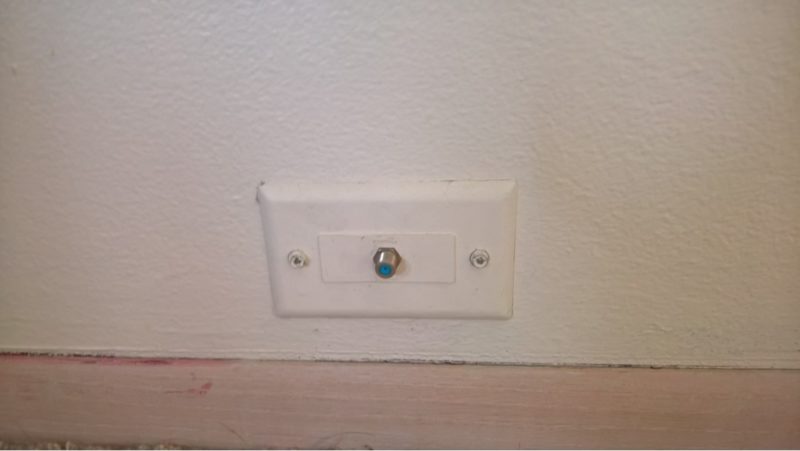
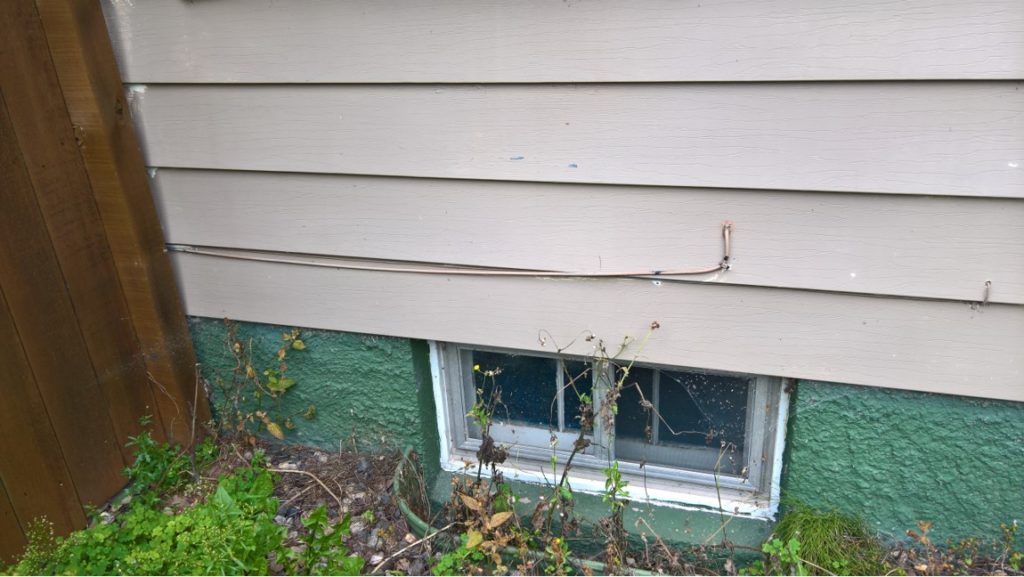
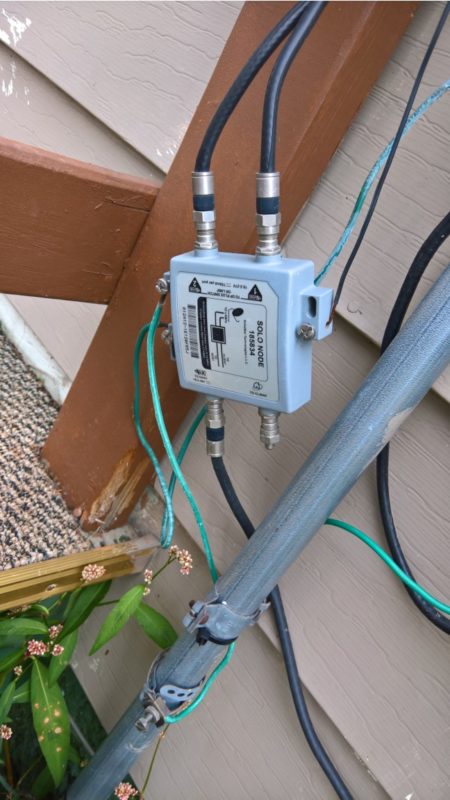
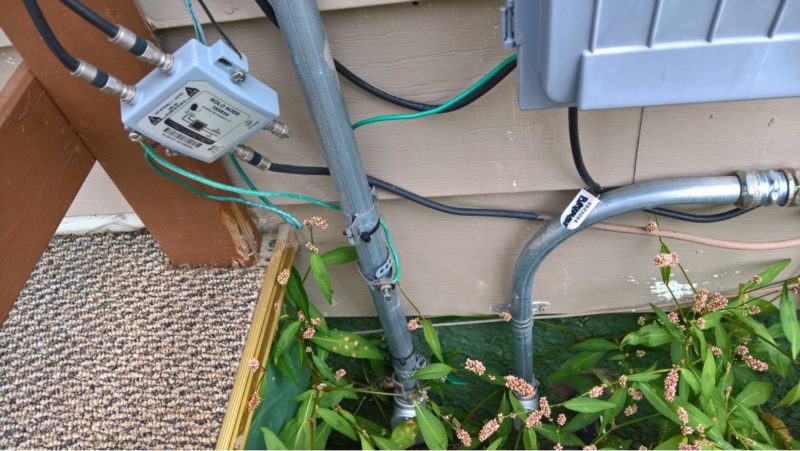
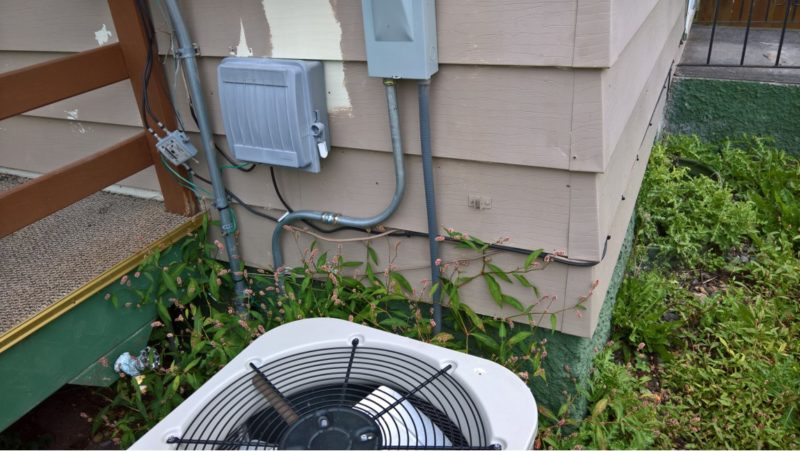
My home’s previous owner had satellite TV, and my question to you is, can I use the existing cabling for my antenna?
There is a connector in my living room, and the cable runs to the connector/splitter box for the dish. Could I run a cable from the end of the existing cable at the splitter box, to the antenna?
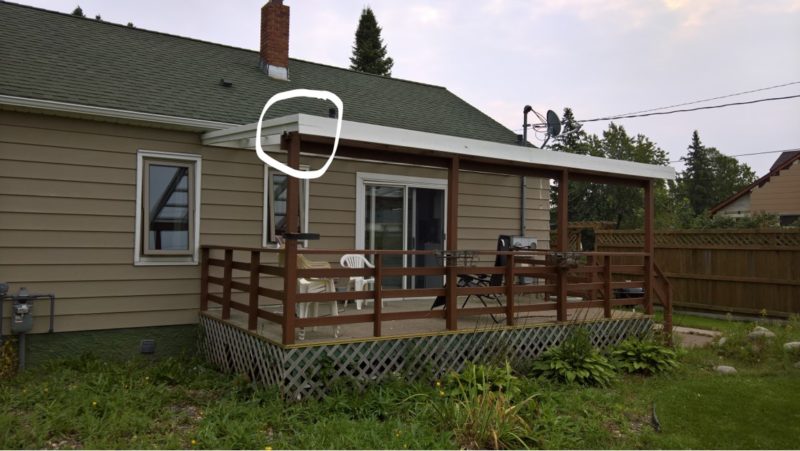
I’ve attached some pictures to show you what the existing cables look like.
Picture 6 has a circle drawn on it to show where I’d like to mount the antenna.
I remember back when I was 9 or 10, laying under the covers at night slowing turning my AM transistor radio dial and seeing what I could pick up. It was a thrill to hear stations from Chicago, Cincinnati or Little Rock. I look forward to the same thrill listening to voices from across the country and around the world……
Thank you for your time, and for the wonderful website.
Thank you, John, for your question and for the kind compliment!
I’m publishing this question here, though, in hopes the SWLing Post community can help you. I have very little experience matching antenna impedance this way especially when transmitting will be involved–there will be a mis-match, I’m pretty sure. With that said, I know many mag loop receive-only antennas actually use RG6. It would certainly be great to use an existing penetration for this application.
Post readers: If you can help John, please do comment. Quite frankly, this isn’t the first time I’ve been asked this question, so I’ll follow comments as well.
John, I’m sure you’ll soon have your radio on the air receiving the world just like when you were nine–or even better! Great choice in that Kenny TS-590SG–it has a brilliant general coverage receiver for broadcast listening!
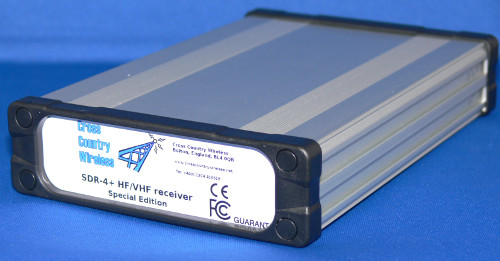
Cross Country Wireless have released a Special Edition version of their SDR-4+receiver.
This includes many features previously only available in custom versions of the receiver.
Adding a high IP3 push pull RF amplifier, RF filter upgrades and a lower noise and distortion IQ amplifier have resulted in a high performance SDR receiver with an overall IIP3 of +31 dBm.
There is no increase in price for the Special Edition version.
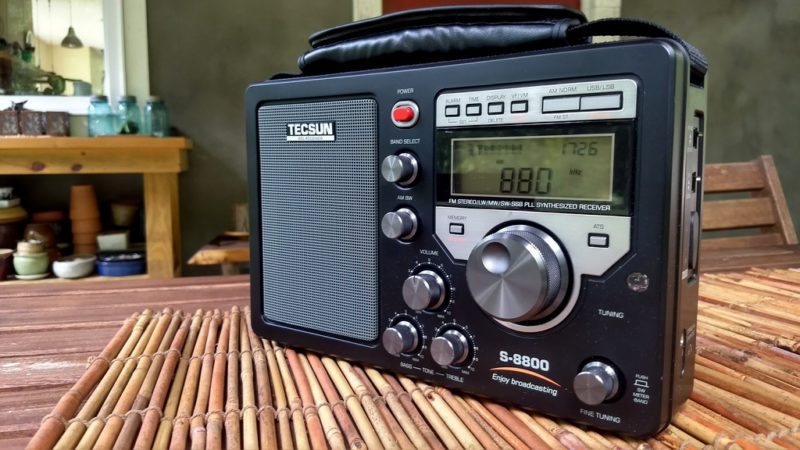
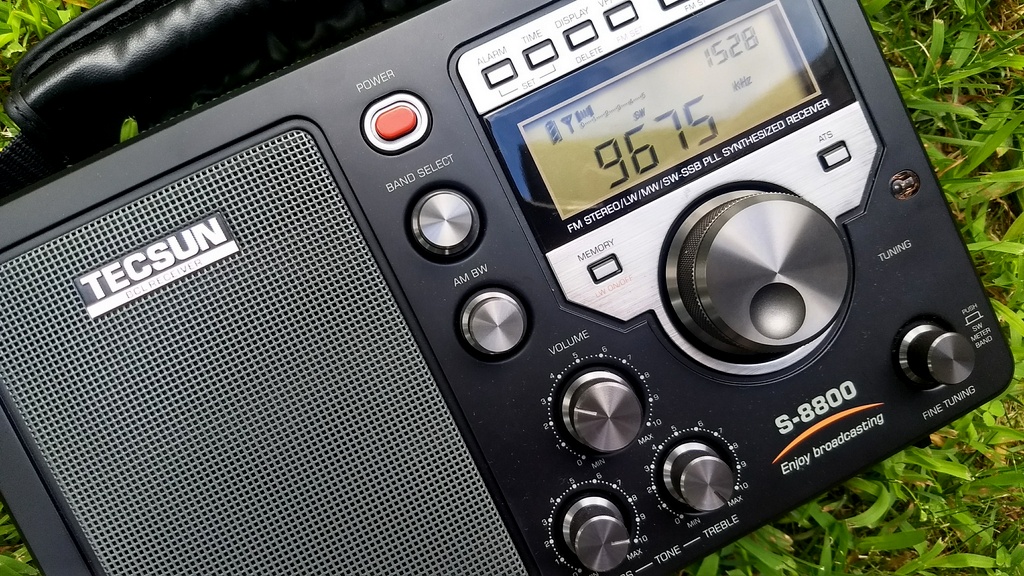
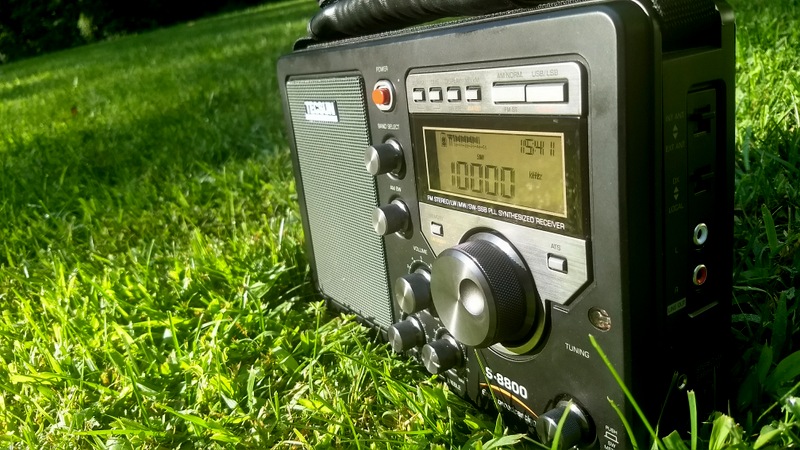
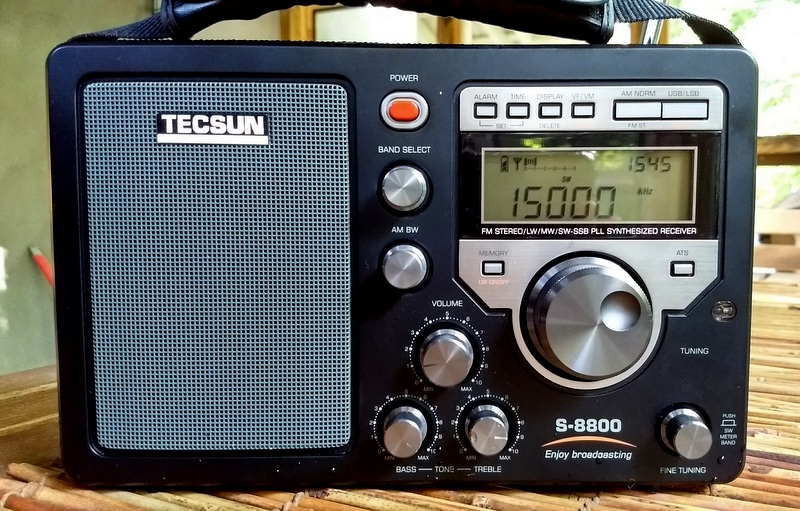
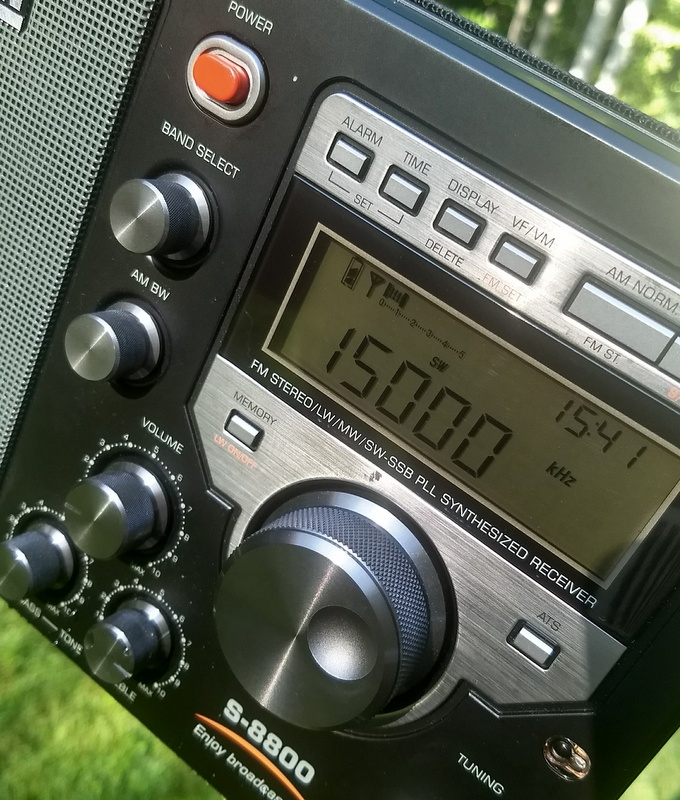
Earlier this year, Tecsun released its long-awaited newest large portable: the Tecsun S-8800 portable shortwave/LW/AM-MW/FM receiver.
Though I fully intended to buy a Tecsun S-8800 for review, our friendly Hong Kong-based Tecsun retailer, Anon-Co, sent an S-8800 to me before I could. I’ve worked with Anna at Anon-Co for at least a decade and have purchased numerous radios for review, not to mention as gifts for family and friends. When she insisted to send it as a gift, I decided I would (gratefully) accept the unit.
My new Tecsun S-8800 had a serious problem, though––one that two early S-8800e adopters noticed as well––internally generated noises, also known as birdies. And while most receivers will have a few minor birdies scattered across the bands, this S-8800 hosted a whole chorus of them, overwhelming the bands and making use of the radio difficult. Read through this post thread for details.
I contacted Anna at Anon-Co and she immediately notified Tecsun; as a result, they halted distribution of the S-8800.
Tecsun took the S-8800 to their engineering team, and I’m happy to report they’ve now eliminated the horrible warbling DSP birdies of the initial unit I received.
On the S-8800s since released, while there are still a few minor birdies across the bands (more on that later), they’re merely what one might expect to find on any receiver. In short, the S-8800 now in production is a functional receiver, and a contender in its class.
I’ve had the S-8800 for a few weeks now and have had time to put it through its paces. What I present now is a review of the re-engineered Tecsun S-8800.
First impressions
In the spirit of full disclosure, I must note that I’m not as avid a user of large portables like the S-8800. Personally, my preference is for smaller, full-featured travel-friendly portables, or else larger tabletop models. I travel often and like to pack lightly, so I rarely reach for anything bigger than my trusty Sony ICF-SW7600GR, or Tecsun PL-880, and more often than not, I grab the ultra-compact Sony ICF-SW100 or C. Crane CC Skywave.
But to say that I never reach for large portables would be inaccurate. In fact, I use a Grundig GS350DL daily; it’s my analog kitchen radio. I rarely move the tuning dial (a good thing, since it unfortunately drifts) because it’s locked onto my in-house SSTran AM transmitter on 1570 kHz.
What large format portables like the GS350DL and S-8800 can provide that a small portable cannot is broad, rich, room-filling audio. In my world, good audio is an important factor in overall signal intelligibility.
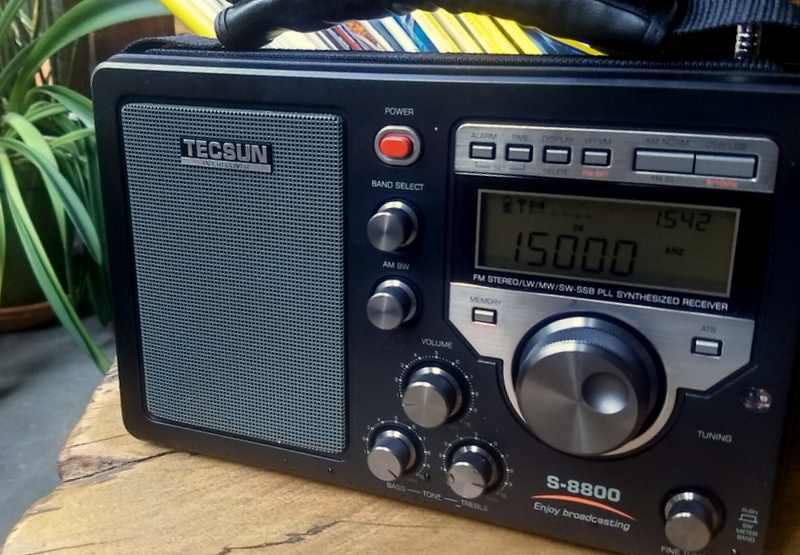
The S-8800 chassis resembles several other receivers: the Grundig GS350DL, S450DLX, and more recently, the Field BT, just to name a few.
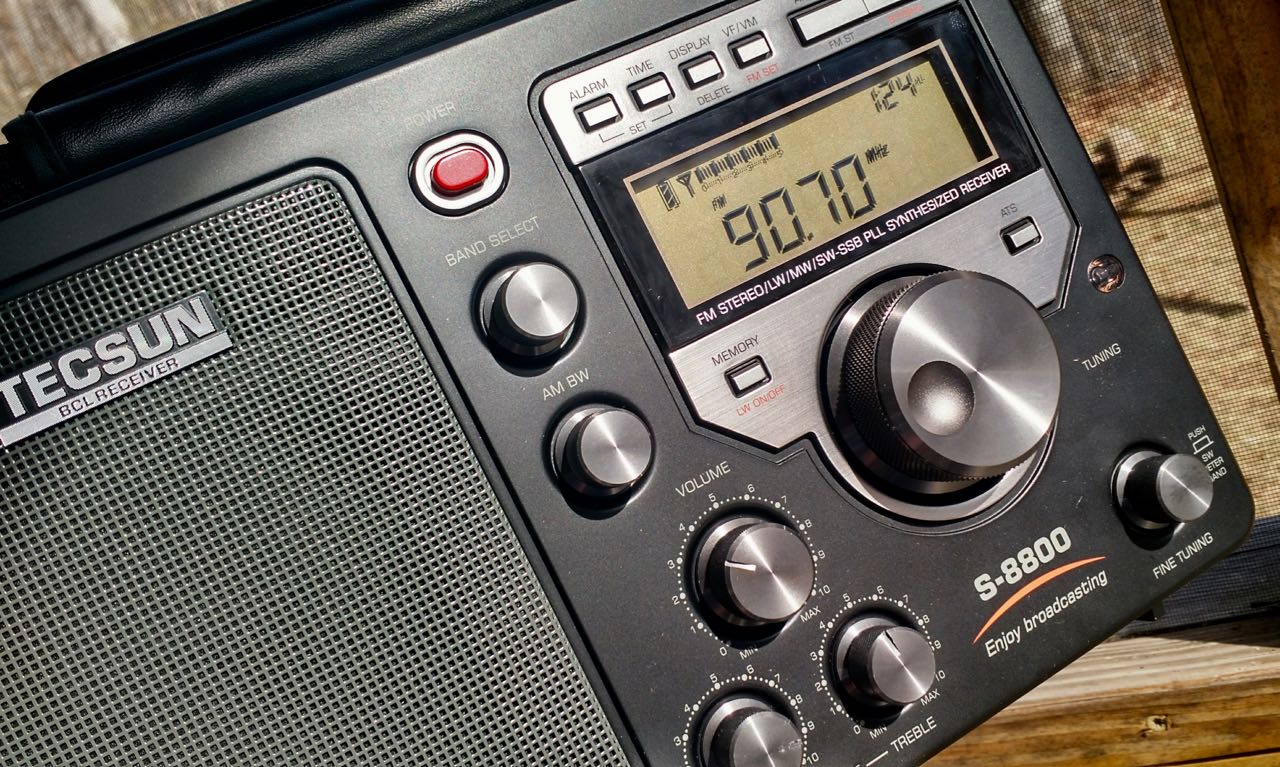
The body is made of a hard plastic (not rubberized) and feels rugged enough. The knobs and buttons also feel tactile and of comparable quality to the previous similar models noted above. With the rechargeable batteries inserted, it weighs about 3 pounds 4 ounces (1.5 KG).
The backlit display is large and viewable from almost any angle––even at a distance.
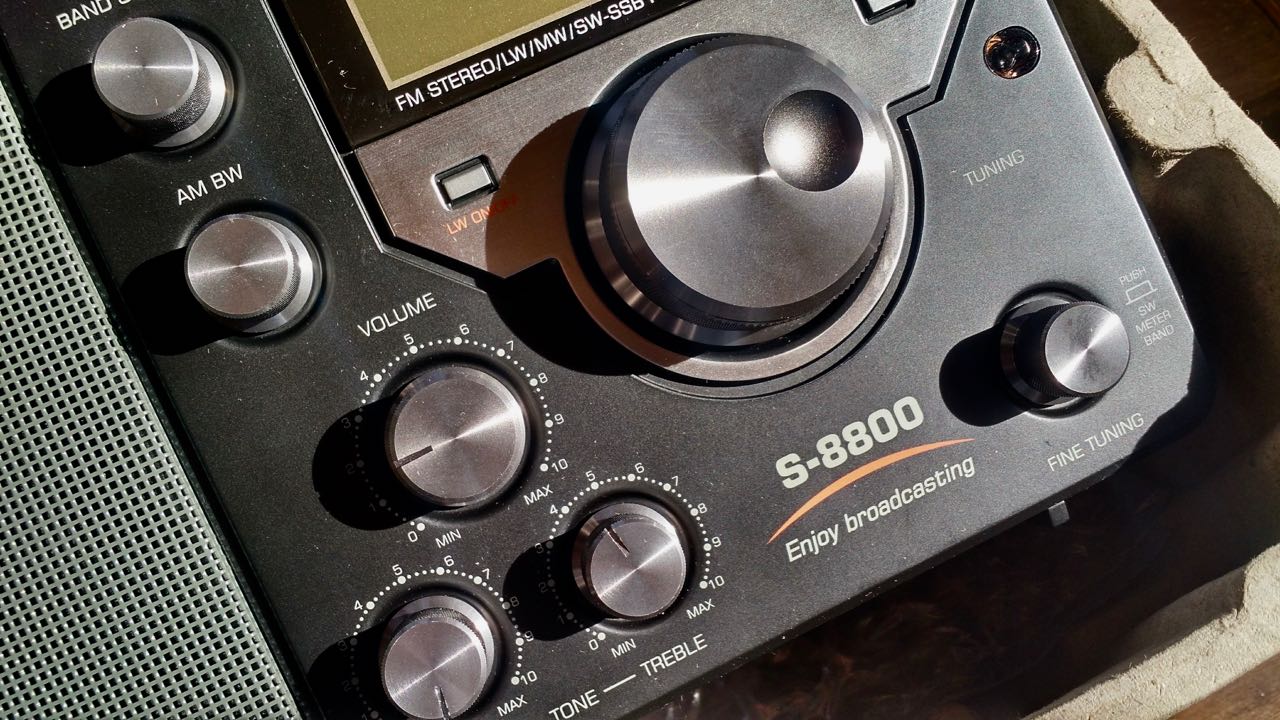
The main encoder (tuning knob) has appropriate amount of brake for most listeners. It wobbles very slightly, but functions amazingly well. I prefer it over its large portable predecessors, especially the 350GL. There is no soft mute while tuning, so band-scanning is a fluid, almost analog, process.
Both the “Band Select” and “AM BW” knobs have soft detents that mark steps in selection. In the field, I noticed that these can occasionally skip an increment when the detent only moves one position or the knob is turned very slowly. This doesn’t really affect functionality in any way, but I thought it worth noting nonetheless.
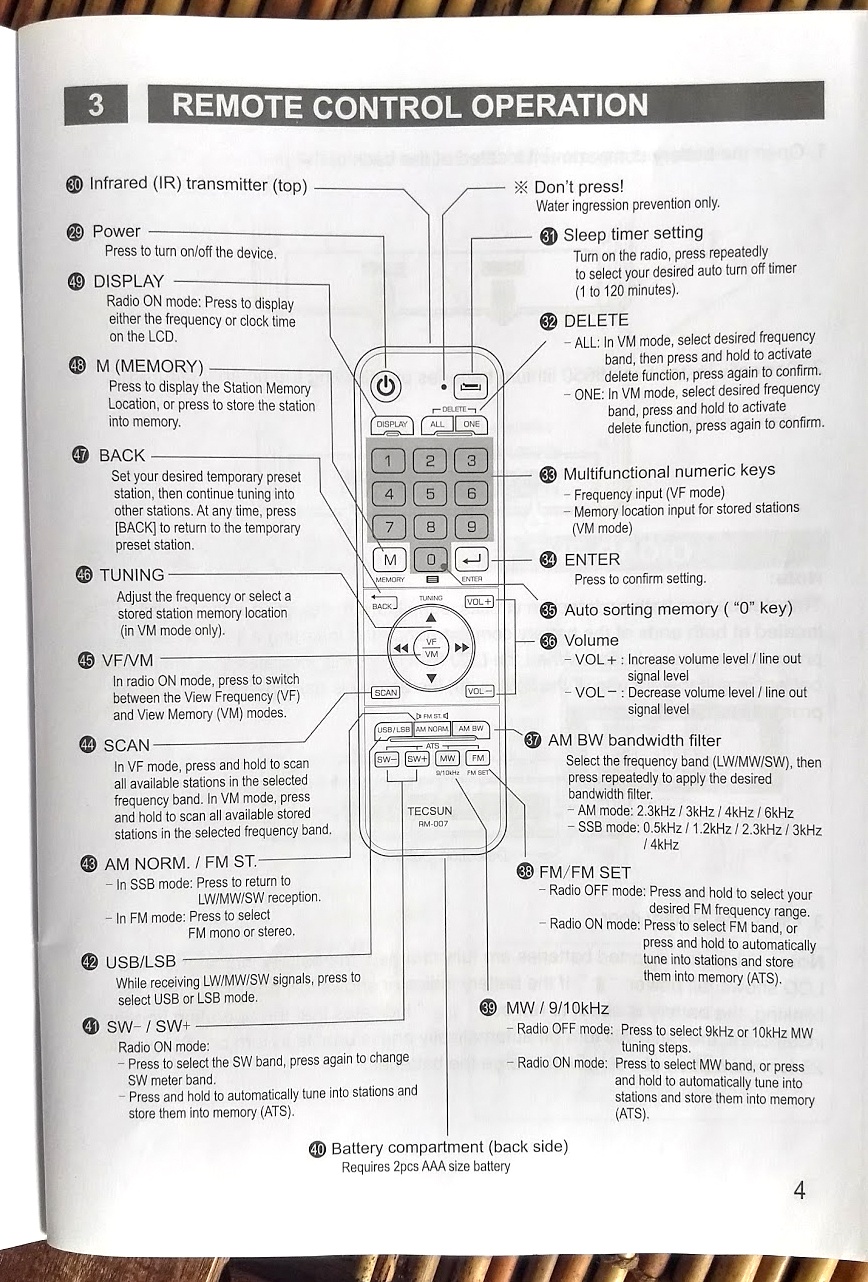
Like previous similar models, the S-8800 lacks a built-in keypad for direct frequency entry. That would be a major negative for a radio in this price class if the S-8800 didn’t come with one invaluable accessory: an infrared remote control.
Infrared (IR) Remote Control
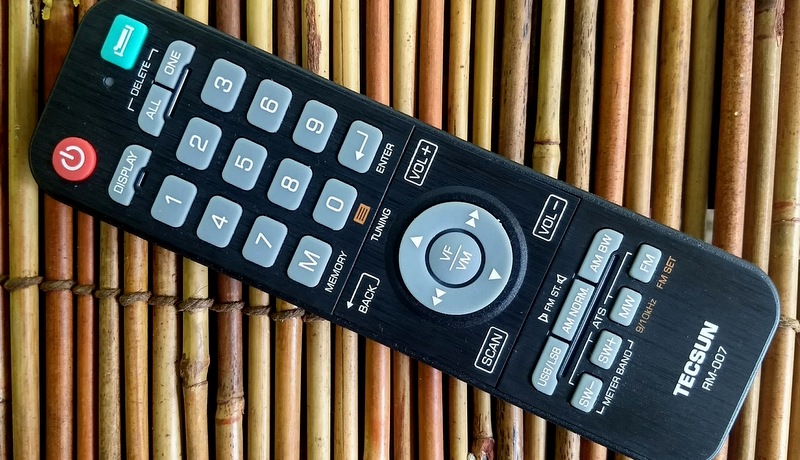
The Tecsun S-8800 ships with a IR remote control, and as far as I’m concerned, it’s great.
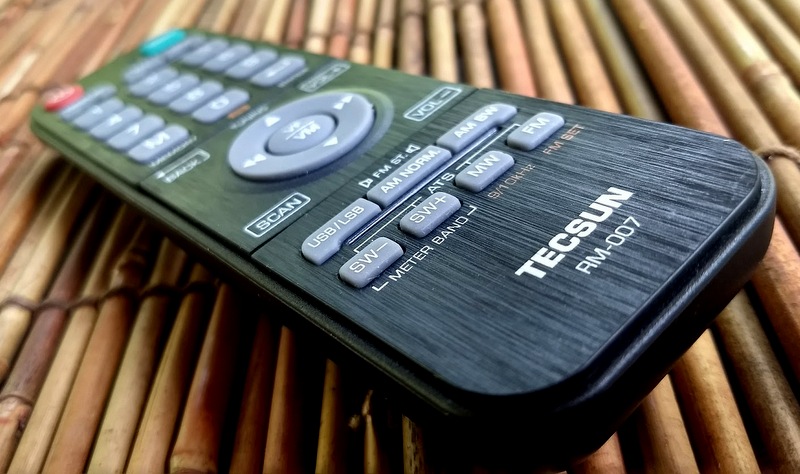
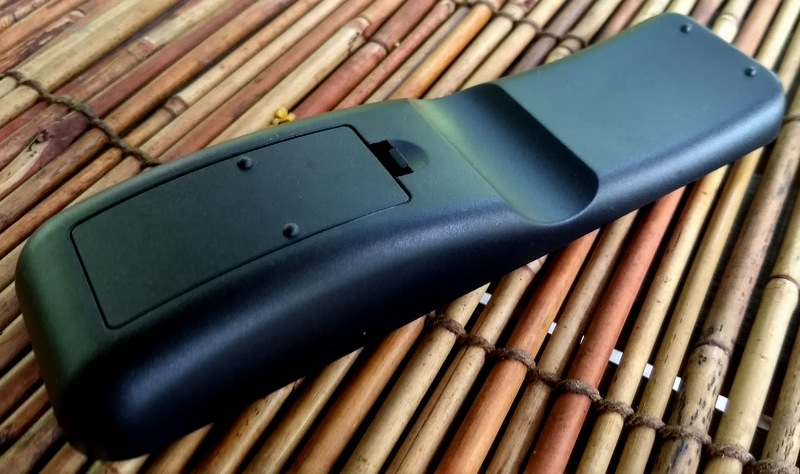
The remote feels durable, fits well in the hand, and the back has a place for it to balance on your index finger when holding…
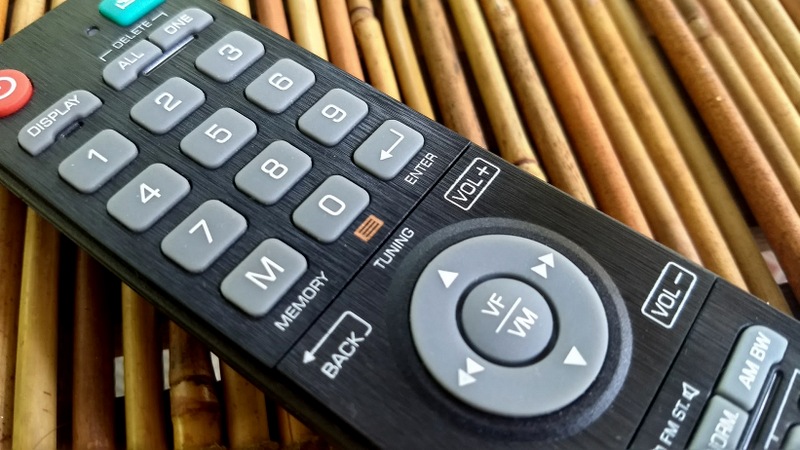
But more importantly, the remote works quite well. The controls are intuitive and the labeled buttons are quite easy to read. They’re also tactile and have a muted “click” response when pressed. Indeed, I wish my television’s remote was this well designed.
And the remote is quite useful, especially if you like listening from bed, from a porch, from the kitchen or dining room or den––or, in fact, from any space where you might wish to control the receiver at a distance. I believe its possible that every function of the S-8800 can be controlled with the remote––even the sleep timer!
Perhaps my dream remote for such a purpose would be backlit, but the S-8800’s remote is so simple to use, I’ve already nearly memorized where the buttons are located for nighttime use.
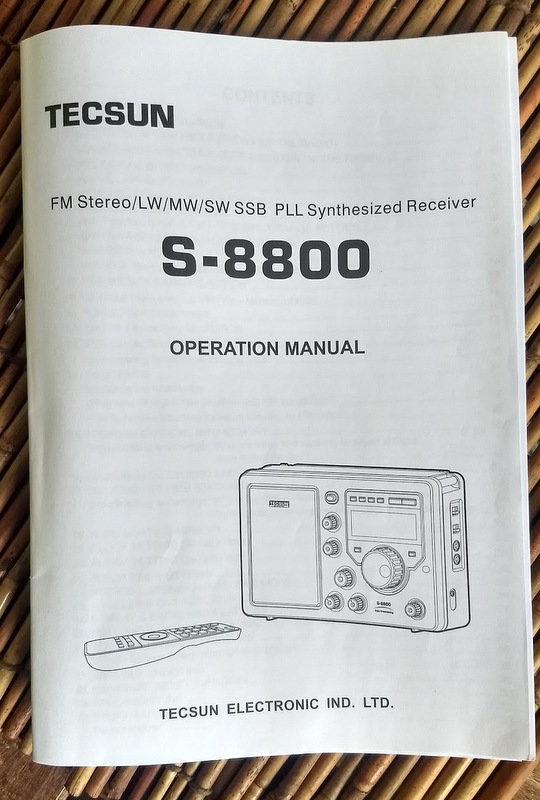
Operation Manual
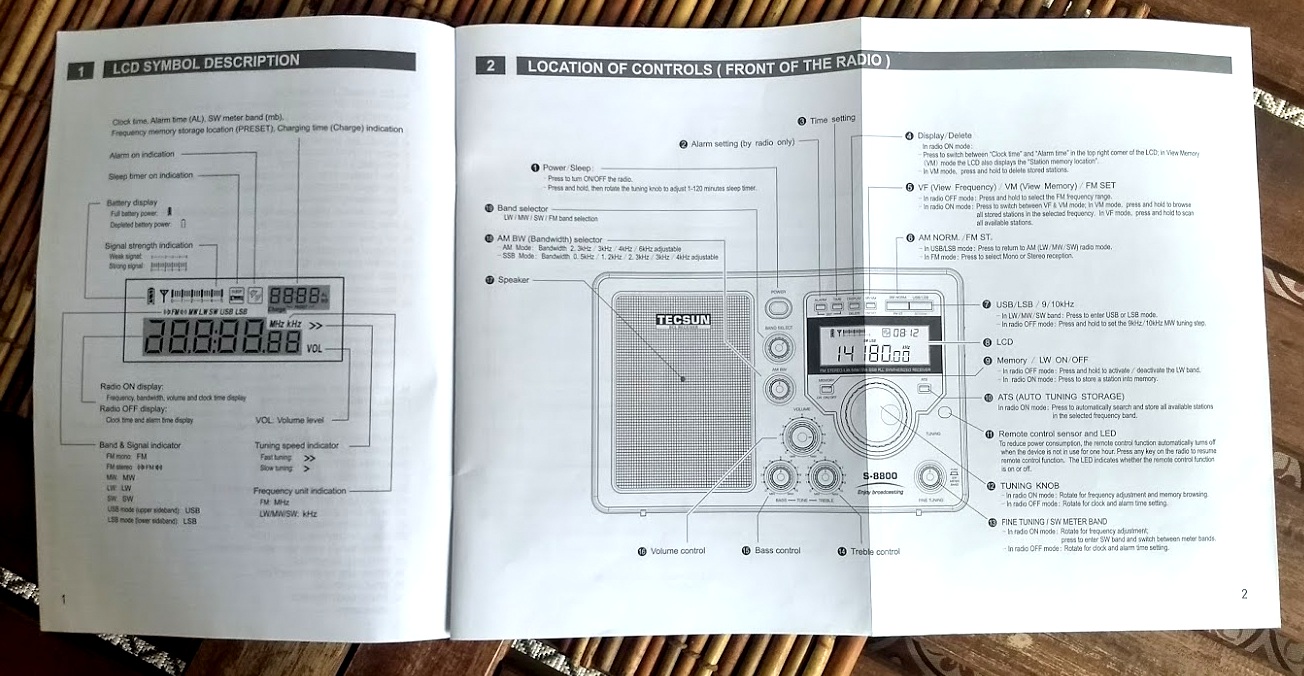
The S-8800 ships with an informative operational manual, although this radio is intuitive enough that a seasoned radio listener will not need to reference it, save for advanced settings. Still, it’s written in clear language––with comparatively few English grammar errors––and the diagrams for both the radio and the remote are exceptional.
I referenced the manual several times to sort out ATS operation, saving/erasing memories, and to hunt down function shortcuts.
Features
The S-8800 is a feature-packed triple conversion receiver. Here’s an abridged list of its features, focusing on those most radio enthusiasts seek:
Note in SSB mode on LW, MW and SW, tuning steps are 10 Hz and 1 kHz.
FM: 64 – 108 MHz (selectable for various markets: Russia, The Caucasus, Caspian/Black Sea regions, Japan, China/Europe, and North America)
Modes: AM, FM, SSB
Variable filter widths
AM: 6, 4, 3, and 2.3 kHz
SSB: 4, 3, 2.3, 1.2, and 0.5 kHz
Digital Signal Processing (DSP)
Antenna gain selection: DX/Local
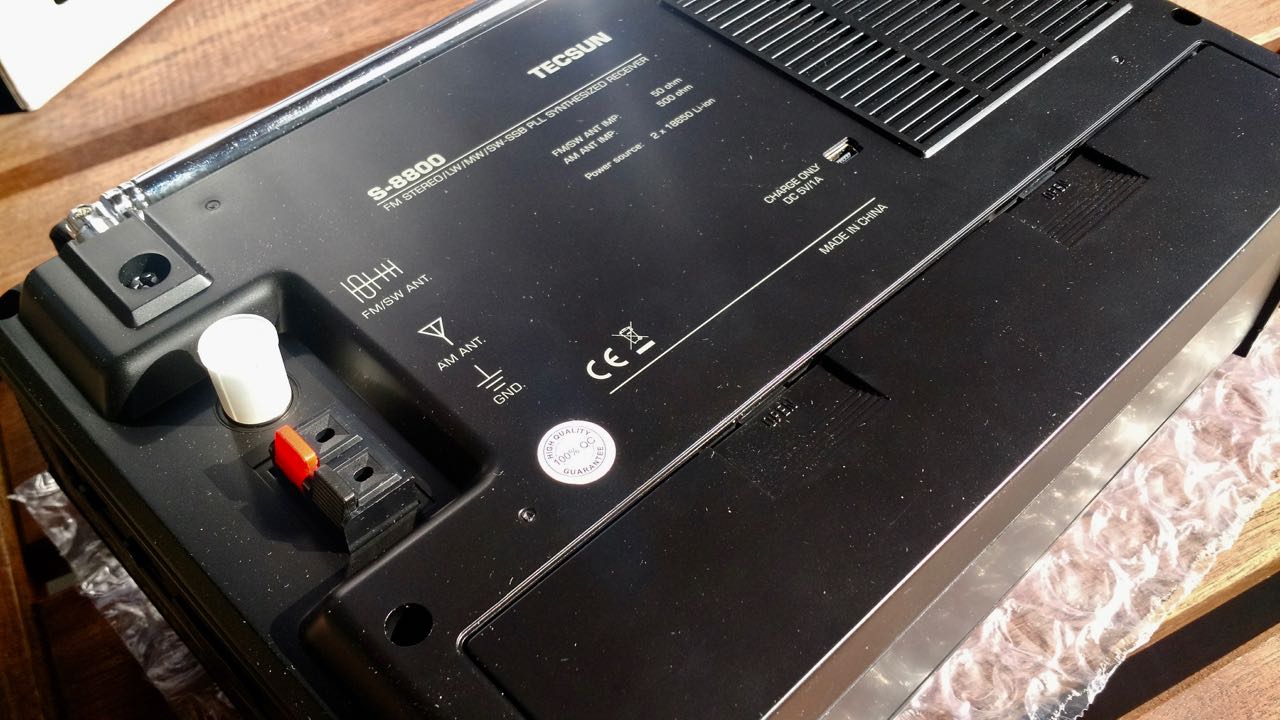
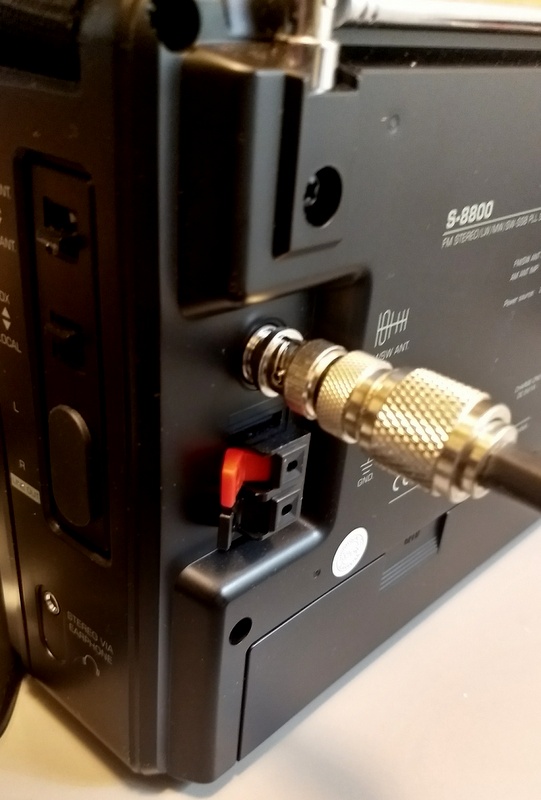
External antenna connections: both BNC (SW and FM) and a high-impedance port (LW, MW and SW)
Both 9 and 10 kHz spacing on mediumwave
Dedicated fine-tuning control
Auto Tuning Storage (ATS)
650 station memories
FM stereo/mono
Backlit LCD display
Treble and bass tone controls
RCA line-out audio
Full-featured clock, alarm and sleep timer
IR remote control
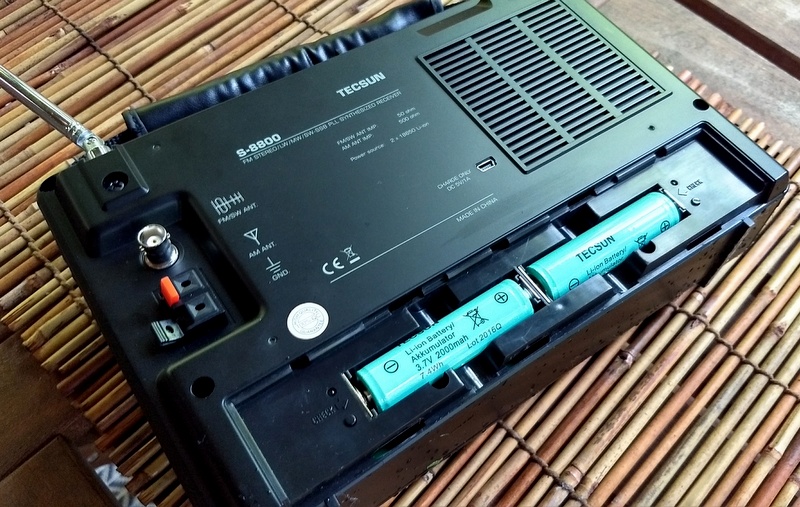
Two 18650 lithium cells (included) that can be safely charged internally via USB
Wishlist? The S-8800 feature set is pretty comprehensive, but my dream large portable would also have synchronous detection and an RF gain control, though the latter is not common in the world of portable radios. Fortunately, the S-8800 does have a local/DX gain toggle.
I’m sure some enthusiasts would also like to see Bluetooth connectivity as on the Eton Field BT, but I personally don’t miss it. I like to keep my HF portables free from anything that could potentially raise the noise floor.
With the exception of synchronous detection, the S-8800 has a solid, comprehensive tool set.
Performance
Over the past two weeks, I’ve had the S-8800 on the air almost every day. I’ve compared it with a number of receivers, but mainly its smaller sibling, the popular Tecsun PL-880. Below, I break down my notes by band.
FM
As is typical with my shortwave portable reviews, I spent less time evaluating FM performance on the S-8800.
With that said, I did compare the S-8800 with the PL-880, PL-680 and CountyComm GP5-SSB and a few other portables. The S-8800 found my benchmark weaker broadcasters with ease.
Here’s a short video demonstrating FM performance with a broadcaster over 100 miles distant:
I’ve had more inquiries about S-8800 mediumwave performance than I’ve had about any other radio I’ve recently reviewed. Why? Well, for one thing, some radios in this particular portable format perform quite well on mediumwave––the C.Crane CCRadio-SW, for example, comes to mind. Also, the S-8800’s large front-facing speaker lends itself to superb AM audio.
Unfortunately, mediumwave is not the Tecsun S-8800’s strong suit.
I did extensive testing, comparing it with much smaller portables: the Tecsun PL-880, the Sony ICF-SW7600GR, the Digitech AR-1780, the CC Skywave, and even a pre-production CC Skywave SSB. All of these portables had better sensitivity on mediumwave.
I posted the following representative video a couple weeks ago in a post:
To reiterate from my previous post, comparing any modern radio with the Panasonic RF-2200 on mediumwave is hardly fair. For one, the RF-2200 has been out of production for a few decades. For another, the RF-2200 has a large rotatable ferrite bar antenna that provides excellent gain. The RF-2200 simply wipes the floor with all of my modern portables, as their ferrite bar antennas are but a fraction of the size.
To my ear, the S-8800’s mediumwave band seems noisier than its competitors. Perhaps this is why it struggles with marginally weak stations.
Here’s another comparison with the PL-880––this time at a totally different location:
With that said, when tuned to a local AM broadcaster, the S-8800 really shines. It produces rich audio which can be customized with bass/treble tone controls and by changing the AM filter width.
I also hooked up the S-8800 to my large horizontal loop antenna. This certainly did improve MW reception, but not as dramatically as I hoped. Additionally, it seemed to be very sensitive to RFI in my shack even when hooked up to the external antenna.
If you took the S-8800 to the field, added a decent inductively-coupled magnetic loop antenna, no doubt it would improve mediumwave reception, but I still doubt it would come close to the RF-2200 in performance. As long as I own the latter, I wouldn’t be motivated to do so.
Due to my schedule over the past few weeks, I’ve had precious little time to test the S-8800 on mediumwave at night, but some quick air checks proved performance was consistent with daytime testing.
I am pleased to report that no receiver overloading was observable during testing.
In short: if you’re only considering the S-8800 for mediumwave DXing, you should look elsewhere. I would suggest a dedicated AM broadcast receiver like the excellent CCradio 2E, a vintage Panasonic RF-2200, or perhaps a used GE Superadio.
LW – Longwave
I’ve spent less time on longwave than I have on mediumwave and shortwave.
With that said, the S-8800 was able to receive our local airport beacons at night with relative ease. I was not able to catch any transatlantic longwave broadcasters, but that’s no surprise as it’s almost impossible on even my commercial-grade receivers during the summer months here in North America.
As I said regarding the mediumwave band, I suspect there are much better radios out there for the longwave enthusiast.
SW – Shortwave
At the end of the day, I believe the Tecsun S-8800 was designed with the shortwave and amateur HF radio enthusiast in mind.
The S-8800 has gapless HF coverage from 1,711 kHz to 29,999 kHz, can be used both in AM or Single Sideband (selectable LSB/USB), and has adjustable bandwidth filters tailored to AM broadcast and SSB/CW (ham radio/utility/pirate) reception. The filter widths are well-chosen for each mode: 6, 4, 3, and 2.3 kHz on AM; 4, 3, 2.3, 1.2, and 0.5 kHz on SSB.
It also has a dedicated fine-tuning control that adjusts steps based on the mode.
All of these are desired features for the HF radio enthusiast.
I’m happy to report that the S-8800 is a very capable shortwave receiver, perhaps even one of the best portables currently on the market.
In every comparison test I made on shortwave, the S-8800 outperformed each of its competitors.
Check out the videos below and judge for yourself:
I was pleasantly surprised by the audio in SSB mode and by how well the filters seem to work. Note in the video the warbling sound as I adjust the fine-tuning control on the S-8800. But it’s actually only present as I adjust the fine-tuning control; I noticed no stability issue once on frequency.
External antenna
Since the S-8800 has a handy standard BNC connector and high impedance AM antenna socket on the back, I hooked it up to my large horizontal loop. In my testing, it handled that antenna’s gain very well and I was most impressed with the performance.
The front end seems to be robust, and selectivity––which is excellent––was not compromised by my antenna. I was able to pull apart two broadcasts with only 5 kHz of separation that were both quite strong. The S-8800 locked onto the stronger of the two stations with ease. When tuned to the weaker station, I used SSB reception on the upper sideband to ignore the noisier lower sideband which was buried in the adjacent signal. Once I zero-beated the signal, it sounded quite good.
Final thoughts about shortwave performance
Perhaps what the S-8800 has going for it on shortwave is a combination of very good sensitivity, excellent selectivity, and a feature all too often overlooked: good audio fidelity (via the internal two-watt speaker).
The AGC (auto gain control) is actually fairly stable on the HF bands (less so on mediumwave). Like the Tecsun PL-880, the AGC has a soft hiss response when the signal fades below the AGC threshold. While I’m not crazy about this, I must confess that it is pretty easy on the ears when fading is pervasive.
I did note one quirk that could annoy those wishing to copy narrow SSB or CW. If the filter bandwidth is set to .5 kHz and you’re listening to a marginal CW signal, the AGC sometimes mutes the receiver during CW dead space. It equates to very unstable audio with audio levels jumping around wildly. This happened more often when I was copying moderate to weak CW signals. I’ve even noticed it when listening to SSB ham radio conversations, but mostly in the narrow bandwidths. I usually keep the filter set to 2.3 kHz or higher and it hasn’t been a problem at these settings. It’s worth noting that I have observed the same AGC behavior in my PL-880 at times.
The S-8800 ships with two rechargeable lithium cells which provide hours of listening time from a full charge.
I never encountered overloading from local AM broadcasters on the shortwave bands, with the caveat that I never tested the S-8800 in an RF-rich urban market.
One thing I have noticed in general about the S-8800 is that it seems pretty sensitive to RFI indoors (electrical noise in the home, office, etc)––more so than my Sony ICF-SW7600GR, for example. If you live in a noisy environment and never plan to use an external antenna or take the radio outdoors, you might think twice about the S-8800.
Birdies
I’m pleased to report that Tecsun did properly address the “birdie” issue I mentioned at the beginning of this review. Still, like most receivers, the S-8800 does have some birdies across the bands. These birdies are well within the norm for such rigs: a relatively stable heterodyne sound. I made a short video to illustrate what I mean when I talk about a birdie:
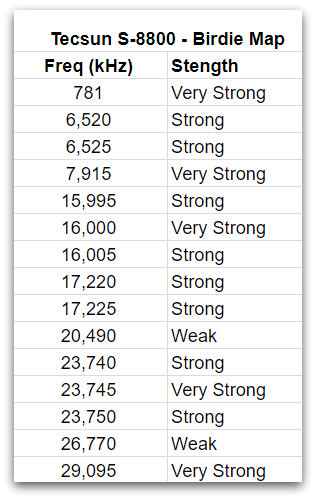
I spent one afternoon carefully mapping out all of the birdies I could find across the longwave, mediumwave and shortwave bands.
Here’s what I mapped:
As you can see, there are no birdies in the middle of sensitive areas like broadcast bands, amateur radio bands, etc. A good report, in my book.
Note that while tuning through the shortwave bands, I used 5 kHz steps. I suppose there’s a possibility I might have missed very weak birdies doing this, but any strong birdies would have been received and noted within the 5 kHz window. On LW and MW, I tuned in 1 kHz increments.
Summary
Every radio has its pros and cons, of course. When I begin a review of a radio, I take notes from the very beginning so that I don’t forget my initial impressions. Following is the list I formed over the time I’ve been evaluating the Tecsun S-8800:
Pros:
Brilliant audio fidelity from built-in speaker
Dedicated AM bandwidth and fine tuning controls
Excellent, bespoke IR remote control
Capable SSB mode
Excellent shortwave sensitivity (see con: mediumwave)
Excellent shortwave selectivity
Excellent FM performance
Easy-to-read backlit LCD digital display
Remote control beautifully equipped for full radio functionality
Included 18650 rechargeable lithium batteries power radio for hours
Cons:
Lackluster mediumwave performance (see pro: shortwave)
No synchronous detector
No direct keypad entry (Pro: Remote control has excellent keypad entry)
Can’t charge and listen at the same time–not designed for AC operation
No backstand
Line-out audio level is a little high (hot)
When in narrowest SSB filters, AGC can’t reliably handle audio/signal changes
Slight “warbling” sound while using fine tune control in SSB mode
No RDS display on the FM band
Conclusion:
As I’ve already mentioned, if your primary use of the S-8800 is for mediumwave or longwave DXing, you should look elsewhere. While the S-8800 will serve you well with local AM stations, it will not dig signals out of the noise like other better-equipped AM receivers. The GE Super Radio, Panasonic RF-2200, or CCRadio 2E are much better options.
But if you’re primarily a shortwave radio listener––? I think you’ll be pleased with the S-8800.
To my surprise, the S-8800 consistently out-performed my beloved Sony ICF-SW7600GR and my PL-880. I fully intend to compare it with other portables in the coming weeks and post the videos here on the SWLing Post. [I will update this review with any other findings.]
I did not mention this in previous posts, but the first S-8800 I received in January––the one with the birdie-chorus problem––also outperformed my other modern portables on shortwave. In part, I feared that when the Tecsun engineers addressed the birdie issue, it could have a negative impact on overall sensitivity. I’m happy to report that it did not.
What’s more, I realize that larger portables do have a place in my life. You might have noted that I did all of my review testing and preparation outdoors, mostly in a nearby national park. I do this, in part, to insure I’m far away from any RFI, but also I simply love playing radio outdoors.
And the S-8800 was a pleasure to tune and use in the field. I really like the large encoder and find that the multi-function knobs, tone controls, volume, and other buttons are well-spaced–I believe I could operate most of this receiver’s functions with gloves on in the winter. And again, there’s that excellent remote control…
This review was in final draft form two days before I learned the price from Anon-Co. I had assumed the price would not be released for another week or two at least, thus I made a few predictive statements that I’ll now quote here:
I understand that the S-8800e is being sold in Europe for 339 Euro, roughly $400 USD, plus shipping. There is no way I’d pay that price; it’s simply too much.
If the price exceeds $300 US, I’d suggest careful consideration, as the S-8800 price would be venturing into the realm of used Sony and Panasonic benchmark portables.
But. If this radio should be sold for less than $250, or even $200…? Being primarily a shortwave radio listener, I would certainly buy this radio for that price.
In the end, the price is $18 higher than the $250 I mentioned in my review draft, but I assumed shipping would be tacked on to that price. So $268 ended up being pretty close to the mark.
So I believe the Tecsun S-8800 hovers at the top price threshold of what most radio enthusiasts would be willing to pay for a portable. At $268, it’s over $100 more than the excellent PL-880 and only $20 less than the Tecsun S-2000. And for radio enthusiasts outside the US, it sounds like shipping will be added to the $268 price. I expect European consumers will pay a premium due to embedded (and required) sales tax and customs handling fees.
Nonetheless, I would still consider purchasing at the $268 US mark because of its shortwave performance, ability to connect external antennas, audio fidelity, and the included IR remote control.
I would like to see the price lower than $268. If the price were nearer the $200 mark, it would be a no-brainer––this radio would likely fly off the shelves, and I’d strongly suggest purchasing.
Perhaps, with time, the S-8800 price will decrease. In the meantime, if you have the budget, I believe the S-8800 would make for a nice field companion, pulling weak DX out of the noise with excellent audio fidelity to boot. It’s already been a great field companion for me…and, I’m sure, will accompany me into the field again.
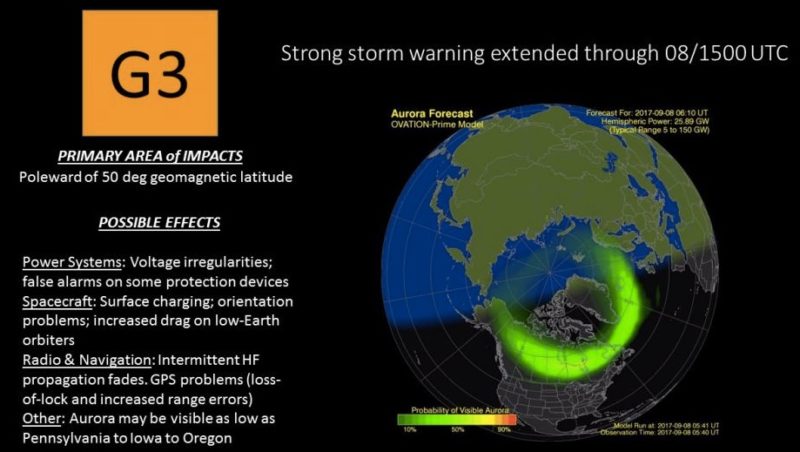
NOAA’s Space Weather Prediction Center (SWPC) has issued a strong (G3) geomagnetic storm watch for September 7 through September 9. The SWPC said the watch for September 7 remains in effect due to the arrival of a coronal mass ejection (CME) and the effects of a CME on September 4.
“Additionally, a G3 watch is now in effect for the 8 and 9 September UTC days in anticipation of the arrival of another CME associated with the X9.3 flare (R3 — strong radio blackout) on 6 September at 1202 UTC (0802 ET),” the SWPC said early on September 7. “Analysis indicates likely CME arrival late on 8 September into early 9 September.” The September 6 flare is being called the strongest in more than a decade.
Its effect on HF radio propagation has adversely affected the Hurricane Watch Net (HWN), currently operating on 20 and 40 meters as Hurricane Irma sweeps through the Caribbean.
As of September 7 at 1400 UTC, the solar flux index stood at 127, the sunspot number at 27, the A index at 11, and the K index at 4. All HF conditions are being deemed as no better than fair. The possibility of extended auroral displays could work to the benefit of VHF and UHF operators who aim their antennas north to take advantage of “buzz” mode. SWPC posts a 30-minute forecast of visible aurora.[…]
Also, check out Tamitha Skov’s forecast on YouTube:
Last night, I tested a couple of HF radios and all but the strongest shortwave broadcasters (WRMI, RHC) were wiped out. Even the strong stations sounded like weak DX. This is truly an HF blackout.
Please support this website by adding us to your whitelist in your ad blocker. Ads are what helps us bring you premium content! Thank you!