Category Archives: Mediumwave

Guest Post: “Tinkering with History”

Many thanks to SWLing Post contributor, Bob Colegrove, who shares the following guest post:


Tinkering with History

By Bob Colegrove

One of the attractive aspects of radio as a hobby is that it has so many specialties to channel our time.  Just for the sake of classification, I would group these into two categories, listening and tinkering.  I think the meaning of each category is fairly intuitive.  Probably few of us approach our interest in radio in the same way.  Most of us have dabbled in more than one listening or tinkering specialty.  Perhaps we have been drawn to one particular area of interest, or we may have bounced around from one to another over a period of time.  I know the latter has been my case.

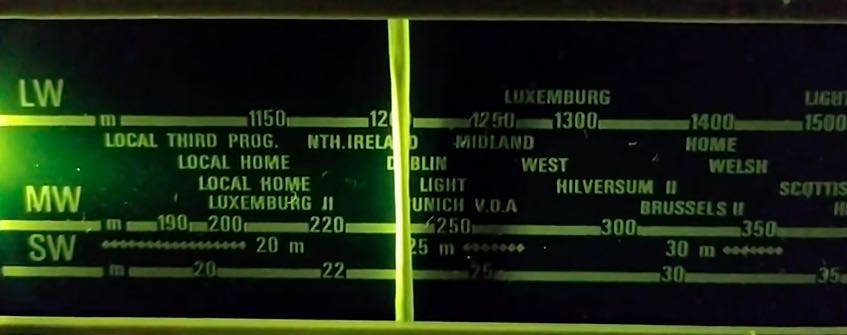
Tinkering might start with a simple curiosity about what makes the radio play, or hum, or buzz, and progress to an obsessive, compulsive disorder in making it play, hum or buzz better.  Unfortunately, over the past 30 years or so, the use of proprietary integrated circuits, as well as robotically-installed, surface-mounted components have greatly short-circuited what the average radio tinker can do.  For example, I have noticed a lot more interest in antennas over that period, and I think the reason is simple.  The antenna is one remaining area where a committed tinker can still cobble up a length of wire and supporting structure and draw some satisfaction.  But the complexity and lack of adequate documentation have largely kept newer radio cabinets intact and soldering irons cold.  Bill Halligan knew you were going to tinker with his radios, so he told you how they were put together.  The fun began when you took your radio out of warranty.  If you did get in over your head, there was usually somebody’s cousin not far away who could help you out.  The following is a sample of how one resolute tinker managed to overcome the problem of locked-down radios in the modern age. Continue reading

Giuseppe’s portable multi-loop homemade shoe rack antenna

Many thanks to SWLing Post contributor, Giuseppe Morlè, who writes:

Dear Thomas,

I’m Giuseppe Morlè iz0gzw from central Italy on the Tyrrhenian Sea, Formia.

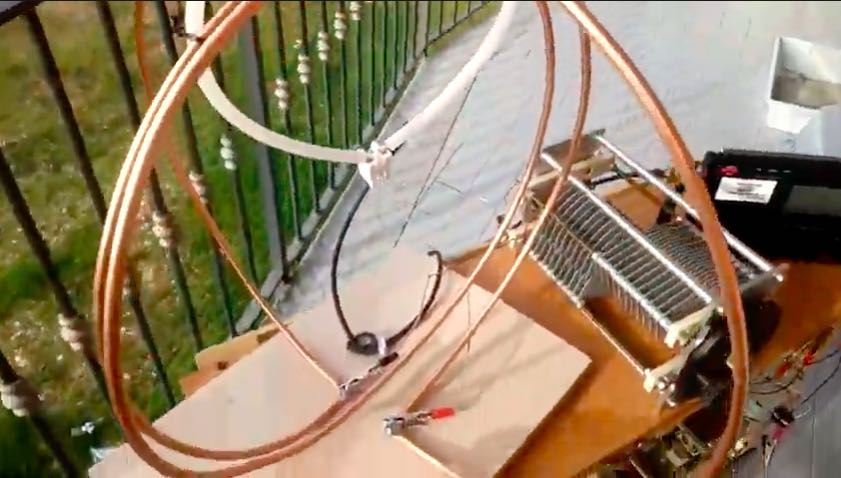
I am sending you this umpteenth project of mine built with poor materials…it is a test bench, loops / capacitors to find the best tuning.

The frame is a shoe rack in beech wood, very light, to take anywhere or to try out at home.
On the frame, there are 4 different loops of different sizes and 3 variable capacitors with different capacities. Only one signal transfer link to the receiver for all loops.

With alligator plugs I can use the different combinations of loop / variable to find the best tune

This test rig can tune the whole HF frequency range and medium wave.

I’ve attached 3 videos where you can see from the beginning to the last test on the balcony of my house.

Videos

Note that the following videos are in Italian, but you can turn on closed captioning and in the settings of the video have it auto-translate into the language of choice:

Click here to view on YouTube.

Click here to view on YouTube.

Click here to view on YouTube.

All, as always, spending very little and employing used materials!

Thanks to you and a warm greeting to the whole SWLing Post community.

I remain available for any clarification.

Greetings to all and good experimentation!

Thank you for sharing this Giuseppe! I love your ingenuity and spirit of experimentation! What a fun project that obviously yields excellent results!

Presentation: Crystal Radio History, Construction, and Contesting

Many thanks to SWLing Post Contributor, David Day (N1DAY), who shares the video presentation below, offering even more insight into his most recent guest post on the topic of crystal radio DXing.

David has also posted this presentation on his website and notes that he’s happy to share the presentation slides without copyright. David notes:

[…]I have purposely not copyrighted this work so that anyone is free to modify it as they see fit. The only thing I ask is that if you make changes that you do not copyright the derivative work as your own intellectual property so that others can benefit from your knowledge and build upon it as well.

That’s brilliant, David! Thank you.

Presentation:

Click here to view on YouTube.

Click here to check out N1DAY’s website.

Radio Waves: HFT Update, Radio Bulgaria on Shortwave, IC-R30 Firmware Notice, 2022 Edition of NDB handbooks, and RIP “Johnny Fever”

Radio Waves:  Stories Making Waves in the World of Radio

Because I keep my ear to the waves, as well as receive many tips from others who do the same, I find myself privy to radio-related stories that might interest SWLing Post readers.  To that end: Welcome to the SWLing Post’s Radio Waves, a collection of links to interesting stories making waves in the world of radio. Enjoy!


Experimental Radio News 3 (Experimental Radio)

This issue concerns High-Frequency Trading (HFT) transmissions, and three prospective stations seeking entry into the International Broadcast service.

Several stations licensed in the Experimental Radio Service (ERS) transmit data for automated trading to foreign exchanges in the shortwave or high-frequency (HF, 3-30 MHz) spectrum.

High-Frequency Trading (HFT) is a form of automated trading that employs low-latency, high-speed telecommunications to minimize response times. The term is not related to the shortwave or HF spectrum, but this article concerns transmission of HFT messages on HF frequencies.

HF signals can traverse great distances by refraction from ionized layers of the atmosphere, a phenomenon known as ionospheric propagation. Several ERS HFT stations have operated in the HF bands for years out of the public view. Bob Van Valzah blogged extensively about these stations starting in 2018.

These ERS stations’ licenses are public records, but the licensees typically ask the FCC to withhold access to station details and experimental plans. The Commission’s routine acceptance of these confidentiality requests makes public oversight difficult. [Continue reading at Experimental Radio…]

Radio Bulgaria back on shortwave

Many thanks to SWLing Post contributor, Richard Langley, who writes:

As I reported to Glenn Hauser’s group today, Bulgarian National Radio’s Radio Bulgaria is back on shortwave.

Their weekday roughly 22-minute podcast in English, called “Bulgaria Today,” is being aired by ShortwaveService from Kall, Germany, on 3985 kHz from 18:30 until about 18:52 UTC.

Today (30 January), the podcast dated Thursday, 27 January, was broadcast. The program consisted of news, COVID-19 information, weather, travel, and the “Music Slot.” Reception using the U. Twente SDR receiver was fairly good.

There is also a German broadcast before the English one beginning at 18:00 UTC. The ShortwaveService tuning signal is used to fill out the half-hour slot in each case.

All the best
— Richard

Notice and apology regarding the IC-R30 firmware (Ver 1.12) (Icom Japan)

Many thanks to Markku Koskinen who discovered that Icom published the following notice on their website regarding their latest firmware update to the IC-R30:

Thank you for using Icom products.

A defect was found in the IC-R30 firmware (Version 1.12) released on our website on January 13, 2022, so we are currently withdrawing the firmware.
We apologize for the inconvenience caused to users. We will let you know when there is any new firmware update information.

[For users who have updated to the IC-R30 firmware (Version 1.12)]
You can continue to use the IC-R30 as before by installing the IC-R30 firmware Version 1.11 again. Please download it from the links [on this page].

[…]We sincerely apologize for any inconvenience that we might have caused to our customers.

Click here for more details.

2022 editions of ENDBH / GNDBH / NANDBH handbooks and CDs

Many thanks to SWLing Post contributor, Michael, who shares:

The 2022 editions of my NDB handbooks and CDs are ready now and have
once again been updated extensively to reflect the latest changes and
monitoring results.

The new GNDBH contains the details of more than 17100 NDBs worldwide.
It is the perfect listening companion for radio listeners who use the
extensive and ever-growing network of WebSDRs.

The updated ENDBH shows the data of more than 8300 NDBs, and the new
NANDBH features more than 5900 NDBs.

Please find all relevant details [on this PDF document].

Once again, I’d like to thank all fellow NDB DXers for your continued
support! Please keep up the good work, I do appreciate your direct
input to keep the handbooks up to date!

vy 73 + gd DX,

Michael

ENDBH, GNDBH & NANDBH editor

https://ndbchangeblog.blogspot.com
https://www.ndblist.info/beacons/NDBpublications2022.pdf

Howard Hesseman, who played Johnny Fever on ‘WKRP in Cincinnati,’ dies at 81 (NPR)

NEW YORK — Howard Hesseman, who played the radio disc jockey Johnny Fever on the sitcom “WKRP in Cincinnati” and the actor-turned-history teacher Charlie Moore on “Head of the Class,” has died. He was 81.

Hesseman died Saturday in Los Angeles due to complications from colon surgery, his manager Robbie Kass said Sunday.

Hesseman, who had himself been a radio DJ in the ’60s, earned two Emmy nominations for playing Johnny Fever on CBS’ “WKRP in Cincinnati,” which ran for four seasons from 1978-1982. The role made Hesseman a counterculture icon at a time when few hippie characters made it onto network television. [Continue reading…]


Do you enjoy the SWLing Post?

Please consider supporting us via Patreon or our Coffee Fund!

Your support makes articles like this one possible. Thank you!

Radio Waves: Dynamic GPS Tutorial, BBC’s First Female Employee, Rugby CW ID in Tubular Bells, and Roger Wallis Passes Away

Radio Sweden QSL

Radio Waves:  Stories Making Waves in the World of Radio

Because I keep my ear to the waves, as well as receive many tips from others who do the same, I find myself privy to radio-related stories that might interest SWLing Post readers.  To that end: Welcome to the SWLing Post’s Radio Waves, a collection of links to interesting stories making waves in the world of radio. Enjoy!


GPS Tutorial by Bartosz Ciechanowski

Check out this amazing, dynamic deep-dive into the world of GPS. 

The BBC’s First Female Employee: Isobel Shields (The British Broadcasting Century with Paul Kerensa)

Episode 41 (aka Season 3 episode 2):

On January 2nd 1923, John Reith interviewed Miss Frances Isobel Shields for a job at the BBC, to be his secretary. At the time the BBC had four or five male staff members. Miss Shields started work on January 8th, instantly making the BBC a 20% female organisation. It’s been greater than that ever since.

This episode’s fab guest is Dr Kate Murphy: academic, former producer of BBC’s Woman’s Hour and author of Behind the Wireless: A History of Early Women at the BBC. Her book is brilliant and highly recommended for a deep dive into the subject.

Hear Isobel Shields’ tale, plus the women who broadcast before her: Britain’s first DJ Gertrude Donisthorpe, 2LO’s first children’s presenter Vivienne Chatterton, and one of our first broadcast comedians Helena Millais. (You can hear their fuller tales if you go back to the earlier episodes on this podcast.)

And hear about some of the women who joined the BBC soon after Miss Shields, like telephonist Olive May and women’s staff supervisor Caroline Banks. Plus hear about some of John Reith’s unusual management practices, from taking his secretaries to the cinema to his brutal firing criteria.

But we dwell on his hiring not firing, as well tell the origin story of British broadcasting. [Continue reading…]

Hidden Morse Code in Tubular Bells (Madpsy’s Palace) 

The link between The Exorcist, Amateur Radio and Alan Turing.

A quick look at how the movie The Exorcist from 1973 has links to the late great Alan Turing via Mike Oldfield’s album Tubular Bells, Scotland and Amateur Radio. It’s Halloween so figured why not throw some horror in the mix.

When Mike Oldfield recorded Tubular Bells in 1973 he had no idea his first album on Virgin Records would be chosen as the soundtrack to The Exorcist later that year. Neither did he know that recording with Virgin Records would have an unintended consequence of hiding a secret message which dates back to 1926, shortly after World War One.

Tubular Bells was famously recorded at The Manor Studio which was owned by Richard Branston and used as a recording studio for Virgin Records. The building is located in Shipton-on-Cherwell, England. Mike was given one week to record the album, on which he played almost all the instruments himself.

The album initially struggled to sell. Then, later the same year, it was chosen as the soundtrack for the movie The Exorcist. It then experienced massive success and has since sold over 15 million copies worldwide. [Continue reading…]

Roger Wallis from “The Saturday Show” on Radio Sweden passes away

Many thanks to SWLing Post contributor, Lennart Wennberg, who notes:

Just got the news that Mr Roger Wallis has died at the age of 80.

I remember him from Radio Sweden’s Saturday Shows on MW in the 70s. He was “Big Bad Roger” and hosted together with Kangaroo Kim.

Lennart Wennberg
Sweden

From Wikipedia:

Roger Wallis (8 August 1941 – 22 January 2022) was a British-born Swedish musician, journalist and researcher.[1]. He was an adjunct professor of multimedia at the Royal Institute of Technology in Stockholm.[2]

Between 1967 and 1981, Wallis was the main presenter of the English language The Saturday Show on Radio Sweden. Wallis also co-wrote “Judy, min vän”.

Wallis died on 22 January 2022, at the age of 80.


Do you enjoy the SWLing Post?

Please consider supporting us via Patreon or our Coffee Fund!

Your support makes articles like this one possible. Thank you!

Guest Post: Comparing the Reuter Pocket and the Icom IC-705 from an SWL’s perspective

Many thanks to SWLing Post contributor, Uli (DK5ZU), who shares the following guest post:


SWL with a Reuter Pocket and the Icom IC-705

by Uli (DK5ZU)

Some time ago I asked how the IC-705 performs on longwave and I got some great feedback. Thanks a lot again. Since the HAM bug bit me again, I wanted to do SWL and HAM Radio portable with one rig. I started with SWL some weeks ago (just before the bug bit). I acquired a second hand Reuter Pocket RDR 51 Version B2. It is a standalone SDR Receiver 0 … 30 MHz / 50 ..71 MHz, and in my B2 version it has also FM (Stereo/RDS) and Digital Audio Broadcasting (DAB). You may find the detailed specs here:
https://www.reuter-elektronik.com/html/pocket.html

The Reuter Pocket could, at one point, be configured as an QRP Transceiver, but it is no longer supported. There is a new RDR 52 small tabletop models, which can be ordered as a transceiver, too. But due to Covid related supply chain problems and price changes for the components, the new model is currently postponed.

The IC-705 is available, though. And for portable HAM operations it is a no brainer; obviously with a high price tag, but comparable with a new Reuter RDR 52 tabletop. And since my budget for the hobby is limited, I thought about funding part of the IC-705 price by selling the Reuter Pocket. But I wanted to do a side-by-side comparison so I ordered the 705 and was able to check them both on one antenna. The goal was to compare their sensitivity and selectivity on the lower bands: BC on AM and HAM bands for SSB. I did not compare CW since I am not a CW operator.

The antenna is a MiniWhip from PA0RDT which works quite well on the lower bands.

This comparison is not at all scientific and reflects just my opinion and what I heard. But anyway, there may be some people out there interested in this. So much for the intro.

Let’s start with my overall findings. Continue reading

Guest Post: Crystal Radios – Construction, Listening, and Contesting

Many thanks to SWLing Post contributor, David Day (N1DAY), for sharing the following guest post:


Crystal Radios – Construction, Listening, and Contesting

By David Day – N1DAY

The date was November 2, 1920 and the world was about to change forever when radio station KDKA out of Pittsburgh PA made its first broadcast of election results from the 1920 presidential election.  For the first time in history people knew who won the election before reading about it the next day in the newspaper.  Radio had arrived!

However, hearing the election results was not as easy as powering up an AM radio receiver because radio electron tubes had only been invented a few years earlier and they were still too expensive for most people to afford in a radio set.  After KDKA’s historic broadcast, large 50,000 watt stations began popping up in all major cities around the world.  Even though a tube-driven radio was not yet commonplace, many people listened to these stations on their crystal radios.  The frenzy around radio in the 1920’s was not unlike the excitement around cell phones and the internet today.  If you didn’t have one, you were simply living in the past.

A family listening to a crystal radio in the 1920’s

Fortunately, in the early 1920’s the crystal radio had been around for a while and it was easy to make or purchase a completed set on a limited budget.  The beauty of the radio was that it was a passive device needing no power source other than the radio station’s broadcast that was received by a good antenna about 50 feet long and 15 or so feet above the ground.  Crystal radios derived their name from use of galena crystals as detectors. Continue reading