Category Archives: News

RCI Action: Last month of RCI broadcasts, unless…

(Source: RCI Action)

June 24, 2012, will be the last day of Radio Canada International’s radio programming unless we can convince Canada’s government that our national public radio and television broadcaster CBC/Radio-Canada went too far when it cut our budget by 80% and decided we would no longer broadcast on shortwave or satellite, and be left with only a web presence on the Internet .

This decision to stop radio broadcasting fails to recognize that most people in the world do not have easy access to the Internet. It fails to recognize that there is very little access around the globe to contextualized Canadian news, news for those outside Canada. And since RCI’s mandate is to explain Canada to as much of the world as possible, CBC/Radio-Canada is making that harder for us.

That is why we are calling on Canada’s federal government to step in, stop the cut, and protect Radio Canada International’s international mandate.

Here’s where we need your help.

Please contact government (Conservative) Members of Parliament and tell them why access to Canadian news is important to you.

You’ll find the e-mail addresses for the MPs, and some more information on the impact of the cuts, announced April 4, 2012, here: http://rciaction.org/blog/what-you-can-do/

“Boatanchors” and antique wireless at the Dayon Hamvention

I’ve always found the Dayton Hamvention flea market to be a great place to find antique radios, but this year, the selection (along with the weather) seems to be exceptional.

I’ve attached a few photos I took yesterday morning as a gallery below. Simply click on a thumbnail to enlarge.  Enjoy

In Zimbabwe, “if you want to hear the truth…listen to Shortwave Radio Africa…listen to VOA”

This is a brilliant piece on the lack of press freedom in Zimbabwe and the importance of shortwave radio. It was broadcast yesterday on Weekend All Things Considered. Links to the show and audio are below.

(Source: NPR)

In Seke, a rural community 40 miles outside Harare, James Chidakwa and his father eat roasted nuts and cornmeal inside a small brick hut. They’re farmers who rely heavily on maize and chickens to survive. James Chidakwa says that like many, his family refuses to listen to government TV or radio broadcasts.

“They always lie to the people,” he says. “Everything they say is a lie.”

So at 6 p.m. most evenings, they turn on a battery-powered, short-wave radio and tune in to a “pirate radio station.” Chidakwa says Shortwave Radio Africa and Voice of America are their favorites.

“If you want to hear the truth, wait for the end of the day to listen to Shortwave Radio Africa, to listen to VOA,” he says.

The stations, which are based in the U.K. and the U.S., send their signals through radio towers in countries that border Zimbabwe. That means Zimbabwean officials — who claim these broadcasts are illegal — have little recourse. In the past, they’ve confiscated short-wave radios. Chidakwa says that forces some people to listen undercover.

“Some of them, they will take the radios into their bedrooms and, low volume, they listen to the news. But the truth is, there is fear in them,” he says.

But for Chidakwa and his father, it’s a risk they are prepared to take.

The stations, which are based in the U.K. and the U.S., send their signals through radio towers in countries that border Zimbabwe. That means Zimbabwean officials — who claim these broadcasts are illegal — have little recourse. In the past, they’ve confiscated short-wave radios. Chidakwa says that forces some people to listen undercover.

“Some of them, they will take the radios into their bedrooms and, low volume, they listen to the news. But the truth is, there is fear in them,” he says.

But for Chidakwa and his father, it’s a risk they are prepared to take.

You can listen to the full story from Weekend All Things Considered, by clicking here (mp3), or read the transcript on this page.

This is just one more story we’ll file under “Why Shortwave Radio.”

RCI, and others, I wish you were listening. Those in Zimbabwe certainly are.

North Korea: Jamming shortwave radio 18 hours a day

(Source: Times Union)

[…]Martyn Williams, who writes the blog NorthKoreaTech.org, said that the government’s intense use of its scant resources and electricity to jam foreign news broadcasts reflected its concern about the impact of outside media.

North Korea targets between 10 and 15 frequencies used by international short-wave broadcasters, such as U.S.-funded Radio Free Asia and stations operated by South Korea’s government, for up to 18 hours a day, and on major occasions like the April centennial, it jams radio signals around the clock, Williams said.

The North appears to have recently installed more sophisticated transmitters acquired from a Chinese company, although jamming operations have been up and down this year, likely because of technical problems or power shortages, he said.

Read the full article, the bulk of which deals with social media and mobile phones, on the Times Union website. Obviously, North Korea feels that shortwave radio is a threat to those in power. They should be afraid–shortwave radio signals easily cross their fortified borders. This article will be filed under why shortwave radio.

The Link talks about the politics of saving RCI

On Friday’s edition of The Link, Mark Montgomery spoke with Amanda Pfeffer about how international radio is being cut around the world and, more specifically, Canada. They discuss how this happened, who is aware of it and if there is any way to save the service.

It’s an informative segment (though see my correction below).

Since this is one of several features in the show, I’ve recorded this specific segment and posted it for listening below.

You can also listen to the segment by downloading the mp3 here.

Please note that Amanda is a little mis-leading about the bureaucratic structure of US international broadcasting. It is rather confusing.

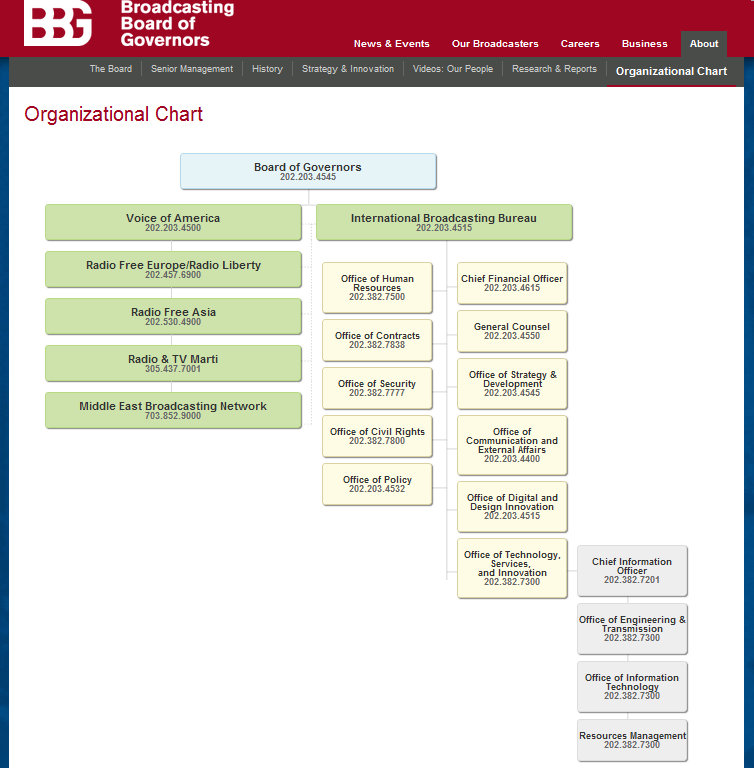
The BBG (Broadcasting Board of Governors) is the governing body of US international Broadcasting. The IBB (International Broadcasting Bureau) is over all of the broadcast/transmission facilities, engineering functions, human resources, finances and other agency support services. To be clear, the Voice of America, Radio Free Asia, Radio Free Europe, Radio Marti and the Middle East Broadcasting Network all take direction from the BBG, not the IBB.

The organizational chart (below) can shed some light on this.

The BBG Organizational Chart as of May 2012 (Click to enlarge)

Edward R. Murrow Transmitting Station: re-dedication videos

Last week, we noted the upcoming re-dedication of the Edward R. Murrow Transmitting Station and the significance of this particular broadcasting location.

Videos of the event have now been posted on the BBG Watch website, including this one, which features the original dedication of the site in 1963:

Local CBS affiliate, Channel 9, provided raw video feeds from the event, which are also posted.  Of particular note is the footage of Governor Victor Ashe’s speech and the tour of the station.

Victor Ashe:

Station tour:

As I previously mentioned, in December 2012, I had the honor of receiving a five-hour tour of the Edward R. Murrow Transmitting Station. Following that marvelous tour, I  wrote a piece for the March 2012 issue of the Monitoring Times in which I describe the day’s experiences; the article has already received many kind comments (thanks!) and continues to draw interest to the station. I think this may be one of the best articles I’ve ever written, and the clear reason for this was my sheer delight in the tour, a dream come true for me.  Moreover, I had early information about the re-dedication of the site, and was immensely pleased that  those who work there should receive such well-deserved accolades.

BTW:  While I have a busy travel schedule this summer, I intend to publish some items of interest in my absence that I’ve been saving for the purpose. This will include the article I wrote for the MT–the full, un-cut version–along with dozens of hi-res photos from the site. It’s quite long, thus will be posted in manageable sections; each post will be tagged: VOA Greenville. Keep an eye open for those!

But if you just can’t wait, you can always download an electronic version of the March issue on the MT’s website.  Hope you enjoy it…!

And to our good friends at VOA Greenville:  thanks again, and congratulations!

WBCQ to send digital message over shortwave tonight

Update: Missed this broadcast? No worries–not only did we record the digital message, but we’ll teach you how to decode it.

(Source: WBCQ on Facebook)

On Friday, May 4, 2012, during Allan Weiner Worldwide (8pm US eastern time, 0000 UTC), we will be presenting an experiment in the transmission of text messages in digital formats. During the show, we will transmit a brief message in MFSK64 format. This message consist of text that listeners can save to a file with an .htm suffix, then open and view it in a web browser.

The message can be decoded using a variety of free software packages. One such package is FLDIGI, which can be found at http://www.w1hkj.com/Fldigi.html.

Thanks to Kim Andrew Elliott, audience researcher at the International Broadcasting Bureau, for coordinating this test.

You can find Allan Weiner Worldwide on 5,110, 7,490 and 9,330 kHz tonight (Friday, May 4th) at 00:00 UTC (20:00 in Eastern US)