Shortwave listening and everything radio including reviews, broadcasting, ham radio, field operation, DXing, maker kits, travel, emergency gear, events, and more
Many thanks to SWLing Post reader, Trevor, who writes:
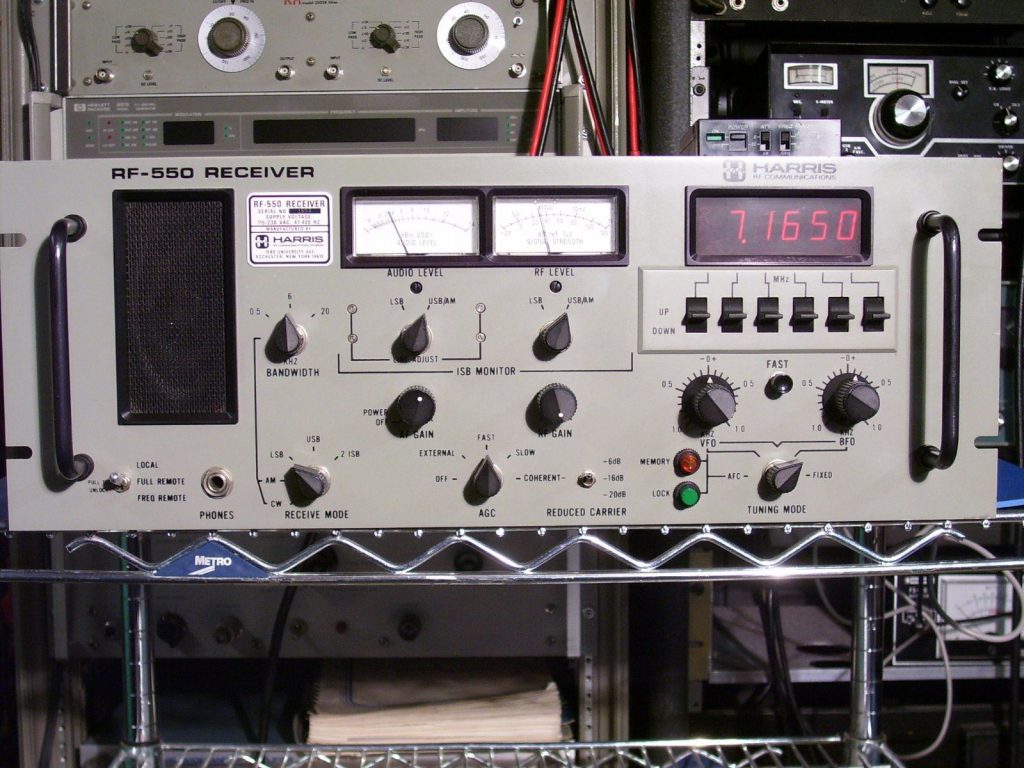
You might wish to share this with your readers. An example of an excellent commercial rack-mounted receiver at (what I would consider) a reasonable price on eBay: the Harris RF-550.
If I lived in The States, I would buy it. Sounds like it’s had a go-over with a technician, checks out and the seller has 100%. Shipping is reasonable, too. BuyItNow at $975 or (current bidding at $750).
Many thank to SWLing Post reader, Stefano Mollo–a licensed Australian broadcaster–who shares the following news:
Hi, Thomas,
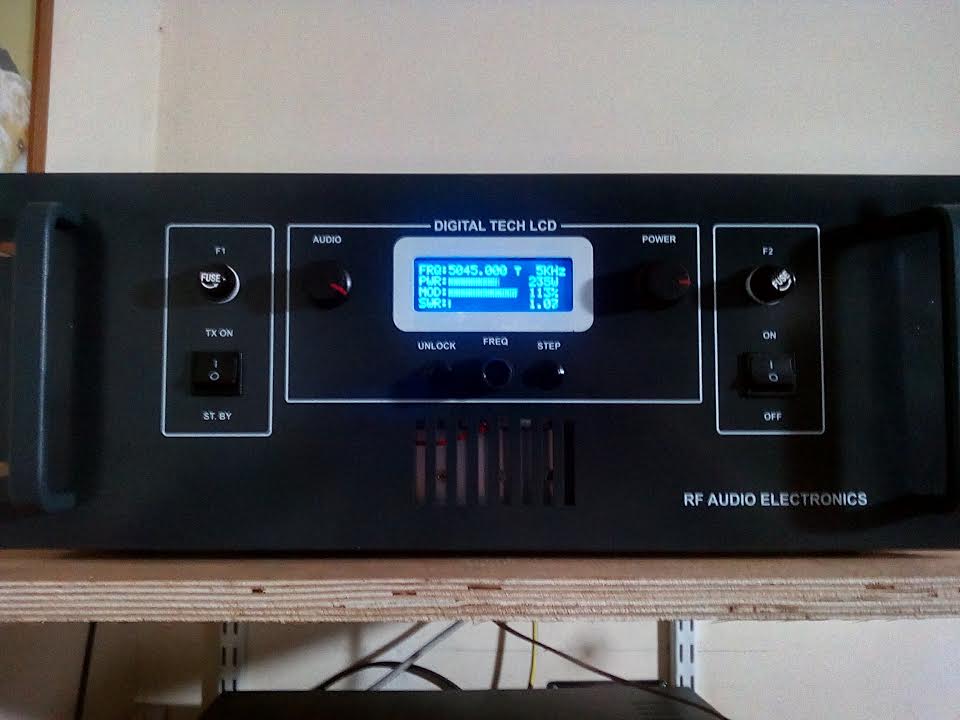
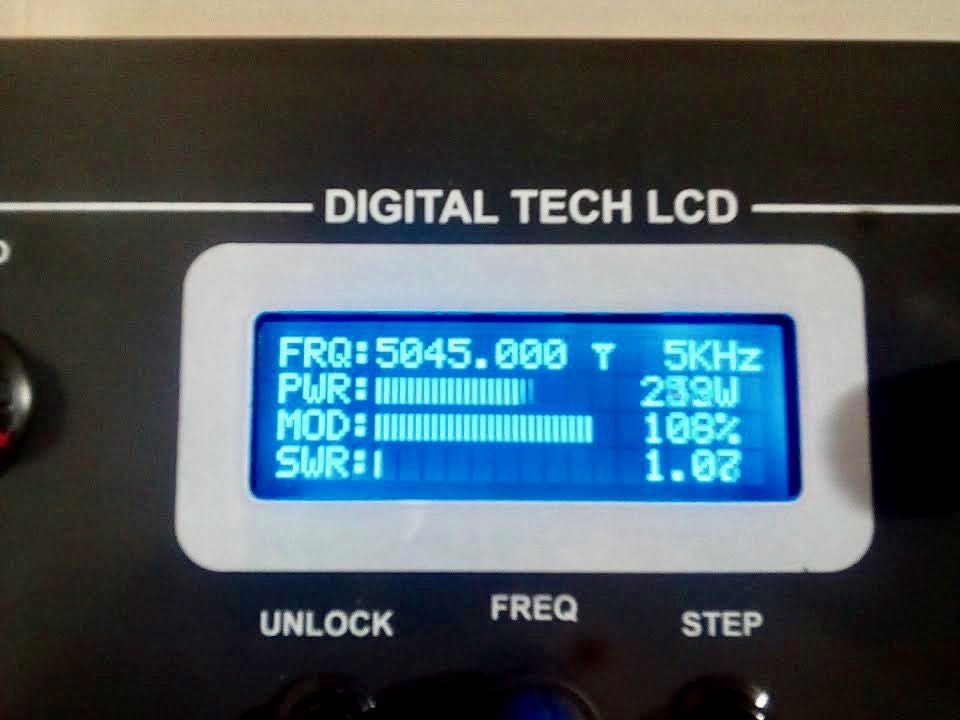
I have started test transmissions from Perth, Western Australia, on 5,045 kHz, at 75 watts (300 PEP).
Stefano’s HF transmitter
For the time being, I am using the same audio of my other station–77.4 MHz FM–which you can also find and stream online here: www.77400.fm
My test transmission are on the air from about 7:00 pm to about 10:00 pm every evening, local Perth WA time (11:00 – 14:00 UTC).
Please direct listener reports and any enquiries to [email protected].
Thank you for sharing your news, Stefano!
Post readers: While 300 watts PEP is a modest broadcast signal, no doubt many in Australia, Oceania and Asia will be able to log Stefano’s station when conditions are favorable. During band openings, his signal might travel quite a distance.
Let’s help Stefano by contacting him with detailed listener reports!
Thanks to the support of our VORW Radio listeners, I am proud to announce that VORW Radio International now has a transmission to South America on 9955 kHz!
Each broadcast features a mixture of my commentary and listener requested music. You’ll hear a great variety of music in this program, from Classical to Classic Country, from Rock to Smooth Jazz, you’ll hear it all!
If you’re interested in listening, the updated broadcast schedule is as follows:
Thursday 1200 UTC – 9875 kHz – Tashkent 100 kW – East Asia
Thursday 2000 UTC – 11580 kHz – WRMI 100 kW – Western Europe
Thursday 2200 UTC – 9955 kHz – WRMI 100 kW – South America
Friday 0000 UTC – 9395 kHz – WRMI 100 kW – North America
Friday 0000 UTC – 9455 kHz – WRMI 100 kW – Central America
Friday 0000 UTC – 7490 kHz – WBCQ 50 kW – North America
Questions, comments, reception reports and music requests may be sent to [email protected]
Reception reports will receive a QSL!
John, I’m so impressed with the number of relays you now have on shortwave–you’re truly a global broadcaster! Keep up the good work!
The FCC is to legalize 27 MHz CB DXing and boost power of license exempt UHF FM Family Radio Service (equivalent of UK PMR 446)
Under its new Chair Ajit Pai, the FCC is seeking to modernize radio regulations and is scrapping pointless rules like the 250 km (155.3 mile) restriction on Citizen Band Radio contacts.
As yet there is no word on the FCC taking action on the archaic Part 97 amateur radio regulations. Over 40 years ago the FCC considered these regulations were in need of a major overhaul and in 1976 introduced the “Regulation by Bandwidth” Docket 20777. The FCC eventually abandoned the modernization attempt after a a long campaign against it waged by the ARRL.
There was a desire by some radio amateurs in the late 1970’s to restrict the bandwidth of digital data transmissions but any form of “Regulation by Bandwidth” was considered anathema. This resulted in the introduction in 1980 of a Symbol Rate restriction on digital transmissions (avoiding the dreaded words “Bandwidth Restriction”). This has crippled amateur radio data communications ever since, preventing amateurs using modern modes.
It may well be that before too long the FCC will make another attempt at reforming Part 97.
Regarding the Part 95 changes the ARRL says:
In a lengthy Report and Order (R&O) in a proceeding (WT Docket No. 10-119) dating back 7 years, the FCC has announced rule changes affecting the General Mobile Radio Service (GMRS), the Family Radio Service (FRS), the Citizens Band Radio Service (CBRS or “CB”), as well as other applications that fall under the FCC’s Part 95 Personal Radio Services (PRS) rules and regulations. Part 95 devices typically are low-power units that communicate over shared spectrum and, with some exceptions, do not require an individual user license from the FCC. As the R&O explains, common examples of PRS devices include “walkie-talkies;” radio-control cars, boats, and planes; hearing assistance devices; CB radios; medical implant devices; and Personal Locator Beacons.
“This draft Report and Order completes a thorough review of the PRS rules in order to modernize them, remove outdated requirements, and reorganize them to make it easier to find information,” the FCC said in a summary attached to the R&O. “As a result of this effort, the rules will become consistent, clear, and concise.”
GMRS and FRS devices are used for personal communication over several miles; compact FRS handhelds, often sold in pairs, are widely available. While GMRS and FRS share spectrum, GMRS provides for greater communications range and requires an FCC license; FRS does not.
“The rules will increase the number of communications channels for both GMRS and FRS, expand digital capabilities to GMRS (currently allowed for FRS), and increase the power/range for certain FRS channels to meet consumer demands for longer range communications (while maintaining higher power capabilities for licensed GMRS),” the FCC explained.
The amended rules eventually will eliminate combination FRS/GMRS radios for the most part, but allow up to 2 W PEP output for FRS transceivers.
The irony here is that CB DXing (regardless of power) has been in wide practice since the begging of the Citizen’s Band service! I suppose I never realized (at legal power) DXing was illegal. 🙂
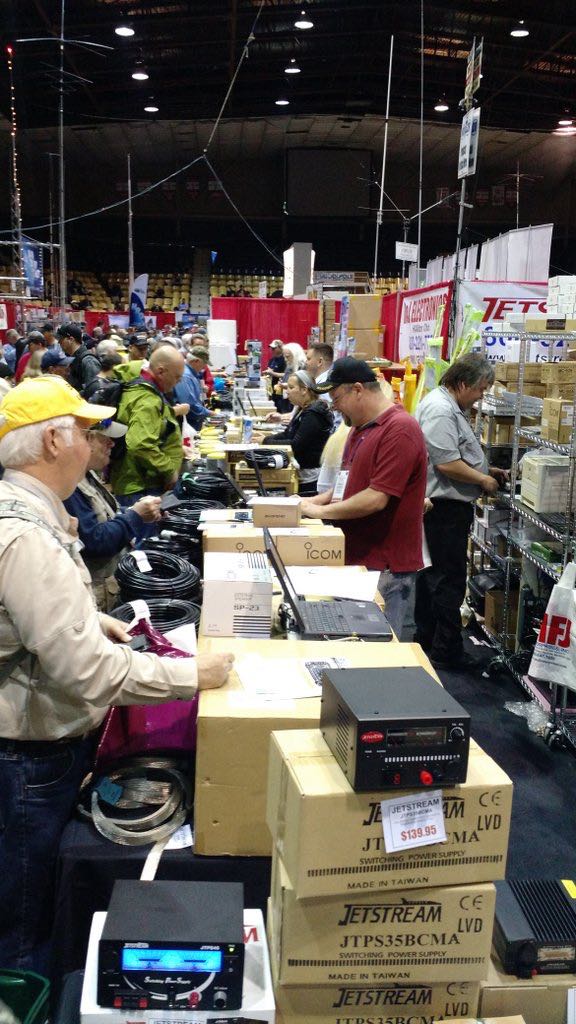
I always enjoy meeting SWLing Post readers who stop by our booth to introduce themselves!
If you’re not familiar with Ears To Our World and our mission to empower children and teachers in the third word through radio and other technologies, check out our website.
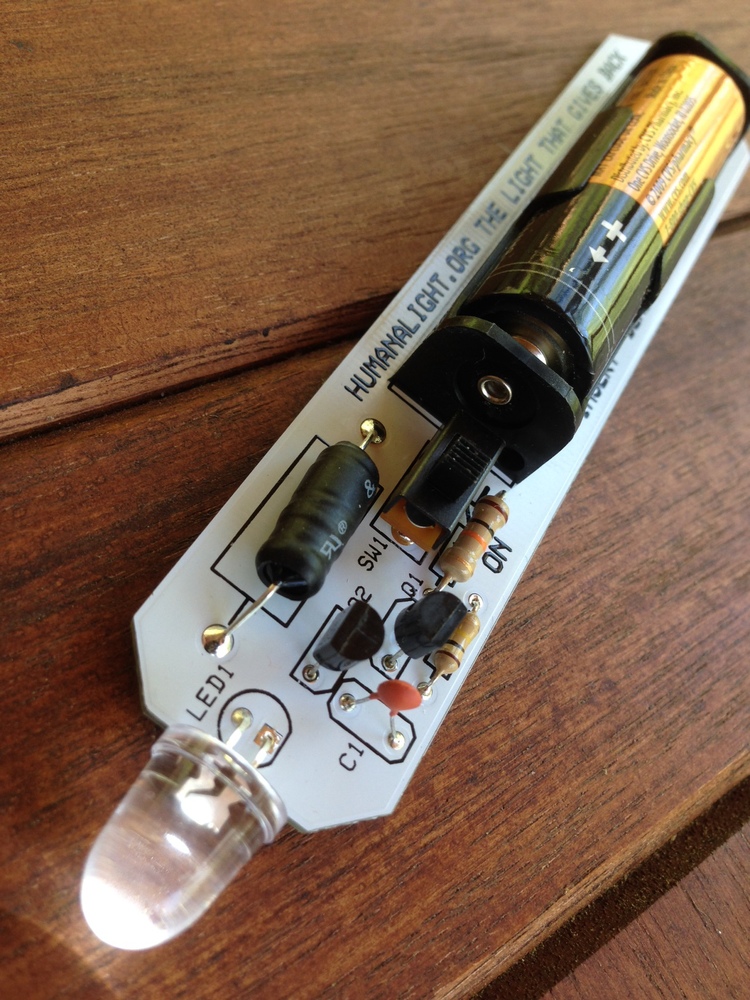
Note that this year we will also give away our HumanaLight kits to those who donate $15 or more to ETOW (while supplies last).
Many thanks to SWLing Post contributor, Gary DeBock, who shares the following notes and recordings from an Ultralight DXpedition in Kona, Hawaii:
April 2017 Kona, Hawaii Ultralight DXpedition
The first long-range test of a “Frequent Flyer” FSL Antenna
By Gary DeBock, Puyallup, WA, USA April 2017
Introduction
Ever since the U.K.’s Graham Maynard published his innovative article about the “Ferrite Sleeve” antenna in early 2011 an enthusiastic group of DXers and tinkerers has continually refined and upgraded the design, with most of them going in the pursuit of maximum possible gain. Monster FSL models were designed with weights of up to 38 pounds (17 kg), and considering the size, weight and subversive appearance of the typical model, the general assumption was that this new type of antenna was highly unsuitable for air travel, since it would send airport security personnel into a serious panic.
This situation continued for a full 6 years, during which the FSL antenna became a star performer in the related new niche of ocean cliff transoceanic DXing. But was there another possible application for the antenna’s compact performance advantage? What if a very lightweight, high-performing model could be designed which would not only provide a huge boost in DXing gain, but fit inside a hand-carry suitcase, and routinely pass airport security screening inspections around the world? This was a tough design challenge, but well worth the effort if successful!
Since the new antenna would need the maximum possible performance for its small, lightweight size, the use of the Russian surplus 100mm x 20mm x 3mm ferrite bars was mandatory. Every possible effort would be used to make the antenna as compact and lightweight as possible, although the choice of the highest-sensitivity 1162/46 Litz wire was critical for best performance. The PVC frame would be shrunk down to the smallest practical size. Finally, in a major experimental effort here over the winter season, the first of the new 5 inch (127mm) “Frequent Flyer” FSL’s became a reality. The finished antenna had a very non-subversive appearance, and could fit inside a custom-sized plastic tote within a hand-carry suitcase. Most importantly, it could still deliver a serious amount of inductive coupling gain– roughly similar to that provided by a 4 foot (1.22m) air core box loop, but with the advantage of somewhat lower noise reception.
Because the Russian surplus 100mm x 20mm x 3mm ferrite bars are extremely scarce (without any current supply source) only five of these original “Frequent Flyer” models would be made, although alternative models using the commonly available 140mm x 8mm ferrite rods were also designed. These antennas would be somewhat heavier and larger, but these “Baby FSL” ferrite rod models could be easily assembled from parts available on eBay, fit inside the hand-carry suitcases, and still deliver a lot of DXing performance (while routinely passing airport security screening). Finally, an economic model using the commonly available 62mm x 12mm x 4mm Russian surplus ferrite bars was also designed. This lightweight FSL can be constructed for around $65 US, and can still provide a serious DXing gain boost to a stock Ultralight radio. For want of better terms, these three classes of “Frequent Flyer” FSL antennas are called the “first class,” the “business class” and “coach class” models, with FSL sensitivity scores (ferrite length x coil diameter) of 585, 490 and 300 respectively.
From April 9-12 a Mini-DXpedition was conducted on a 6th floor oceanfront room at the Royal Kona Resort Motel in Kona, Hawaii. This was the first of many long-range DXing trips based upon the performance boost provided by the compact new antenna– which was specifically designed to easily pass through airport TSA security checkpoints. A 5 inch (127mm) “Frequent Flyer” FSL antenna was packed inside a matched-size plastic tote within a hand-carry suitcase, and breezed through TSA security screening in both the Seattle and Kona airports (without even a single question ever being asked). This was one of the “first class” Frequent Flyer models described previously, and was used to boost DX station gain on a 7.5″ loopstick C.Crane “Skywave” Ultralight radio. This combination was effective enough to track down many exotic Pacific Island stations (540, 621, 1440, etc.) at S9 levels during transmitter-site sunset skip propagation into Kona, as well as Asian TP-DX of varying strength around local sunrise.
This Kona trip was primarily designed as an anniversary celebration with my wife, so before we took off I had (somewhat reluctantly) agreed that DXing would have a secondary priority to sightseeing over the four days. Because of this there were many frequencies that could not be investigated in Kona, but I knew very well which Pacific island stations were tough challenges in both North America and Japan, and I was determined to go after them with a vengeance. 540, 621 and 1440 would all receive serious attention in Kona– not because they were great challenges in Hawaii, but because most DXers in both North America and Japan needed all possible information about them if they were to have any chance of reception at all. Besides this I was eager to try my long-range luck chasing exotic Asians around local sunrise with the innovative FSL antenna, but I knew that east-west propagation was almost totally dependent upon solar activity– and as it turned out both the A and K indexes shot up after our arrival.
Overall the Kona MW propagation to the Pacific islands was exceptional around local midnight (as expected), but the sunrise propagation was somewhat challenging for long range Asians. Perhaps the biggest success of this entire trip was the interest and excitement that the “Frequent Flyer” FSL antenna series (the major experimental project here this past winter) has inspired among DXers who routinely travel to foreign countries and other faraway venues. As I write this Craig Barnes of Wheat Ridge, Colorado is conducting his own 5 inch “Frequent Flyer” FSL- based DXpedition to Hawaii. Good luck, Craig!
Recordings
[Note: a selection of audio files have been embedded in the post below, but all audio is available to download and stream via the links provided.]
531 6DL? Dalwallinu, Australia Presumably the one with the same-sounding announcer and program as the one on 630-4QN at the time (at 1547 on 4-9; see MP3 for 630-4QN), but it didn’t seem to be exactly parallel (maybe a time zone delay?)
https://app.box.com/s/7bg1hruxrufccuys5axc4yzumexr3q36
540 2AP Apia, Western Samoa This station features a lot of Samoan music (with both male and female announcers), and dominates the frequency in Kona at night as long as it transmits. Unfortunately it doesn’t follow the listed PAL sign off time of 1000, but runs past this time routinely, which made it tough to track down an exact sign off time during my limited sessions. My guess is that it signs off sometime between 1030 and 1100. The following MP3 is of S9+ level Samoan Christian worship music at 0931 on 4-9. This overwhelming signal was one of the most awesome recorded during the entire DXpedition:
558 Radio Fiji One Suva, Fiji Somewhat of an underperformer considering its South Pacific location and (nominal) 10 kW power level. My guess is that the station has some transmitter and/ or antenna issues. Here is some fair level male speech with island music at 1001 on 4-9, which was the strongest signal it managed during the entire trip
558 UnID-TP Once again, this weak signal sounded a lot like the 630-4QN program at the time (1548 on 4-11), so my guess is that 6WA in Wagin, Australia is the most likely possibility
603 HLSA Namyang, S. Korea One of the common Asians which ran the gauntlet of dicey solar activity. It was fairly good at 1521 on 4-12, but was MIA during a couple of days
621 3RN Melbourne, Australia This LR network station would start to fade in just when Radio Tuvalu was about to sign off (around 1000), although it never provided any serious competition for the exotic station. This MP3 was made just after Tuvalu’s sign off at 1006 on 4-9
621 Radio Tuvalu Funafuti, Tuvalu A very tough station to track down on the mainland, but certainly a “piece of cake” in Kona. Routinely has sign off at 1003 UTC, preceded by island choral music and the national anthem (sung by the same choral group). Around 0950 a female announcer begins the routine by giving a monolog news broadcast about 5 minutes long, typically followed by an island music song right before the fixed 5-minute sign off routine. The latter two features are included in the following 8 minute recording (at near S9 strength) made at 0955 on April 10
The usual female announcer with her 5 minute news broadcast at near S9 strength at 0955 prior to the sign off routine on April 11. The lady giving the correct pronunciation for “Tuvalu” is at the 11 second point
630 4QN Townsville, Australia This 50 kW station was far and away the strongest Australian signal heard throughout the trip. Unfortunately it wasn’t in the same time zone as fellow LR network stations on 531 and 558 in Western Australia, making parallel checks seem dubious. Here is a typical signal at 1543 on 4-9
657 Pyongyang BS Pyongyang, N. Korea This bizarre station was far and away the strongest Asian heard during the trip– almost like it was a South Pacific semi-local. When solar activity cooled off it could blast in with serious power, such as at 1555 on 4-9
693 UnID-TP This mystery signal showed up at 1604 on 4-9, after NHK2 (JOAB) sign off. Obviously there is male speech and some kind of backup music at various times, but I’m totally unfamiliar with stations on this frequency (except for JOAB). Any hints or suggestions? This station only showed up on 4-9; rising solar activity brought in only 690-Honolulu splatter on the other three days
1035 Newstalk ZB Wellington, NZ Received late in sunrise enhancement at 1611 on 4-12, this was a rather modest signal from the Kiwi big gun, which never seemed to get anywhere close to its Oregon cliff strength during the entire trip
1098 V7AB Radio Marshalls Majuro, Marshall Islands One of the regular Pacific island stations received in Kona, and one of the best bets for Mainland reception. The frequency has very little QRM, although Newstalk ZB could be weakly received in between the island music songs after around 0900.
Strong island music at 0955 on 4-9 (its best performance during the trip)
1098 Newstalk ZB Christchurch, NZ Heard only once in between island songs on V7AB (at 0957 on 4-9); and never really strong enough to compete for the frequency with Radio Marshalls
1440 Radio Kiribati Bairiki, Kiribati Because of its domestic frequency this obscure station is another of the toughest Pacific island stations (and countries) to receive on the Mainland, but some very helpful identity clues were discovered in Kona (where the station is a breeze to hear). The station routinely signs off at 0936 UTC each evening, with a very loud 1000 Hz audio tone right before it cuts power. The sign off routine includes station ID’s in both the local language and English around 0932 prior to the choral music national anthem, although because of her heavy accent the fact that the female announcer is talking in English might well go unnoticed. The full sign off routine is included in the following MP3, preceded by an Island music number (during which a 1440 Spanish pest attempts a run on the frequency, only to be immediately drowned out)
The American country music format can be heard prior to the 4-bong time signal.
Prior to the sign off routine this station also uses its female announcer to give a final news update (like 621-Tuvalu). This recording is of such a news update at 0925 on 4-11, with several mentions made of the American president
1566 HLAZ Jeju, S. Korea Fairly regular with its Chinese Christian service around 1530 each morning in Kona, but never at very great strength (possibly due to unfavorable solar activity). Here at 1609 on 4-9 it is the music station playing the Chinese version of “I Would Rather Have Jesus,” in a mix with the (presumed) Mainland Chinese Yanbian Jammer
1566 Yanbian, China (Presumed location, Jammer) Because of Chinese inflection this is the apparent co-channel of HLAZ in the same recording at 1609 on 4-9; it was also received at 1600 on 4-10 with Chinese 5+1 time pips (thanks to Chris Kadlec for his assessment)
“Arctic Radio Club in Sweden celebrates the 2017 Convention in Jönköping, Sweden May 6 & 7th. Our radiostation ( the radiovan above) will be on the air with many different type of programs, mostly in Swedish. The transmitter will have a power of 250 W (ERP) on 1593 kHz and the antenna is located on a high hill near lake Vättern. In the evening of May 5th we will start tests. There will be station identifications in English, too.
The official start will be May 6th at 1900 UTC and the programs will be running until 1100 UTC on Sunday noon
On the 7th there will be a program dedicated to the local SR P4 Radio Jönköping that celebrates its 40th year of broadcasting. this year. This program starts at 1000 UTC and will be in Swedish. Until the station signs off at 1100 UTC.
Reception reports are appreciated and a special QSL-card is issued, if you enclose return postage in your letter. Reception reports by e-mail will be answered by an e-QSL. Address: Ronny Forslund, Arctic Radio 1593, Vita Huset, SE-17995 Svartsjö, SWEDEN. E-mail: info(AT)rock.x.se”