Shortwave listening and everything radio including reviews, broadcasting, ham radio, field operation, DXing, maker kits, travel, emergency gear, events, and more
August 21st and 22nd PCJ Radio International will present part 2 of From The Radio Netherlands Archives.
In the first program we played a mix bag of stuff. But in program two the focus will be on news and documentaries. You will hear Ginger Da Silva, Eric Beauchemin, Pete Myers and more.
There will be a special E-QSL issued for this program. PCJ Radio International’s partner stations will receive this program in two parts.
The program will be presented by Paulette MacQuarrie.
Europe: 0600 to 0800UTC – Frequency 7570kHz
August 21, 2016
North America: 0100 to 0300UTC – Frequency 7780kHz
August 22, 2016
For the first time, the BBC has given detailed access to the plans it drew up in the Cold War for a Wartime Broadcasting System to operate in the event of nuclear war. Paul Reynolds, a former BBC diplomatic and foreign correspondent, has been studying the secrets of what was known as the “War Book”.
The War Book reveals a world of meticulous BBC planning. The Wartime Broadcasting System (WTBS) – referred to in the book as “Deferred Facilities” – would have operated from 11 protected bunkers spread across the UK.
Known as “Regional Seats of Government”, these would also have sheltered government ministers and staff from government departments during what is termed a “nuclear exchange”. The BBC had a studio in each, usually with five staff drawn mostly from nearby local radio stations.
The BBC’s headquarters would have been a bunker at the Engineering Training Department at Wood Norton in Worcestershire, where 90 BBC staff would have been assembled, including engineers, announcers, 12 news editors and sub-editors and ominously “two nominations from Religious Broadcasting”. Output would have been controlled by the government.
To keep the public amused during Armageddon, a collection of cassette tapes of old radio programmes including the Goon Show, Just a Minute and Round the Horne, was kept in a grey locker at Wood Norton. It was eventually realised, however, that these were redundant. If there had been a nuclear attack, radios would probably have been dependent on batteries and these would have needed to be conserved for news and important announcements.[…]
Oh how I would love to read a copy of the “War Book”–! I hope, at some point, the BBC adds it to their online archives. Last year, we published a post with the actual statement the BBC would have broadcast in the event of a nuclear exchange. Click here to read the post.
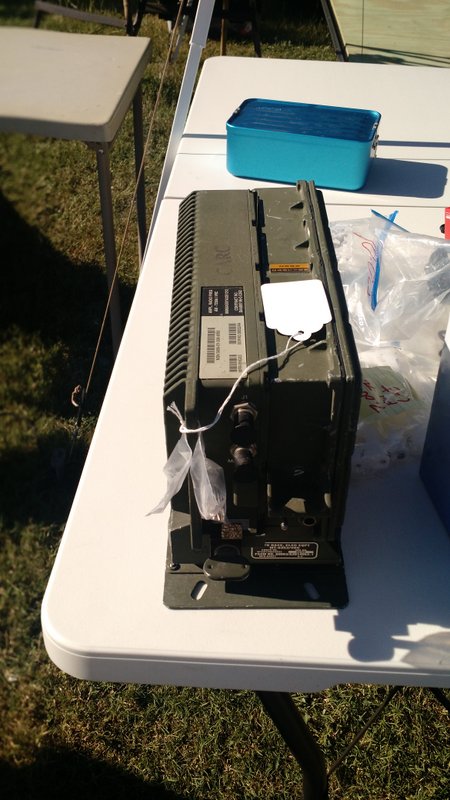
Sometimes good fortune drops in our lap at the least expected moment, but we have to act quickly to take advantage of it! This was the case with the receiver above; I spotted it on Ebay just moments after the seller posted a Buy-It-Now auction. Had I been planning to buy a D2935? No, but I immediately knew I was looking at something special.
This particular D2935 receiver from Magnavox had remained new and unused from 1987 until July 2016, when I had the good fortune of spotting the newly-listed Ebay auction and purchasing the radio for $175. Continue reading →
Several weeks ago, an SWLing Post reader (sorry–I’m missing your name in my notes!) sent me the following YouTube video. The video is essentially a review of the Pioneer RT-707 reel-to-reel tape deck. The reviewer is using a “mystery” tape of shortwave radio broadcasts in the deck.
You’ll recognize a number of broadcasters in his audio clips:
I’ve actually asked this YouTube reviewer if he would digitize the tape so that I could add it to the shortwave archive. I love lost and found recordings like this.
We’ve just posted yet another excellent recording by Jim Jordan to the Shortwave Radio Audio Archive. This Cold War recording of Radio Moscow dates back to September 19, 1984.
Jim notes:
A nice Cold War piece from Radio Moscow on the double defection of the Soviet journalist Oleg Bitov. The real story behind it was revealed ten years later [click here to read article].
Also, check out this short mention in the Ukrainian Weekly:
THE UKRAINIAN WEEKLY SUNDAY. NOVEMBER 4,1984
Jim’s recording was made using a National Panasonic RF-2200 tuned to 9.5 MHz around 08:10 UTC. The location was South Shields, UK.
No seasoned shortwave DXer can forget one of the most distinctive interval signals ever–the “barnyard animals” which marked the beginning of the broadcast day of Radio Botswana, Gaborone, for decades.
On its long-time frequency of 4820 kHz, Botswana was an occasional catch for me from the Seattle USA area. I yearned for clearer, more reliable reception of this station and other Africans which my East Coast USA DXer pals enjoyed!
Zebras mingle with other animals at Chobe National Park, Botswana.
It was always fun–and a DXing challenge–to catch Radio Botswana’s interval signal and sign-on announcements, but it was typically mid winter for reception in Seattle. Propagation on 60 meters needed to be favorable to enjoy anything other than a weak, barely listenable signal. Imagine my surprise and excitement when on the evening of December 27, 1987 I came upon the following signal booming in on 4820 kHz, far, FAR better than any previous Botswana reception. Indeed, their signal that evening surpassed in clarity even the Papua New Guinea and Indonesian “regulars” I would hear on the tropical bands from the Northwest USA.
This recording begins with the famous barnyard animals interval, the beautiful Botswana national anthem (Fatshe leno la rona, or This is Our Land in English) and is followed by a full list of broadcasting frequencies and times in English and the (presumed) Setswana language. That information is followed by a flute instrumental version of the Christian hymn Beautiful Savior, which introduces a short devotional or scripture message. The 10 minute recording wraps up with an a cappella children’s choir.
Great Circle route from the Gaborone transmitter to Seattle receiver location.
My receiving setup for this 1987 recording was an ICOM IC-R70 and a 300 foot long random wire antenna. Such a long antenna is unusual for the middle of an urban area, but I took advantage of living in a 3rd floor apartment across from a small city park. One midweek day, while most folks were at work, I managed to string out this long antenna with very small diameter braided steel wire from the 3rd floor apartment balcony to a distant treetop. This “sloper” antenna had significant directivity to the northeast, which happens to be the bearing for many African stations heard from the Pacific Northwest USA. The small diameter wire was suspended so high that it was virtually invisible from ground level.
Antenna orientation for 1987 reception of Radio Botswana. I’m sure this urban location is plagued by QRM and radio frequency interference now in 2016! My ICOM IC-R70 receiver handled the strong signals from nearby MW & FM broadcasters surprisingly well with the addition of a Grove Tun3 Mini-tuner preselector.
I continued to log Radio Botswana occasionally on 60 meters until the station eventually left the air (early 2000s I think), but I never heard them again with such a strong, clear signal as in late December 1987!
Guy Atkins is a Sr. Graphic Designer for T-Mobile and lives near Seattle, Washington. He’s a regular contributor to the SWLing Post.