Category Archives: Nostalgia

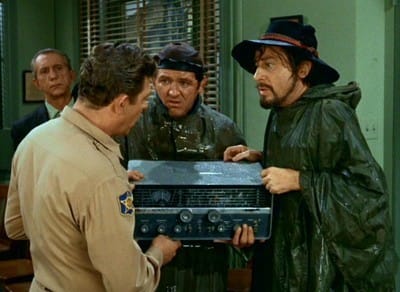
Emilio’s favorite scene from “Never Cry Wolf”

Many thanks to SWLing Post contributor, Emilio Ruiz, who writes:

I [note you] have published movies scenes with radios and I remember one of my favorite movies about nature, science, silence, wolves and Inuit culture called “Never Cry Wolf” I’m sharing with you and all readers of SWLing Post blog a radio (I don’t know what brand is, I think is military radio) appear in Never Cry Wolf movie.

I love this scene because the heterodyne sound is a particular sound that drives us crazy to everyone who loves radio!! jaja 😛

The video was extracted from the original Beta format movie, sorry for
the quality.

Thank you for sharing, Emilio!

That heterodyne sound leads me to believe they obtained it using a regenerative receiver. I’ve heard that squeal so many times tuning regen receivers!

I’ll add this post to our ever growing archive of radios in film!

Radio Memories: Andrew’s brush with HCJB

HCJB, 1987 (click to enlarge)

Many thanks to SWLing Post contributor, Doug Evans, who shares the following radio memory:

I have been an SWL on and off for the past 30+ years, listening from New York, North Dakota, Texas, Korea, Saudi Arabia, Turkey, and now from Denver and loving my Tecsun PL-660. Back in the 80’s and early 90’s the SWL waves were full of awesome. It was huge fun to dial up Radio Saigon or Radio Pyongyang and listen to their opinions, in return the USA fired back with Rush Limbaugh on WRNO

Through my early years in SWLing I would always find HCJB in Quito Ecuador “The Voice of the Andes” I loved their shows especially “DX Party Line” but I’d settle for the other  programming, “HAM Radio Today”, “The Music of the Andes”, “Tips For Real Living”… I always had a SW radio and a longwire where ever we went and especially on camping trips, and HCJB could always be found.

Job changes caused me to box up my radios for several years, but around 2010 I broke out the radios and found that HCJB was nowhere to be found. The hobby lost a lot of it’s attraction because of that. Not long after that my future wife asked me to drive with her from our home in Denver down to Colorado Springs to visit her relative, her mother’s cousin Tommy. She said he was a missionary in South America and handed me a book he wrote. In the preface he mentioned radio station HCJB.

Her mother’s cousin Tommy lived near the HCJB work headquarters in Colorado springs and I asked him about HCJB, he told me he was an engineer there for over 30 years and spent the afternoon telling me glory days of the largest radio stations on earth, and eventually having to take down the huge antenna farm to make room for the Quito airport. I wish I had taken notes, and I wish I had a chance to meet with him again, but like HCJB Tommy is no longer with us.
What an amazing coincidence it was to meet one of the men who kept HCJB on the air.
What a coincidence indeed! Thanks for sharing your memory, Douglas!

Post readers: Do you have a radio memory you’d like to share?  Please contact me with your story!

Do you enjoy the SWLing Post?

Please consider supporting us via Patreon or our Coffee Fund!

Your support makes articles like this one possible. Thank you!

Robert discovers radio station lucite artifacts

Many thanks to SWLing Post contributor, Robert Yowell, who writes:

I walked into an awesome store today in Manhattan which specializes in vintage radios and ephemera. He had these two small lucite paperweights which I bought – one from KDKA the other from WOWO – two historic AM stations. The WOWO one contains a piece of the “world famous fire escape” [see above] which was from the original studio building on Washington Blvd in Ft Wayne Indiana.

The other lucite is a mystery that I hope your readers might help with. It was issued in 1995 for the 75th anniversary of KDKA. It appears to be a silver disc sandwiched with something orange colored in the center. Could it be from the transmitter site? I have attached photos here.

Thanks so much for maintaining such a great Blog site for SWL and other radio listeners ! I hope someone out there can help with my question – thank you!

A few hours later, Robert wrote this follow-up message:

Thomas – I just found the answer to my question. I now own a piece of the original KDKA transmitter tower!

http://www.antiqueradio.com/KDKA_3-96.html

What a great piece of history you have there, Robert.  Both WOWO and KDKA are legendary! Thanks for sharing!

Cap spots an Icom and Yaesu in Netflix Sci-Fi film IO

Many thanks to SWLing Post contributor, Cap Tux, who spotted two ham radio rigs in IO. Cap notes:

ICOM IC-740, Yaesu FT-901DM and Shortwave make an appearance in Netflix Sci-Fi film IO:
Mentions “transmitting on frequency 9043kHz and listening on frequency 9560kHz daily, that’s the 31m band”.

https://www.netflix.com/gb/title/80134721

Thanks for sharing, Cap! I’ll add this post to our ever growing archive of radios in film!

Balázs spots a wide variety of radios in film

Many thanks to SWLing Post contributor, Balázs Kovács, who shares the following radio sightings and notes:

The Priest’s rig from the last episode of “The Walking Dead

A Yaesu in “Jurassic World – Fallen Kingdom

Some emergency/weather radios in the “The Darkest Minds

The Last Ship S05E01
After a cyber attack a backup comm solution for the US Navy.

Night of the Living Dead (1968/1990)
In the original a radio broadcast was the first information source, in the remake only a small one was used at the end.

Hunt for the Wilderpeople (2016)
In a remote shack.

+1: The “Álmodozások kora” (Age of Illusions (US) / The Age of Daydreaming (Int)) was the first (Hungarian) feature film of the director István Szabó (winner of an Academy Award for Best Foreign Language Film in 1981 (Mephisto), English language films: Meeting Venus (1991), Sunshine (1999), Taking Sides (2001), the Oscar nominated Being Julia (2004) and The Door (2012)) in 1965 about a group of young electrical engineers. Two scenes from it about the radios, unfortunately I found the hungarian speaking version only online, but I think maybe it can be still interesting: https://ok.ru/video/228250552961

  • 33:58-35: A custom rig receiving 4 european stations (Paris, London, Rome, Prague) on different speakers at the same time
  • 1:05:43-1:07:20: “How radio works” animation
  • (and there was a short scene also where they talk about the The Pioneer Railway and how they learned the morse code there)

I found another (splited) version of the movie now with english subtitles, the new links and timings:

https://ok.ru/video/904027376280
33:58-35:28: A custom rig receiving 4 European stations (Paris, London, Rome, Prague) on different speakers at the same time

https://ok.ru/video/904028097176
20:00-21:39 “How radio works” animation

The same actor (András Bálint) 13 years later have a short ham radio scene (new year greetings in english) in another movie (BUÉK, 1978). I checked the callsign from the wall (HA5FA) and probably it was already a real one, belongs to Jen? Matzon, active member of the radio amateur community (DXCC Honor Roll, etc.) now a Silent Key.

Wow! Many thanks for sharing all of these radio spots, Balazs! Funny thing is I remember so well those shots from Night of the Living Dead even though I likely watched it 40 years ago! I guess I never forget a Zenith!

Of course, I’ll add this post to our ever growing archive of radios in film!

VOA Museum 75th Anniversary Events & Activities

(Source: WVXU via Michael Bird)

Voice Of America Museum Sets 75th Anniversary Events

The National Voice of America Museum of Broadcasting will celebrate the 75th anniversary of West Chester Township’s Bethany Station with yearlong programs highlighted by a presentation by VOA White House Bureau Chief Steve Herman on March 6.

Events include a talk by Rod Serling biographer Nicholas Parisi; a program on sound effects from the golden age of radio; a “Hamvention” by the West Chester Amateur Radio Association; and a free four-part series of programs called “The Voice of Truth in America: Celebrating 75 Years of the VOA Bethany Station” with the MidPointe Library System.[…]

The anniversary events include:

Feb. 17: “The Imagination of Rod Serling: A Conversation with Nick Parisi,” by the author of Rod Serling: His Life, Work, and Imagination published last year.

March 6: “Covering the White House and the World” by Steve Herman, VOA White House Bureau Chief.

April 6: “History of the VOA-Bethany Station and the VOA Museum Today” presentation by museum director Jack Dominic at MidPointe Library West Chester Township.

April 9: “Theater of the Mind: Sound Effects During Radio’s Golden Age” with Mike Martini, president of the museum’s Media Heritage Collection.

May 16-19: “Hamvention Nights at the VOA Museum” with the West Chester Amateur Radio Association.

June 5: “There’s a Radio in My Cell Phone!,” a children’s STEM (Science, Technology, Engineering and Mathematics) event at MidPointe Library Liberty Township.

July 11: “Stealth Antennas for Amateurs Living in HOAs.”

Aug. 25: Big Band music at MidPointe Library West Chester Township.

Sept. 21: The fourth annual VOA Museum “75 Years of Rockin’ the Radio” fundraiser.

Oct. 18-20: “Jamboree on the Air” with West Chester Amateur Radio Association and area scouting organizations at the museum.

[…]The museum is open Saturdays and Sundays 1-4 p.m. at 8070 Tylersville Road. General admission is $5 for adults and $1 for children.  Museum events are listed at the VOA Museum website.

Click here to read the full article at WVXU.

Finding a repair service for boat anchors and other vintage valve/tube radio gear

Vintage tube radios will likely survive an EMP, but how do you power them without mains electricity?

Here’s a common question I receive from SWLing Post readers:

“Where can I have my vintage valve/tube radio repaired? Can you recommend a good repair service?”

The answer isn’t always a simple one, especially for those living in rural or remote parts of the world.

Go local

The short answer is: try to find a local repair service.

Unlike modern solid state radios, “boat anchors” (metal chassis vintage radios) are heavy and very pricey to ship.

Some repair services and retailers won’t even consider shipping vintage metal chassis radios because of the likelihood of damage or a tube or other component loosening during transit resulting in a DOA (Dead On Arrival) situation. They insist on in-store or local pickup/delivery.

Johnson Viking Ranger transmitter


Last year at the Dayton Hamvention I was speaking with an acquaintance who restores and repairs vintage tube radios–he specializes in WWII and Cold War era boat anchors (Collins, Signal Corps, Hallicrafters, National HRO, etc.). Although he makes a tidy profit from doing repairs, it’s most certainly a labor of love and not the most profitable use of his time.  He told me that he recently stopped accepting any repairs other than those delivered and picked up locally.

He told me he took great care in packing equipment after repairs had been made–he’d secure all components so that they couldn’t budge during shipment and would either double box or use industrial strength cartons. Being so diligent, his return shipments almost always arrived unscathed, but customers would complain about the shipping costs. He could, of course, skimp on packaging, but then risk his repair work being undermined by rough handling. He was never willing to compromise on shipping and I certainly don’t blame him.

So again, due to the complexities of shipping heavy gear, I always recommend trying to find someone local to do your “boat anchor” repair work first.

Where can you find a local repair shop? If you belong to or know of a local ham radio club, stop by a meeting and ask around. If there’s a vintage radio repair technician in town, someone in the club can likely connect you.

Shipping boat anchors

With that said, there are some excellent repair technicians out there who will take work via parcel shipments, but be prepared to pay upwards of $50-150 each way each way (depending, of course on the radio size and weight).

Lighter tube radios are easier and cheaper to ship, but should still be packed carefully. Bakelite radios, for example, are lightweight but incredibly fragile.

In short: if you ship your vintage radio, pack meticulously and confirm that your repair person will do the same.

And where do you find repair services? I point readers to radio repair service reviews on eHam.net. You might also search the QRZ.com forums or even post a question.

Let’s be clear: some radios are worth the shipping costs!

I am fortunate in that I do have a local friend and mentor Charlie (W4MEC) who repairs tube gear. Better yet, Charlie is willing to teach me how to do repairs and alignments myself. This, I would argue, is the best of both worlds!

A Note of Caution: When it comes to repairing tube/valve gear, I believe you should always learn the ropes with an experienced technician. Unlike battery-powered solid state devices, tube gear is mostly high voltage. If you don’t know what you’re doing inside the chassis of a tube radio, you could be severely shocked or even electrocuted. No radio is worth that price.

Who do you recommend?

If you have any advice about repairing boat anchors and other vintage electronics, please comment! Also, if you can recommend a repair service, please share details.