Category Archives: Radios

The bands are open! Make time to listen.

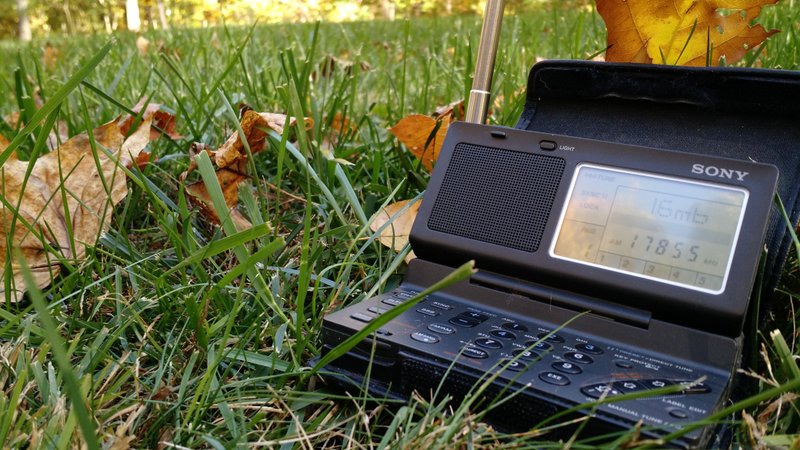
Sony-ICF-SW100-Outside-Fall

Though I’ve spent the entire day sawing and splitting firewood, I’ve been actively recording spectrum on the 31, 25, 19 and 16 meter bands with the WinRadio Excalibur, Elad FDM-S2 and the SDRplay RSP. Why? Propagation–especially on the higher bands–has been the best it’s been in several weeks.

As I discovered at the recent SWLing Post DXpedition, my shack PC can handle making multiple spectrum recordings simultaneously as long as I limit each recording to the width of a broadcast band. (I’ve never tried pushing the limit very hard.) Someday in the future–perhaps when we’re having terrible propagation–I’ll play those spectrum recordings back and tune through them as if they were live.

Radio time travel at its best.

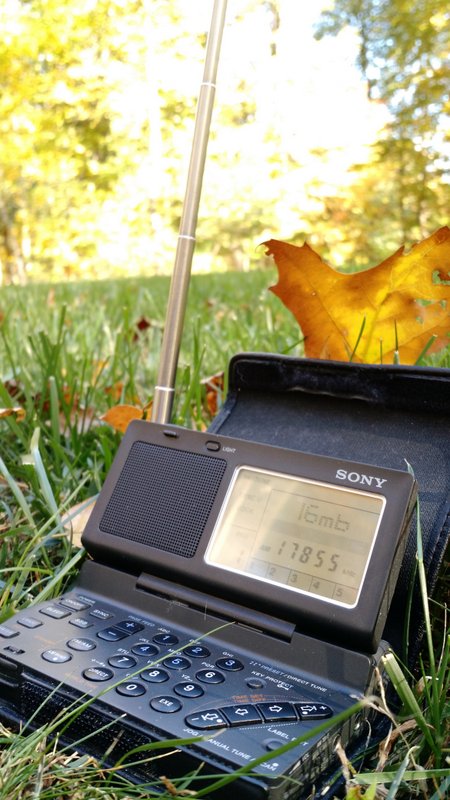
Sony-ICF-SW100-Outside-2

When I decided to throw in the towel with all of the firewood processing, I fired up the Sony ICF-SW100 (above) and tuned in a game on 17,855 kHz: Radio Exterior de España.

The REE signal was simply booming into eastern North America!

Hard to break away from the radio on days like this.

My advice? Take advantage of these conditions and make time to listen!

For me, SWLing a great excuse to relax and let me back heal after a long day of splitting wood. For some, perhaps it’s a good excuse to take the radio outdoors and away from urban interference. Whatever the excuse, don’t hesitate to fire up your radio!

There are some interesting stations on the bands this evening. Feel free to comment with some you’ve logged.

C.Crane fixes CC Skywave overloading

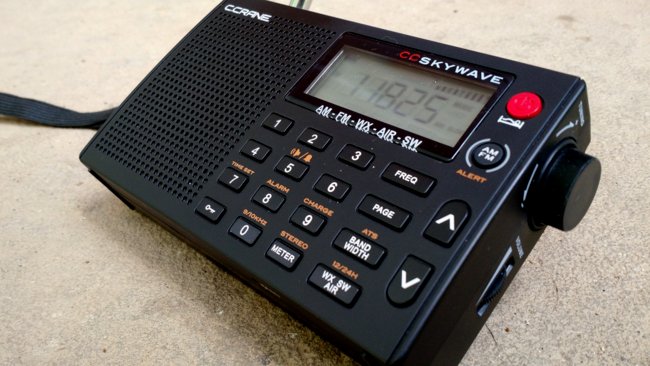
CCrane-CC-Skywave

Many thanks to SWLing Post readers, Mark and Alan, who were both recently notified by C.Crane that the CC Skywave has been updated.

Mike purchased the CC Skywave early this year after reading our review. He was disappointed to find out, though, that a local radio station (in his urban location) overloaded the Skywave’s front end, causing imaging and other problems.

Mike, along with other Skywave owners, notified C.Crane about the issue and returned their units.

C.Crane passed along this feedback to their engineers, who have updated the CC Skywave accordingly.  C.Crane believes the latest production run will be immune to this sort of overloading. [Kudos to C.Crane for listening to customer feedback.]

I contacted C.Crane yesterday–they recommend ordering directly from their website to insure your unit is coming from the latest production run. It’s possible that some of their distributors could still have some of the older units in inventory for the next few weeks. At least, to be certain, you should check with the distributor directly.

To be clear, I’ve never noted the overloading issue on my Skywave, but I live in a rural area with no blowtorch stations nearby. If you live near an AM broadcaster, and are considering the CC Skywave, you should certainly purchase the updated unit.

Click here to view/purchase the CC Skywave on C.Crane’s website.

Again, many thanks to Mike and Alan for the tip!

New from Heathkit: the Explorer Jr TRF AM radio receiver kit

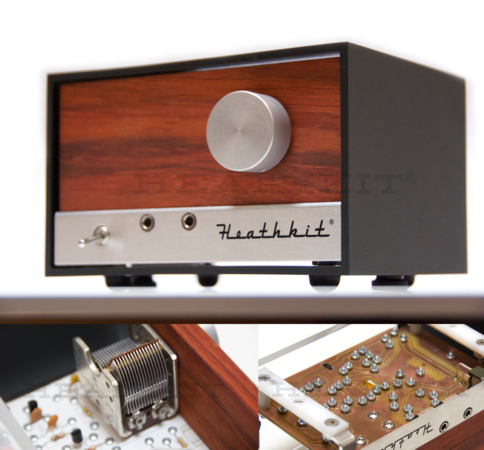
HeathkitExplorerJr

The Heathkit Explorer Jr. (Image Source: Heathkit)

Yes, the legendary Heathkit company is back and their first kit is a simple Tuned Radio Frequency (TRF) AM/mediumwave analog receiver: the Explorer Jr.

I knew Heathkit was back in business and under new management, but hadn’t heard any updates as of late. Their president, Andy, just sent a message to the “Heathkit Insiders” group explaining what the team has been up to:

“We’ve designed and developed a wide range of entirely new kit products. We authored the manuals for these kits, complete with the beautiful line art you rely on, preserving and respecting our iconic historic Heathkit style. We developed many new inventions and filed patents on them. We relocated Heathkit, and set up a factory, and a warehouse, and offices, in Santa Cruz, California, near Silicon Valley. We built the back office infrastructure, vendor and supply chain relationships, systems, procedures, operations methods, and well-thought-out corporate structure that a manufacturing company needs to support its customers, to allow us to scale instantly the day we resume major kit sales. All this effort enables us to introduce a fleet of new kits and helps ensure Heathkit can grow, prosper, and continue to bring you great new products for a very long time.”

The Insiders’ message goes into much more detail–I would encourage you to contact Heathkit about joining this group.

The big news in this message was the launch announcement of the Explorer Jr. kit which can be ordered from their website now. The price is $149.95 plus shipping. Heathkit anticipates a 30-day shipping time for the first set of orders.

Here’s a description of the kit from their website:

A Radio Kit Whose Time Has Come.

Again.

When Heath started designing & selling do-it-yourself airplane kits shortly after the Great War, the state-of-the-art in radio was the Tuned Radio Frequency (TRF) design.

A TRF radio was a great deal. If you had a great deal of money. A TRF receiver became a fixture in the homes of families around the world, receiving the news and music AM broadcasts of the day. A family AM radio was a big investment — $100 to $625 in 1929 dollars. (With inflation, that’s $1,400 to $8,700 in today’s dollars.)  Of course, at that price radios also were beautiful. They were made of fine wood, and designed to last. Radios were a visible and attractive furnishing you could be proud to have in your living room or parlor.

Heathkit’s TRF radio is a great deal. And a great deal of radio. This Explorer Jr TM radio is modeled on the original TRF designs, but better. You get to build it yourself. It’s safe and simple enough for beginners to assemble and understand. But it receives AM broadcast stations with performance superior to the vintage radios of 1930.

With the number of Heathkit enthusiasts out there, I suspect this first run of kits won’t last long. The kit trim is available in six colors: Silver, Cranberry, Cucumber Green, Plum Pie, Sapphire Blue, and Tangerine.

Click here to view and order the Explorer Jr on Heathkit’s webstore.

Radio Kiribati and WiFi Radios

Kiribati

Many thanks to SWLing Post reader, Paul Walker, who writes:

Thomas.. I know this isn’t quite SW news anymore, but Radio Kiribati usedto be on SW a while ago and is now on AM.

I just found out something to those of us interested in Pacific radio signals. Radio Kiribati 1440 JUST started a live web stream…JUST…as in, like within the last few days!

The audio levels can be a bit loud and overdriven at times, but i am corresponding with their Chief Engineer and the Radio station manager at the Broadcasting & Publications Authority in an effort to get levels set just right.

The audio is average and I wouldn’t expect much more, quality wise, then what they’ve got now.. as most of these stations have hare basics when it comes to some equipment.
The Radio Kiribati stream was just added to the Reciva.com database for internet radios and should be there soon if it isn’t already.

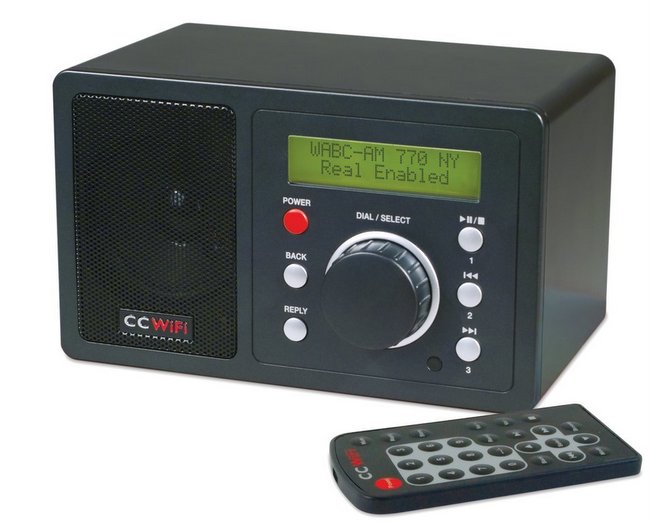
CC-Wifi-Radio

The stream is at http://202.6.120.13:8000/ The stream itself is of amazing quality at 64k vorbis, which sounds good to my ears via my CC Wifi Radio and CCrane Senta speaker.

Radio Kiribati only broadcasts local programming at certain times of day. Sometimes I’ll hear Radio New Zealand International outside of local broadcasting, other times I won’t.

TX times are as follows…most of their programming is in their native language, which is Gilbertese according to Wikipedia. It’s a Micronesian language of the Austronesian language family. They do three segments of English broadcasting every day, some 30 minutes long and one is an hour long.
Kiribati is UTC+14… at 416pm Thursday in Southwest Arkansas, where i am.. it’s 916am Friday morning in Kiribati.

  • Morning: 0700am to 0830am. English at 8am
  • Lunch: 1200 noon to 1330. English at 1300
  • Evening: 1700 to 2130. English at 1800

Feel free to post this to your own blog, website, Facebook group or page.. let’s spread the word!!

Thanks, Paul!

WiFi radios

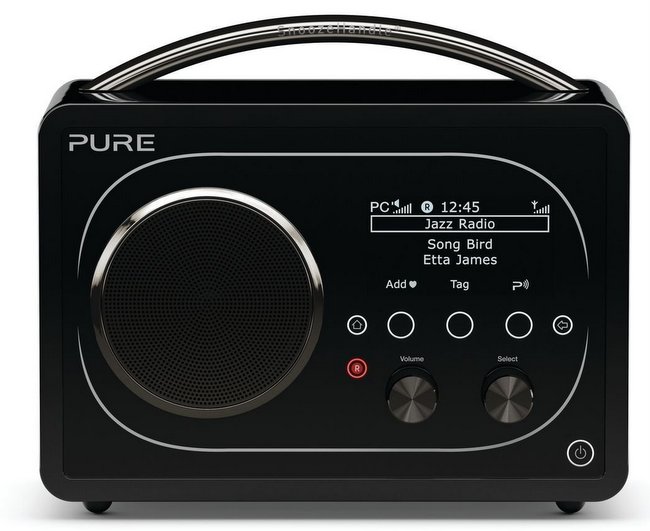
Though pricey, I've heard the Pure Evoke F4 has fantastic audio and a meticulously curated database of Internet streams.

Though pricey, I’ve heard the Pure Evoke F4 has fantastic audio and a meticulously curated database of Internet streams.

This is one of the benefits of Wi-Fi radios and Internet streams: the ability to hear “local” stations–many of which used to broadcast on shortwave–from all corners of the globe.

I’m seriously considering purchasing a Wi-Fi radio for my wife to make it a little easier for her to listen to Internet streams in her office.

I’ve been looking at the C.Crane CC WiFi radio, the CC WiFi 2, the Grace Digital WiFi Music Player and the (much pricier) Pure Evoke F4 which my buddy, John Figliozzi, so highly recommends.

Any suggestions and recommendations are most welcome.

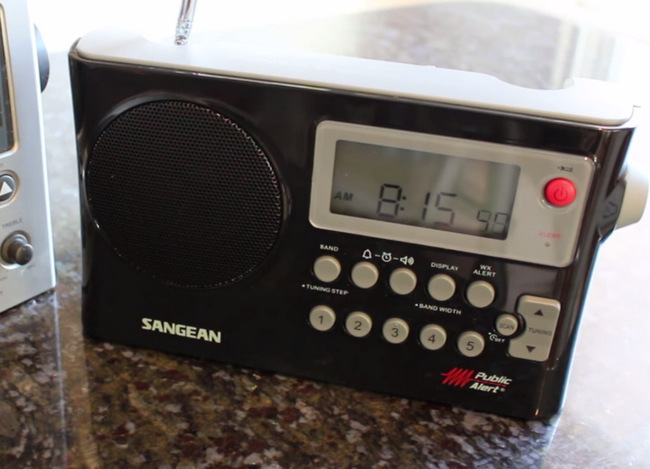
Jeff’s Updated Sangean PR-D4W Review

Sangean

Many thanks to Jeff McMahon, from the Herculodge, who shares an update to his Sangean PR-D4W review.

The good news is that Jeff continues to be impressed with the PR-D4W and ranks it above the venerable C.Crane CCRadio-2E in almost every category. At $64.50 on Amazon, the PR-D4W is a much better value.

Follow this link to his review:

http://herculodge.typepad.com/herculodge/2015/10/sangean-pr-d4w-review-with-fm-wire-antenna-upgrade.html

Dan spots an extremely rare HRO-600 on eBay

HRO-660

SWLing Post contributor, Dan Robinson, writes:

Wow . . . a huge, amazing rarity…this is perhaps the rarest of radios, the HRO-600.

It is almost never seen on the used market and when it is, it is usually in non-operational condition. In its day it was quite advanced, though now, a Tecsun could run rings around it, and it uses NIXIE tubes…good luck obtaining those…anyway for anyone who has never seen one in this condition, and for everybody, here it is…

Click here to view on eBay.

Wow–I thought that receiver might sit on eBay for a while, but it sold for $3,895 US only moments after Dan spotted it.

Assuming this listing will eventually disappear from eBay, I downloaded a few more photos:

This slideshow requires JavaScript.

I really enjoy tips like this from Dan.  While rare radios like the HRO 600 are well beyond my budget, it’s so much fun to learn about them. Indeed, I had no idea HRO made a receiver that used Nixie tubes!

What is a Nixie tube you ask? Per Wikipedia:

Nixie2“A Nixie tube, or cold cathode display, is an electronic device for displaying numerals or other information using glow discharge.

The glass tube contains a wire-mesh anode and multiple cathodes, shaped like numerals or other symbols. Applying power to one cathode surrounds it with an orange glow discharge. The tube is filled with a gas at low pressure, usually mostly neon and often a little mercury or argon, in a Penning mixture.

Although it resembles a vacuum tube in appearance, its operation does not depend on thermionic emission of electrons from a heated cathode. It is therefore called a cold-cathode tube (a form of gas-filled tube), or a variant of neon lamp. Such tubes rarely exceed 40 °C (104 °F) even under the most severe of operating conditions in a room at ambient temperature. Vacuum fluorescent displays from the same era use completely different technology—they have a heated cathode together with a control grid and shaped phosphor anodes; Nixies have no heater or control grid, typically a single anode, and shaped bare metal cathodes.”

As Dan states, Nixie tubes can be very difficult to source these days. I’m sure the radio collector that purchased this HRO 600 is well aware.

Update: While I don’t know what Nixie tubes the HRO-600 takes, Leeds Radio, has a substantial collection of Nixie tubes at reasonable prices. Click here to browse through the collection. Leeds, by the way, is a fantastic resource for pretty much any sort of tube/valve you may need. Check out this piece on Leeds Radio from WNYC.

I hope someone uploads a video of the HRO-600 in operation; I’ve never seen one in action.

Dan, thanks again for sharing your eBay finds!

Craig Seager’s review of the Dansk RX4000 receiver

Dansk ReceiverMany thanks to SWLing Post reader, Rob Wagner, who writes:

Craig Seager is one of Australia’s finest SWL DXers, a longtime listener with great experience on shortwave, mediumwave and other modes. His amateur radio callsign is VK2HBT. Craig also has another special interest – old radio receivers. He has personally restored many fabulous radios to full working order and has accumulated a fine collection of his own. His knowledge of communications receivers is extensive.

The Mount Evelyn DX Report blog is delighted to welcome Craig who, over the next few months, will regularly contribute a new series called Retro Receiver Reviews – a look at some common and not so common communications receivers from the past. This series will be of interest to both amateur radio operators and shortwave listeners.

Craig’s first review has just been published, covering a radio not often seen these days – the Dansk RX4000 receiver. Check it out at:

http://medxr.blogspot.com.au/2015/09/retro-receiver-dansk-rx-4000.html

Thanks for passing this along, Rob!  That Dansk RX4000 sounds like a robust receiver, with a bullet-proof front end. A nice addition to any collection.