Category Archives: Shortwave Radio

Rare 1968 Radio Dzaoudzi QSL card fetches $158 at auction

Many thanks to SWLing Post contributor, Dan Robinson, who writes:

In recent years, a number of records have been set for QSL cards from former shortwave stations around the world. The latest example shows that there is still strong collector demand for one of the rarest stations on the air from Africa, Comoros Islands.

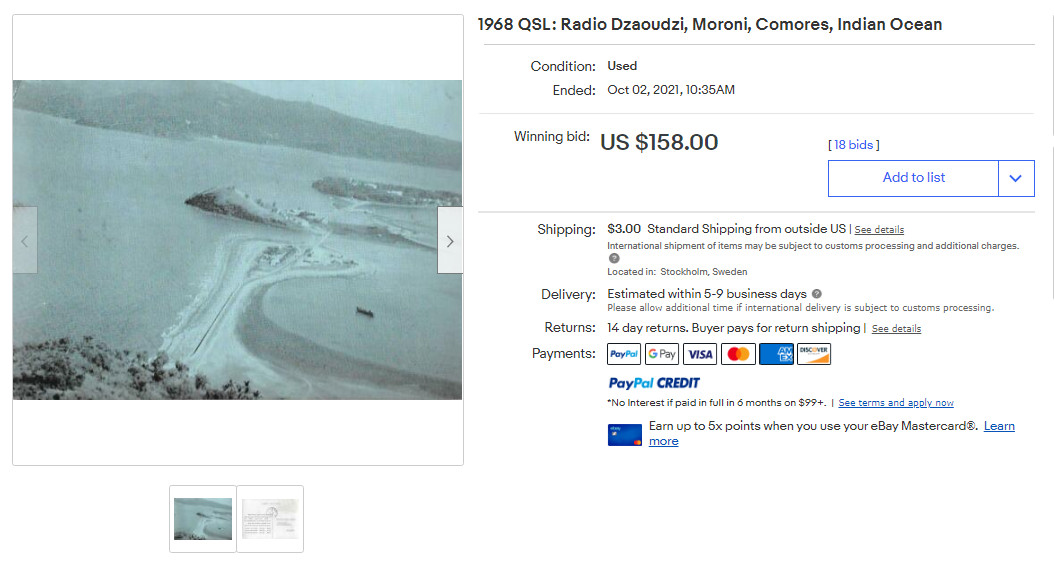
In this eBay auction, a classic photo QSL from the station at Moroni went for $158. That’s in the high end for QSL auctions — there have been higher, for example for QSLs from the former AFAN station at McMurdo, Antarctica, and for some other African and Asian cards.
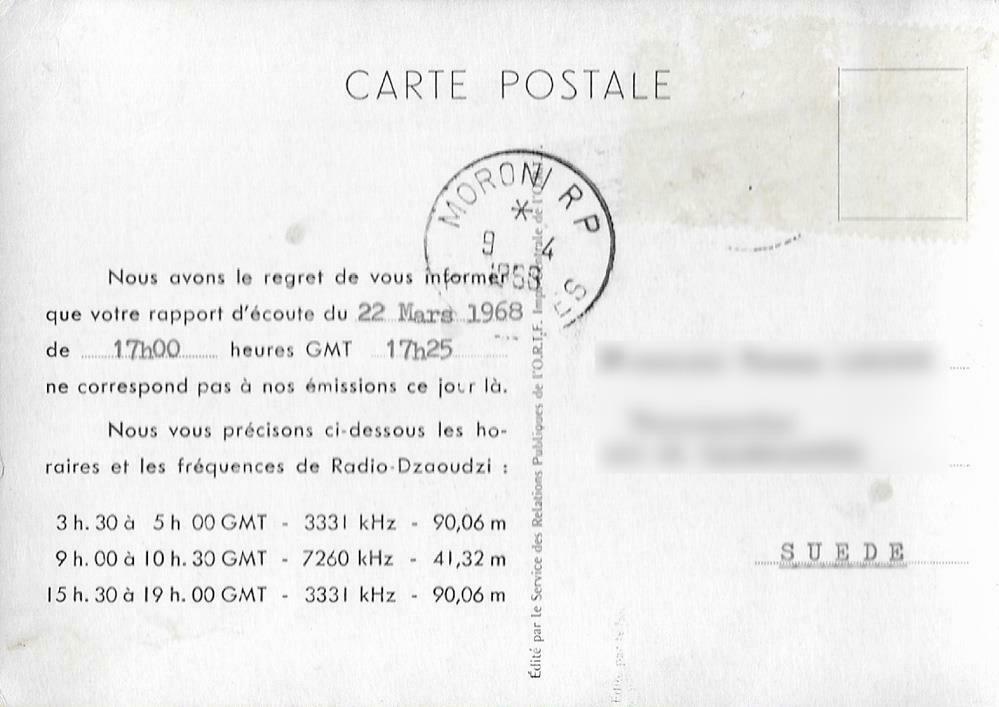
This card shows the 90 meter band shortwave frequency for the station, 3,331 kHz which as veteran DX’ers who are still around recall could be heard with great difficulty from 0300 UTC when the station signed on for morning programming. The other frequency of 7,260 kHz was also heard, though the 90 meter frequency was the easiest for U.S. DX’ers.

– Dan Robinson

Wow! Thank you so much for sharing your insight, Dan. What a fascinating find!
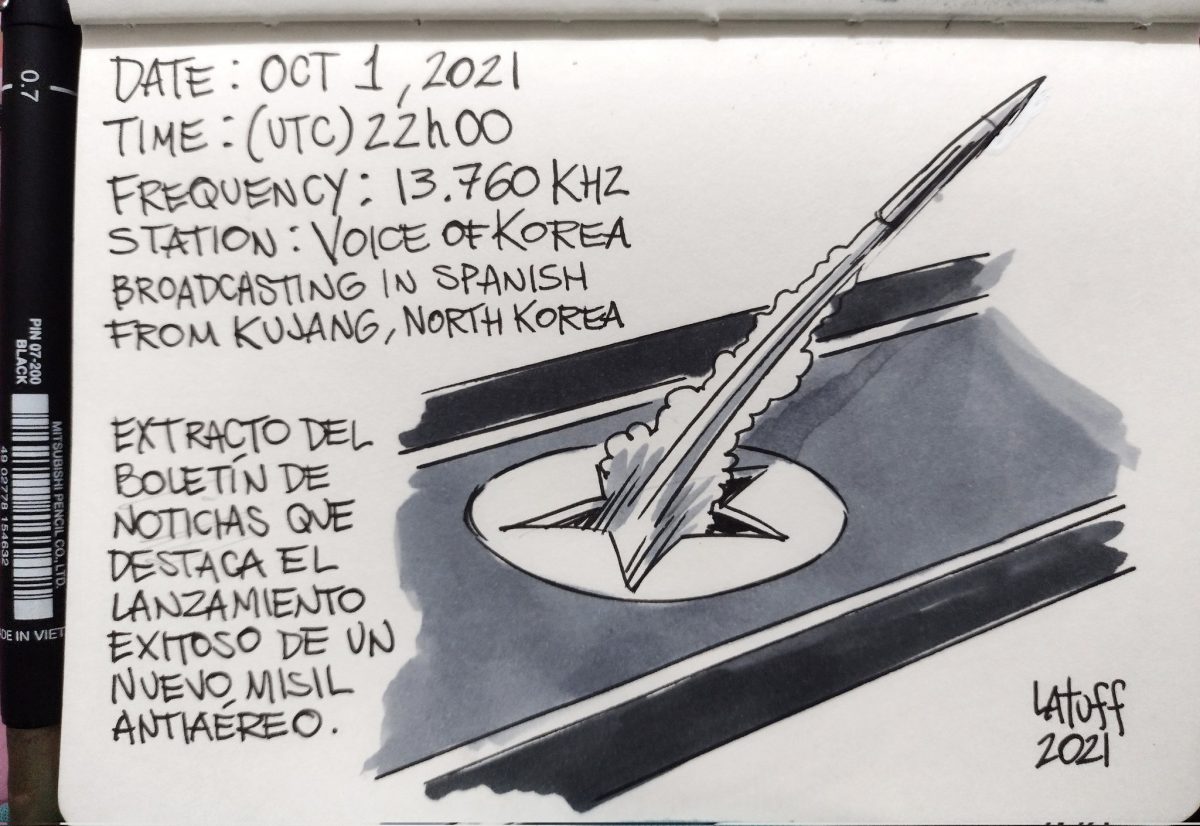
Carlos’ VOK Shortwave Log Art and Audio Clip

Many thanks to SWLing Post contributor, Carlos Latuff, who shares one more example of his radio log art, this time for a Voice of Korea broadcast in Spanish.

Here’s Carlos’ clip of the Voice of Korea which accompanies the log art at the top of this post:

Carlos has been posting his shortwave logs on his Twitter feed–definitely check them out!

Many thanks, Carlos!

Looking for firmware files? Don’t download unless you know the source!

A quick PSA from SWLing Post HQ…

Many of our modern receivers, transceivers, and SDRs allow us to perform firmware updates in order to upgrade product functionality and even fix known bugs. I try to keep the latest firmware on all of my radios.

With that said, always go to the original manufacturer or authorized retailer’s website to download firmware files, drivers, and firmware installation tools.

The internet is chock-full of deceptive sites offering “firmware files” for a wide variety of products that are nothing more than viruses and malware.

Never follow a firmware file link from a radio discussion forum, for example, unless that link can be verified as authentic and supported by the manufacturer or product designer/developer. It’s too easy for someone to pose as a discussion member and drop a link to a malicious bit of code!

I was contacted by two different SWLing Post readers recently who found links to malware posing as firmware files for radios in discussion groups. Obviously, I’m not going to share those links, so I simply ask that you double check the authenticity of the site before downloading.

That is all! Have a wonderful weekend and good DX!

-Thomas

Radio Waves: Skyworks Acquires Silicon Labs, DRM Response to RW Article, CNN finds Radio Biafra, and Free Online Foundation Course

Radio Waves:  Stories Making Waves in the World of Radio

Because I keep my ear to the waves, as well as receive many tips from others who do the same, I find myself privy to radio-related stories that might interest SWLing Post readers.  To that end: Welcome to the SWLing Post’s Radio Waves, a collection of links to interesting stories making waves in the world of radio. Enjoy!

Many thanks to SWLing Post contributors Troy Riedel, Dan Robinson, and the Southgate ARC for the following tips:


Skyworks completes acquisition of the infrastructure & automotive business of Silicon Labs (Skyworks)

IRVINE, Calif.–(BUSINESS WIRE)–Jul. 26, 2021– Skyworks Solutions, Inc. (Nasdaq: SWKS), an innovator of high-performance analog semiconductors connecting people, places and things, today announced that it has completed its acquisition of the Infrastructure & Automotive business of Silicon Laboratories Inc. (Nasdaq: SLAB) in an all-cash asset transaction valued at $2.75 billion.

“On behalf of the entire Skyworks organization, I want to welcome the Infrastructure & Automotive team,” said Liam K. Griffin, chairman, chief executive officer and president of Skyworks. “In addition to a strong legacy of innovation and execution, the I&A business brings a highly diversified customer base that will enable our continued expansion into strategic end markets. Together, we will accelerate profitable growth in key industry segments, including electric and hybrid vehicles, industrial and motor control, power supply, 5G wireless infrastructure, optical data communications and data center.” Continue reading

Guest Post: A synchronous detector crash course!

Many thanks to SWLing Post contributor, 13dka, who shares the following guest post:


Revisiting the Belka’s “pseudo-sync detector”: A sync detector crash course!

by 13dka

“It’s usually hard to assess whether or not a sync detector helped with a particular dip in the signal or not, unless you have 2 samples of the same radio to record their output simultaneously and compare.”*

That’s what I wrote about the “pseudo sync detector” in my review of the Belka DSP last year.

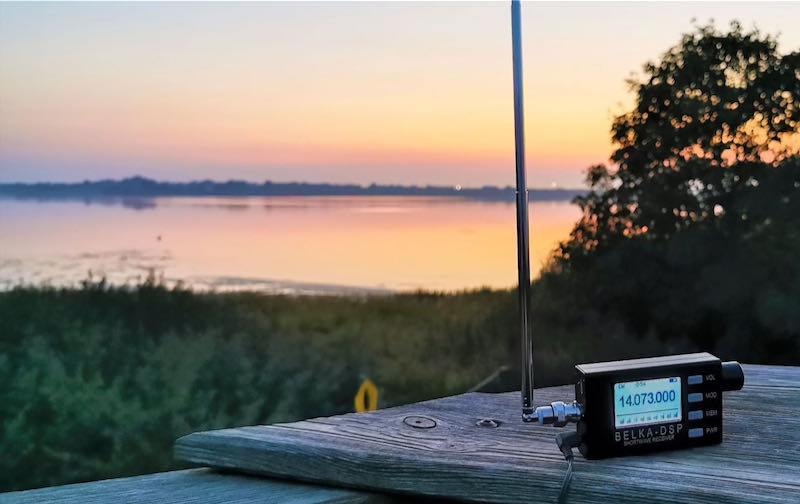
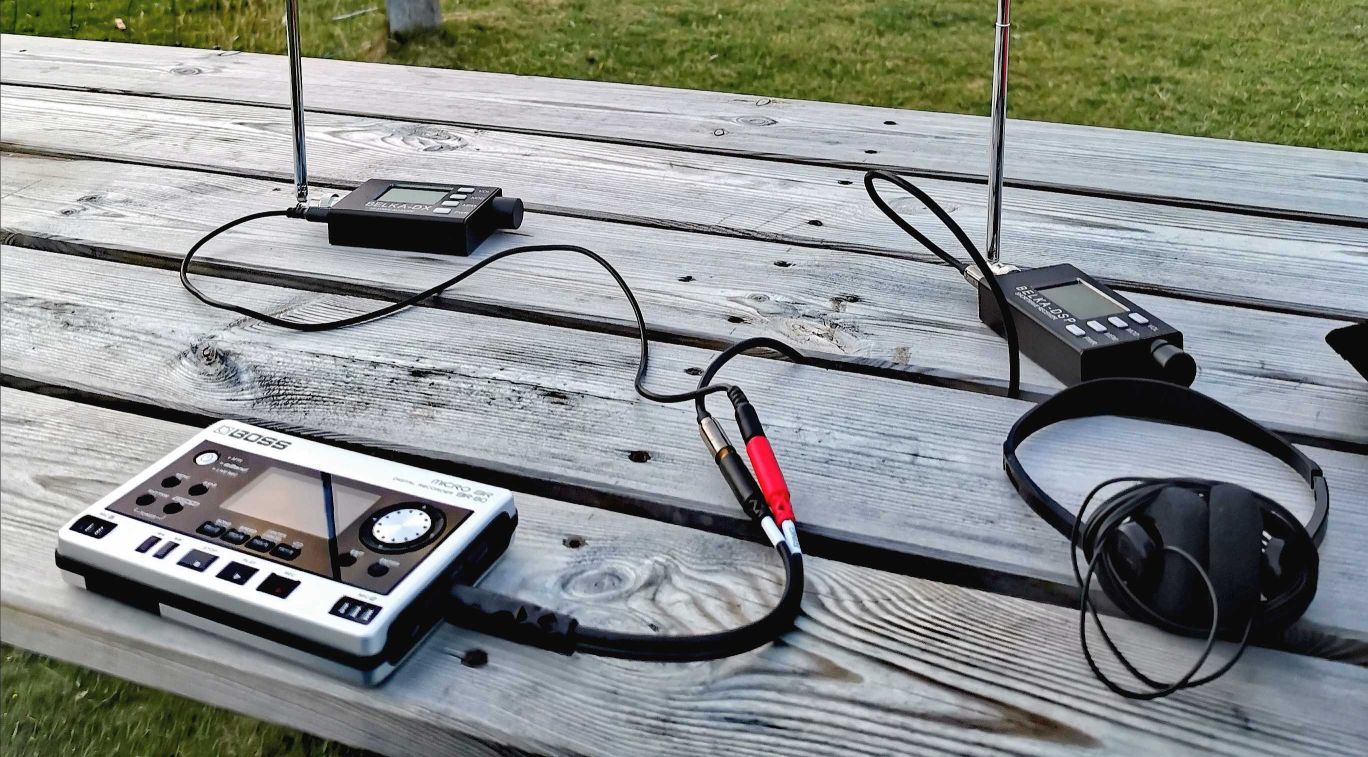
Since I was recently upgrading to the Belka DX in order to pass on the Belka DSP to a friend, I had briefly two examples of almost the same radio on the table at the dike. I tuned them to the same stations and recorded some audio clips with one radio on sync detector, the other in regular AM mode, to answer the question whether or not sync has “helped with a particular dip in the signal”. Then I thought that demonstration would be an opportunity to try an explanation on what exactly (I think) sync detectors are all about anyway, hoping to find a middle ground between “technical” and “dumbed down beyond recognition”.

The trouble with sync detectors

Perhaps no component of a shortwave receiver is surrounded by so much misconception and confusion as sync detectors. Full disclosure: Until quite recently, I had an, at best, vague concept on what they do myself. It seems it’s not so much that people don’t know how they work, what they actually do when they work is where the ideas often diverge. Continue reading

Paul wants to know: How do you store your radios?

Many thanks to SWLing Post contributor, Paul, who writes:

This may be a good discussion question on your great blog.

Basically, I am curious to learn where and how do people store their various radios – I think it’s safe to say that many of us have more than 5 or 10. Do you use bookshelves? TV stands? Those storage cube organizers? Custom shelving on the walls? It will be interesting to know …

All the best
Paul

I think this is a great question, Paul.

Personally, I have a lot of portables, so storage is definitely an issue. Since I do radio reviews, many models aren’t ones I use daily but I keep them for comparison reviews and for using in rotation.

The first thing I do when I store a radio is remove its batteries if it takes traditional cells (like AA, AAA, C, or D batteries). I remove them to prevent them from leaking and corroding the battery terminals. Even though I’ve migrated the Eneloop batteries (for AA and AAA), I still remove them for storage.

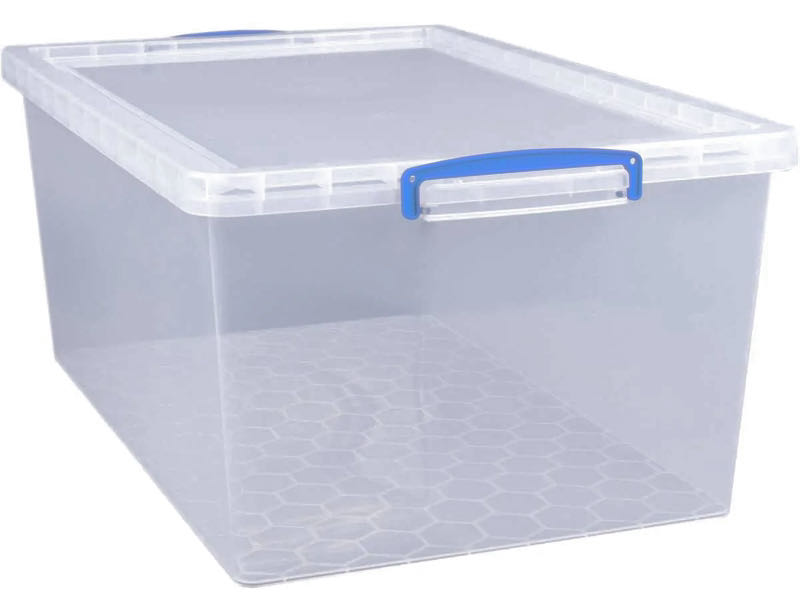
I built custom shelves into my office to accommodate large standard size clear storage containers; I believe the ones I have originally came from IKEA. I store all of my portables in those containers with a little padding or their original box to keep them from getting scratched up.

This system has worked for me very well over the years, but I’ll admit that I wish my small office had more shelf area for radios on display!

Readers: How do you store your radios when not in use? Please comment!