Category Archives: Shortwave Radio

The Worldwide Listening Guide: the content DXer’s handbook

WWLG-7th-EditionI’m very pleased to have just received the 7th edition of John Figliozzi’s Worldwide Listening Guide (WWLG), the latest, most updated version of the excellent guide I’ve often reviewed.

As I’ve said, you may want a copy of the WWLG in your shack, especially alongside your computer or Wi-Fi radio.

SWLing Post readers know that I’m a huge fan of the Word Radio TV Handbook (WRTH); it’s my go-to guide for radio frequencies and schedules. Well, Figliozzi’s Worldwide Listening Guide is my go-to for programming and content, not only helpful on the shortwaves, but also handy when tracking online content.

WWLG: The Content DXers Guide

Like many SWLs, I’m something of a “Content DXer:” I love chasing obscure programming––news, documentaries, music, and variety shows, anything the broadcasting world has to offer.  For this, I often turn to Wi-Fi radio.  Wi-Fi radio offers the discerning listener the ability to track down fascinating regional content from every corner of the globe––content never actually intended for an international audience.

But the fact is, there’s so much content out there, it’s hard to know where to start. This is where the WWLG comes in: Figliozzi exhaustively curates more than 4,000 programs (!), indexing their airing times, stations, days of broadcast, program types, frequencies, and web addresses. Additionally, he sorts the programs by genre:  arts, culture, history, music, sports, and more. And Figliozzi also includes a well-thought-out directory of at least forty genres.   In short, this directory has helped me not just locate, but identify, programming I would never have known about otherwise.

Frankly, I’m not sure how Figliozzi manages to curate such a vast assortment of programming.  But I’m happy that he does, and especially, that he offers it for the SWL’s benefit––!

Thus the WWLG  has become a permanent reference book in my shack, alongside my trusty WRTH. There’s a surprising amount of information packed into this slim, spiral-bound book…enough to keep even a seasoned DXer contented for years.

The 7th edition of Worldwide Listening Guide can be purchased here:

With a retail price under $25, I feel like the WWLG is an excellent bargain.

Mike IDs a Hallicrafters Skyrider in Avengers scene

Avengers-Ultron-Hallicrafters-Radios

In response to my post about finding a glowing Hallicrafters radio in a scene from the Avengers: Age of Ultron, SWLing Post reader, Mike (AC4NS) writes:

“I put the pic in Lightroom and pulled it out of the shadows.

It is definitely a Skyrider and not an SX-28.”

Avengers-Ultron-Hallicrafters-Radios-1024x429

Wow–I’m amazed there was enough information in that photo to pull it out of the shadows! You can see the silk screening and the SEND-REC. switch in the lower right corner.

Again, here’s my Hallicrafters SX-24 Skyrider Defiant for comparison:

My Hallicrafters SX-24

I know why they used a Skyrider in the film; the warm glow of the dials and signal meter were simply irresistible! (At least, they are for me!)

Thanks for helping ID this, Mike!

Spectres of Shortwave: near completion

SackvilleCurtainAntennas

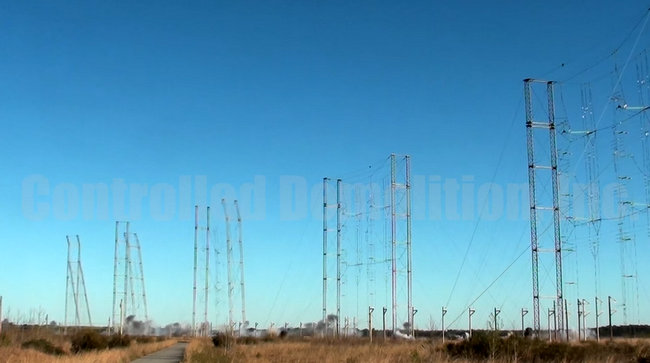
I took this photo of the RCI Sackville curtain antennas in June, 2012. (Photo: Thomas)

Many thanks to SWLing Post contributor, Richard Langley, who shares this CBC New Brunswick article about Amanda Dawn Christie’s film, Spectres of Shortwave:

(Source: CBC)

Amanda Dawn Christie launching documentary about demise of RCI towers

Documentary ‘Spectres of Shortwave’ to be finished in time for possible premiere at Toronto’s Hot Docs

Moncton artist Amanda Dawn Christie says after six years, her documentary Spectres of Shortwave, about the demise of the Radio-Canada International towers in Sackville, is nearly complete.

“A project like this is very hard,” Christie said in an interview on Information Morning Moncton. “When I went into this project they weren’t supposed to be tearing the towers down.”

After budget cuts in 2012, CBC announced the shortwave service would end after 67 years of broadcasting around the world.

Christie calls that decision a loss for the international community.

“Shortwave communication is something that will always get through. Even though technology advances and people rely on the internet — not everyone can afford a computer or digital receiver … Canada was known for more objective, non-biased broadcasting.”

Continue reading on the CBC New Brunswick website…

The Russian Woodpecker movie: now online

woodpecker_movie-graphic

Many thanks to SWLing Post contributor, Andrea Borgnino, who tweets:

The Russian Woodpecker movie is now on Vimeo, Google Play & Itunes:

http://www.russianwoodpecker.com/

Thanks, Andrea!

It appears the movie costs $9.99 (buy) or $3.99 (rent) via Google Play, $12.99 (buy) via iTunes, and $12.99 (buy) or $4.99 (rent) via Vimeo on Demand.

Via Amazon, the movie costs $9.99 (buy) or $4.99HD/$3.99SD (rent) but, if you’re an Amazon Prime member, it’s offered as a “free” stream. If I can finish a few projects on my table, I hope to watch this tonight.

Avengers ‘Age of Ultron’ scene: is that a Hallicrafters receiver?

Avengers-Ultron-Hallicrafters-Radios-1 With the recent posts about shortwave radio in films (Star Wars and Star Trek), I remembered a scene from Avengers: Age of Ultron where I thought I spotted a vintage Hallicrafters receiver.

In the scene, Hawkeye (Jeremy Renner) is using an “old school spy method” to find the whereabouts of Black Widow (Scarlett Johansson). I remembered Haweye sitting in front of a 1940s era radio.

This weekend, I found the clip from the movie (first time I had seen it since the theatre) and sure enough, I’m positive this is a Hallicrafters. Click on the images above or below to enlarge.

Avengers-Ultron-Hallicrafters-RadiosI can’t quite determine the Halli model, though–can anyone ID it?

The images aren’t the best: the scene is dark and the radio at quite an angle. Still, there’s no mistaking that Hallicrafters glow.

My Hallicrafters SX-24

My Hallicrafters SX-24

I think there’s a good chance it’s the same model I have in my radio shack: the Hallicrafters SX-24 ‘Sky Defiant‘–but I can’t quite confirm. Perhaps it’s an SX-28?

Can anyone provide a positive ID? Please comment!

How Bob McGwier used a Cray-2 supercomputer to decode a ham radio transmission heard in Star Trek IV

Startrek4-MoviePoster-SmallIn response to our recent post with a message to us from Star Wars sound designer Ben Burtt, SWLing Post reader, David Guilbeault, comments:

Here’s a similar story that circulated on the Internet around 1990 (pre WEB!). I worked in packet switching at that time and was very impressed with Bob’s achievement (even with a CRAY to work with) .

I reached out to Bob McGwier (N4HY), who is a Facebook friend, and he has kindly given us permission to share his message again here and with a few new comments:


Star-Trek-IV-Cap

Decoding HF packets in Star Trek IV

Originally posted on December 4, 1989 by Bob McGwier (N4HY)

Several months ago, Harold Price, NK6K, challenged me to demodulate what he thought might be HF packets in Star Trek IV.

Chekov-Uhura-Star-Trek-IV

During the scenes where Scotty is valiantly trying to beam both Chekov and Uhura back from the U.S.S. Enterprise, where they have been stealing Nuclear vessel high speed photons, Scotty is having a hard time hearing them.

Scotty-Star-Trek IV

Listen to the audio clip by clicking here or using the embedded player below (target sound is at 5 seconds):

One of the sources of interference is what appeared to Harold to be HF packet. Always being one to rise to a challenge, I took on the job of doing some fancy Digital Signal Processing footwork. Almost from the first I was certain that it must be an HF packet since my very first demodulator attempt clearly revealed flags before the start of a frame and end of frame was also clear. I knew it was HDLC of some variety.

Several things impeded the effort, including Scotty’s voice on top of the packets, some SSB from 20 meters was also nearly on top of the signal. All of this had to be filtered out. I spent an hour of time on the Cray-2 at work and used the fanciest FSK demodulator I could write and I finally had noisy baseband signal plotted on paper in front of me. I did my best to get an integral number of samples per baud as the signal was very noisy, and though the bits could be made out by eye, I could tell that it was going to take another hour of Cray-2 time to get the clock recovered and to make good bit decisions. In a couple of places, HDLC showed me what were clearly bit errors, and these could be done by eye as well.

A Cray-2 operated by NASA. (Source: NASA)

After the filtering, and building a demodulator for the badly mis-tuned signal (almost 900 Hz below), I took the bits to Phil Karn, KA9Q and he decoded the NRZI data and proved beyond a shadow of a doubt that it was indeed an HF amateur radio packet. It was WA8ZCN-0 sending an RR for NR-3 to N6AEZ on 20 meters. I got Bill Harrigill, WA8ZCN on the phone and he agrees that it was probably him.

Thanks Harold for the challenge and Phil for the help.

Bob N4HY

P.S. A Cray-2 is about 50% faster than the fastest Pentium-Pro computer available today.

Again, keep in mind that the message above dates from 1989! This past week, Bob added the following comment when I contacted him:

The Cray Supercomputer on which the work was done was being operated on behalf of the National Security Agency by my research institute.

I received permission to “to test optimal algorithms for software decoding of FSK transmissions” and this was my test case!!!!

That is why Phil Karn was decoding the AX.25 bits by hand. I did not have permission to develop link layer protocol code, though I tried.

A few years later when half the bad guys in the world seemed to be using AX.25 and cheap ham gear I said “See, I told you so several years ago and you didn’t listen”.

I used that transmission in so many different ways I no longer remember them all.

That’s fantastic, Bob, and so great to know the back story on your decoding process! Thank you again for sharing this with us!

Star Trek fans can find the scene Bob references starting around time mark 1:12 in the film.

Phil’s review of the Digitech AR1946

digitech-AR1946-frontMany thanks to SWLing Post reader, Phil Ireland, who shares his review of the Digitech AR1946:

I’ve now purchased the AR1946 and I have to say, I’m very impressed! No noise problems at all with mine, although if you listen very carefully under certain conditions, you can discern a slight digital hash. Not in anyway imposing though.

This radio is super sensitive, AM comes very close to the CCRadio-EP in performance and FM is outstanding. SW is very impressive but there are a few quirks in tuning:

  • below 10MHz, you hit the Frequency button, key in the value and hit the Frequency button again to tune [to the desired station]
  • above 10MHz, you hit the Frequency button, type in the value and it jumps straight to the frequency [without pressing the Frequency button again].

Not a great issue but worth knowing.

This radio has 7 bandwidths in AM both accessible on MW and SW and rudimentary fine tuning with a separate wheel control. Unfortunately FM only has 1 bandwidth but seems well chosen. DAB+ is not available in Regional NSW so that cannot be commented on.

The telescopic antenna is ridiculously small but seems to pull in the signals with no problems. There are external antenna connections for improved performance.
Audio is very pleasant and you can control both treble and bass with the push of a button. The display is bright, well lit and easy to read with a useful tuning indicator.
There are a number of useful features and with 700 memories, there are more that needed. The radio is very reminiscent of the Grundig Satellit 700 in some respects. Build quality seems very good, time will tell if reliability becomes an issue.

What I don’t like is the radio partially mutes when tuning, this is annoying when bandscanning with the rotary tuning control. I have noticed what appears to be synchronous detection being used as occasionally when tuning onto a frequency, you will hear the detector lock on frequency. If so, there is no control over this feature. That may explain the display showing synch but the final model has automatic synch lock..

The AR1946 dispenses with Airband that was good on the AR1945 and SSB. Its a pity that SSB is omitted but along with the Tecsun PL310ET with DSP, they don’t have SSB capabilities as well. I suspect the same DSP chip is being used in this radio.

Can I recommend the radio? A resounding yes! As mentioned I’m very impressed. Try before you buy, though, as it may be that QC is variable along with many Chinese radios of late.

Digitech-AR1946-Front-HandleMany thanks for your review, Phil!

When Phil notes a lack of noise in his receiver–he’s referring to a previous review we posted from Avo, who complained of internally-generated noise in his AR1946.

It seems, like with many other DSP portables (including the Sangean ATS-405) internally-generated noise may vary from unit to unit. I’m guessing this could have to do with slight variations in the board assembly (variations in soldering, grounding, shielding connections).

As Phil advises, please check your radio immediately after purchase and compare it to another shortwave portable if you have one available. This way, if you detect a noisy receiver, you can get a refund or exchange within the time limits of the return policy.