Category Archives: Shortwave Radio

Russia “quietly” ends longwave services

Zenith Transoceanic tuned to shortwaveThe BBC reports that Russia has “quietly switched off nearly all of its long-wave transmitters, ending almost nine decades of broadcasting – as cost finally catches up on the medium.” Read the full story on the BBC News.

Not a huge surprise as many countries are pulling the plug on longwave, despite the medium’s large local broadcasting footprint. It does make one wonder if VOR shortwave could also be pulled with little fanfare or warning.

Indeed, check out Jonathan Marks’ comments on the changes at the (former) Voice of Russia which we’ve mentioned has at least, administratively, been liquidated and consolidated.

I can tell you that for those of us in North America, VOR is now a much harder catch on shortwave–a very strange shift from the ubiquity of the broadcaster’s signal in past decades.

But if you want to hear frank, public comments about how these changes are affecting the staff of VOR, just bookmark and listen to From Moscow With Love. Hosts Vasily and Natasha happily march to their own beat and comment openly to listener inquiries.

CommRadio CR-1 and WRTH: Power outage essentials

20140107-092801.jpg
Like much of North America, we’re currently experiencing record low temperatures and strong winds here at our mountain home. This morning, I woke to no power and no Internet. My iPhone still works though, hence the ability to publish this post.

But no power is really no problem when it comes to SWLing. Indeed, for those living in urban areas, power outages represent temporary refuge from all of those electronic noises (RFI) that plague daily listening.

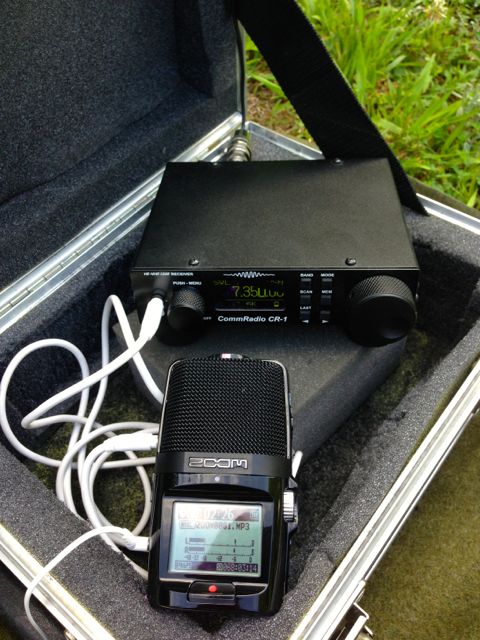
I’ve spent the morning SWLing with my CommRadio CR-1. The beauty of the CR-1 is that it can operate for hours on its internal battery and can also be charged/powered via USB or anything from a 6V to 18v DC power source. I’m currently charging the CR-1’s battery from our solar-powered battery bank. It makes me realize that the CR-1 is an ideal, top-shelf radio for off-grid DXing.

Additionally, I received my 2014 WRTH yesterday in the post. The WRTH is always a welcome delivery, but this morning was even more appreciated since it requires no power source whatsoever to work!

No power? No worries! With a WRTH and CommRadio CR-1 combo, I’m a happy listener!

Etón introduces two travel portables: the Etón Traveler III and Mini 400

Eton-shortwave-radio-family-001

In addition to the shortwave portables we mentioned earlier this morning, SWLing Post reader, Tom, points out two more radios Etón will introduce at CES:

[Etón is] showing off 2 other models all under the label of the World Travel Radios at CES.

They posted the others on the following page
http://blog.etoncorp.com/index.php/2014/01/ces-2014-travel-radios/

Your leaving out the Traveler 3 at
http://www.etoncorp.com/en/productdisplay/traveler-iii

And the Mini at
http://www.etoncorp.com/en/productdisplay/mini

Eton describes these radios on their press release:

The Eton Mini 400

The Etón Mini 40

Etón Mini – This compact radio gives you access to news and music from across the globe, right in your pocket, whether on an AM, FM or Shortwave frequency. The Mini’s built-in digital tuner and internal and telescoping antennas easily identify stations, which can be viewed on the high-contrast digital display. The radio also features an alarm clock, sleep timer and earphone jack. Perfect to listen to the radio broadcast at your favorite sporting events.

Features:

  • Frequency coverage:
    • AM:  520 – 1710 kHz
    • FM: 87.5 – 108 MHz
    • SW1: 3.2 – 10 MHz
    • SW2: 11.65 – 18 MHz
  • Digital tuner and display
  • Digital display frequency timer and alarm activation
  • Key lock function
  • Band selector on left side
  • Tuning/Volume knob
  • Metal speaker grill
  • Sleep timer
  • FM telescopic antenna
  • Rich orange LCD display
  • Earphone jack (3.5 mm)
  • Powered by USB cable (provided) or 2 AAA batteries (sold separately)
  • Click here to download spec sheet
The Eton Traveler III

The EtónTraveler III

Etón Traveler III – The Etón Traveler III receives a multitude of radio wavelengths – AM(MW), FM with RDS, Longwave and Shortwave. Providing four options to tune the radio including auto, manual and Auto Tuning Storage (ATS), the Etón Traveler III also boasts internal and telescoping antennas to ensure your reception is clear and crisp. The Etón Traveler III can store up to 500 stations in the memory and the rich, orange LCD display allows you to see temperature and time. The perfect travel companion, the Traveler III also features an alarm clock and sleep timer.

Features:

  • Frequency coverage:
    • AM: 520 – 1710 kHz
    • FM: 87.5 – 108 MHz
    • LW: 150 – 285 kHz
    • SW: 3150 – 21950 kHz
  • FM with RDS (Radio Data System)
  • Automatic or manual digital tuning
  • Auto tuning storage (ATS) function
  • 500 memory stations
  • Local/world time setting
  • Sleep timer
  • Single alarm clock (by radio or buzzer)
  • Snooze
  • Rich orange LCD display
  • Earphone jack (3.5mm)
  • FM telescopic antenna
  • Reset/lock function
  • Power supply: Use USB cable (included), 4 AA batteries or 6V adapter (both sold separately)
  • Click here to download spec sheet

Traveler III will most likely become a part of my portable collection. I loved the Traveler II as it had great overall performance on all bands and was very compact for travel. As a (major!) bonus, the Traveler III has RDS.

Etón introduces two new shortwave portables: the Field and Satellit

EtonField


Many thanks to The Herculodge and SWLing Post reader, Gary, for pointing out these two new portables from Etón Corp: the Etón Field and Etón Satellit.

The Etón Field, pictured above, looks like an updated version of the Grundig S450DLX. Etón mentions the following features on their website:

  • Frequency coverage:
    • AM: 520 – 1710 kHz (selectable 9/10 kHz spacing)
    • FM: 87.5 – 108 MHz
    • SW: 1.711 – 30 MHz
  • FM with RDS (Radio Data System)
  • Dial-in-Dial coarse/fine digital tuning
  • Treble/Bass control
  • RF gain control
  • Wide/Narrow bandwidth selection
  • 50 memory stations
  • External AM/FM/SW antenna connections
  • Local/DX switch
  • Rich orange LCD display
  • Line-in/Line-out and headphone jacks
  • FM telescopic antenna
  • Carrying strap
  • Reset/Lock button
  • Power supply: 6V DC Adapter or 4 D Batteries (sold separately)
  • Click here for the product spec sheet

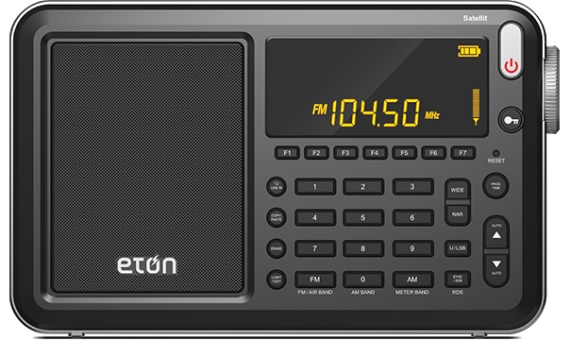
EtonSatellit

  • Frequency coverage:
    • AM:  520 – 1710 kHz (selectable 9/10 kHz steps)
    • FM:  87.5 – 108 MHz
    • LW: 150 – 285 kHz
    • SW: 1.711 – 30 MHz
    • AIR: 118 – 136 MHz
  • FM with RDS (Radio Data System
  • Single sideband (SSB) with +/1 kHz tuning
  • VHF Aircraft band
  • Automatic or Manual Digital Tuning
  • FM stereo/mono selection
  • Electronic/volume/treble/bass control
  • Sync detector with selectable sideband
  • Direct key-in meter band for SW
  • 700 memory stations
  • PLL synthesized dual conversion receiver
  • Local/DX switch
  • Local/world time zones
  • Clock/Alarm/Sleep Timer with time backup
  • Rich orange LCD display
  • Reset/Lock button
  • FM telescopic antenna
  • Power supply: 6V DC Adapter or 4 AA batteries (sold separately)
  • Click here for the product spec sheet

If you’re interested in the Satellit and would like to participate in open and active discussions, join this newly created Etón Satellit Yahoo Group.

It’s interesting to note that FM RDS has become a feature on both the Field and Satellit and that they sport a unique orange LCD display.

Update: Also note that Etón has introduced the Traveler III and the Mini 400 travel-sized shortwave portables.

A note about Etón

For those of you not familiar, Etón Corporation (based in Palo Alto, California) is also known as the Grundig brand throughout North America. Throughout the company’s history of designing and manufacturing shortwave radios, Etón has either branded their radios as “Grundig” or “Etón” (indeed, some models were branded with both, for example the Grundig G5 and Etón E5).  I find the news of the Etón Field and Satellit very exciting as I feared the exit of the venerable Grundig G3 from the market might have also marked the departure of the company from the shortwave radio market altogether. Apparently not!

This is quite important for the SWLing hobby (in North America, at least) as Etón and Grundig products are unquestionably some of the most accessible shortwave radios on the market. Nearly every corporate or franchise retail store of RadioShack (Tandy) carries Grundig radios, as well as Universal Radio and a number of independent electronics/hobby stores throughout the continent.

By and large, I have always liked Etón/Grundig radios–I have purchased nearly everyone they’ve produced in the past six years. I also like the corporation, and it’s founder/CEO Esmail Hozour.

Indeed, Mr. Hozour and Etón Corp generously support global humanitarian efforts–they’ve donated and distributed thousands upon thousands of their self-powered radio/lighting products in the wake of disasters in Japan, the Philippines, Haiti, and even more.  Regular SWLing Post readers will also know that Etón Corp generously supports my radio-based charity, Ears To Our World (a disclaimer that will be prominently mentioned on any future Etón/Grundig radio review here.)

It’s also quite simple to get in touch with Etón product support–a live human being is only an email or phone call away. Numerous times, I’ve directed readers to Etón support and their problems have been solved.

Bookmark this tag for more information on the Etón Field and Satellit.  I have a hunch that they won’t be available until after the 2014 Consumer Electronics Show (CES).

Win a shortwave portable via The Happy Station Show

ccradio-swpSWLing Post reader, Tom, writes:

The Happy Station Show from Tawain just started testing its show on 11880 for a time via WRMI facilities in Okeechobee FL, ex-WYFR

Broadcast schedule can be found here:  http://www.pcjmedia.com/

Also looks like they plan on giving away a shortwave radio [CCRadio SW Pocket] this week from their twitter account post at https://twitter.com/PCJMedia/status/418955953807962113/photo/1

Many thanks, Tom!

Forcing the Tecsun PL-880 to use an external antenna on MW/LW

For those of you who aren’t satisfied with the PL-880’s internal ferrite antenna for mediumwave and longwave reception, here is a video explaining a work-around that will force the PL-880 to use an external antenna on those bands:

Many thanks to YouTube user pesnyaozemle for posting this video and to SWLing Post reader Jon for sharing.

Listening Rewind: Radio Australia rings in the millennium

Source: Wikimedia CommonsYesterday–New Year’s Eve, 2014–I spent some time listening to a few broadcasters as the new year passed through their time zones. While I missed hearing Radio New Zealand International (the first to welcome the New Year on the air), I did manage to catch Radio Australia, and the New Year was celebrated with no fanfare; one program merely ran into the next, and there was a brief mention of 2014’s arrival in the headline news.

Oh, but it wasn’t that way when we moved into the year 2000…

Rewind 14 years

Back in December of 1999, before setting off to visit family for the New Year, I had a sudden notion: I decided it would be fun–and a bit novel–to record radio broadcasters as each moved into the new millennium. As we were packing the car to travel, I changed my mind about using my Grundig Yacht Boy 400 to accomplish this fairly ambitious, round-the-world listening/recording endeavor; instead, I grabbed my ham radio transceiver, an Icom IC-735, and packed it, along with a hefty 12-volt power supply. While my IC-735 lacked AM filters (at the time) it had much better sensitivity than the YB400, especially when hooked up to a decent antenna. I also had the foresight to take along a few odds and ends, including a mechanical antenna tuner and a spool of long wire.

The Icom IC-735

The Icom IC-735

To record the broadcast, I used my trusty Aiwa AM F70 MiniDisk recorder–remember those? Upon arrival at our extended family’s home, they kindly permitted me to erect a long wire antenna in a sloping configuration in their yard. It did a fine job netting the airwaves. The MiniDisk recorder recorded brilliantly, allowing me to monitor levels and even edit afterward.

As a result, I spent New Year’s Eve 2000 recording station after station as the earth turned.  It was great fun, and meanwhile had very little impact on our family celebrations as I simply left the recorder running for long periods of time.

My trusty Aiwa

My trusty Aiwa AM F70 MiniDisk recorder.

While I have yet to dissect the many hours of recordings, if memory serves, I think I managed to record Radio New Zealand International, Voice of Russia, Radio France International, NHK, Voice of America, and Radio Canada International as each rang in 2000. The IC-735 performed quite well, save a lack of bandwidth filters, as I only really had two–very wide, and very narrow.

So, for your New Year’s Day listening pleasure:  I hope you’ll enjoy, as much as I did,  listening to Radio Australia ring in the new millennium yet again. In the news items, you’ll hear that Russian President Boris Yeltson has handed the reigns over to Vladimir Putin, and remarks about the (lack of) problems resulting from the infamous Y2K threat.

Click here to download the recording as an MP3, or simply listen below: