STF Radio sent the following announcement for their “1-hour Million-Watt Special”:
Category Archives: Shortwave Radio
Shortwave.am: a new online frequency guide
A few SWLing Post readers have recently recommended that I check out a new shortwave radio schedule site: shortwave.am.
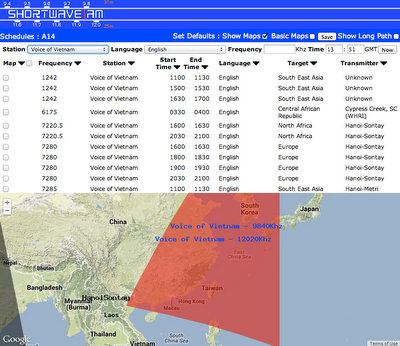
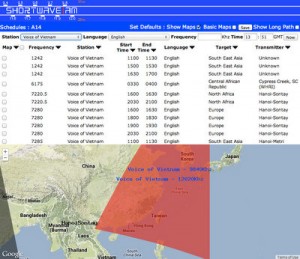
Shortwave.am has a unique layout that lists broadcast schedules along with a map that displays broadcast footprints (both short and long path).
Fortunately, I was able to get in touch with the site developer, Stephen Cooper, who frequently comments on the SWLing Post.
Stephen kindly answered a couple of questions I posed.
My first question was why, with the number of shortwave schedule sites on the Internet, he felt motivated to create a new site. Evidently, inspiration came from Stephen’s Android app, Shortwave Radio Schedules. He responds:
I first created the [Shortwave Radio Schedules] app to give me searchable listings on my phone which I found interfered much less with my radio than on my PC so I could turn my PC off and look at frequencies and schedules on a phone/tablet.
Since then I have just added extra features that I find useful, such as the ability to save logs including the station name, time, SINPO, a comment and a recording of the audio. I’ve used the app to then share my logs to Facebook groups, DXLD Yahoo Group etc. including the audio recordings made on the app.
The maps option I added because I had been using AOKI listings with the beam direction to try and work out favourable beam directions of broadcasts for me in the UK even if they were not targeted to Europe. I realised that it would be much easier to visualise this on a map and started looking at the Google Maps API to work out this would be possible on the app.
Once I added to the app I had noticed screenshots of the maps being posted on groups such as the Rally DX 2012 Facebook group’s and a few people who didn’t have Android asking if there was a web version. I looked into it and it wasn’t too hard to create shortwave.am after converting the Java code to PHP:and Javascript then the site was complete.”
When I asked Stephen what made his site differ from others, he responded:
“[I]t uses data from a combination of Eibi and AOKI to display the listings with maps showing the beam direction. It can also show estimate long paths of each broadcast and uses AJAX web technologies to show search results and maps without having to reload the page for each search or change of parameters.
[…]If you choose a station or language or both and click “Save” (next to the “Set Defaults” part of the site) it will set these as the default that will open each time you go to the site.
Also if you click on a transmitter it now shows all broadcasts coming from that transmitter.
[…]I am going to add some more of the features from the [Shortwave Radio Schedules] app such as the ability to add logging reports, view others reception reports from each station and the options to add recordings of a station and listen to others recordings.”
I think shortwave.am is fantastic, and I’m glad Stephen has put the time behind developing it in his spare time.
Stephen is eager to hear your comments, as he wishes to further develop the shortwave.am. Either post them here, or email Stephen directly.

Weak signals: Which radio do you prefer?
I’m in the process of reviewing a number of shortwave portables and pitting them against each other. Sometimes, it can be very difficult to decide which radio is better–especially if you have more than two radios to compare at a time.
What I’ll often do to help level the playing field is to make an in-line recording of each radio (via my Zoom H2N handy recorder) with the mic and volume levels equal. I then tune to the same frequency with similar filter settings (wide, maximum RX gain, antennas fully extended, etc.).
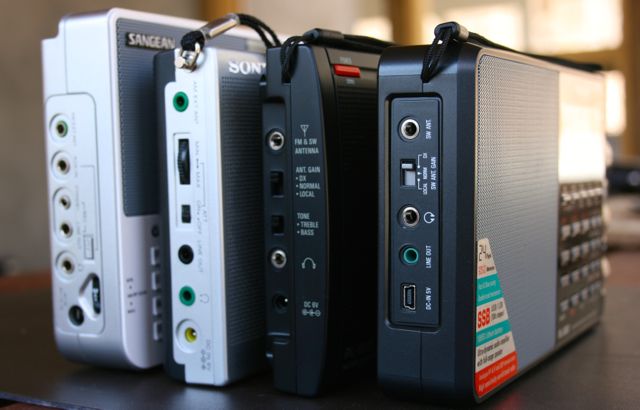
I also like comparing radios while listening to weak signals and/or when conditions are less favorable. Those were exactly the circumstances yesterday when I pitted four radios against each other: the Sangean ATS-909X, Tecsun PL-660, Tecsun PL-880 and the Sony ICF SW7600GR.
I found a weak signal from Radio Romania International on 11,975 kHz. Normally, the signal would have been stronger, but propagation was rough and QSB (fading) was pronounced at times. Under these conditions you get the opportunity to hear how the AGC circuit handles fading and troughs, how the noise floor sounds as conditions change and note the overall sensitivity.
While I give priority to a receiver’s sensitivity and selectivity, there’s more to evaluate–for example, sometimes the more sensitive radio may be less pleasing to listen to.
Below are three recordings of Radio Romania International made from three of the four radios tested (I did not include one of the four radios that was notably less sensitive). These are audio snapshots, but represent what a listener would hear via headphones during similar conditions. All recordings were made within a four minute period of time.
[Update: Check out the results of this test.]
Which of the three recordings do you prefer? Which radio do you find handles these unfavorable conditions best? Why do you prefer one over the others?
Please add your comment below, or contact me via email with your favorite and any comments. I’m also very interested in which one you believe is second best. I’ll tally up the results in one week and will reveal which radio came out on top!
Shortwave Shindig rebroadcast, April 18 and 19
This just in from David Goren at Shortwaveology:
Shortwave Shindig rebroadcast!
The show originally broadcast on 3/14 will be heard again on WRMI: Friday, April 18, at 6-7 pm ET (2200-2300 UTC) and Saturday, April 19 at 11 pm-12 midnight ET (0300-0400 UTC April 20) — both on 9955 kHz from Okeechobee.
Another solution for whole-house shortwave
London Shortwave posts the following on Twitter:
Inspired by @SWLingDotCom‘s RaspberryPi post I put this together to listen to the radio in my shack around the house http://youtu.be/vOX41wIS1Qk
On YouTube, London Shortwave explains that much of his modern system was inspired by a drawing from a 1930s shortwave listening magazine.
Below is a scan of the original illustration that inspired him:
Pirate Radio Recordings: Chairman of the Board Radio
For your listening pleasure: a short 20 minute broadcast from the pirate radio station, Chairman of the Board Radio–recorded Saturday, April 12, 2014 starting around 3:30 UTC.
Chairman of the Board Radio was broadcasting on 6,935 kHz in the upper side band. As you’ll hear, the signal was quite strong, with just a little compression noise.
I really enjoyed this short set of Frank Sinatra tunes. You’ll hear the station ID at the end with a shout out to listeners in Chicago.
Click here to download the recording as an MP3 or simply listen via the embedded player below:
Updates to the Shortwave Broadcast Schedules smart phone app
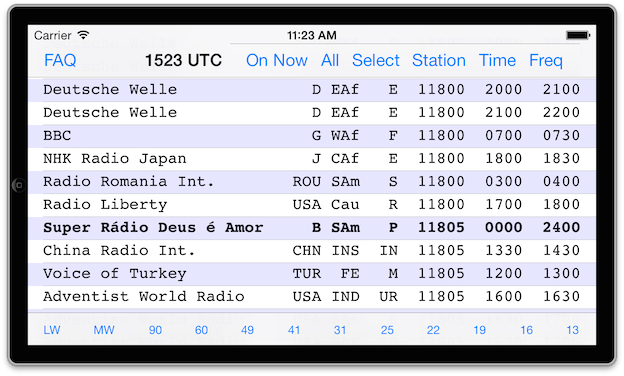
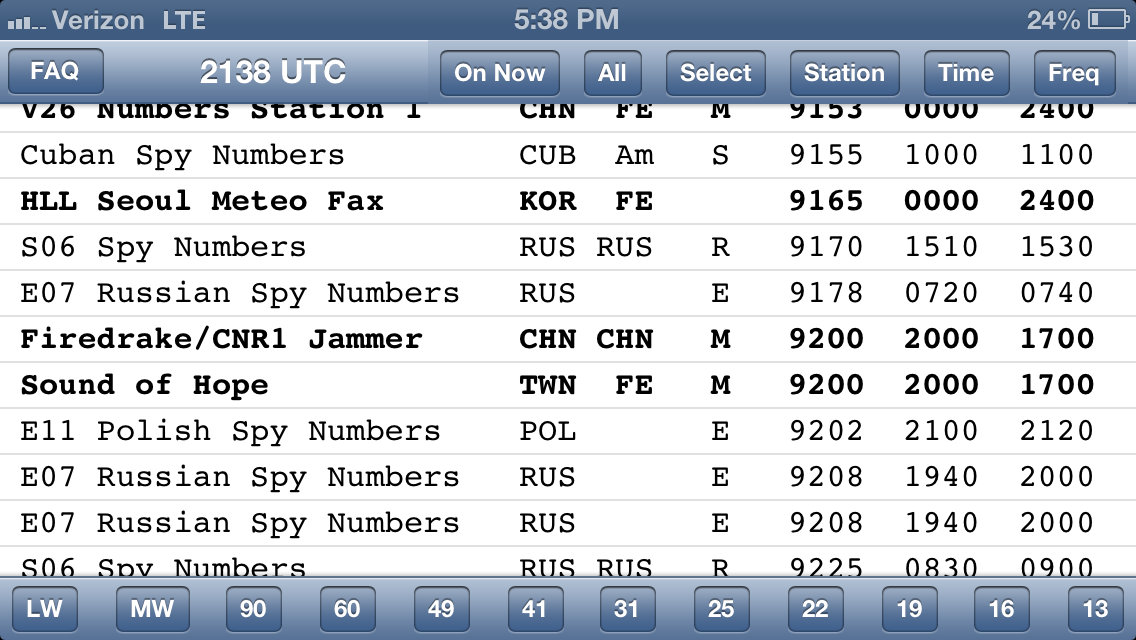
A smartphone app that I find quite useful is Shortwave Broadcast Schedules by Chris Smolinski at Black Cat Systems.
Chris has just announced an update which adds features like the ability to enable schedule reminders as well as keep track of your favorite broadcasts.
I’ve been using this app for a year and have noticed frequent schedule updates–indeed, A14 schedules were ready at the beginning of the season.
It’s an ideal app to use for one bag travel–indeed, you don’t even need an Internet connection to browse the listings. Admittedly, the typical smartphone screen is fairly small to display such a large amount of broadcast data, but Back Cat’s interface is designed with this in mind. I find the app easy to use and very useful while I’m on the go.
I have only used the iOS version on my iPhone. Black Cat also offers an iPad version which, I believe, would be ideal. I have not tested the Android version of the app.
Shortwave Broadcast Schedules is available on the iPhone/iPad ($2.99) and Android ($0.99) devices.
Click here to check out our comprehensive, frequently updated list of radio apps.