SWLing Post DXpedition at PARI is all systems go!

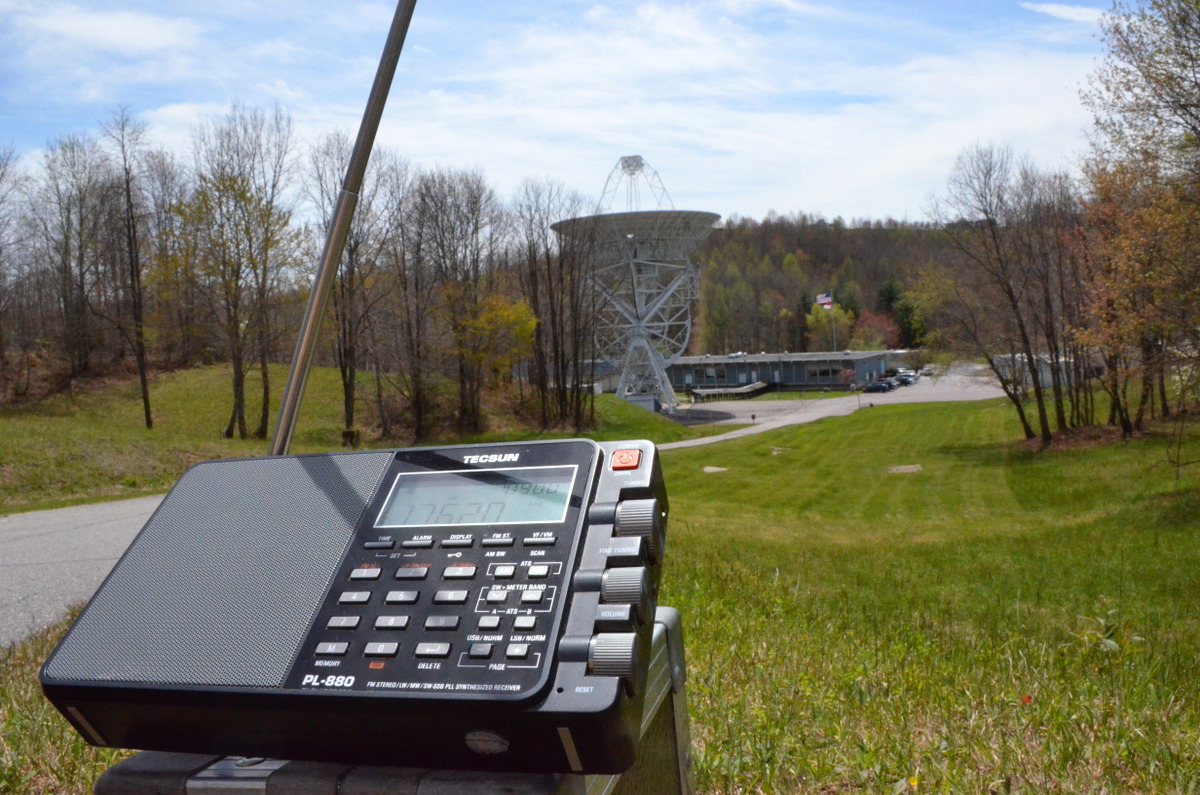
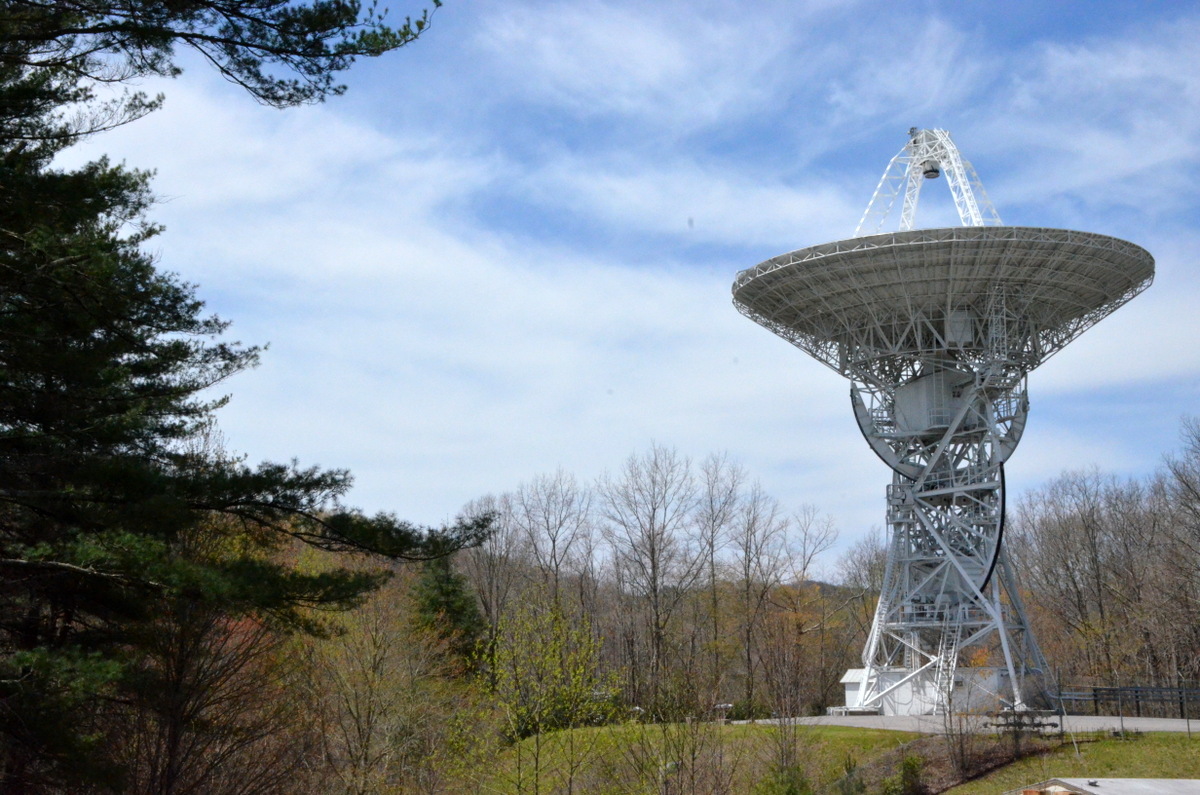
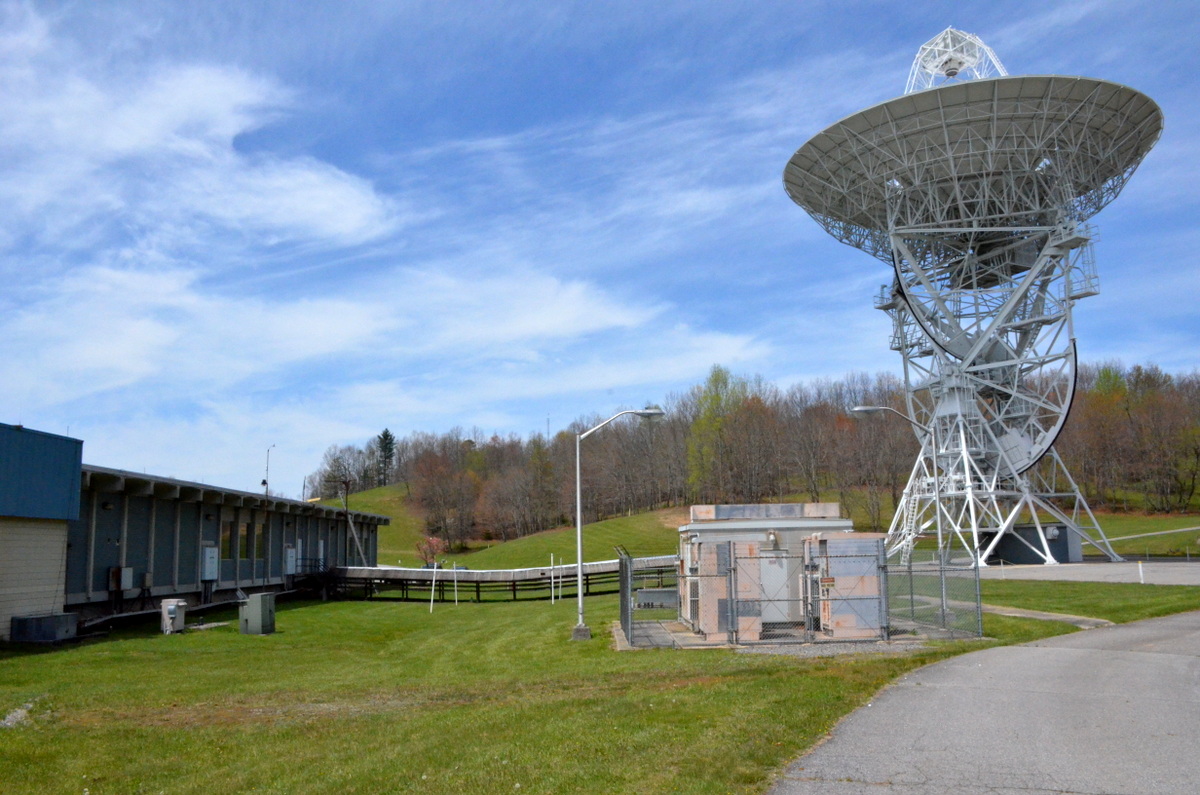
DSC_0884Some of you may recall a post I published last year regarding a shortwave and medium wave DXpedition at the Pisgah Astronomical Research Institute (PARI), a 200-acre radio astronomy observatory and former NASA tracking station located deep in the mountains of western North Carolina.

Since this is the first event of its kind, we’ve been working closely with PARI staff to put the DXpedition together.  And come together, it has.

I’m pleased to announce that we’ve now received the official go-ahead: we’re clear to launch the (first-ever!) 2015 SWLing Post DXpedition, which will take place Friday, October 9, through Sunday, October 11.  Come join us!

PARI will soon post the official registration form on their website; of course, I’ll post an update when this form is ready.

Meanwhile, those of you who may be interested in attending, keep reading…and do join our dedicated email discussion group (more info below).

A few DXpedition details…
DSC_0916

As I mentioned last year, PARI has agreed to handle all of the event’s arrangements, and will even provide a limited number of basic shared dormitory rooms to the first registrants who request them. An event fee will pay for facilities and PARI staff (see below); modest profits, should there be any, will benefit PARI’s worthy science education mission.

We are fortunate to be sharing the beautiful PARI campus with with a larger party of amateur astronomers, aka, a “star party,” taking place the same weekend; the DXpedition will benefit from this in terms of expanded facilities access. An additional benefit is that we can share our passion for radio with members of the star party, while learning a little about astronomy from their members.  And for those of us who enjoy both, all the better.

Costs

The costs associated with the event are as follows:

Registration fee: $100

Lodging: On campus, the fee is $50 per night, per person, in a shared dormitory room; or $20 per night, per tent or travel trailer (no hook ups, though electricity is available). Want to come along, but not interested in roughing it? You’ll find numerous comfortable hotels and inns within a 30-40 minute drive of PARI’s mountain campus.

Meals: Catered meals will be provided for a modest charge to be determined (PARI is working with local food services to arrange our meals currently). Of course, you can always bring your own food and prepare it on-site, as well.  The campus has a lunchroom with a microwave.

The PARI campus and accommodation

DSC_0934

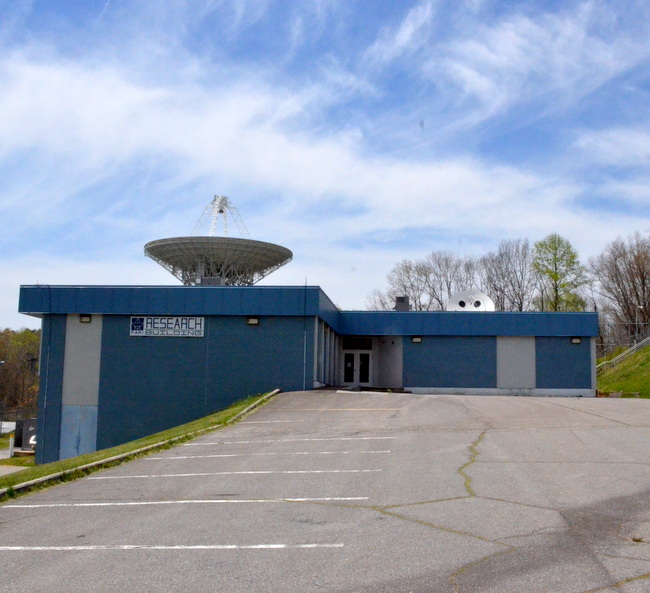
PARI was formerly a NASA tracking station, and following that, a Department of Defense monitoring facility.  Because of the remote nature of the campus, basic on-site dormitories were built; scientists use these throughout the year as they conduct their research, and the shared rooms are available upon request.
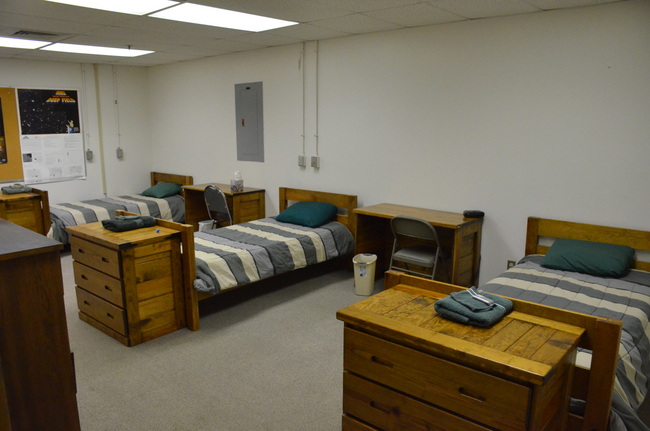
Typical PARI dorm room (click to enlarge)

Typical PARI dorm room (click to enlarge)

The dormitories are conveniently located in the heart of the 200-acre campus, and sleep about four to each room.  These are simple facilities, and no private rooms are offered. Bathrooms (with showers) are shared, and separate buildings house men and women; thus the dormitories may not be the best option if you plan to bring a spouse, a large family, or young children.

Of course, if you enjoy camping and/or star-gazing, you can pitch a tent (just $20/night), or park your travel trailer on campus (also just $20/night). Note that this is not a travel park, thus hook-ups for travel trailers are not supplied, although power is available.

For those who prefer not to camp or stay in a shared room, the nearby mountain town of Brevard, NC (approximately 35 minutes from PARI by car) is a charming small town offering numerous hotels, bed-and-breakfasts, and other comfortable private accommodations. PARI often recommends the Hampton Inn in Brevard, NC. Hotels.com and AirBnB offer alternatives.

Receivers, antennas, and other radio equipment
DSC_0904DXpedition participants should bring their own receivers, antennas, and accessories. If you wish to bring an SDR or tabletop receiver, there are quite a few places on campus where you’ll have access to power. At least one main listening post will be set up under cover, as well, for our participants.

Feel free to bring any type of receiver you like. A few potential participants have noted that they plan to bring a portable receiver only, and that’s absolutely fine–this is your DXpedition, your chance to sit back and listen to your radio without distraction, so any radio you choose to bring is the right one.

Of course, a few SDRs, tabletops, and portable receivers will be available for participants to try out, so if you can’t bring your own receiver, please let me know in advance; I’ll try to reserve a time slot for you to use one of the available rigs.

SWLing Post DXpedition email group
DSC_0838

We have created an email discussion group for the DXpedition. If you are seriously considering joining the DXpedition, click here to become a member of the group as this is the place where we’ll organize and make further plans.

Since this is the first time the SWLing Post and PARI have sponsored a DXpedition, we’re certainly trail-blazing here. My sincere hope is that this event will lead to future DXpeditions…not to mention, real friendships among our readers and fellow SWLers.

Looking forward to the DXpedition–we’ll see you at PARI in October!
Shortwave Radio Recordings: Voice of Greece

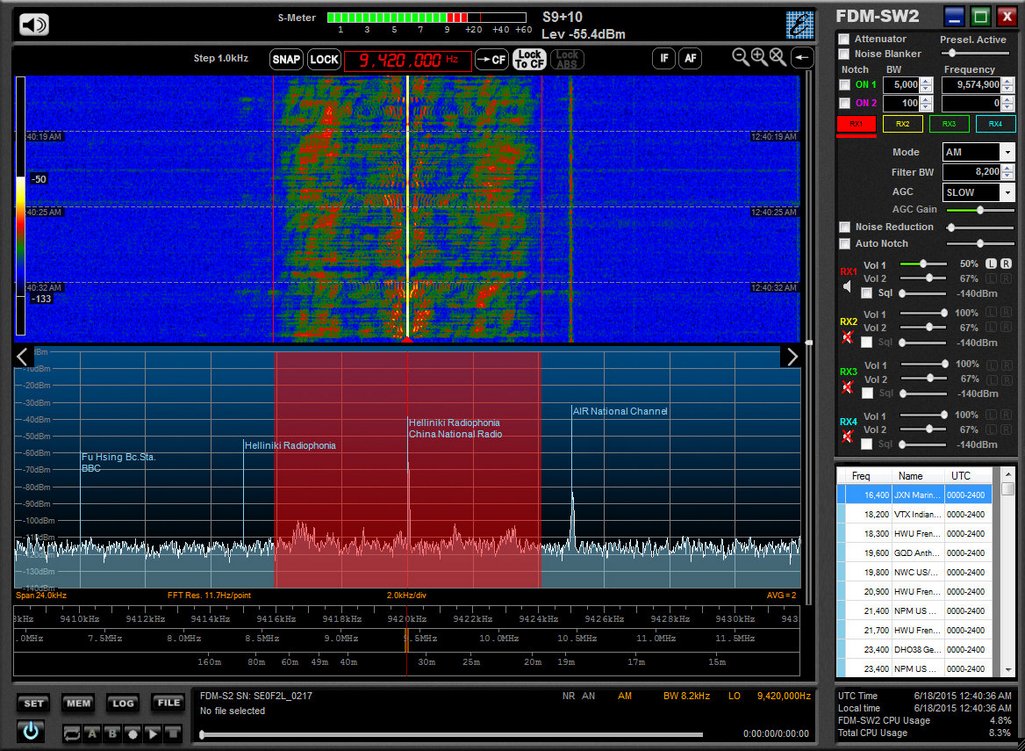
Elad-FDM-S2-VOGEarly this morning, around 01:14 UTC, I tuned to 9,420 kHz with the Elad FDM-S2 and heard the Voice of Greece for the first time since the Greek national broadcaster, ERT had been restored.

SWLing Post contributor, Richard Langley, also noted the strong signal from Greece.  He has kindly shared the following information which he also posted in the DXLD Yahoo group:

“Greece is back on 9420 kHz this evening after being absent for some days and is now carrying the Voice of Greece […] program and not ERT from Athens or Thessaloniki. Noted with good signals in eastern Canada at 01:40 UTC. Radio audio is about half a minute delayed with respect to Internet stream: […](http://www.ert.gr/i-foni-tis-elladas/?). Not noted on other frequencies.

[…]9420 kHz signed off just after [02:00] UTC. Internet stream continued. And I should correct myself when I mentioned “not ERT from Athens or Thessaloniki.” Should have said not ERA from Athens or Thessaloniki. ERA is the abbreviation for Hellenic Radio […], as opposed to ERT which stands for Hellenic Radio-Television […]. ERT1, ERT2, etc. are TV stations while ERA1, ERA2, etc. are radio stations. This is a bit like BB1, BBC2, …, and BBC Radio 1, BBC Radio 2, and so on.”

Richard followed up a few hours later:

“I continued listening to the Internet stream after the SW transmission ended, and at 02:57 UTC, the station identified itself in both Greek (“Edo Athina, I Foni Tis Elladas”) and English (“This is Athens. You are listening to the Voice of Greece”) several times, followed by the traditional interval signal and then what I believe to be the Greek national anthem at 03:00 UTC. A program of Greek music then ensued.”

Many thanks for sharing the details, Richard.  My recording actually ended when VOG signed off–I suppose I caught about the last 46 minutes of the broadcast.

Click here to download the recording as an MP3, or simply listen via the embedded player below:

Correction: Antarctic Midwinter Broadcast transmission tests take place on Friday

SX-99-DialIn the title of my last post, I noticed that I’ve incorrectly stated that the Friday, June 19 BBC Antarctic Midwinter Broadcast tests were to take place “today.” While the post content was correct, the date in this title was not.  My apologies for the mix-up–I’ve since corrected and noted this in the original post.

To be clear, the transmission tests for Sunday’s Antarctic Midwinter Broadcast will take place on Friday, June 19 2015 from 21:30-21:45 UTC on the following frequencies:

  • 7,425 kHz, Ascension, 207 degrees
  • 5,985 kHz, Woofferton, 184 degrees
  • 9,590 kHz, Woofferton, 182 degrees
  • 5,905 kHz, Dhabayya, 203 degrees

Apologies for any confusion.

Friday: transmission tests for Sunday’s Antarctic Midwinter Broadcast

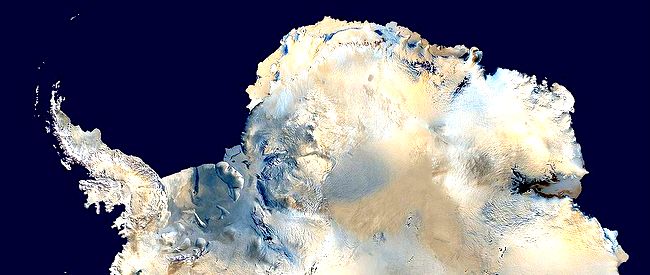
1024px-Antarctica_6400px_from_Blue_Marble

Many thanks to SWLing Post contributor, Rob Wagner, who reports:

HFCC is now listing a test transmission (as the BBC usually does) before the official Antarctic broadcast. The test will be held on Friday June 19 at 2130-2145 UTC. All frequencies listed [below] will be tested INCLUDING the 7425 Ascension outlet! Tests usually consist of a simple feed to BBC WS English programming.

  • 7,425 kHz, Ascension, 207 degrees
  • 5,985 kHz, Woofferton, 184 degrees
  • 9,590 kHz, Woofferton, 182 degrees
  • 5,905 kHz, Dhabayya, 203 degrees

What’s interesting about this is that 7425 wasn’t listed in the finally three freqs chosen for the broadcast, but they are including it in the test! Sounds like they are having “an each-way bet” (as we say in Australia) – 7425 may still possibly be used as a backup for the actual broadcast on June 21.  Cheers, Rob VK3BVW

Many thanks, Rob!  These test broadcasts will give us a good idea which frequencies to focus on during the official broadcast on June 21, 2015.  I’ll be listening Friday at 2130 UTC!

[Update: Note that I originally noted the broadcast time as Thursday in the title of this post. Apologies! I’ve since made this correction. The test broadcast is Friday night (June 19, 2015).]

BBC At War: new series sheds light on WWII broadcasting

BBC-AT-WAR

Many thanks to several SWLing Post readers from the UK who have pointed out this new BBC Two documentary: The BBC at War, Presented by Jonathan Dimbleby.

BBC Two describes the documentary as, “[a]n enthralling series exploring how the BBC fought not only Hitler but also the British government to become the institution it is today.”

Of course, the BBC iPlayer is region-locked, so you either need to be resident in the UK or using a proxy server in order to view. The first episode is available to view now; the second will be soon.

Click here to view Episode 1: The War of Words.

2015 BBC Antarctic Midwinter Broadcast frequencies confirmed

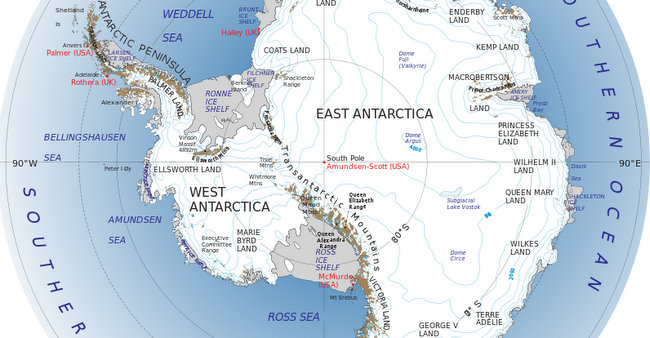
800px-Antarctica.svgMany thanks to SWLing Post contributor, Stephen Cooper, who has confirmed the frequencies that will be used for the 2015 BBC Antarctic Midwinter Broadcast on June 21 at 21:30 UTC.

Again, this year, I’m calling on all SWLing Post readers and shortwave radio listeners to make a short recording (say, 30-60 seconds) of the show and share it here at the Post. Click here for details.

Stephen received confirmation of the following frequencies directly from the BBC World Service:

  • 5,985 kHz,
  • 9,590 kHz,
  • and 5,905 kHz

Evidently, these were the frequencies chosen from the following that were tested:

  • 7,425 kHz, Ascension, 207 degrees
  • 5,985 kHz, Woofferton, 184 degrees
  • 9,590 kHz, Woofferton, 182 degrees
  • 5,905 kHz, Dhabayya, 203 degrees

I think it’s safe to assume that the same antenna paths will be used from the tests. I had hoped an Ascension Island frequency would have made the cut as it’s typically the frequency I hear best here in eastern North America. Of course, the selections were made based on actual test reception in the various parts of Antarctica where the team is located.

Please note these frequencies and take a little time to submit your recording! We look forward to sharing and mapping them across the globe.

Shortwave Radio Recordings: UNID 12,365 kHz USB

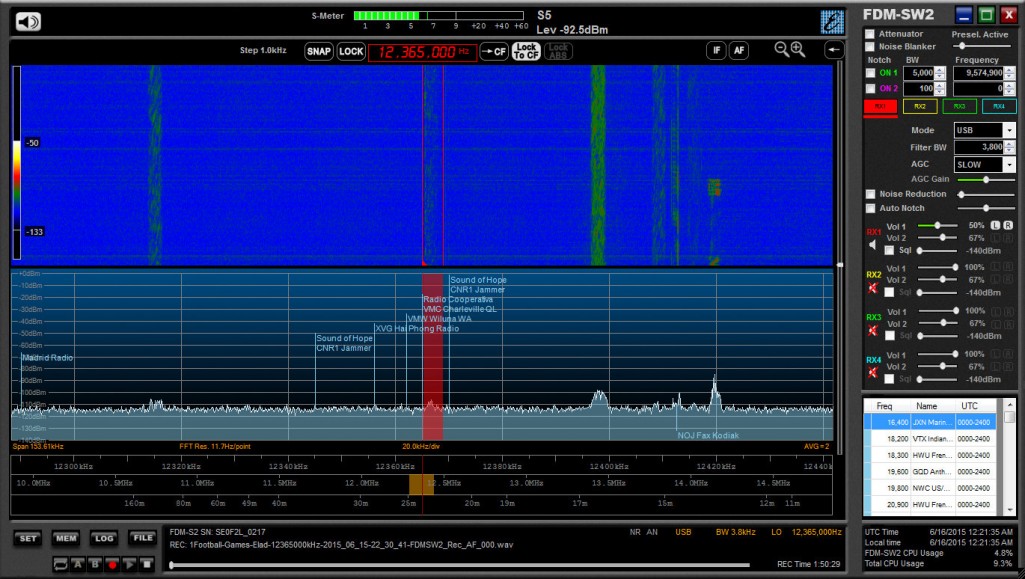
Fullscreen capture 6162015 122135 AM

Yesterday, I posted a note about an unidentified station who was broadcasting the Chile v Mexico football game on 12,365 kHz USB. Several readers sent messages with reception reports, most of which indicated a signal strength of less than S5.

Several of us speculate that this could be a relay from a South American (perhaps Chilean?) shipping service for their fleet in the Pacific; hence the weak signal reports in North America. SWLing Post reader, @K7al_L3afta, suspects that it could even be an audio feed for a radio station.

We may never know, but it’ll be fun to listen for future broadcasts.

I recorded almost four hours of the station last night, starting around 22:00 UTC –during the Ecuador v Bolivia game–on my Elad FDM-S2 software defined receiver (see screen grab above). Below, I’ve embedded a 30 minute clip from the Chile v Mexico game, starting at approximately 23:45 UTC.

The FDM-S2 was hooked up to my large horizontal delta loop wire antenna.  The signal was certainly very much buried in the static at time. I could have improved the clarity of the signal by using the FDM-S2’s built in DSP noise reduction, but opted to keep the USB audio unaltered to better represent reception.

Click here to download this audio clip as an MP3, or simply listen via the embedded player below: