Domo I Viti: New Fiji clandestine station

I just received this message from Glenn Hauser via the Hard-Core DX group:

** FIJI [non]. As first reported exclusively on WORLD OF RADIO 1617 and DXLD 12-20:

HOT NEWS: A station for Fiji named Domo I Viti should start on 4 June at 0830-0900 on 11565 via WRN from Palau. Not sure what its agenda is, clandestine or at least political? Seems there are at least two programs/stations by same name, in Auckland and Sydney by expatriates. Related to either of them, originating where? E.g.:
http://www.aucklandfiji.org.nz/community_features_view.asp?newsid=408
(Glenn Hauser, OK, May 9, WORLD OF RADIO 1617, DX LISTENING DIGEST)

WRN confirms that this new clandestine starts June 4 at 0830-0900 on 11565 via PALAU, and will be weekly on Mondays only. It`s sponsored by the Fiji Freedom and Democracy Movement, based in Adelaide, South Australia.

If anyone can hear it, please note how much, if any, is in English, any contact info, and if possible record an ID. I haven`t found any Adelaide office, altho searching on ABC News stories gets some hits which aren`t very productive.

Note that HFCC has WHRI rather than T8WH registered on 11565 at 08-09. WHR schedules show Angel 4, the most likely transmitter, on 17650 at that time, and Angel 3 on 9930. 11565 was probably just a place-holder in HFCC. Searching WHR program schedules is fruitless (Glenn Hauser, June 3, DX LISTENING DIGEST)

Click here to check out Glenn Hauser’s DX program, World of Radio.

Note that we’ve covered Fiji in the past as their ruling party routinely blocks free press. Click here to read past articles referencing Fiji.

Voice of Greece plays music format during strike

On Monday, May 28, I recorded over 2 hours of popular Greek music programming from the Voice of Greece on 9,420 kHz with a Microtelecom Perseus. Propagation was excellent.

UPDATE: Once again, SWLing Post reader, Christos, provided more info on the strike and recording below:

This time only the journalists had gone on strike. So, no news were broadcasted, no newspapers, no news in internet portals. Announcements between songs concerned the artists and cultural events of the same day, such as theatre, movies, concerts etc. The programme recorded from 42nd minute till 99th was from ERT’s archive introducing contemporary songs. The announcements of this part were about the songs, the singers and the composers. The programme recorded from 100thminute and on contained songs of 60ties, 50ties and older. Music programmes’ producers made no comments about the strike of their colleagues.

Thanks, Christos!!!


You can listen via the player below, or simply download the MP3 by clicking here.

Click here to check out previous Voice of Greece recordings.

RFE: Radio Farda Families A Target In Iran

One of the points I often make is that repressive regimes can track and take action against citizens who read online content from banned/blocked media sources. Here is a case in point:

(Source: Radio Free Europe)

In an escalation of ongoing efforts to thwart Radio Farda, RFE/RL’s Persian-language Service, Iranian authorities are interrogating journalists’ family members in Iran.

Employees of Radio Farda believe that their journalism, which attracts over 10 million page views monthly on Radio Farda’s website, is the motive behind at least 20 incidents this year involving the interrogation and intimidation of their family members in Iran by officials of the country’s Intelligence Ministry.

In sessions that sometimes lasted for several hours, agents denounced the work of Radio Farda journalists and warned family members against having further contact with them. In several cases they instructed family members to tell their relatives to resign from their jobs and return to Iran; in one instance they demanded that a specific series of reports be discontinued. During questioning, family members were also asked about their foreign contacts and trips abroad.

The interrogations have targeted family members, who in some cases have been repeatedly summoned, in Tehran and at least six other Iranian towns and cities.

“This is a proxy war against Radio Farda. It shows the extremes to which the regime will go to prevent the exchange of information it doesn’t control,” said Steven W. Korn, RFE/RL president. “Our journalists make enormous sacrifices for the work they do and will not submit to this pressure on them and their families.”

Radio Farda, produced in and broadcast from Prague, is a leading source of uncensored information in Iran. Each month 1.5 million users inside the country defy the government by employing proxies to access Radio Farda’s website, which is blocked. Radio Farda and “Pasfarda,” its signature satire program, are active on social media, with a combined 300,000 Facebook fans. Iranians actively participate in Radio Farda’s weekly call-in shows, connect with it daily through hundreds of email and SMS messages, and despite government jamming, tune in to satellite radio and shortwave to hear its programs.

In media freedom surveys this year, Freedom House ranked Iran 192 among 197 countries surveyed and Reporters Without Borders ranked it 175 of 179.

Yet one more reason why shortwave radio is safer than the internet as a reliable source of news and information and one more reason why countries like Canada should not abandon this vital resource.

RCI Action: Last month of RCI broadcasts, unless…

(Source: RCI Action)

June 24, 2012, will be the last day of Radio Canada International’s radio programming unless we can convince Canada’s government that our national public radio and television broadcaster CBC/Radio-Canada went too far when it cut our budget by 80% and decided we would no longer broadcast on shortwave or satellite, and be left with only a web presence on the Internet .

This decision to stop radio broadcasting fails to recognize that most people in the world do not have easy access to the Internet. It fails to recognize that there is very little access around the globe to contextualized Canadian news, news for those outside Canada. And since RCI’s mandate is to explain Canada to as much of the world as possible, CBC/Radio-Canada is making that harder for us.

That is why we are calling on Canada’s federal government to step in, stop the cut, and protect Radio Canada International’s international mandate.

Here’s where we need your help.

Please contact government (Conservative) Members of Parliament and tell them why access to Canadian news is important to you.

You’ll find the e-mail addresses for the MPs, and some more information on the impact of the cuts, announced April 4, 2012, here: http://rciaction.org/blog/what-you-can-do/

Finding the “English Man” numbers station while scanning for pirates

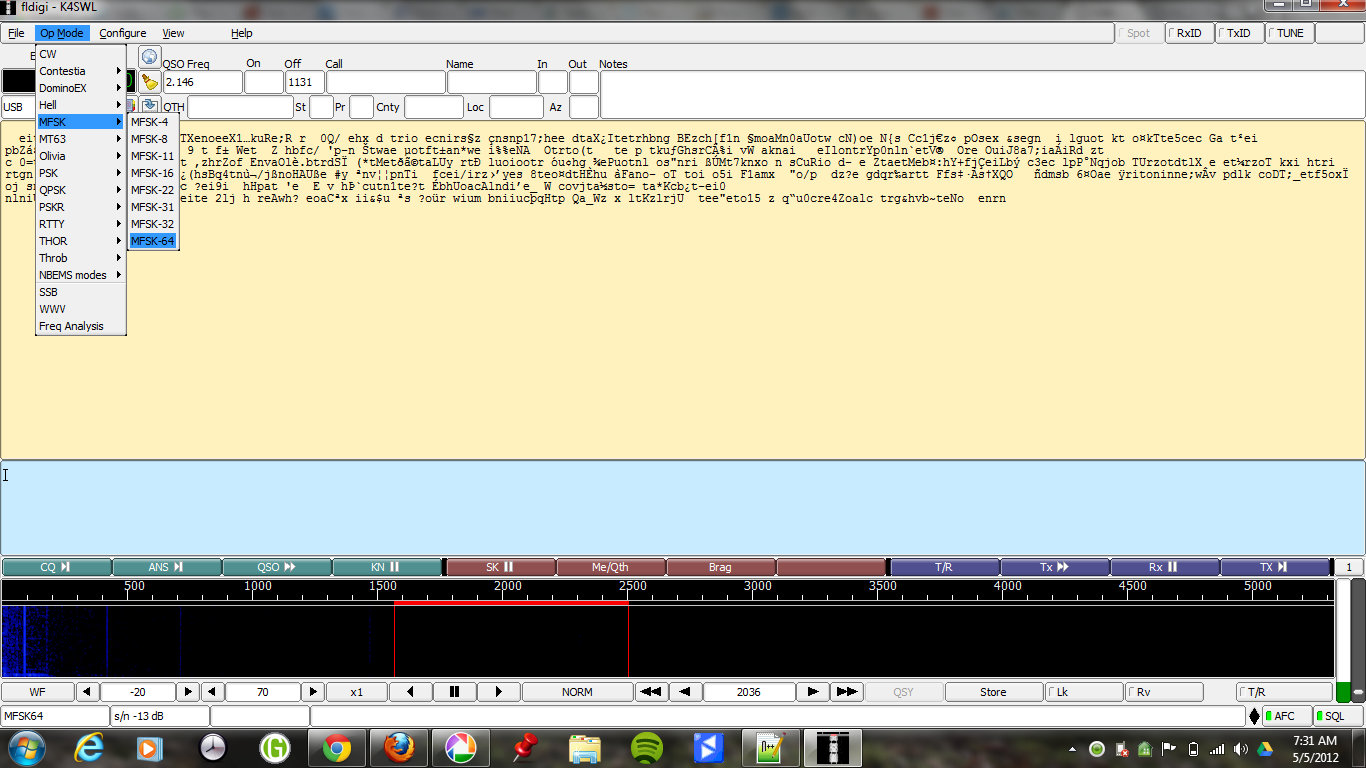
While listening for pirate radio stations last night, I recorded a numbers station. I found it on 6,949 kHz at 1:30 UTC, 26 May 2012. It was broadcast in USB for almost exactly ten minutes. The ID was sent for a full four minutes of that time. I have a full recording below.

With a quick check on SpyNumbers.com, I’m pretty sure this is a station called, the “English Man.”

If you’re not familiar with numbers stations, check out this previous post where Shortwaveology author, David Goren, explores numbers stations.

If you have trouble listening to the embedded player below, simply click here to listen to the mp3 file.

The Tecsun PL-380: a great travel radio

My Tecsun PL-380 and Eagle Creek pack

SWLing Post reader, Alan, commented on our “most durable radios for travel” post:

You should include the Tecsun PL-380 [on] the list. It is an excellent tuner with good selectivity. The ETM feature was made for a traveler. The radio is cheap enough that it won’t bother you if you lose it or break it.

I have to say, I agree! In fact, I travel with the PL-380 quite often. It has become my back-up radio when I make field recordings (my primary portable for field is the Sony ICF-SW7600GR).

Eagle Creek pack with contents: Tecsun PL-380, Zoom H1 recorder, earphones, audio cables, external antenna, spare batteries and Kindle. Click to enlarge.

In fact, I have a small Eagle Creek bag with a shoulder strap that holds my field recording kit and other electronic “necessities:”  Tecsun PL-380, Zoom H1 recorder, ear buds, audio cables, roll up antenna, spare batteries, and, of course, my Kindle (so I can read while waiting for my plane/train/bus). In a pinch, it can even accommodate a Sony AN-LP1
active antenna (which I use primarily in hotel rooms with inoperable windows). To help you visualize, check out the photo on the right.  It’s my grab-and-go bag.

Paul will never travel without a shortwave radio again

This South African traveler, Paul Ash, will never travel without his shortwave radio again. It has taken him around the world and he has taken it around the world:

(Source: The Times Live)

[…]Some time in the 1980s, my ma gave me a Sony shortwave radio, nine shortwave bands in a box the size of a deck of cards. It was the equivalent of a permanent round-the-world air ticket. Night after night, I hopped frequencies, roaming with the Voice of America, the BBC’s World Service – the mother lode – sometimes the Dutch (when I could find them), and, occasionally, Radio Moscow. So, the Russians were real!

There were no radio plays here, to be sure, but drama – and propaganda – on a grand scale. One night, instead of swotting for the next day’s exam, I listened to the Berlin Wall come down, utterly transported from a summer night in Jo’burg to cheering with Berliners as they helped topple the concrete barrier in an orgy of tearful happiness.

When I started travelling, the radio came with me for entertainment and as an alarm – I figured if there was trouble brewing in whichever dodgy part of the world I was in, it would be the BBC who got wind of it first.

The little radio has been to Vietnam and Kenya, France and Senegal. It filled lonely nights while I roamed America like a freight-hopping bum. It survived a long kayak expedition up Lake Malawi and gave me and my cameraman a passable diversion during an ill-advised summer fortnight in the rotten Hotel Zambeze in Tete, the worst city in Mozambique, if not the world.

Last year, I ditched the radio in favour of a smartphone for a short trip to Poland. The bill for five days of roaming was R2500 without a single moment of entertainment. Never again.

Now the little Sony has fresh batteries and the shortwave frequencies are copied on the back of a business card. No charger, no roaming hassles and free to air. E-mail can wait. I’ll send a couple of postcards instead.[…]

Read the full article at The Times Live.

If you’re thinking about buying a shortwave radio for travel, check out our recommendations for the best travel radios.