CC Skywave Sale: $63.88 at Cabelas

Many thanks to SWLing Post contributor, Rich Kuzma, who writes:

I’m a long time reader, and wanted to share this amazing deal I just stumbled across and maybe you would like to pass down to your readers.

Cabela’s is a national chain and I’ve never seen a price this low on the Skywave. I’m also not sure how long the sale or stock will last.

Click here to view this deal at Cabelas.

Thanks again for all the great work on your blog!

Thank you for for sharing this deal, Rich, and thank you for the kind comments!

This is the best deal I’ve ever seen on the CC Skywave, too.

Regular SWLing Post readers know the Skywave is one of my favorite travel radios.

Note that Cabelas does typically charge $10.95 for shipping. If you purchase more than $99 of gear, shipping is free. If you have a Cabelas store near you, the Skywave can be shipped for free for pickup.

Tecsun S-8800: Unboxing, photos, and initial impressions

UPDATE: Click here to read our full Tecsun S-8800 review.

Yesterday, I received a Tecsun S-8800 from Anon-Co in Hong Kong.

I like opening radio boxes to find a cardboard insert like this one. It protects the radio and has so much less waste and individual cardboard bits inside.

As I always do when a new radio comes on the scene, I requested to purchase an early release of the Tecsun S-8800 radio for review months ago.  But this time, my contact at the Chinese distributor Anon-Co, Anna, insisted on sending us one “as a gift for the Chinese New Year of the Rooster.”

Because I’ve worked with Anna at Anon-Co for at least a decade, having purchased numerous radios for review and as gifts for family and friends, this was difficult to refuse.  I decided there was no need to do so. Each time I do an in-depth review and note shortcomings or deficiencies in the radios I’ve purchased from Anon-Co, Anna immediately passes my feedback and criticisms directly to the manufacturer’s engineers. I believe this feedback loop between customers, reviewers and manufacturers leads to improved product iterations. Of course, sometimes the negatives can be so problematic, manufacturers simply drop the product line and move on (remember the Tecsun R-2010D?  Case in point). So, while there are a number of other eBay retailers in China that distribute Tecsun radios, I prefer Anon-Co for these reasons.

Thank you, Anna!

The S-8800 is packed face-down to protect the front panel.

Manufacturers and retailers who send me products for review know that we radio geeks have fairly high expectations of our gear, and will therefore hold them to exacting standards. I’m not the least among these.  While I endeavor to be realistic, understanding producers’ limitations and the need for product growth, I also try to keep my reviews as objective as I can, and accommodate my own and others’ particular requirements and preferences.

So In the spirit of full disclosure, I must note that I’m not as avid a user of large portables like the S-8800 (or the Grundig GS350DL, S450DLX, or the C.Crane CCRadio-SW).

Personally I prefer smaller, full-featured travel-friendly portables, or else larger tabletop models.  Radios with a form factor like the Tecsun S-8800 are an “in-between” product in my world, thus I rarely use them.

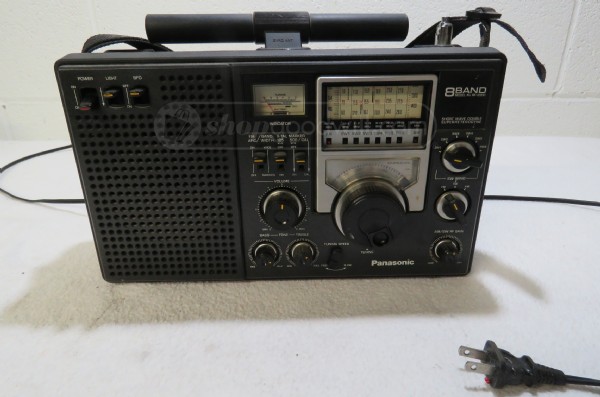
That said, every month I receive questions from readers looking for this very “large portable” form factor. Some hobbyists enjoy a radio that’s easy to operate, featuring simple controls, robust audio, and dedicated external antenna connections.  For these listeners, a large tuning knob and generous display are more important than things like SSB and synchronous detection.In other words, they want a broadcast receiver. Some have literally asked for a modern version of the venerable Panasonic RF-2200 (which I admittedly love, an exception to the rule of my avoidance of large portables). In terms of aesthetics, it’s impossible to live up the legendary solid-state RF-2200, in my opinion…kind of like comparing a modern muscle car with the 1960s original from which it copies its design.

The S-8800, and its many predecessors, were certainly influenced by the RF-2200’s popular design & form factor: large speaker on the left, large tuning knob, wide-spaced knobs, and a generous display. Like the RF-2200, it has a durable, adjustable woven carry strap.  

The S-8800 ships with the accessories in the photo below: an IR remote control, two rechargeable cells, an RF adapter, and a USB charging cable.

Note the charging cable is only a cable; the S-8800 doesn’t ship with a wall-wart type charger. If you’re like me, you probably have a handful of USB chargers scattered around your home that you could use for the purpose of charging this radio.  And if you don’t, you can also use any free USB port on your PC to charge it.

USB chargers are cheap and well-known to spew RFI. I doubt you’ll enjoy listening to shortwave or mediumwave/AM while charging the S-8800’s internal cells. It doesn’t appear the S-8800 was designed for listening while plugged in; Tecsun clearly wants you to charge it and then listen, off battery power. The latter is my preference for listening anyway, but it may put off some potential S-8800 owners.

The display is easy to read from any angle, and it’s also easy to view in bright sunlight. In low light, you’ll be pleased with the backlight function.

On the right side of the S-8800, you’ll find an internal/external antenna switch, a DX/local switch, RCA type stereo line-out ports (covered in the photo above) and a stereo headphone jack.

On the back, you’ll find a mini USB port for charging, an antenna port for a radiator and ground wire, as well as an FM antenna port. 

The battery cover is predictably located at the bottom of the back panel and––a first for any shortwave radio I’ve reviewed––accommodates two (supplied) 3.7V Li-Ion (internally) rechargeable cells.

The right side panel has no connections or controls.

I must admit…the Tecsun S-8800 has some front panel controls I really appreciate. Most notably, it has a dedicated AM bandwidth selector and fine tuning control. I also like the dedicated treble and bass controls which can also be found on its predecessors’ front panels.

Over the next week, I’ll be evaluating the performance of the S-8800. I plan to post blind audio samples as I’ve done in the past, comparing the S-8800 to other portables: likely the PL-880 and the ICF-7600GR, PL-660 or PL-680.  Please be patient, however, as making these recordings takes time as I like to make sure each radio has a true representative sample and fair shot at showcasing performance.

What about those initial impressions? Yes, I must say I do like the package of the S-8800 better than its predecessors. I like the dedicated IR remote control, the many antenna connections, and, so far, the audio fidelity from the built-in speaker. Makes for a nice package.

But, ultimately, the proof is in the pudding:  let’s put the S-8800 on the air and compare it with some benchmarks!

Follow Tecsun S-8800 posts by bookmarking the tag: S-8800

RNZI “continues to serve people across the Pacific region”

(Source: RNZ Press Release via London Shortwave)

Press release: Following the ABC’s decision to cut shortwave radio transmission in the Pacific, Radio New Zealand International wants to reassure our listeners that we are committed to our Pacific broadcast partners.


Radio New Zealand International (RNZI) continues to serve people across the Pacific region, delivering essential day to day news and information and providing a vital lifeline in times of natural disaster.

RNZ CEO, Paul Thompson, has confirmed that there will be no reduction in Radio New Zealand’s commitment to its Pacific broadcast partners. His reassurance comes as Radio Australia closes its international shortwave transmission service to Papua New Guinea and the Pacific.

Paul Thompson has emphasised the importance of RNZI’s 25 year relationship with New Zealand’s Pacific neighbours.

“Remote parts of Papua New Guinea, Solomon Islands and Vanuatu who may be feeling the loss of the ABC can rest assured RNZI will continue to provide independent, timely and accurate news, information and weather warnings as well as entertainment to its Pacific listeners.”

RNZI has been broadcasting since 1990 to the Pacific and is regarded as the authoritative voice of the Pacific. It can be heard across the region and has proven to be a vital lifeline during times of disaster. In 2007 RNZI was named international Radio Station of the Year by the Association for International Broadcasting (AIB).

RNZI broadcasts timely cyclone and tsunami warnings via shortwave and can continue to be heard should local broadcasters go off-air due to a cyclone or other disaster.

Paul Thompson said the essential nature of Radio New Zealand’s role in the Pacific has been regularly underlined by the positive feedback to RNZI following cyclone and tsunami alerts.

“A Vanuatu villager has told our reporter Koroi Hawkins that he knew to take shelter during Cyclone Pam just because of the warnings broadcast on RNZI. At times like this we are the essential voice of the Pacific ” See attached photograph.

RNZI’s coverage of the aftermath of Cyclone Pam in Vanuatu in 2015 won RNZI reporter Koroi Hawkins a silver medal at the prestigious New York Festival Radio Awards in 2016.

RNZI broadcasts in digital and analogue short wave to radio stations and individual listeners across the Pacific region.

Around twenty Pacific radio stations relay RNZI material daily, and individual short-wave listeners and internet users across the world tune in directly to RNZI content.

The RNZI signal can sometimes be heard as far away as Japan, North America, the Middle East and Europe. RNZI also provides rich content for online users through our website

How to listen to RNZI

For further information contact:

Walter Zweifel, RNZI News Editor +644 474 1432

[email protected]

Adrian Sainsbury, RNZI Technical Manager, +644 474 1430 [email protected]

RNZ: ‘Thousands’ in Solomon Islands affected by ABC shortwave cut

(Source: Radio New Zealand via London Shortwave)

The ABC ends its short-wave service to the region from 1pm Solomon Islands time and says it will focus on FM and online services.

Ruth Liloqula said people from Choiseul to Malaita and as far south east as Tikopia tuned in to the ABC because the signal was stronger than that of the country’s public broadcaster SIBC.

Ms Liloqula who works with Transparency International says the ABC has been very valuable for the country and a good way to get her message across.

“We are very very mindful of the fact that the SIBC media here is owned by the government. I mean they don’t ask the questions that they need to ask for obvious reasons. I mean we do get asked those tough questions by ABC and that gives us the opportunity to talk about the issues that affect this country.”

Ms Liloqula said after the recent earthquake people in the bush in Choiseul only knew there was no tsunami by listening to the ABC.[…]

Continue reading at Radio New Zealand’s website…

75 years ago today, VOA started German broadcasts

Voice of America Bethany Relay Station, May 2015

Many thanks to SWLing Post contributor, Alexander (DL4NO), who writes:

Hello Thomas,

I just heard a short feature on Deutschlandfunk: 75 years ago today VoA started transmitting – in German.

vy 73
Alexander
DL4NO

Many thanks for the tip, Alexander!

The Deutschlandfunk article, of course, is in German. I found, that Google Translate did an acceptable job translating it into English.


End of Radio Australia shortwave service, Mark compares final moments

This morning, I woke up, tuned to 9,580 kHz and all I heard was static.

Other than when the Shepparton transmitting station has been silenced for maintenance in the past, 9,580 kHz is one of the most reliable frequencies I’ve ever know on shortwave. Radio Australia has met me there every morning I’ve listened since I was eight years old.

I feel like I’ve lost a dear friend and certainly a staple source of news on shortwave radio. I know I’m not alone–a number of readers have shared similar sentiments this morning.

Archiving Radio Australia’s final days on the air

Listening to Radio Australia on 12,065 kHz with the Titan SDR Pro.

Since the beginning of the year, a few of us have been making a concerted effort to thoroughly archive Radio Australia’s final days on the air. Mark Fahey, London Shortwave, Richard Langley, Rob Wagner and I (to name a few) have been making both audio and/or spectrum recordings.

At 0100 UTC on January 31, 2017, we heard the “Waltzing Matilda” interval signal for one last time. As I understand it, the crew at the Shepparton site left the transmitter on a few extra seconds extra so their famous interval signal would be, in essence, the final sign-off.

Our friend and contributor, Rob Wagner, from Mount Evelyn, Australia, posted an excellent recording/video of the final minutes earlier today.

Due to propagation and the time of day when the shut down happened, I was unable to make a recording, so I’m pleased others could.

Mark compares shortwave and satellite feeds

Mark Fahey’s Wellbrook Mag Loop antenna.

I’m grateful to friend and contributor, Mark Fahey, who lives near Sydney, Australia, and was also able to record the final moments of Radio Australia as well. Mark recorded the shortwave service and RA satellite feed simultaneously.

Mark shares the following recordings and notes:

Recording 1

This is RA’s final few minutes on shortwave – it was recorded on 17840kHz.
The file picks up the regular program ending, then into a Promo for RA “Pacific Beat” (a Pacific current affairs program), then the classic RA Interval Signal then the transmitter clicks off and the void is heard.

Click here to download the MP3.

Recording 2

The file starts at exactly the same time as the first file, but in this example we are monitoring the Network Feed from Intelsat 18 at 180.0 degrees east (above the equator right on the international date line). This satellite feed is the way Radio Australia gets to the network of FM Transmitters they have scatted around the Pacific Region (which is why they feel they don’t need shortwave anymore for – most populated areas of Radio Australia’s target area now is covered by a network of Radio Australia FM transmitters).

Click here to download the MP3.

Some differences to the first file – Radio Australia is produced in FM quality stereo, though of course DXers only ever heard it in shortwave quality mono. So this network feed is in stereo and has a wider dynamic range that what DXer’s are familiar with from Radio Australia. At the end of the Pacific Beat Promo, Radio Australia goes straight into News, the closing of the shortwave service was not an event that would have been noticed for the typical listeners of RA who now listen via FM in Pacific capitals and major towns.

Thank you Mark for your comparison–I’ve never heard RA so clearly. Only you would’ve thought to simultaneously record the satellite feed! It gives the moment that much more context.

A number of SWLing Post contributors have been sharing recordings this morning. I will plan to collect these and put them on the Shortwave Archive in the near future.

Moving forward

Though senator Nick Xenophon says he will introduce legislation to Parliament to force the ABC to reinstate its shortwave radio service, we have to assume we’ve heard the last of Radio Australia and ABC on shortwave. (With that said, I understand Xenophon is a determined fellow.)

Rest assured: if Xenophon’s legislation gains traction, we will post updates!

No doubt, Radio New Zealand International’s shortwave service has just become that much more important in remote Pacific Islands. Click here to view RNZI’s schedule.

Radio Australia shortwave services silenced: “Like listening to our old aunt passing away”

Locals hold a wake to signal demise of ABC shortwave service; destroy a donated shortwave radio with a golden sledge hammer.

Many thanks to SWLing Post contributor, Dennis Dura, who shares the following report via ABC News 24 on Twitter:

Click here to view this video on ABC News 24’s Twitter feed.