BBC Predicts Internet-Only Radio in the Future

BBC-logo(The following is part news / part editorial)

According to a report going to Parliament for the BBC’s broadcast charter proposal, the BBC is preparing for an Internet-only world for broadcasting. This has prompted an investigation of other radio broadcasting services by Radio World magazine to get their take on this perspective. Part of the article “Is Broadcast Radio Doomed”  follows:

 Conventional radio and television broadcasting are doomed, eventually. Or so one might reasonably assume from reading “British, Bold, Creative,” the BBC’s broadcast charter proposal for the next decade of its mandate. The BBC’s 10-year broadcast charter is up for renewal in 2016. The proposal is the Beeb’s funding pitch to Parliament.

To be sure, the BBC didn’t use the word doomed, or put a timetable on it. However, over the next 10 years, “We will be moving to an Internet-fit BBC, to be ready for an Internet-only world whenever it comes,” states the BBC proposal. The only limiting factor will be to “move at the pace of our audiences”; ensuring that older subscribers have access to content on radio and TV as long as they need it.

Subsequent to issuing this proposal, the BBC announced that it is reorganizing its internal divisions along content rather than platform lines. For instance, “Each overarching division would have subsidiary divisions such as BBC Youth, a mooted subdivision of BBC Entertainment, which would include the online channel BBC Three, and pop music station Radio 1,” reported The Telegraph newspaper . . . .

In the current transitional environment, it is impossible to see just where broadcast radio will be in 10 and 20 years’ time. The BBC’s prediction of an inevitable “Internet-only world” notwithstanding, there are still many parts of the Third World where one-way radio broadcasts remain the only economical, effective way to reach mass audiences; no matter what advances are being made in 4G-and-beyond smartphones in the First World. Add broadcast radio’s resiliency in the face of natural and man-made disasters — compared to the frequent overloading and failure of cellular telephone networks during such incidents — and the notion of shutting down broadcast lifelines seems unlikely in these regions.

– See the full article at: http://www.radioworld.com/article/is-broadcast-radio-doomed/278577#sthash.YrBAkCfQ.dpuf

The demise of broadcast radio has been predicted many times in the past 50-60 years and yet it remains. Still there is a growing mindset in what I call  the Western culture’s business mindset that the pervasiveness of the Internet is the dominant factor in future media decisions. This is the same justification for various governments reducing or eliminating SW Broadcast budgets. After all “Everybody has the Internet now!”

This is a mistake, and belies a Western-centric view of the world. I cannot claim to know the real numbers, but I have little doubt the numbers representing Internet availability are inflated, partially because of assumptions and partially for selfish business interests.

In an ever-competitive entertainment market broadcasters (and governments) are naturally worried about such things as market share and the like, but this is only looking at things from one side of the coin. Anyone who uses the Internet outside of the home knows data fees can become enormous, and therefore we watch just how much traffic we pass through our wireless devices. (Yes I admit it – any place I go regularly which has “free Internet” gets loaded into my list of networks so as to keep my data charges down.)

How many people are going to listen to radio streams like they do now to radio broadcast stations? Are you going to drive home with your radio on through the Internet? I doubt it. Similarly how many people listen to the radio in places where there would be no coverage of wireless? I believe the market share would decrease rather significantly in these same western cultures where the Internet is indeed plentiful, but not certainly not free.

Having been involved in the early days of the public Internet back in the 90s, I remember meeting with city planners when they were looking to offer free Wi-Fi within the city so everyone could have access. While the idea sounded good, the logistics of equipment, and more importantly the expense of such an ongoing system, quickly laid such plans to rest for most government budgets.

I hope the pendulum swings back over time and business leaders and government officials recognize the value of both shortwave and OTA radio broadcasts. The Internet is a shiny diversion to be sure, but it is not the answer to all of our media needs. And whether folks like to admit it or not, the Internet is a fragile thing. As the old saying goes, a chain is only as strong as its weakest link. How many times a year does your Internet service go out for no apparent reason, much less because of weather or other disasters?

Broadcast radio needs to be supported for many of the same reasons as shortwave radio – there simply is no more reliable way getting information out to the most number of people over the greatest possible coverage area.

Robert Gulley, AK3Q, is the author of this post and a regular contributor to the SWLing Post. Robert also blogs at All Things Radio.

Nothing to hear on shortwave? Jacques disagrees…

MauritiusIsland-IndianOcean-SM

Many thanks to SWLing Post reader, Jacques Catherine, who left the following comment on our post from 2012: Is there anything to listen to on shortwave?

“I live in Mauritius Island in the Indian Ocean and I’ve been listening to Shortwave since I was a kid (I’m 58 today) on my dad’s good old Phillips wooden valve radio.

I’m sorry, but shortwave is certainly not dead. After having read all the comments above, I come to the conclusion that reception definitely depends on your location.

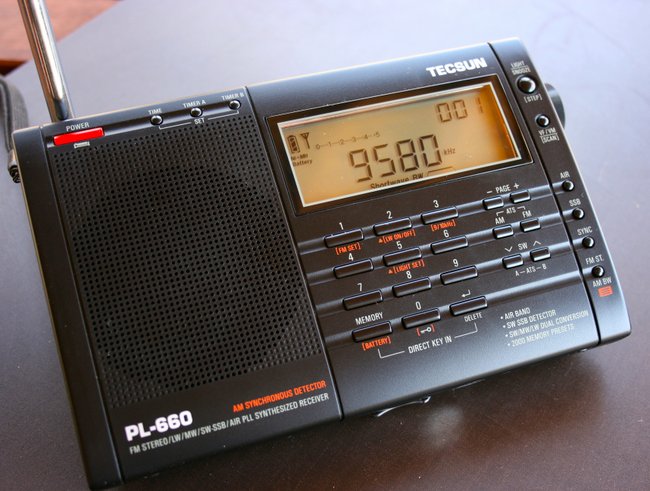
The Tecsun PL-660.

The Tecsun PL-660.

I have two Tecsun receivers ( Tecsun S 2000 and PL 660) hooked to a Windom antenna and an ATU. I receive dozens of stations from all over the world here as well as a lot of stuff on ssb, including – in the morning – New York MWARA (8825.0 usb), Gander (8831.0 usb) or, in the evening, Brisbane (5634.0 usb).

Broadcast stations from Japan, Taiwan, India, Iran, Australia, Singapore, China, Africa and even the US, come in here loud and clear with very little static, depending on the season and time of the day. I think I’m privileged to be located where I am !

And I bought some years back a pair of cheap small wooden amplified speakers in Hong Kong that reproduce exactly the sound of my dad’s old valve radio!”

Thank you for your comment, Jacques. You’re right: it’s all about your location…and you certainly live in a prime spot!

I’m most fortunate that I live where I do–quite far away from sources of noise that plague our urban readers/listeners (and that have plagued me in the past). My location is not ideal (from a radio/receiving standpoint) because my ground conductivity is very poor and I’m in North America where very few broadcasts are targeted these days. I do, however, have the space for a rather large horizontal delta loop antenna that serves me well across the HF bands. I might have invested $50 in the antenna wire and components five years ago.

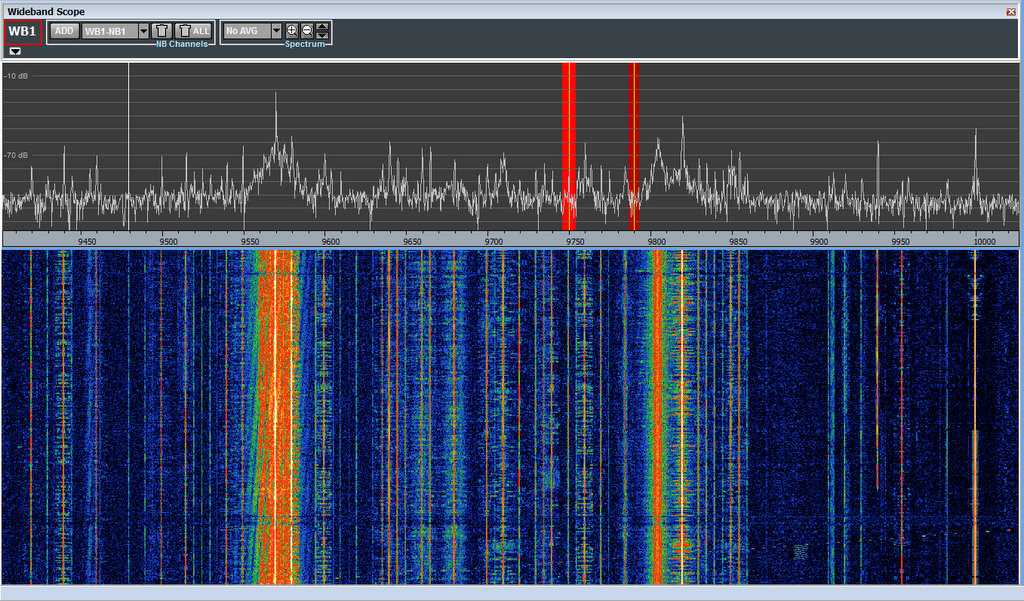
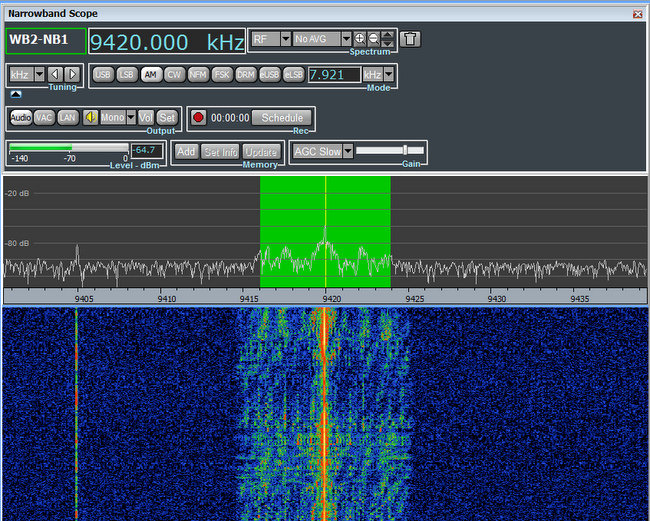
When propagation is good, some broadcast bands are actually packed tightly with signals. Indeed, Thursday last week, I could’ve easily logged two dozen stations on the 31 meter band alone.  Here’s a screen capture from the spectrum display of my SDR:

TitanSDRPro-Spectrum-31MB

If you live in an urban area and feel that you’re missing out on the action, consider taking your receiver outdoors and away from interference. Take your receiver on hikes, camping trips or to the beach. You might be surprised by the number of stations you’ll log!

Recently, our friend London Shortwave has been posting an amazing array of broadcast recordings he’s made in a park in the middle of London, England. He’s the guru of mitigating urban interference.

When I have time to curate the recordings, I hope to do a 2016 update of “Is there anything to listen to on shortwave?“–it’s been on my to-do list for a while now.

Jacques, thanks again for your comment and reminding us to keep listening!

Psst, Buddy! Wanna Buy a Spy Radio?

This unusual Ebay posting is one of the most interesting I’ve seen in a long time: a genuine, new spy radio transceiver!

Given its rarity and new condition, the $1,900 asking price seems reasonable to me for what a well-heeled collector might pay. The set is referred to as a “FIELD SET MODEL FS-5000 SHORT WAVE SPY RADIO”.

It comes as one carton containing four larger fiber boxes and three smaller fiber boxes, all containing modules that are combined to make a digital radio transceiver system.

spy_radio

spy_radio_xmtr

The seller says that the equipment (complete with shock-absorbing transit containers) bears no manufacturer marks, but was likely made in Germany by Telefunken. The various components look to be extremely well made, and the seller has provided these links for more information on this unusual 0.5-30 MHz transceiver:

http://www.cryptomuseum.com/spy/fs5000/index.htm

http://www.tuberadio.com/robinson/Information/FS5000/

http://www.prc68.com/I/FS5000.shtml

Be sure to check out all the clear photos provided by the Ebay seller of this fascinating transceiver.

Guy Atkins is a Sr. Graphic Designer for T-Mobile and lives near Seattle, Washington.  He’s a regular contributor to the SWLing Post.

One year with the TitanSDR

TitanSDR-VOG

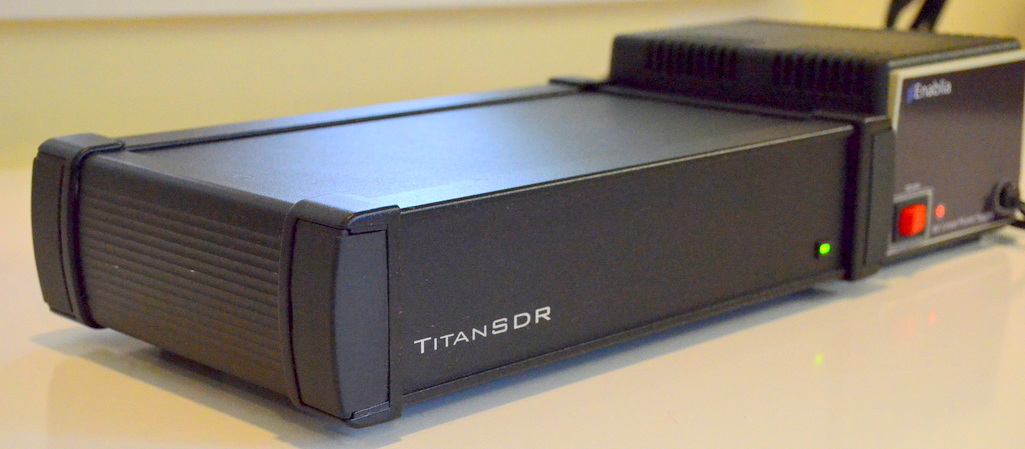
Last year, I reviewed the TitanSDR Pro by the Italian manufacturer, Enablia,. I was very impressed with not only this receiver’s performance, but also its accompanying application’s user interface. I also noted in the review that the TitanSDR is pricier than many other benchmark SDRs on the market ($1380-1970 EUR) but it is, after all, essentially a military-grade SDR that has been ported to the enthusiast/ham radio market.

I’ve been using and testing updates to theTitanSDR Pro for a year now, and I continue to be just as impressed with this receiver––and, especially, with the company who manufactures it, Enablia.

TitanSDRPro-3

I wondered at the time of my initial review how supportive Enablia might turn out to be; I knew time would tell.  Since my original review last year, Enablia has been regularly updating the TitanSDR application, adding many features requested by its users.  This shows a remarkable degree of responsiveness, and I now feel safe to say that that Enablia is an exceptional manufacturer with an exceptional product.

Only recently, I received an update which added two notch filters per narrowband channel, memories that retain AGC and notch filters settings, and sessions that retain AGC settings. I understand Enablia is also preparing updates that improve upon memory management, user interface, audio defaults, as well as offering a few tweaks to the existing feature set.

Overall, Enablia developers are certainly making this signal intelligence SDR cater to the ham radio and enthusiast market even better than before.

Though I use a number of SDRs, I reach for the TitanSDR any time there are multiple-band openings since it can record spectrum and audio across the entire LW/MW/SW landscape. Unlike my other SDRs, it’s not limited to an (already generous)  2-6 MHz recording/listening window.

For example, on Thursday night I had a lot on my listening/recording plate as there were a number of band openings. I had the TitanSDR tuned to:

  • the 31 meter band,
  • the 20 meter ham radio band,
  • the 49 meter band (specifically monitoring South American stations), and even
  • the mediumwave band.

The TitanSDR was recording spectrum on the 49 meter band while I made this AF recording of the Voice of Greece on the 31 meter band (9420 kHz, starting around 00:26 UTC on April 8, 2016):

Surprisingly, all of this recording wasn’t taxing my PC, nor the TitanSDR.

The TitanSDR application is highly stable and uses resources efficiently. Indeed, in the past year, to my knowledge the TitanSDR application hasn’t crashed even once, despite my rigorous demands of it. Since it runs nearly 24/7 in my shack, on a four-year old PC (third generation i5 Win 7), that’s saying a lot.

SWLing Post reader, Tony Roper, is also a heavy TitanSDR user and recently posted this 30+ minute video demonstrating some of the TitanSDR’s new features. Note that his screen capture software produced fairly low audio, so you’ll need to turn up the volume to hear his commentary:

Click here to view on YouTube.

In short, I stand by my conclusions drawn last year in my TitanSDR review:  although pricey compared to the competition, for those who can afford the price tag, the TitanSDR is a worthy hard-core DX machine that is especially useful to need a receiver with a bullet-proof front end, to weak-signal DXers, and to radio archivists like yours truly.

ISS Slow Scan TV reception opportunities in April

ISS(Source: Southgate ARC)

ISS Slow Scan TV in April

ARISS reports that International Space Station (ISS) Slow Scan Television (SSTV) transmissions on 145.800 MHz FM may take place between April 11-15, 2016

The schedule for the ARISS commemorative event is currently:
• Setup and activation on April 11 about 18:25 UT.
• Paused April 12 from 12:15 until 14:15 UT to allow for a school contact with Romania.
• Paused April 13 from 12:45 until 14:30 UT to allow for a school contact with Argentina.
• Deactivation on April 14 at 11:35 UT.

This opportunity should cover most of the world during the operational period. The image transmissions should be on 145.800 MHz and the mode is planned to be PD180.

In addition, MAI-75 (SSTV Experiment) will be conducting two sessions afterwards. The first one is April 14 from 14:45 until 18:00 UT.
The second session is on April 15 from 14:10 until 19:00 UT. These times do not cross N. America but will provide opportunities for Europe, Southeast Asia, Australia and S. America.

Check the ARISS SSTV Blog for the latest updates
http://ariss-sstv.blogspot.co.uk/

For information on how to receive SSTV from the ISS with sample audio from John Brier KG4AKV and a link to his popular hints page see
https://amsat-uk.org/beginners/iss-sstv/

Information on the MAI-75 SSTV experiment
http://www.energia.ru/eng/iss/researches/education-26.html

Click here to read this article on the Southgate ARC website.

Can you help Paul ID this station?

SX-99-Dial-Nar

Many thanks to SWLing Post contributor, Paul Walker, who is seeking your help. Paul writes:

Well, I think I have an ID but I also think I’m wrong.

I had weather in english by a female computerized voice on 6518.80USB. Heard on 04/10/16 at 910PM AKDT (0510UTC 04/11/16) in Galena, Alaska using a Tecsun PL880 and 80 foot longwire.

Here’s the audio, all 7 minutes and 3 seconds worth:

Click here to listen on YouTube.

It was fairly clear and pretty steady here in the middle of central Alaska.
It was giving weather for the Caribbean and apparently the only hit I can find online for either both from Eibi and Google says that 6518.80 USB belongs to Punta Carretas, Uruguay.

If that’s really what I heard, A.) It was strong and B.) Why was it in english?
I suspect I didn’t really have them and it was from somewhere else. This signal is just to be good to be Uruguay, but a DX says they are the only things that come up in a search for 6518.80 USB but the times I heard them don’t match.

If you can help Paul, please comment!

eBay find: Rack of classic receivers

Rack-Gear

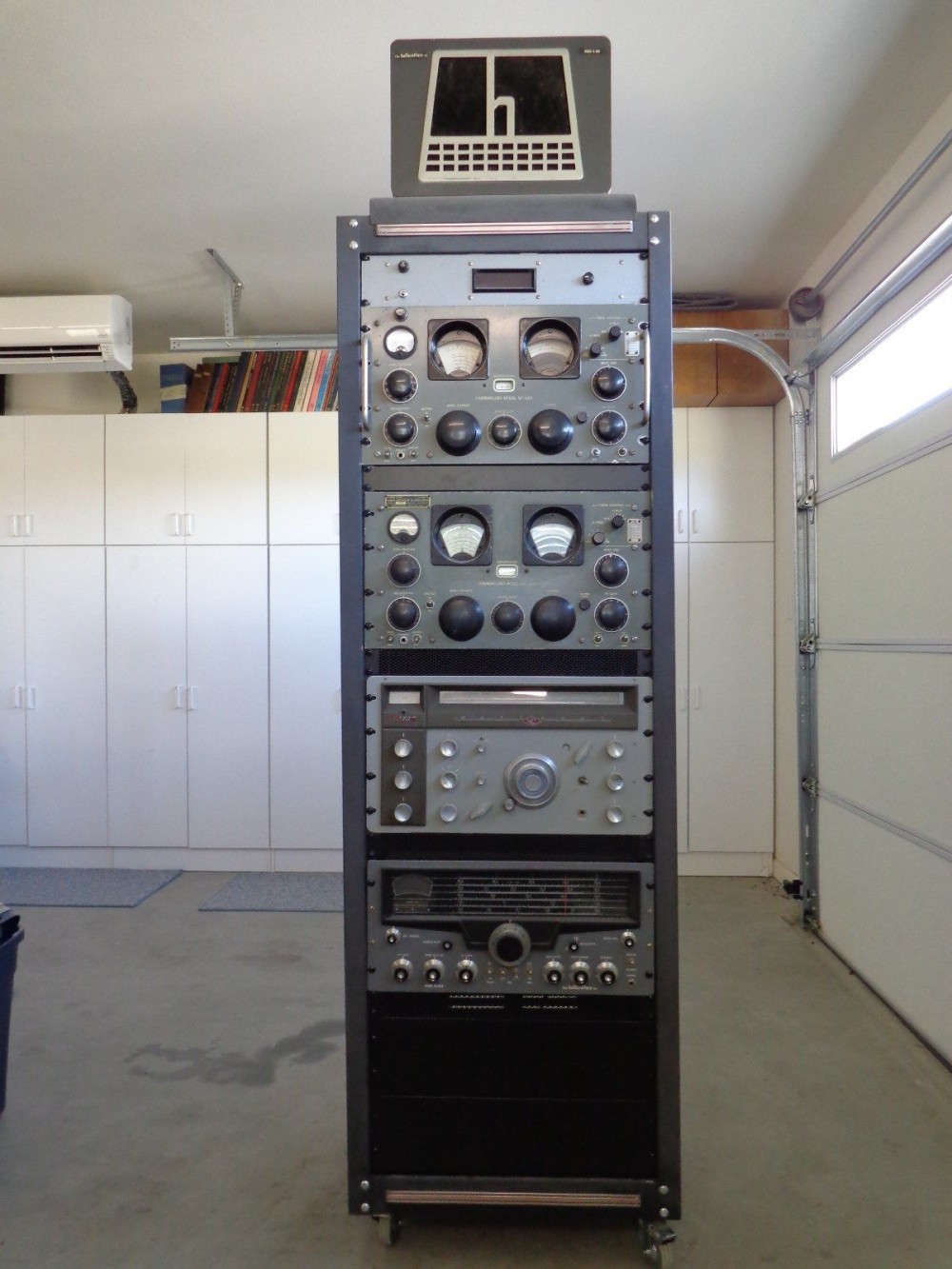
Many thanks to SWLing Post contributor, Dan Robinson, who shared a link to this rack of classic cold war era receivers. The starting bid is $943.75 and there is no shipping cost as it’s local pickup only (no surprise there).

Here’s the description from eBay:

LOCAL PICK UP ONLY Paso Robles Ca. 93446. Good condition, rack of Communications and Amateur Radio receivers. Includes Hallicrafters R-46B loudspeaker, two each Hammarlund SP-600 JX-26 receivers with one frequency readout as shown above the top receiver, a National NC-300 receiver with calibrator accessory, and a Hallcrafters SX-101A receiver with calibrator accessory. The rack cabinet is included. All have normal wear for vintage electronics, worn with faded, chipped and rust spots. The SP-600 receivers (both) dial slips and may need repair. All units may need further repair, alignment, or refurbishing. Local pick up only, I can help loading into your vehicle. 70hi 22wide 20deep weights about 600 pounds

Click here to view on eBay.

I think this would be a great deal if all of the equipment was in working order. I suspect this seller hasn’t tested anything and is, most likely, not a radio enthusiast. I bet the reason the SP-600 dials are spinning freely is because the tuning lock is engaged on each unit–possibly a good sign that the previous owner took care of the equipment.  All of it looks good (cosmetically) for its age.

If I were interested, I’d go by and check this out in person prior to bidding.