Author Archives: Thomas

Tales of the Orient interview with Ralph Perry about his novel “Pacific Dash”

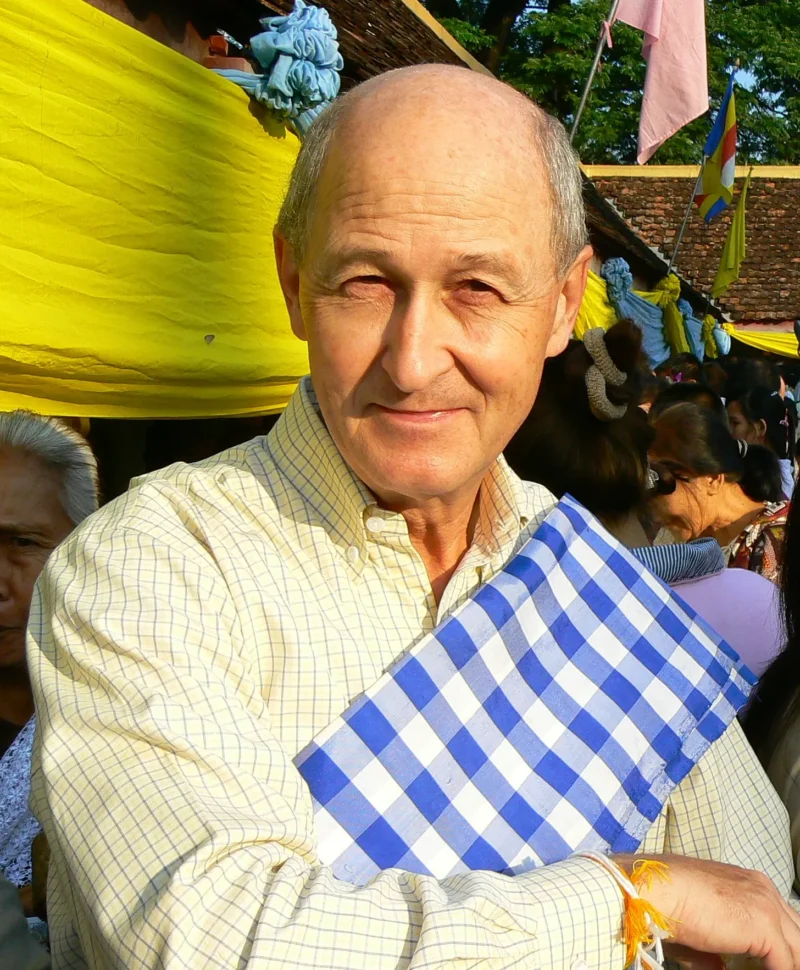
Many thanks to SWLing Post contributor, noted DXer, and author, Ralph Perry (a.k.a. Chet Nairene), who notes that he was recently interviewed by Simon Ostheimer on Tales of the Orient regarding Ralph’s latest novel, Pacific Dash.

Ralph notes that, “DXing directly influenced my seeking an international life” and thus fueled his passion to write novel about traveling and exploring local scenes throughout Asia and the Pacific.

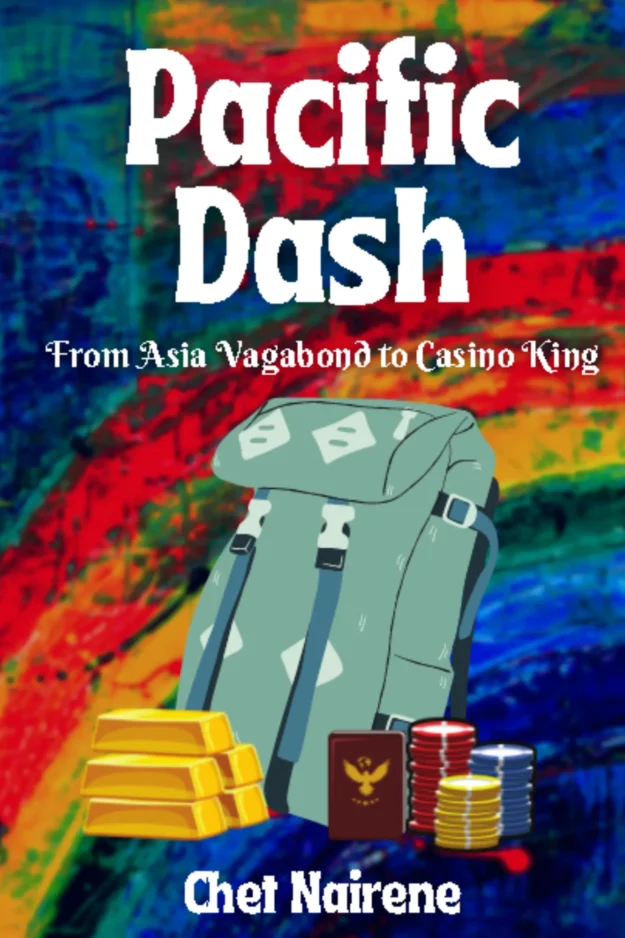
Pacific Dash isn’t a novel about DXing, rather, “a fictional first-person account of Dash Bonaventure, a young 1960s American whose life journey drags him across Asia.”

Please note that the following post was originally published on Tales of the Orient and is being re-posted here with permission from Ralph Perry.

Enjoy!


Tales of the Orient by Simon Ostheimer: Cool Runnings

Meet Chet Nairene, the American author of ‘Pacific Dash’, a new novel that follows the Asian adventures of Dashiell Bonaventure, from an Illinois farm to glitzy Macau casinos
Hi Chet, tell me more about your new book, Pacific Dash

Greetings, Simon!

Pacific Dash is a fictional first-person account of Dash Bonaventure, a young 1960s American whose life journey drags him across Asia. Dash is utterly impulsive (his next prudent plan will be his first), but makes up for that with outsized good luck and karma. The story begins in 1968 with him as a reluctant expat student at the then-new Hong Kong International School. International adventures immediately start to find him. Dash covers a lot of ground, for several decades spending time in Indonesia, Malaysia, Singapore, HK, Macau, Taiwan and Myanmar. He finds himself in love and at other times in trouble. One day at a Bali losmen (a cheap homestay), things really take off when meets Little Fatty, an engaging and chubby Malaysian businessman who hooks Dash up in the illegal casino business, located offshore from Singapore.

Dash gets around! How did you come up with the story?

Ever since taking up fiction writing, I had been juggling several good story ideas, but Pacific Dash (my “backpacker novel”) was always the one I wanted to lead with. I knew it would be pure fun for the reader and a pure joy for me to write. My primary goal is to entertain and transport readers to exotic places, crammed with interesting people, odd experiences and cultural nuggets. I wanted to share so many of the things I love about Asia – the wonderful people, the food and spirituality, the bars and temples, beaches and even gambling. So, what better way to introduce all that than through the eyes of a young foreigner who is totally unprepared for what he’s about to encounter?
What led you to start writing your own fictional literature?

It’s funny, but during my career as an expatriate executive in Asia, friends often said (usually after a few too many beers and colorful stories), “You really ought to write a novel.” Yeah, right, someday. But upon retiring I started to think, hey, why not?

Like Dash, I understand that you also lived in Asia for more than 25 years, how much of your own story is in the book?

As the old writing adage goes: ‘Write about what you know.’ And I certainly know Asia. Many (but not all) of Dash’s experiences are based upon things that happened to me or to my friends. Therefore, while the resulting story is off-kilter and quirky, it should also have an authentic ring. But Dash and I are punched from different molds.

He is something of the accidental, unintentional traveler in Asia. I, on the other hand, made happen my desire to live and work in Asia. It was just something in my DNA and I had to obey. My fascination with Asia, Africa and Latin America all probably began with my childhood hobby, tuning into foreign radio stations on shortwave.

Continue reading

Radio Waves: G4 Solar Storm, AM for Car Safety, AI DJs Next Month, and NYC Pirate Fined $2 Million

Radio Waves:  Stories Making Waves in the World of Radio

Welcome to the SWLing Post’s Radio Waves, a collection of links to interesting stories making waves in the world of radio. Enjoy!

Many thanks to SWLing Post contributors Troy Riedel, Dennis Dura, and Richard Cuff for the following tips:


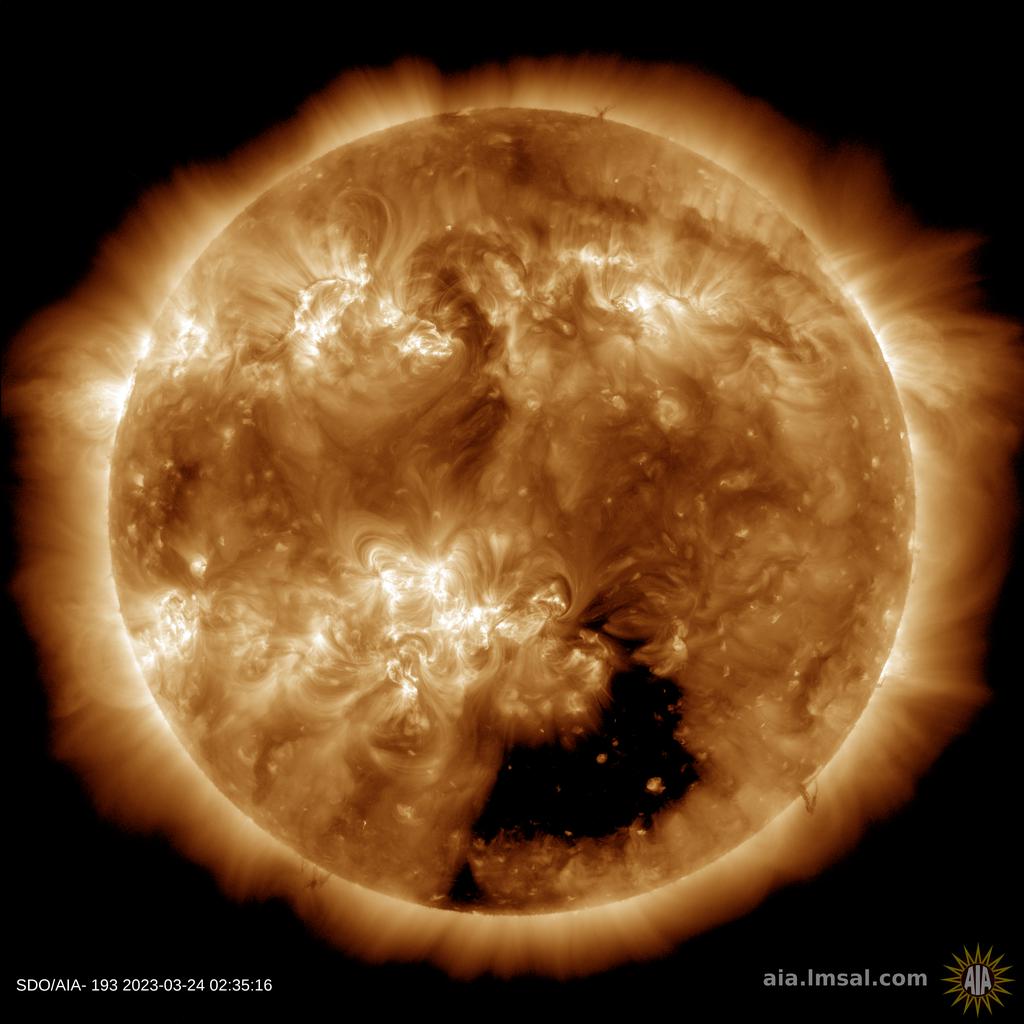
Strongest solar storm in nearly 6 years slams into Earth catching forecasters by surprise (Space.com)

The powerful solar storm supercharged auroras as far south as Colorado and New Mexico.

The most powerful solar storm in nearly six years slammed Earth today (March 24), but strangely, space weather forecasters didn’t see it coming.

The geomagnetic storm peaked as a severe G4 on the 5-grade scale used by the U.S. National Oceanic and Atmospheric Administration (NOAA) to assess the severity of space weather events. The storm’s unexpected ferocity not only made auroras visible as far south as New Mexico in the U.S., but it also forced spaceflight company Rocket Lab to delay a launch by 90 minutes.

Geomagnetic storms are disturbances to Earth’s magnetic field caused by solar material from coronal mass ejections (CME) — large expulsions of plasma and magnetic field from the sun’s atmosphere. It turns out that this particular geomagnetic storm was triggered by a “stealth” CME which — as the name suggests — is rather tricky to detect. [Continue reading…]

Congressman Says Make AM a Mandatory Car Safety Feature (Radio World)

Gottheimer also supports federal spending on AM infrastructure to assure continuity of service

A congressman from New Jersey wants the government to add AM radio to the list of safety equipment that carmakers must include in their vehicles.

Rep. Josh Gottheimer has called on the National Highway Traffic Safety Administration to “add AM radio to the Federal Motor Vehicle Safety Standards to require that all automakers, including EV manufacturers, include AM radio as a stock feature in their vehicles. Federal Motor Vehicle Safety Standards are the minimum safety standards that a manufacturer must meet when making a vehicle — including requirements related to airbags, brakes, seatbelts, tires, controls and displays.”

The National Association of Broadcasters welcomed his effort.

Gottheimer, a Democrat who represents a district along the state’s northern border, held a news event next to a Tesla dealership in Paramus, N.J., along with New Jersey Broadcasters Association Executive Director Jordan Walton. [Continue reading…]

AI-generated DJs are coming to radio stations in the US and Canada next month (Business Insider)

An AI-generated radio DJ could be coming to your local radio station.

RadioGPT, a GPT-4-powered radio content generator from media company Futuri, is set to debut next month in radio stations in the US and Canada, Axios Cleveland reported.

Powered by the same tech that ChatGPT draws upon, RadioGPT aims to man radio airtime spots with AI-generated scripts and voices, as well as tailored local news content.

You can listen to a demo from the company that gives you a preview of what the AI-generated DJ voices sound like — which tell listeners that they are, in fact, fully AI — sprinkled between curated songs. The page includes snippets of RadioGPT-generated voices presenting news, weather, and traffic updates.

“Anything a radio human can do, I can do better,” one of the AI hosts can be heard saying in between songs. “Every voice you hear is 100% AI.” [Continue reading…]

FCC Fines 15 Year-Old Pirate Radio Station in NYC $2 Million (Vice)

The FCC is using its new powers to ask from the maximum fine from an Ecuadorian pirate radio station that’s run for more than 15 years.

The Federal Communications Commission (FCC) is using a new law to fine a pirate radio station operating in New York City for more than $2 million. For 15 years, Impacto 2, which has been operated by two brothers, has broadcast Ecuadorian news, culture, sports, and talk-radio on 105.5 FM in Queens. The feds have tried to shut it down repeatedly, but have never succeeded.

The FCC announced the fine in a press release last week. “The Commission proposed the maximum penalty allowable, $2,316,034, against brothers César Ayora and Luis Angel Ayora for pirate radio broadcasting in Queens, New York,” the release said. The FCC also said it was trying to seize $80,000 in equipment from a man broadcasting pirate radio in Eastern Oregon.

The Ayoras have been on the FCC’s radar since 2008 when they started broadcasting Impacto 2 for the Ecuadorian community in Queens: “The brothers César and [Luis] Angel Ayora in September 2008 founded the first Ecuadorian FM radio station in New York City. . . The station never sleeps, because a team of communication professionals are working for you 24 hours a day,” their website, which is currently down, said. The station is broadcast over the internet and has moved around the FM spectrum several times over the years. [Continue reading…]


Do you enjoy the SWLing Post?

Please consider supporting us via Patreon or our Coffee Fund!

Your support makes articles like this one possible. Thank you!

Wellbrook Communications is closing shop

Mark Fahey’s Wellbrook antenna

Many thanks to SWLing Post contributor, Dennis Dura, who shares the following news from the Wellbrook Communications homepage:

Wellbrook Communications will cease trading at the end of April 2023.
This is due to retirement.
I would like to thank everyone for their custom over the past 27 years.

No doubt, the venerable Wellbrook loop has helped thousands radio enthusiasts mitigate RFI/QRM and make it possible to once again DX from home.

We wish Wellbrook owners a wonderful retirement!

The International Radio Club’s Reprints collection

Many thanks to SWLing Post contributor Nick Hall-Patch who shares the following announcement:


IRCA Reprints open to public

The International Radio Club’s Reprints collection of over 1100 articles about antennas, radio propagation, receivers, accessories, plus items of general interest to MW DXers, continues to grow.   We’ve published an update to the index, at DXer.ca [PDF] , so that everyone can get access to these latest additions.  (also accessible at https://www.ircaonline.org/ “Free IRCA Reprints” button)

The latest update includes items from DX Monitor up the end of June 2022. as well as many items of interest from elsewhere, used with permission.

Added items in this update are marked “(NEW)”,  plus there are a few updated articles as well.

Please pass on this information to others as you see fit.

(if you’ve used the index before, you may need to refresh your browser page to see the latest update, dated December 2022)

Marwan discovers vintage radios in the family

Many thanks to SWLing Post contributor, Marwan, who writes:

Hello Thomas,

I hope this email finds you well and you will enjoy the photos I am attaching.

Two weekends ago my wife and I and went to see our grand daughter who lives and hour and a half away. On our way back we decided to drop by my sister in law’s house. I had not seen my sister in law since she moved in with her new boyfriend.

It was a beautiful day and we joined them on their outside porch. The first thing that caught my eye when we arrived were the two 1950’s Fords, and a double rear wheels motorcycle he was working on in his shack. They were beautiful, polished and spot less machines.

I made a comment on how her boyfriend must like to collect old vehicles. My wife said, well you need to take a walk inside the house and see what else he has got in there. My goodness. I really thought I was at some museum of old antique items.

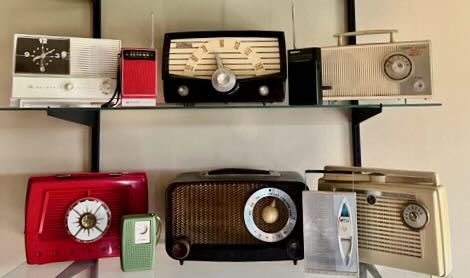
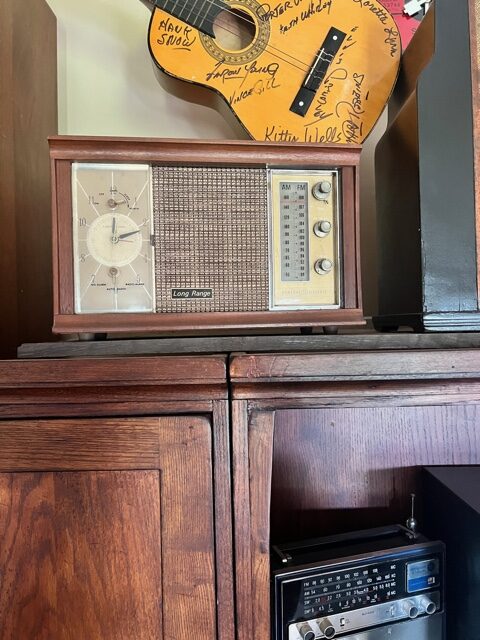
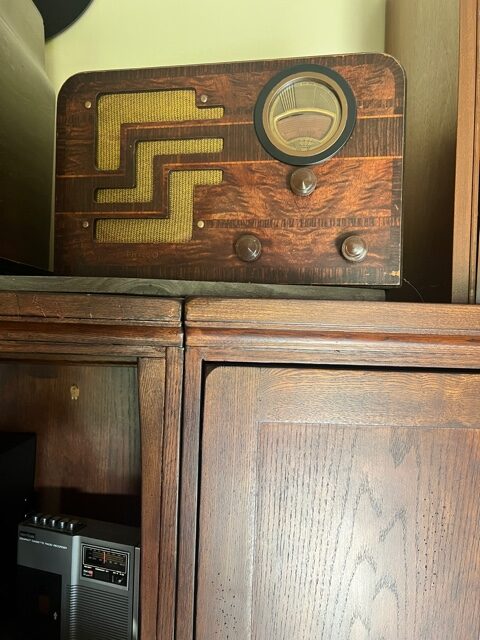
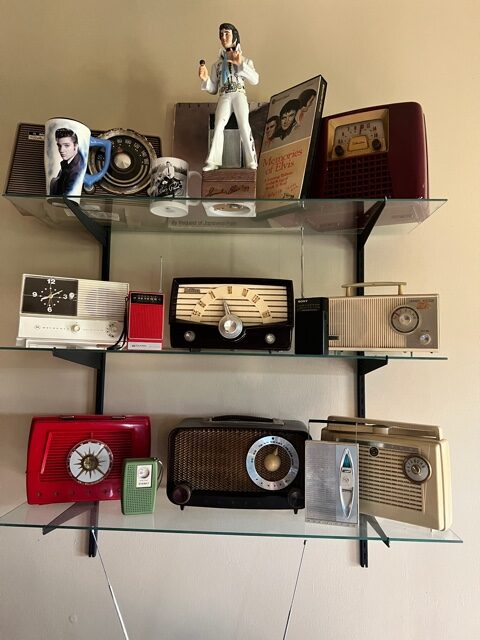
There were too many things to list here so I am going to limit it to the radios he had. One of the rooms he has is filled with old radios, and an old TV. On top of the TV there were three shelves with various old radios that I had to take photos of.

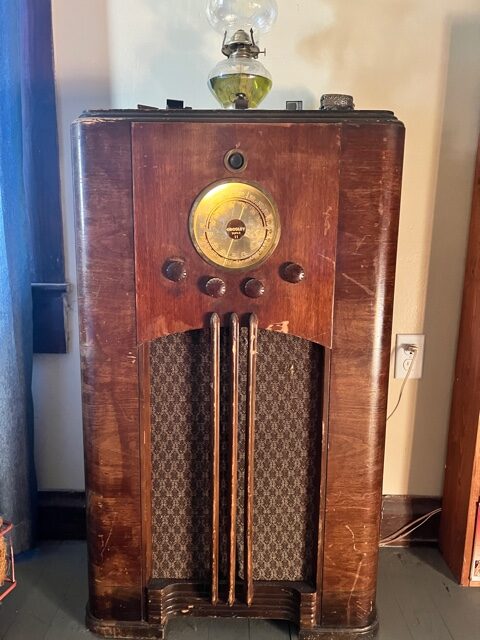
On the other side of the room he had a Crosley Super II. It is not working but still had the speaker(s) on the inside. Gary had ran a cable from an old receiver he had to the speaker(s). He played music from his receiver to the Crosley and oh my.

The crisp sound that came out of that cabinet was amazing. I could not believe how crisp the sound was, made me wished I had a Crosley like that one. The sound filled the room, it was so magical to listen to it.

I was so exited and grateful we passed by their house and wanted to share some of the photos I took with you and your subscribers.

Cheers,

Marwan

Thank you for sharing these, Marwan. I hope that he restores that Crosley Super II. That is certainly a magnificent console radio! He’s got some beautiful radios in his collection!

Survey results: What type of radio is your daily driver?

Last week, I published a post asking SWLing Post readers what type of radio their “daily driver” is at present. Click here to read that post.

I created a survey form and left it open for about five days. In that time, we received 639 responses! If you’d like to read the results, continue scrolling or click on continue reading below.
Continue reading

Don Moore’s Photo Album: Cuenca, Ecuador (Part Two)

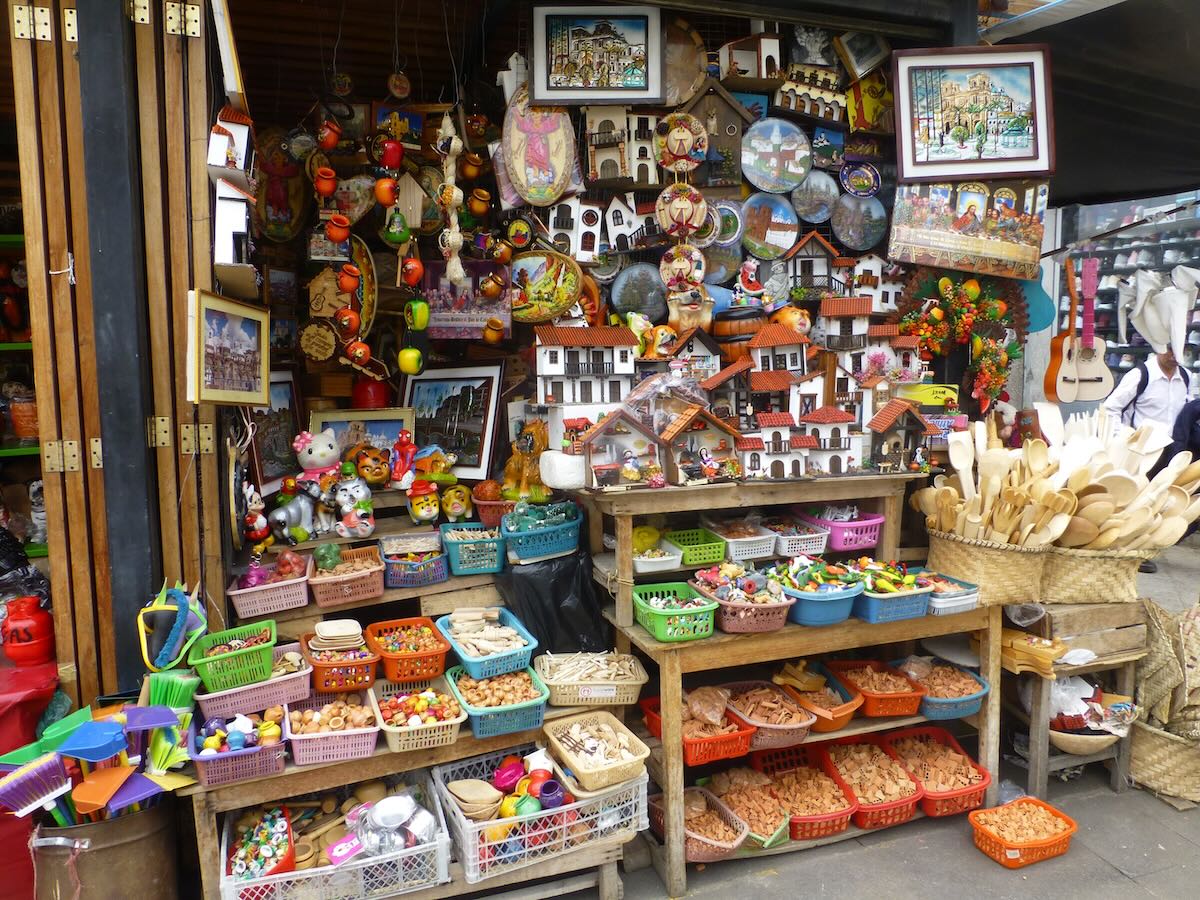
A Cuenca Artisan Market

Many thanks to SWLing Post contributor, Don Moore–noted author, traveler, and DXer–for the latest installment of his Photo Album guest post series:


Don Moore’s Photo Album: Cuenca, Ecuador (Part 2)

by Don Moore

In the song Por Eso Te Quiero Cuenca (That’s Why I Love You Cuenca) the singer recites a litany of the many reasons to love this city. What do I love about Cuenca? Well, unlike the song, I won’t include well-roasted guinea pig.

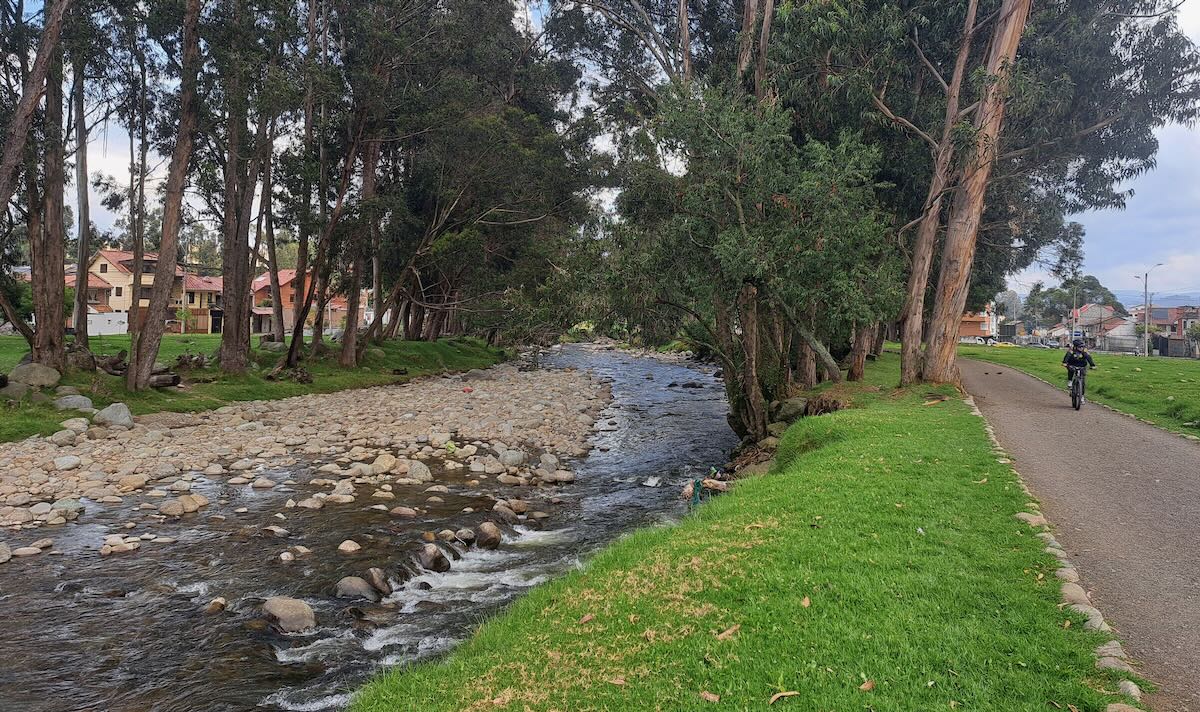
The elevation of 2560 meters (8,400 feet) gives Cuenca a comfortable spring-like climate year-round. Daily highs are usually around 20C/70F. Nights are chilly but not cold. Most days have at least several hours of sun, even during the rainy season (as it is now). There are numerous green parks and plazas including long tree-lined walking paths along the two main rivers that run through the city. The drinking water, which comes from high up in the mountains, is the best in South America. Yes, you can drink it right from the tap.

A walking/bike path runs along the Yanuncay River for over six kilometers through the south side of Cuenca. A similar path runs along the larger Tomebamba River in the center of town.

The people of Cuenca are among the friendliest I’ve found anywhere. It’s a well-run, educated city with lots of civic pride. The metro area population is only about a half-million so it’s small enough to easily get anywhere but large enough to have the benefits of a city. Cuenca has several good universities and theaters and the symphony orchestra gives free concerts most Friday evenings. It’s a pleasure to simply stroll through the beautiful architecture in the old centro neighborhood.

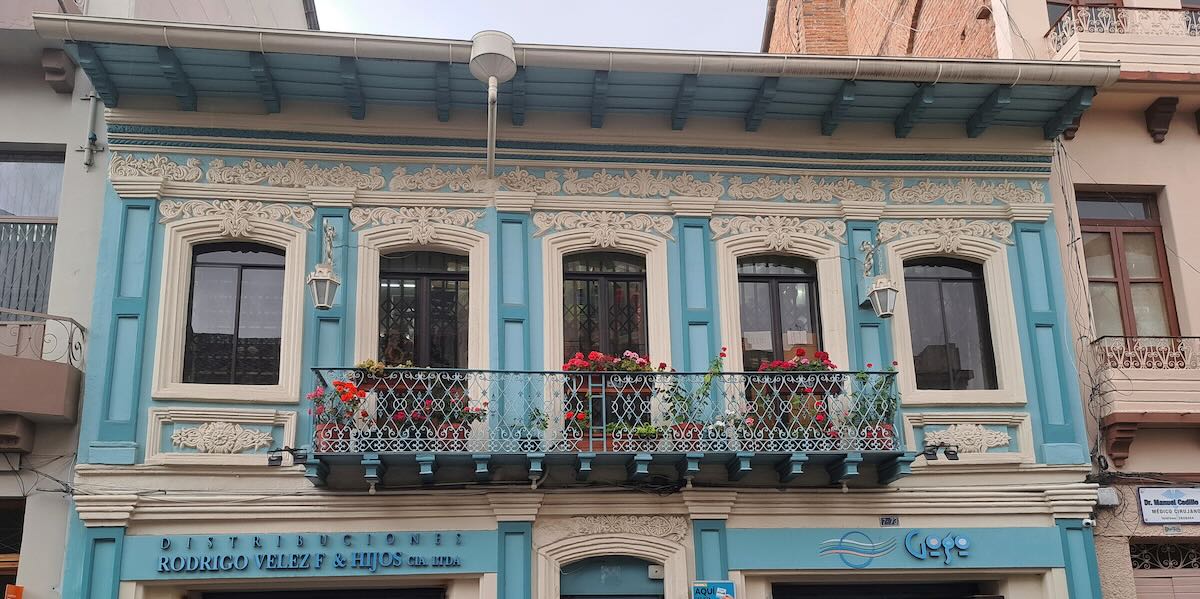
One of many beautifully restored buildings in Cuenca’s old centro.

Getting around Cuenca is easy. A ride on the excellent bus system costs just thirty cents and taxi rides usually run under two dollars. And, unlike the much larger cities of Quito and Guayaquil, Cuenca has a mass transit system. In 2013 city leaders voted to put in a light rail line. Doing so required digging up two of the main streets through the old downtown but rather than just dig up two streets they decided to dig up the entire old downtown … to replace the aging water and sewer systems, move all electric lines and cables underground, and install high-speed fiber optic Internet. (Fiber optic Internet was also run above ground in the newer neighborhoods outside the centro.) The result is one of the few places in Latin America where one can enjoy beautifully restored architecture and colonial churches without the views being marred by powerlines. And the Internet here is better than most places I’ve stayed at in the United States.

Those are just a handful of the reasons that I love Cuenca.

Early Radio in Cuenca

Radio broadcasting in Ecuador started in 1925 with Radio El Prado in Riobamba, a small city in the center of the country. Other stations soon started up in Guayaquil and Quito, including HCJB in 1931. Broadcasting came to Cuenca in 1934 when a group of friends purchased a homemade ten-watt transmitter from an engineer in Guayaquil and put it on the air as La Voz de Tomebamba. The name came from the main river flowing through Cuenca. At the time there were only four receivers in the city so the audience was rather sparse. La Voz de Tomebamba initially broadcast for only one or two hours a night and most of the musical selections were done live as there weren’t many 78 RPM records in town. Years later one early listener reminisced, “It was sixty percent noise. Only radio fanatics could be entertained by listening to such a thing.

Old studio equipment from La Voz de Tomebamba

Gradually, the owners added new equipment and expanded the daily schedule. A fifty-watt transmitter was added in 1938 and by 1947 the power had been increased to two hundred watts. The first frequency listing that I’ve found for La Voz de Tomebamba was for 4200 kHz in a 1944 FBIS newsletter. The 1947 WRTH listed it as on the air from 0000 to 0430 GMT on 4200 kHz. And that was the station’s only frequency. Until the 1960s it was very common for radio stations in Ecuador to only broadcast on shortwave and not on medium wave. For example, the 1957 WRTH lists eighty Ecuadorian stations on shortwave (not counting HCJB) but only fifty-nine on medium wave. 

Sometime in the early 1960s La Voz de Tomebamba made the switch to medium wave and left shortwave. Their 4200 kHz frequency is not listed in the 1965 WRTH, nor are they listed in any later ones. (I would be interested to hear from anyone who remembers listening to them on shortwave.) The changes may have had to do with financial problems the station was having. It closed in 1967 and remained off the air until returning under new ownership four years later. Today La Voz de Tomebamba is one of the most popular radio stations in town and has an excellent news department. Their sister station, Super Rock FM 94.9, is very popular with younger listeners.

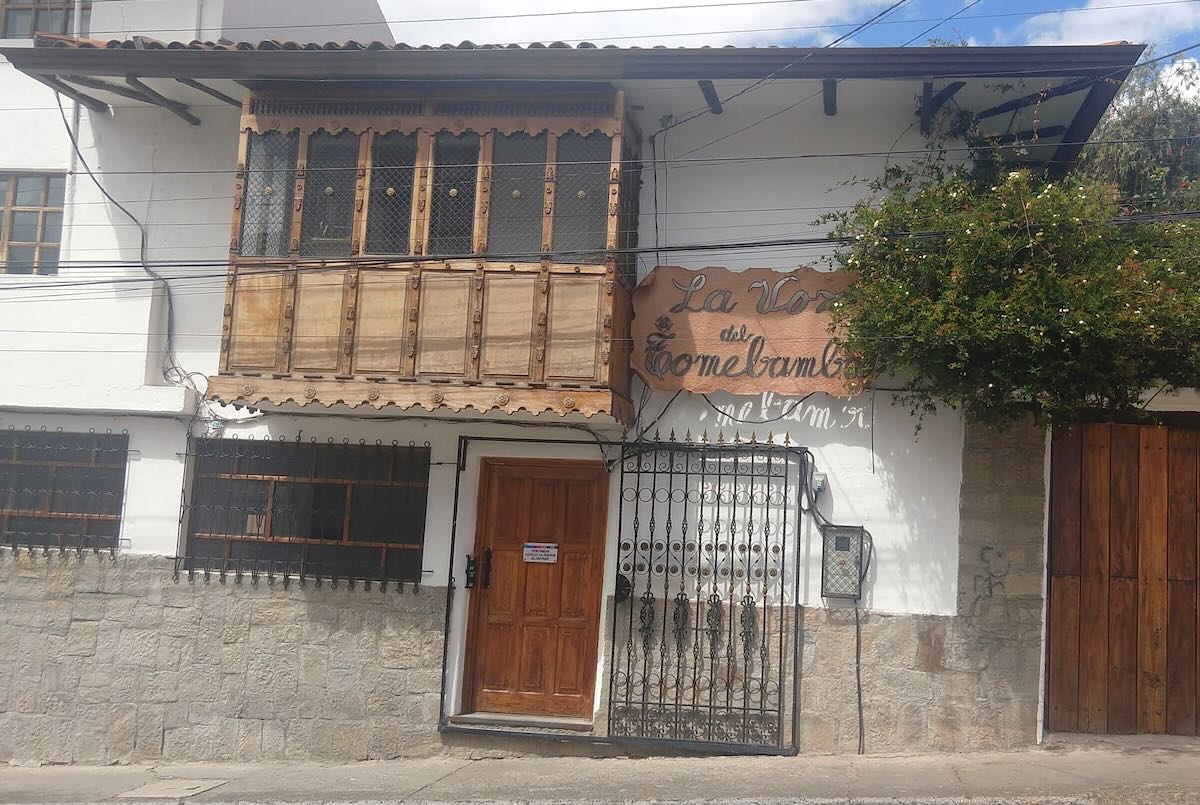
La Voz de Tomebamba today.

The second station in Cuenca was Radio Cuenca, which began broadcasting in October 1945 on 2830 kHz with two-hundred watts.  It was included in a 1953 list of stations logged by the Universal Radio DX Club of Indiana. To the local audience, Radio Cuenca was best known for its many live music broadcasts.  Continue reading