Shortwave listening and everything radio including reviews, broadcasting, ham radio, field operation, DXing, maker kits, travel, emergency gear, events, and more
Many thanks to SWLing Post contributor, Dan Robinson, who shares the following review:
Comparing the CountyComm GP5-SSB and Tecsun PL-365
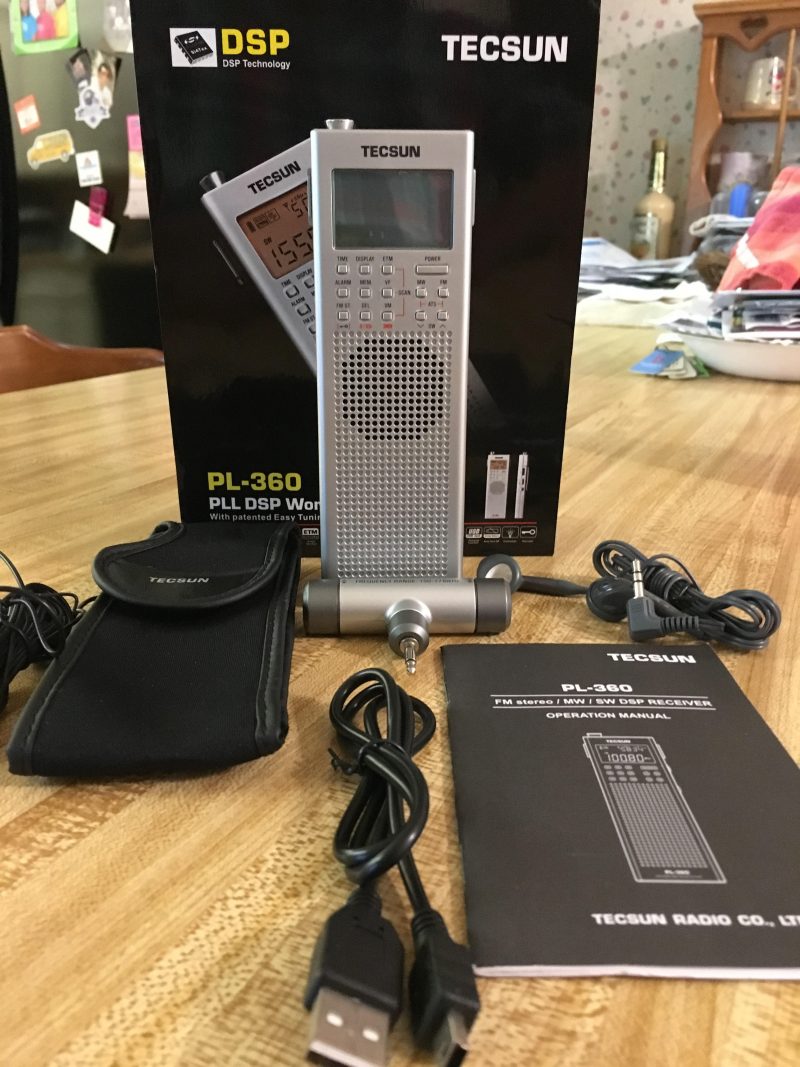
County Comm GP-5/SSB and Tecsun PL-365: a couple of years ago, I obtained a GP-5/SSB from Universal and have enjoyed using the radio. It’s extremely sensitive, often bringing in signals in the middle of my house here in Maryland, and is fun to use, provided the auto-tune is done to insert frequencies so you don’t have to use the thumb wheel too much.
I have often thought that the next logical upgrade for this radio would be to add a small keypad to allow direct frequency selection, but perhaps that is not in the cards. The County Comm is basically the Tecsun PL-365, but the actual Tecsun version has not been available for the most part from major sellers, even from Anon-Co in Hong Kong, or Universal. You can still find some PL-365’s from certain Ebay sellers. Last year I obtained two from a Hong Kong seller. Both were NIB, and arrived within about a week or so of purchase.
What I noticed immediately is that the PL-365 has a different kind of exterior surface, more rubberized than the County Comm. I was curious about any differences in performance that might be obvious. Recently, I took both outside for a very basic comparison — not scientific by any means, but I think it shows something that I have noticed.
Both share the characteristics of extreme directionality, and sensitivity to touch — sensitivity increases markedly when they are hand-held, decreases noticeably when they are left standing on their own, or angled. I have noticed this when using them at the beach. If I am recording a station, and leave the radio alone for a few minutes, I return to find reception degraded quite a bit, because they were not being held.
In my very basic comparison, I had both receivers next to each other on a backyard table, both antennas fully extended, full batteries on both. While on some frequencies, at least initially, it seems little difference can be heard, on others there is what seems to be greater clarity and signal separation on the PL-365.
I noticed this from the start on 13.710 where the County Comm appears to be noisier than the PL-365, and on the portions later in the video when both are tuned to 11.820 (de-tuned to 11,818) Saudi Arabia, and to 11.945 khz.
Apologies for the length of the video. It’s hard to draw any conclusions based on this comparison, and I intend to do some additional tests with both my PL-365s and will report back on any findings, but I thought this would be of interest to those of you out there with these fine little radios.
Thank you for this review and comparison, Dan. I’m often asked if there is any difference in performance to justify the extra costs typically associated with the PL-365. I can now share this video and your review–potential owners to draw their own conclusions.
As we mentioned last month, the remnants of WOO at Good Luck Point are slated to be removed soon. Many thanks to our intrepid SWLing Post contributor, Dennis Dura, who shares the following excellent photos he took at Good Luck Point yesterday. Dennis notes:
I finally got to the site [Saturday] afternoon.
All the towers are still there!
There was some construction next to the old AT&T building, but zero work on the poles…Who knows for how long though? So if anyone wants to visit they should do it soon.
Here’s all the pictures I shot. They start with my entry on Bayview Avenue heading east then back out again.
Thank you so much for sharing your excellent photos, Dennis! Since I don’t live near Good Luck Point, I appreciate the virtual tour through your photos!
A little more than seven weeks after the United States officially entered World War II, a live, 15-minute shortwave radio broadcast was transmitted into Germany from a small studio in New York City on February 1, 1942.
It was introduced by the American patriotic song “The Battle Hymn of the Republic.” Then, announcer William Harlan Hale’s voice could be heard saying: “We bring you Voices from America. Today, and daily from now on, we shall speak to you about America and the war. The news may be good for us. The news may be bad. But we shall tell you the truth.”
That was the very first broadcast from what, 75 years later, is now the Washington-headquartered Voice of America.
By the end of the war, VOA was broadcasting in 40 languages, with programming consisting of music, news and commentary.
Since then, VOA has grown into a multimedia international broadcasting service, with programming and content in 47 languages on multiple platforms, including radio, television and mobile.
On that first broadcast, announcer Hale’s words set the standard for future programs.
?And since 1976, his words have carried the weight of the VOA Charter, which by law requires VOA to “serve as a consistently reliable and authoritative source of news.” What’s more, it says VOA news must “be accurate, objective and comprehensive.”
“It’s been 75 years since we first began broadcasting objective news and information around the world,” said VOA Director Amanda Bennett. “And now, I think what we do here is more important than ever.”
Over the years, VOA correspondents and freelance reporters in many parts of the world have been on the scene to cover major world events.
In 1989, VOA East European correspondent Jolyon Naegele reported on demonstrations in Czechoslovakia and the fall of the communist government. Later that year, on the other side of the world, VOA increased programming and added staff to its Beijing bureau to cover the student-led demonstrations in Tiananmen Square. Beijing Bureau chief Al Pessin was expelled from China for his reporting.
Today, VOA broadcasts news and other programming through 2,500 television and radio affiliates around the world. At the same time, it provides content for mobile devices and interacts with audiences through social media.
As of 2016, VOA’s weekly audience across all platforms averaged more than 236 million people worldwide.
[The Yaesu VX-3R] is a neat little HT, but the Kenwood TH-F6A is way more versatile.
How? Full 5W on 2m, 222MHz, and 440MHz, and will RX 150KHz to 1.3GHz in AM, FM, FM wide, NBFM, USB, LSB, and CW. All that in a size of a pack of cigs. Yes, it will overload easily, but something that wide banded and this small, I kind of expected that.
However, want to hear what your wireless FM innercom sounds like on 175KHz? You can do that. Want to hear what your 222.1MHz transverter sounds like on SSB? You can do that. Need to tune-in to local AM / FM radio when power goes out? You can do that. Want to listen to CB CH19 truckers gripe about traffic conditions? You can do that. Want to listen to aircraft traffic at an air show? You can do that. You want to monitor 6M 50.125MHz USB to hear when that band opens? You can do that.
No, it doesn’t have D-Star, DMR, Fusion, or even SW’s DRM, but analog-wise this HT is so versatile, what else is out there like it?
Thanks for sharing your thoughts about the TH-F6A!
A couple more things I like about the TH-F6A:
it meets MIL-STD 810 C/D/E standards for resistance to vibration, shock, humidity and light rain
It has a dedicated number keypad for direct frequency entry (something, sadly, the VX-3R lacks)
I’ll put the TH-F6A on my “wish list” this year and perhaps give it a thorough review. (Perhaps Santa Claus is listening!?)
Here’s a snapshot of TH-F6 pricing at time of posting:
[Update: Most comments point to these negative reviews as outliers–possibly a bad batch from the factory. All-in-all, the PL-310ET is favorably reviewed.]
Many thanks to SWLing Post contributor, Dave Zantow, who writes:
I see the Tecsun PL-310(ET) has been receiving some very negative reviews over on eHam in the last days. Too bad:
Perhaps these reviewers simply received faulty/lemon units? Internal soldering and construction can vary. On the other hand, both reviews were submitted on Feb 1, 2017 implying their units probably came from the same production batch. There are a couple of recent negative reviews on Amazon.com as well (though not detailed).
Of course, it does make one wonder if Tecsun made any internal design changes to the PL-310ET. But again, perhaps these two reviewers simply received units from a faulty batch.
For sure, these reviews are not consistent with the excellent performance of the PL-310ET I know–which is, by any standard, an amazing little radio!
I don’t want to imply there’s something wrong with the current PL-310ET production run, but I am curious if anyone else has been disappointed with their recently-purchased PL-310ET. Comments?
[UPDATE: based on the many comments–thank you!–it appears at least PL-310ETs that were purchased up to the end of December 2016 are functioning perfectly. Again, perhaps these two reviewers received faulty units.]
Many thanks to SWLing Post contributor, Juan Pablo Carlino, who writes:
Hi. I own one RF-2200 after buying it in eBay in March 2008. Since then it became my favourite portable radio and as everybody [has commented], its a pleasure to hear MW with it.
I explain this due to the fact that it has a good rotative ferrite antenna and also because the narrow and wide filters have a suitable shape for MW: at least in my country each MW is spaced from the other by 10 KHz, so you don’t need a very sharp filter. The narrow one is not so narrow, just enough to attenuate maybe 6 db the splatter from the louder station and not loosing audio quality.
When you tune around you have the impression that the filter shape suites perfectly for MW, making the audio quality very pleasant. I would never sell it. If you are interested i’ve captured a short clip while playing with it outdoor on 7 MHz band, hearing ham stations on AM, SSB and CW.
Pay attention to how loud and clear i was hearing stations at 400 Km in AM:
I agree with you completely. At least here in countries where MW stations are spaced at 10 kHz, I find the RF-2200 a mediumwave DX boss!
I’m constantly amazed with the RF-2200’s MW sensitivity and selectivity–and low noise floor. That combo, along with the filter shapes Juan mentions and the excellent built-in full-fidelity speaker make for a proper listening experience.
As I’ve said before, the RF-2200 is a radio with fortitude and purpose.
The only place I’ve ever really searched for an RF-2200 is eBay. I like eBay, because if you receive a faulty unit, you can typically return it or have some sort of recourse (as long as the seller accepts returns).
I would only buy an RF-2200 (or any vintage solid-state rigs) from a seller that has near 100% ratings with a number of radio sales in their past. That is, if you’re seeking a working unit.
Though the RF-2200 is vintage and thus might eventually need repair. It’s ultimately reparable by a skilled technician, though. My buddy Vlado, for example, has repaired 2200s in the past–indeed, we cracked my RF-2200 open a few months ago to clean contacts.
Panasonic RF-2200s typically cost between $175-300 for one that’s mechanically and cosmetically sound. Of course, NOS units go for much more and units with faults sell for much less.