Category Archives: AM

BBC sets plans for next decade

BBC-AT-WARMany thanks to SWLing Post reader, Bill, for sharing a link to this article which summarizes the BBC’s plans for the next ten years.

BBC director general, Tony Hall, said the corporation will become an “open BBC for the internet age”.

While Hall was quick to add that funding cuts would equate to “the loss or reduction of some services” he also highlighted several efforts that would include shortwave and mediumwave broadcasts, including:

  • “Significant investment” in the BBC World Service, including a daily news programme for North Korea and more broadcasts to Russia, India and the Middle East
  • A news service for Ethiopia and Eritrea on medium wave and short wave

Of course, we can expect more cuts to BBC World Service shortwave broadcasting over the next ten years even if it wasn’t specifically mentioned in Hall’s speech. If we’re lucky, the BBC will continue to broadcast into those parts of the world that still rely on shortwave. Specifically mentioning North Korea, Ethiopia and Eritrea appears to be a nod in that direction.

Click here to read this article on the BBC News website.

Also, The Guardian has posted the full text of Tony Hall’s speech. It’s worth reading.

The New York Times: breaking news and antique radios

NYTimes-AntiqueRadios

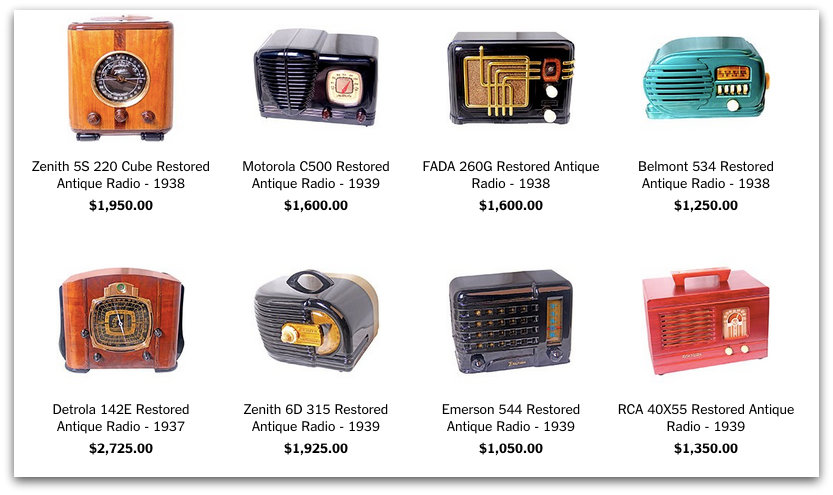
Many thanks to my buddy, David Goren, who recently discovered that the New York Times Store is now selling fully-restored antique radios.

Pricing is not for the faint of heart–at time of posting, prices ranged from $395 to $23,000 US.  Each radio is beautifully presented, with a full description, and carries a one year restoration warranty. For an additional $95, many models can be modified with an AUX in audio jack.

While these radios are well outside my meager vintage radio budget, I must say that I’ve thoroughly enjoyed looking at the photos and reading the descriptions.

Click here to view on the NY Times Store.

Using synchronous detection and notch filter to eliminate het noise

WinRadioExcalibur-VOG-Notch

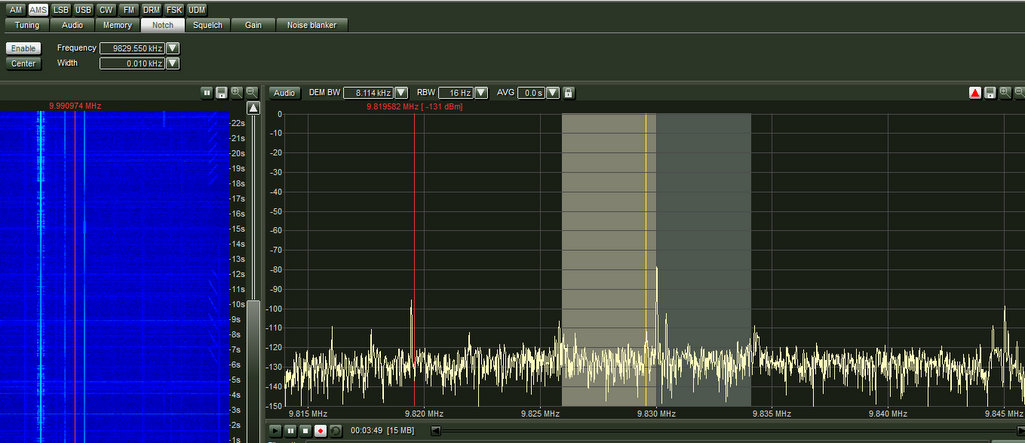
The lighter shaded side of the AM carrier indicates a lower sideband sync lock. (Click to enlarge)

A few days ago, I tuned to 9,420 kHz and found a relatively strong signal from the Avlis transmitter site of the Voice of Greece. The broadcast was quite clear until a heterodyne (het) tone popped up out of nowhere.

I checked the spectrum display of my Excalibur to find two steady carriers located about .5 kHz off each side of VOG’s AM carrier. I assume this may have been a faint digital signal centered on the same frequency as VOG.

The noise was annoying, but SDRs (and many tabletop radios) have tools to help mitigate this type of noise.

The het tone was originating from both sidebands of the VOG AM carrier (see spectrum display above). I had planned to use my notch filter to eliminate the noise, but I had two carriers to notch out and only one notch filter.

VOG AM carrier

Synchronous detection to the rescue… 

The simple solution was to eliminate one of the carriers using my SDR’s synchronous detector which can lock to either the upper or lower sideband. In this case, it didn’t make any difference which sideband I locked to because both had similar audio fidelity and were otherwise noise free. In the end, I locked to the lower sideband, thus eliminating the het in the upper sideband.

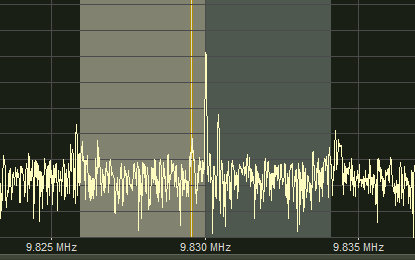
Next, I enabled my notch filter and moved its frequency to cover the annoying het carrier in the lower sideband; I kept the notch filter width as narrow as I could to preserve VOG’s audio fidelity. You can see the notch filter location and width in the spectrum display above (the notch filter is the thin yellow line).

I should note here that the great thing about using an SDR–or tabletop receiver with a spectrum display–is that you can see where the noise is. I was using my WinRadio Excalibur, but pretty much any SDR in my shack could have handled this task.

The results? No het tone and I was able to preserve the great audio fidelity from the Voice of Greece broadcast!

Here’s a 3.5 hour recording I made after cleaning up the signal. I believe at one point in the recording, I switched off the notch filter to demonstrate how loud the het tone was:

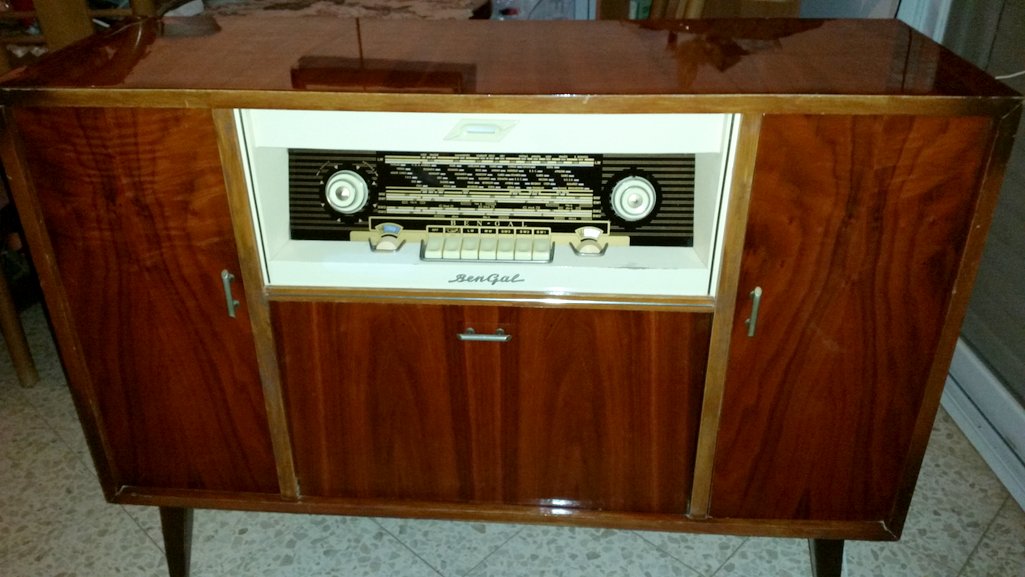
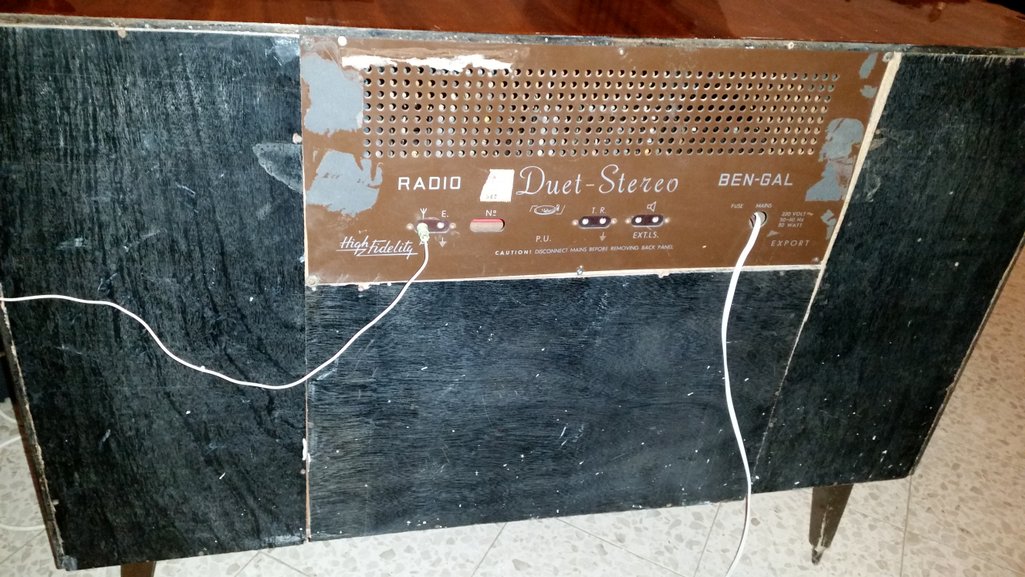
Moshe restores a Ben-Gal “Duet-Stereo”

Ben-Gal-Duet-Stereo-Full

Many thanks to SWLing Post contributor, Moshe, who writes:

About 2 weeks ago, a very good friend called me and exclaimed, “you just have to see this radio…I’m keeping it for you!”–so, I drove to his aunt’s house and saw this beauty.

After hauling the radio to my place, I started to check it out, to see what would be needed for restoration; it was working, with bad contacts, poor frequency response and low output.

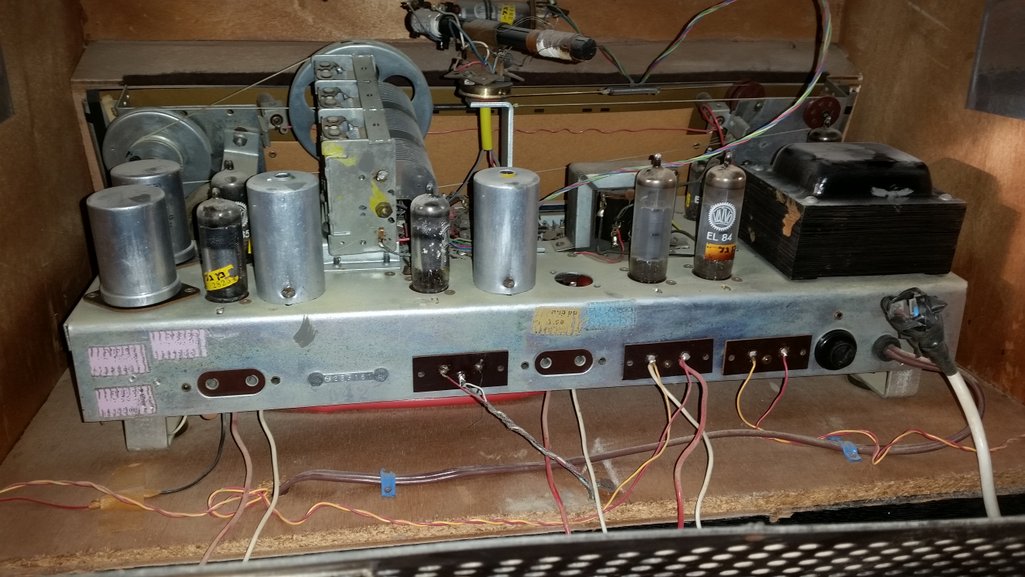
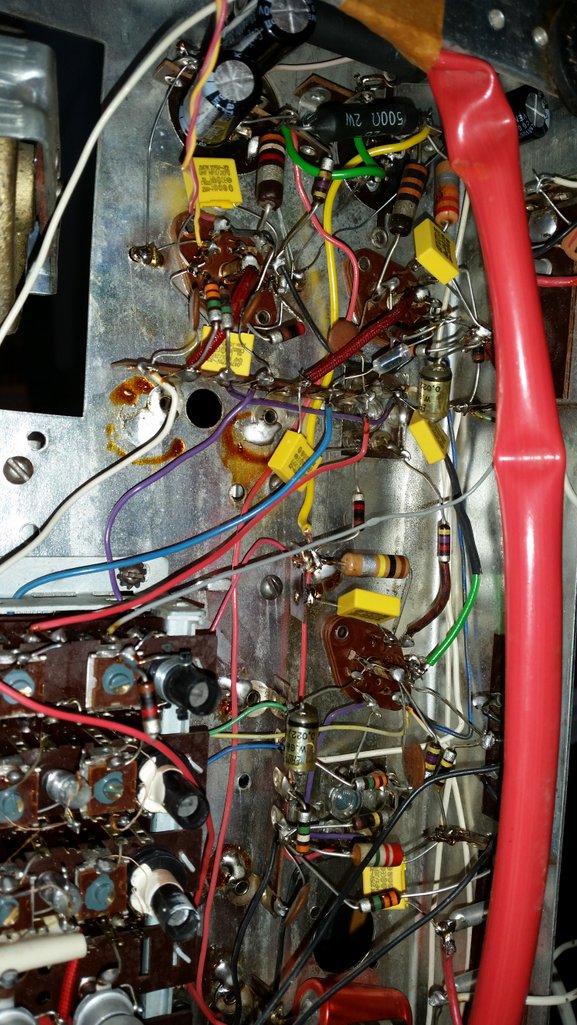
I took hi-res pictures of this radio, some during restoration. Now the radio sounds great. It has been recapped, a couple of bad resistors and bad wires replaced, contacts have been cleaned, and some good cleaning for the chassis as well.

Ben-Gal-Duet-Stereo-Board3

Ben-Gal-Duet-Stereo-Rear2

Ben-Gal-Duet-Stereo-Front-Detached

As I wanted to keep the original appearance of the chassis, I kept the original filter capacitors on board, but disconnected them from the circuit, added terminal strips and new capacitors from underneath.

Ben-Gal-Duet-Stereo-Board2 Ben-Gal-Duet-Stereo-Board1

The radio uses an EF85 tube as the RF stage. With the addition of a grounding connection and random wire antenna, it’s very sensitive on shortwave.

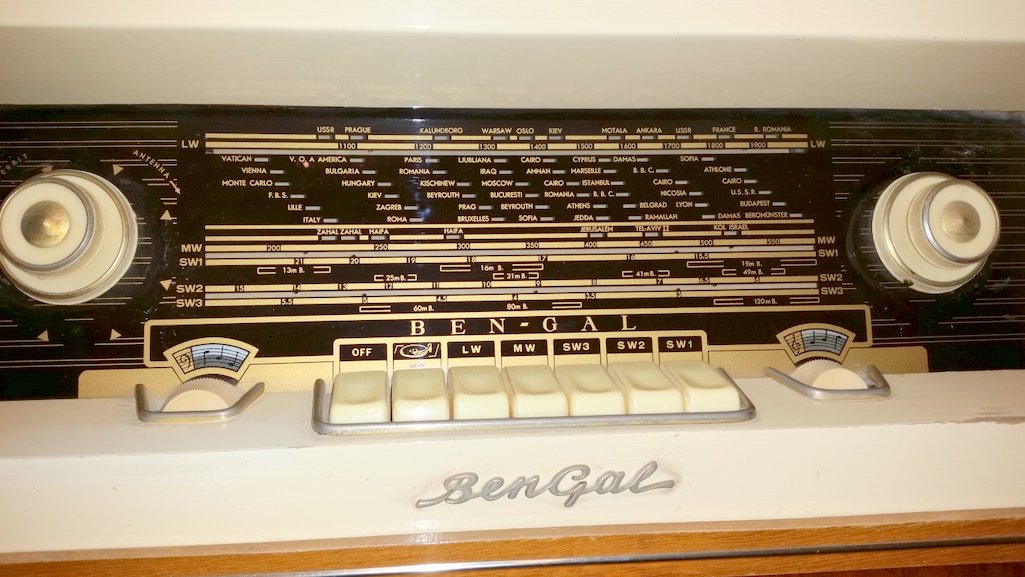
Ben-Gal-Duet-Stereo-FrontPanel

About the Ben-Gal Duet-Stereo:

It was made in Israel by Ben-Gal, a label inside shows it was made at 12th of December, 1965.

It is a console model with record player. As the model name suggests, the amplifier and record player are stereo (though the tuner is not…).

The radio has longwave (marked in meters), mediumwave (marked in meters) and 3 shortwave bands (with megacycle and meter band marks).

The shortwave bands overlaps with each other, so cover is continuous:

  • SW3 2.3MHz to 6MHz,
  • SW2 5.5MHz to 15.5MHz,
  • and SW1 14.5MHz to 23MHz.

Ben-Gal-Duet-Stereo-Open

Many thanks, Moshe, for sharing photos and this description of this beautiful Ben-Gal Duet-Stereo. I bet the audio fidelity is amazing. My father has a 1960’s console–with a similar configuration–made by Admiral, though it was limited to mediumwave and FM reception. Some day, I will try to restore it to its former glory!

Thanks for the inspiration, Moshe!

DSP noise may come from clock and data line harmonics

ATS-405-9580kHz

In response to our review of the Sangean ATS-405–which noted DSP noises on 800 and 1600 kHz–SWLing Post reader, Steve Yothment, comments:

“Yes, modern radios usually have a micro communicating with the DSP IC through I2C communications.

The inter-IC communications includes a clock and data line. The clock for I2C is typically 400 kHz nowadays. Harmonics from this clock line are probably the source of the interference.

The manufacturer should have designed the product to ensure that this interference does not occur. It may be that they resolved it at one time but with limited manufacturing quality and component substitutions that often occur in mass production, the problem is occurring now even though it may have looked OK earlier in development. At least, that is my experience with such things. (I used to design car radios for the Panasonic Company.)

You can learn more about the I2C bus at https://en.wikipedia.org/wiki/I%C2%B2C.

Many thanks for your comments, Steve! I recall a similar metronomic sound on another DSP-based radio, but can’t remember which model. I need to dig through my reviews as I’m sure I noted this. I believe checking 400, 800 and 1600 kHz will become a standard checklist item when I review DSP-based radios.

The Aiwa FR-C33 AM\FM\WX portable radio

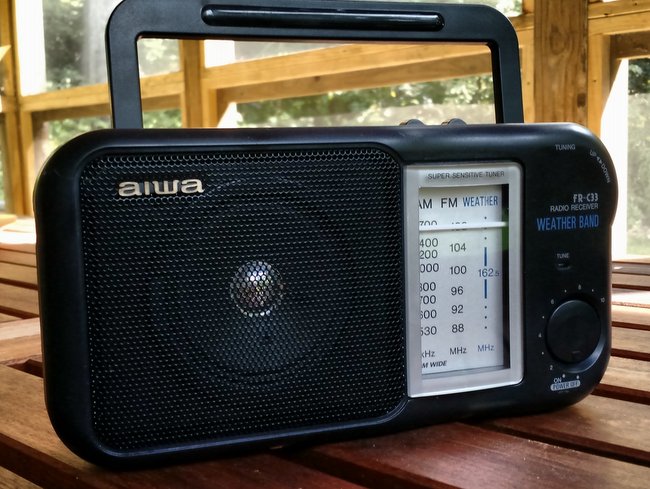
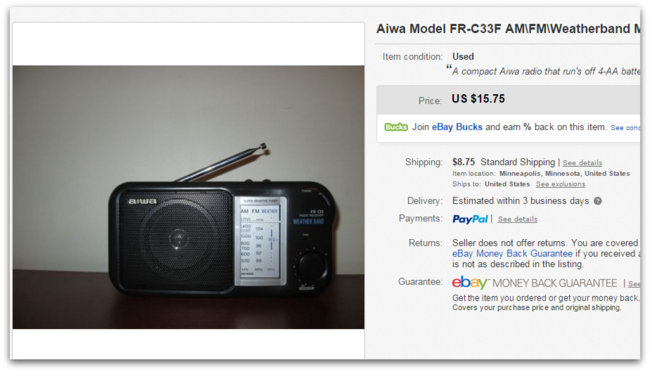
Aiwa-FR-C33-FrontA few weeks ago, SWLing Post contributor, Ron, sent me an eBay listing for a radio with which I was not familiar: the Aiwa FR-C33.

Ron wrote:

“I know you are primarily HF but here is something rather special and unique and inexpensive:

Fullscreen capture 8132015 32839 PM

Aiwa’s response to C-Quam in the late 90’s was “AM Wide.” Apparently all this meant was a somewhat wider Murita ceramic filter.

But…the bandwidth just matches the 10,200 cycle limit imposed on AM stations today…try a Sony SRF-42 or SRF-A1 C-Quam receiver at night on today’s band and note that they’re just too wide.

I have one of these and can tell you the build quality is great…it has a tone control and on Sony Walkman headphones stations like WSM are just flat-out unreal in sonic quality…the speaker isn’t bad, either.

A nice big ferrite bar makes it a bit of a DX machine, too.

FM is also very good; even the weather-band add-on works too.

Very much worth a go for your collection and enjoyment[.]”

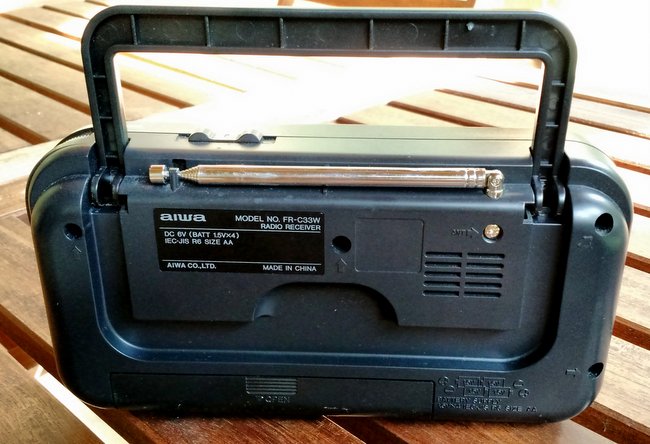
Aiwa-FR-C33-BackI’ve been enjoying the FR-C33 for a few weeks now; Ron’s assessment is spot-on.

The FR-C33 produces clear audio via its internal speaker, but where it really shines is with a pair of good headphones plugged in. Though it has no “Mega Bass” feature like many radios of its era, the Aiwa produces great bass tones via a good set of “cans” (I’ve been using my Sennheiser HD 428s).

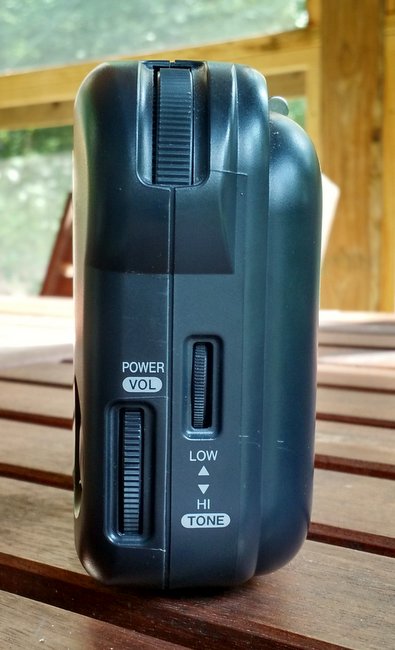
Aiwa-FR-C33-RightSide

The FR-C33 has a very useful tone control with a smooth, wide spread between the full bass and treble settings.

All of the FR-C33’s controls are fluid and functional.

AM (mediumwave) reception is truly fantastic. I find that the analog tuning wheel is easy to use and there’s enough room for the needle to easily travel across the dial without skipping stations inadvertently (a problem I often find with smaller analog portables).

It really shines, however, when you can center on a local broadcaster with a quality AM signal. While the FR-C33W doesn’t receive C Quam stereo, of course, its wide AM filter offers up excellent fidelity.

FM reception is also sound. While I haven’t done a formal comparison on FM, it receives my benchmark FM stations with ease and produces great audio fidelity via headphones. Sensitivity-wise, it might lag slightly behind some of the better DSP-based radios out there, but for an inexpensive analog receiver, it must be at the lead of the pack.

Ron, I really appreciate the recommendation–thank you! The FR-C33 is a keeper for sure.

Though these don’t pop up regularily on eBay, you can search for an Aiwa FR-C33 by clicking this link.

Winner of the Virtual Radio Challenge III

AT_-_Franconia_Ridge

Dennis Blanchard (K1YPP), author of Three Hundred Zeroes: Lessons of the Heart on the Appalachian Trail, recently contacted me from the road, en route to another lengthy trail in Vermont.

Before this latest hiking expedition, Dennis spent many hours pouring over the Virtual Radio Challenge III entries, looking up weights and specifications of radio gear and accessories…And the upshot?  He’s chosen a winner of our Reader Challenge.

Again, in summary, a participant’s goal was to find the best and most portable radio gear to receive shortwave, AM (medium wave), FM, and NOAA weather to support a long through-hike on the Appalachian Trail, to plan each day’s hike, and to make accommodations for frequent spring and summer thunderstorms (as well as occasional spring snow or sleet)…all for a budget of $300 US. [Read full details of the Challenge by clicking here.]

This year, Universal Radio rewarded–and has already dispatched!–a brand new CountyComm GP5/SSB portable receiver to the winning entrant.

Below are Dennis’ comments, along with those of the Challenge winner.


Dennis Blanchard (K1YPP) writes:
“This photo was taken in NJ. Shortly after I took these photos, and walked down the trail about a 100 feet, a bear came over to check the table to see if I had left anything.” (Photo: K1YPP)

Dennis Blanchard operating a portable radio on the Appalachian Trail. (Photo: K1YPP)

I’ve just spent about five hours going over the entries. There are several that are very good…indeed, Challenge participants obviously put lots of thought into their entries.

It was really tough to decide, but I had to go with most practical.

Weight is a big consideration for me, and that leaves out solar panels, hand crank generators, and the like.

What most don’t realize is that the AT has a nickname: “The Long Green Tunnel.” This eliminates solar panels because there is little sun to be had, as you’re in the shade most of the time. By the time you get to camp it is usually too late in the day for any charging, and wearing a panel just doesn’t do any good because of the shade (and weight).

Not only is weight an issue, so is space in the pack…hikers need all the room they can get for food, and in the cooler weather, heavy clothes.

Anyway, out of five finalists, I would have to go with Eric McFadden (WD8RIF).

Eric’s winning entry

So, what did Eric choose?  The following is Eric’s winning entry, beginning with his radio choice and following with a clear, practical explanation for it:
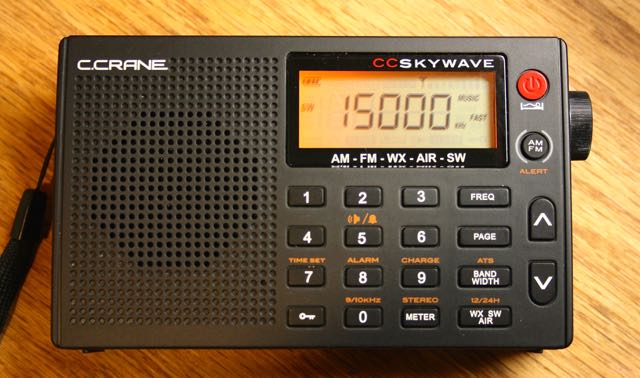
CC-Skywave-1

C.Crane CC Skywave, AM/FM/SW/Air/WX, $89.95 at Universal Radio
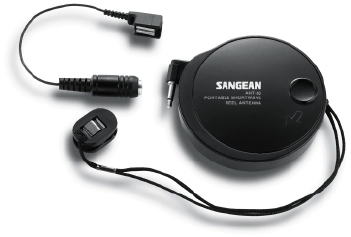
Sangean-ant-20-roll-up-antenna

Sangean ANT-60 Roll-Up 23′ Antenna, $12.95 at Universal Radio
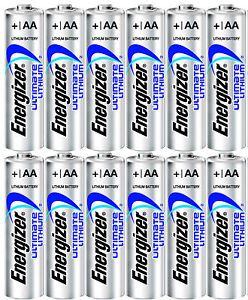
Energizer-Ultimate-Lithium-Cells

Energizer L91 Ultimate Lithium Cells, AA, 12-pack, $17.45 at Amazon

“The C.Crane Skywave is small (4.75″ x 3″ x 1.1″); light (5.5oz); power-stingy (30mA with headphones); and receives AM, FM, SW, NOAA Weather, and VHF Aviation.The Skywave runs on two AA cells, and comes with a case and CC Earbuds.

The Energizer L91 Ultimate Lithium AA cells provide 1.5v at approximately 3000m Ah, weigh 1/3 that of an alkaline AA cell, and last several times longer than an alkaline cell.

The Sangean ANT-60 would be tossed over a handy tree-limb and clipped to the Skywave’s whip antenna when the Skywave’s built-in 16″ whip isn’t quite adequate for listening to a shortwave broadcast station.

The purchase price of the Skywave, six pairs of Ultimate Lithium AA cells, and ANT-60 would be about $121 plus shipping, well under the $300 limit. The entire station should be small enough and light enough for easy carry in a backpack. If the twelve Ultimate Lithium AA cells don’t last the entire hike, enough of the budgeted $300 remains to purchase more cells (either Ultimate Lithium or alkaline, as available) along the route.”

To this sensible explanation, Eric adds:
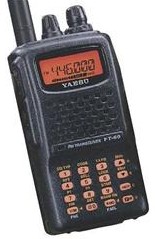
Yaesu-FT-60R“Being a ham radio operator, I’d want to have a ham rig along, too. While I’d love to be able to operate HF CW along the AT, my Elecraft KX3 is too large and heavy to carry that far. However, my current Yaesu FT-60R 2m/70cm HT and Diamond SRH77CA whip should travel nicely clipped to a backpack strap and would serve as a back-up receiver for NOAA Weather and be available for pedestrian-mobile QSOs (chats) and calls for help, if needed.

In order to save weight and not have to hassle with charging batteries, I’d leave the NiMH pack at home and carry the FBA-25 six-cell AA holder and stuff it with additional Energizer Ultimate Lithium cells in order to save weight.

Since the C.Crane Skywave already meets all the requirements of the Virtual Challenge, and since I already own the HT, battery holder, and antenna, I won’t consider the cost of the HT, antenna, and batteries as part of the challenge.”

About Eric’s entry, Dennis notes:

Eric’s solution is small, lightweight, and does everything needed. He speculates that he would also bring along his Yaesu FT-60R, but didn’t feel he could include it because of cost. Curious, I looked it up on Amazon; should he take it along, this addition would still keep his total well under the $300.00 limit.

This would provide Eric with two receivers, [the ability to enjoy] ham radio communications, and not much weight to haul. He includes the AA Lithiums, and I have to say that, without a doubt, these are the finest hiking batteries out there: they’re light, last forever, and are readily obtainable. I only had to change mine out once on the entire, six-month AT hike, and I was on the air a lot.

Several of the other entries were winners also great; I basically had to use a dartboard to pick a winner.  Good thinkers out there, especially considering none of them have actually ever done a hike of this magnitude.


Congrats, Eric! Thanks, Dennis!  And more to come…

Congratulations to Eric McFadden for such a well thought-through entry!

I must say, I don’t envy Dennis in making this selection: it was obviously a challenging  process on his end, too, and I’m glad I didn’t have to make it!

Dennis informed me that he plans to post and comment on some of his favorite entries in a few weeks, once he completes this latest multi-week hike. We will, of course, post his comments along with the finalist entries.

Note that when I originally received the reader inquiry which prompted the idea behind this Reader Challenge, the CC Skywave had not yet entered the market. Yet several of you chose it as your sidekick for the Appalachian Trail; clearly, clever minds think alike. Obviously, a radio that would function well on the Appalachian Trail would also be a great radio for your BOB (“bug out bag”), go kit or emergency supplies.

Thanks again to Dennis Blanchard, our intrepid judge, thanks to Universal Radio for the great prize, and many, many thanks to all our Reader Challenge participants, who made this process even more exciting and challenging! Meanwhile, don’t worry if you didn’t win the CountyComm GP5/SSB this time; we’ll soon have another opportunity to win one of these handy rigs in a completely different–and fun!–way.