Category Archives: AM

Radio Taiwan Test transmission

RadioTaiwanInternationalLogoMany thanks to SWLing Post reader, David Iurescia, who relays this translated message from Radio Taiwan International:

Frequency test for South America between 5 – 7 March, 2015

Looking for alternatives to transmit our programming to South America, Radio Taiwan International will carry out test transmissions frequency to the region  from Thursday March 5 until Saturday March 7, 2015 through 11920 kHz frequency in the 0200-0300 UTC .

We request the cooperation of our listeners friends who are in the South American countries , to verify that signal and send us reports of listening to the new test frequency to our e- mail soon: [email protected]

Many thanks for your help!

Source: http://spanish.rti.org.tw/whatsNew/?recordId=8357

Many thanks, David! Perhaps some of listeners can help RTI by sending a listener report and also record a broadcast for the SW Radio Audio Archive.

Video: Chris reviews the Tecsun 2P3 AM radio kit

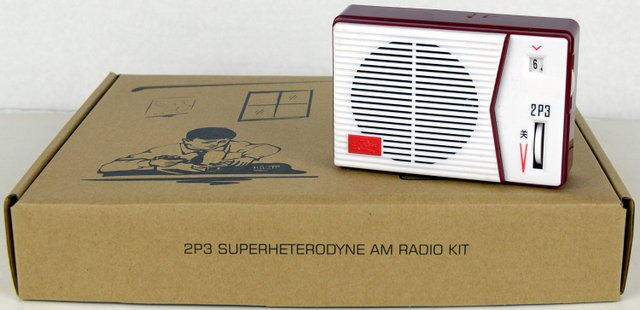
Tecsun2P3superhetAMkitSWLing Post reader, Chris, writes:

“I just wanted to let you know that I just put together the Tecsun 2P3 AM radio kit over the holiday break. I wanted to also let you know that I made a YouTube review on this radio and some of the short comings on this little radio. I think that some of your readers may be interested also. I have the link below for your review and if you like, you can share it with your readers.”

Many thanks, Chris, for sharing your video! I plan to purchase this kit soon and look forward to referencing your video again and appreciate your advice.

Click here to view Chris’ video on YouTube, or simply watch via the embedded video below:

The Tecsun 2P3 AM radio kit is available from various sellers on eBay–click here to search.

Video: 1940s-era holiday treat from Tommy Dorsey (c/o a vintage rig)

Tommy_dorsey_playing_trombone

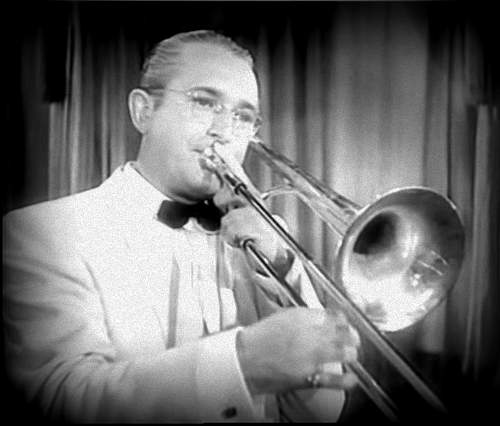
Below you’ll find a short video of my 1945 Scott Marine Radio Model SLR-M playing Tommy Dorsey and his Orchestra’s  jazz-infused version of “March of the Toys” from Victor Herbert’s holiday classic “Babes in Toyland.”

It’s a little holiday time-travel I cooked up for you on this great vintage rig. I’m actually playing the song via an SStran Model AMT3000 AM transmitter I built from a kit (more on that in a future post). The transmitter has been set to 1410 kHz, to which the SLR-M is tuned.

Though the microphone on my Flip Video camera makes the sound in this little recording tinny (you’ll have to trust me that, live, it’s remarkably warm and rich), it does feel a bit like radio time-travel to hear a 1940s-era song played on a 1940s era-radio. This is just how WWII servicemen might have heard this music.

For your holiday enjoyment: “March of the Toys” by Tommy Dorsey and his Orchestra:

The Spectrum Monitor: only $24 for a year’s subscription

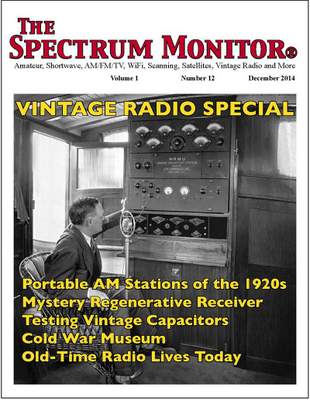
December14Cover.1On occasion, the things you enjoy most, you forget to share with your friends. Not sure why this happens, but this is certainly the case with the Spectrum Monitor magazine (TSM). I’m long overdue to properly pitch TSM to my readers, which I feel is an absolute bargain at just $24 per year.

Why? Many of you may recall that it was only July of last year when we learned about the closure of The Monitoring Times magazine.  I had always loved the magazine–not only were the management and editors a great group, but the magazine content was some of the best in the communications business when I began writing features and reviews for MT. But the owners of MT, Bob and Judy Grove, were ready to retire; ultimately, they decided to close their magazine down rather than sell it off.

Shortly after the announcement, MT‘s managing editor, Ken Reitz (KS4ZR), decided to make a go of a new publication. Albeit wholly digital, this magazine was to cover the same scope and content depth as MT, and would be known as The Spectrum Monitor (TSM).

In January of this year, TSM launched, and like many SWLing Post readers, I was eager to see if the content met the benchmark MT had set for so many years.

I needn’t have worried.  Ken had corralled many excellent contributors, in many cases drawing upon previous writers for MT.  And in the past year, I don’t believe it’s a stretch to say that in many respects, TSM not only met that benchmark, but has actually even exceeded itTSM is now–unquestionably–a good, solid, thoroughly enjoyable publication. 

Each issue is packed with topics covering the radio spectrum: shortwave, ham radio, vintage radio, pirate radio, scanning, public service, satellite, AM/medium wave and host of digital/mobile technologies, as well. Really, everything a listener could hope for.
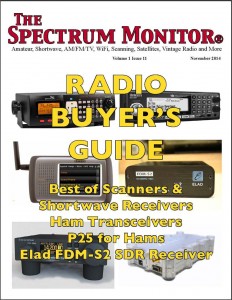
November2014Cover Initially, I had my doubts.  I frankly wasn’t sure whether I’d like reading a “digital-only” radio publication, or whether other readers would. I confess to being a bit “old school;” as a radio listener, I like to hold a radio in my hands, to physically tune it; as a reader, I prefer holding a printed publication in hand, to turn the (paper) pages…How would I feel with an e-reader or laptop, instead? Would reading that way feel like work?

But TSM soon swayed me toward the digital as both reader and as a columnist. As a writer, there was less stress on word count. If it was a bit short, or lengthy– as my October column was–I soon found it mattered less. In a digital publication, page count is comparatively irrelevant as long as content is worthwhile and captivating for the reader.  And as a reader, I appreciated that the columnists that I was reading would have the freedom to write at length, too.

Secondly, a digital publication gave its writers an opportunity to infuse columns with a multi-media element–something I’d become accustomed to as a blogger here on the SWLing Post. When I published a review of a radio, I could include actual audio clips in the article. If I wrote about pirate radio, for example, I could embed actual pirate radio recordings. Brilliant! And, again, more fun for the reader.

Also, including links or references to external websites is a cinch in a digital format, and quite easy for the reader to check out. Instead of copying a long gangly URL from a printed page, you simply click on a link as you would on a website, such as on this one. Second nature, really.
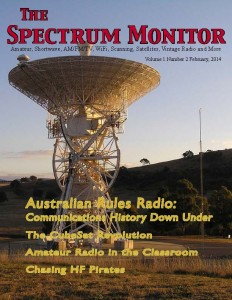
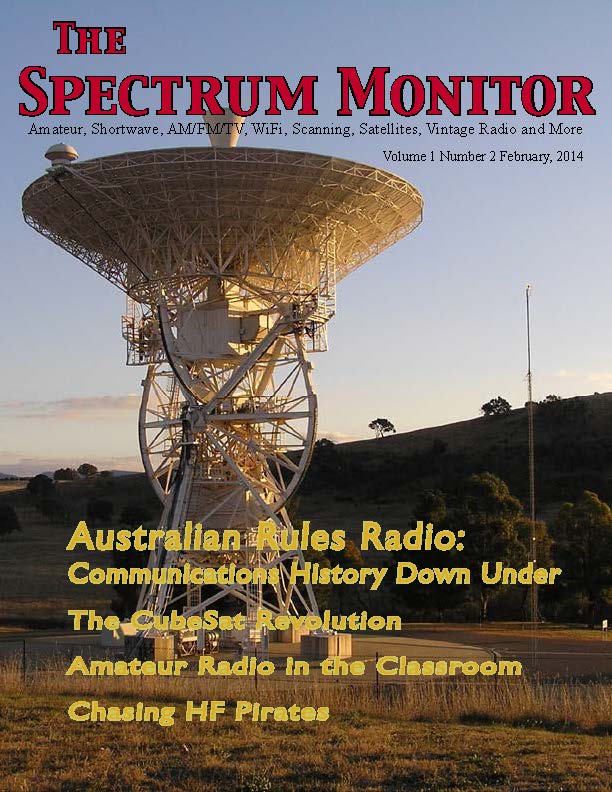
FEB2014CoverFinally, in a digital publication, I found writers could use more full-color images in their articles. I really enjoy the addition of the images; they make articles come to life…

So, I soon learned to relax with the e-reader just as I had with the printed Monitoring Times.  No pages to turn, but then again, not so different from reading…well, a blog like this.  I’ve received excellent feedback from TSM readers, too, many of whom admitted their initial bias against a “digital” magazine had since been withdrawn completely.

I continue to enjoy reading TSM every month.  And although–due to time constraints–I’m no longer TSM‘s primary shortwave radio columnist, I still enjoy writing for TSM when time permits, so you will see my reviews and features pop up in TSM now and again.

But why take my word for it?  Check it out for yourself–it’s one of the best magazines for the radio enthusiast, digital or print…And at only $24 annual cost, it’s a terrific and affordable last minute Christmas gift for a friend, family member, or–let’s be honest–for yourself.

Afraid to commit to a one year subscription? Individual issues of TSM are available online for $3 each. If you like what you’re reading (you will), you can then purchase a one year subscription, and the cost of your issue will be refunded.

If you’re lucky enough to receive a subscription to TSM in your stocking, I can assure you that you’re in for a real treat.  Happy reading!

WG2XFQ: Brian Justin’s annual longwave broadcast Dec 24-25

Reginald Aubrey Fessenden (October 6, 1866 – July 22, 1932)

Reginald Aubrey Fessenden (October 6, 1866 – July 22, 1932)

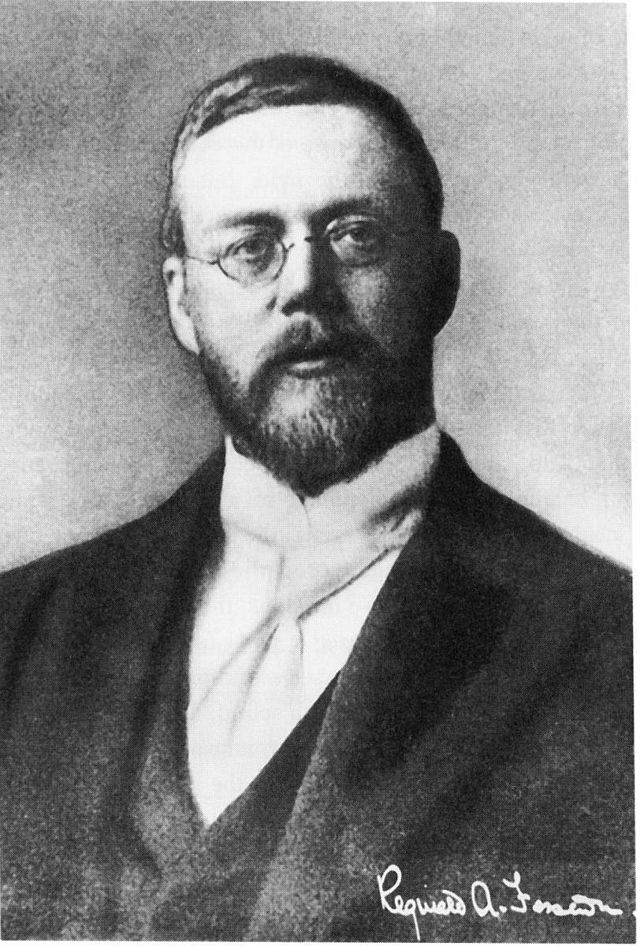
Now an annual Christmas tradition, Brian Justin (WA1ZMS) will put his longwave experimental station WG2XFQ on the air to commemorate the 108th anniversary of Reginald Fessenden’s first audio transmission.

WG2XFQ will broadcast on 486 kHz from Forest, Virginia, beginning on December 24 at 0001 UTC. WG2XFQ will remain on the air for 48 hours.

Listener reports may be sent to Brian Justin, WA1ZMS, at his QRZ.com address.

If you would like more information about Brian Justin and WG2XFQ, check out our interview with him last year. Indeed, I successfully heard the 2013 WG2XFG broadcast and posted this audio clip on the Shortwave Radio Audio Archive.

Additionally, SWLing Post reader, George Stein has a very personal connection with radio pioneer, Reginald Fessenden: click here to read his story.

NY Times: “Recalling the Imperfect Radio and TV Reception of the Past”

TV-Analog-Noise-SnowMany thanks to my dear friend, BJ Leiderman, for sharing this brilliant piece by Dana Jennings in the NY Times.

I’m only including a few quotes from this piece (below), so please visit this link to read the full article about the adventures, charm and nostalgia of analog TV and radio:

by Dana Jennings

I miss the television snows of yesteryear. And I don’t mean easy nostalgia for the inevitable reruns of “It’s a Wonderful Life” or “A Charlie Brown Christmas.”

I’m talking real television snow, a longing for static, ghost images and the picture endlessly rolling and flip-flopping. While we’re at it, I ache for well-used vinyl crackling like bacon sizzling in a skillet … and the eerie whistles and wheezes from terrestrial radio.

This eccentric pining for the primitive electric hiss and sputter of my 1960s childhood is an honest reaction to our modern culture’s unhealthy addiction to (apparent) perfection. We want it all, we want it now, and we want it sublime.

We not only demand our television, radio and music in unblemished HD on whatever device we choose, but also our weddings, children, houses and bodies. And in our heedless embrace of digital cosmetic surgery, we’ve forgotten that it’s the flaw that makes a thing all the sweeter — like the bruise on a peach.[…]

[Like TV, my] radio needed the human touch, too. As I listened to Boston Red Sox night games, I’d grip the radio like a vise, its hot, orange guts stinging my hand; my skin would lobster up, but I didn’t care, because I could hear the game better. (That radio, a yellowing white Sylvania, also hummed constantly, kind of like the ringing in your ears hours after a Metallica concert.)

Then there was the utter delight of reeling in a far-away station late at night: from Montreal, from Wheeling, from Nashville. Even more bewitching were the otherworldly soundscapes to be found between station stops: eeps and boops, trills and squeals, shrill dronings from the ether that maybe signaled an alien invasion, or first contact with another galaxy.[…]

Read the full article on the NY Times…

Anthony rediscovers radio

Analog Radio DialCheck out this charming article about rediscovering radio by Anthony M. Castelletti in The Buffalo News:

“As a child in the 1960s, I enjoyed listening to distant radio stations, I suppose initially for no reason other than because they came from far away. It was a young boy’s hobby based on the accidental discovery of 1050 CHUM in Toronto. Remember, this was quite a feat for a one-transistor, pocket AM radio without an antenna that was the product of 1950s technology. I soon discovered that if I took that little radio outside, even more distant stations were right there on that dial.

Along with my beloved hometown Buffalo Bisons, I also became a fan of the Fort Wayne Komets hockey team, not due to any connection to Indiana, but rather due to my ability to listen to their games on WOWO-AM. This was soon followed by CKLW from Windsor, Ont., a rock ’n’ roll station as powerful as my hometown favorite KB 1520.

It took a couple of years of playing with that little radio for me to figure out that if I snuck outside and listened to the in-dash radio in my father’s Chevy, without starting the car and giving myself away of course, broadcasts from faraway places like New York City, Chicago and on rare occasions Florida, Georgia, Tennessee and other places I had never visited, were right there at my finger tips.

It also didn’t take long for my father to find out why the battery in his car had suddenly died. This was followed by a calmly delivered, yet lengthy and technically detailed lecture from my father, an electrician, on the effects of using a car battery without doing anything to charge said battery.”

Continue reading the full article at The Buffalo News…