Category Archives: Broadcasters

Today is UNESCO World Radio Day 2014

unesco_wrd_logoToday is UNESCO World Radio Day–a day to celebrate the continued relevance of radio in the twenty-first century.

You can make a difference with radio.  Here’s how:

  1. Send a shortwave radio, care of Ears To Our World. You can send one self-powered shortwave radio to a classroom or community in the third world for as little as $40.  In impoverished regions still without internet access or electric power, your tax-deductible donation of one radio can inform and empower an entire community of listeners.
  2. If you’ve heard my 2013 recording for UNESCO regarding the relevance of radio, you may also like to visit World Radio Day’s webpage and listen to what others have to say about the relevance of shortwave radio. Share this page with your friends.
  3. If you do nothing else, please contact your representative(s) and remind them of the continued importance of shortwave radio in today’s world. Click on the following links to search for your government representative(s) in the USACanadaUnited Kingdom, Australia, and New Zealand.
  4. Need more ideas to celebrate World Radio Day?  Check out UNESCO’s list.

Oh, and here’s one more thing you can do:  Simply turn on your radio, and listen.  I’m pleased to note that World Radio Day, although still a fairly new international holiday, is receiving increased media attention each year.  After all, radio listening can be a wonderful, meaningful experience–as well as a worthy cause.  So, enjoy!

Happy listening,
Thomas

Radio New Zealand’s Peter Fry will take you on a musical journey

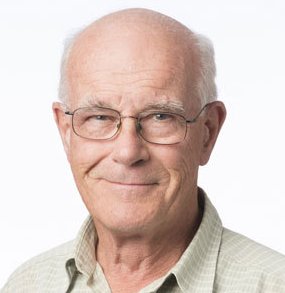
Peter Fry, host of Saturday Night on Radio New Zealand

Peter Fry, host of Saturday Night on Radio New Zealand

If you’ve ever had the distinct pleasure of tuning to Radio New Zealand International when their musical request show, Saturday Night, is on the air, chances are that you’ve become, like I have, addicted to this show.

The show’s inimitable host, Peter Fry, has one of the best radio presences in the business. His warm personality and penchant for playing absolutely anything back-to-back will captivate you. You’ll hear songs and genres (including comedy skits) spanning the decades, and Fry offers his excellent commentary between sets.

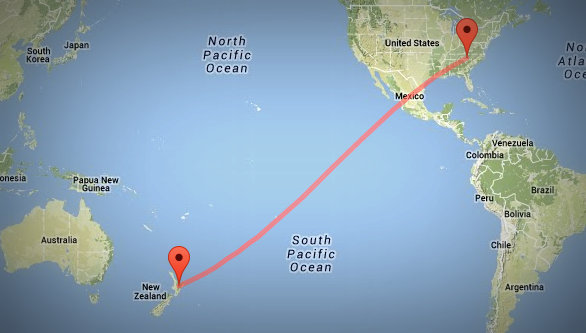
What amazes me, too, (when I stop to think about it) is the relatively robust audio fidelity from RNZI’s shortwave signal here in eastern North America, especially considering that this broadcast originates in Rangitaiki, on the north island of New Zealand, and is powered by only 50 kilowatts, a modest signal by international broadcasting standards.  RNZI’s signal crosses the Pacific at the speed of light–and at 6 watts per mile, by my calculations–delivers my Saturday Night as clearly as if it originated…well, locally.

The RNZI signal travels a full 8,249 miles (13,276 kilometers) to reach my home.

The RNZI signal travels a full 8,249 miles (13,276 kilometers) to reach my radio.

Yes, shortwave radio is magic.  And so is Peter Fry’s show:  Enjoy.

Click here to download the recording as an MP3, or simply listen via the embedded player below:

This broadcast was recorded on February 8, 2014 on 9,765 kHz, starting at 07:59 UTC.

Nothing on shortwave? I still disagree.

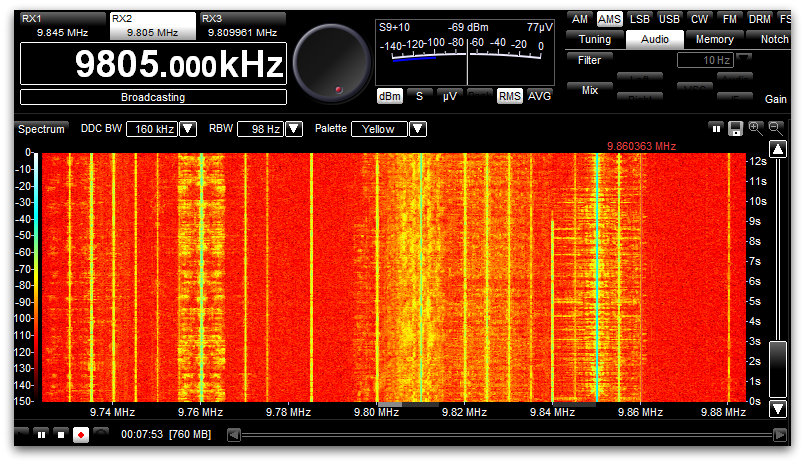
SpectrumDisplay-31Meters-WinRadioExcalibur

One of the most popular posts on the SWLing Post is one published nearly two years ago: “Is there anything to listen to on shortwave?

In that article, I posted recordings made on the 31 meter band of eight different broadcasters, all of which I found within a 250 kHz chunk of bandwidth on a Friday afternoon.

On February 8th (this past Saturday), I recorded a 160 kHz chunk of spectrum on the 31 meter band with my WinRadio Excalibur, starting around 1:00 UTC and lasting for about 9 hours.  I made this spectrum recording in attempt to capture the Voice of Korea on one of their three scheduled frequencies.

While VOK wasn’t audible enough to make a good recording, I did log the following stations all within this thin slice of radio spectrum (click on links for recordings):

I’m guessing that I only logged 50% of what I heard as this list was put together from a quick scan through the recording. In fact, I’m systematically making recordings of each of these broadcasts, from the spectrum file, and adding them to the Shortwave Radio Audio Archive. I may actually discover more stations in the process.

My point is, if you think there’s nothing to listen to on shortwave, you’re simply not listening!

Now back to my radio…

Shortwave Radio Recordings: Voice of Indonesia French language service

RRI-VoiceOfIndonesiaFor your listening pleasure: one hour of the Voice of Indonesia’s French language service. This broadcast was recorded in Europe on February 5, 2014 by Shortwave Radio Audio Archive contributor, Frank, around 20:00 UTC on 9,526 kHz.

Frank was using his Kenwood R-5000 and Wellbrook ALA 1530+ antenna.

Click here to download the recording as an MP3, or simply listen via the embedded player below:

Please check out the Shortwave Radio Audio Archive for recordings from around the world. Consider becoming a contributor!

Listening to beHAVior Night on the Elecraft KX3 QRP transceiver

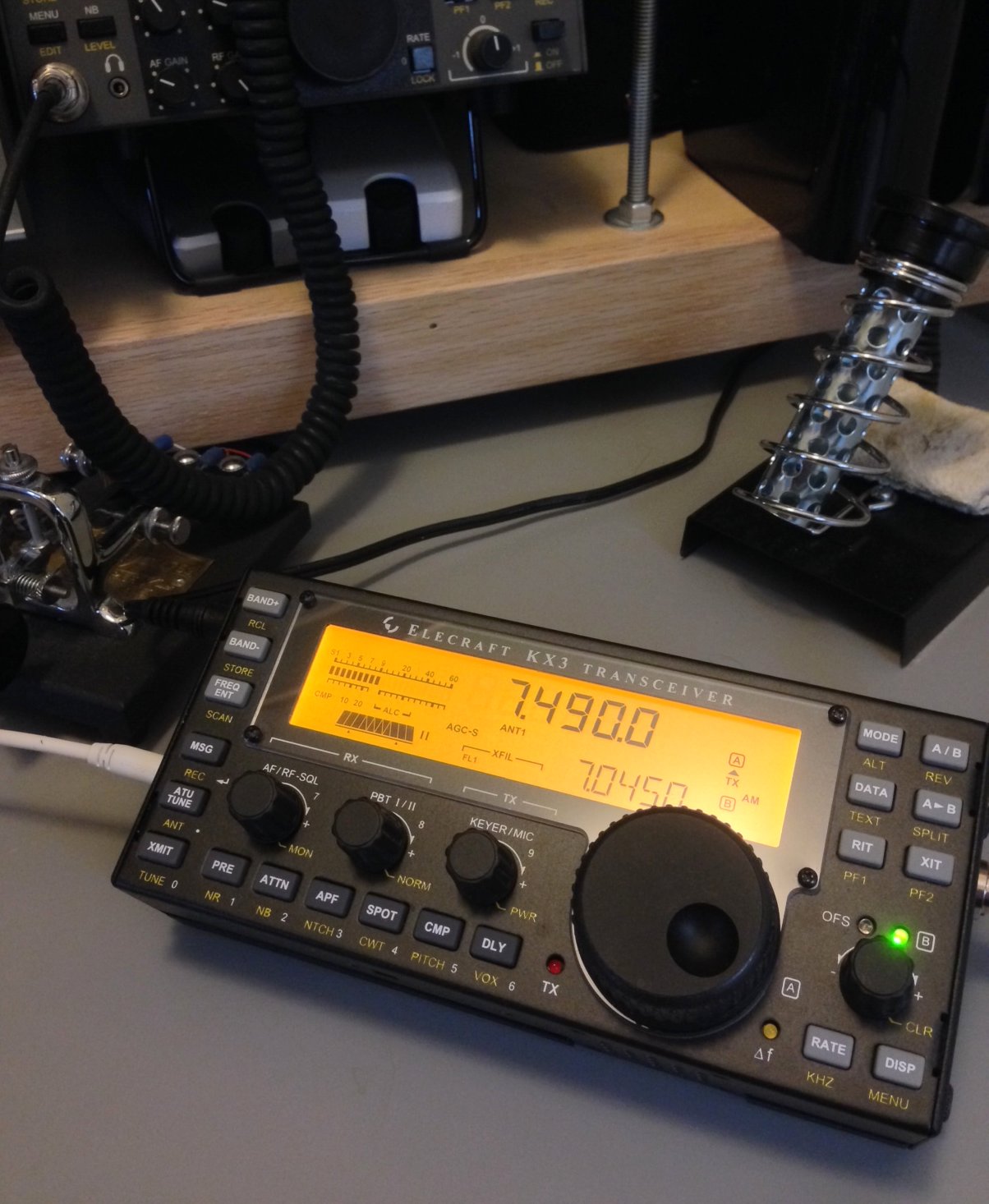
The Elecraft KX3 transceiver tuned to 7490 kHz

Last year, I reviewed the Elecraft KX3 transceiver as a fantastic radio to consider if you’re an amateur radio operator who also happens to love SWLing.

Tonight, I used my KX3 to tune in one of my favorite weekly programs: beHAVior Night, a shortwave radio show, relayed by WBCQ, which showcases music from the first four decades of the 20th Century.

What’s so pleasant about the KX3 is the robust AM audio it delivers, even though its AM filtering is limited to a maximum of 4.2 kHz in width. That’s a very narrow width, by SWLing standards, but the audio sounds wider.

Listen for yourself: click here to download a recording of beHAVior Night made with the Elecraft KX3 (via my Zoom H2N digital recorder) or simply listen via the embedded player below:

HFCC Conference: “Shortwave remains essential”

ABU-logo(Source: Asia-Pacific Broadcasting Union)

“Short wave will continue to be an important part of broadcasting, a coordinating conference hosted by the ABU in Kuala Lumpur has been told.

The 10th Global Shortwave Co-ordination Conference of the High Frequency Coordination Conference (HFCC) with the ABU and the Arab States Broadcasting Union (ASBU) from 20-24 January 2014 is part of the regular twice-yearly seasonal management of shortwave frequencies around the globe to coordinate usage and minimise interference.

Mr Bassil Zoubi, Head of Transmission at ASBU, said: “Shortwave programs will continue to be vital in addressing and communicating with some important parts of the world, especially with Internet penetration in the Arab countries around 34% while in some other parts of the worlds it is less than 10%.”

He said the ASBU had adopted T-DAB+ as a delivery platform for regional audio broadcasting, though the union continued to support [shortwave] DRM as a important delivery medium for international as well as national coverage, which was why the ASBU was calling for a universal radio chipset.

HFCC Chairman Mr Oldrich Cip said shortwave radio was important for travellers and isolated people, and it reached across the digital divide to the most disadvantaged and marginalised societies.

The International Federation of Red Cross and Red Crescent Societies had underlined this role of wireless radio in the 2013 World Disaster Report.

“It said that marginalised populations may not have the money or the knowledge to take advantage of the digital revolution,” Mr Cip said. “The report has noted that with only six per cent of people in low-income countries using the Internet in 2011, the digital divide was still stark and therefore access to low cost media technology was really the key.”

He also urged the conference that effort was needed to ensure that terrestrial broadcasting was part of the framework of the Global Strategy for Disaster Risk Reduction.

ABU Director of technology Dr Amal Punchihewa reiterated the importance of ensuring there were mechanisms in place to deliver information technology to the most needy and vulnerable populations around the globe.

“The ABU will continue to work with our partners to ensure this technology will survive and thrive for the benefit of the population, in times of crisis, in areas of isolation and at the most vulnerable times,’ he said.

Mr Gary Stanley, Rapporteur of the HFCC Steering Board, thanked the ABU for hosting the conference and said shortwave radio was still very important for disseminating news and information to regions where Internet penetration was low and other ways of receiving international media were limited.”