Category Archives: Ham Radio

Got some extra time to read? Subscribe to The Spectrum Monitor!

While most of us across the planet are sheltering at home due to the C-19 pandemic, we have a little extra time to catch up on reading.

I subscribe to (and write features for) a number of radio publications, but the best bargain on the planet must be The Spectrum Monitor Magazine (TSM).

Issues of TSM are a mere $2 each if you purchase an annual subscription ($24). Don’t care for an annual subscription? You can buy issues á la carte–preview an issue on the TSM website then purchase it for $3.

As a writer, I love TSM because 1.) they cover an impressive variety of radio topics and 2.) there is no real word limit on articles. I can take my readers on a truly deep-dive into a review or topic and not have to worry that portions will be cut to meet page margins for print. As long as content is relevant and informative, TSM keeps it.

In addition, TSM is published as a PDF which means it can be read with any computing device–desktops, laptops, tablets, eReaders, and smart phones. There’s no need to load a proprietary publisher app–it’s a truly portable electronic issue. PDFs are also the easiest of all formats to print at home if you want to archive a paper copy of an article or entire issue.

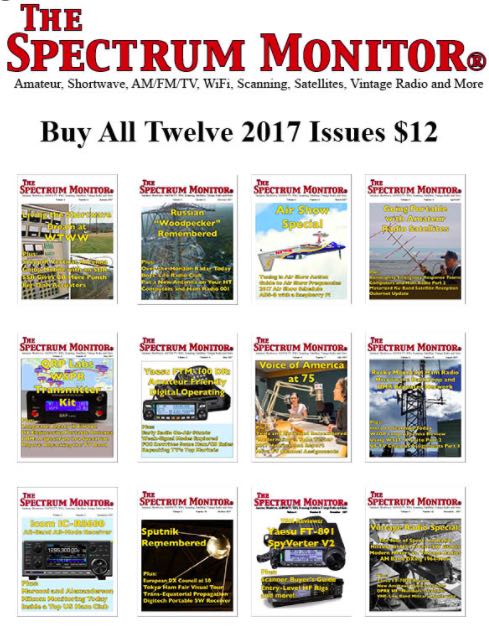
If you haven’t subscribed to TSM before, you may be especially interested in their annual archives. I recently discovered you can purchase an entire year of archived issues for $12…that’s only $1 per issue!

Check out the annual archives in the left sidebar of the TSM website.  When you click on a year, you can browse an index of all topics and features before making your purchase. The $12 price is valid for the 2014-2017 years.

TSM Publisher and Managing Editor, Ken Reitz (KS4ZR), has done a fabulous job collecting a group of writers who are not only experts in their respective fields, but are effective writers as well. These two qualities do not always go hand-in-hand.

At $24 ($2/issue) per year, I think TSM is one of the best radio bargains out there. While you’re sheltering at home, why not explore the full spectrum of radio via TSM?

Click here to visit The Spectrum Monitor.

Radio Waves: Zombie Sats, Radio Provides Undemanding Friendship, Boom in New Stations, and One Retailer’s Ham Radio Connection

Radio Waves:  Stories Making Waves in the World of Radio

Because I keep my ear to the waves, as well as receive many tips from others who do the same, I find myself privy to radio-related stories that might interest SWLing Post readers.  To that end: Welcome to the SWLing Post’s Radio Waves, a collection of links to interesting stories making waves in the world of radio. Enjoy!

Many thanks to SWLing Post contributors BJ Leiderman and Richard Black  for the following tips:


Long-Lost U.S. Military Satellite Found By Amateur Radio Operator (NPR)

There are more than 2,000 active satellites orbiting Earth. At the end of their useful lives, many will simply burn up as they reenter the atmosphere. But some will continue circling as “zombie” satellites — neither alive nor quite dead.

“Most zombie satellites are satellites that are no longer under human control, or have failed to some degree,” says Scott Tilley.

Tilley, an amateur radio operator living in Canada, has a passion for hunting them down.

In 2018, he found a signal from a NASA probe called IMAGE that the space agency had lost track of in 2005. With Tilley’s help, NASA was able to reestablish contact.

But he has tracked down zombies even older than IMAGE.

“The oldest one I’ve seen is Transit 5B-5. And it launched in 1965,” he says, referring to a nuclear-powered U.S. Navy navigation satellite that still circles the Earth in a polar orbit, long forgotten by all but a few amateurs interested in hearing it “sing” as it passes overhead.[]

Ken Bruce: ‘Radio provides friendship in an undemanding way’ (BBC News)

You wouldn’t normally hear a tractor driving past or birds tweeting in the background of Ken Bruce’s BBC Radio 2 show.

But, if you listen closely, those are just a few sounds you might be able to pick up on now the presenter is broadcasting from his Oxfordshire home.

“I do live in dread of the binmen arriving or the Royal Air Force flying over in extremely noisy Chinooks as they do sometimes,” Bruce laughs. “But so far it’s been fine.”

Bruce’s mid-morning show on Radio 2 – which he has hosted continuously since 1992, following an earlier stint in the 1980s – is particularly popular at the moment as more listeners turn to the radio while confined to their homes.

“At a time like this, people want to hear the news, but they don’t want it all day,” Bruce says. “From my point of view, I’ll pay attention to one news broadcast a day, and after that I don’t really want to know too much unless it’s a major development.

“So escapism is a big part of keeping people feeling right during this and I think we provide a certain amount of that, a chance to put the worries of the world to one side.”[]

The coronavirus is bringing about a boom in new radio stations (The Economist)

MILLIONS OF PEOPLE in lockdown are finding diversion at the flick of a dial. According to Radiocentre, the industry body for commercial radio in Britain, local and national stations reported increases in daily listeners of between 15% and 75% in the second half of March. They’ve got competition. Radio stations offering information, entertainment and reassurance to listeners isolated at home have sprung up from Ireland to Syria, Italy to India. Informal and interactive, many are run by amateurs from their homes, with producers learning the ropes as they go.

In Italy Radio Zona Rossa (Radio Red Zone) began broadcasting from the town of Codogno, the site of the country’s first locally transmitted coronavirus infection, just days after Lombardy went into lockdown on February 21st. Hosted by Pino Pagani, an octogenarian whose co-presenter and friend was killed by the virus in March, the twice-daily programme uses the registered FM frequencies of a local station, Radio Codogno, to provide updates on the spread of the virus and the opening hours of local essential services. Mr Pagani also interviews experts and invites residents to call in for a chat. [Note that the full article is behind a paywall …]

Unclaimed Baggage began from a social distance connection, 1970’s style (Unclaimed Baggage)

Doyle Owens loved radios––specifically ham radios. We don’t use them much these days; most of us don’t even know what they are (for the uninitiated: “ham” is slang for “amateur” radio, and its enthusiasts make a hobby of connecting with each other over radio frequencies). In the ‘60s and ‘70s, it was the equivalent of a group FaceTime call, sans face.

Doyle, call sign K4MUR, went to bed early so he could be on the radio by 4:30am to talk to friends in different time zones all around the world. Some were friends from childhood, friends from his days of service in the Korean War. Most of his friends, however, were friends he’d never met in person, who he knew only from the airwaves. Many of them knew him more intimately than the friends and neighbors he saw every day.

Those mornings were his window into the world outside Scottsboro, Alabama, population 9,324 (in 1970), where he’d been working in insurance since shortly after the Korean War. The insurance business paid, but it bored him to tears. Creative energy ran in his blood: during the Great Depression, his father ran a general store on wheels in rural Alabama, which he used to barter for much needed goods. Doyle knew he was destined for more, but he didn’t know what.

One day, a ham radio friend who worked for Trailways Bus Company in Washington, D.C. let Doyle and his friends in on an unusual problem: the bus line had an accumulating pile of unclaimed bags that they didn’t know what to do with. Doyle’s ears perked up. “How much would you sell it for?” he asked his friend. “Well, I’m not sure,” his friend said. They settled on three hundred dollars.

That afternoon, Doyle borrowed his father’s ’65 Chevy pickup truck and stopped at his father-in-law’s house on the way out of town to borrow three hundred dollars. When he returned, he and his wife Mollie Sue set to unpacking the massive load of luggage. They rented a house on the outskirts of town and set up card tables inside to display the contents of the luggage. Outside, a homemade storefront sign read “Unclaimed Baggage”. That Saturday the doors opened for business, and by the end of the day the tables were empty.

The rest isn’t exactly history. It took many more loads of luggage, many more loans, many more long days and short nights before Doyle’s business grew into the worldwide, fifty-year-old retail phenomenon it is today. But it all started with an idea.

No one knows where they come from, ideas. What we do know is that the right environment––the kind populated by dear friends, clear air, long drives down country roads and the like––clears space for them to land.

The current moment, plagued by uncertainty, financial distress and, well, actual plague, could be seen as less conducive than ever to creativity. Ernest Hemingway once wrote that worry destroys the ability to create, and ill health, which produces worry, attacks your subconscious and destroys your reserves. If we all, like Hemingway, had the ability to combat the malaise with all the fishing, sailing and boxing our hearts desire, we might not be in such a tough spot.[]


Do you enjoy the SWLing Post?

Please consider supporting us via Patreon or our Coffee Fund!

Your support makes articles like this one possible. Thank you!

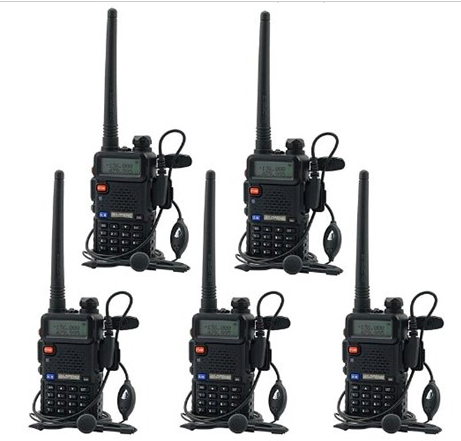
Radio Deal: 5 Pack BaoFeng UV-5R HTs $94.99 via Woot

The daily deals site, Woot, is selling a five pack of BaoFeng UV-5R HTs, each with charging cradle, earpiece and programming cable for $94.99 US. Not a bad deal as you can outfit you whole ham family for a mere $19 per radio!

Woot clearance deals like this one last only one day. At time of posting, this deal will only be available for 17 more hours or when supplies run out.

Amazon Prime members get free standard shipping.

The BaoFeng UV-5R is a super cheap radio, but is quite durable and has a massive ham radio user base.

Click here to check out this deal at Woot.

More about hacking VGA cables to make binocular ferrite cores

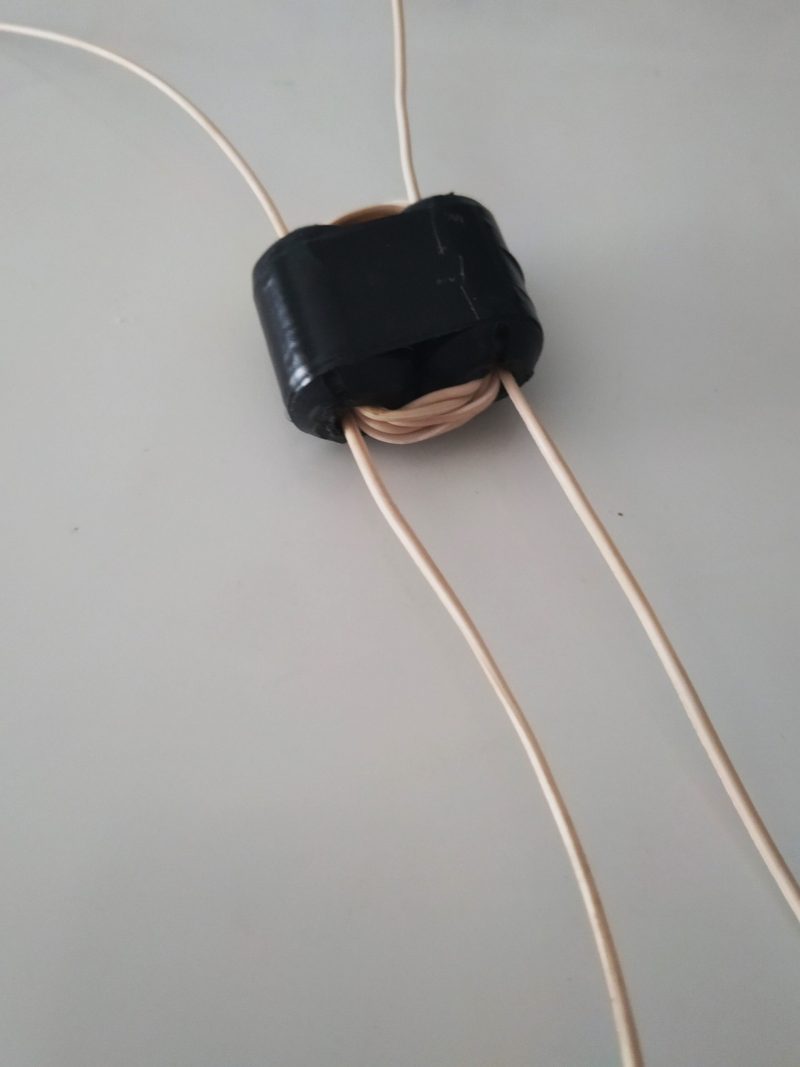
A few days ago, we posted an a short article showing how Oscar hacked a VGA cable to make a binocular ferrite core for his homebrew NCPL/Youloop antenna. Many thanks to SWLing Post contributor, Grayhat, who explored this clever hack a little further:

Hi Thomas, Having some time in my hands Sunday afternoon I decided to try pulling out the ferrite chokes from a VGA cable I had around, and while doing so, I decided to coarsely document the process with some pics.

Figure 1

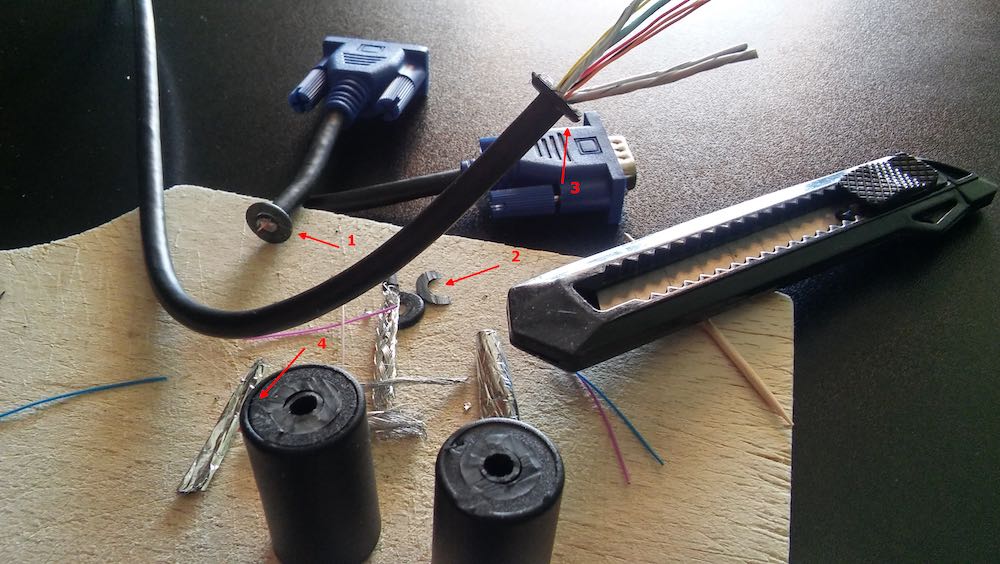
The first thing to do is use a cutter to carefully cut around the “washer” shaped plastic at the connector end of the choke (fig.1, #1,#2, #3 above), then on the same side, after cutting the plastic also cut the inner conductors (fig.1, #1).

Move to the other side of the choke, gently cut around the “washer” w/o cutting the inner conductors, now pull the cable to extract it from the choke (fig.1, #3), repeat the process for the other choke.

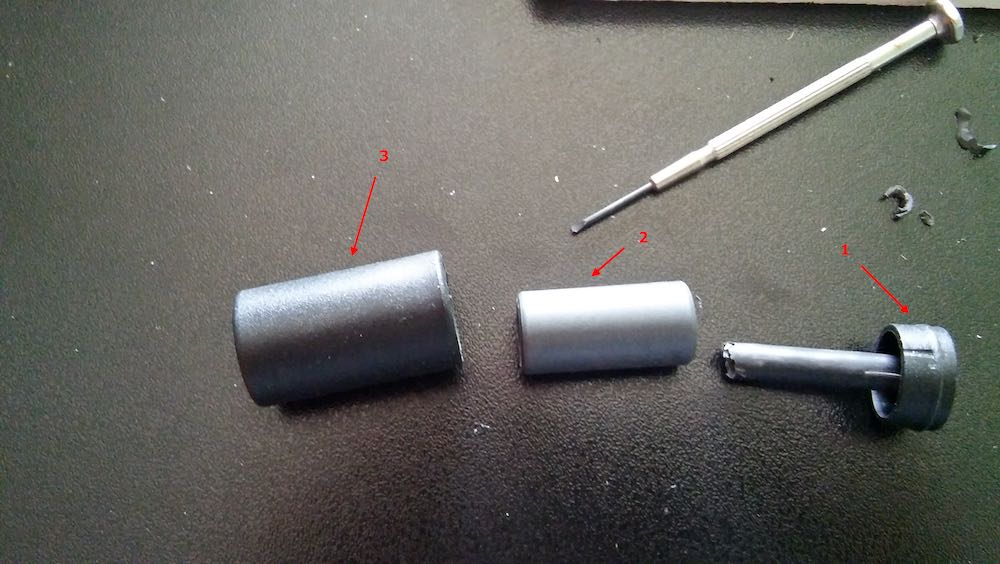
Now look at the “cans” containing the chokes, one side of those will show a “cap” (fig.1, #4), insert a small screwdriver into the center hole and gently ply to one side to raise the cap and extract it (fig.2, #1).

Figure 2

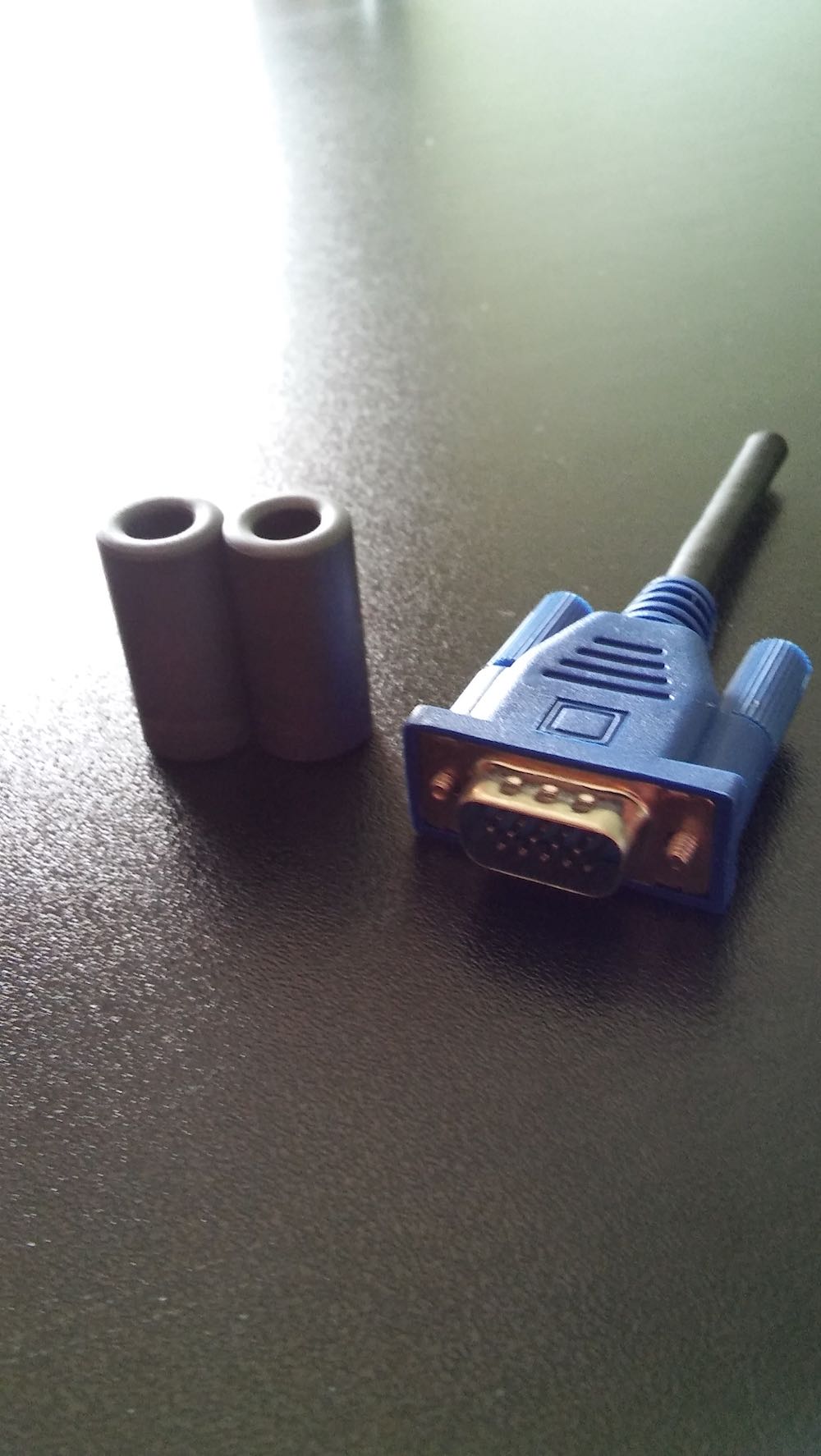
The result will be as in fig.2, where #1 is the closing cap, #2 is the ferrite choke and #3 is the “can” containing the choke. Repeat the process and you’ll have two ferrite chokes as shown in fig.3 (the VGA connector is there to give an idea of the dimensions):

Figure 3

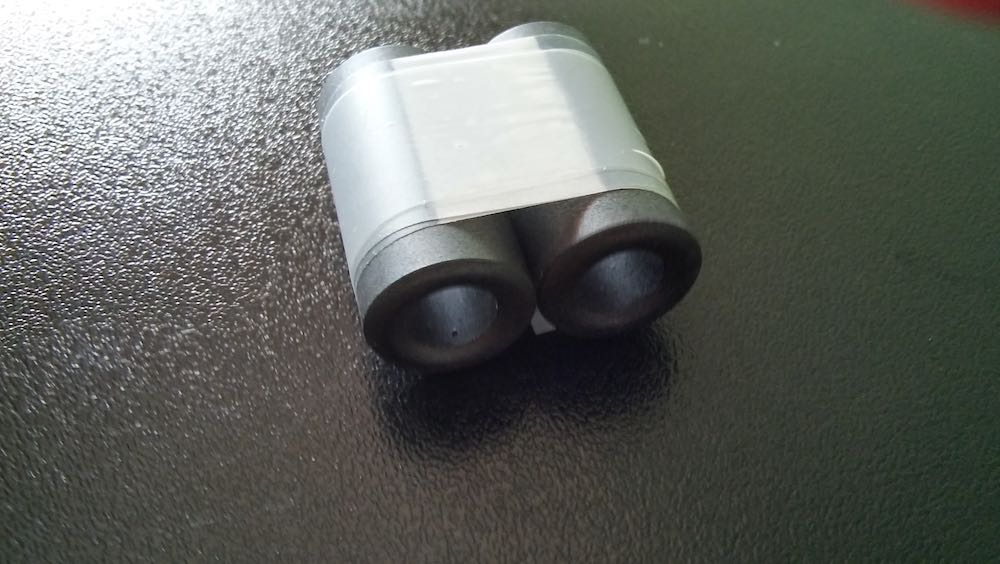
At this point, use some tape (duct tape will be a better idea, I used clear tape just to make an example) to tie the two ferrites together as in fig.4 and you’ll have your “binocular ferrite”:

Figure 4

Willing to use whatever you have there to wind the transformer, you may now extract the tiny insulated wires from the VGA cable (fig.1, #3, see wires) and use them for the windings.

Notice that other cables may use different choke “cans” which may need to cut a larger portion around the flat faces at the ends. But remember that in any case, those are just “snap-in” cans containing the ferrites, so with a bit of attention and patience, it shouldn’t be difficult extracting the ferrites.

Based on a little online research, it sounds like the ferrites used to choke the VGA cables (HDMI ones too) are generally type #31.

Looking at some #31 datasheets it appears that while #73 is works fine at frequencies below 50MHz, the #31 is best suited for the 1-300MHz range.

This means that #31 won’t be the best pick for mediumwave, although if one doesn’t have another choice… well, go for that! Also notice that the ferrite permeability is different:1500 for #31 and 2500 for #73. This means that we’ll need to increase the number of windings to achieve acceptable signal transfer, otherwise the transformer loss will make our antenna deaf.

One might try increasing the number of windings to say 8:8 or 16:16; as long as the winding
ratio will remain the same, there won’t be problems (although the resulting bandwidth will become narrower).

Thanks for documenting and sharing this, Grayhat! Since most of us have more time on our hands at home, I think it would be worth experimenting with the number of windings to see how it affects the antenna performance. That’s a clever thought, too, to use the VGA wires to wind the Balun. As long as the cable is long enough for the amount of turns, it’s certainly the most efficient use of resources!

Radio Waves: Tribute to Gene Pell, Dangerous AM Demonstration, White House Criticism of VOA, and Essex Online Classes Break Records

Radio Waves:  Stories Making Waves in the World of Radio

Because I keep my ear to the waves, as well as receive many tips from others who do the same, I find myself privy to radio-related stories that might interest SWLing Post readers.  To that end: Welcome to the SWLing Post’s Radio Waves, a collection of links to interesting stories making waves in the world of radio. Enjoy!

Many thanks to SWLing Post contributors Troy Riedel, Dennis Dura, and Dan Robinson for the following tips:


Ernest Eugene “Gene” Pell 1937-2020 (Radio Free Europe)

As noted in this obituary published by his hometown newspaper, The Paducah Sun, Ernest Eugene “Gene” Pell, 83, died quietly on April 7, 2020, at his home near Syria, after a 3-year battle with cancer. Pell served as President and Chief Executive Officer of Radio Free Europe/Radio Liberty (RFE/RL) from 1985-1993, leading the Radios during the peaceful revolutions that occurred in Eastern Europe and the Soviet Union from 1989-1992.

In Tribute to Gene Pell

In 1989, we who were privileged to serve in the management of RFE/RL as Gene Pell’s colleagues watched the awesome professionalism of RFE/RL’s broadcasters as peaceful revolution swept from the Baltics to the Balkans, and the Radios helped each country share with others the power – even the slogans – of peaceful protest, and the wisdom of restraint by police and armed forces.

Romania was a tragic exception. Ceaucescu’s regime was doomed by RFE’s broadcast of a recording of the shooting of civilians protesting in Timisoara. As Ceaucescu fled Bucharest, and violence by unknown combatants erupted, Gene ordered a million watts of shortwave power from our transmitter stations across Europe diverted to the Romanian service. Before long, Romanian army commanders seeking to restore calm established phone contact with the service in Munich.

In the immediate aftermath of the liberation of Eastern Europe, and the 1991 collapse of the Soviet Union, Gene saw the need and found the resources to open bureaus across the region and begin on-the-ground reporting by talented local journalists – and local rebroadcasting of RFE/RL programming.

And he persuaded the U.S. government to allow RFE/RL for the first time to broadcast to the former Yugoslavia, during the Bosnian War, with a new, multi-ethnic service led by Nenad Pejic*.

On Gene’s watch, Lennart Meri, Foreign Minister of a newly free Estonia, nominated RFE/RL for the Nobel Peace Prize.

Gene’s leadership was crucial as another struggle soon ensued, this time in Washington, as efforts arose to save the federal government money by shrinking or closing the Radios, on the premise that if Europe was free, why did we need Radio Free Europe (and Liberty)? Support from new democratic leaders across the region, notably from Lech Walesa and Vaclav Havel, helped convince a Presidential Commission addressing this question that the Radios’ mission should not end but evolve, as it has.

The views of these freedom leaders were decisive in keeping RFE/RL on the air and positioned to win the enormous multi-media audience it enjoys today. Gene Pell’s vision is alive for future generations.

Two of my closest colleagues, Ross Johnson and Kevin Klose, join me, as I am sure many others would, in saluting Gene for his contribution to a freer world.

— Robert Gillette []

A Dangerous Demonstration of the Power of Radio (Hackaday)

Terrestrial radio may be a dying medium, but there are still plenty of listeners out there. What would a commute to or from work be without a check of “Traffic on the Eights” to see if you need to alter your route, or an update of the scores from yesterday’s games? Getting that signal out to as many listeners as possible takes a lot of power, and this dangerous yet fascinating demo shows just how much power there is on some radio towers.[]

White House Criticism of VOA, Unprecedented in its 78 year History (Public Diplomacy Council)

The Voice of America is the nation’s largest publicly-funded international broadcaster, reaching 280,000,000 multimedia users in 47 languages each week, many of whom access it daily for honest, balanced and accurate world news.

To most senior VOA officials, past and present, including this writer, an unsigned White House blog on April 9, 1600 Daily, omitted or misstated vital information about the scale and original date of the coronavirus outbreak in mainland China. That blog asserts in a bold headline: “Voice of America spends your money to speak for authoritarian regimes.”

But that attack was just the beginning.

President Trump went even further at his daily news briefing on April 15, largely devoted to the coronavirus. “If you heard what’s coming out of the Voice of America, it’s disgusting”. The President then assailed Congress for failing to take up his nomination of conservative Michael Pack as chief executive of all five U.S. funded multimedia organizations, the U.S.Agency for Global Media, until recently known as the U.S. Broadcasting Board of Governors.

The USAGM is the oversight body of five overseas multimedia U.S.-funded networks: VOA, Radio Free Europe/Radio Liberty, Radio Free Asia, the Middle East Broadcasting Network in Arabic, and Radio/TV Marti in Spanish to Cuba. Research in approximately 100 countries indicates that collectively, the five networks reach 350,000,000 people abroad every week.[]

Essex Ham Foundation Online Training breaks all records (Southgate ARC)

The Coronavirus outbreak and the RSGB’s introduction of online exams that can be taken at home have led to a surge in demand for free online amateur radio training courses such as that run by Essex Ham

Volunteers from Essex Ham run a completely free online training course for the UK amateur radio Foundation exam.

A record breaking 260 people enrolled on the course that started April 5 with a further 164 waiting to start the next course.

In response to the demand Essex Ham are running an additional course, open to anyone in the UK, starting on April 19.

You can find out more about online training and register to join a course at
https://www.essexham.co.uk/train/foundation-online/

Essex Ham
https://www.essexham.co.uk/
https://twitter.com/EssexHam


Do you enjoy the SWLing Post?

Please consider supporting us via Patreon or our Coffee Fund!

Your support makes articles like this one possible. Thank you!

Radio Waves: Libre Space Foundation Reviews SDRs, ARRL VEC Statement, Pandemic Pastime, and Former CEO of RadioShack Now C-19 ER doctor

Radio Waves:  Stories Making Waves in the World of Radio

Because I keep my ear to the waves, as well as receive many tips from others who do the same, I find myself privy to radio-related stories that might interest SWLing Post readers.  To that end: Welcome to the SWLing Post’s Radio Waves, a collection of links to interesting stories making waves in the world of radio. Enjoy!

Many thanks to SWLing Post contributors Ron, Paul, Marco Zennaro, and Richard Langley for the following tips:


The Libre Space Foundation reviews software defined radios (Hackaday)

If you want to go to the next level with software defined radio (SDR), there are a lot of choices. The RTL-SDR dongles are fine, but if you get serious you’ll probably want something else. How do you choose? Well, your friends at the European Space Agency Libre Space Foundation have published a paper comparing many common options. True, they are mostly looking at how the receivers work with CubeSats, but it is still a good comparison.

The devices they examine are:

  • RTS-SDR v3
  • Airspy Mini
  • SDRPlay RSPduo
  • LimeSDR Mini
  • BladeRF 2.0 Micro
  • Ettus USRP B210
  • Pluto SDR

They looked at several bands of interest, but not the HF bands — not surprising considering that some of the devices can’t even operate on HF. They did examine VHF, UHF, L band, S band, and C band performance. Some of the SDRs have transmit capabilities, and for those devices, they tested the transmit function as well as receive.

The review isn’t just subjective. They calculate noise figures and dynamic range, along with other technical parameters. They also include GNURadio flowgraphs for their test setups, which would be a great place to start if you wanted to do these kinds of measurements yourself.[]

ARRL VEC Issues Statement on Video-Supervised Online Exam Sessions (ARRL News)

Very few ARRL Volunteer Examiner teams have successfully conducted in-person exam sessions (following social distancing guidelines) and video-supervised exam sessions using fillable PDF exams and documents. So far, we have found that both types of sessions take volunteer teams two to three times longer to conduct and accommodate fewer candidates than sessions conducted prior to the COVID-19 pandemic. So far, the video sessions have included only one examinee per session.

We ask the community to be patient with our volunteer teams as they navigate uncharted territory. Please remember with the introduction of significant new processes such as these, that there should be proof of concept, establishment of protocols and procedures, and beta testing before expanding to a larger audience. Video-supervised exam sessions require a different skillset than in-person exam administration. Not all teams will be equipped to deliver video exams right away.

The ARRL Volunteer Examiner Coordinator (VEC) has been investigating options for an online examination system.

Fillable PDFs are cumbersome within a video-supervised exam session process. We recognize that online testing would represent a large-scale solution for our thousands of VEs and would make session procedures easier for our teams, but this will not happen overnight.

The ARRL VEC will continue to adapt and respond to the evolving crisis as we search for viable and easy-to-use online examination system solutions and conduct exam sessions in innovative ways.[]

Pandemic Pastime – Shortwave Radio (KFGO)

Ever since I was a little kid, I was fascinated that at night you could listen to radio stations from all over the country. My little Heathkit radio, which I built myself, could pick up stations in Minneapolis, Chicago, St. Louis, Denver, Little Rock, Pittsburgh to name a few. West coast stations were rare because it was tough getting a signal over the Rocky Mountains.

Then there was shortwave radio. A buddy of mine had one and he showed me a list of all the countries he was picking up. England, France, Germany, Latin American countries, numerous stations on the shortwave bands in America. Even Radio Havana coming out of Cuba. Anything from religion to hard edge rock and roll. He also noted he picked up Radio Free Europe and the Voice of America.

Well years later I would stop by my local Radio Shack and decided it was my turn to take up this hobby of monitoring shortwave radio. This particular radio also had a built in cassette player so you could record your found stations as well. It was really interesting to hear the news from other countries and get their take on what was happening in America.

One of the first frequencies I tuned in was WWV a shortwave radio station out of Fort Collins Colorado, that broadcasts the time via the atomic clock. The seconds tick off until the top of the hour when you hear a voice announce the time, followed by a tone that hits the top of the minute exactly on the nose. Great way to set the clock.

Now I know you can probably find all these shortwave stations on the internet, but what fun is that right?

With the covid-19 pandemic, this is a little something different than binge watching television, or building that 10th jigsaw puzzle or cleaning out that closet again and again.

Have a chair on the patio, a glass of your favorite beverage, extend the antenna, and start turning up and down the dial and see what you can find. I had a little notebook that I kept track of my searches. Don’t have it now though…lost it.

I’ll start a new one.

Stay safe everyone![]

Former CEO of RadioShack now an ER doctor (National Post)

‘I am just one of those people who was very fortunate, where things worked out, and where I could do not just do one thing I really enjoyed in life, but two’

Brian Levy loved science as a kid. He had a microscope, read up on stuff in the encyclopedia and messed around with home experiment kits. During his high school years, he took every science credit possible. By his own admission, he was a “geek,” one with an equally strong passion, alongside science, for electronics.

Levy knew how to operate a shortwave radio. Weekend teenage heaven, in his mind, was hanging around the local RadioShack store, a warehouse of gizmos where he scored his first part-time job in 1974, earning US$1.40 an hour at a shop in downtown Atlanta. He was 15, which, alas, was too young to be working for the company, according to the folks at corporate headquarters in Texas, who fired him upon receiving his paperwork.

The dismissal didn’t sit well with Levy.

“I actually called the vice president of human resources in Texas,” he says. The executive was impressed by the moxie of the kid. On the day he turned 16, Levy was hired back.

[…]Levy did not foresee the premature end to his business career. When it came, rather than being crestfallen, he felt liberated, and free to pursue an “itch” that he had always felt the need to scratch. So he applied to medical school at McMaster University in Hamilton, ON. (Levy came to Canada in the first place after relocating RadioShack HQ north of the border as CEO. He is now a dual citizen, although his soft, buttery accent betrays his roots in the American south.)[]


Do you enjoy the SWLing Post?

Please consider supporting us via Patreon or our Coffee Fund!

Your support makes articles like this one possible. Thank you!

ARRL: “Remotely Administered Amateur Exam Systems Showing Promise”

(Source: ARRL News)

Facing a growing demand for amateur radio exam sessions in a time of social distancing and stay-at-home orders, sponsors of some Volunteer Examiner (VE) teams have risen to the challenge and are developing systems to remotely proctor test sessions.

“Many of our VEs and VE Teams have been working on remotely proctored exam session ideas, employing both video and in-person components — following social distancing protocols,” ARRL Volunteer Examiner Coordinator (VEC) Manager Maria Somma, AB1FM, said. “We have been receiving interesting and innovative suggestions, and we appreciate the dedication and ingenuity our examiners have shown.”

The Spalding County Amateur Radio Club in Georgia is among those that have come up with plans to remotely administer amateur exams while complying with ARRL VEC testing standards during COVID-19 stay-home mandates and social distancing guidelines. Current systems leverage Zoom video-teleconferencing technology, the “Fill & Sign” feature of Adobe PDFs, reliable email, appropriate computer equipment and internet connection, and no volunteer examiners (VEs) present at individual remote test sites. The Georgia club collaborated and shared ideas with the Emergency Amateur Radio Club (EARC) in Hawaii, which has successfully conducted sessions since 2011 with its own remote testing system, initially with paper exams with a proctor on site and now with fillable PDFs, with no on-site proctor.

The Georgia club obtained ARRL VEC approval to administer video-supervised exams. The club’s David Robinson, K4WVZ, said the first exam session took place this week, with another set for next week, and “many more in the pipeline” going forward.

“We have started with testing just one candidate at a time but are planning to ramp up to multiple candidates — probably two or three — simultaneously,” Robinson told ARRL. “Before we do that, we want a few more single sessions under our belt and a few more Video VEs trained. It also gives us an opportunity to garner lessons learned from each test session and upgrade our procedures accordingly.” Robinson said this week’s session went “exceedingly well,” and the candidate passed the test.

The club’s procedures entail a pre-exam video interview with candidates to ensure they understand all the requirements and procedures. “This also allows us to test the candidate’s ability to work with the video and computer technology before the actual exam,” Robinson explained. “Training sessions were conducted for VEs to make sure they understood their role and how to use the technology.”

Following the exam, the VEs score the test and sign off on the paperwork, with the VE Team Leader submitting the application online and by mail, per ARRL VEC instructions. Application and successful exam are first accepted and then submitted to the FCC for processing.

New England Amateur Radio Inc (NE1AR), an affiliate of New England Sci-Tech, (NESciTech), has taken it one step further, Somma said. It got the approval of ARRL VEC to begin trials of what it describes as “completely online testing with strict rules and protocols for maintaining the integrity of the testing environment.” NE1AR is limiting candidates to one exam per candidate, due to the current candidate backlog and the “difficulty of administering exams online.” Candidates must agree to a list of protocols, which include no visitors (or pets) in the exam room and a cell-phone camera scan of the entire room and exam area “to show that there are no materials or people [in the room] that could aid in taking the exam.” If the VE team suspects the possibility of cheating, the exam may be terminated and the candidate barred from future online exam sessions.

“We began a series of trials on April 1 under ARRL VEC review and have now been asked to help train more VE Teams on the process,” NE1AR President Bob Phinney, K5TEC, told ARRL. “We have now tested 12 applicants and are still working on streamlining the process. We are working with the software developer of the exam delivery system to help them adapt the system for video-supervised testing.” At present, Phinney said, only one person at a time can be tested. Another time-related issue is how long it takes a candidate to go through the NE1AR security protocol. “Sometimes, the setup and follow-up for an exam take far longer than the exam itself, in order that we provide complete integrity of the exam session,” he said.

With pressure continuing to build to provide testing compatible with COVID-19 guidelines and stay-home orders, ARRL VEC Manager Maria Somma, AB1FM, has asked the amateur radio community to be patient. “Please remember that with the introduction of significant new processes such as these, that there should be proof of concept, establishment of protocols and procedures, and beta testing, before expanding to a larger audience,” she said this week. Somma said video-supervised exam sessions require a different skillset than in-person exam administration, and not all teams will be equipped to deliver video exams right away.

“ARRL is pleased to be one of the leaders in providing an opportunity, although limited initially, for video-supervised exams in this time of social distancing and isolation required by the current health situation,” Somma said.

Click here to read the full article at the ARRL News.