Category Archives: Mediumwave

Paolo’s review of the Eton Elite Satellit

Many thanks to SWLing Post contributor, Paolo Viappiani, who shares the following guest post:


ETON Elite Satellit: an expensive flop 

by Paolo Viappiani, Italy 

Introduction 

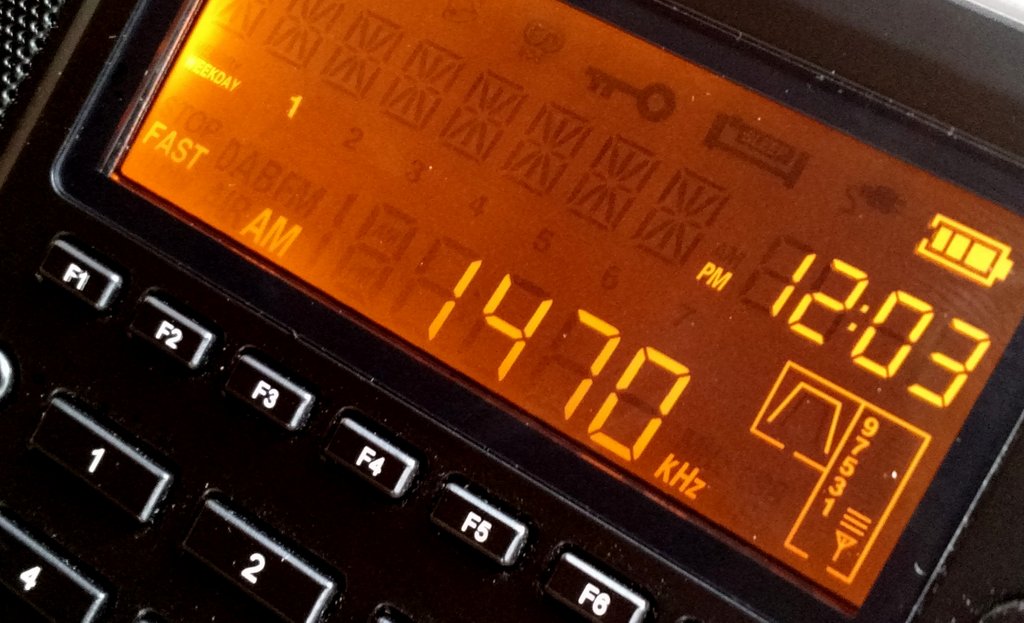
After various and sometimes conflicting announcements that have created strong expectations in radio listening enthusiasts, ETON has recently launched on the extra-European market (basically in the United States) what should have been its “top of the range” portable, the Elite Satellit model . Aesthetically (and also functionally) inspired by the previous E1 model, the new portable radio should have been free from the defects of its predecessor, in particular as regards the “sticky” coating of the plastic case but also with respect to other technical drawbacks repeatedly reported by users (display contrast and shading, etc.).

The new Elite Satellit was announced to look practically identical to the E1 model and to use the same cabinet, but with various additions and improvements: RDS, FM-HD reception, Air Band, etc. A frequency resolution of 10 Hz in the shortwave bands, a PBT (Pass-Band Tuning) facility, a large LCD display with the possibility of changing its background color were also provided.

It is therefore obvious that its release was highly anticipated, and the resulting expectation gave rise to numerous pre-orders of the radio in the United States, where the main distributor was (and still is) the well-known Universal Radio company owned by Fred Osterman [1].

Unfortunately, the initial boom in sales of the ETON Elite Satellit was followed by many return requests due to the poor performances of the radio and the numerous defects encountered by users, also reported in a lot of videos and negative reviews on the Internet [2].

Fred Osterman himself, disappointed by the performance of a radio that he should have sold as an excellent portable, began to test the individual devices in his own laboratory and to return to ETON all the units that did not meet the declared specs (basically the vast majority of those received for sale) [3]. All this caused great confusion at ETON, which was forced to somehow remedy its errors (mainly due both to a very approximate alignment of the circuits and to an almost non-existent final quality control).

Unfortunately, despite the precautions adopted “hastily” by ETON, most of the “overhauled” devices that were returned to Universal Radio continued not to comply with the specifications, so that Fred Osterman, who is a good technician and a very honest dealer, decided to cancel most of the orders received and to sell the very few radios found to be in good working order within the United States only, (see again note [3]). I myself placed an order from Universal Radio for an ETON Elite Satellit on August 8, 2022 (Order ID: #8992932, retail price $599.99 plus shipping and import customs duties), but Fred was forced to “drastically cut” the orders received and to cancel mine too, due to the impossibility of satisfying the many customers on this side of the pond. However, my desire to have an example of the ETON Elite Satellit in my hands, in order to be able to see, test and judge the new radio it was really great, and great was also the wish to realize if the many negative impressions circulating on the web were or were not justified and true.

So I decided to look for other ways to buy the “latest cry” of ETON. The opportunity presented itself to me, almost unexpectedly, by visiting the American site of Amazon [4].

The purchase and the arrival of the radio; my first impressions 

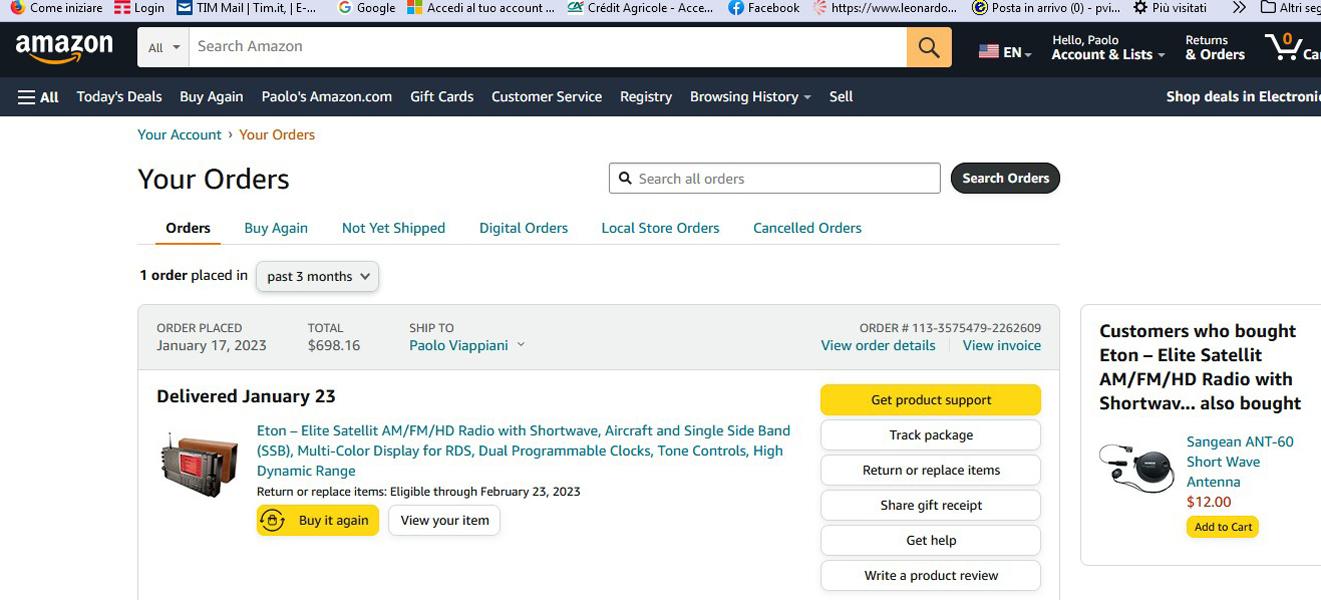
I therefore ordered an ETON Elite Satellit portable radio on the Amazon.com website on January 17, 2023 at the price of $698.16 (including shipping and customs duties). I report in Figure 1 the screenshot concerning my order #113-3575479-2262609 which, as it appears, was delivered to me on January 23, 2023, after only five days; this demonstrates the truthfulness of my statements.

Figure 1: A Screenshot of my Amazon.com order dated January 17, 2023.

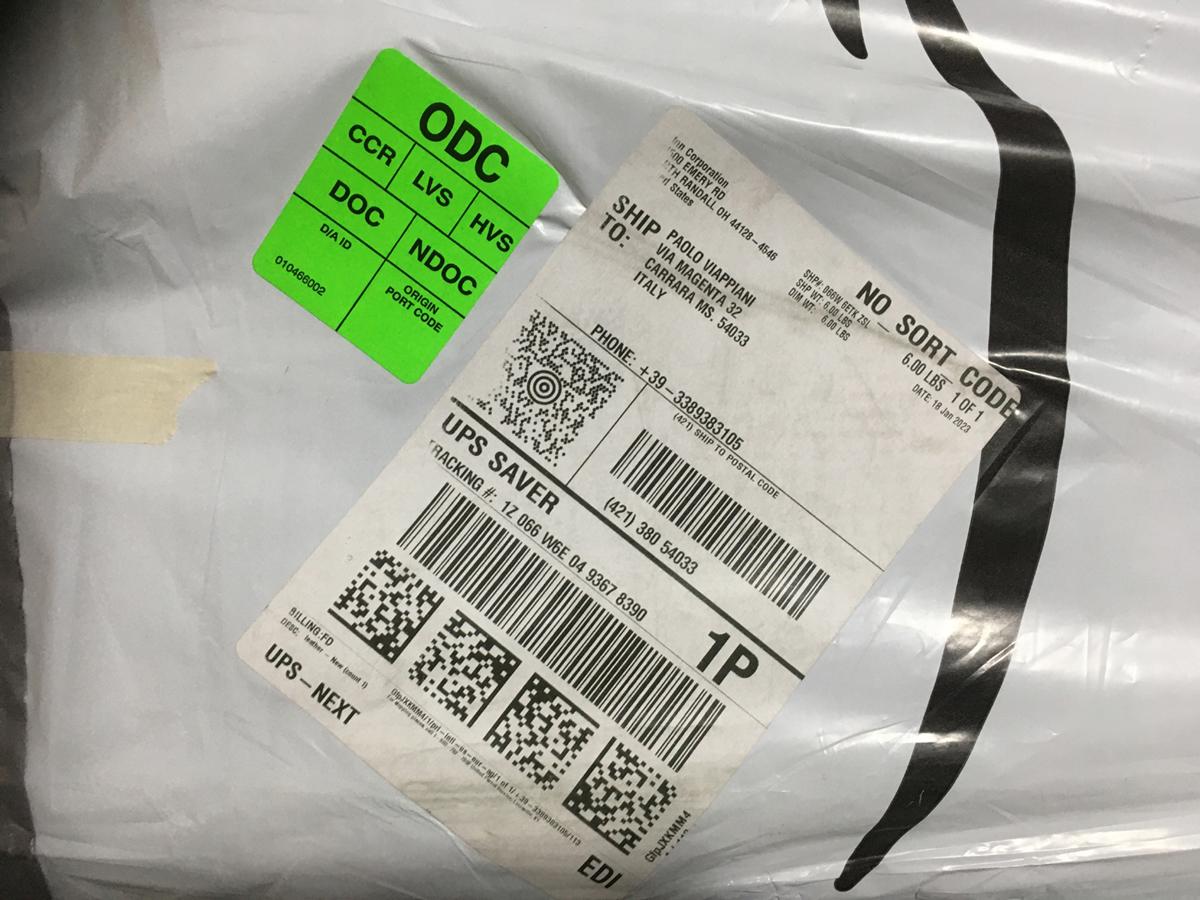
The shipment was delivered to me by UPS courier in the usual Amazon packaging in a plastic bag (Figure 2).

Figure 2: The UPS label and the Amazon plastic bag.

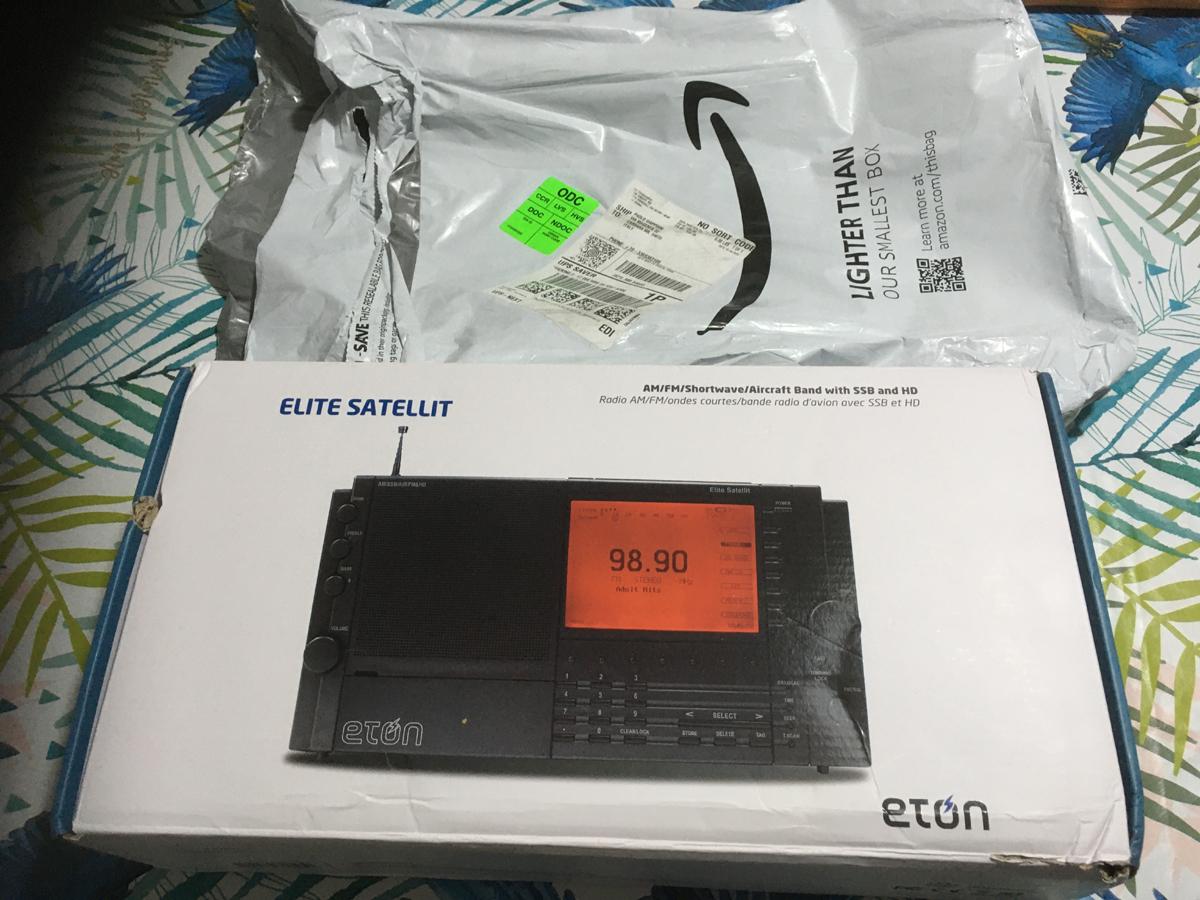
Inside the envelope was a cardboard box containing the radio, in understandably less than perfect conditions (Figure 3).

Figure 3: The cardboard box of the ETON Elite Satellit.

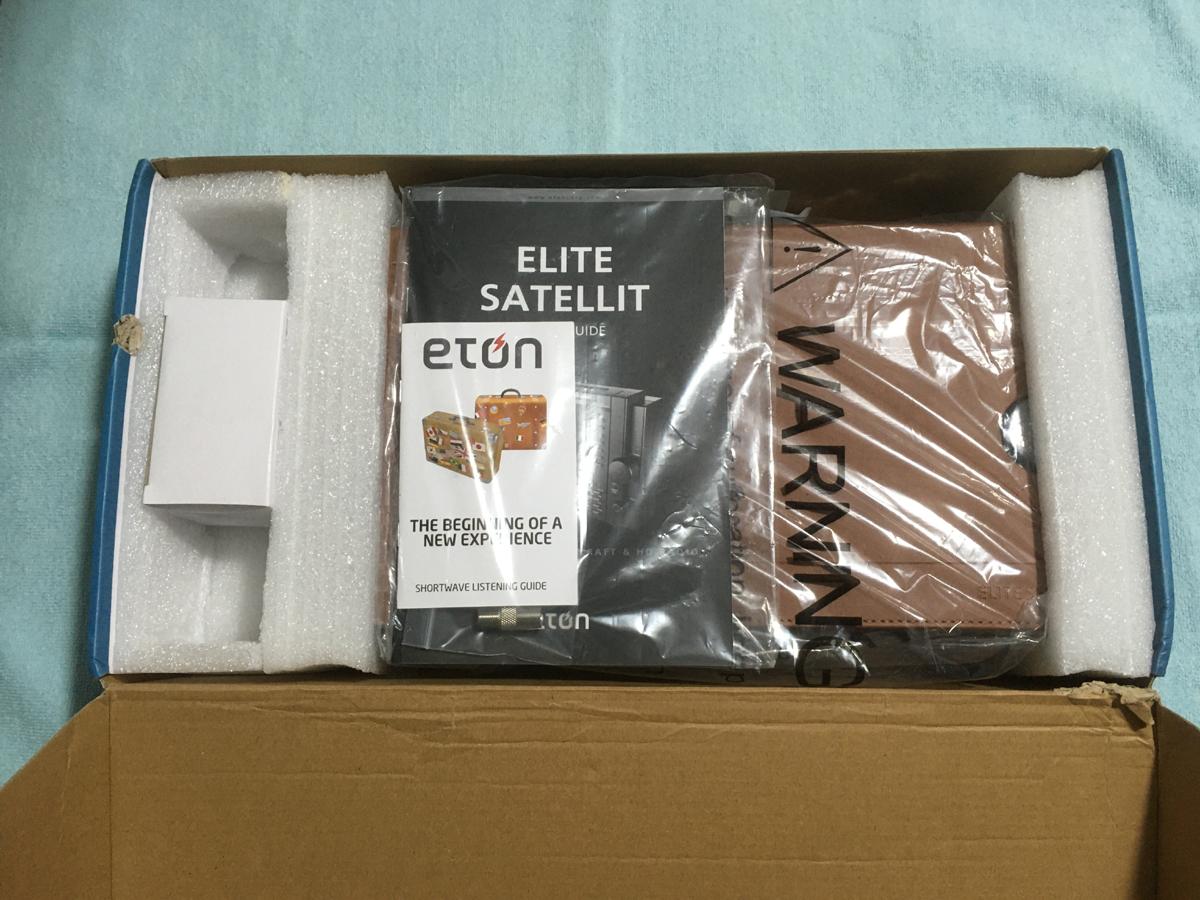
Figure 4: The contents of the radio box.

Once the package was opened, the contents of the box looked like in Figure 4: two shock-absorbing spacers held the device in position (inserted in a plastic bag) and its AC power supply (into a white box, and obviously with a 117V input voltage). There was also the “User Guide” in a paper version and a “mini-guide” to listening to short waves; completely absent was the CD that used to be enclosed in the box of the previous E1 version of the radio.

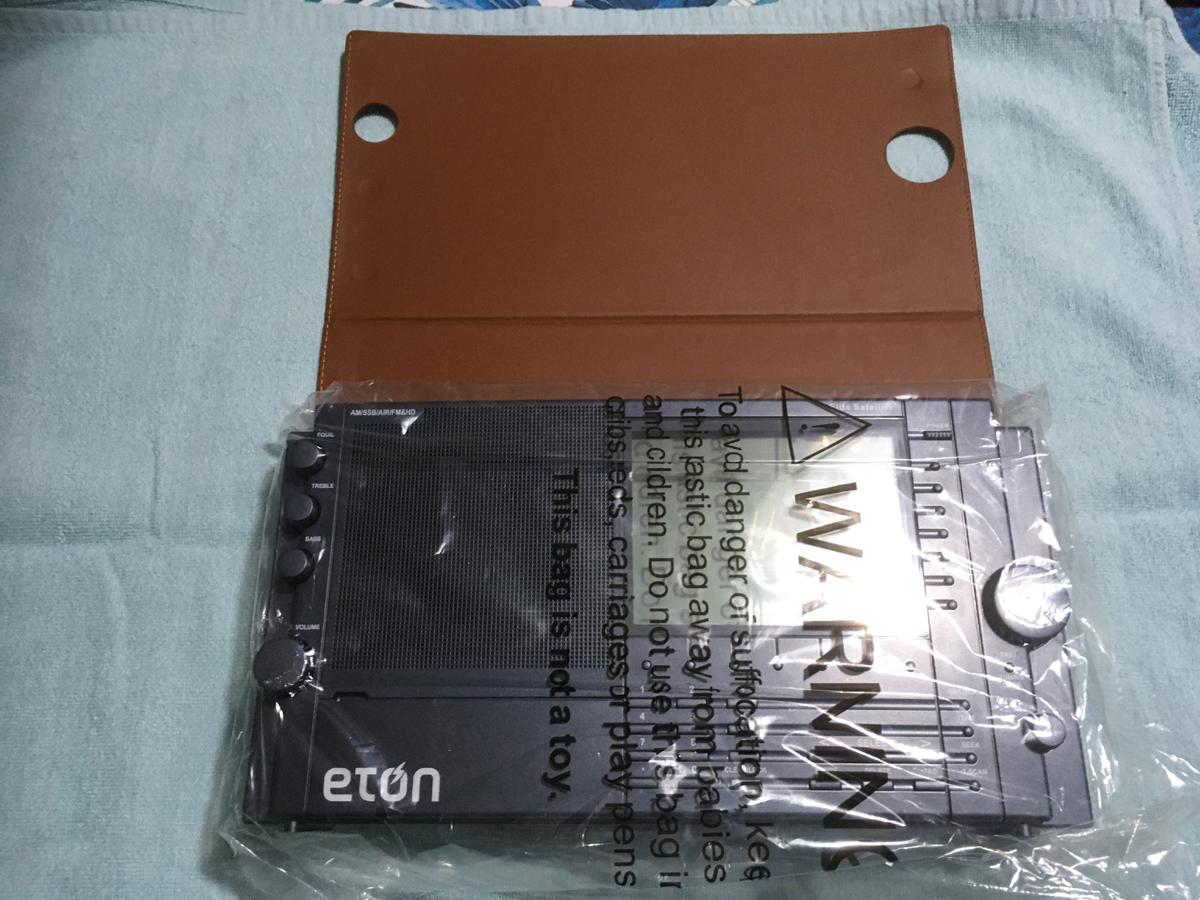
Continuing with the operations, I came across a sort of brown plastic cover intended for the protection of three sides of the radio (front, top and back) which can be held in position by some magnets and is provided with two circular holes in correspondence with the tuning knobs and volume of the radio (Figure 5).

Figure 5: The ETON Elite Satellit radio and its “case” (?)

I omit to make comments on this “protection”; I only say that in my opinion it is useless (and ugly too) and I believe that the gentlemen of ETON could have wasted their energies otherwise; but maybe someone likes it too…

Figures 6 and 7 show the front and back of the portable radio as soon as it has been removed from the protective plastic bag. Note the almost identical appearance of the cases of the Elite Satellit and of the previous E1 model.

Continue reading

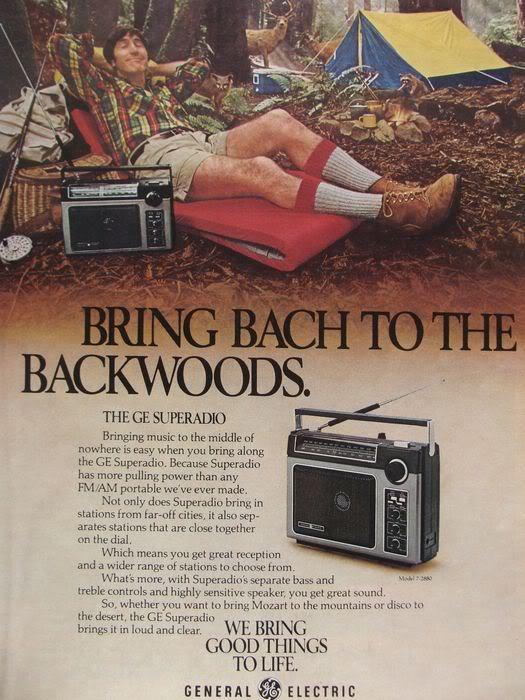
Chuck Rippel’s GE Superadio Repair and Recapping Service

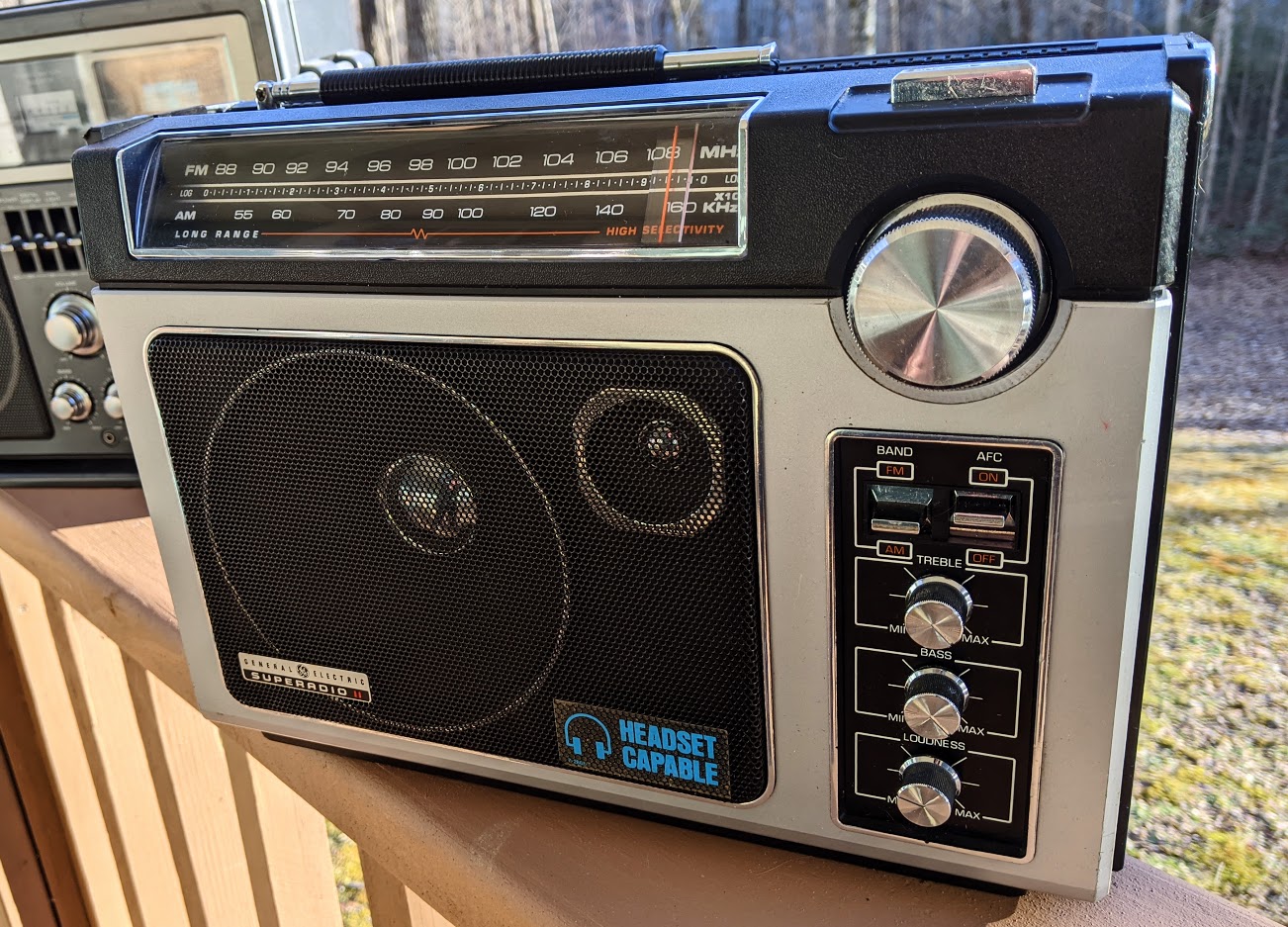
If you own a GE Superadio I or Superadio II and you would like an expert to restore and/or replace the capacitors, you’re in luck!

Chuck Rippel (K8HU) has announced that he will start repairing and restoring GE Superadios for anyone interested. In the past, he’s done this on a case-by-case basis when time allowed, but he has stocked up on top-shelf components and cleared off his workbench to bring Superadios back to life.

I can confirm that his work is superb. You might recall this post and video showing just how impressive his re-capped and restored Superadios perform. My restored Superadio held its own when compared with my Panasonic RF-2200 and even outperformed it in some respects. Click here to read that post.

Chuck asks that you contact him via email if you would like your Superadio recapped or repaired.

You can reach Chuck at:

A note about the Superadio III

As mentioned above, Chuck only works on the SRI and SRII models.

Chuck notes that the issue with repairing SRIIIs is: “[working with] the tuning mechanism and putting it back together so it works and the dial is in reasonable calibration. If the dial cord comes off, it’s terrible to tray and re-install so, I stay away from model III’s.

Radio Waves: Absolute Radio’s Switch-Off, Pirate Database, Little Pea Island, Zero Power Transmitting, and is AM Radio Dead?

Radio Waves:  Stories Making Waves in the World of Radio

Welcome to the SWLing Post’s Radio Waves, a collection of links to interesting stories making waves in the world of radio. Enjoy!

Many thanks to SWLing Post contributors Dennis Dura, JP, NT, and Paul for the following tips:


Hear Absolute Radio’s 200KW Transmitter Switch Off Forever (YouTube)

Saturday morning fun: “fat” MW DXing with the MFJ-1886

By Jock Elliott, KB2GOM

It was a reader, Mario Filippi, who set me on this path. He posted a comment that said, in part: “An interesting place to DX would be the segment between 1500 – 1590 kc’s where there are a number of news stations, one being federal news on 1500.”

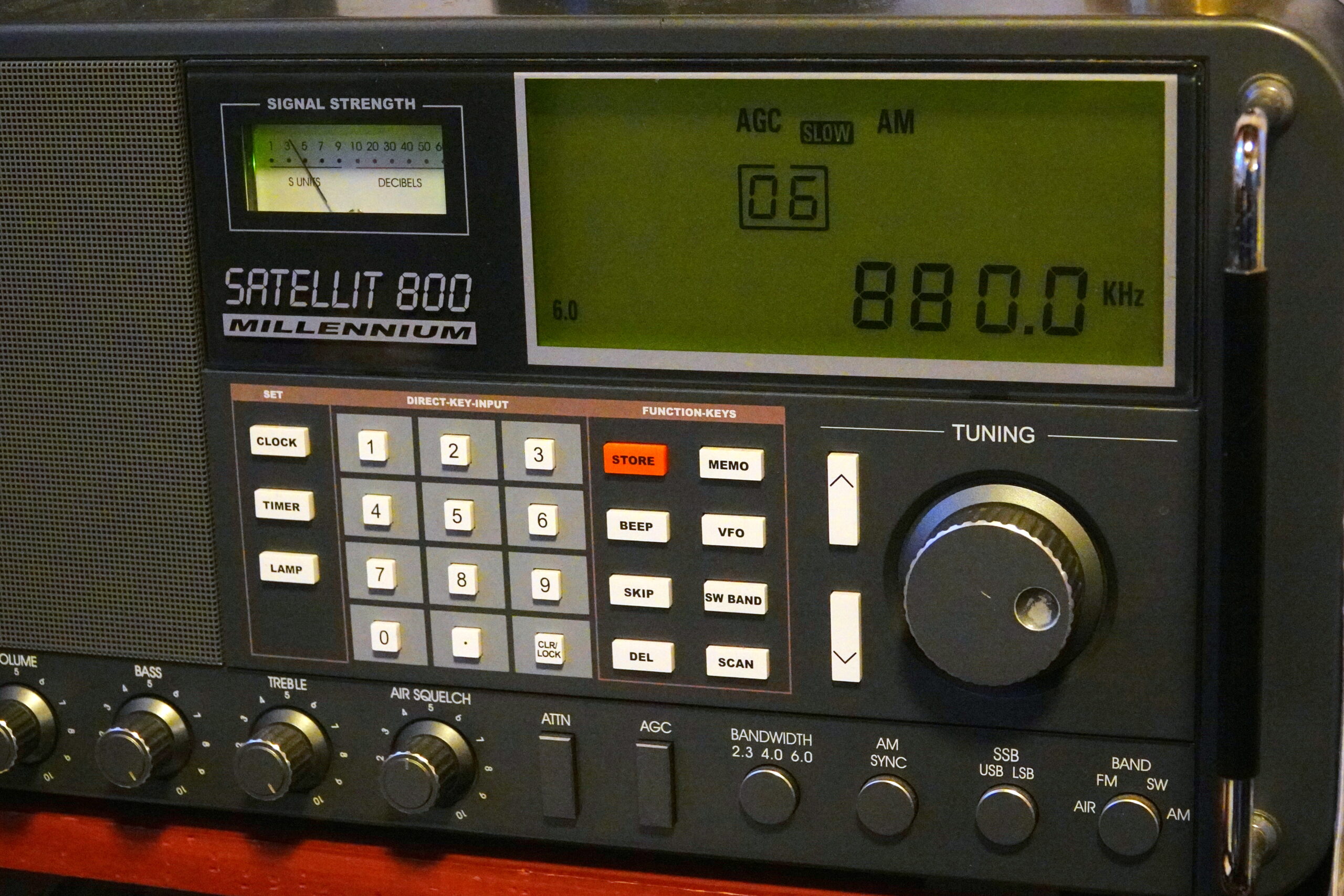
Huh, I thought, federal news? I wonder if I can hear that. So I hooked up the MFJ 1886 Receive Loop Antenna to my Grundig Satellit 800 receiver and tuned to 1500. With the 800’s whip antenna, I heard mostly static; switching to the 50-foot indoor room loop, pretty much the same; same thing with the 1886 with the amplifier turned off. But turn the 1886’s amplifier on, and it was like getting slammed against the wall by the schoolyard bully: LISTEN TO ME! A big, fat, S9 signal, sounding like WGY 810 just a few miles from me. Wow, I thought, this loop can really pull out a signal.

A little research revealed, as nearly as I can tell, that Federal News 1500 is in Washington, DC, over 300 miles from me. Over the next few days I would occasionally check on Federal News 1500 using the 1886 loop, and typically it was loud and clear here in Troy, NY.

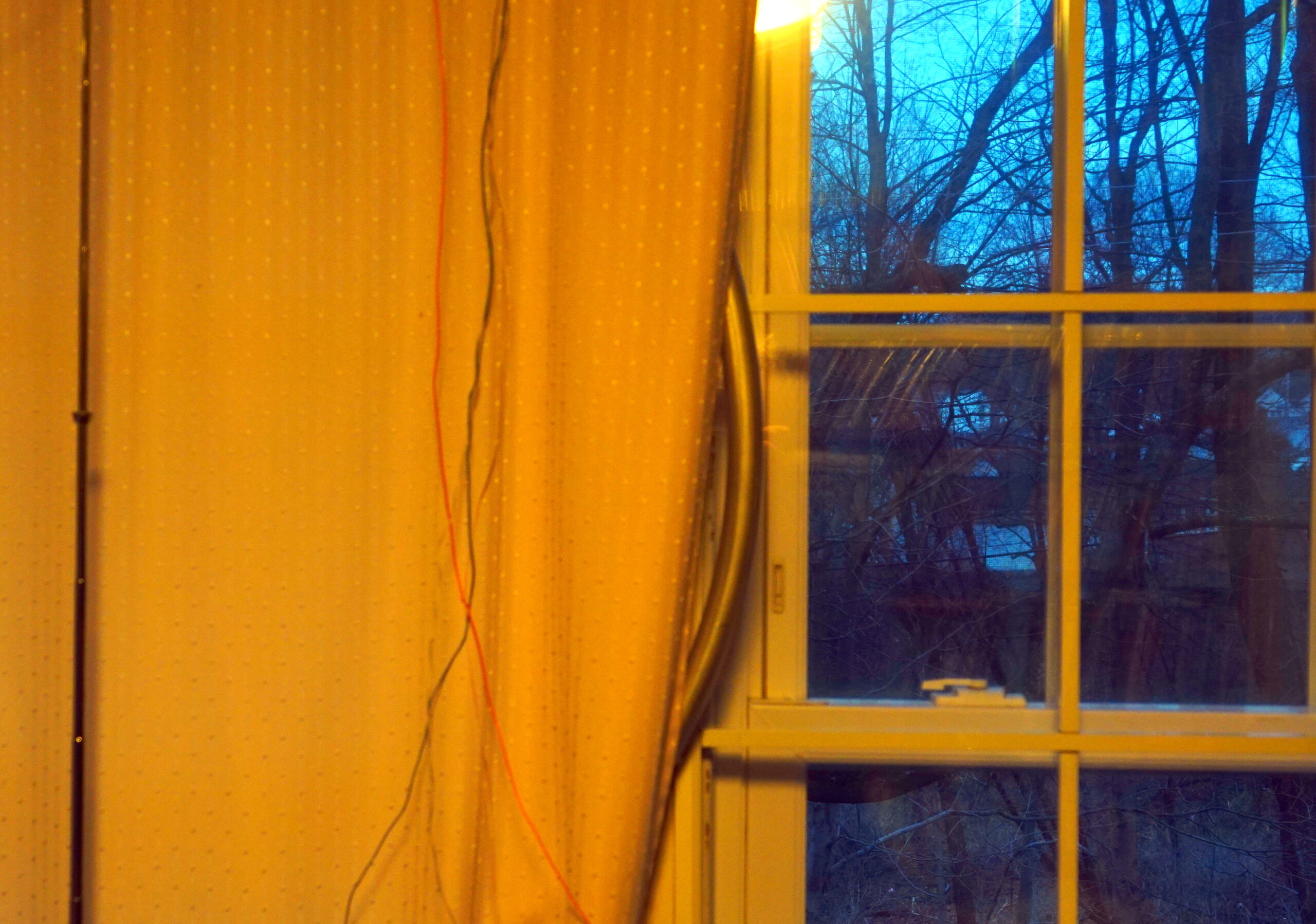
Hidden behind a curtain, the 3-foot aluminum loop of the MFJ 1886 works well for MW DXing.

Early this morning, Jan. 28, 2023, a thought crept into my brain: how many big, fat, MW signals could I detect with the combo of the Satellite 800 and the MFJ 1886 loop antenna? (Bear in mind that my 1886 rests flat against a window and is NOT rotatable in its current configuration.) Here’s the log, with station IDs when I could get them.

Time                Frequency                   Station

1100Z              1520                            WWKB Buffalo

1102Z              1530                            Milwaukee? Sports, Australian open

1106Z              1540                            CHIN Toronto, old time radio programs

1112Z              1560                            religious music

1115Z              1660                            orchestral music, Strauss waltzes

1118Z              540                              middle eastern music

1121Z              660                              WFAN, NYC

1124Z              700                              WLW, Cincinnati

1127Z              710                              WOR, the Voice of New York

1129Z              730                              French language, Canada mentioned

1132Z              750                              WSB, Atlanta

1134Z              770                              WABC, NYC

1135Z              790                              ortho doctor show

1138Z              860                              French language, Canada mentioned

1140Z              880                              WCBS, NYC

1142Z              1010                            WINS, NYC

1144Z              1020                            Talk

1146Z              1030                            WBZ, Boston

1148Z              1050                            WEPN, ESPN radio, New York

1149Z              1060                            KYW, Philadelphia, PA

1153Z              1090                            WBAL, Baltimore

1154Z              1110                            WBT Charlotte, NC

Bottom line: it was immense fun, tuning around for “fat” MW stations in the early AM. Periodically I checked the other antennas as I traversed the band, but universally the MFJ 1886 was better at pulling them in.

Fat station DX? You bet! Try it; you’ll like it!

Don Moore’s Photo Album: Cuenca, Ecuador (Part One)

Cuenca Cathedral

Many thanks to SWLing Post contributor, Don Moore–noted author, traveler, and DXer–for the latest installment of his Photo Album guest post series:


Don Moore’s Photo Album: Cuenca, Ecuador (Part One)

by Don Moore

For me travel is all about seeing new places and having new experiences. When I retired in 2017 my plan was to spend the next fifteen years visiting new countries and new places in countries I already knew. Is that a viable goal? Three years ago while crossing the border from Ecuador to Colombia I shared a taxi with Dutch man who, like me, was traveling overland by bus with just a knapsack and a suitcase. And two weeks earlier he had celebrated his eightieth birthday. I don’t remember his name but he’s my hero.

The pandemic put a pause on travel but I’m happy to be back on the road. I’m currently in Ecuador, the country where I’ve spent more time than anywhere except the United States and Honduras. After landing in Quito at the beginning of December I visited four provinces I hadn’t been to before, including spending three nights at the bohemian beach town of Montañita where I had some good DX. I like seeing new places but there is also something to be said for returning to a familiar place that holds a special meaning. For me that place is where I am now – Cuenca, Ecuador.

My ex-wife and I finished our Peace Corps service in 1984, flew home to get married, and then in January 1985 flew to Quito, Ecuador to begin a long journey that would take us overland all the way to Buenos Aires and back. On our way to Peru in late February we stopped for a few days in Cuenca and fell in love with the little city. We visited Cuenca again in July at the end of our travels. When we left I knew we would be back but I never could have imagined the circumstances that would lead to that next visit. In 1997 we returned with our seven-year-old daughter to adopt a six-year-old son. We spent almost three weeks in Cuenca doing all the required paperwork but we had no complaints as we enjoyed being there so much. I clearly remember sitting in a park one day and commenting that Cuenca would be a perfect place to retire in someday. I was only ten years ahead of my time.

La Voz del Río Tarqui

Cuenca was home to several shortwave broadcasters over the decades but La Voz del Río Tarqui was probably the best known to my generation of DXers. The station was founded in 1960 by Manuel Pulla but didn’t begin its shortwave service on 3285 kHz until 1982. My loggings of the station run from July 1982 through 1997 but I believe they were on shortwave for a few more years after that. (Don’t confuse La Voz del Río Tarqui with Radio Tarqui, a sometimes broadcaster from Quito on 4970 kHz.)

La Voz del Río Tarqui in 1985. The facilities inside were no more impressive than the outside of the building was.

La Voz del Río Tarqui takes its name from the famous Battle of the River Tarqui. After the new countries of South America gained their independence from Spain there was often disagreement over just where the boundaries were that they had inherited from Spanish rule. Ecuador was in a union with present-day Colombia and Venezuela until 1830 and during this time Peru claimed much of present-day southern Ecuador, including Cuenca and Guayaquil. In 1828 a large Peruvian army occupied Loja, to the south, and a few months later marched north to complete their conquest. In February 1829 General Antonio de Sucre, a hero of the war of independence, met the Peruvians on the banks of the Tarqui, twenty-five kilometers south of Cuenca. Both sides suffered heavy losses but Sucre’s army routed the Peruvians. Cuenca, Guayaquil, and Loja remained a part of Ecuador. Continue reading

Radio Waves: Shively Labs Broadcast Antennas, Fedora SWL, F-150 Lightning AM, and Young Listeners on the Decline

Radio Waves:  Stories Making Waves in the World of Radio

Welcome to the SWLing Post’s Radio Waves, a collection of links to interesting stories making waves in the world of radio. Enjoy!

Many thanks to SWLing Post contributor Dennis Dura for the following tips:


Public radio engineers await fate of major antenna maker (Current)

The potential sale of one of the country’s only major manufacturers of high-power FM broadcast antennas is causing concern among public radio engineers who have long depended on the company for challenging projects such as directional antennas and multistation combiner systems.

Antennas and combiners made by Shively Labs carry the signals of many major stations, from Boston’s WBUR to Dallas’ KERA/KXT to Seattle’s KUOW. Shively’s headquarters in Maine boasts one of the few test ranges needed to fully prepare complex directional antenna systems for real-world performance.

Founded in 1963 by former RCA engineer Ed Shively, the company has been owned since 1980 by Howell Laboratories, an engineering firm that now has a wide range of product lines. Those include water purification systems, dehydrators and an increasing amount of contract work for the U.S. Navy.

While its military and commercial marine business has grown, broadcast antennas have become a smaller piece of the company’s portfolio, said Shively VP Angela Gillespie. [Continue reading…]

How to become a Shortwave listener (SWL) with Fedora Linux and Software Defined Radio (Fedora Magazine)

Catching signals from others is how we have started communicating as human beings. It all started, of course, with our vocal cords. Then we moved to smoke signals for long-distance communication. At some point, we discovered radio waves and are still using them for contact. This article will describe how you can tune in using Fedora Linux and an SDR dongle.

My journey

I got interested in radio communication as a hobby when I was a kid, while my local club, LZ2KRS, was still a thing. I was so excited to be able to listen and communicate with people worldwide. It opened a whole new world for me. I was living in a communist country back then and this was a way to escape just for a bit. It also taught me about ethics and technology.

Year after year my hobby grew and now, in the Internet era with all the cool devices you can use, it’s getting even more exciting. So I want to show you how to do it with Fedora Linux and a hardware dongle. [Continue reading…]

Did AM Radio Just Get Hit By “Lightning”? (Radio World)

There’s something missing from the newest F-150 Lightning truck

These days, the auto industry is as disrupted as broadcast radio. Like the radio companies – a group of independent operators, each moving down a different pathway – automakers are highly individual companies. Continue reading