Shortwave listening and everything radio including reviews, broadcasting, ham radio, field operation, DXing, maker kits, travel, emergency gear, events, and more
Many thanks to SWLing Post contributor, Bill Patalon, who reminds us that 78 years ago today (September 21, 1939) radio station WSJV made an audio recording of its entire 19 hour broadcast day. Bill points to these details from Wikipedia:
This undertaking was a collaboration between the station and the National Archives, and it was the first time that such a comprehensive recording of a radio broadcast had been made. The station then donated its original set of recording discs to the National Archives, giving it a rare and complete artifact from an era frequently called the Golden Age of Radio. Due to their historical significance, the United States Library of Congress has since added these sound recordings to its National Recording Registry.
If you would like to relive September 21, 1939, you can listen to all of the WSJV recording segments courtesy of Archive.org. I’ve embedded the full playlist below–simply press play at the top of the player and each segment will load automatically as long as this page is open. Note that in the very first segment, due to a WSJV equipment glitch, there is a period of silence. Enjoy:
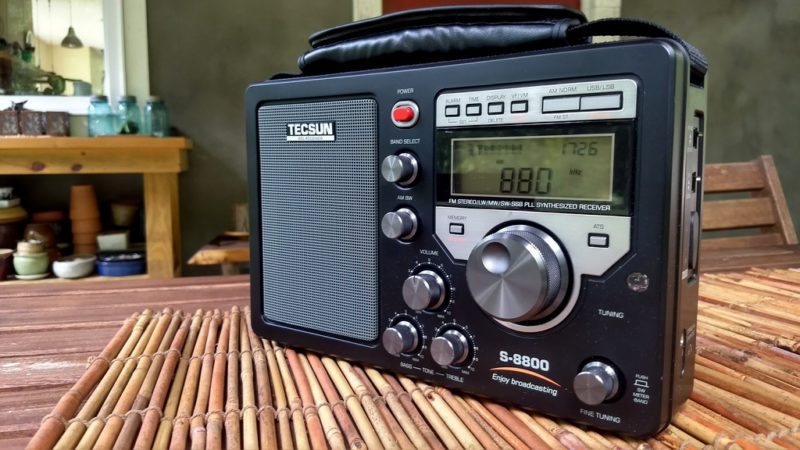
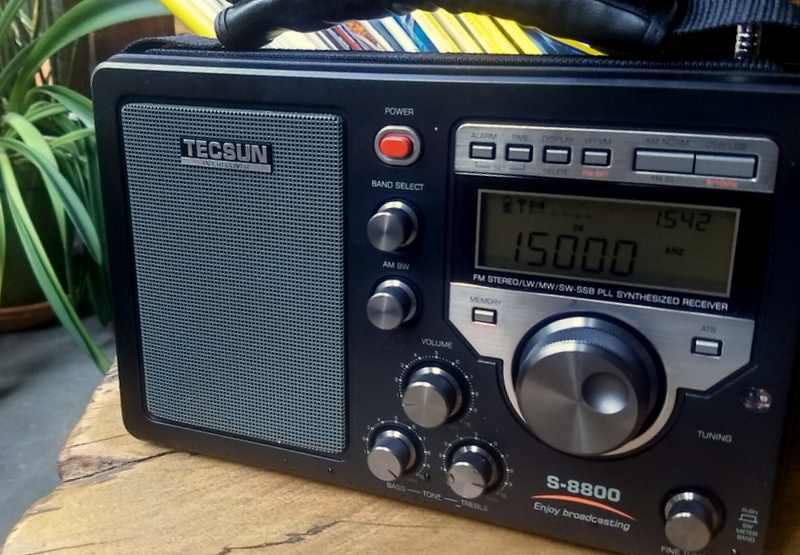
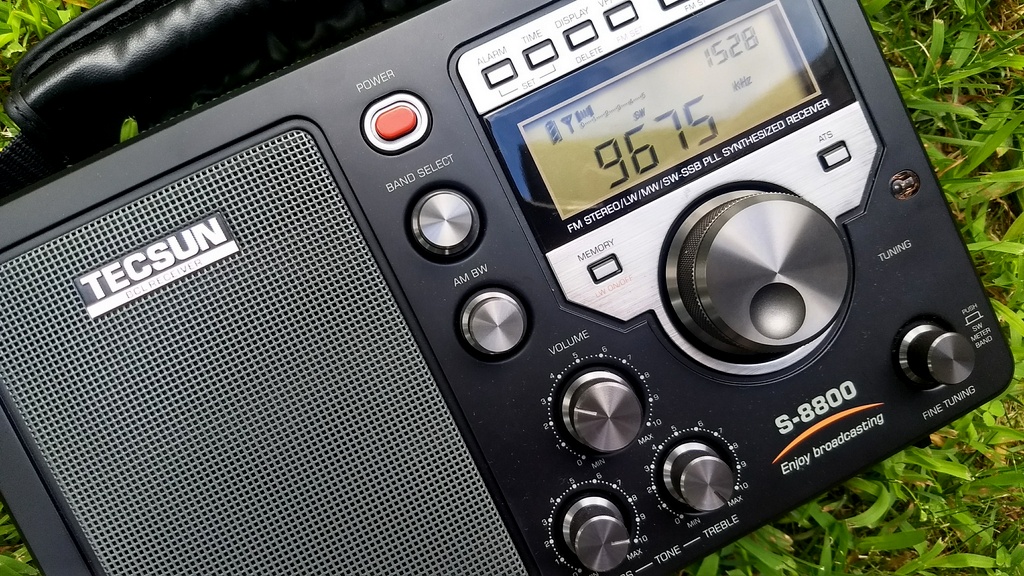
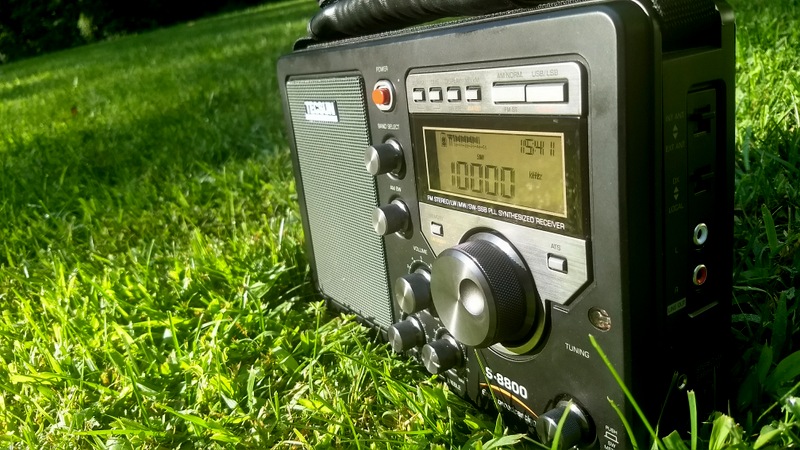
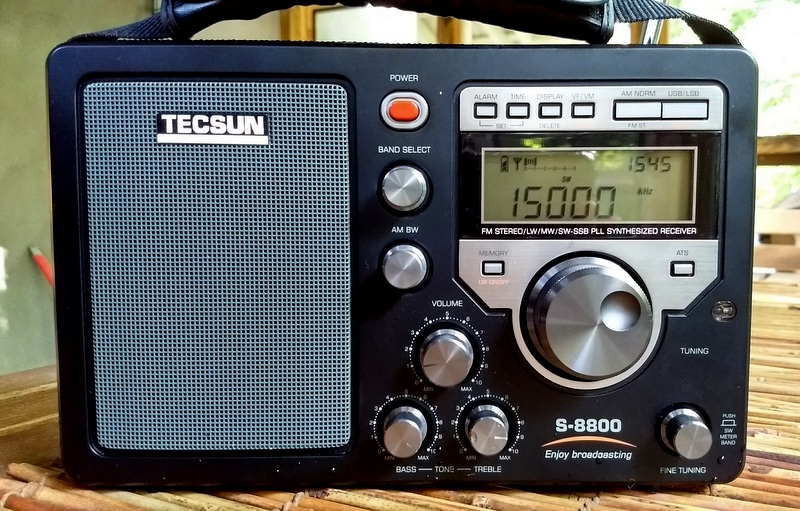
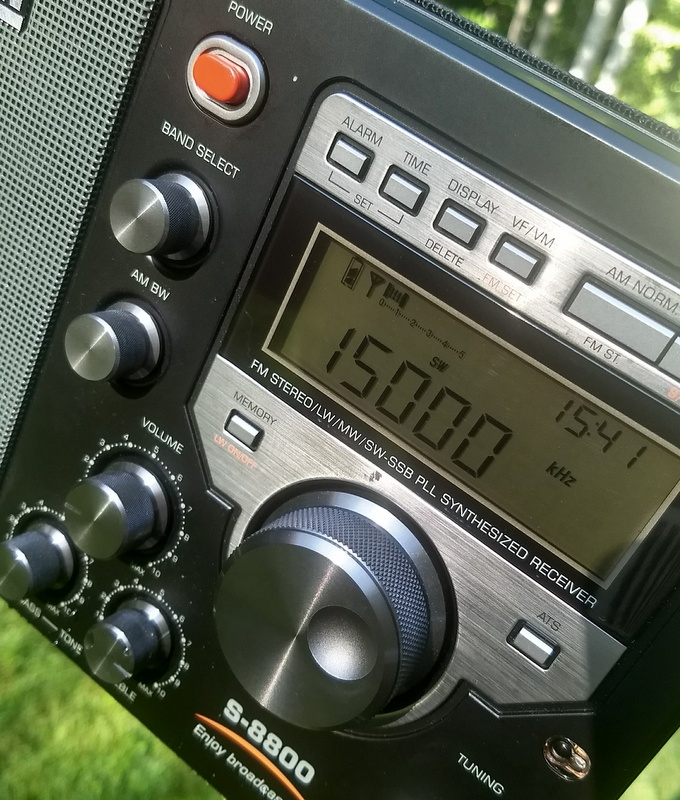
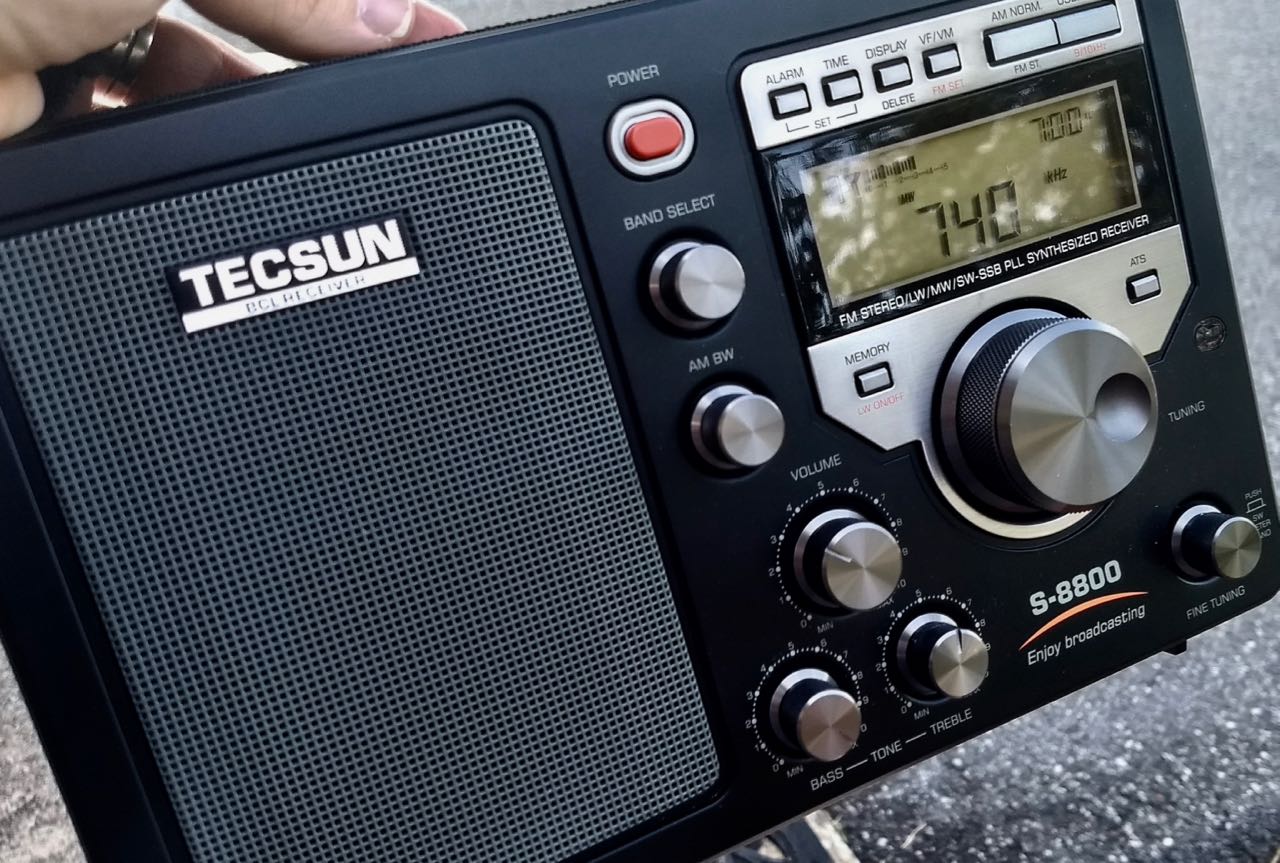
Earlier this year, Tecsun released its long-awaited newest large portable: the Tecsun S-8800 portable shortwave/LW/AM-MW/FM receiver.
Though I fully intended to buy a Tecsun S-8800 for review, our friendly Hong Kong-based Tecsun retailer, Anon-Co, sent an S-8800 to me before I could. I’ve worked with Anna at Anon-Co for at least a decade and have purchased numerous radios for review, not to mention as gifts for family and friends. When she insisted to send it as a gift, I decided I would (gratefully) accept the unit.
My new Tecsun S-8800 had a serious problem, though––one that two early S-8800e adopters noticed as well––internally generated noises, also known as birdies. And while most receivers will have a few minor birdies scattered across the bands, this S-8800 hosted a whole chorus of them, overwhelming the bands and making use of the radio difficult. Read through this post thread for details.
I contacted Anna at Anon-Co and she immediately notified Tecsun; as a result, they halted distribution of the S-8800.
Tecsun took the S-8800 to their engineering team, and I’m happy to report they’ve now eliminated the horrible warbling DSP birdies of the initial unit I received.
On the S-8800s since released, while there are still a few minor birdies across the bands (more on that later), they’re merely what one might expect to find on any receiver. In short, the S-8800 now in production is a functional receiver, and a contender in its class.
I’ve had the S-8800 for a few weeks now and have had time to put it through its paces. What I present now is a review of the re-engineered Tecsun S-8800.
First impressions
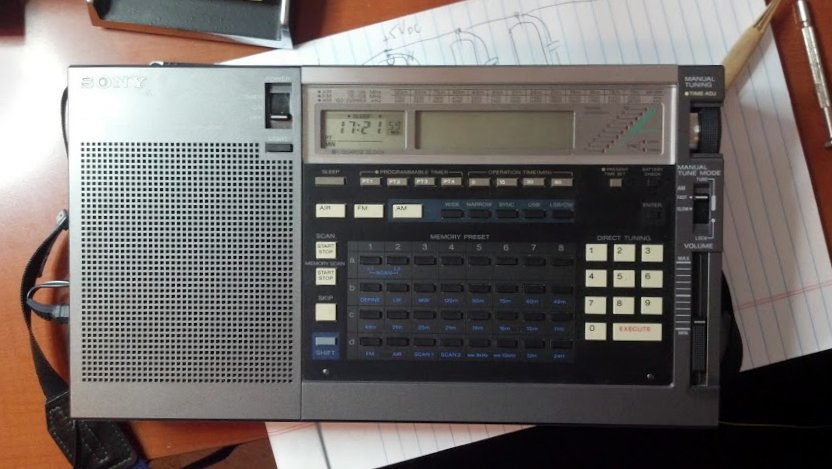
In the spirit of full disclosure, I must note that I’m not as avid a user of large portables like the S-8800. Personally, my preference is for smaller, full-featured travel-friendly portables, or else larger tabletop models. I travel often and like to pack lightly, so I rarely reach for anything bigger than my trusty Sony ICF-SW7600GR, or Tecsun PL-880, and more often than not, I grab the ultra-compact Sony ICF-SW100 or C. Crane CC Skywave.
But to say that I never reach for large portables would be inaccurate. In fact, I use a Grundig GS350DL daily; it’s my analog kitchen radio. I rarely move the tuning dial (a good thing, since it unfortunately drifts) because it’s locked onto my in-house SSTran AM transmitter on 1570 kHz.
What large format portables like the GS350DL and S-8800 can provide that a small portable cannot is broad, rich, room-filling audio. In my world, good audio is an important factor in overall signal intelligibility.
The S-8800 chassis resembles several other receivers: the Grundig GS350DL, S450DLX, and more recently, the Field BT, just to name a few.
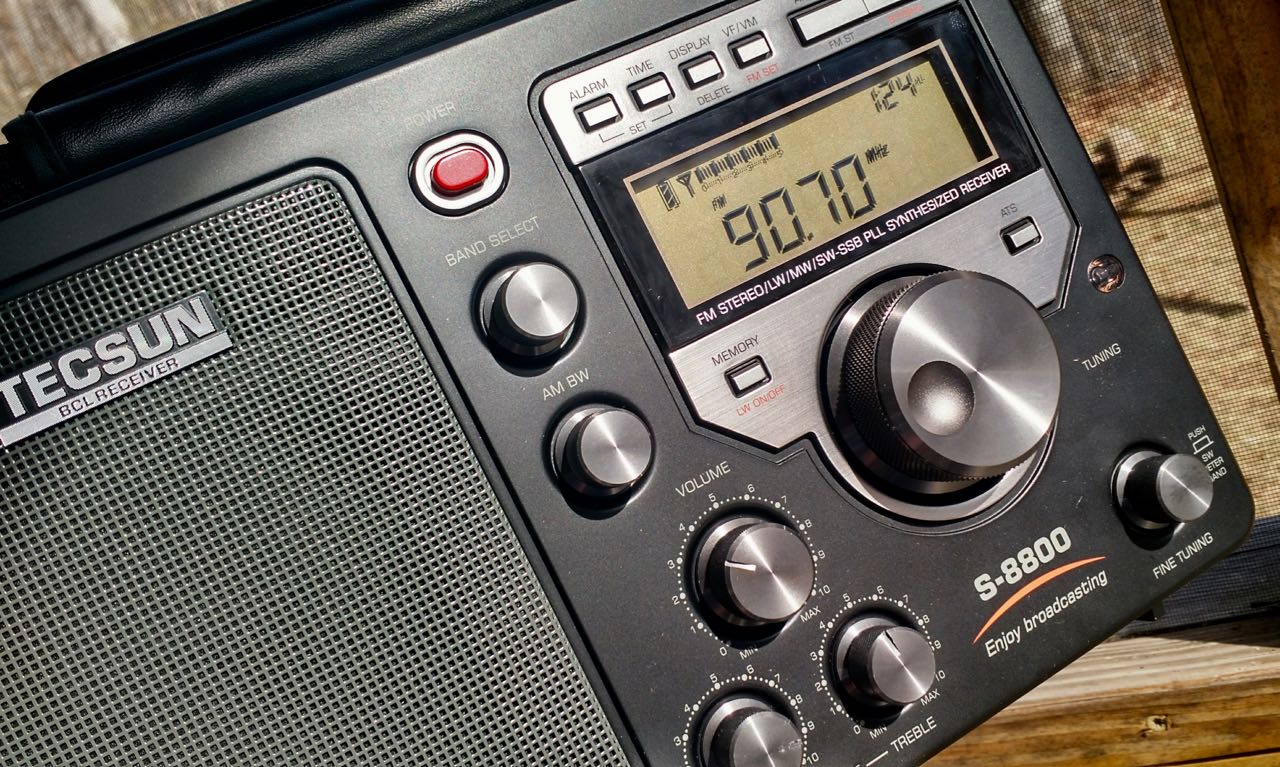
The body is made of a hard plastic (not rubberized) and feels rugged enough. The knobs and buttons also feel tactile and of comparable quality to the previous similar models noted above. With the rechargeable batteries inserted, it weighs about 3 pounds 4 ounces (1.5 KG).
The backlit display is large and viewable from almost any angle––even at a distance.
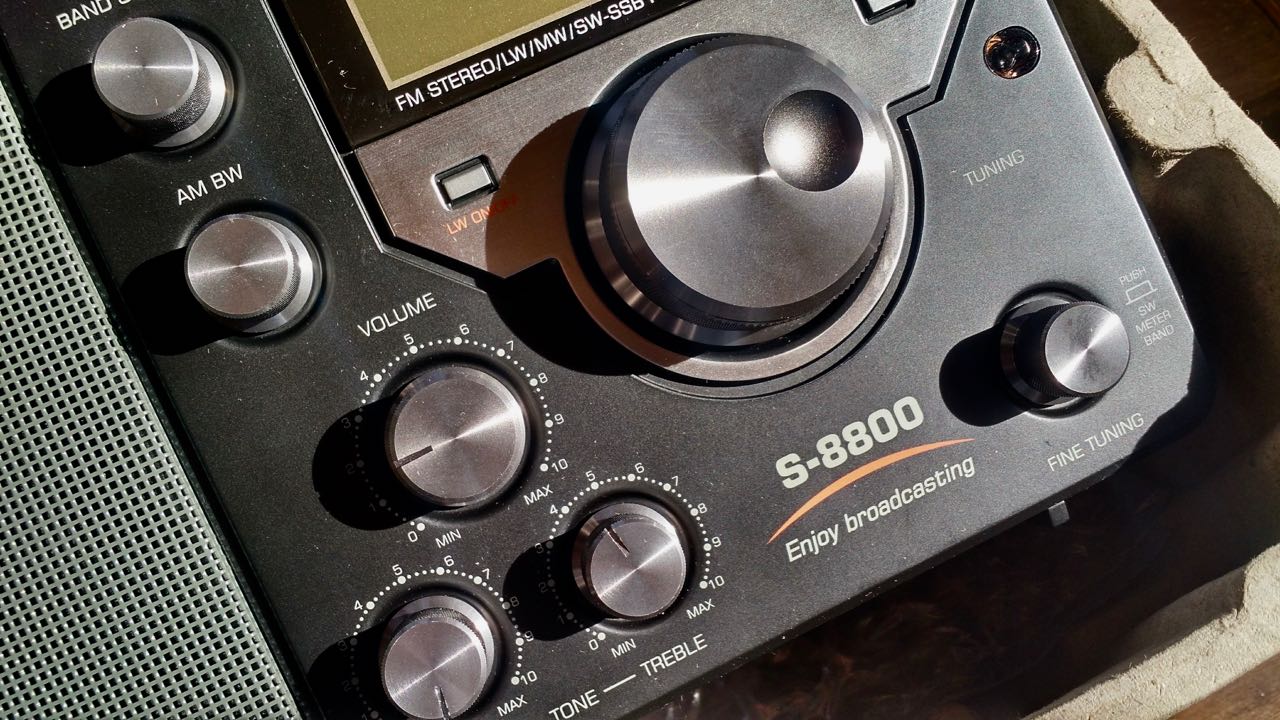
The main encoder (tuning knob) has appropriate amount of brake for most listeners. It wobbles very slightly, but functions amazingly well. I prefer it over its large portable predecessors, especially the 350GL. There is no soft mute while tuning, so band-scanning is a fluid, almost analog, process.
Both the “Band Select” and “AM BW” knobs have soft detents that mark steps in selection. In the field, I noticed that these can occasionally skip an increment when the detent only moves one position or the knob is turned very slowly. This doesn’t really affect functionality in any way, but I thought it worth noting nonetheless.
Like previous similar models, the S-8800 lacks a built-in keypad for direct frequency entry. That would be a major negative for a radio in this price class if the S-8800 didn’t come with one invaluable accessory: an infrared remote control.
Infrared (IR) Remote Control
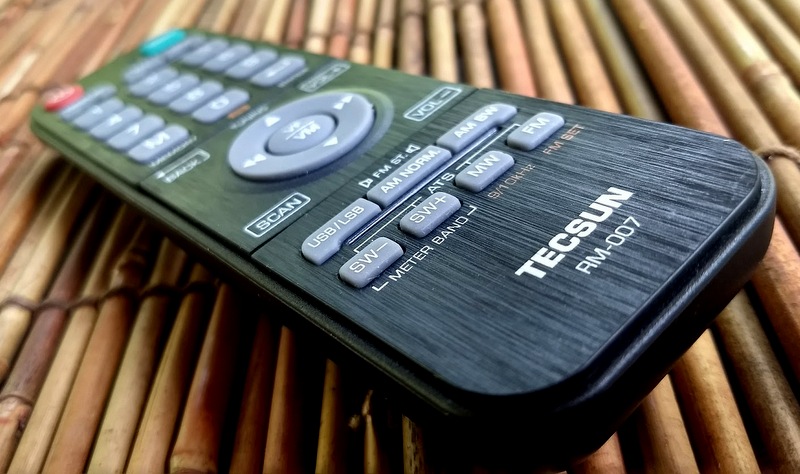
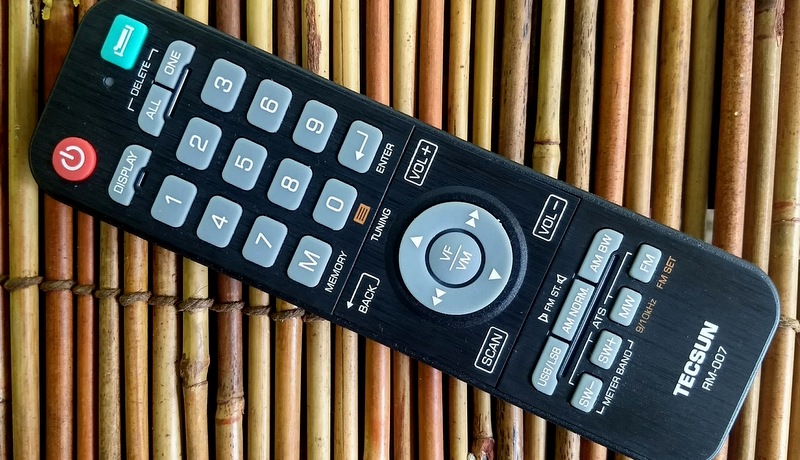
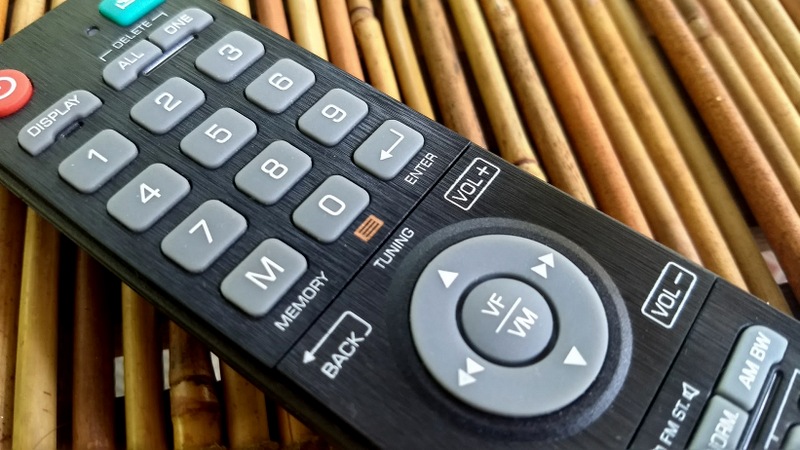
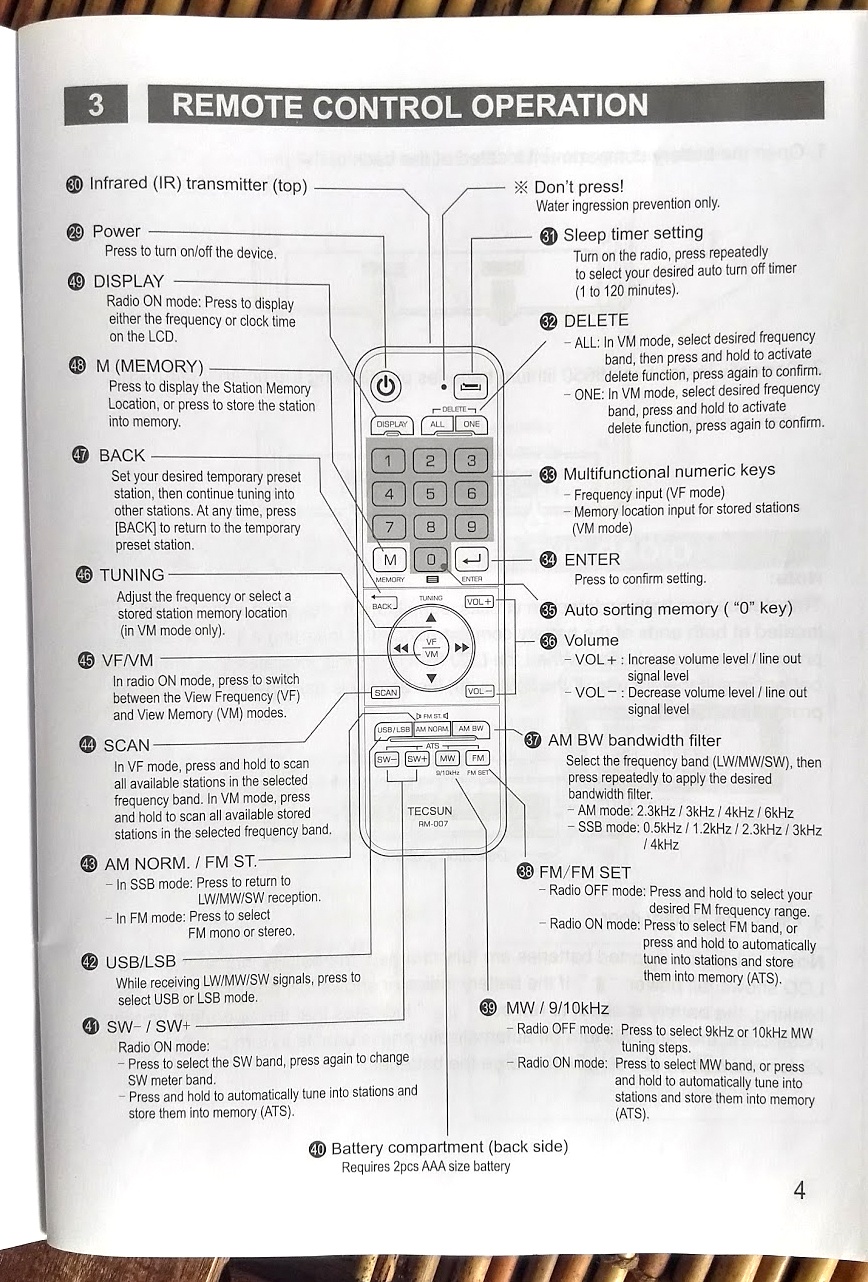
The Tecsun S-8800 ships with a IR remote control, and as far as I’m concerned, it’s great.
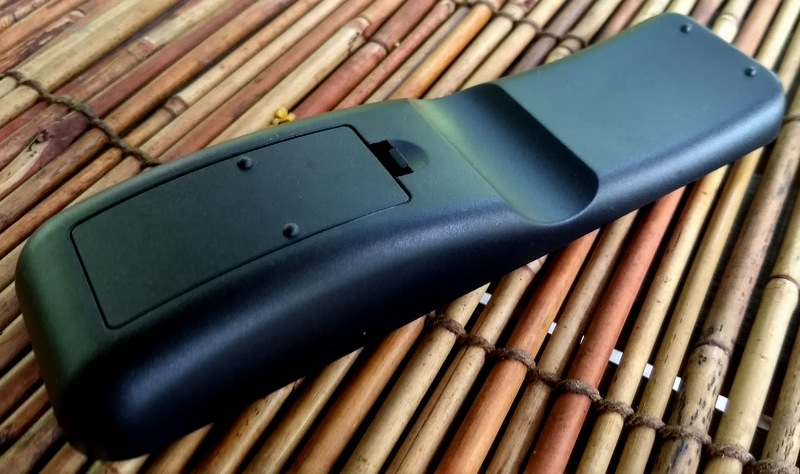
The remote feels durable, fits well in the hand, and the back has a place for it to balance on your index finger when holding…
But more importantly, the remote works quite well. The controls are intuitive and the labeled buttons are quite easy to read. They’re also tactile and have a muted “click” response when pressed. Indeed, I wish my television’s remote was this well designed.
And the remote is quite useful, especially if you like listening from bed, from a porch, from the kitchen or dining room or den––or, in fact, from any space where you might wish to control the receiver at a distance. I believe its possible that every function of the S-8800 can be controlled with the remote––even the sleep timer!
Perhaps my dream remote for such a purpose would be backlit, but the S-8800’s remote is so simple to use, I’ve already nearly memorized where the buttons are located for nighttime use.
Operation Manual
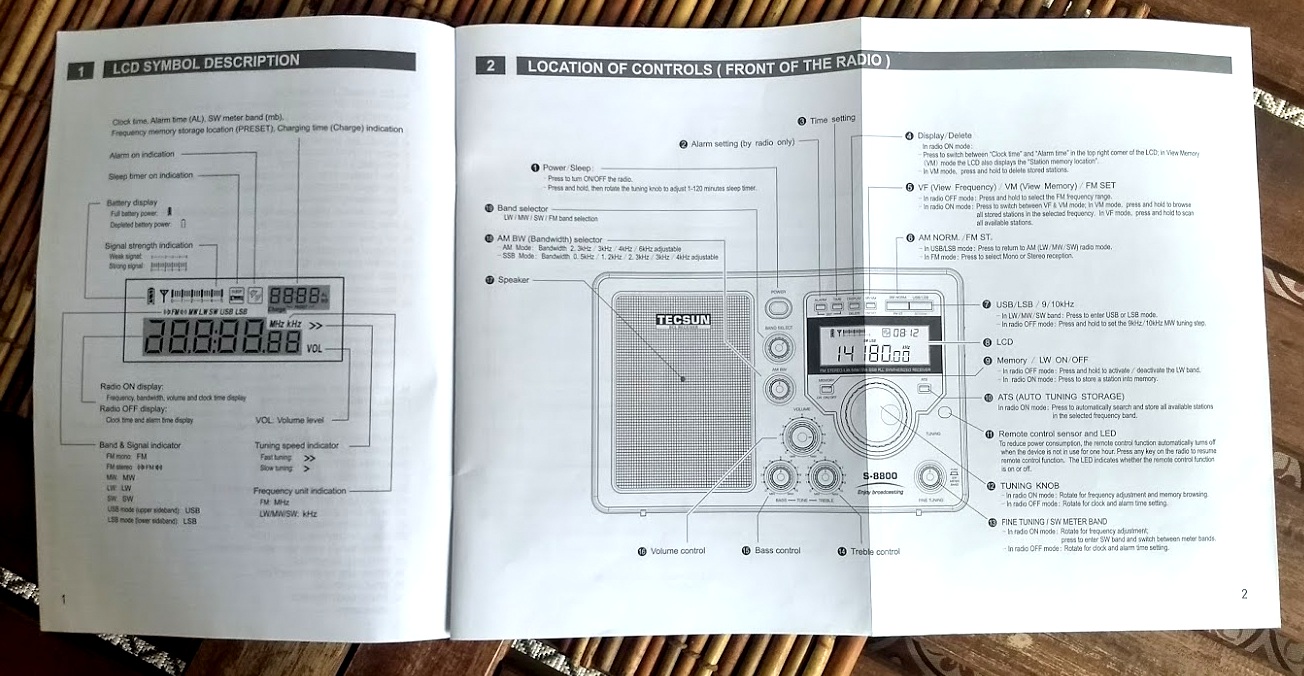
The S-8800 ships with an informative operational manual, although this radio is intuitive enough that a seasoned radio listener will not need to reference it, save for advanced settings. Still, it’s written in clear language––with comparatively few English grammar errors––and the diagrams for both the radio and the remote are exceptional.
I referenced the manual several times to sort out ATS operation, saving/erasing memories, and to hunt down function shortcuts.
Features
The S-8800 is a feature-packed triple conversion receiver. Here’s an abridged list of its features, focusing on those most radio enthusiasts seek:
Note in SSB mode on LW, MW and SW, tuning steps are 10 Hz and 1 kHz.
FM: 64 – 108 MHz (selectable for various markets: Russia, The Caucasus, Caspian/Black Sea regions, Japan, China/Europe, and North America)
Modes: AM, FM, SSB
Variable filter widths
AM: 6, 4, 3, and 2.3 kHz
SSB: 4, 3, 2.3, 1.2, and 0.5 kHz
Digital Signal Processing (DSP)
Antenna gain selection: DX/Local
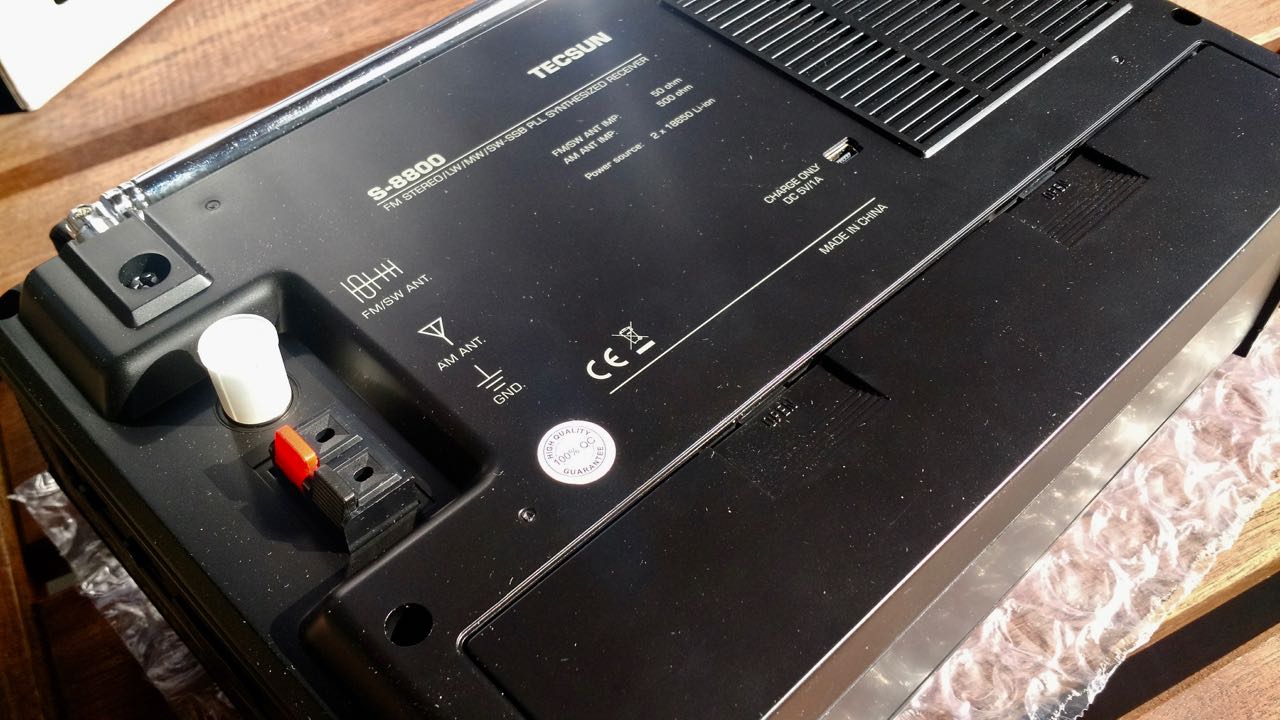
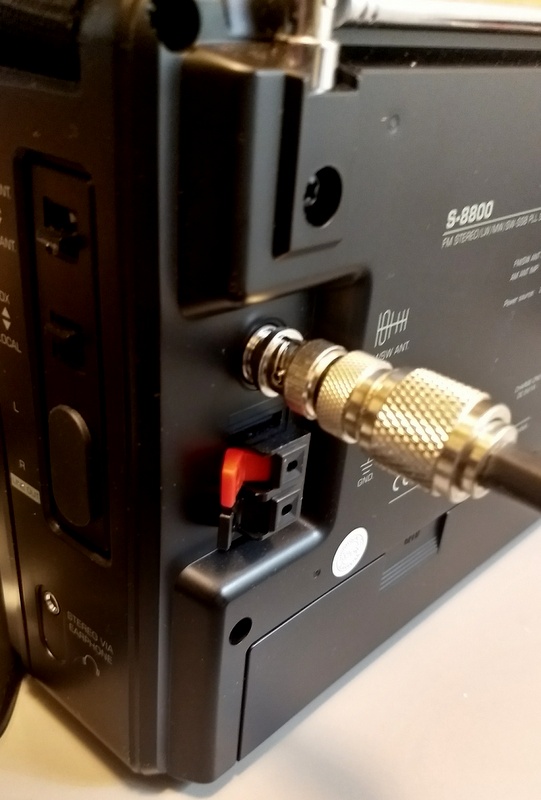
External antenna connections: both BNC (SW and FM) and a high-impedance port (LW, MW and SW)
Both 9 and 10 kHz spacing on mediumwave
Dedicated fine-tuning control
Auto Tuning Storage (ATS)
650 station memories
FM stereo/mono
Backlit LCD display
Treble and bass tone controls
RCA line-out audio
Full-featured clock, alarm and sleep timer
IR remote control
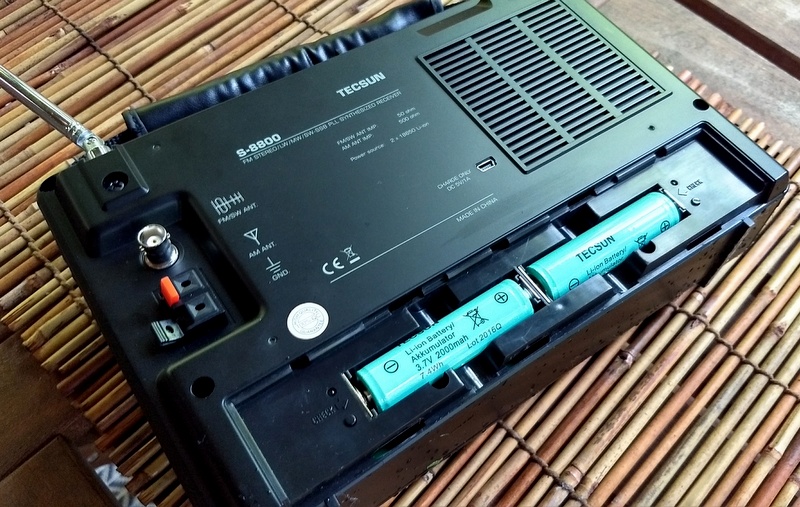
Two 18650 lithium cells (included) that can be safely charged internally via USB
Wishlist? The S-8800 feature set is pretty comprehensive, but my dream large portable would also have synchronous detection and an RF gain control, though the latter is not common in the world of portable radios. Fortunately, the S-8800 does have a local/DX gain toggle.
I’m sure some enthusiasts would also like to see Bluetooth connectivity as on the Eton Field BT, but I personally don’t miss it. I like to keep my HF portables free from anything that could potentially raise the noise floor.
With the exception of synchronous detection, the S-8800 has a solid, comprehensive tool set.
Performance
Over the past two weeks, I’ve had the S-8800 on the air almost every day. I’ve compared it with a number of receivers, but mainly its smaller sibling, the popular Tecsun PL-880. Below, I break down my notes by band.
FM
As is typical with my shortwave portable reviews, I spent less time evaluating FM performance on the S-8800.
With that said, I did compare the S-8800 with the PL-880, PL-680 and CountyComm GP5-SSB and a few other portables. The S-8800 found my benchmark weaker broadcasters with ease.
Here’s a short video demonstrating FM performance with a broadcaster over 100 miles distant:
I’ve had more inquiries about S-8800 mediumwave performance than I’ve had about any other radio I’ve recently reviewed. Why? Well, for one thing, some radios in this particular portable format perform quite well on mediumwave––the C.Crane CCRadio-SW, for example, comes to mind. Also, the S-8800’s large front-facing speaker lends itself to superb AM audio.
Unfortunately, mediumwave is not the Tecsun S-8800’s strong suit.
I did extensive testing, comparing it with much smaller portables: the Tecsun PL-880, the Sony ICF-SW7600GR, the Digitech AR-1780, the CC Skywave, and even a pre-production CC Skywave SSB. All of these portables had better sensitivity on mediumwave.
I posted the following representative video a couple weeks ago in a post:
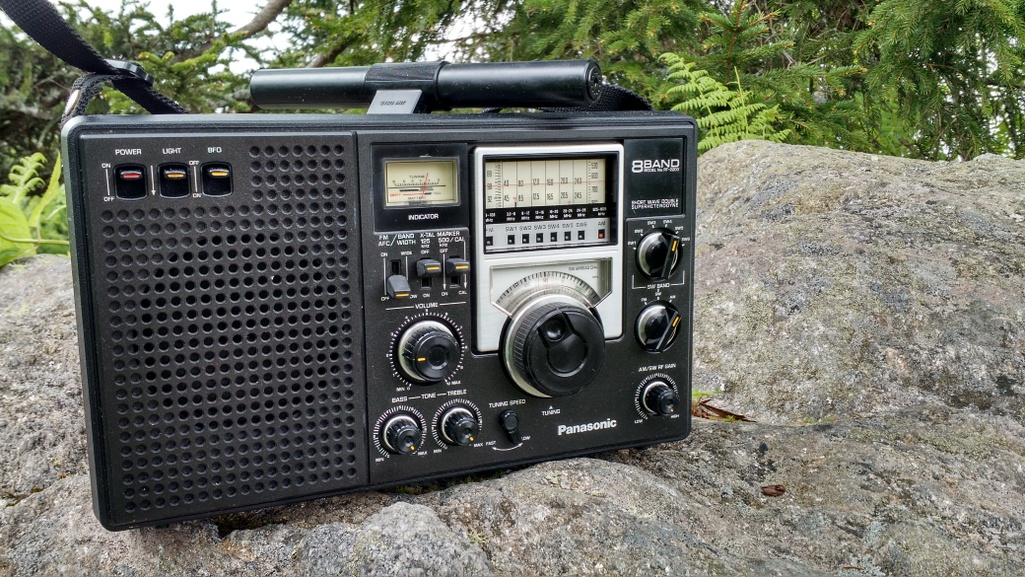
To reiterate from my previous post, comparing any modern radio with the Panasonic RF-2200 on mediumwave is hardly fair. For one, the RF-2200 has been out of production for a few decades. For another, the RF-2200 has a large rotatable ferrite bar antenna that provides excellent gain. The RF-2200 simply wipes the floor with all of my modern portables, as their ferrite bar antennas are but a fraction of the size.
To my ear, the S-8800’s mediumwave band seems noisier than its competitors. Perhaps this is why it struggles with marginally weak stations.
Here’s another comparison with the PL-880––this time at a totally different location:
With that said, when tuned to a local AM broadcaster, the S-8800 really shines. It produces rich audio which can be customized with bass/treble tone controls and by changing the AM filter width.
I also hooked up the S-8800 to my large horizontal loop antenna. This certainly did improve MW reception, but not as dramatically as I hoped. Additionally, it seemed to be very sensitive to RFI in my shack even when hooked up to the external antenna.
If you took the S-8800 to the field, added a decent inductively-coupled magnetic loop antenna, no doubt it would improve mediumwave reception, but I still doubt it would come close to the RF-2200 in performance. As long as I own the latter, I wouldn’t be motivated to do so.
Due to my schedule over the past few weeks, I’ve had precious little time to test the S-8800 on mediumwave at night, but some quick air checks proved performance was consistent with daytime testing.
I am pleased to report that no receiver overloading was observable during testing.
In short: if you’re only considering the S-8800 for mediumwave DXing, you should look elsewhere. I would suggest a dedicated AM broadcast receiver like the excellent CCradio 2E, a vintage Panasonic RF-2200, or perhaps a used GE Superadio.
LW – Longwave
I’ve spent less time on longwave than I have on mediumwave and shortwave.
With that said, the S-8800 was able to receive our local airport beacons at night with relative ease. I was not able to catch any transatlantic longwave broadcasters, but that’s no surprise as it’s almost impossible on even my commercial-grade receivers during the summer months here in North America.
As I said regarding the mediumwave band, I suspect there are much better radios out there for the longwave enthusiast.
SW – Shortwave
At the end of the day, I believe the Tecsun S-8800 was designed with the shortwave and amateur HF radio enthusiast in mind.
The S-8800 has gapless HF coverage from 1,711 kHz to 29,999 kHz, can be used both in AM or Single Sideband (selectable LSB/USB), and has adjustable bandwidth filters tailored to AM broadcast and SSB/CW (ham radio/utility/pirate) reception. The filter widths are well-chosen for each mode: 6, 4, 3, and 2.3 kHz on AM; 4, 3, 2.3, 1.2, and 0.5 kHz on SSB.
It also has a dedicated fine-tuning control that adjusts steps based on the mode.
All of these are desired features for the HF radio enthusiast.
I’m happy to report that the S-8800 is a very capable shortwave receiver, perhaps even one of the best portables currently on the market.
In every comparison test I made on shortwave, the S-8800 outperformed each of its competitors.
Check out the videos below and judge for yourself:
I was pleasantly surprised by the audio in SSB mode and by how well the filters seem to work. Note in the video the warbling sound as I adjust the fine-tuning control on the S-8800. But it’s actually only present as I adjust the fine-tuning control; I noticed no stability issue once on frequency.
External antenna
Since the S-8800 has a handy standard BNC connector and high impedance AM antenna socket on the back, I hooked it up to my large horizontal loop. In my testing, it handled that antenna’s gain very well and I was most impressed with the performance.
The front end seems to be robust, and selectivity––which is excellent––was not compromised by my antenna. I was able to pull apart two broadcasts with only 5 kHz of separation that were both quite strong. The S-8800 locked onto the stronger of the two stations with ease. When tuned to the weaker station, I used SSB reception on the upper sideband to ignore the noisier lower sideband which was buried in the adjacent signal. Once I zero-beated the signal, it sounded quite good.
Final thoughts about shortwave performance
Perhaps what the S-8800 has going for it on shortwave is a combination of very good sensitivity, excellent selectivity, and a feature all too often overlooked: good audio fidelity (via the internal two-watt speaker).
The AGC (auto gain control) is actually fairly stable on the HF bands (less so on mediumwave). Like the Tecsun PL-880, the AGC has a soft hiss response when the signal fades below the AGC threshold. While I’m not crazy about this, I must confess that it is pretty easy on the ears when fading is pervasive.
I did note one quirk that could annoy those wishing to copy narrow SSB or CW. If the filter bandwidth is set to .5 kHz and you’re listening to a marginal CW signal, the AGC sometimes mutes the receiver during CW dead space. It equates to very unstable audio with audio levels jumping around wildly. This happened more often when I was copying moderate to weak CW signals. I’ve even noticed it when listening to SSB ham radio conversations, but mostly in the narrow bandwidths. I usually keep the filter set to 2.3 kHz or higher and it hasn’t been a problem at these settings. It’s worth noting that I have observed the same AGC behavior in my PL-880 at times.
The S-8800 ships with two rechargeable lithium cells which provide hours of listening time from a full charge.
I never encountered overloading from local AM broadcasters on the shortwave bands, with the caveat that I never tested the S-8800 in an RF-rich urban market.
One thing I have noticed in general about the S-8800 is that it seems pretty sensitive to RFI indoors (electrical noise in the home, office, etc)––more so than my Sony ICF-SW7600GR, for example. If you live in a noisy environment and never plan to use an external antenna or take the radio outdoors, you might think twice about the S-8800.
Birdies
I’m pleased to report that Tecsun did properly address the “birdie” issue I mentioned at the beginning of this review. Still, like most receivers, the S-8800 does have some birdies across the bands. These birdies are well within the norm for such rigs: a relatively stable heterodyne sound. I made a short video to illustrate what I mean when I talk about a birdie:
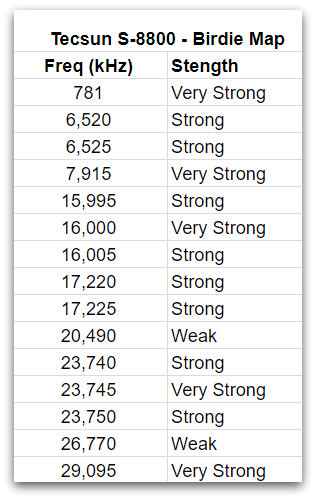
I spent one afternoon carefully mapping out all of the birdies I could find across the longwave, mediumwave and shortwave bands.
Here’s what I mapped:
As you can see, there are no birdies in the middle of sensitive areas like broadcast bands, amateur radio bands, etc. A good report, in my book.
Note that while tuning through the shortwave bands, I used 5 kHz steps. I suppose there’s a possibility I might have missed very weak birdies doing this, but any strong birdies would have been received and noted within the 5 kHz window. On LW and MW, I tuned in 1 kHz increments.
Summary
Every radio has its pros and cons, of course. When I begin a review of a radio, I take notes from the very beginning so that I don’t forget my initial impressions. Following is the list I formed over the time I’ve been evaluating the Tecsun S-8800:
Pros:
Brilliant audio fidelity from built-in speaker
Dedicated AM bandwidth and fine tuning controls
Excellent, bespoke IR remote control
Capable SSB mode
Excellent shortwave sensitivity (see con: mediumwave)
Excellent shortwave selectivity
Excellent FM performance
Easy-to-read backlit LCD digital display
Remote control beautifully equipped for full radio functionality
Included 18650 rechargeable lithium batteries power radio for hours
Cons:
Lackluster mediumwave performance (see pro: shortwave)
No synchronous detector
No direct keypad entry (Pro: Remote control has excellent keypad entry)
Can’t charge and listen at the same time–not designed for AC operation
No backstand
Line-out audio level is a little high (hot)
When in narrowest SSB filters, AGC can’t reliably handle audio/signal changes
Slight “warbling” sound while using fine tune control in SSB mode
No RDS display on the FM band
Conclusion:
As I’ve already mentioned, if your primary use of the S-8800 is for mediumwave or longwave DXing, you should look elsewhere. While the S-8800 will serve you well with local AM stations, it will not dig signals out of the noise like other better-equipped AM receivers. The GE Super Radio, Panasonic RF-2200, or CCRadio 2E are much better options.
But if you’re primarily a shortwave radio listener––? I think you’ll be pleased with the S-8800.
To my surprise, the S-8800 consistently out-performed my beloved Sony ICF-SW7600GR and my PL-880. I fully intend to compare it with other portables in the coming weeks and post the videos here on the SWLing Post. [I will update this review with any other findings.]
I did not mention this in previous posts, but the first S-8800 I received in January––the one with the birdie-chorus problem––also outperformed my other modern portables on shortwave. In part, I feared that when the Tecsun engineers addressed the birdie issue, it could have a negative impact on overall sensitivity. I’m happy to report that it did not.
What’s more, I realize that larger portables do have a place in my life. You might have noted that I did all of my review testing and preparation outdoors, mostly in a nearby national park. I do this, in part, to insure I’m far away from any RFI, but also I simply love playing radio outdoors.
And the S-8800 was a pleasure to tune and use in the field. I really like the large encoder and find that the multi-function knobs, tone controls, volume, and other buttons are well-spaced–I believe I could operate most of this receiver’s functions with gloves on in the winter. And again, there’s that excellent remote control…
This review was in final draft form two days before I learned the price from Anon-Co. I had assumed the price would not be released for another week or two at least, thus I made a few predictive statements that I’ll now quote here:
I understand that the S-8800e is being sold in Europe for 339 Euro, roughly $400 USD, plus shipping. There is no way I’d pay that price; it’s simply too much.
If the price exceeds $300 US, I’d suggest careful consideration, as the S-8800 price would be venturing into the realm of used Sony and Panasonic benchmark portables.
But. If this radio should be sold for less than $250, or even $200…? Being primarily a shortwave radio listener, I would certainly buy this radio for that price.
In the end, the price is $18 higher than the $250 I mentioned in my review draft, but I assumed shipping would be tacked on to that price. So $268 ended up being pretty close to the mark.
So I believe the Tecsun S-8800 hovers at the top price threshold of what most radio enthusiasts would be willing to pay for a portable. At $268, it’s over $100 more than the excellent PL-880 and only $20 less than the Tecsun S-2000. And for radio enthusiasts outside the US, it sounds like shipping will be added to the $268 price. I expect European consumers will pay a premium due to embedded (and required) sales tax and customs handling fees.
Nonetheless, I would still consider purchasing at the $268 US mark because of its shortwave performance, ability to connect external antennas, audio fidelity, and the included IR remote control.
I would like to see the price lower than $268. If the price were nearer the $200 mark, it would be a no-brainer––this radio would likely fly off the shelves, and I’d strongly suggest purchasing.
Perhaps, with time, the S-8800 price will decrease. In the meantime, if you have the budget, I believe the S-8800 would make for a nice field companion, pulling weak DX out of the noise with excellent audio fidelity to boot. It’s already been a great field companion for me…and, I’m sure, will accompany me into the field again.
A map of the United States showing the path of totality for the August 21, 2017 total solar eclipse. (Source: NASA)
Many thanks to SWLing Post contributor, Bob LaRose (W6ACU), for the following guest post:
Eclipse 2017 Propagation Observations
by Bob LaRose (W6ACU)
DXers know that the reception of overseas Shortwave Broadcast stations offers one of the best ways to immediately gauge shortwave radio propagation conditions from your location to distant areas of the world. For the eclipse of 2017 I decided to see how reception of SW broadcast stations on lower shortwave broadcast frequencies (and to a smaller extent medium wave AM) reacted to the short term effects of the eclipse.
Going into this experiment I suspected that since the eclipse should temporarily reduce ionization to D-layer of the ionosphere, there might be some reduction in corresponding typical D-layer daytime absorption on lower frequencies. The hope was that this would enhance lower frequency propagation, particularly on the path between Asia and Western North America, which is normally totally absorbed at that time of day. I also monitored for propagation on other HF stations such as WWV as well as US-based SW Broadcast Stations in Alaska and Tennessee, and to a lesser extent AM MW broadcast stations. Here are the results of my experiment.
EQUIPMENT:
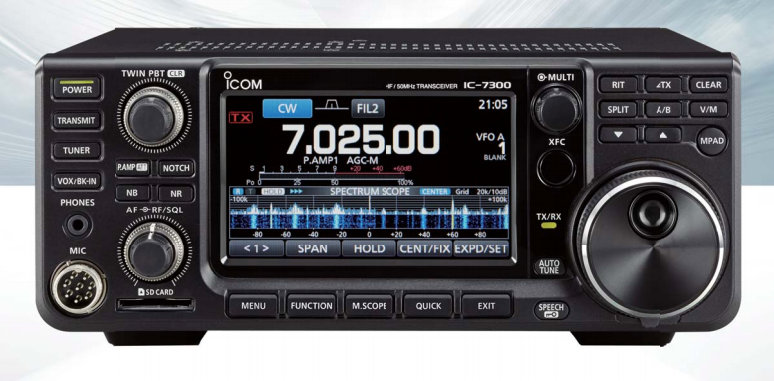
The Icom -IC-7300
For these tests I was using an ICOM IC-7300 Transceiver as a receiver connected to my standard antenna for lower frequency use – a Carolina Windom with the center about twenty feet off the ground. The antenna works reasonably well over a wide frequency range, including the lower SW and the medium wave AM broadcast bands. Because of my high local electrical noise level and proximity to several local AM broadcast transmitters, I turned off the built-in RF amplifier of the IC-7300 for all the tests. I used the uncalibrated S Meter of the radio to measure relative signal strengths in S units and dB above S-9.
BASELINE TESTS
The day before the eclipse I took baseline measurements at about the time of the eclipse. Because of normal summer daylight absorption, there were no signals present on either the 49 or 41 meter SW broadcast bands. At this time of year signals on those two bands generally fade below the local noise level at my QTH San Diego by about 1500 UTC.
I also checked the reliable daily beacons on SW at that time are the WWV frequencies of 5 and 10 MHz, The baseline for WWV was a signal strength of S5 on 5 MHz and S7-9 on 10Mhz.
I also took some baseline measurements of AM broadcast stations in Los Angeles (KFI 640 and KNX 1070). I was not able to receive any of the San Francisco, Sacramento, Las Vegas stations or points further North.
THE DAY OF THE ECLIPSE
According the Internet sources the eclipse began in San Diego at 1607 UTC, peaked at 1723 UTC and ended at 1846 UTC. It reached 66% of totality.
My first observation was at 1550 UTC. The strength of all signals were at the nominal readings from the day before. At 1630 I still did not hear any SW broadcast stations above the local noise level.
By 1640 the HF broadcast stations had begun to break through the noise. Here is a chart of my reception observations during the observation period:
Freq KHz
Station and Location
Time in UTC vs. Relative Signal Strength (S Units)
1550
1630
1640
1650
1710
1725
1745
1800
1815
1830
640
KFI Los Angeles
9
9
9
9
9
9
9
9
9
9
1530
KFBK Sacramento, CA
0
0
0
0
3
6
2
0
0
0
5000
WWV Ft Collins, CO
5
5
7
9
9
9
6-7
7
5
5
5845
BBC Singapore (ends at 1700)
0
0
0
9
0
0
0
0
0
0
5995
Korea – Echo of Hope (presumed)
0
0
0
0
6
0
0
0
0
0
6015
Korea (presumed)
0
0
0
5
0
0
0
0
0
0
6045
Korea (presumed)
0
0
0
6
0
0
0
0
0
0
6125
China National radio
0
0
0
6
0
0
0
0
0
0
6155
Taiwan (1700-1730)
0
0
0
0
S9+10
5-7
0
0
0
0
6165
Yamata Japan for Korea (1600-1700)
0
0
6
7-9
0
0
0
0
0
0
6175
China National Radio
0
0
0
0
5-7
7-9
7-9
0
0
0
6195
BBC Singapore (open carrier – presumed tune-up for next morning
0
0
0
0
S9+10-20
0
0
0
0
0
7300
Radio Taiwan
0
0
7
0
0
0
0
0
0
0
7385
China National Radio
0
0
9
0
0
0
0
0
0
0
7465
BBC Singapore (ends at 1700)
0
0
S7-8
0
0
0
0
0
0
0
7485
VOA Thailand (started 1700)
0
0
0
0
7-8
3
0
0
0
0
7540
VOA Thailand (started at 1700)
0
0
0
0
0
S5-7
0
0
0
0
9355
Radio Free Asia (Marianas Islds, starts at 1700)
0
0
0
0
5-7
0
0
0
0
0
9475
WTWW Lebanon, TN
0
0
0
0
0
0
7-9
7
4-6
0
9655
KLNS Anchor Point, AK
0
0
9
6-7
7-8
0
0
0
0
0
9965
Radio Free Asia (Marianas Islds, starts at 1700)
0
0
0
0
9
5-7
0
0
0
0
9980
WWCR Nashville, TN
8
7-9
7-8
7-8
7-8
7-8
7-8
9
7-9
7-8
10000
WWV Ft Collins, CO
7
S9+10
9
9
9
5-7
9
9
6-8
7-9
12160
WWCR Nashville, TN
S9+20
S9+10
S9+10
N/R
N/R
N/R
N/R
S9+10
S9+20
N/R
N/R = Not recorded
REVIEW OF RESULTS
As the results show, there was a very significant improvement in lower frequency shortwave propagation between San Diego and Asia during the eclipse. The 49 and 41 meter SW broadcast bands in particular went from below the noise level to providing good reception of a number of Asian and Pacific broadcast stations, starting at around 1640 UTC. Stations were received from China, Korea, Mariana islands, Taiwan, and Singapore. All stations fell back below the noise level by 1745UTC.
Reception of WWV Ft Collins, CO on 5 MHz also greatly improved around 1700 UTC. The 10 MHz signal was not significantly affected.
As the eclipse moved East, Reception of WTWW on 9475 kHz and WWCR on 9980 kHz from Tennessee peaked at around 1745 UTC. There was no major effect to the WWCR transmission on 12160 kHz.
On mediumwave AM the only long distance station that I could hear was KFBK Sacramento,1530kHz. The distance is roughly 475 miles. It went from below the noise to an S-6 at peak at 1725 UTC. (Note – I tried the clear channel stations in the Bay Area, Portland, Boise, etc. but none of them were heard. Many of these frequencies have either low power daytime stations or are right next to high power local stations here in Southern California). Reception of KFI 640 kHz Los Angeles (about 90 miles) was unchanged with no sign of typical nighttime selective fading.
This was an interesting once-in-a-lifetime opportunity for this propagation experiment and the results show that the eclipse conditions can significantly improve certain types of radio propagation over long distances!
Fascinating results! Thank you so much for sharing your report of shortwave radio propagation during the 2017 Solar Eclipse, Bob!
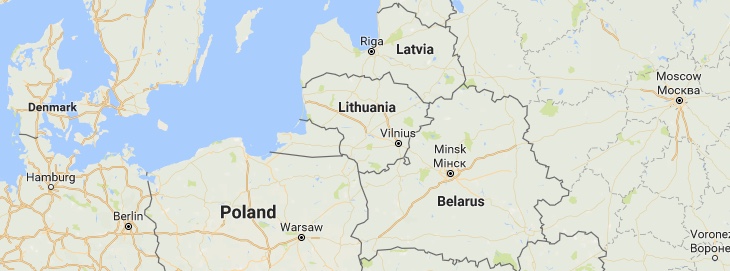
A new transmitter will be launched in Lithuania this week for broadcasting the Russian and Belarusian-language services of the US Congress-funded Radio Free Europe/Radio Liberty (RFE/RL) aimed at countering Russian propaganda, reports LETA/BNS.
It will replace a 52-year-old transmitter in Sitkunai, close to Kaunas, that has been transmitting programs for listeners in Russia, Belarus, Ukraine and Moldova at a lower quality.
The medium wave (AM) transmitter was manufactured some five years ago and was used by the US Defense Department in Western Germany to broadcast a radio program for American troops stationed abroad.
The transmitting power of the new device is set at 75 kilowatts, the same as that of the old one, but it can be increased up to 300 kilowatts if needed, Rimantas Pleikys, the owner of Radio Baltic Waves International, said.[…]
Many thanks to Rocus de Joode who shares the following announcement and request for listener reports:
(Este mensaje seguirá en español.)
Dear radio friends,
I received your Email addresses from Jeff White, from WRMI in Florida.
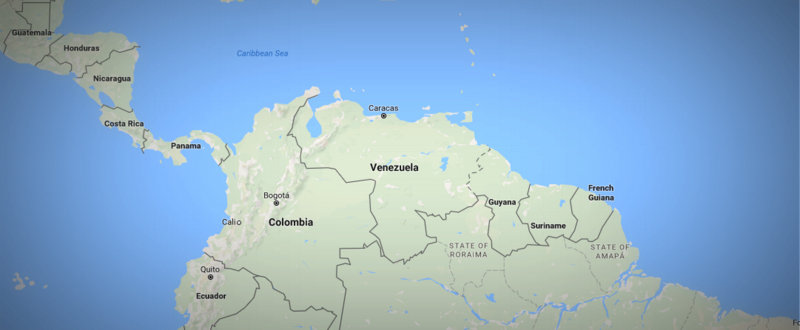
[W]e would like to inform you about a possible new initiative for radio transmissions via mediumwave to Venezuela on 800 kHz.
We will perform test transmissions starting on Wednesday August 30th for seven days long at 1600 hours local time (2000 UTC). As you can understand we would like to receive test reports in order to verify the quality of reception.
The transmissions will be 30 minutes long and we will use two different antenna systems.
Therefore we ask you your kind cooperation to monitor as much as possible and report this back to us via this special Email address: [email protected]
This is our test schedule:
Dates of transmission: 30 August – 06 September 2017 (7 days)
Frequency: 800 kHz
Time of test broadcast: 1600-1630 LT / 2000-2030 UTC
Antenna 1: 1600-1615 LT / 2000-2015 UTC
Antenna 2: 1615-1630 LT / 2015-2030 UTC
Program content: General announcements and Music
We would like to receive your reception reports in the following order:
Dates of listening
Time of listening
Your location or city name
Reception quality in SIO or SINPO for both Antenna 1 and Antenna 2.
If possible also an S-meter reading
Audio quality
Type of radio used
Type of antenna used
We would appreciate if you also could inform other DX colleagues and radio enthusiasts you know.
We are also curious how the signal will perform while driving in a car.
On behalf of the initiators of this project I thank you already in advance for your cooperation!
73 from Rocus de Joode
Estimado amigo de la radioescucha,
Por medio de este mensaje me complace informarle acerca de una posible nueva iniciativa para transmisiones a través de la onda media para Venezuela en los 800 kHz.
Iniciaremos nuestras emisiones de prueba a partir del miércoles 30 de agosto durante 7 días a partir de las 16:00 hora local (20:00 UTC). Como bien comprenderá nos gustaría recibir sus informes de recepción de estas emisiones de prueba para así verificar la calidad de la recepción.
Las transmisiones tendrán una duración de 30 minutos y utilizaremos dos sistemas distintos de antena.
Le pedimos su amable cooperación en monitorear lo más posible y enviarnos sus informes de recepción
Fechas de transmisión: del 30 de agosto al 6 de septiembre de 2017 (7 días)
Frecuencia: 800 kHz
Hora de la trasmisión de prueba: 1600-1630 HL / 2000-2030 UTC
Antena 1: 1600-1615 HL / 2000-2015 UTC
Antena 2: 1615-1630 HL / 2015-2030 UTC
Contenido del programa: Información de interés general y música
Nos gustaría recibir sus informes de recepción en el siguiente orden:
Fecha de la recepción
Hora de la escucha
Su localidad o ciudad
Calidad de la recepción en los códigos SIO o SINPO tanto para la Antena 1 como la Antena 2.
de ser posible, también la indicación del nivel relativo de la señal recibida – medidor S
Calidad del Audio
Tipo del receptor utilizado
Tipo de antena utilizada
También apreciaríamos mucho si usted pudiera informar sobre estas transmisiones a otros Dxistas y entusiastas de la escucha de la onda media que usted conozca. También estamos muy interesados en saber sobre la calidad de la señal cuando se escucha a bordo de un automóvil en marcha.
En nombre de los participantes en este proyecto quisiera agradecerles de antemano su amable cooperación!
My schedule last week made it impossible to carve out the dedicated time I needed to begin an S-8800 evaluation.
Yesterday, however, I spent the afternoon with my family at Richland Balsam, the highest point on the Blue Ridge Parkway (6,000′ ASL) and a completely RFI-free zone. I brought the Tecsun S-8800 and a few other portables along for the ride–namely the Digitech AR-1780, the C.Crane CC Skywave and the Panasonic RF-2200.
I had just enough available space on my smart phone to record this one short video:
Let’s be clear: comparing any modern radio with the RF-2200 on mediumwave is hardly fair.
For one, the RF-2200 has been out of production for a few decades.
Secondly (what I never finished saying in the video is that) the RF-2200 has a large rotatable ferrite bar antenna that provides excellent gain. The RF-2200 simply wipes the floor with all of my modern portables as their ferrite bar antennas are a fraction of the size.
In other words, the RF-2200 was engineered to rule mediumwave like a boss.
On shortwave, the RF-2200 does a fine job, but isn’t nearly as accurate and stable as modern DSP receivers.
Spoiler alert
Still, as the video indicates, my final review of the Tecsun S-8800 will indicate that it is not a receiver for the serious Mediumwave DXer. It’s been my experience that few shortwave portables are excellent on both HF and MW.
At home, tuned to local station 880 AM.
Of course you can’t tell from the video, but the S-8800 actually sounds brilliant when tuned to a relatively strong/local AM station, but either a lack of sensitivity or internal noise makes MW DXing a challenge.
I spent the better part of two hours yesterday evaluating its daytime MW performance–the video is pretty indicative of my findings. The S-8800 struggles with weak stations, but does a fine job with strong ones. It’s overall audio fidelity almost matches that of the RF-2200 when tuned to a strong broadcast. I’ve yet to test evening MW
The S-8800 still has some birdies on MW, but they’re not the loud warbling kind found on the previous model. Tecsun did properly address this, though in full disclosure, I haven’t fully explored the shortwave bands yet.
Shortwave?
I suspect the S-8800’s performance on shortwave will be much better than mediumwave because the previous S-8800 showed excellent results. As long as sensitivity wasn’t harmed while addressing the DSP birdies, I expect it’ll give the PL-880, PL-680 and Sony ICF-SW7600GR a run for their money.
Still…the lesson learned yesterday?
The Panasonic RF-2200 is the indisputable champion of mediumwave!
Many thanks to SWLing Post contributor, TomL, for sharing the following guest post:
August 21, 2017: Individual Recordings of MW During Totality
by TomL
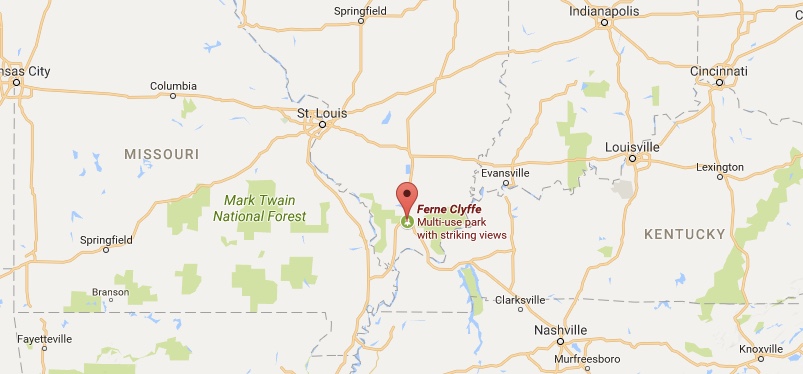
I setup flimsy “Backpack Shack” loop antenna and preselector to my Sony ICF-2010 to listen to any propagation of MW signals as each transmitter experienced Totality. My location was a picnic area facing southwest with only a small hill to the east at Ferne Clyffe State Park near Goreville, IL.
I did not bring a DSP radio and computer which would have been better in hindsight. My observations were generally as follows:
Anything west of my location, except for local St. Louis stations were not identifiable.
Noise levels were somewhat elevated because of thunderstorms that had just moved through the area during the evening.
Anything east of my location experienced dramatic increases in signal along the path of totality.
Since large signal increases were seen with the Umbra moving AWAY from me, it would be more beneficial to use a DSP receiver with good outdoor antenna than a single frequency radio and preselector like my setup. The loop antenna sitting on a picnic table acted great and was usable to get strongest signal for each station.
It is still unknown why I could not identify any stations west of me with the Umbra moving TOWARDS my location and needs further study. I thought I heard KTWO in Casper WY, but upon listening to the recording, it was a male announcer buried in the noise and unintelligible.
A transmitter being IN the path of Totality has a better chance of lasting longer with a strong signal than one that is just outside of Totality. Compare behavior of WSB vs. WBT.
If this happens again, make sure to make multiple hotel reservations and cancel the ones not needed. Traffic was horrible and had to stay in a hotel half way from home and I aggravated an achillies heel problem in the stop and go traffic (YUK).
So, it was quite disappointing to not hear anything special west of my location. As Totality neared my site, I just left the radio tuned to KNOX for the people around me to hear. Its signal did become about 25% stronger and near the end of the recording you can hear other weaker stations trying to break in.
As soon as totality was over, and my picture taking was done, I returned to the radio and found 1510 khz WLAC Nashville, TN was moderately strong! And this was seconds after their Totality had already ended. A baseline reading beforehand showed this station coming in very very faintly. Subjective SINPO rating beforehand=15452, just after Totality=34433.
The next surprise was tuning to 750 WSB Atlanta GA was BOOMING in! They were very clever and had no announcers. Instead they were playing snippets of songs about sun, moon, dark themes. Very entertaining! Baseline beforehand was just moderate noise, no signals. During recording, SINPO=55444 with propagation getting slightly worse near the end of the recording.
Final surprise was 1110 WBT Charlotte, NC, which was not in the path of Totality but just north of it also booming in but not as strongly. Also, near the end of the recording, the signal dropped off very sharply, unlike the WSB signal which stayed strong throughout the 5+ minute recording. Baseline beforehand was low noise and no signals. During recording, SINPO=43434 at 14:40 ET, then approximately 1½ minutes after their maximum eclipse (14:43 ET), SINPO=33423, then at 14:46 ET a SINPO=22422 with another unidentified station breaking through playing a Johnny Cash song.
Tom, thank you for taking the time to share your recordings and listening experiences with us! Snagging a daytime MW broadcast from the Atlanta, GA and Charlotte, NC regions is most impressive. I reckon they were about 400-500 miles (as the crow flies) from your Ferne Clyffe, IL location.
Sounds like you had an amazing experience, despite the stop-and-go traffic!