Shortwave listening and everything radio including reviews, broadcasting, ham radio, field operation, DXing, maker kits, travel, emergency gear, events, and more
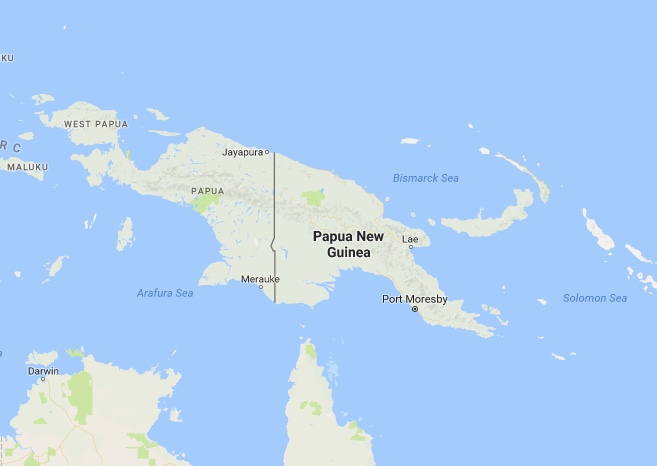
Minister for Communication, Information Technology and Energy Sam Basil wants all 22 provinces to have short wave frequency radio stations.
He said this during the Central Province assembly induction program last week Friday in Port Moresby.
“My role as the minister is to make sure that we go back to all the 22 provinces to make sure that we revive the radio stations,” Mr Basil said.
He said most of the radio stations currently using frequency modulation (FM) face the problem of signal loose in the rural settings as it is only powered by repeater and could not be able to penetrate when it meets obstacles.
“This is to ensure that people are kept informed and in tuned with the government of the day,” Mr Basil said.
[…]“I want to go short wave and we want to bring back to all the provinces capital in Papua New Guinea through National Broadcasting Corporation so that people in the mountains can have excess to communication,” Mr Basil said.
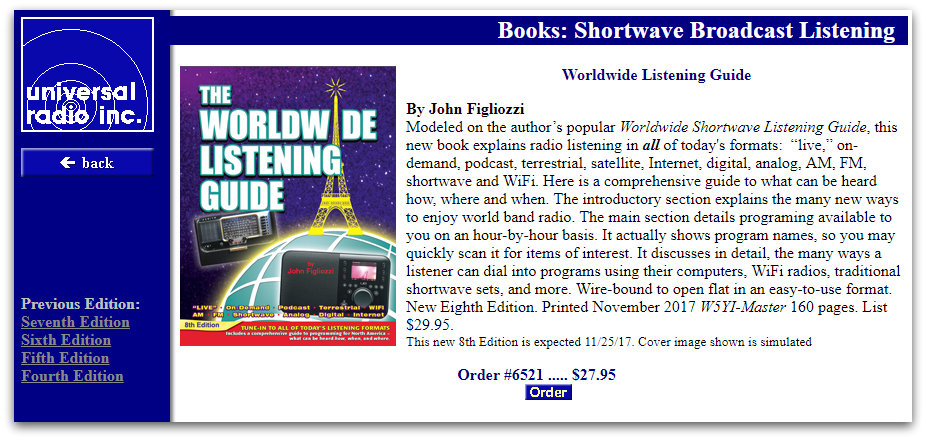
Many thanks to SWLing Post contributor, Troy Riedel, who notes that Universal Radio is now taking pre-orders for the 8th edition of the Worldwide Listening Guide by John Figliozzi.
Many thanks to SWLing Post contributor, Rolf Snijder, who writes:
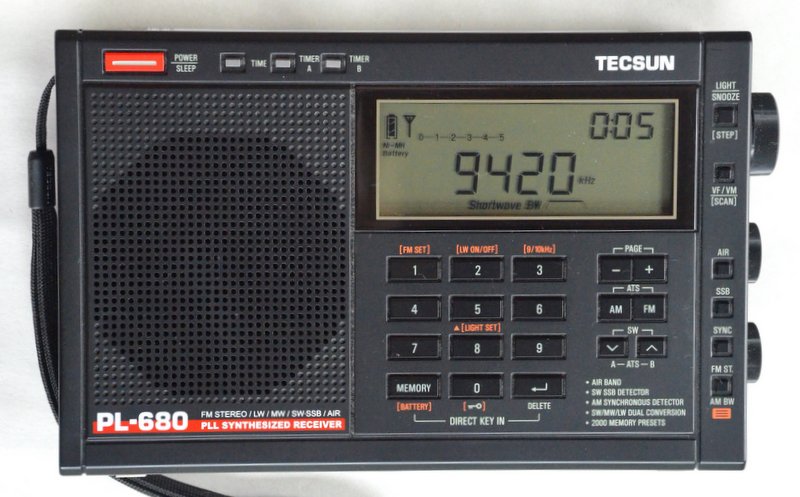
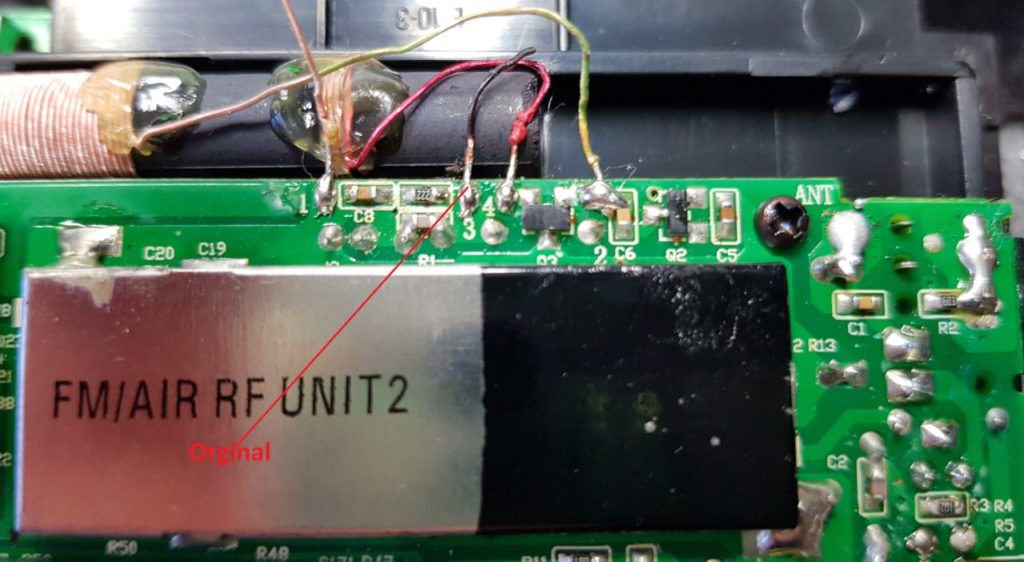
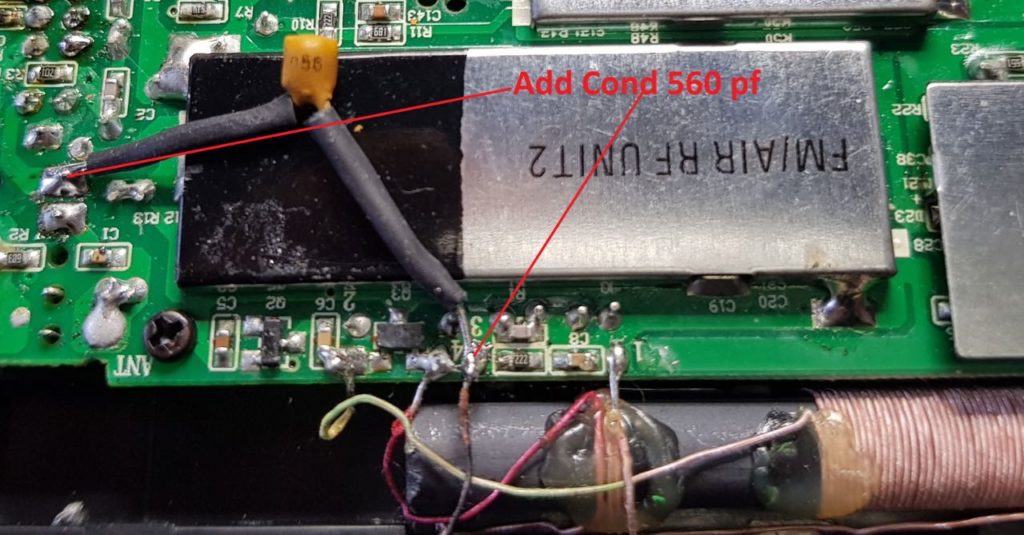
I did a modification today on the Tecsun PL-680 [which allows for an] external antenna on LW and MW.
The internal ferriet is also working, but on my active loop, MW and LW is now working !
So far away stations I can now receive on this portable radio.
It is only a560 pF capacitor added!
Click to enlarge.
Click to enlarge.
It works on LW and MW now with this mod.
FM is less now I think, maybe I will put it on a switch so I can turn it off.
And now also the ferrite is still working, so I hope to find a solution for that.
Many thanks for sharing your modification and photos, Rolf! Check out Rolf’s other PL-680 mod by clicking here.
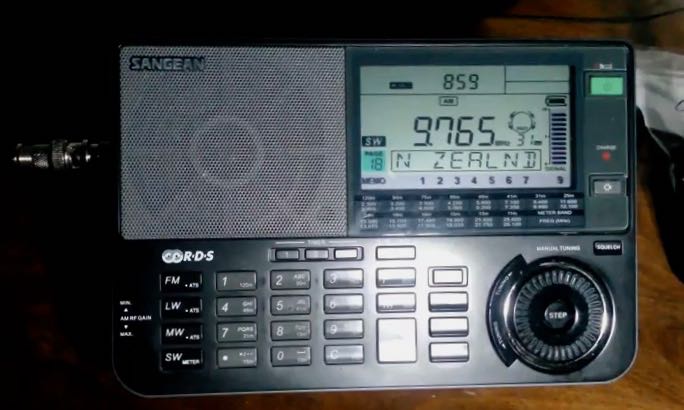
I do love RNZI–thanks for sharing, Dan. Indeed, since the demise of Radio Australia on, RNZI has become the voice of the Pacific on shortwave. Amazing signal!
On our Australian doorstep is an amazing place, Papua New Guinea. Seven of us were there for the month of August, exploring a remote region of islands and atolls in the Massim district of Milne Bay Province by boat, visiting places most people would not think of seeing.
[…]As Australians we were warmly received everywhere. Australia was the PNG administrator for decades and has left many good things in place. The Australian influence was there in diverse ways, including an inspired wooden Hills Hoist and outdoor bench setting at Boagis village, way out at the extreme end of PNG territory.
[…]But there was a worrying side that we shared. We visited many remote islands where basic services are deplorable, particularly their health services. At one sub-provincial health centre in Guasopa village [Woodlark Island], they had nothing but Panadol. We shared our first aid resources and knowledge, and treated those we could with spare drugs we had brought from Australia. There are so many issues facing PNG that we despaired at its future prospects.
Australia is the lucky country, but right now New Guinea is not. We were most surprised and quite angry to learn that Radio Australia no longer transmits to the region, or even the wider Pacific. One small service that Australia could offer is the return of shortwave radio.
The island of Panaeati, south of Misima, is typical of many we visited. It has a population of 2,080 people, many well educated, and fluent in English. The missions and the former Australian administration are responsible for this. Our contacts there expressed great disappointment at the loss of Radio Australia services in January 2017. So much so, that they discussed the prospect of raising a petition at local government level to the Australian government.[…]
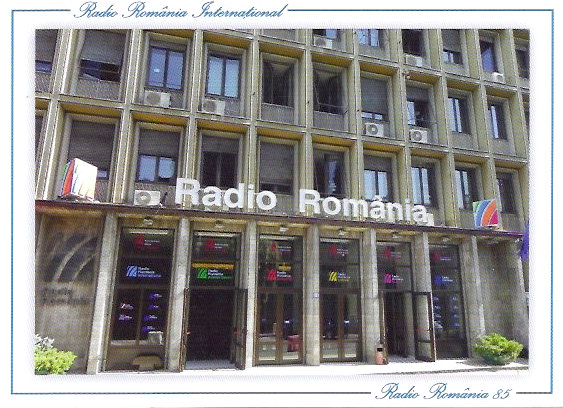
Ten years after WWI and the unification of Greater Romania, the most efficient and popular means of communication was first introduced in Romania: the radio. On November 1, 1928, the newly founded Romanian Radio Broadcasting Corporation aired its first broadcast. From the very beginning the radio was described as a means of public information, education and entertainment.
This year Radio Romania celebrates 89 years of continuous radio broadcasting. Despite having to constantly adapt its editorial policies, the public radio survived each radical change on the political spectrum, from the interwar democracy to right-wing dictatorships around the Second World War, and from the communist dictatorship to the democracy restored after the anti-communist revolution of 1989. For years now the Romanian Radio Broadcasting Corporation has been considered one of the most trustworthy and reputed media institutions in Romania, due to its large number of listeners.
Radio Romania addresses all generations and caters for all tastes, addressing society as a whole. It consists of channels with nationwide coverage, Radio Romania News and Current Affairs, Radio Romania Culture, Radio Romania Music and the Village Antenna, as well as regional and local studios, Internet platforms and a children’s and youth station. The Romanian public radio has started broadcasting abroad ever since the 1930s.
Today, Radio Romania International tries to keeps both international audiences and Romanians living abroad up to date with news from Romania and our traditional values. RRI broadcasts in 11 languages: Arabic, Chinese, English, French, German, Italian, Serbian, Spanish, Russia, Ukrainian and starting this year, Hebrew, as well as in Romanian and the Aromanian dialect. Its target audience virtually includes the entire world, from Alaska to Australia, from Argentina to the Russian Far East.
Nearly nine decades since its first broadcast, Radio Romania continues to innovate, to reinvent itself and to adapt to the ever-increasing market competitiveness and legislative changes. One such change was the recent scrappage of the radio license fee, traditionally covered by taxpayers, which now means the institution is fully funded by the state, amidst criticism from the political, civil and journalistic fields over editorial interference.
Similarly, other voices from outside or within the institution have over the years signaled controversial managerial practices of successive administrations. Thanks to its professionals, however, Radio Romania remains the leading media institution in the country to date. (translated by Vlad Palcu)
The following review first appeared in the October 2017 issue of The Spectrum Monitor magazine.
Earlier this year one of my readers in Australia noted the addition of the Digitech AR-1780 to the product offerings of the Australia and New Zealand-based retailer Jaycar.
One thing I’ve learned over the years is that there are few in-country sources of shortwave radios in both Australia and (especially) New Zealand. Jaycar, in a sense, represents what RadioShackand The Source have offered in the US and Canada––a more accessible electronics retailer with some shortwave radio selection.
The Jaycar models are either very cheap sub-$30AUD digital portables, or pricier large portables with a form factor similar to the Grundig S350DL and S450DLX, or the C.Crane CCRadio-SW. The new AR1780 fits somewhere between––a compact portable that promises a compliment of features tailored for the radio enthusiast.
In this review, we’ll take a close look at the AR1780, starting with its feature set.
Features
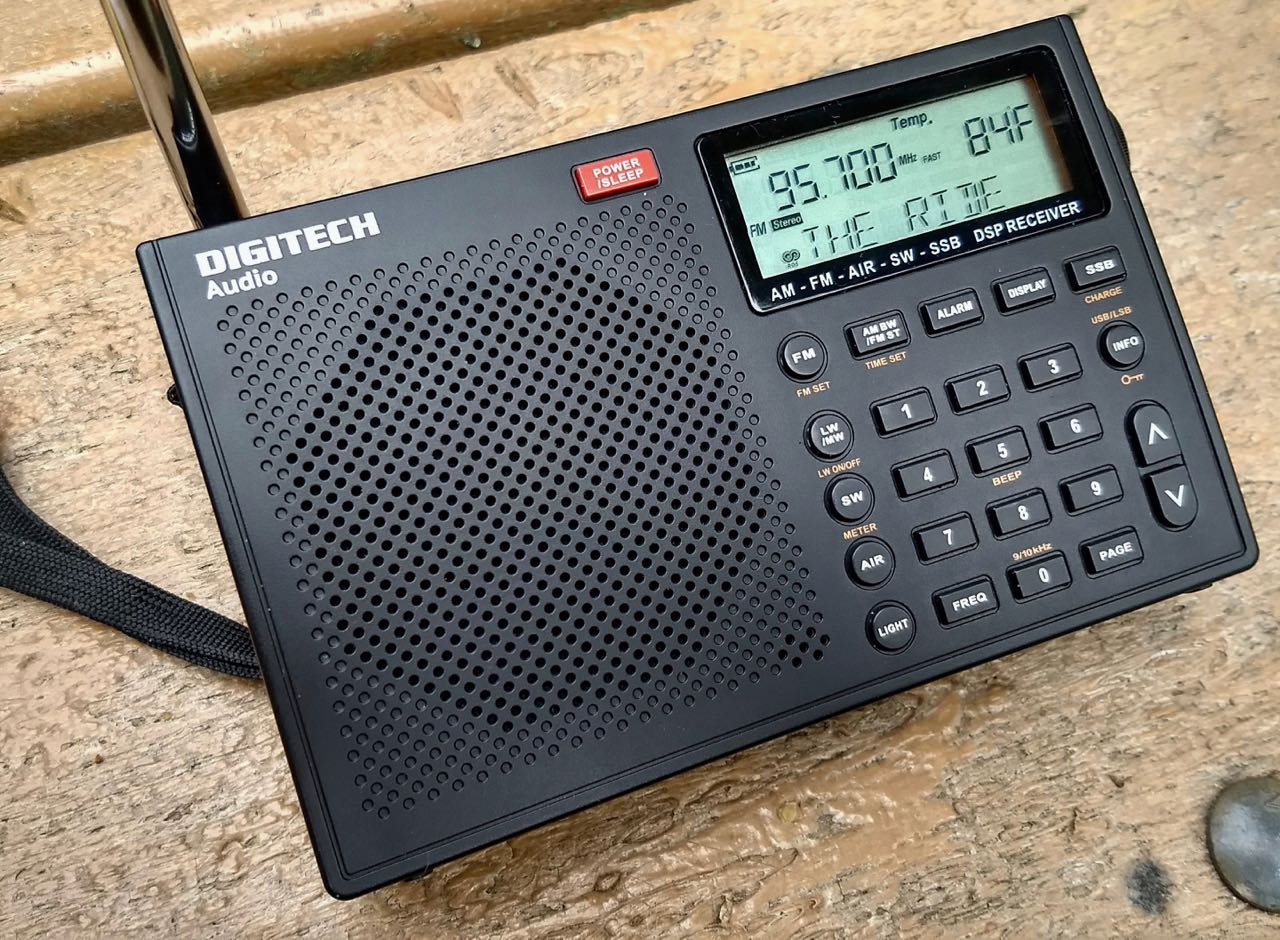
What appeals to me about the Digitech AR1780 is the amount of features provided by such a compact, traveller-friendly form factor.
Here’s a comprehensive list of the AR1780’s features and specs:
Frequency coverage:
FM 87.5 – 108 MHz
MW 522 – 1620 kHz or 520 – 1710 kHz
SW 1711 – 29,999 kHz
LW 150 – 450 kHz
AIR 118 – 137 MHz
Modes:
FM (including RDS)
AM
Single Sideband
Selectable Bandwidths:
AM mode: 6, 4, 3, 2.5, 2, & 1.81 kHz)
SSB mode: (4, 3, 2.2, 1.2, 1 & 0.5 kHz)
Convenient features:
Sleep timer
Clock/Alarm
Thermometer
Signal strength meter
Squelch control
Voice/Music selectable audio filter
Dedicated fine tune control
Headphone jack (3.5 mm)
Key lock button
Key beep on/off
Tuning knob and tuning step up/down buttons
Display button cycles through alarm, time, temperature, and signal strength
FM mono/stereo selection
Backlight button
Selectable 9/10 kHz regional MW tuning steps
Flip-out backstand
Power source: 7 VDC or 4 x AA cells (not included, can be internally charged if NiMH cells)
Antenna: Built-in telescopic and 3.5mm socket for external antenna
Weight: 253g/0.56 lbs (excluding batteries)
Dimensions: 150(W) x 95(H) x 30(D)mm
Operation Manual
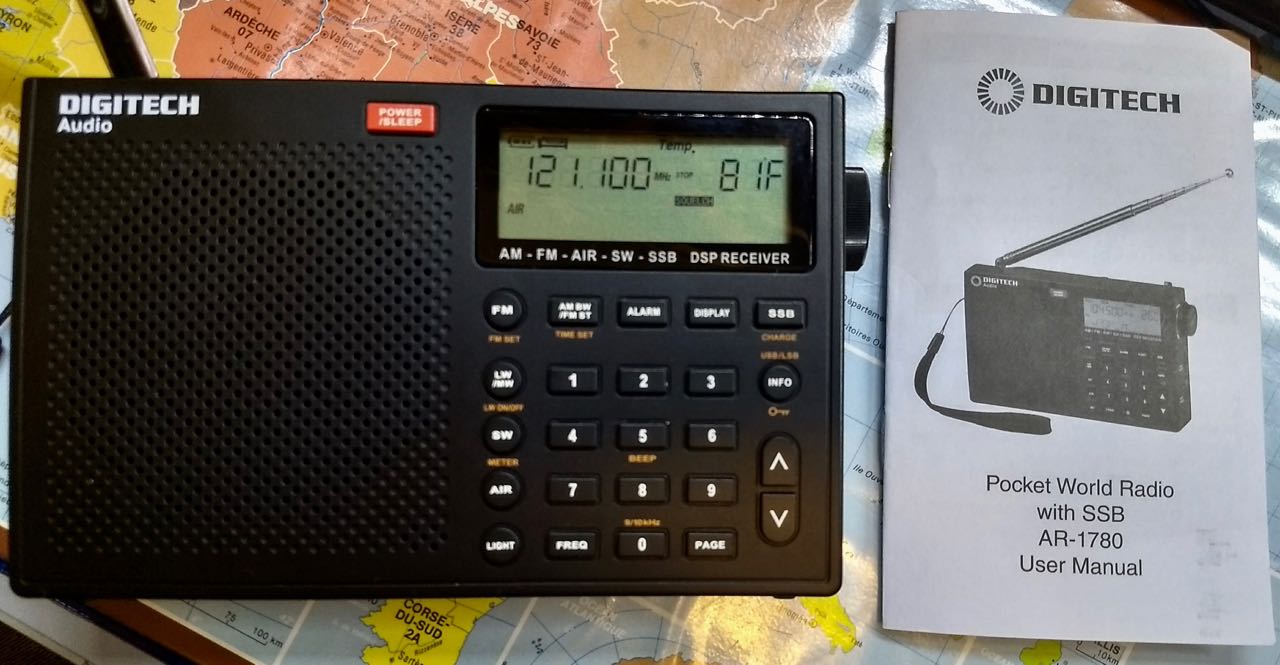
The Digitech AR1780 ships with a small user manual. In fact, other than the hand strap, the user manual is the only additional item in the box besides the radio itself.
The manual is quite thin––slightly smaller in height and width than the AR1780––and only contains about eight front-and-back mini pages. Although readable, it’s littered with grammatical and punctuation errors. While a manual is certainly a welcome reference item with this feature-packed radio, this manual comes up short, lacking detailed explanations of features and even leaving some out altogether: it does not, for example, offer any explanation on the use of the excellent squelch control, nor does it fully explain the station memory set on multiple memory pages––! Rather unfortunate, as these features deserve a clear explanation.
First impressions
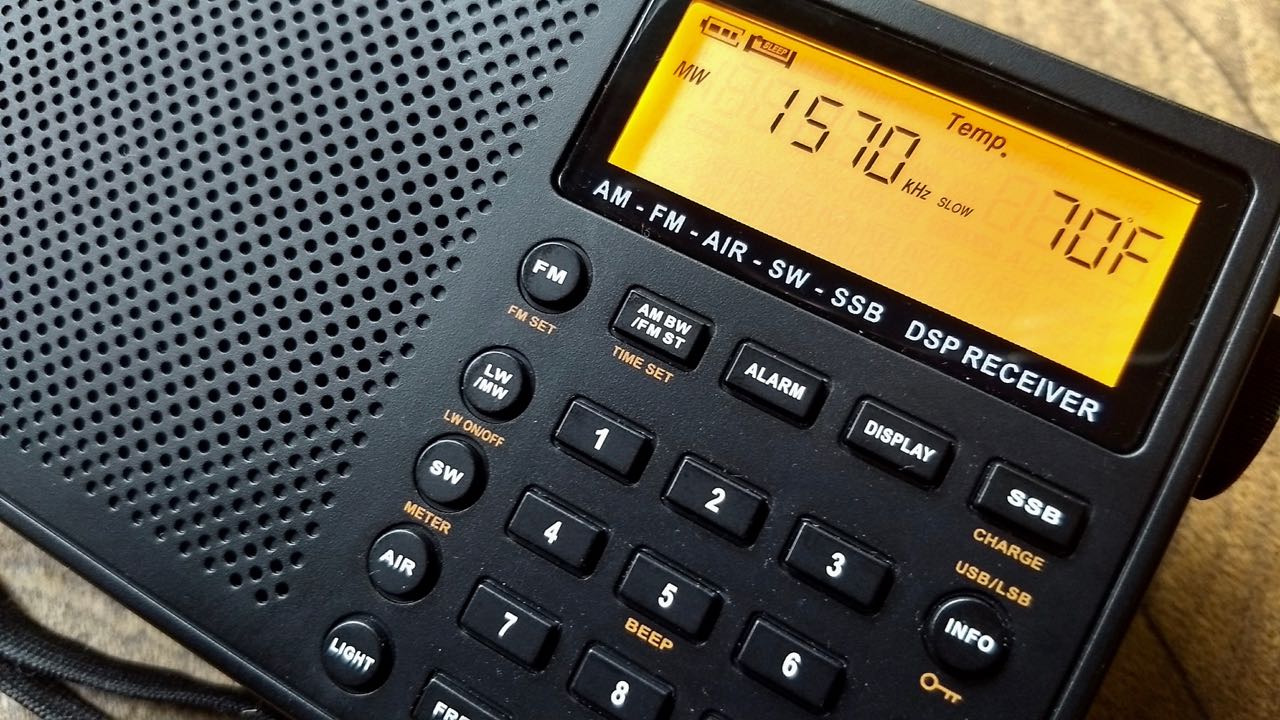
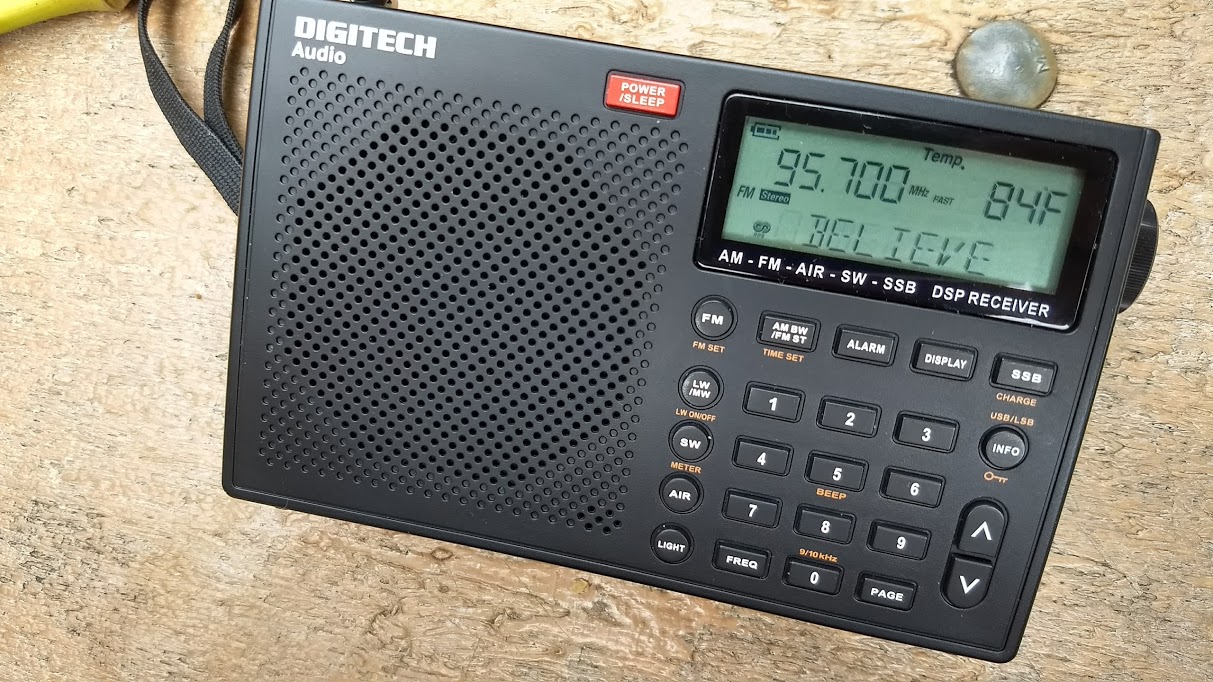
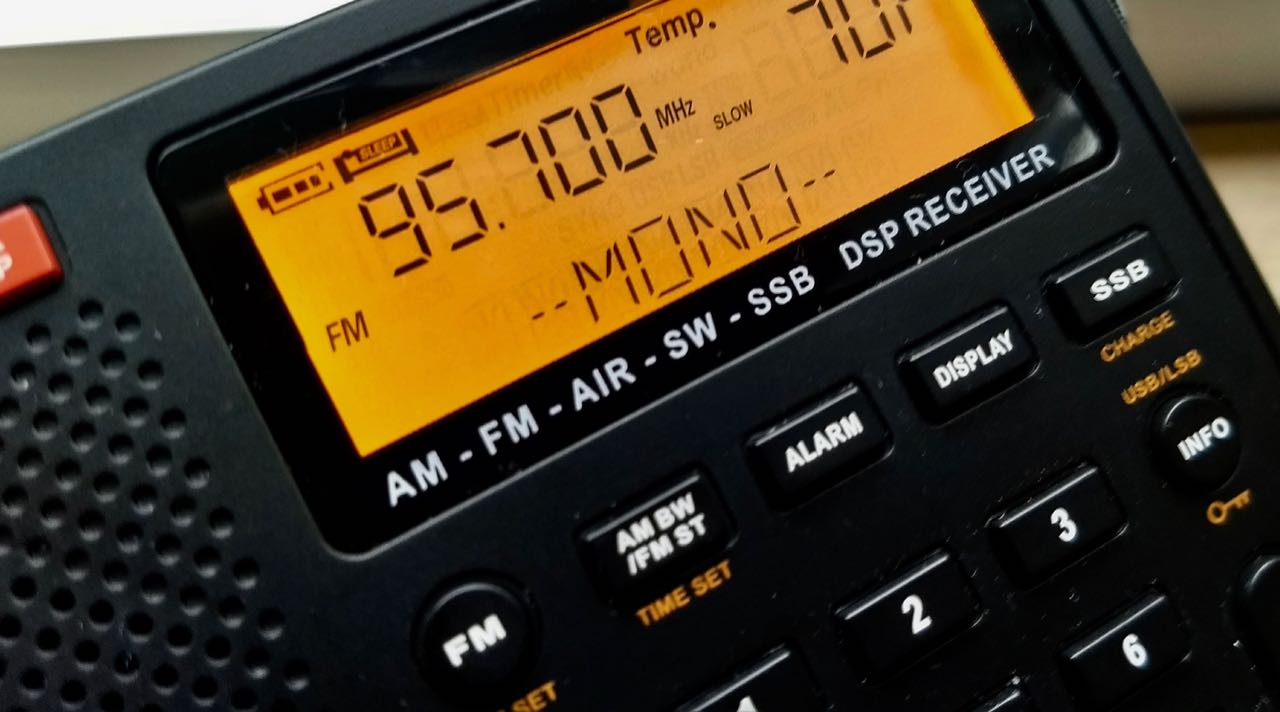
The Digitech AR-1780, like many DSP-based portables, includes a handy temperature display which can be toggled for Celsius or Fahrenheit.
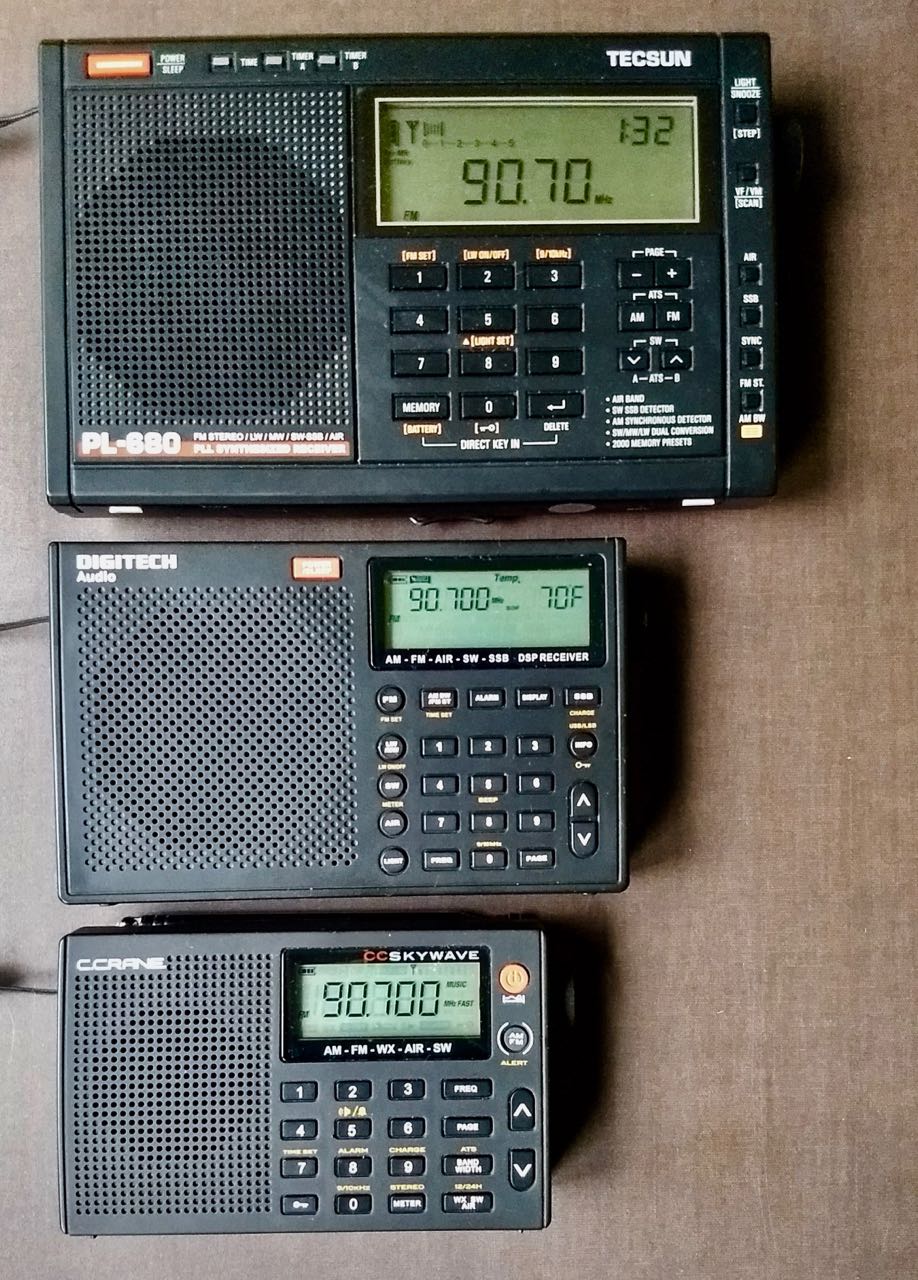
I really appreciate the modest, portable form factor of the AR1780, so it had that going for it before I even opened the box. I travel with portable radios a lot, so the compact body of the AR1780 is very appealing. It’s not as compact as the C. Crane CC Skywave series, or the Grundig G6, but is much smaller than my Tecsun PL-660 and PL-880, or my Sony ICF-SW7600GR.
Comparing size: The Tecsun PL-680 (top), Digitech AR1780 (middle), and the C. Crane CC Skywave (bottom)
Unlike the radios mentioned above, the AR1780 does not include some sort of protective case or bag. I believe this is an omission for a radio aimed squarely at the traveler.
Fortunately, the plastic chassis of the AR1780 feels substantial enough. With the key lock engaged, the only likely problem that could arise from having no protective case is damage to the display, such as scratching.
The buttons all have a tactile feedback and seem to respond quickly enough, save powering up the radio, engaging the SSB mode, or changing bands, each of which takes a couple of seconds to engage.
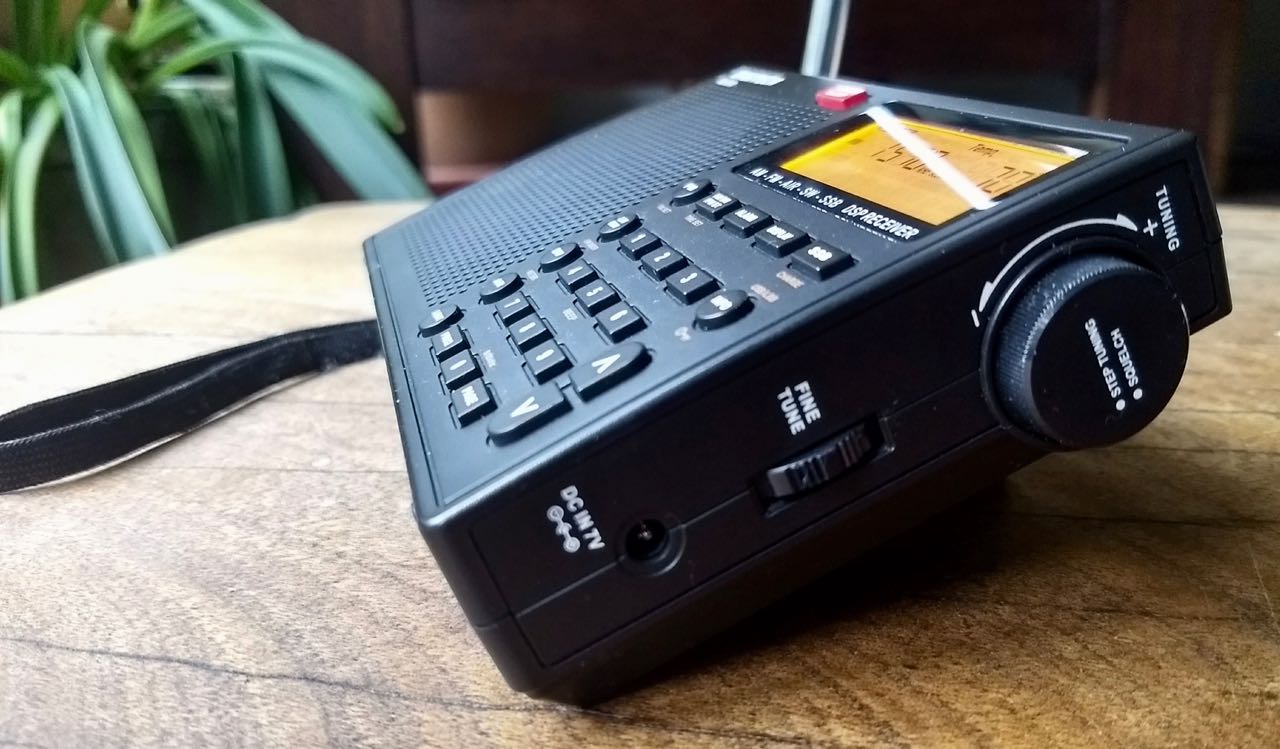
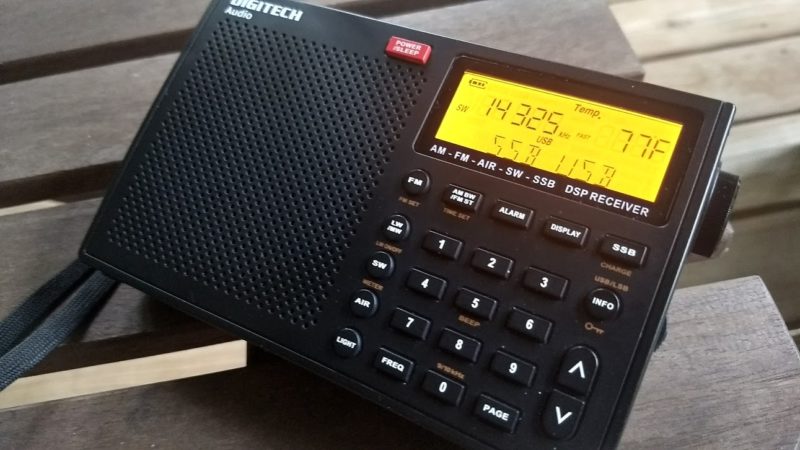
I especially like the fact the AR1780 has, on the right, a dedicated multi-function tuning knob. One can turn the tuning knob to scan frequencies or press it to cycle through fast or slow tuning steps (or to turn off this knob’s function entirely).
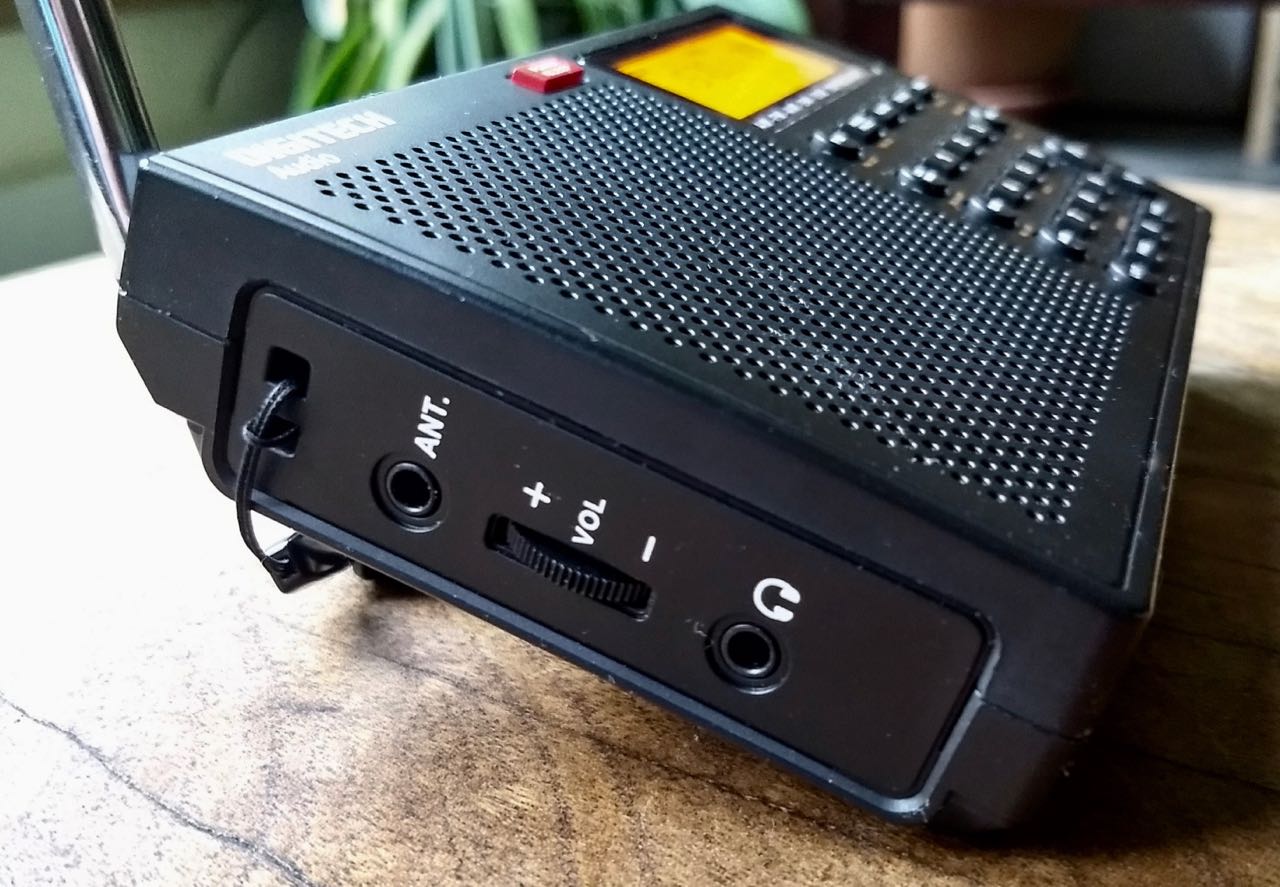
The AR1780 also has a dedicated fine tune control––a tuning wheel just beneath the main tuning knob also on the right side of the radio (see image above). The only odd quirk about this is that this is where most radios have a volume control. Being a creature of habit, many times I’ve inadvertently shifted frequencies when I simply wanted to turn up or down the volume! The volume control, meanwhile, is in the same position on the left side panel of the radio between the antenna and earphone jack.
Speaking of volume, the AR1780 can provide plenty of it-––almost room-filling audio––via the internal speaker. Best yet, I like its balanced fidelity: mellow, with notes of bass, but ample treble when listening at moderate volume. The audio response curve is almost ideal for such a small package.
Something else worth noting: the AR1780 fits nicely in the hand. In general, it’s a great size for portable listening.
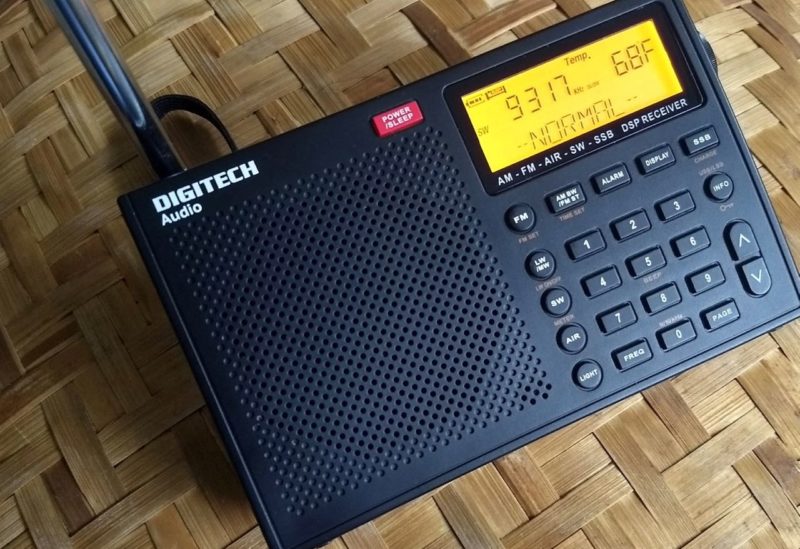
Major bonus for a travel radio: the AR-1780 is powered by standard, accessible AA cells. Note that the frequency range information silk-screened on the back stand is incorrect–shortwave coverage extends up to 29,999 kHz.
On the downside, however, one negative I noted shortly after beginning use: muting between frequency steps. In AM mode, this is not as distracting as in SSB mode. Muting makes band scanning a more tedious and fatiguing experience. Unfortunately, in this era of DSP-chip-based receivers, it seems muting has resurfaced.
Also, as with many other DSP portables, you can often hear “input” noise when pressing buttons. In other words, if while listening to one frequency I decide to key in another, I’ll hear a little clicking or buzz in the audio as each button is pressed. This is a very minor annoyance since it only happens when buttons are pressed, nonetheless, I thought it worth mentioning. I often wonder if it’s a result of poor shielding, something from which similar models suffer.
Performance
Over the past two weeks, I’ve had the AR1780 on the air almost every day. I’ve compared it with a number of receivers, but mainly The C. Crane CC Skywave, The CountyComm GP5-SSB, and even the Grundig G6. Below, I break down my notes by band.
AIR band
Let’s start with the “bonus” band: the VHF aviation band.
I’m sure there a number of readers who’ll never use this band, but I am not one of them. Personally, I really enjoy listening to aviation traffic, especially when I travel by air. Since the advent of the AIR band on ultra-compact radios, I no longer feel like I have to lug an additional scanner or receiver just to listen to the local air traffic control; that’s a plus.
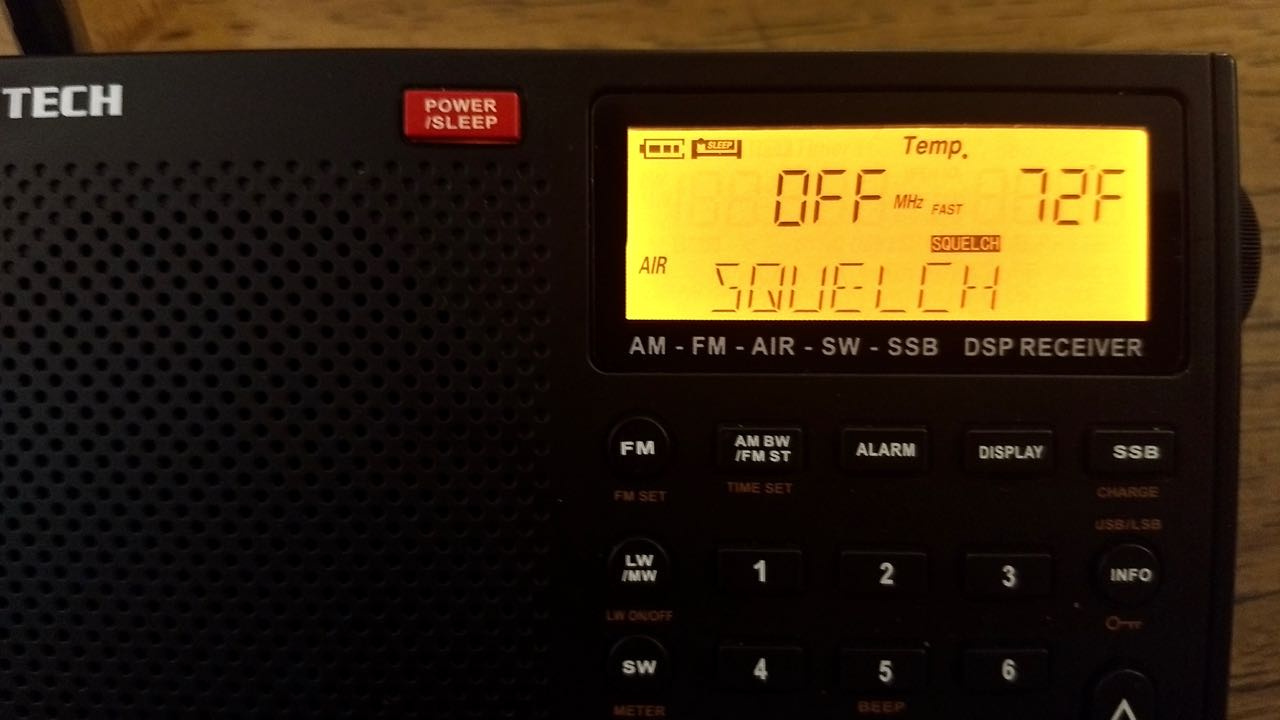
Performance-wise, the AR1780 seems to be equal with the CC Skywave on the AIR band. Like the CC Skywave, the AR1780 has a squelch control––a fantastic feature, indeed. Simply tune the radio to your favorite aviation frequency, press and hold in the tuning knob on the side, and then use the tuning knob to adjust the squelch level. I find level 3 or 4 works well.
Note that unlike the squelch on the CC Skywave, the squelch control on the AR1780 actually carries over to the shortwave band. If you have squelch set on the AIR band, then switch to another band where squelch isn’t needed, you will need to turn it off. I never use squelch on the shortwave or mediumwave/AM broadcast bands; normal fading (QSB) can trick the squelch to open and close while tuned to a frequency.
Another convenient feature: press and hold the AIR button to start an automatic scan of the entire band. It’ll run through the AIR band once, saving any active frequencies. This is an ATS feature, so only makes one pass. I wish you could set it to continuously scan the aviation band in a loop, much as a traditional scanner would.
FM
The AR1780 does a fine job on the FM band. It easily received my benchmark FM stations and even decoded the RDS from one broadcaster about 110 miles from my home base.
When listening to marginal FM signals, the AR1780 can be set to mono mode instead of default stereo mode.
What’s more, the internal speaker is exceptional at handling music––reasonably full fidelity given the limitations of the speaker size.
Longwave/Mediumwave
I’ll be the first to admit that longwave is not an easy band for me to evaluate. Here in North America, there are so few opportunities in the summer to log trans-Atlantic longwave stations. Indeed, unless I’m travelling to New England or the Canadian Maritime provinces, I never try to do so on a portable. I leave TA longwave DXing to my SDRs and tabletops back home where I can listen with the assistance of a large antenna.
But when I travel to Europe, longwave is a must, so my travel radio needs this capability. Based on my ability to receive benchmark LW airport beacons, I’m going to assume the AR1780 will do a fine job receiving European longwave stations while in Europe.
Likewise, the AR1780 should serve you well for both daytime and nighttime reception on mediumwave. Fortunately, switching between 10 and 9 kHz steps is simple: with the radio powered off, simply press and hold the “0” button to toggle between these steps.
On longwave and mediumwave, you can also use SSB mode (both upper and lower sideband). This could come in handy to reject adjacent signal interference on MW.
Likely an oversight on the part of the manufacturer, you can even engage the squelch feature, though why you would on LW and MW, I’m not sure.
Of course, with the fine-tuning control, you can navigate both bands in 1 kHz steps should you desire.
In short: the AR1780 is adequately sensitive on mediumwave and likely on longwave, as well. I wouldn’t rely on it for any serious DXing, but for a travel radio, it will serve you well.
Shortwave
Being first and foremost an avid shortwave listener, I spent the bulk of my AR1780 evaluation time on the shortwave bands and I’m overall very pleased with its performance.
In almost all of my comparisons on the shortwave bands, the AR1780 had a slight edge over its competition, namely, the CountyComm GP5-SSB, the Grundig G6, and the C. Crane CC Skywave.
To be clear, though, it was a very slight performance edge which I think may be attributed to the fact the AR1780’s telescopic antenna is longer, giving it a bit of gain over its competitors. For example, the AR1780’s antenna is about 17.7 cm (7 inches) longer than that of the smaller CC Skywave.
Still, placed on a table and not held in the hand, the AR1780 was able to pull in weak signals better than its competitors. I also compared it with the the Tecsun PL-680––one of my most sensitive shortwave portables––and, not surprisingly, the PL-680 outperformed the AR1780.
Again, I should stress that the sound from the AR1780’s internal speaker is more pleasant to listen to for extended periods than that of its smaller competitors.
SSB
Single sideband reception on the AR1780 is pretty impressive for a radio in this price class. On my particular unit, I found that the fine-tuning control was almost always needed to budge the frequency a few tenths of a kilohertz, even when I knew a particular signal was exactly on frequency. My Grundig G6 always had the same problem––indeed, sometimes in SSB mode, I had to listen “up” as much as 2 kHz on the G6.
The fine-tuning control works very effectively in SSB mode, nonetheless. Audio is quite pleasant, although the noise floor is not quite as low as it is on my larger portables like the Tecsun PL-680, PL-880, and the new S-8800. In my comparison tests, the AR1780 was slightly more sensitive than the CountyComm GP5-SSB, and about equal to that of the Grundig G6.
In short? SSB is a welcome, capable addition on this compact portable.
Summary
Every radio has its pros and cons, of course. When I begin a review of a radio, I take notes from the very beginning so that I don’t forget my initial impressions. Following is the list I’ve formed over the time I’ve been evaluating the Digitech AR1780:
Pros:
Display is clear and easy to read
Time is always present via display button
RDS info scrolls on lower line
Backlit display easy to read
Viewing angle good, save from top
Dedicated fine-tuning control (even on FM)
External antenna jack
9/10 kHz selectable MW steps
Time set is simple
Adjustable bandwidth in AM and SSB
Decent battery life from four standard AA cells
Audio from the built-in speaker has better fidelity than other radios in this size
Cons:
No bag or carry case
DC input voltage is an odd 7V
Muting between frequency changes, especially annoying in SSB
Sometimes keylock activates backlit display permanently
Scan function on AIR band doesn’t loop, it’s an ATS pass only
My AR1780 had incorrect information silk-screened on the back regarding frequency coverage
Minor: sluggish response when switching bands or modes
Conclusion
Is the Digitech AR1780 worth the price? I think so. For $129.00 AUD (roughly $103 USD), you’re getting a full-featured radio that is, by and large, a pleasure to operate. It has its quirks, but so do so many ultra-compact portables in this price bracket. It’s certainly worth considering if you live in Australia or New Zealand.
I’d like the AR1780 to be a little more refined:
No muting while band scanning in AM or SSB modes
A proper scan function to accompany squelch on the AIR band
Squelch that doesn’t carry over when bands are switched
What I do think is impressive for this price:
Overall smooth audio from the internal speaker
Dedicated external antenna port
Dedicated tuning and fine-tuning controls
Useful screen which displays time and even RDS information
Sturdy, relatively long telescoping whip antenna
These are features that make the AR1780 stand out among radios in its price class.
Is it a benchmark performer? No. But it does the job rather well for the price, and frankly, I think I’ll use this during travel occasionally, even though I have several other smaller portables.
Why? Well, for one thing, this radio has better audio fidelity from the internal speaker than most of my ultra-compact portables. When I’m in a hotel and listening to a local radio station or even a shortwave broadcaster that’s punching through typical hotel RFI, I’ll appreciate the richer, mellower audio. Many of my smaller portables are lacking in this respect, thus I usually end up listening through headphones.
In fact, the only thing this little receiver lacks for us here in North America is NOAA weather/Environment Canada radio frequencies––but it’s no wonder it’s not included, as it was never intended for this market. But I’m glad the step size on the AM broadcast band can be switched to our 10 kHz spacing, which makes it useful here in North America.
In short, the AR1780 has exceeded my expectations––though admittedly, it may be because it was my first experience with a Digitech radio and I had heard so many lukewarm reviews of previous models.
Regardless, I’m happy I paid a small premium to order this little rig from Down Under.
If you’re a radio enthusiast in Australia or New Zealand who wants the best performance in a portable, and doesn’t mind a larger radio, then do splurge for the Tecsun PL-660, PL-880, or Grundig Satellite. There is a dedicated Tecsun distributor in New South Wales and there are always, of course, retailers on eBay and one of my favorites, Anon-Co in Hong Kong.