Shortwave listening and everything radio including reviews, broadcasting, ham radio, field operation, DXing, maker kits, travel, emergency gear, events, and more
These fine, collectable receivers appear on Ebay regularly, but this one is in pristine shape:
The asking price is a cool $1,800 USD, but for the near mint condition of this T-1000 it is likely appropriate; perhaps the new owner will acquire it for a “Best Offer” price. Other T-1000s on Ebay currently are priced from $370 to $1,299.
Of course, the cost is in-line with a collectable value; functionally, it’s reception abilities are almost certainly surpassed by a modestly priced SDRPlay RSP1 or a vintage Sony ICF-2010 for instance. The radio aficionado interested in the 55 year old T-1000 is not expecting best-in-class reception, but the chance to own a recognized icon of industrial design (the T-1000 is in NYC’s Museum of Modern Art’s permanent collection).
Many thanks to SWLing Post contributor, Dan Hawkins, who writes:
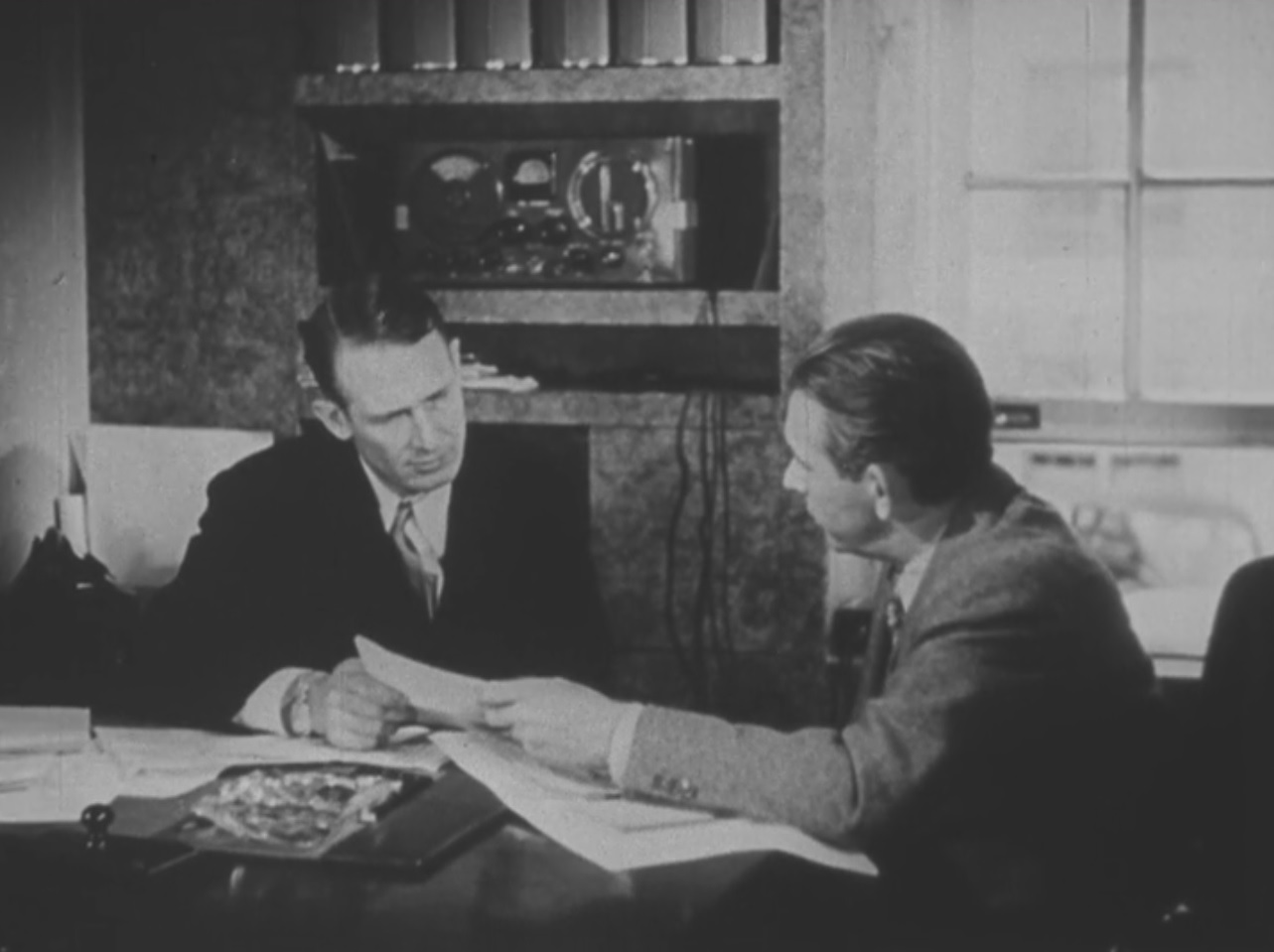
This evening I watched the excellent Undercover: How to Operate Behind Enemy Lines on Netflix streaming. This is a 1943 training film for Office of Strategic Services personnel learning how be secret agents. The film was directed by the legendary John Ford who also took an acting role in the film. In this scene, Al is receiving his forged papers from an OSS agent before leaving for Germany. A radio may seen on a shelf in the background.
Undercover: How to Operate Behind Enemy Lines is also available on YouTube:
The next film is much better known. The same model radio makes a foreground appearance in Some Like it Hot. Osgood Fielding III has one of these on his yacht.
Maybe Osgood is laughing because the film takes place in 1929 and the company that made the radio was founded several years later.
I won’t spoil the secret of this radio’s maker and model. It will probably not take long for SWLing Post readers to come up with an answer.
Post readers: are you up for the challenge? 🙂 What model of radio do we see here? I’ll keep quiet, because it’s one of my favorite manufacturers.
And, Dan, many thanks. I really do owe you one because I was not familiar with Undercover: How to Operate Behind Enemy Lines. I can’t believe there was a WWII era Ford film I had missed. I, too, have Netflix but the YouTube copy you suggested is actually a better restored version in terms of audio. Thanks again!
Many thanks to SWLing Post contributor, Jonathan Marks, who shares the following details about the ‘Keep in touch with the Dutch’: Symposium marking the ninetieth anniversary of international radio broadcasting in the Netherlands, 1927-2017:
Symposium marking the ninetieth anniversary of international radio broadcasting in the Netherlands, 1927-2017
Thursday 1 June 2017, 2-5pm
Doelenzaal, Singel 425 Amsterdam
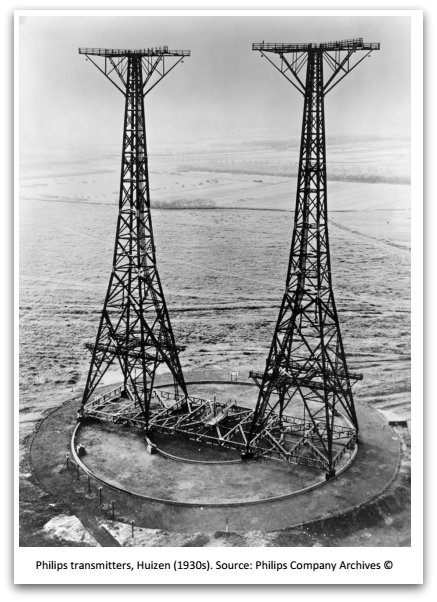
On 1 June 1927 Queen Wilhelmina officially inaugurated international radio broadcasting from the Netherlands with a speech to listeners in the Dutch colonies. This transmission attracted attention from all over the world as it was one of the first times that sound had been transmitted via radio waves across such a distance. In the decades that followed Dutch radio-makers continued to play a pioneering role in international broadcasting, experimenting with new technologies and programming formats. This symposium aims to highlight several themes from this rich history and explore source-materials in order to think about a research agenda in this field and new broadcasting techniques in the digital age.
Program
2.00-2.15pm: Vincent Kuitenbrouwer (University of Amsterdam)
Introduction
2.15-2.45pm: Bas Agterberg (Beeld en Geluid)
Everybody Happy? Archiving RNW and the Heritage of Eddy Startz at Sound and Vision
2.45-3.00pm: break
3.00-3.30pm: Jonathan Marks (CEO Critical Distance)
International Radio Broadcasting in the Era of Amazon Echo
3.30-4.00pm: Rocus de Joode (Independent Consultant at JRCC)
The Importance of Shortwave, the Madagascar Relay station Now and Then
4.00-4.15pm: break
4.15-5.00pm: Panel: International radio in the digital age
– Alec Badenoch (University of Utrecht/Vrije Universiteit): Radio Garden
– Leon Willems and Suzanne Bakker (Free Press Unlimited): Radio Dabanga
5.00-6.00pm: drinks reception
Please register
Vincent Kuitenbrouwer, History Department, University of Amsterdam
Email: [email protected]
This symposium is sponsored by the Amsterdam School of Historical Studies (ASH) and the Modern History Research Group
If I lived within a reasonable distance of Amsterdam, I would certainly attend this afternoon symposium. Impressive line-up!
Hopefully you have now had chance to read through Radio Adventures of the Communicator book? I hope you enjoyed reading and it was informative? I am interested to hear any comments, questions or suggestions you might have.
There is still considerable mileage in the Laser brand – hobby pirates using the Laser brand enjoy considerable success.
You don’t need me to tell you how successful Laser was. Few of us in the 1980s thought the memories would last so long, yet hundreds have bought my recent books about Laser, and many would like to work on a new Laser project. Maybe it’s because interest in 80s music has never been higher, or maybe deep down, everyone wants to be a pirate, even if only at weekends!
Our project is to Relaunch Laser
I’ve joined with other broadcast professionals to relaunch the Laser project from a ship. We believe that a reborn Laser venture would be economically viable, and it will be fun and exciting as well as profitable. A “little bit of naughtiness” invariably gives a project a whiff of extra desirability, it attracts more interest from anyone with a freedom-loving rebellious streak. The original Laser team and I were already aware of this when planning the station in 1983 and that basic tenet is just as true today. This is however 100% legal.
I felt that you would want to be involved and not miss this wonderful opportunity. The chance of a lifetime to be part of an exciting fun project. YOU could be working with experienced Laser engineers and some of her best known DJs. This is a golden opportunity to be a part of a radio venture on board a ship; one that the public can visit and get enthusiastic about.
The Pirate Ship
Our ship is chartered, licensed and insured for the public to visit and can berth in any of five dozen harbours and docks around the UK. Both radio and TV studios are being constructed on board along with a public performance area. With on board dining facilities, it means our audience can join us to experience life on board and enjoy a live performance by one of the artists recording that week. As well as recording facilities we are offering the ship for filming, just like the Radio Veronica ship in Amsterdam. The ship will be the main location for a feature length movie to be shot on board which the producers hope to expand into a TV series; we’ve seen some scripts and it’s very exciting. Members of our team may even be seen on screen!
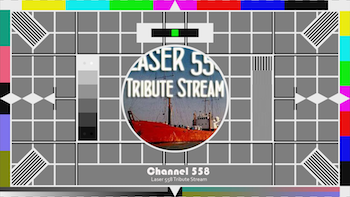
This project is much more than just a radio station. We have been testing a Laser Tribute stream for some time and more recently our Laser TV Channel 558 has been streaming too. This will have both live and pre-recorded programmes. The music and videos showing on our ‘test transmissions’ now are taken from genuine 1980s Laser discs; we have a very wide library of all the hits from the era, and more, but Channel 558 will be more than just 80s. You can watch CHANNEL 558 right now on your computer or a smartphone – just click here or the test card at the top of this page. (some interesting adverts at :15 and :45!)
EVENTS
We’re currently lining up special events to publicise both the Pirate Ship and the radio brands:
Live Laser Lover Road Shows from various indoor and outdoor locations.
Laser Weekends at a UK Holiday Camp.
Laser Party Nights live from the radio ship each weekend.
BROADCAST EXPANSION
Programmes will be made available to local radio stations for rebroadcast, perhaps overnight. A DCMS consultation exercise currently taking place is expected to remove the restrictions on networking, which will substantially expand the possibilities of our daytime shows also being carried on other stations.
Our radio programmes will also be made available to the new local DAB muxes and we may take a channel on the national DAB, if reasonable terms can be agreed.
GOING FORWARD
What need to expand our team to include more help to help us relaunch LASER in some style and carry our plans out in full. The opportunities for this project are limitless, and this time around, its all legal! This exciting new opportunity is a metamorphosis of pirate radio into a legitimate and even more enjoyable operation; using today’s technology and communications capabilities, with a tried and tested brand identity.
News will be published HERE when we are ready to release it. I’m sure that you would like to be involved in what will be the most fun-packed radio party ever. If you confirm that you really ARE interested and we can take things from there.
Many thanks, Dave, for sharing the news. Sounds like Laser 558 has some ambitious goals ahead! Pretty amazing. We’ll continue to follow their progress.
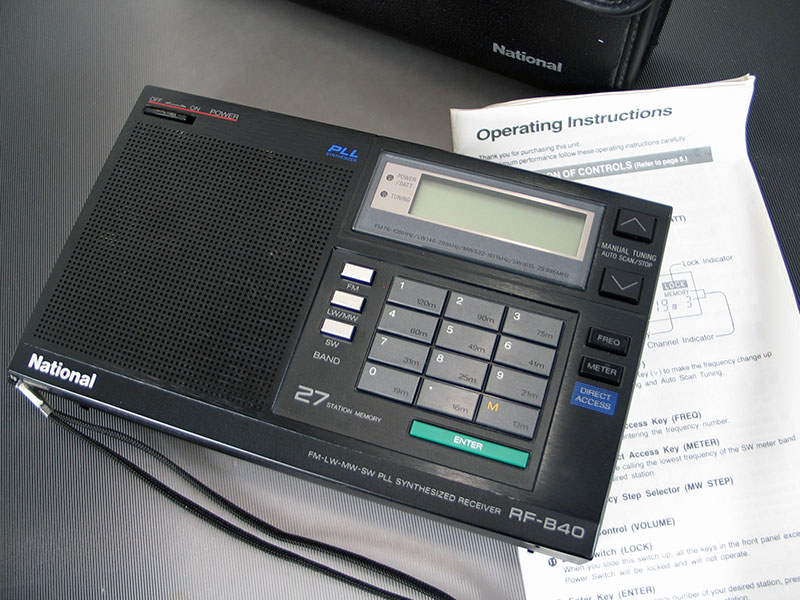
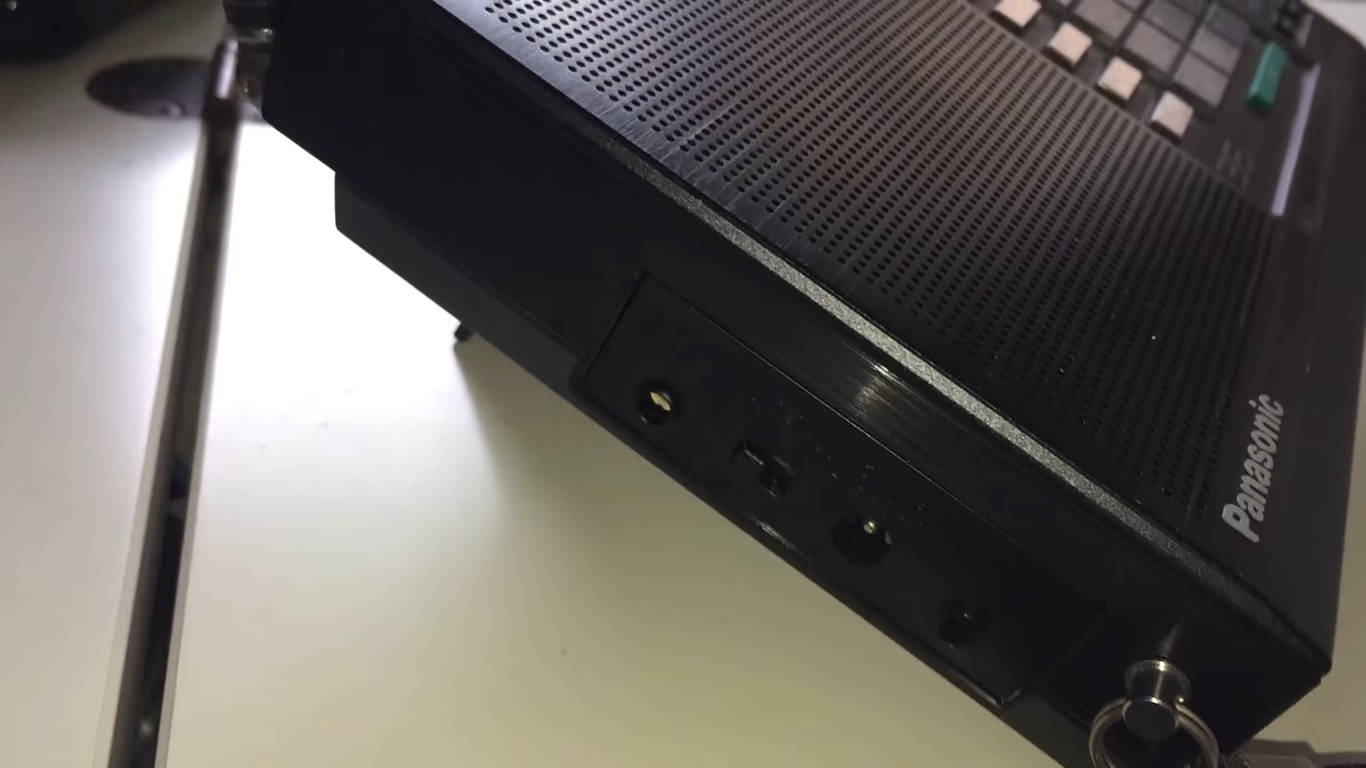
Hi there, back in 1990 I was given a Panasonic RF-B40 for my birthday (I think it was my birthday…1990 was a long time ago!). I found that radio to be very sensitive on shortwave, more so perhaps than my Sangean ATS-803A, but ultimately it didn’t really add much value to any serious DXing because it would only tune on shortwave in 5 kHz steps. This rather course tuning arrangement was very limiting in terms of tuning out adjacent noise and copying tropical band – and other signals that weren’t quite on-frequency etc. Frustrated, I lent my RF-B40 to my brother a few years ago and serves me right; following a house move, he managed to lose it! Quite a shame really because almost three decades later, I would have been very interested to put the RF-B40 through it’s paces on a DXpedition or two. You really don’t see them in action very often at all these days.
Above: the Panasonic RF-B40 (not mine – unfortunately) and the RF-B60, mid-DXpedition!
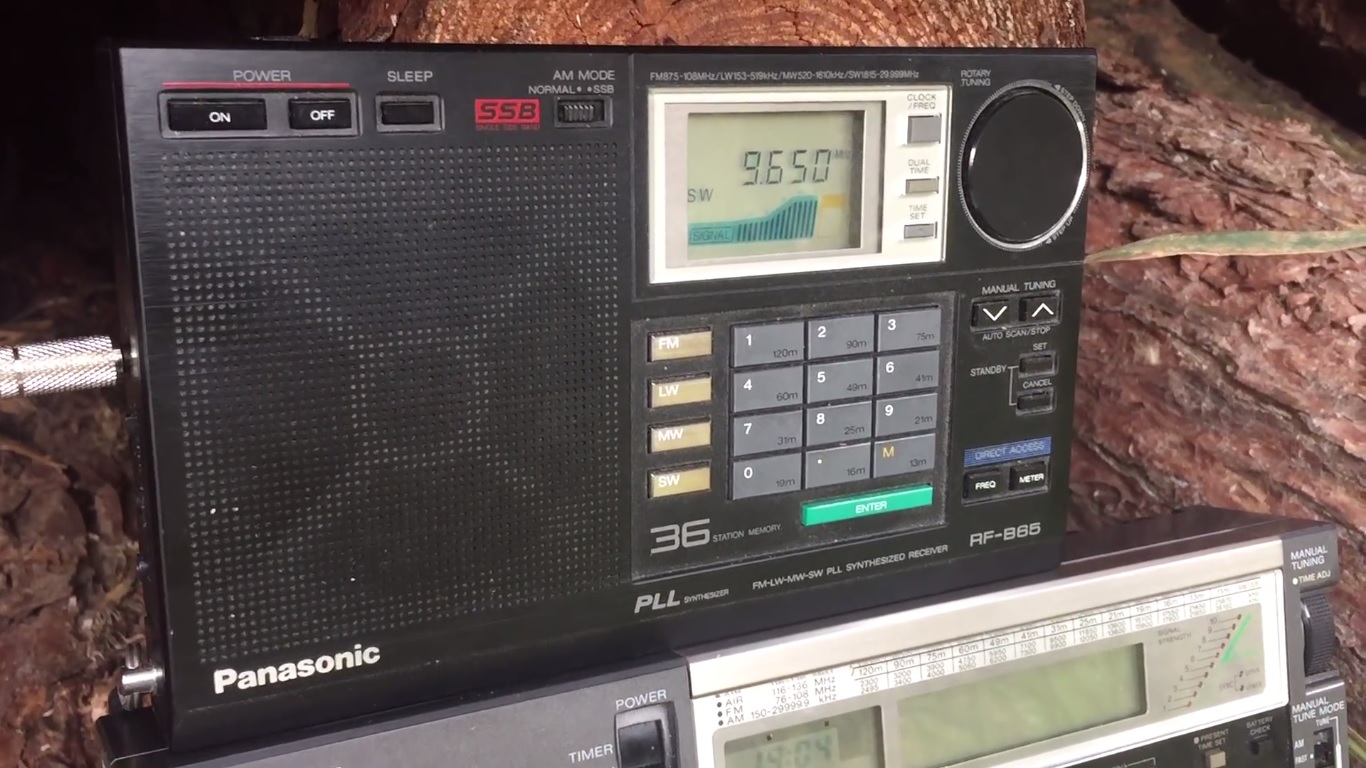
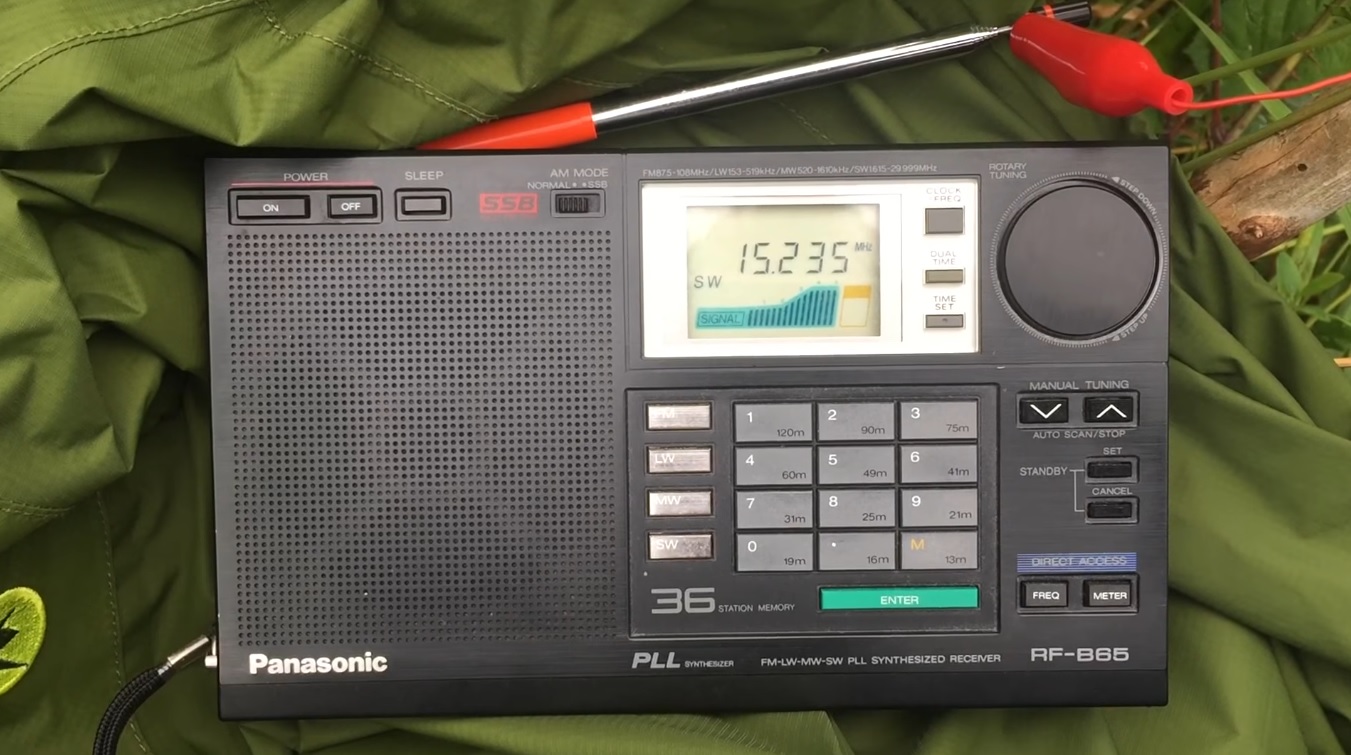
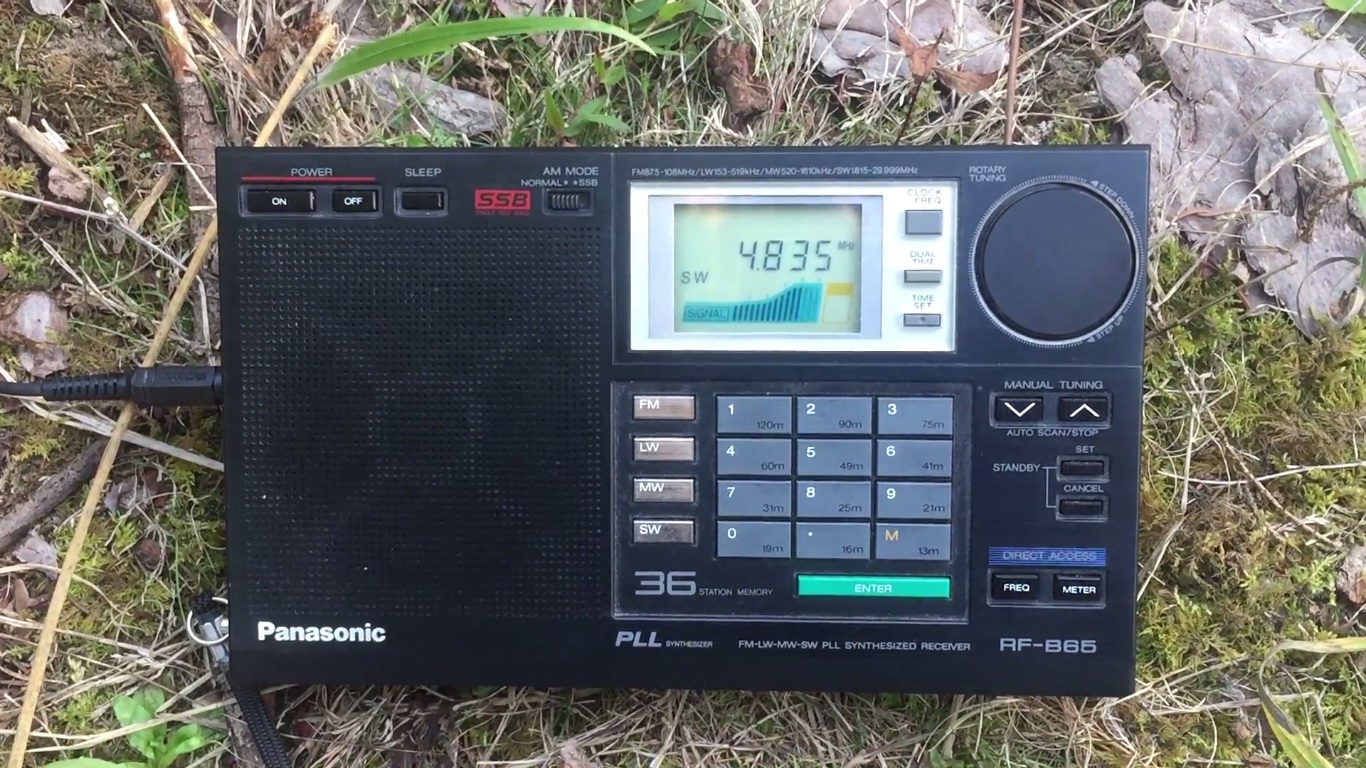
At that time, which was around the beginning of the 1990s, I read a review somewhere and it became clear that the better receiver was quite obviously the RF-B65. Upon it’s introduction into the market, the RF-B65 was immediately recognised as an excellent receiver, however, in the intervening years it’s reputation has continued to grow to the point today where it enjoys legendary status amongst DXers and bit of a cult following. There’s a lot of information on the RF-B65 to be found on the internet, so I won’t go into huge detail, but the obvious question is: what makes thsi receiver so special? Well, it’s a quite compact PPL double conversion receiver, covering 153 kHz to 29,999 kHz AM and 87.5 to 108 MHz, FM. It has a keypad for direct frequency input, although you have to press either the ‘FREQ’ or ‘METER’ buttons prior to punching in the numbers to define whether you wish to access a particular frequency, or band. I actually find that slightly annoying, but you easily learn to live with such trivial matters when using a radio of this quality and performance.
Furthermore, there’s an electronic signal strength meter, a DX/local attenuation switch, external antenna jack, SSB reception mode, 1 kHz tuning steps on shortwave (unlike it’s little brother the RF-B40) and fine tuning. The single bandwidth filter is 6 kHz wide and thus limits selectivity a little, although the SSB option and fine tune helps offset that somewhat. It would have been nice to have a couple more filtering options, particularly narrower for serious DXing in crowded bands, to combat adjacent channel QRM. Build quality is generally excellent as you would have expected from a high-end Panasonic portable and with a very compact form-factor – roughly the size of a paperback book and weighing in at just 1.4 Ibs, it is eminently more portable than a Sony ICF-SW77 or the iconic ICF-2001D/2010.
Ultimately, the RF-B65 continues to enjoy an excellent reputation today, nearly 30 years after it was introduced because it is a wonderfully sensitive receiver and arguably the best-ever performing shortwave portable in the paperback book size category – often touted as ‘travel portables’. I managed to acquire an example in as-new condition from eBay, although mind you, I paid through the nose for it lol – that cult following ensures prices remain very robust! I have tested my example against the equally legendary Sony ICF-2001D, still considered by many to be the benchmark for shortwave portables, and in my experience the Panasonic is right up there with it. There’s virtually no difference whatsoever in sensitivity. Where the Panasonic comes a little unstuck is the lack of bandwidth filtering and SYNC, leading to lower selectivity. However, clever use of SSB and fine tuning does provide quite good compensation for these shortcomings. Overall though, given it’s size, sensitivity, build quality and audio, as a complete package, in my opinion, the RF-B65 is equal to the ICF-2001D, and this is why today, it remains so highly sought after.
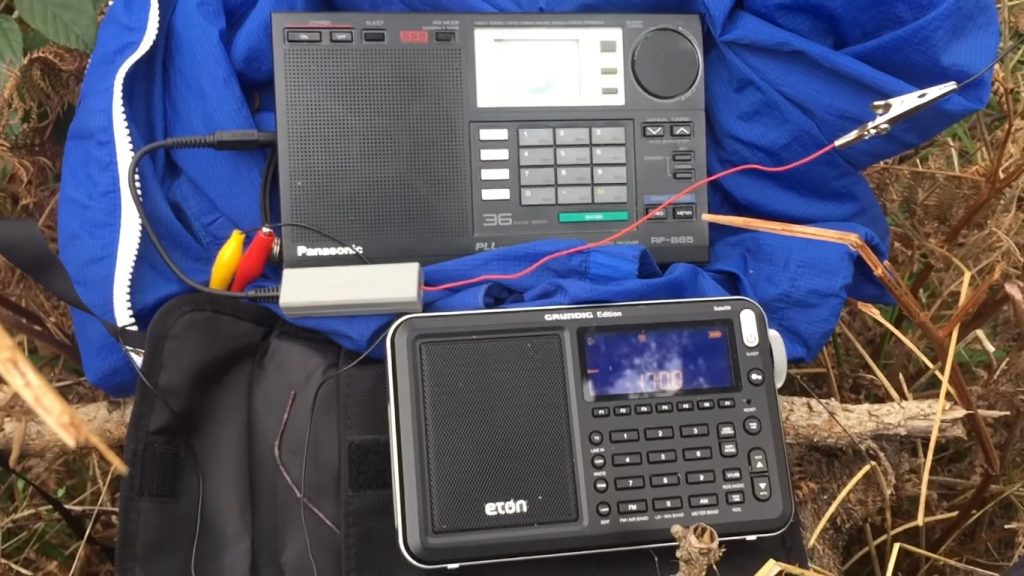
Below are embedded reception videos and text links to the Oxford Shortwave Log YouTube channel, with various DX catches on the RF-B65. Some of these are considered quite rare in Europe, for example EXPPM Radio Educación’s 1 kW signal from Mexico City, the now defunct ABC Northern Territories on 120 metres and Radio Bandeirantes from Sao Paolo, Brazil, amongst others. Please note; right at the bottom of this post is a link to some very recent comparisons with the brilliant Eton Satellit – one of the very best portables currently on the market today. The vintage Panasonic holds its own, despite 30 years of supposed technical innovation in electronics. Thanks for reading/watching/listening and I wish you all great DX.
Clint Gouveia is the author of this post and a regular contributor to the SWLing Post. Clint actively publishes videos of his shortwave radio excursions on his YouTube channel: Oxford Shortwave Log. Clint is based in Oxfordshire, England.
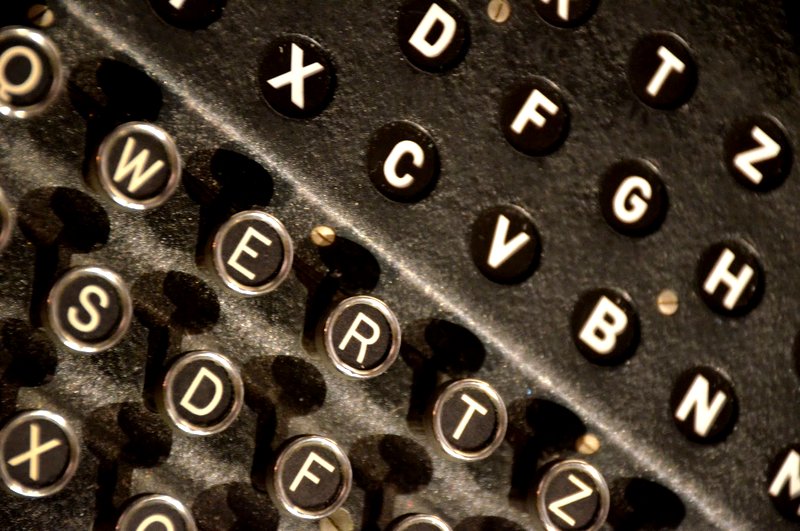
On Friday, April 7 the amateur radio station DLØHNF transmitted an Enigma encrypted message on 7036 kHz to Bletchley Park
DLØHNF is the club station at the Heinz Nixdorf Museum in Paderborn, Germany. The encrypted telegraphy message they transmitted was received at the home of the World War Two UK Codebreakers in Bletchley Park. There the message was fed into a replica of the Turing Bombe which enabled the encryption to be cracked.
The message read: “Paderborn greets the Codebreakers at Bletchley Park”