Category Archives: Pirate Radio

Radio Waves: Ofcom London Pirate Stats, RNZ Invests in New SW Transmitters, Public Media Supports Ukraine Refugees, and Migration to DAB+ Spurred by Energy Costs

Radio Waves:  Stories Making Waves in the World of Radio

Welcome to the SWLing Post’s Radio Waves, a collection of links to interesting stories making waves in the world of radio. Enjoy!

Many thanks to Eric Jon Magnuson for summarizing these news items for Radio Waves!


Pirate radio stations operating outside London (Southgate ARC)

In a Freedom of Information request Ofcom were asked to provide details of pirate broadcast radio stations outside of London for the years 2021-2022

Ofcom refused to give names of the stations but they did provide some statistics, see this link.

You can submit a Freedom of Information request to Ofcom online at
https://www.whatdotheyknow.com/new/ofcom

RNZ welcomes Pacific infrastructure investment

Released at 3:19 pm on 19 May 2022

RNZ Chief Executive and Editor-in-Chief Paul Thompson has welcomed the budget investment in RNZ Pacific shortwave transmitters.

In Budget 2022 the Government announced $4.4 million dollars capital funding for a new transmitter for RNZ Pacific.

RNZ Pacific broadcasts into the wider Pacific on shortwave 24 hours a day, collaborating with 22 broadcasting partners across the region. Its current primary transmitter is nearing end of life, and its other transmitter has in effect already been retired.

“The value of the RNZ Pacific service can’t be underestimated. Our voice reaches all parts of the Pacific, at times with critical information such as cyclone warnings. During the Tonga eruption, when the undersea cable was cut, RNZ Pacific short wave was a lifeline source of information,” said Thompson.

This investment secures a productive future for our unique voice. The attraction of the shortwave service is its robustness, and the ability to have the signal travel great distances, and achieve good audiences,” he said.

RNZ Pacific broadcasts enhance the Government’s Pacific strategy as we share our history, culture, politics and demographics. The strategy is underpinned by the building of deeper, more mature partnerships with Pacific Island countries, and by supporting their independence and sustainable social and economic resilience.

Since the ABC ceased its shortwave broadcasting the only other shortwave broadcaster in the region is Radio China. Thompson says RNZ can now start work on its infrastructure development with a new transmitter likely to take approximately 12 months to get in place depending subject to further project planning.

Click here to read at RNZ.

Public Service Media Continue To Mobilize Wide Range Of Support For Ukrainian Refugees (EBU)

More than 14 million people have fled their homes since Russia’s invasion of Ukraine and the war shows no sign of ending. For World Refugee Day on 20 June, we are highlighting some of the issues faced by displaced Ukrainian people – and reaffirming that the support from the EBU and its Members will continue.

That support has manifested across a range of projects:

Air strikes on the TV towers in Kyiv and Rivne underlined the vulnerability of broadcast communications in a war zone. Together with our Members, we have coordinated the supply and delivery of critical equipment such as IP connectivity solutions, satellite phones, AM transmitters, and studio support to enable the uninterrupted transmission of vital news and information.

In these circumstances, being able to rely on accurate news sources is key. Many EBU Members have launched dedicated news services specifically for refugees in their own language, so that they can tap into vital updates from home, wherever in the world they are. Rai News in Italy has a daily news bulletin in Ukrainian; RTBF UKRAINE is a new web-based radio station for Ukrainian refugees in Belgium, with 100% of its content in Ukrainian; and Yle in Finland has a Ukrainian-language news service for providing the latest news bulletins in Ukrainian. Many public media outlets are also re-transmitting content directly from Ukrainian public broadcaster, UA/PBC for Ukrainian refugees.

Providing practical information to help people navigate the uncertainties of settling into new homes has also been a priority and has seen the launch of many dedicated programming and channels: GPB has a hotline for Ukrainians in Georgia; Czech Radio and Radio Prague have launched a podcast, ‘News for Ukrainians in Czech Republic’, that offers practical information for incomers. While ARD in Germany presents How To Deutschland Insta; Swedish Radio’s Ukrainian service for new arrivals includes practical advice on how to access medical care or education facilities for kids and RTP’s online service helps with learning a new language.

For children, displacement through war is particularly traumatic. TVP in Poland has developed a site for kids from Ukraine which, as well as showing selected content in Ukrainian, also presents lessons in learning Polish; ARD and ZDF in Germany have included content in Ukrainian for children, including German-language learning programmes, and Czech Radio has recorded fairytales in Ukrainian.

Noel Curran, Director General, EBU, said “Few of us can understand the trauma of being forced to leave our homes, not knowing when or if we will return. I’m proud to belong to a community that has mobilized a wide range of practical support so quickly while ensuring trusted news and information continues to reach those who need it, wherever in the world they are. World Refugee Day is a moment to reflect on a situation that continues to need targeted support. And to reaffirm our commitment to giving it for as long as it takes.”

Click here to read at the EBU website.

Rising Energy Costs Could Spur Digital Migration (Radio World)

Projected cost reductions cited as reason for Germany to accelerate the migration to DAB+

As energy costs rise, Deutschlandradio Director Sefan Raue sees a further reason to hasten an FM switch-off for Germany.

“We will not be able to afford two terrestrial distribution channels in the long run. The signs are clearer than two or three years ago,” Raue told German press agency dpa, according to Hadelsblatt. “FM is an energy guzzler.”

A public broadcaster, Deutschlandradio is based in Cologne and Berlin and operates several national channels on DAB+ and FM. The channel been steadily replacing its remaining FM transmitters with DAB+; six of its short-range analog transmitters are going dark at the end of June 2022. The broadcaster expects to have at total of 161 locations broadcasting its DAB+ channels nationwide by year-end, reaching some 90% of the German populace. [Continue reading at Radio World…]


Do you enjoy the SWLing Post?

Please consider supporting us via Patreon or our Coffee Fund!

Your support makes articles like this one possible. Thank you!

Radio Waves: Led Zeppelin Saved by Off-Air Recording, News on a Music Station, FFC Notice to Pirate Landlords, and Hamvention 2022

Radio Waves:  Stories Making Waves in the World of Radio

Welcome to the SWLing Post’s Radio Waves, a collection of links to interesting stories making waves in the world of radio. Enjoy!


The improvised Led Zeppelin song that was lost by the BBC for over 40 years (Far Out)

During Led Zeppelin’s 12 years together, the group released eight studio albums, each composed of tracks Jimmy Page and company believed to be the best representation of the group at that specific moment in time. When amassed, these albums trace the evolution of Zeppelin’s style, approach to production, individual musical skills, and songwriting habits. And while we might have assumed this rendering of Zeppelin’s musical life to be complete, it would seem that we’ve not been given the full picture. Indeed, there are certain Led Zeppelin songs that even some of the group’s most die-hard fans never knew existed.

Following the release of the Led Zeppelin compilation album BBC Sessions in 1997, Jimmy Page began hearing a bootleg version of a song he hadn’t heard in just under 30 years. The band had never attempted it during an album session, and it never appeared on any of their records. After a bit of digging, Page realised that the track had come from a BBC performance Led Zeppelin made in the first months of 1969. Unfortuantely, it transpired that the BBC had managed to lose the tape from that day, meaning that Page was forced to track down a copy of the song a fan had recorded off the radio back in ’69. [Continue reading…]

How One Music Station Covered The Buffalo Massacre (Radio Ink)

(By Tom Langmeyer) The unfortunate conventional wisdom that has prevailed in radio during the last 20 years is “We are a music station. We don’t do news.” Unfortunately, this sentiment represents many people who set the tone for the industry and make these proclamations proudly, as the radio business becomes more and more irrelevant.

There is some truth to the statement that a “music station should not be covering news” by those who think completely linearly. However that culturally process-driven approach that has zero to do with results.

A music-intensive radio station is not expected to do news in the traditional sense, nor should be competing with news stations. It’s not a music station’s role.

However, all radio stations must have a component of “news. Now, before folding your arms across your chest, think about it this way.

“News” is really what your listeners need and want in the radio experience. What does “news” mean for your station? What is it? How is it delivered? How much? How do we activate our listener? That’s where things are different and need to be defined.

Think about a great country station that’s talking about a concert that’s happening in town and building an experience around it. That’s NEWS.

No one is saying a music station should be WINS, WBBM, KNX or KCBS.

No matter the music format is, there needs to be a playbook for how and what information (relevant “news”) gets presented.

On the advising side of Great Lakes Media’s business, we create customized plans for stations committed to localism and winning on the revenue hill. Sure it’s different – and that’s why it works.

It’s called the “Great Lakes Media Way.” [Continue reading at Radio Ink…]

FCC Sends Pirate Radio Notices to Property Owners (Radio World)

Agents traced signals in Pennsylvania, Maryland and Oregon

The Federal Communications Commission has sent notices to several property owners of alleged pirate radio activities on their properties.

The letters from the Enforcement Bureau are headlined “Notice of Illegal Pirate Radio Broadcasting.” They remind the owners that federal law now provides for fines of up to $2 million “if we determine that you have continued to permit any individual or entity to engage in pirate radio broadcasting from the property that you own or manage.”

The bureau said its agents used direction finding techniques to source these FM signals. It mailed letters to Richard Manson for broadcasts on 103.5 MHz in Philadelphia in January; to Maria V. Hernandez of Kissimmee, Fla., for signals on 87.9 MHz in Hazleton, Pa., in January; to Edwin and Joyce Pitt of Baltimore, Md., for signals on 91.3 in February; and to Kent and Deanna Coppinger for signals on 100.5 MHz in La Grande, Ore., in March. [Continue reading…]

Hamvention to kick off this weekend in Xenia; Thousands expected to attend (Southgate ARC)

After nearly three years, Hamvention is back.

The convention is the world’s largest amateur radio gathering at Greene County Expo Center, according to the event’s website.

Around 30,000 visitors are expected to come to the event from all over the world.

Michael Kalter, the spokesperson for Hamvention, said that based on numbers from the Greene County Convention Visitors Bureau, Hamvention adds $30 million to the local economy.

He said amateur radio, also known as ham radio, is something people of all ages and backgrounds can be a part of, which is why he thinks the convention draws such a large crowd.

Kalter shared how it feels to bring so many people from around the world together. “That makes me feel really good,” Kalter told News Center 7?s Kayla McDermott. “I’m glad that the hobby seems to be really growing and flourishing,” he added.

There are no COVID-19 restrictions in place for this year’s convention. With thousands of people expected to attend, safety is a top priority. Before entering the convention center, people must have their bags checked. The Greene County Sheriff’s Department said they have prepared for the event.

Major Shawn Prall, with the sheriff’s office, said they have a plan in place to make sure traffic moves along smoothly as there are only two lanes to get to the grounds. Crews will also keep an eye on the weather, in case there is a chance for it to turn severe. Prall said this will be his fourth Hamvention and he has never had an incident. “We’re taking precautions, both that the public will see in uniform presence and also things that they can’t see. Just trying to keep everybody safe and be ready for any kind of incident, whether it be weather or manmade or anything like that,” Prall said.

The convention runs this weekend 9 a.m.-6 p.m. Friday, 9 a.m.- 5 p.m. Saturday and 9 a.m.-1 p.m. Saturday.

Source: https://www.whio.com/news/local/hamvention-kick-off-this-weekend-xenia-thousands-expected-attend/RUMUJLOHEJCUXOOSMEZJL6S22I/


Do you enjoy the SWLing Post?

Please consider supporting us via Patreon or our Coffee Fund!

Your support makes articles like this one possible. Thank you!
Wireless Flirt episode explores shortwave radio

I’m very honored to have been interviewed by John Walsh who produces the excellent program Wireless on Flirt FM in Ireland. John reached out to discuss the relevance of the shortwave radio medium, particularly through the context of the Russian invasion of Ukraine. Here’s the show description:

In the April 2022 edition of Wireless, we look at the part of the radio spectrum called shortwave, consider its importance in the past and continued relevance in a digital world. Founder of the SWLing blog Thomas Witherspoon discusses the historical development of shortwave, including its heyday during the Cold War, and explains how it continues to be used today, for instance to evade Russian internet censorship during the Ukrainian war. The programme also remembers Irish pirate shortwave operators of the 1980s as featured on our related site Pirate.ie.

Click here to listen to the full show at Wireless Flirt.

John is a true kindred spirit and devoted radio enthusiast. I would encourage you to subscribe to his monthly Wireless episodes via your favorite podcast player; here are links to iTunes, Spotify, and Stitcher.

In addition, John is the one of the founders and curators of Pirate.ie which is a brilliantly documented archive of pirate radio stations in Ireland. I highly recommend checking it out! 

Tim recommends shortwave pirate “Ballsmacker Radio”

Many thanks to SWLing Post contributor, Tim Brockett, who writes:

Good Morning Thomas.

I enjoy receiving your daily posts. They are informative, helpful and sometimes enlightening.

I wanted to alert you to a change in frequency for Ballsmacker Radio.

I tuned into them on Friday, March 26 at 6960 kHz. They came in well at Willow Beach, Arizona which is just south of Las Vegas, Nevada. The broadcast started at 01:00 UTC and ended at 02:25 UTC.

Ballsmacker is a pirate station that airs from “somewhere in the northeast” in the USA. He uses just 200 watts but has a great frequency and time. I have routinely picked him up in Willow Beach.

His website is at https://ballsmacker.net/

He welcomes reception reports and sends out eQSLs that appear to be different for each week. He broadcasts once a week at 01:00 UTC. You can also stream past shows from his website. The theme of last night’s show was “luck”. Each song had something to do with chance or luck. Most of the show is popular music from the 20th century. The music is interspersed with station IDs, email and website addresses.

His email is [email protected]

Hope this assists with your fine work.

Sincerely,
Tim Brockett

Thanks so much, Tim! You’re right: Ballsmacker Radio puts out a great signal and certainly offers up proper music variety! Thanks again for sharing your tip!

BBC Newshour Reports Jamming of UVB-76 (The Buzzer) With Music and Digital Imagery

Many thanks to SWLing Post contributor, Mark, who writes:

Thomas,

The morning (EST) edition of BBC Newshour on Wednesday presented a five-minute report on the jamming of Russian shortwave mystery station UVB-76 (The Buzzer) with music and digital imagery.

Newshour – Uncertainty over Russian ‘de-escalation’ near Ukraine – BBC Sounds

https://www.bbc.co.uk/sounds/play/w172xv5lss6rtdm

Report begins at 37:26

Also at:

BBC World Service – Newshour – Available now

https://www.bbc.co.uk/programmes/p002vsnk/episodes/player

Sincerely,

Mark

Thank you for the tip, Mark. Impressive that this bit of shortwave news would be included in a Newshour report. They did a fantastic job including some audio clips from the Conet Project and authentic UVB-76 audio.

Radio Waves: Data RX via Web SDRs, Mystery Signals from Space, Public Media’s role in Democracy, and Pirates SPAM UVB-76

Radio Waves:  Stories Making Waves in the World of Radio

Because I keep my ear to the waves, as well as receive many tips from others who do the same, I find myself privy to radio-related stories that might interest SWLing Post readers.  To that end: Welcome to the SWLing Post’s Radio Waves, a collection of links to interesting stories making waves in the world of radio. Enjoy!

Many thanks to SWLing Post contributors Marty, Troy Riedel, and Rich Cuff for the following tips:


Receiving data with web based shortwave radios (Nuts and Volts)

Your computer and the Internet give you free access to over 100 web based shortwave receivers that you can use as if they were your own. Unfortunately, employing these radios to decode data transmissions can be very difficult or impossible — unless you know the secret.

[…]A while back, I discussed how to receive data signals with a low cost shortwave radio (N&V May 2015). Now, the concept takes on a new dimension since we are using virtual radios not in our possession.

As astonishing as it seems, many of these Web based shortwave receiver data signals can be processed and decoded using just your PC and some free decoding software. Yes, some signals are encrypted, and can’t be decoded. Fortunately, there are plenty of unencrypted data signals around to keep us busy for a long time.

However, as will be discussed later on, it does require a special trick to allow you to pipe the streaming audio signals from the Web to the decoding software. In this article, I will show you how to use these Web based shortwave receivers to access data transmissions and to get started in this exciting hobby. [Click here to read the full article…]

Unknown objects at the heart of the Milky Way are beaming radio signals, then mysteriously disappearing (Business Insider)

Ziteng Wang found a needle in an astronomical haystack.

Wang, a physics PhD student at the University of Sydney, was combing through data from Australia’s ASKAP radio telescope in late 2020. His research team had detected 2 million objects with the telescope and was classifying each one.

The computer identified most of the stars, and the stage of life or death they were in. It picked out telltale signs of a pulsar (a rapidly rotating dead star), for example, or a supernova explosion. But one object in the center of our galaxy stumped the computer and the researchers.

The object emitted powerful radio waves throughout 2020 — six signals over nine months. Its irregular pattern and polarized radio emissions didn’t look like anything the researchers had seen before.

Even stranger, they couldn’t find the object in X-ray, visible, or infrared light. They lost the radio signal, too, despite listening for months with two different radio telescopes. [Continue reading…]

Do countries with better-funded public media also have healthier democracies? Of course they do (Nieman Lab)

But the direction of causality is tricky. Do a democracy’s flaws lead it to starve public media, or does starving public media lead to a democracy’s flaws?

There’s a new book coming out in the U.K. this week called The BBC: A People’s History, by David Hendy. Its publisher calls it a “monumental work of popular history, making the case that the Beeb is as much of a national treasure as the NHS…a now global institution that defines Britain and created modern broadcasting.”

Cross the pond: While Americans generally like PBS and NPR, I wouldn’t expect them to come up quickly if you asked someone on the street to begin listing national treasures. (I’m even more sure America’s health care system would go unmentioned, too.) Who “created modern broadcasting” in the U.S.? It certainly wasn’t the two public broadcasters that didn’t hit airwaves until 1970. And what TV network is a “global institution” that “defines” the United States abroad? Apologies to PBS Newshour, but that’s CNN.

No one says “Auntie Peebs.”

It’s obvious that the U.S. approached the new broadcasting technologies of the 20th century in ways wildly different from their European peers — and in ways that reflect on the countries themselves. American radio began wild and unregulated, experimental, a bubbling font of creativity — and then quickly became commercialized, optimized for mass audiences and massive profits. The BBC, which turns 100 this year, was more structured, more statist, more controlled — but has remained more central to residents’ lives, more civic-minded, and more beloved. [Continue reading…]

Pirates Spammed an Infamous Soviet Short-wave Radio Station with Memes (Vice)

The UVB-76 numbers station took a break from being a suspected communications tool of Russian intelligence to blast ‘Gangnam Style’

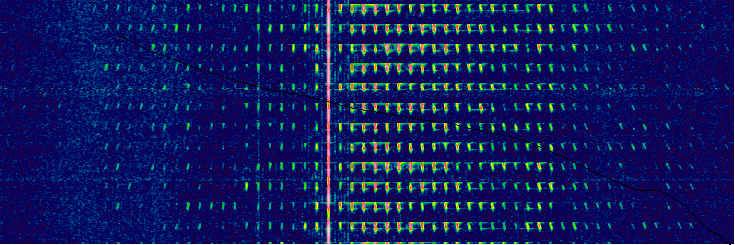
Pirates hijacked an infamous short-wave radio station, which dates from the Soviet era but is still online today, and used it to broadcast everything from Gangnam Style to audio that draws memes when inspected under a spectrum analyzer.

For decades the numbers station known as UVB-76 has emitted an enigmatic series of beeps and a voice reading numbers and names, in what people suspect is a long running communications method for Russian intelligence. Since the broadcast is public, pirates are able to use their software-defined radio (SDR) transmitters to effectively flood the frequencies with noise and memes.

The recent barrage of attacks on the station come as Russia prepares to invade neighbouring Ukraine, where radio enthusiasts speculate at least some of the pirate broadcasts originate. [Continue reading…]


Do you enjoy the SWLing Post?

Please consider supporting us via Patreon or our Coffee Fund!

Your support makes articles like this one possible. Thank you!
Halloween weekend will offer up excellent SW pirate listening!

Halloween is typically the most active day of the year for shortwave pirates. This year, Halloween falls on Sunday, October 31st which essentially opens up a Friday through Sunday Halloween Piratefest. Expect pirates to emerge like The Great Pumpkin!

Here are two things you’ll want to do this Halloween weekend:

HF Underground

hfunderground

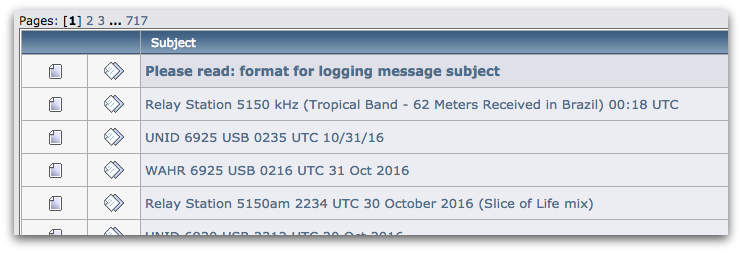
Follow real-time pirate radio spots and loggings on the HF Underground discussion forum. Chris Smolinski at HFU typically posts post-Halloween pirate stats on the SWLing Post as well–always a fascinating overview.

You might also venture over to Andrew Yoder’s pirate radio blog, the Hobby Broadcasting blog. Although he doesn’t log frequently, he usually makes time on Halloween (no pressure, Andy! Ha ha!)

Listen!

Photo by Bill Patalon

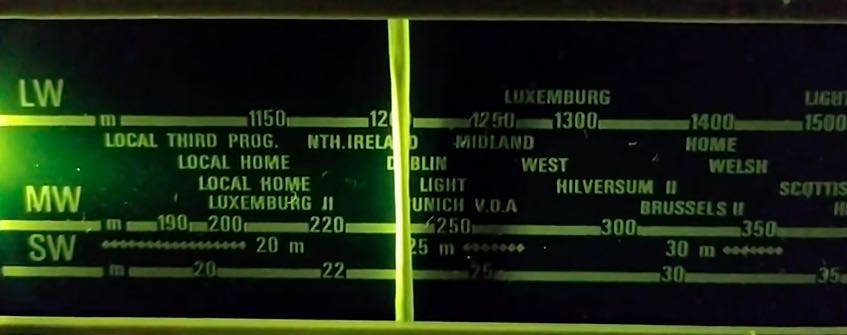
Listen for pirate radio stations today and throughout the weekend!  Turn on your radio anytime today, but especially around twilight and tune between 6,920 – 6,980 kHz. Pirates broadcast on both AM and SSB; you’re bound to hear a few. If you’re brand new to pirate radio listening, you might read my pirate radio primer by clicking here. I will be listening until late in the evening.

Happy Halloween to all!