Shortwave listening and everything radio including reviews, broadcasting, ham radio, field operation, DXing, maker kits, travel, emergency gear, events, and more
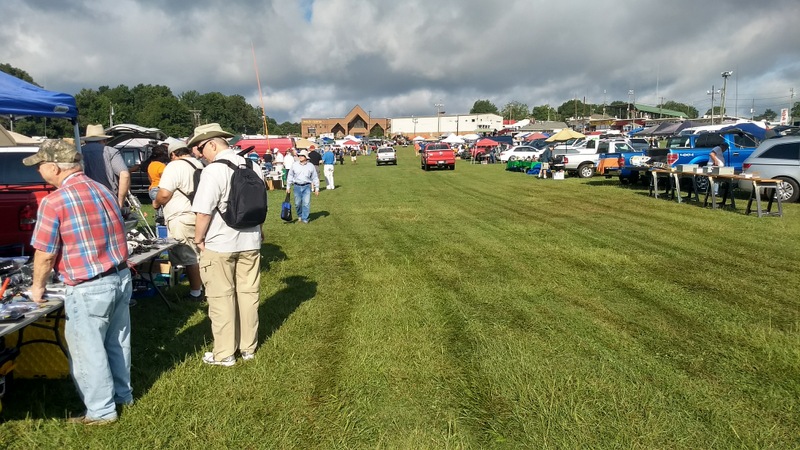
My Labor Day weekend was free of travel again this year, so I was able to make another pilgrimage to the Shelby (North Carolina) hamfest with my good buddy, Vlado (N3CZ).
The Shelby Hamfest–referred to, locally, as “The Grand-Daddy of them All”–has long been regarded as one of the largest hamfests in the southeast US. This is the third year I’ve made a concerted effort to publish a photo tour of the event.
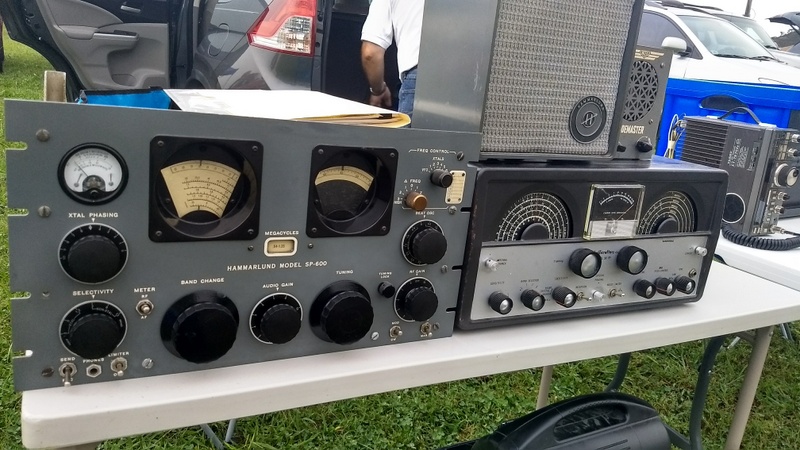
I sold both my Hammarlund SP-600 and Hallicrafters SX-99.
Like last year, we set up a table in the flea market to sell a few items along with other good friends from the NCDXCC. In other words, once again, I was in selling mode, not buying mode, as I need to downsize some of my collection and use the money to offset costs of review radios, and some of the conferences I’m attending this year (including the Radio Preservation Task Force Meeting in Washington DC on behalf of our Shortwave Radio Audio Archive).
Overall turnout was a little less than last year, I believe. No doubt, this was due to the possibility of rain that never materialized. By lunch time the sun was out and the foot traffic increased.
Shelby Photo Gallery
Click on the thumbnails below to enlarge or comment on the photos:
Note that if you’re viewing this post via our email newsletter, the embedded gallery (above) might not be viewable. Click here to view via web browser.
My schedule last week made it impossible to carve out the dedicated time I needed to begin an S-8800 evaluation.
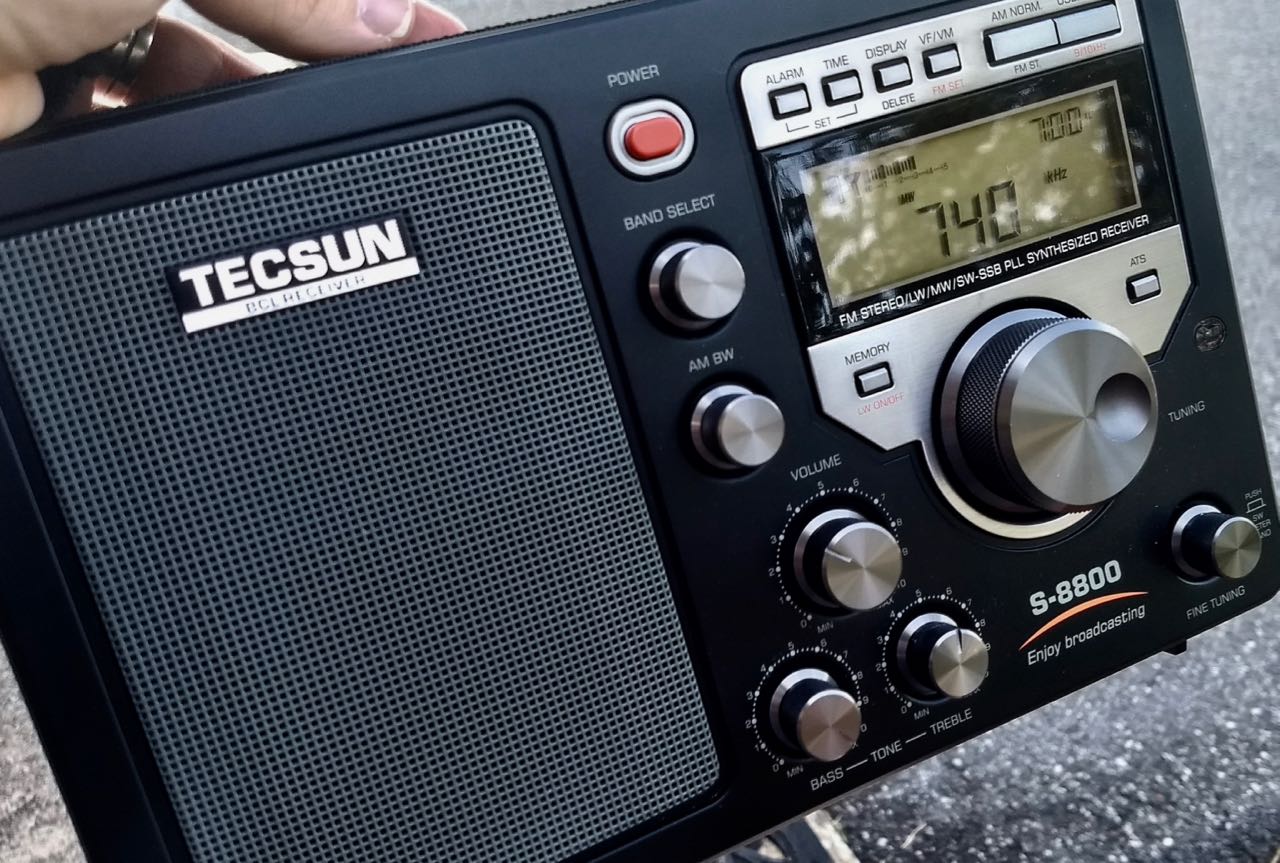
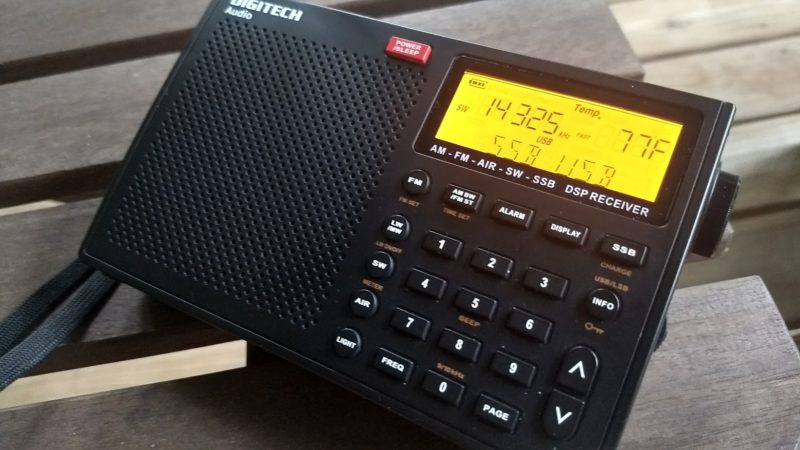
Yesterday, however, I spent the afternoon with my family at Richland Balsam, the highest point on the Blue Ridge Parkway (6,000′ ASL) and a completely RFI-free zone. I brought the Tecsun S-8800 and a few other portables along for the ride–namely the Digitech AR-1780, the C.Crane CC Skywave and the Panasonic RF-2200.
I had just enough available space on my smart phone to record this one short video:
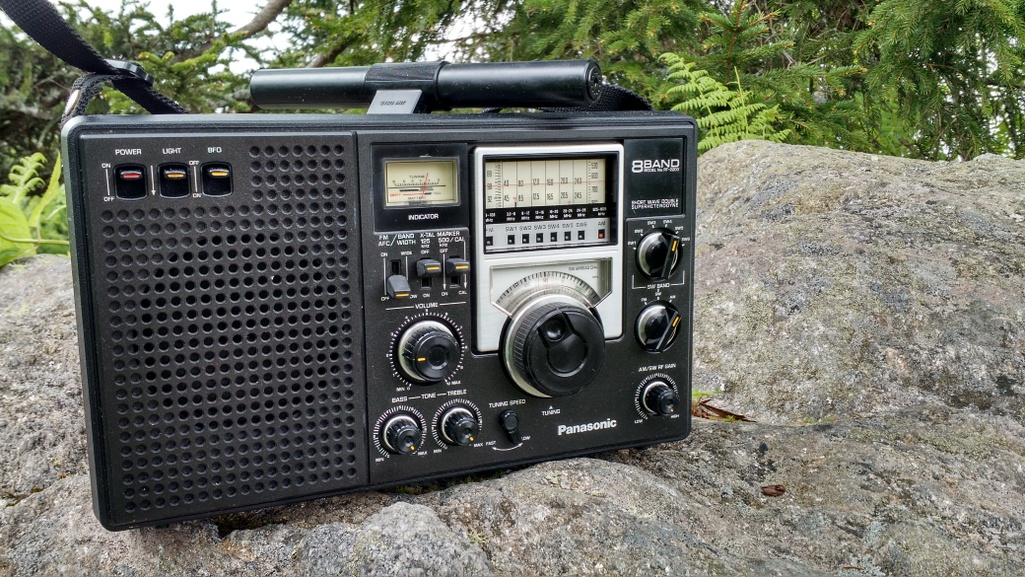
Let’s be clear: comparing any modern radio with the RF-2200 on mediumwave is hardly fair.
For one, the RF-2200 has been out of production for a few decades.
Secondly (what I never finished saying in the video is that) the RF-2200 has a large rotatable ferrite bar antenna that provides excellent gain. The RF-2200 simply wipes the floor with all of my modern portables as their ferrite bar antennas are a fraction of the size.
In other words, the RF-2200 was engineered to rule mediumwave like a boss.
On shortwave, the RF-2200 does a fine job, but isn’t nearly as accurate and stable as modern DSP receivers.
Spoiler alert
Still, as the video indicates, my final review of the Tecsun S-8800 will indicate that it is not a receiver for the serious Mediumwave DXer. It’s been my experience that few shortwave portables are excellent on both HF and MW.
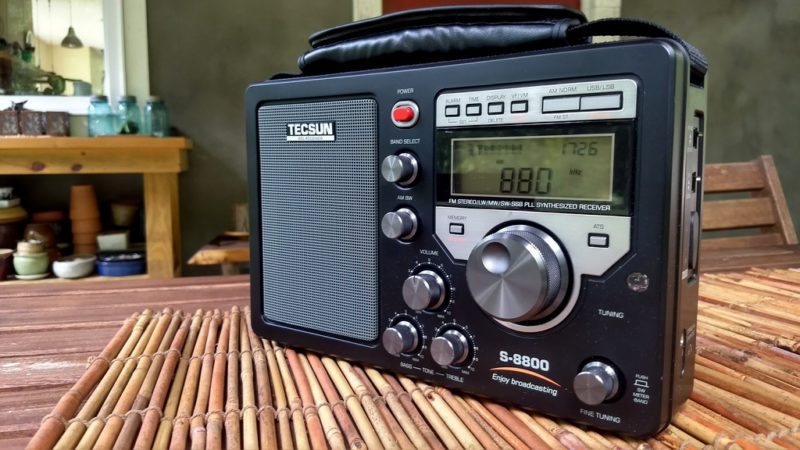
At home, tuned to local station 880 AM.
Of course you can’t tell from the video, but the S-8800 actually sounds brilliant when tuned to a relatively strong/local AM station, but either a lack of sensitivity or internal noise makes MW DXing a challenge.
I spent the better part of two hours yesterday evaluating its daytime MW performance–the video is pretty indicative of my findings. The S-8800 struggles with weak stations, but does a fine job with strong ones. It’s overall audio fidelity almost matches that of the RF-2200 when tuned to a strong broadcast. I’ve yet to test evening MW
The S-8800 still has some birdies on MW, but they’re not the loud warbling kind found on the previous model. Tecsun did properly address this, though in full disclosure, I haven’t fully explored the shortwave bands yet.
Shortwave?
I suspect the S-8800’s performance on shortwave will be much better than mediumwave because the previous S-8800 showed excellent results. As long as sensitivity wasn’t harmed while addressing the DSP birdies, I expect it’ll give the PL-880, PL-680 and Sony ICF-SW7600GR a run for their money.
Still…the lesson learned yesterday?
The Panasonic RF-2200 is the indisputable champion of mediumwave!
There’s a quick and dirty video review of the AR-1780 by Peter VK3YE, which highlights a few interesting quirks (if that’s the right word!) with this receiver. Some birdies, specs that don’t appear accurate, and a query over one of the bandwidth settings. Well worth a look!:
Peter (VK3YE) has done an excellent job indeed summing up the AR-1780–his notes and comments mirror my own. I would have never caught that oddity with the 1.2 to 1 kHz bandwidth reversal.
With travels, solar eclipse events and family activities this week, I’ve had very little time to play radio.
Yesterday was a gorgeous day though, so I took the family to the Blue Ridge Parkway and (of course) packed a couple portable radios.
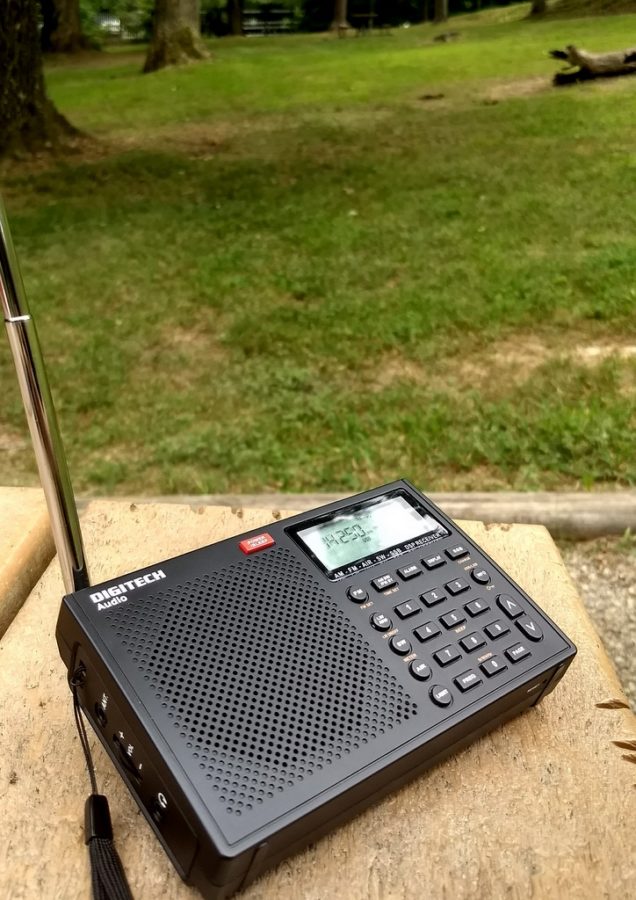
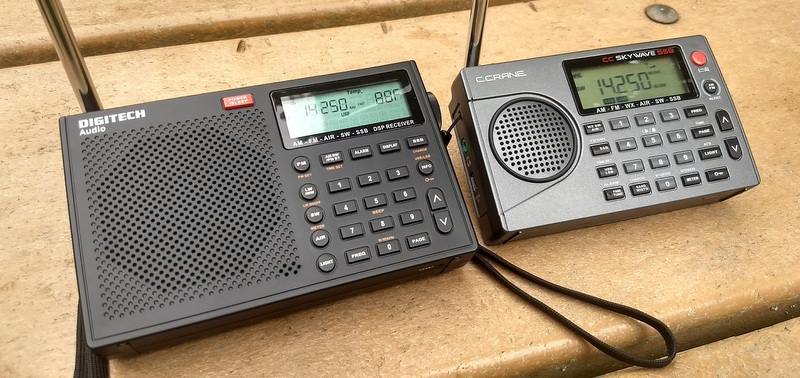
While we all enjoyed a picnic, I pulled out the AR-1780 with the intention of exploring its SSB performance and audio fidelity. I found an Islands On The Air (IOTA) activation with a decent pileup on 14,250 kHz.
Overall, I’m very pleased with the AR-1780 on SSB. The noise floor is pretty low, the filter selections are handy and the overall audio is comparable to slightly larger portable radios.
The dedicated fine tune control is quite handy, even though it’s oddly located on the right side of the radio (where one typically finds a volume control).
I’m putting together a short review of the AR-1780, but will need more air and comp time before I form any firm opinions.
For readers that have made it this far down the post, you might recognize a yet-to-be-released portable next to the AR-1780. Of course, I’m comparing it with the AR-1780 and its predecessor, but it’s not a production run unit (yet!), so I can’t comment on performance. Stay tuned, though, as I will be posting more in the coming days!
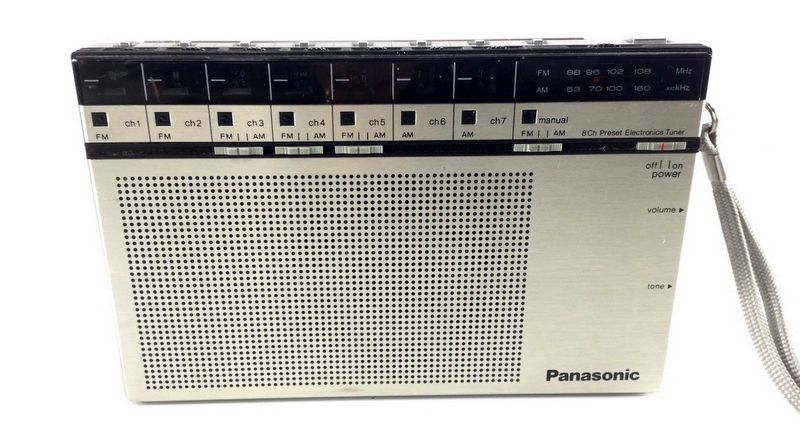
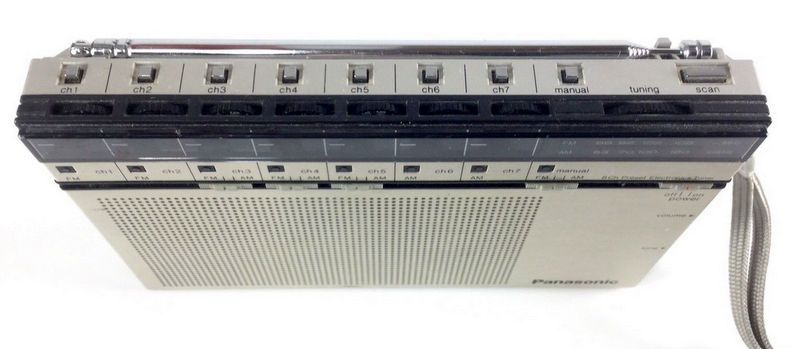
I haven’t seen one either, Jeff. Appears to be pretty compact. At first, I was curious how an analog radio could have so many presets until I took a peek at the top of the radio.
Each preset is individually tuned. Hard to believe such a compact radio has a total of eight tuning mechanisms! Two presets are designated for FM, two for AM and four presets can be either. Pretty clever! Since it’s a Panasonic, I bet it’s a sensitive little portable.
Many thanks to SWLing Post contributor, Cap Tux, who writes:
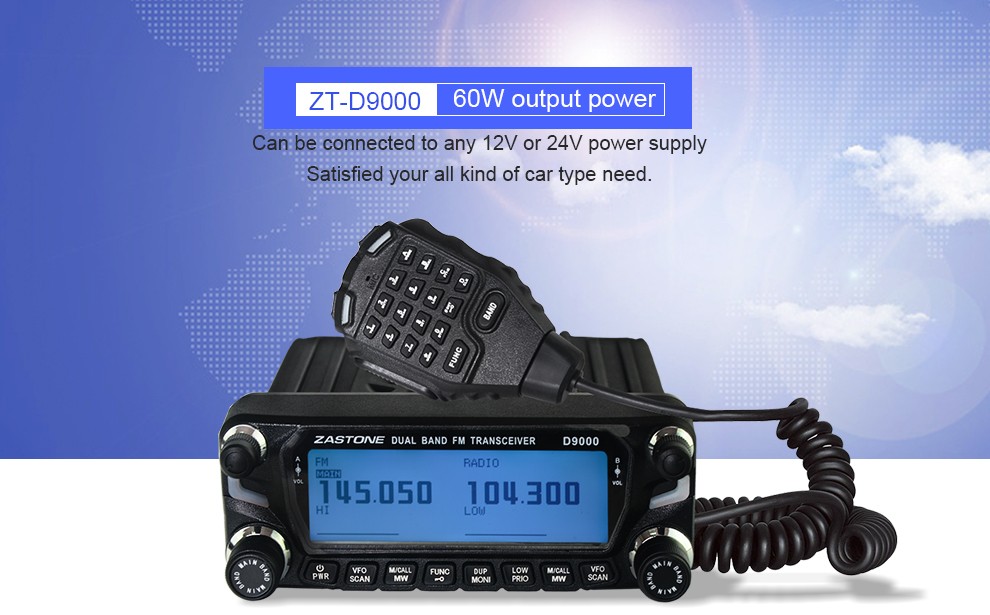
The Zastone ZT-D9000 radio has actually been out for a while and is a Dual Band Mobile (Triband with option), nothing fancy there and bears a striking resemblance to the Icom IC-2820H (clone?). Options include GPS, Bluetooth, 220Mhz and LW (The latter is really weird!).
What caught my eye is the 2.3-30 MHz Shortwave coverage, a quick search on YouTube turns up a video showing Shortwave working!
Yes, probably as wide as a barn door with no filtering except the 12kHz default but an extremely useful feature if you did need a dual band mobile in your jeep/car.
Two other noteworthy features are a dedicated RX BNC antenna socket and a built in FM Transmitter so you can listen to it on the FM Radio in your car/jeep, very cool. A bit like a pimped IC-2820H. Also has all the bells and whistles a Dual Bander should have,
A/B Band RX:
136-174MHz
200-260MHz (OPTION)
400-470MHz
470-520MHz
B Band RX:
153-279kHz (AM) (OPTION)
0.5MHz-1.8MHz (AM)
2.3-30MHz (AM)
64-108MHz (WFM)
113-137MHz (Airband – AM)
TX:
136MHz-174MHz
222-225MHz (Type USA 200-260MHz) (OPTION)
400-520MHz
Channel Steps: 1.5, 6, 6.25, 10, 12.5, 15, 20, 25, 50, 100kHz Frequency Stability: +-2.5ppm Repeater Shift: +-600kHz(144MHz), +-5MHz (430MHz) Emission Type: F1D, F2D, F3E Antenna Impedance: 50 ohms Supply Voltage: Nominal: 13.8VDC, Neg Gnd, Operating: 12-24V Neg Gnd Operating Temp: -40F to +-1400F(-20C to +-60C) RF power Output: UHF: 40W/25W/5W VHF:50W/25W/5W Case Size: (WxHxD) 6″ x 2.3″ x 1.3″ (Panel w/o knobs and connectors)
6″x6″x 1.8″ (Rear chassis w/o connectors) Weight: 3.7 lbs
Transmitter:
RF Power Output: UHF: 40W/25W/5W, VHF: 50W/25W/5W
Modulation Type: Variable Reactance F1 D, F2D, F3E
Maximum Deviation: +- 5KHz
Spurious Emission: at least 60 dB below
Microphone Impedance: 2 k ohms
Receiver:
Sensitivity Radio Band:
B Band:
5uV TYP for 10db SN (153-279 KHz, AM)
5UV TYP for 10 db SN (0.5-1.7 MHz, AM)
2uV TYP for 10db SN (203-30 MHz, AM)
2Uv TYP for 12db SINAD (64-108 MHz, WFM)
0.8 uV TYP for 10 db SN 9113-134 MHz, AM)
A&B Band:
0.2 uV for 12db SINAD (136-174 MHz, FM)
0.2 uV TYP for 12db SINAD (200-260 MHz, FM)
0.2 uV for 12 db SINAD (400-470 MHz, FM)
0.2 uV TYP for 12 db SINAD (470-520 MHz, FM)
Squelch Sensitivity: 0.16 uV (144/430 MHz Band)
Selectivity: NFM, AM 12 KHz/30KHz(-6dB/-60dB)
AF Output:
6W@4 ohm for 10% THD (@13.8V) EXP SP
3W@ 8 ohm for 10% THD (@13.8V) Normal EXP SP/CH
AF Output Impedance: 4-16 ohm
3 Speakers
Included in Purchase:
– Radio
– Microphone
– Power Cables
– Remote Install Kit
– Software CD
– Programming Cable
– All Mounting Hardware
– 1 Year Warranty
Options:
– Bluetooth
– GPS
– Barometric altimeter and thermometer
– 220MHz
– LW Band
Very interesting, Cap! Thank you for sharing. Honestly, I have a very difficult time keeping up with the radio equipment being produced and sold out of China.
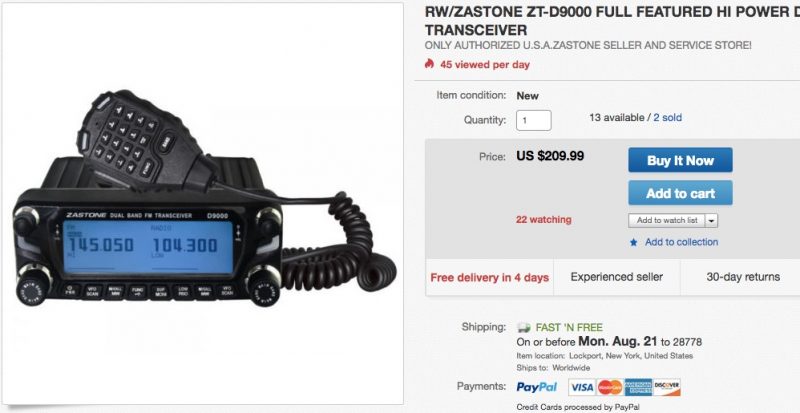
And you’re right: what a surprise to find HF coverage on a dual-band mobile radio and especially longwave coverage! Like you, I wouldn’t anticipate stellar performance. The price is certainly “bargain basement” at $210 US shipped.
SWLing Post readers: Has anyone purchased and tested the ZT-D9000? Please comment!