Category Archives: Shortwave Radio

Matt’s 2022 Portable Loop Antenna Shootout

Many thanks to SWLing Post contributor, Matt Blaze, for the following guest post:

Matt’s 2022 Portable Loop Antenna Shootout

by Matt Blaze, WB2SRI

Followers of this blog may be familiar with my “shortwave radio shootouts” that I post from time to time. The idea is to compare how well different radios demodulate the exact same signal. Basically, I take a bunch of radios, hook them up to the same antenna via an RF distribution amplifier, tune the radios to some distant signal, and record the audio output from them simultaneously. Sometimes that kind of comparison can be more revealing of actual real-world performance than lab measurements or technical specifications.

The other day, I decided to do the same thing, but for antennas instead of radios. Essentially, I inverted the setup. Instead of hooking up different radios to the same antenna, I hooked up identical radios to different portable antennas and recorded them demodulating the same signals at the same time.

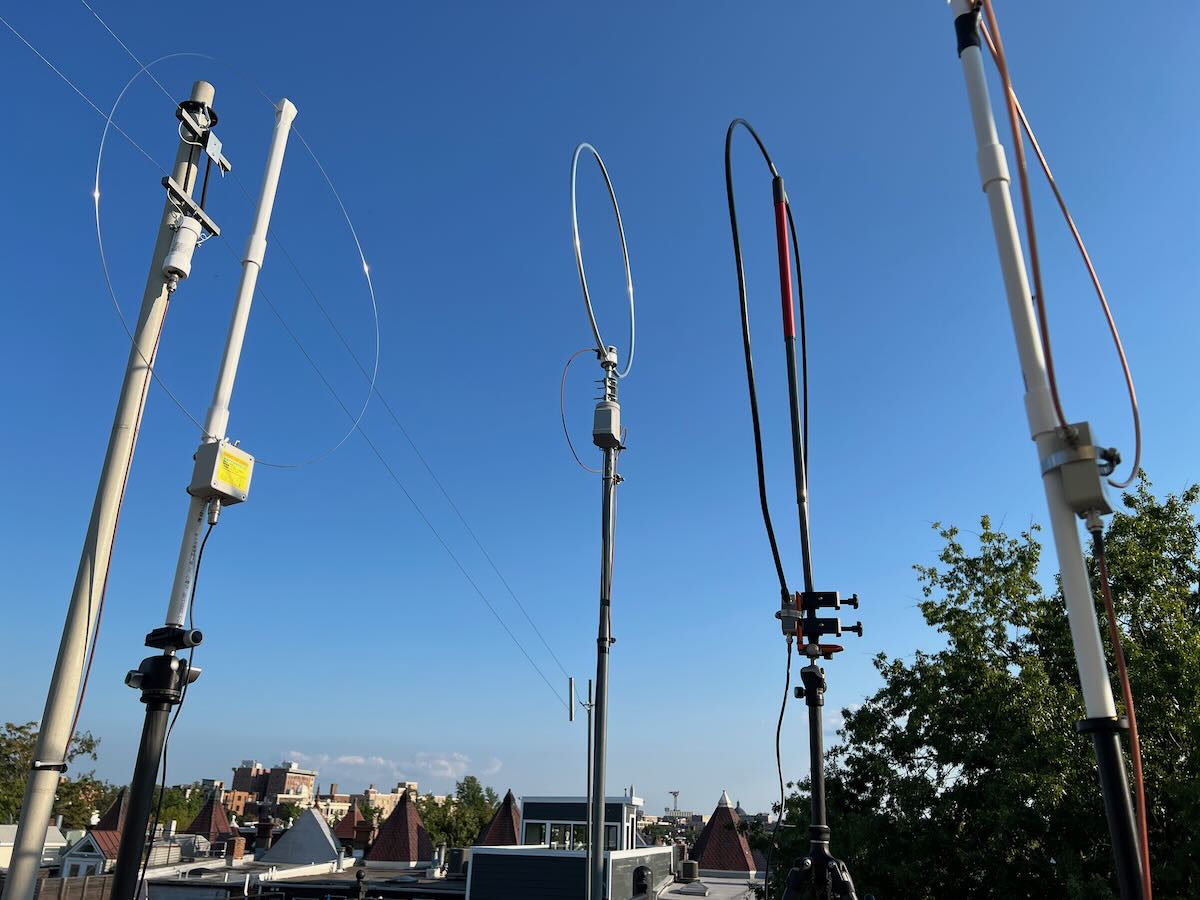
In this first of perhaps a series of these antenna shootouts, I wanted to compare three portable amplified magnetic loop antennas. When I say “portable” here, I mean broadband antennas that can pack reasonable compactly for travel and that can be set up and broken down easily for use “on location”, say on a picnic table or hotel balcony, or perhaps installed temporarily on a roof, without too much fuss.

The antennas are:

The Wellbrook FLX1530LN with a 1 meter diameter loop of LMR400 coax. This is my “standard” portable antenna (I use a telescoping broom handle for the support; I wrote about it here as the “signal sweeper” last year). Excellent performance, but on the bulky side for travel. Performs well from LW through HF. Not cheap, at about USD 225 including shipping for the amplifier and power injector, but not including the loop, mounting hardware, or feedline.

The Wellbrook FLX1530LN with a 0.5 meter diameter loop of RG142 (a stiff “aircraft grade” version of RG58 that holds it shape well at this size). I used some 1/2 inch PVC pipe as the vertical support. Because of the smaller diameter loop and thinner coax, it packs down to a much smaller and lighter package than the 1 meter LMR400 version.

The K-180WLA, an inexpensive (about USD 60) 0.5 meter loop from China, sold on eBay and Amazon. The loop is steel wire (which can be wound down to a small diameter for transport), and the kit includes everything you need, including a rechargeable power injector. (However, the power injector uses a noisy voltage booster, so I substituted my own bias-T injector for these experiments). Ostensibly covers LW through VHF, but the low end coverage is, shall we say, somewhat aspirational, as you will see.

– I also recorded, for comparison, the built-in ferrite bar (for LW/MW) and whip antenna (for HF) of the receiver.

This is, of course, only a small sampling of portable loop antennas, both commercial and homebrew. But I wanted to start with what I had on hand and with what meets my own needs. (I omitted from consideration loops that require tuning, since I want to be able to install the antenna without needing access to it every time I change frequency).

For each signal captured, I oriented and positioned each antennas to maximize signal quality, taking care to move them away from each other and interfering metal objects. So you’re hearing (approximately) the best each antenna had to offer (on my roof under suboptimal band conditions).
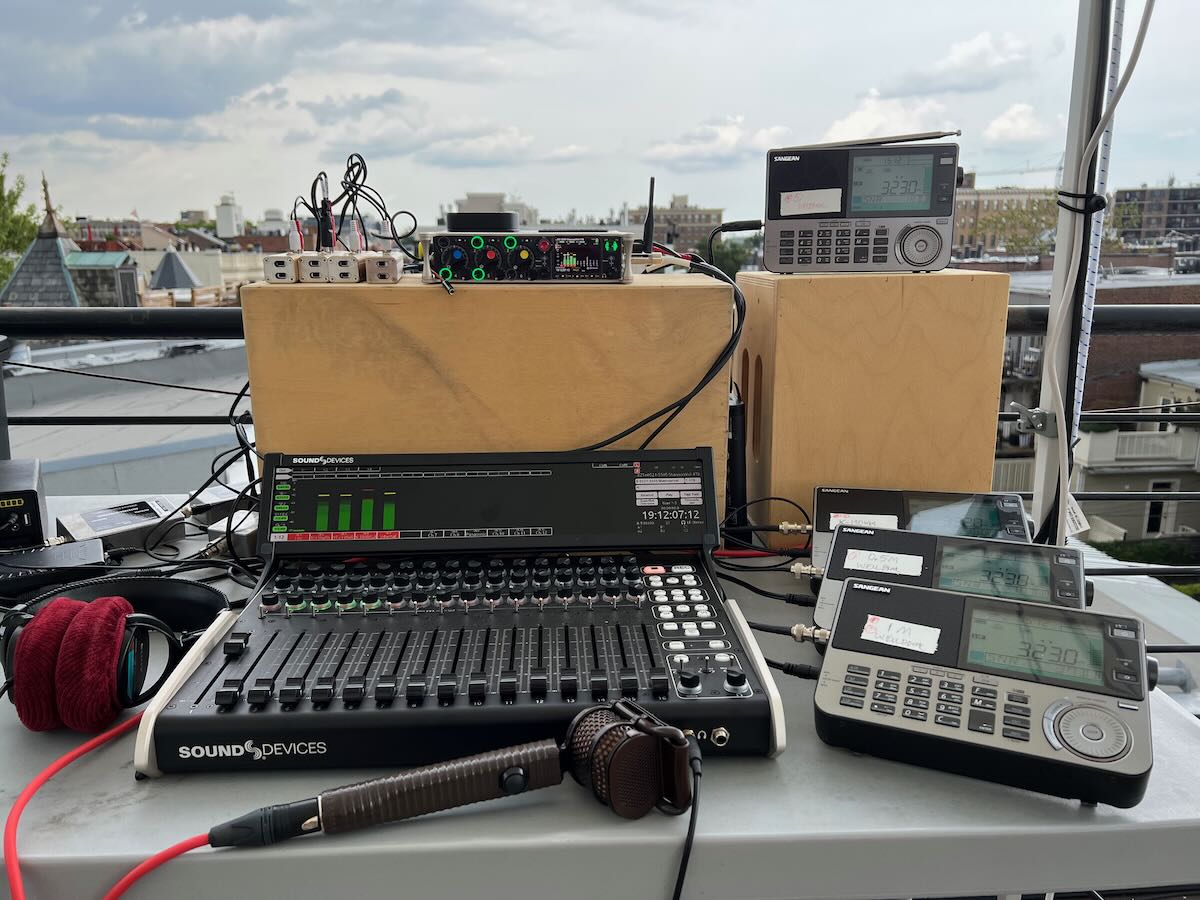
The receivers I used were four Sangean ATS-909×2 portable LW/MW/SW/FM/Air radios. I believe this to be the best currently available (relatively inexpensive) portable shortwave receiver on the market. It has excellent performance (and is admirably resistant to overload and intermod when used with an active antenna). It lacks a sync mode, but that’s rarely implemented well on portable radios anyway. As a practical matter, it has a good line-level output jack, and I already happened to own four of them.

As in my other shootouts, for each signal, there are a total of five recordings: a monoaural recording of the audio from each of the four antennas, plus a narrated stereo recording comparing a reference (the 1M Wellbrook) on the Left channel with each of the other antennas in succession on the Right channel. The stereo recording is intended as a quick overview, but it will only make sense if you listen in stereo, preferably with good headphones. (You can switch the earcups to get a quick comparison as you listen.)
Continue reading

Guest Post: Dan’s letter concerning the new Elite Satellit

Many thanks to SWLing Post contributor, Dan Robinson, who publishes the following guest post:


Letter to Eton:  Cutting Corners on Elite Satellit Won’t Succeed

by Dan Robinson

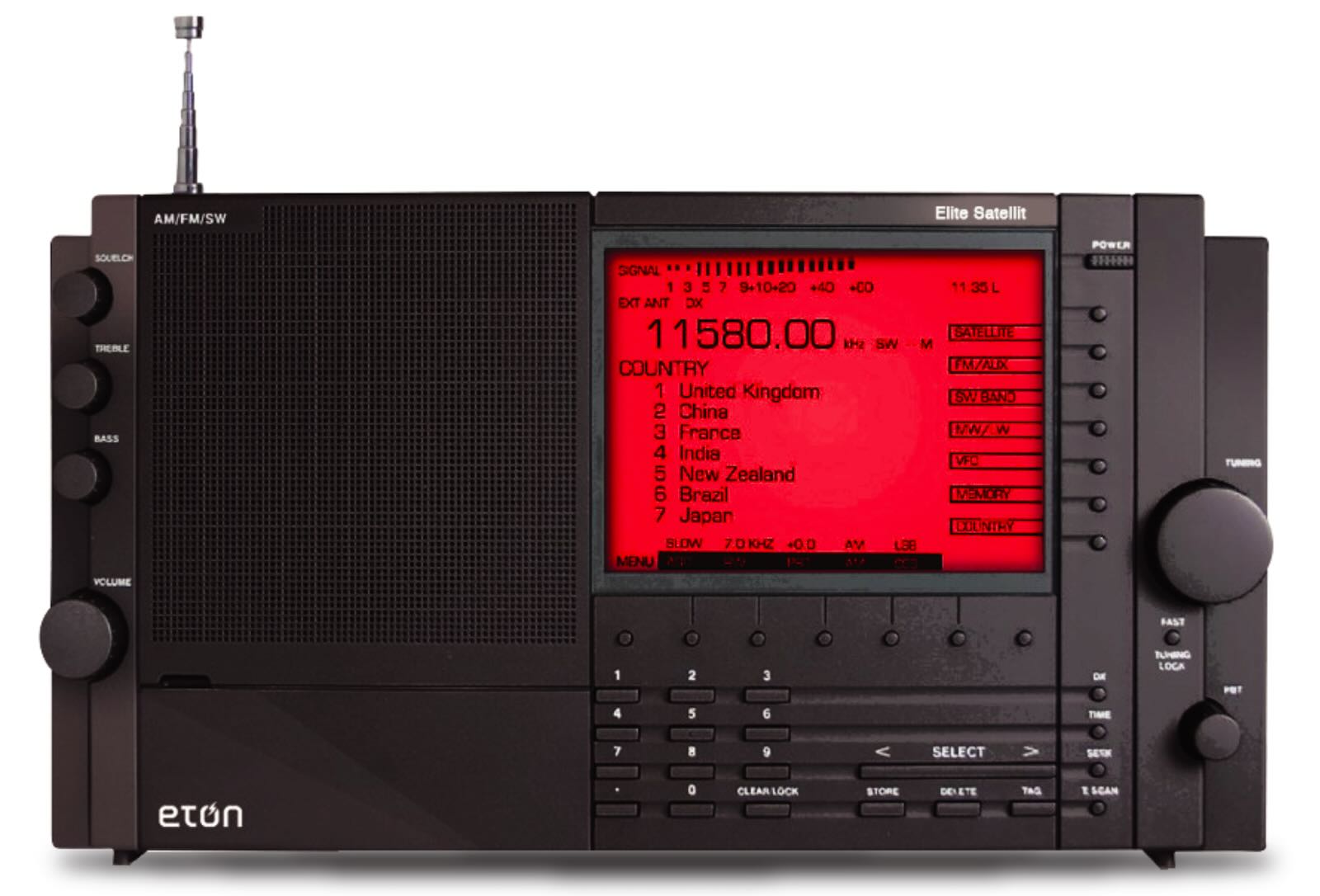
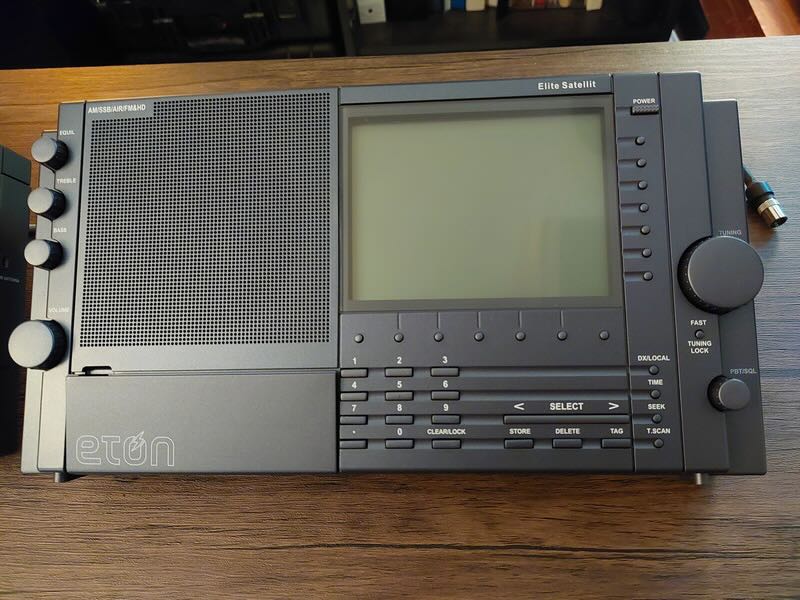
As SWLing.com readers will recall, weeks before Eton shipped the first group of Elite Satellit receivers I published a commentary that asked a key question:  would Eton be able to meet the higher standards of the listening community in 2022 when it comes to new advanced portables?

Unfortunately, we all see what the answer to that question was.  Eton was forced to recall Elite Satellit radios that had been shipped to major resellers such as Universal Radio, Ham Radio Outlet, and others as defects became all too apparent.

A radio that had been on its way to me for review was among those recalled.  But I recently was able to examine a unit that a friend in the Washington, DC area purchased.  What I found I am putting in this commentary as a letter to Eton.

If the company takes these points seriously, I think there is still hope that the Elite Satellit can join the ranks of respectable multi-band portables – after Eton has gone back to the drawing board so to speak.  However, if Eton continues to cut corners with this receiver, its future is not bright:

Letter to Eton on the Elite Satellit

Dear Eton,

MUTING WHILE TUNING

As many who purchased or tested the Elite Satellit have remarked, the fact that you decided to release a radio with this issue is beyond comprehension.  Tuning on the Elite Satellit is, tragically, an uncomfortable and frustrating experience.  This needs to be corrected/fixed – you only need to take a look at Tecsun receivers such as the H-501 or PL-990x to know what needs to be done.

POORLY-IMPLEMENTED PASSBAND TUNING

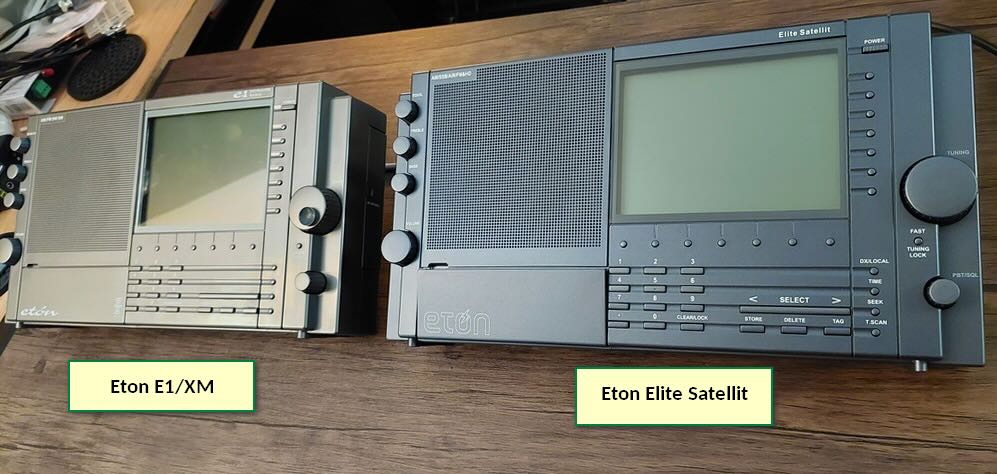
Perhaps even more puzzling than muting, the Elite Satellit I tested had an even more mind-boggling issue.  Passband tuning should function to adjust the signal pitch without changing the audio frequency.  On the radio I tested, PBT was actually TUNING and changing the frequency.  Using PBT on this radio was virtually no different from tuning in SSB, with injected tones heard, until a zero beat was achieved.  All you had to do was take a look at a E1 receiver, or any other receiver with well-implemented PBT to understand how real PBT is supposed to function.

Continue reading

The shortwave showdown of 2022

Hi all the SWLing post community. Fingers crossed all stops will be pulled out this weekend via WRMI with the broadcast of TOOTS vs WELK. This programme in the Imaginary stations series will be a showdown of music from Toots Thielemans in the left hand corner and the great Lawrence Welk in the right. The transmission will be on air on 9395 kHz from 2200 utc on Sunday 28th August 2022. Tune in for a great musical encounter!

And here’s a guide how to listen to Imaginary stations from the good folks there. Watch and enjoy. Fastradioburst23 

Video: Nick’s initial review of the Eton Elite Satellit

Many thanks to SWLing Post contributor, Nick Booras, who writes:

I bought [an Eton Elite Satellit] on Amazon and received it today. Here is a link to my YouTube review.

I have made several radio videos on YouTube recently and your audience may enjoy them.

Click here to view on YouTube.

Many thanks for sharing your initial review, Nick! I look forward to seeing any comparison videos you might produce as well!

Can you help Rob identify two mystery signals on the 20 meter band?

I received the following message from my buddy Rob (NC0B) who is trying to identify a couple of signals on the 20 meter band. Rob kindly gave me permission to post his email here on the SWLing Post with the idea that someone may be able to help him solve this:

The following is a description of two odd digital signals observed on 20 meters with transmission modes I do not understand. They may not amateur transmissions, but I have no way to decode them. They stick out like a sore thumb on 20m in the Extra portion of the phone band. The time of day on August 20th was between 11:50 AM and 12:00 PM MDT.

Two weeks ago I was in QSO on 14,170 kHz and occasionally there was the same 10 kHz wide digital signal but centered on 14,171 kHz. It sounded like the old Russian jammers buzz saw modulation. Those signals from decades ago were much wider, and or course we didn’t have high resolution spectrum scopes back then. Today the same transmissions occurred several times, and more than once a minute for about 5 seconds each. In total the transmissions may have occurred on and off for about 10 minutes.

Then after a few 10 kHz transmissions a different signal came on the air a few times with what looked like a digital modulated carrier plus digital sidebands on each side of the middle signal.

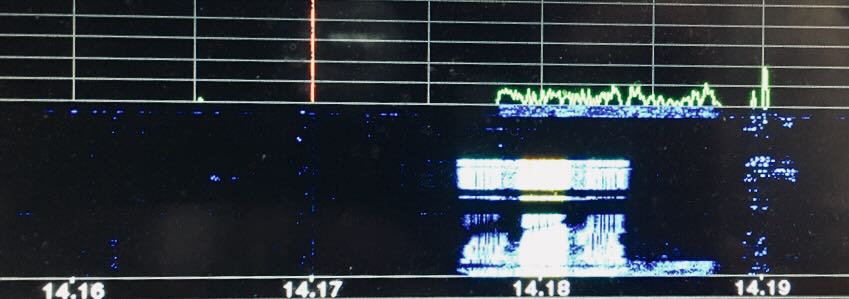
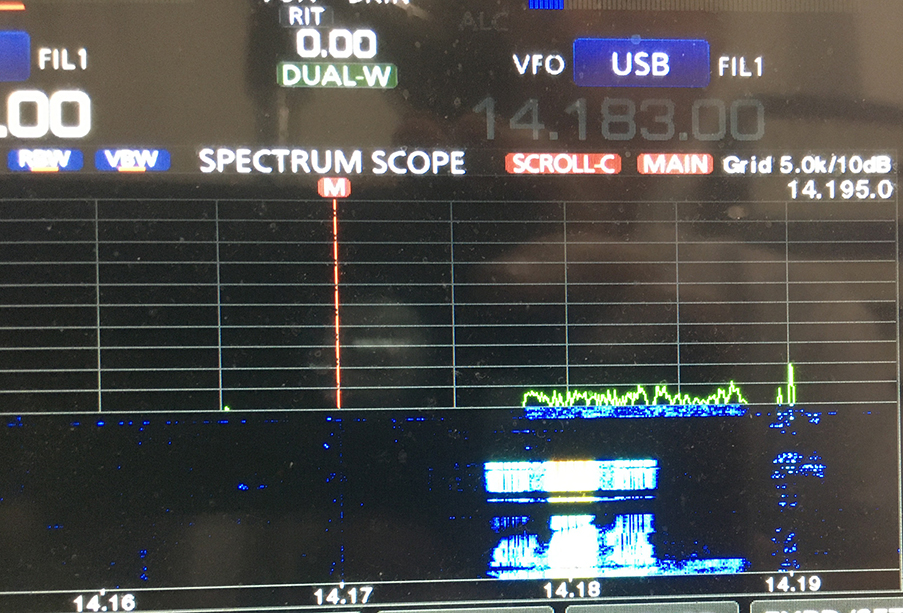
Look at the attached JPG file and I’ll try to make sense out of it:

The waterfall image lasts about 50 seconds on the Icom IC-7610 set on slow. There are two different signals to differentiate in this image. The signal I observed two weeks ago and today is 10 kHz wide and today spans from 14,178 to 14,188. It shows up in green on the band scope, and just under it in blue on the water fall for about 3 seconds of the approximate 5 second transmission. You can also see at the bottom of the waterfall the previous transmission that has about 4 seconds worth saved on the waterfall running off the bottom. The horizontal span of the scope was set to 5 kHz per division.

Once the 10 kHz wide signal started, I went to Dual Watch so I could listen for KL7QOW on 14,170 kHz for a sked, and hear the buzzing signal on 14,183 kHz in SSB mode. That frequency placed the carrier position of the SSB 2.8 kHz bandwidth in the center of the 10 kHz wide signal.

Soon after I started observing the relatively flat spectrum of the 10 kHz signal, a new digital signal appeared about 3 kHz lower in frequency. At first it had a much stronger center modulated carrier about 2 kHz wide and then two symmetrical digital signals on each side within about a 6 kHz total bandwidth. I wasn’t able to capture the best picture of the 2nd signal as it appeared to be tuning up. The amplitude difference between the central signal and the separate sidebands initially was about 15 dB. Vertical divisions are 10 dB.

On the waterfall you can see the second type of signal is centered on about 14,180 kHz. The modulation depth of the outer pairs of signals were not constant, possibly due to selective facing. QSB was quite significant at this time at least to Alaska. You can see there was a short break of a few seconds in the 6 kHz wide signal. Every time I have seen the 10 kHz wide signal its amplitude across the transmission bandwidth has been fairly constant, always of short duration, and repeating several times within 10 minutes before terminating.

Does anyone have any idea what either of these transmissions are? I have heard of email digipeaters, but I would not think their bandwidth would be this wide.

Rob, NC0B

SWLing Post community: Please comment if you can help Rob ID these signals!

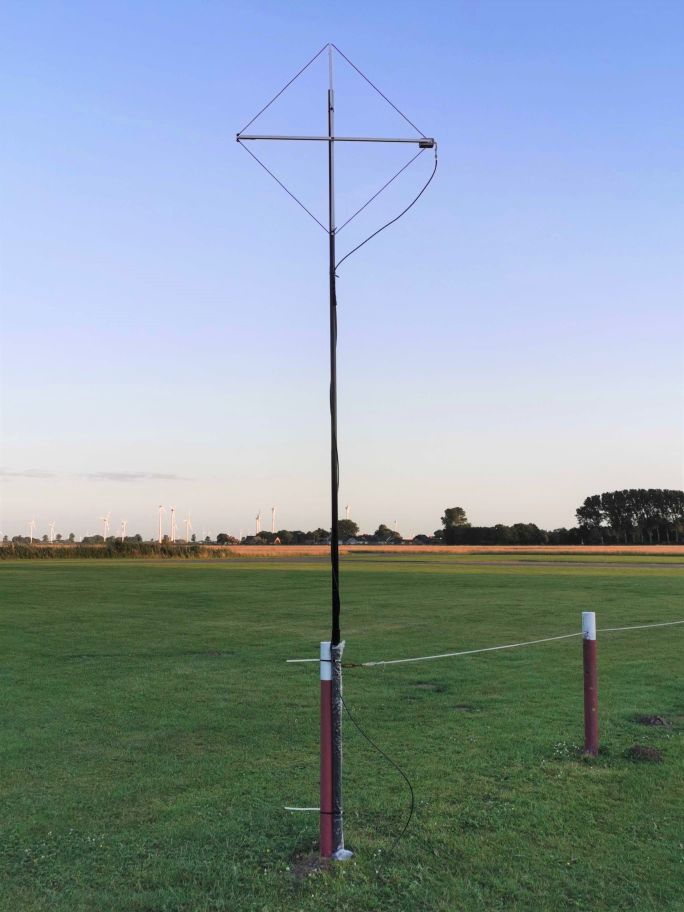
Small Unidirectional Loop Antenna (SULA) Part 2: Construction Notes

Many thanks to SWLing Post contributor extraordinaire, 13dka, who brings us Part Two of a three part series about the new SULA homebrew antenna project. This first article describes this affordable antenna and demonstrates its unique reception properties. This second article focuses on construction notes. The third and final article will essentially be a Q&A about the SULA antenna. All articles will eventually link to each other once published.

This wideband unidirectional antenna is an outstanding and innovative development for the portable DXer. I love the fact that it came to fruition via a collaboration between Grayhat and 13dka: two amazing gents and radio ambassadors on our SWLing.net discussion board and here on the SWLing Post. So many thanks to both of them!

Please enjoy and share Part 2:


Part 2: SULA Construction notes

by 13dka

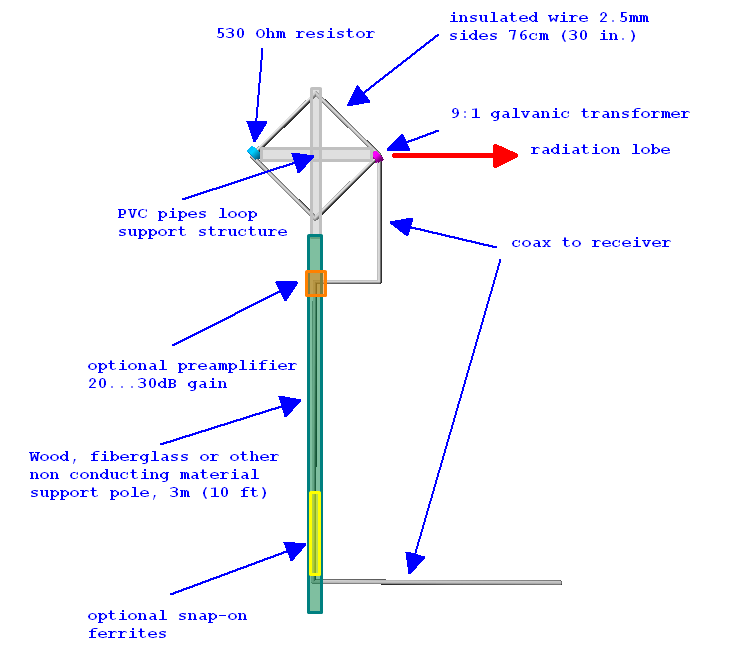
The drawing [above] has all you need to know. You basically need to put up a symmetrical wire diamond starting with a balun at the one end and terminating in a resistor at the other end of the horizontal boom, the sides are supposed to be 76cm/29.92″ long so you need to make yourself some…

Support structure:

I used 0.63″/1.6cm square plastic square tubing/cable duct profiles from the home improvement market to make the support structure. You can use anything non-conductive for that of course, broom sticks, lathes… The plastic profiles I used had the advantage of being in the house and easy to work on with a Dremel-style tool and everything can be assembled using the same self-tapping screws without even drilling. The profiles are held together with 2 screws, for transport I unscrew one of them and put that into an extra “parking” screw hole on the side, then I can collapse the cross for easy fit into the trunk, a rucksack etc.

These profiles are available in different diameters that fit into each other like a telescoping whip. This is useful to make the support structure variable for experiments and to control the loop shape and tension on the wire. The booms end up at 1.075m each, the profiles come in 1m length, so that’s 4 short pieces of the smaller size tube to extend the main booms by 37mm on each side

On the resistor end of the loop that smaller tube isn’t mounted in the “boom” tube but to the side of it in order to keep the wire running straight from the balun box on the other side.

Mast/mounting:

You can use anything non-conductive to bring it up to height. On second thought that is indeed bad news if you were planning on putting that up on your metal mast…and we have no data on what happens when you do it anyway. I don’t know if the smallest (4m) telescoping fiberglass poles would suffice for portable operation, but I’m a fan of just using the big lower segments of my 10m “HD” mast for the stiffness they give me (3 segments for the height, the 4th collapsed into in the base segment for easy rotation). Telescoping masts also give you easy control over…

Height:

The published patterns are for 3m/10′ feedpoint height over “average” ground. Increasing height further has no expectable advantage, instead it will deteriorate the favorable directional pattern of the loop. Flying it lower, or even a lot lower in windy weather on the other hand is causing a surprisingly moderate hit on performance.

Continue reading