Russian spies used shortwave numbers stations and satellites inside Germany

towersThanks to Andrea Borgnino for sharing this article:

(Source: Der Spiegel)

A pair of Russian agents was convicted on Tuesday of spying in Germany for more than 20 years. Russian President Vladimir Putin is personally conducting the negotiations for a potential exchange, but now a new case is straining German-Russian relations.

A treasure in the exhibit room at the German Federal Criminal Police Office in the western city of Wiesbaden has aroused a great deal of curiosity among the world’s intelligence agencies. It looks like an ordinary, black laptop bag. It contains a Siemens hard drive, or at least it looks that way. But a notch reveals that it is not an off-the-shelf product. It’s a high-frequency satellite transmitter, with an antenna hidden in the flap of the bag.

The device is state-of-the-art military technology, a “top quality intelligence product,” raves an expert. In the spy wars, German authorities haven’t gotten their hands on anything this important in years. The significance of this high-tech device, however, approaches that of the legendary Enigma code machine from World War II. Domestic intelligence officials at the Federal Office for the Protection of the Constitution (BfV) in Cologne are eager to examine the device. The American intelligence agencies, the CIA and the NSA, as well as Israel’s Mossad have also asked for permission to inspect the miraculous piece of equipment.

The satellite device served Andreas and Heidrun Anschlag as a connection back home. They were Russian spies who lived as agents in Germany for more than 20 years, until they were arrested in October 2011.

[…]In their dispatches, which the couple received with a shortwave radio, the agent controllers in Directorate S of the SWR referred to the Anschlags as “Pit” and “Tina.” They were given the state-of-the-art satellite equipment during a trip to St. Petersburg and Moscow. They also attended a course on the use of a decoding program called “Sepal” and an encoding program called “Parabola.”

This enabled “Pit” and “Tina” to establish a secure connection to Moscow. All they had to do was pay attention to the times when one of the six to eight satellites sent into space by Russian intelligence for spying activities came into range. A red light on their radio device signaled to the Anschlags that the satellite was approaching, while a blue light indicated the transmission of encoded messages.

Sometimes, when the equipment failed, the Anschlags placed the transmitter below one of their attic windows, among the fruit trees in the garden or on a nearby hill. The hills directly behind the house proved to be unsuitable, because nearby wind turbines apparently interrupted communication with the satellite.[…]

Read the full article “In the ‘Land of the Enemy’: Spies Strain German-Russian Ties” at Der Spiegel Online International.

WWVB celebrates 50 years of quietly keeping time

WWV building in Fort Collins, Colorado (photo courtesy: NIST)

WWV building in Fort Collins, Colorado (photo courtesy: NIST)

Thanks, David, for sharing a link to this brilliant article on the history and future of WWVB:

(Source: Wired)

Every night, while millions of Americans are fast asleep, clocks and wristwatches across the country wake up and lock on to a radio signal beamed from the base of the Rocky Mountains. The signal contains a message that keeps the devices on time, helping to make sure their owners keep to their schedules and aren’t late for work the next day.

The broadcast comes from WWVB, a station run by the National Institute for Standards and Technology. WWVB marks half a century as the nation’s official time broadcaster on July 5. Together with its sister station, WWV, which is about to hit 90 years in service, NIST radio has been an invisible piece of American infrastructure that has advanced industries from entertainment to telecommunications. (WWV’s broadcast includes a wider range of information, including maritime weather warnings and solar storm alerts).

Most people aren’t even aware that these stations exist, but they have a rich and fascinating history. Their future is uncertain, however, as newer technologies threaten to make them obsolete.

[…]WWV began broadcasting reference frequencies for signal calibration using equipment not that different from the chunk of quartz in a modern wristwatch. These days, though, a bit of quantum physics keeps the nation’s signals in sync. Cesium-133 atoms within the NIST-F1 atomic clock oscillate a frantic 9,192,631,770 times per second, acting like the pendulum of a grandfather clock. By tuning into that oscillation, NIST defines the basic unit of time, and by extension, frequency. Over the years, the reference frequencies have been so finely calibrated that they are accurate to beyond a single cycle in a trillion.

[…]WWVB’s value might have a lot to do with the type of signal it broadcasts and its location. While most commercial radio waves measure only a few meters between peaks, WWVB’s low frequency signal results in a whopping five kilometer wavelength. These long-wavelength signals can reach around the curvature of the planet by clinging to the semi-conductive surface of the Earth. On a clear night, a radio-controlled watch can pick up WWVB’s 60 kHz signal as far away as Patagonia or New Zealand.[…]

Read the full article at Wired.com.

Seeking 1970s era recordings of Radio Australia

The Shortwave Radio Audio Archive

The Shortwave Radio Audio Archive

Yesterday, I received a message from Sam, via the Shortwave Radio Audio Archive.  He writes:

Nice website! I’ve been looking (and listening) through it for the last hour or so. Nice!

I see you have some Radio Australia recordings and was wondering if you have any older ones? I’ve been trying for a couple of years now to find a recording of the top of the hour from Radio Australia in the mid 1970s. I was a youngster then and used to rush home from school to hear the station – I grew up in Northern Ireland and used to be able to get Radio Australia from around 1530 local time until maybe 1800 local, depending on the conditions. One thing I remember about it was the time “pips”, which included a pip at 10 seconds to the hour, which I had never heard before (or anywhere else since). I’d love to hear this again along with the theme to the news which came on the hour – I’ve found out that it was called Majestic Fanfare, but the version played on 70s Radio Australia is different to that played now and in every recording I’ve heard. Seems they changed the recording they used during the 80s. Even the ABC and Radio Australia can’t help as I’ve contacted them, so I’m trying every avenue which comes along.

I know it’s probably way before your oldest recording but heck, I had to ask! 😉

Many thanks.

If you happen to have 1970s era recordings of Radio Australia that you would like to share with Sam (and the world), please contact me and I would be happy to upload them to the Shortwave Radio Audio Archive.

Thanks for your inquiry, Sam!

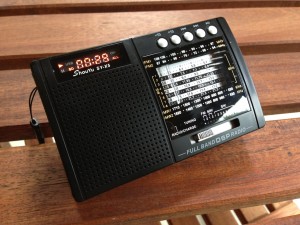
A review of the ShouYu SY-X5 DSP shortwave radio

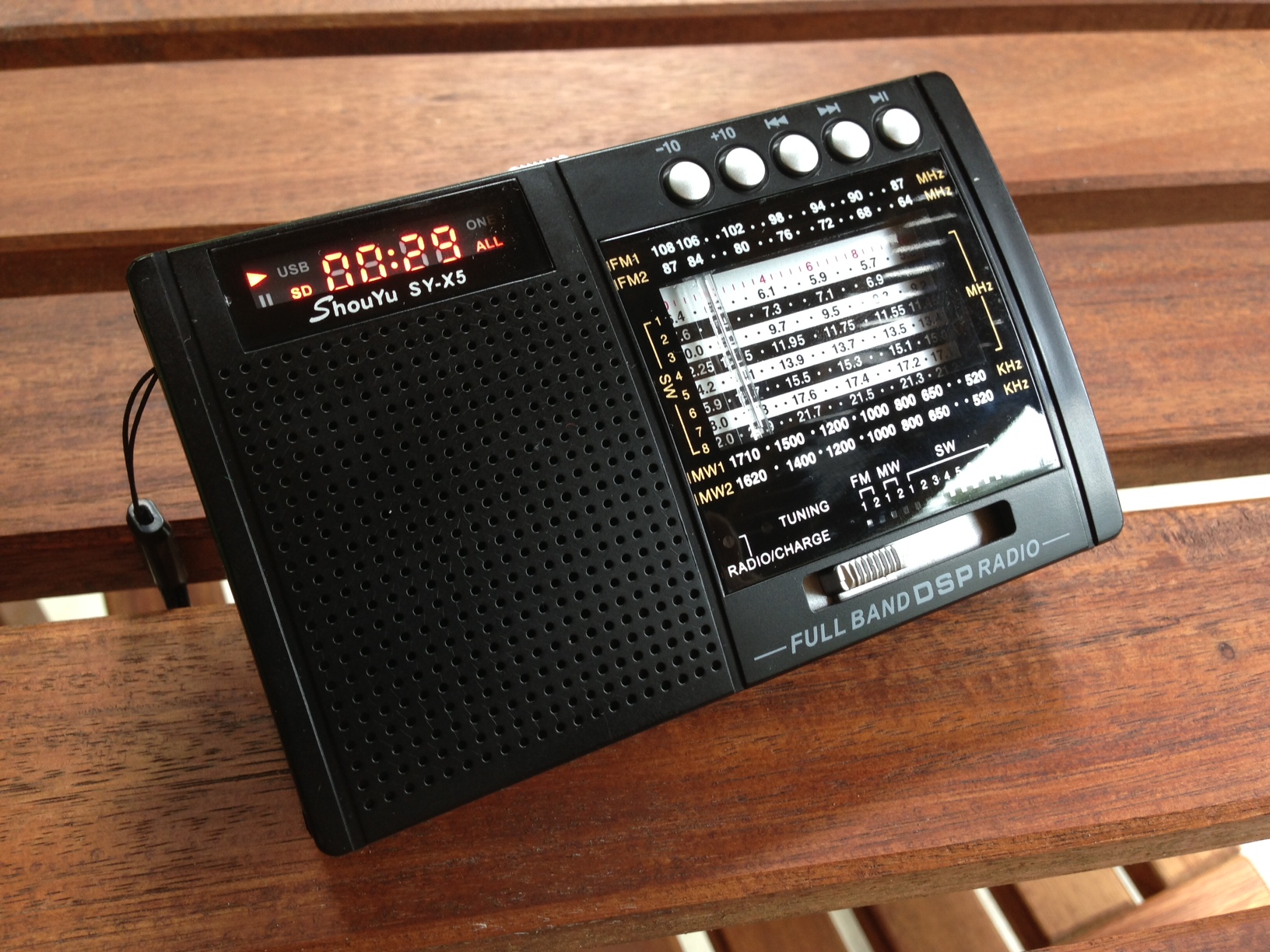
The Shouyu SY-X5 mechanically-tuned, DSP portable radio. (Click to enlarge)

The Shouyu SY-X5 mechanically-tuned, DSP portable radio. (Click to enlarge)

The ShouYu SY-X5 shortwave radio came to my attention only a few weeks ago. It is yet one more mechanically-tuned, DSP based, portable shortwave/AM/FM radio. I have reviewed several other models based on the same DSP chipset: the Silicon Labs SI4844–see my reviews of the Degen DE321, Degen DE32, and the Kichbo KK-9803. I also recently reviewed the Tecsun R-2010D, though it is based on a slightly newer, though similar, SiLabs DSP chipset.

What makes the ShouYu SY-X5 stand out is the fact that it can be powered by either a rechargeable slim battery pack (found in the DE32) or three standard AA batteries.  It also has a built-in MP3 player that uses a standard microSD card for media storage. Why are these features of particular note for me?  I have been searching for a shortwave radio/mp3 player for use by my charitable non-profit, Ears To Our World. ETOW works in parts of the world where people lack mains power as well as access to the Internet (or else simply can’t afford Internet service). In such settings, radio allows teachers and school children to hear up-to-date international news via shortwave, and through pre-recorded educational material, they can play (and replay) MP3 content as needed.

Therefore, I immediately ordered an SY-X5 for review here, hoping to donate it for use in the field care of Ears To Our World.

First impressions

Degen DE321 (left) Shouyu SY-X5 (right)

Degen DE321 (left) Shouyu SY-X5 (right)

The ShouYu SY-X5 is a small radio, almost exactly the same size as the very portable Grundig G6 and only slightly larger than the Degen DE321 (see left). It feels sturdy and even slightly heavy in your hand (no doubt, due to the number of batteries it holds). The antenna is rotatable and feels more robust than other radios in its price class.

The SY-X5 has a back stand that likewise feels sturdy enough. Note: to open the battery compartment, you must lift up the back stand.

The overall quality is better than one might expect for $27 (US), with one notable exception: the printed frequency display behind the analog dial on my unit is positioned slightly off-center and not level, making needle position on the dial, well, frankly ambiguous.

Audio

Without a doubt, the greatest aspect of the SY-X5 is the audio delivered from the built-in speaker. It is exceptional for this size radio, full and with impressive bass characteristics. It very much reminds me of the Melson M7 (not yet reviewed here) and the Degen DE1129.

(Click to enlarge)

(Click to enlarge)

Performance

I’ve reviewed enough of these mechanically-tuned DSP-based radios now that I’m beginning to note performance commonalities that can only be attributed to the design of the DSP chipset itself (regardless of how they are implemented in each model of radio).

At risk of sounding like a broken record, this radio’s sensitivity, selectivity and AGC performance is nearly identical to the Degen DE321 on every band; here’s a summary:

  • Shortwave
    • sensitivity is mediocre–expect to hear all strong stations
    • AGC circuit has difficulty coping with weak station and fading
    • selectivity is mediocre
  • Medium Wave (AM)
    • strong daytime stations sound great
    • the SY-X5’s AGC circuit struggles with night time conditions, even with some strong stations
    • selectivity is mediocre
  • FM
    • FM performance is quite good
    • Both selectivity and sensitivity are great for the price–in this case, $27 US
(Click to enlarge)

(Click to enlarge)

Between the two FM bands, the SY-X5 should easily accommodate world-wide FM broadcasts (even Russia). The two AM (medium wave) bands are almost identical in frequency allocation, but have been set up so that one is on 9 kHz spacing and the other on the 10 kHz spacing typically used here in North America (nice touch).

Tuning

While the “feel” of the tuning wheel on the right side of the radio seems smooth, in reality it is not. The tension or actual mechanics behind the analog tuner are problematic; I find that upon tuning in even a strong station, when I let go of the tuning wheel, it immediately moves off-frequency. It’s most annoying. Over the course of several days of use, it doesn’t seem that the mechanism has broken in at all as I had hoped. This is perhaps the biggest negative of the ShouYu SY-X5; it is just not easy to accurately tune it.

(Click to enlarge)

(Click to enlarge)

MP3 Player

While I haven’t spent hours using the MP3 player, I find that it’s simple, yet quite effective. Most notably, it lacks fast-forward and reverse controls, though it does have buttons for ten-second skips both in the forward and reverse directions. Of course, you can pause, stop and skip to next/previous MP3 files.

The SY-X5 has a dedicated MP3 player red LED display; it is very bright–almost too bright, in fact, for low light conditions–and quite simple, offering only basic functions (no alpha-numeric tags, for example). Unfortunately, I find that the LED display does inject a little noise into the audio, but it’s nothing that would deter me from using it with the built-in speaker.

(Click to enlarge)

(Click to enlarge)

Summary

Every radio has positive and negative attributes; below are the pros and cons I noted from the moment I unpacked the SY-X5:

Pros:

  • Audio from internal speaker excellent for size
  • Integrated digital audio player
    • Uses standard Micro SD card for storage
    • Very bright red LED display (see con)
    • Dedicated, tactile buttons for basic MP3 functions
  • Multiple power sources
    • Internal rechargeable slim battery pack
    • Standard AA batteries
    • Charged/powered via standard mini USB cable
  • Relatively sturdy construction
  • Good FM sensitivity
  • Tuning indicator light
  • Inexpensive
(Click to enlarge)

(Click to enlarge)

Cons:

  • “Sticky” tuning wheel/dial results in immediate and annoying digital “drift” off-frequency
  • Sloppy selectivity (typical of this class of mechanically-tuned DSP radios)
  • MP3 player’s LED display almost too bright for low light settings; the LED does inject some slight noise into the headphone amp chain
  • Shortwave and medium wave sensitivity is mediocre, typical of other SiLabs SI484X radios
  • MP3 capabilities are only as a player, the SY-X5 cannot record in any capacity
  • Analog dial is small enough to make tuning accurately quite difficult
  • The dial’s printed frequency display in my unit is positioned off-center and tilted, resulting in ambiguous needle alignment

Conclusion

The ShouYu SU-X5 is very similar, performance-wise, to the Degen DE321. Out of all of the mechanically-tuned DSP portables reviewed thus far, the SY-X5 may have the best audio fidelity via its built-in speaker (save the Tecsun R-2010D). Also, like other similarly sized and priced models in this family, the SY-X5 has tuning issues; in its case, a tuning wheel that will not stay on frequency without practice.

(Click to enlarge)

(Click to enlarge)

I’ve decided to take my SY-X5, on behalf of Ears To Our World, to inner Belize City in the near future. I’m going to offer this radio–together with a microSD card packed with VOA Special English programming (and a host of other English language educational materials, music and stories)–to a visually-impaired, economically-disadvantaged school child who will hopefully give this basic little radio lots of use, and perhaps even maximize its potential. While the SY-X5 has shortcomings, for this particular use–serving an individual who will not rely primarily on sight, but on tactile response, to operate it–I think it may serve its purpose. Perhaps this will be the best litmus test for the SY-X5’s utility and longevity:  I may post an update when I receive feedback in approximately one year, as to whether this radio has required repair, replacement, or has offered (as I sincerely hope!) some measure of benefit to the child-owner.

For the radio hobbyist, I would encourage you to skip the ShouYu S-X5 and, instead, invest in a Tecsun PL-380, PL-390, PL-398BT, Degen DE1102, DE1103, or the Tecsun PL-600. Though all are pricier, each is under $100 US, and will actually provide a lot of performance for the price. The SY-X5 and other mechanically-tuned DSP radios seem only to offer mediocre performance and a low price.
Click here to search for the Shouyu SY-X5 on eBay.

Shortwave Radio Recordings: Voice of Greece

greeceFor your listening pleasure: over three hours of mostly music and commentary from the Voice of Greece. Recorded Sunday, June 23, 2013 on 9.42 MHz starting around 23:00 UTC.

Click here to download the full recording, or simply listen via the embedded player below:

Part of me fears that when the ERT budget is scrutinized in the near future, the Voice of Greece may struggle to stay on the shortwaves. I’ve been recording hours of their programming over several days and will have more recordings to post in the future.

Please share your recordings on the Shortwave Radio Audio Archive. Thanks!

Geomagnetic storms in weekend forecast

(Source: SpaceWeather.com)

(Source: SpaceWeather.com)

Heads up! Geomagnetic storms may make it a challenge to hear the test broadcast of Hamburger Lokalradio this weekend or any shortwave broadcaster for that matter.

Full details at Spaceweather.com and the ARRL (below):

(Source: ARRL)

Spaceweather.com reports a strong geomagnetic storm is in progress as Earth passes through a region of south-pointing magnetism in the solar wind. The storm has generated auroral displays as far south as Kansas in the US. The NOAA Space Weather Prediction Center indicates the storm is a G3 level event. WWV announced at 0900 UTC, “Geomagnetic storms reaching the G3 level are likely” over the next 24 hours. NOAA says that in a G3 level storm, HF radio may be intermittent. Calculated band conditions reported on the DX Summit site indicate “poor” conditions on 80 through 10 meters. WWV reported the estimated planetary K index at 0900 UTC was 5 (the 0600 UTC figure was 7). […] A coronal mass ejection (CME) is expected to deliver a glancing blow to Earth’s magnetic field late on June 30 or early on July 1.

VOA Radiogram includes EasyPal comparison this weekend

VOARadioGram(Source: VOA Radiogram)

During the weekend of 29-30 June 2013, VOA Radiogram will continue experiments with the EasyPal digital image software. EasyPal will be transmitted in both its 4-QAM and 16-QAM settings to see if the former can be decoded in conditions where the latter cannot. Download EasyPal from  vk4aes.com.

VOA Radiogram for 29-30 June 2013:

2:31  MFSK16: Program preview

4:19  MFSK32: VOA News: “super-earths”

2:05  MFSK32: Accompanying image

:23  MFSK32: Introduction to MFSK64

2:15  MFSK64: VOA News: China space mission

2:53  MFSK32: Accompanying image

:33  MFSK32: Introduction to EasyPal

7:00  EasyPal 4-QAM: “super moon” in Greece

2:40  EasyPal 16-QAM “super moon” in Singapore

1:08  MFSK16: Closing announcements

:24  Surprise mode of the week

 VOA Radiogram transmission schedule (all days and times UTC):

  • Sat 1600-1630 17860 kHz
  • Sun 0230-0300 5745 kHz
  • Sun 1300-1330 6095 kHz
  • Sun 1930-2000 15670 kHz